arXiv:1104.2431v1 [physics.acc-ph] 13 Apr 2011
CLIC. Part II
J. Resta-L´opez1, D. Angal-Kalinin2, B. Dalena3,
J. L. Fern´andez-Hernando2, F. Jackson2, D. Schulte3, A. Seryi1 and R. Tom´as3
1
JAI, University of Oxford, UK
2
STFC, Daresbury, UK
3
CERN, Geneva, Switzerland
E-mail: [email protected]
1. Introduction
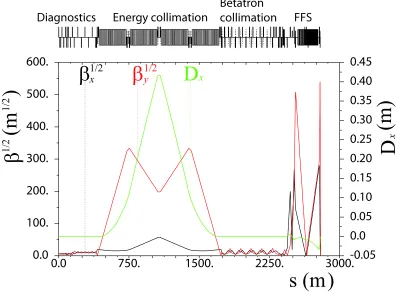
[image:2.612.97.498.260.554.2]The post-linac collimation systems of the future linear colliders will play an essential role in reducing the detector background at the interaction point (IP), and protecting the machine by minimising the activation and damage of sensitive accelerator components. The CLIC Beam Delivery System (BDS), downstream of the main linac, consists of a 370 m long diagnostics section, an almost 2000 m long collimation system, and a 460 m long Final Focus System (FFS) [1, 2]. Figure 1 shows the betatron and dispersion functions along the CLIC BDS. Some relevant CLIC design parameters are shown in Table 1 for the options at 500 GeV and 3 TeV centre-of-mass (CM) energy.
Figure 1. Optical functions of the CLIC beam delivery system.
In the CLIC BDS there are two collimation sections:
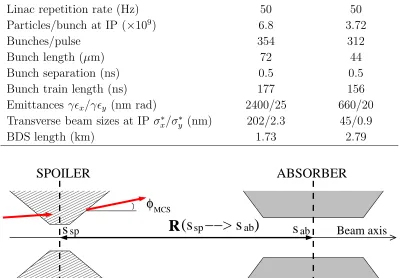
• The first post-linac collimation section is dedicated to energy collimation. The energy collimation depth is determined by failure modes in the linac [3]. A spoiler-absorber scheme (Fig. 2), located in a region with non-zero horizontal dispersion, is used for intercepting miss-steered or errant beams with energy deviation larger than 1.3% of the nominal beam energy.
Table 1. CLIC parameters at 0.5 TeV and 3 TeV CM energy.
Parameter CLIC 0.5 TeV CLIC 3 TeV
Design luminosity (1034 cm−2
s−1
) 2.3 5.9
Linac repetition rate (Hz) 50 50
Particles/bunch at IP (×109) 6.8 3.72
Bunches/pulse 354 312
Bunch length (µm) 72 44
Bunch separation (ns) 0.5 0.5
Bunch train length (ns) 177 156
Emittances γǫx/γǫy (nm rad) 2400/25 660/20
Transverse beam sizes at IP σ∗ x/σ
∗
y (nm) 202/2.3 45/0.9
BDS length (km) 1.73 2.79
0000000000 0000000000 0000000000 0000000000 0000000000 0000000000 0000000000 0000000000 1111111111 1111111111 1111111111 1111111111 1111111111 1111111111 1111111111 1111111111 0000000000 0000000000 0000000000 0000000000 0000000000 0000000000 0000000000 1111111111 1111111111 1111111111 1111111111 1111111111 1111111111 1111111111
SPOILER
ABSORBER
φ
R(s −−> s )
MCS
sp ab Beam axis
sp
s
ab [image:3.612.95.497.148.426.2]s
Figure 2. Basic spoiler-absorber scheme.
The spoilers are thin devices (. 1 radiation length) which scrape the beam halo and, if accidentally struck by the full power beam, will increase the volume of the phase space occupied by the incident beam via multiple Coulomb scattering. In this way, the transverse density of the scattered beam is reduced for passive protection of the downstream absorber. The absorbers are usually thick blocks of material (of about 20 radiation length) designed to provide efficient halo absorption or complete removal of potentially dangerous beams.
The optics of the CLIC collimation system was originally designed by rescaling of the optics of the collimation system of the previous Next Linear Collider (NLC) project at 1 TeV centre-of-mass energy [4, 5] to the 3 TeV CLIC requirements. In the present CLIC baseline optics the length of the energy collimation section has been scaled by a factor 5 and the bending angles by a factor 1/12 with respect to the 1 TeV NLC design [6]. On the other hand, the optics of the CLIC betatron collimation section was not modified with respect to the original design of the NLC.
collimation section is upstream of the betatron one. The main reason of choosing this lattice structure is because miss-phased or unstable off-energy drive beams are likely failure modes in CLIC, and they are expected to be much more frequent than large betatron oscillations with small emittance beams. Therefore, the energy collimation system is conceived as the first post-linac line of defence for passive protection against off-energy beams in the CLIC BDS.
Recently many aspects of the CLIC collimation system design have been reviewed and optimised towards a consistent and robust system for the Conceptual Design Report of CLIC (CLIC CDR), to be completed during 2011. In this report we describe the current status of the CLIC collimation system at 3 TeV CM energy. Here we mainly focus on the description of the collimation layout and the optimisation of the necessary parameters of the baseline design to improve the collimation performance, only taking into account the primary beam halo. The aim is to define basic specifications of the design. Studies including secondary particle production and muon collimation are described elsewhere [8, 9]. Part II is mainly dedicated to the study of the betatron collimation system and collimator wakefield effects. Moreover, the current status of the CLIC collimation system at 500 GeV CM energy is also described.
2. Betatron collimation
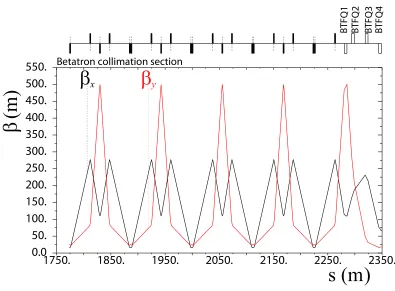
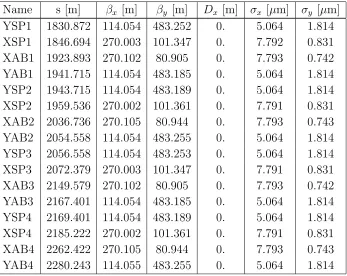
The main function of the betatron collimation section is the removal of any particle from the transverse halo of the primary beam, i.e. beam particles with large betatron amplitudes, which can cause unacceptable experimental background levels in the interaction region. In addition, the collimation system design must limit the regeneration of halo due to optical or collimator wakefield effects. The optics of the betatron collimation section is shown in Fig. 3. The values of the betatron functions and transverse beam size at each betatron collimator (spoiler and absorber) position are indicated in Table 2.
In order to provide an acceptable cleaning efficiency of the transverse beam halo the betatron collimation depths are determined from the following conditions:
• Minimisation of the synchrotron radiation photons in the first final quadrupole magnet (QF1) that can hit the second final quadrupole (QD0).
• Minimisation of the beam particles that can hit either QF1 or QD0.
• Neither synchrotron radiation photons nor electrons (positrons) of the beam are permitted to impact the detector or its mask.
Figure 3. Optical functions of the CLIC betatron collimation section.
particles which can generate unacceptable background at the IP, are efficiently removed for collimator aperture<15σxin the horizontal plane and<55σy in the vertical plane.
Therefore, we have defined 15 σx and 55 σy as the transverse collimation depths.
Figure 5 shows the residual synchrotron radiation fans from the final quadrupoles QF1 and QD0 to the IP for an envelope covering 15 standard deviations in xand 55 in y. At the IP the photon cone is inside a cylinder with radius of 5 mm, which is within the beam pipe radius‡. Therefore, in principle, they are not an issue of concern from the detector point of view.
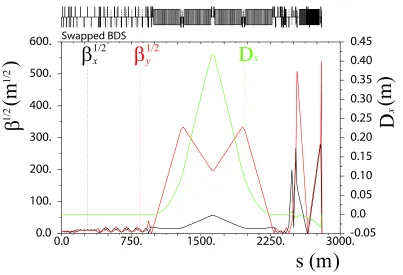
It should be considered whether swapping the betatron and energy collimation sections (see Fig. 6) may lead to further improvement on the betatron cleaning efficiency. This issue has recently been investigated by means of sophisticated tracking simulations, taking into account the halo generation by beam-gas scattering (Mott scattering) and inelastic scattering (Bremsstrahlung) in both linac and BDS, and the production of secondaries [9]. These simulations indicate that the effect of swapping the betatron and energy collimation sections results only in modest 40% reduction in the muon flux reaching the detector. We have decided to maintain the original order of location of the collimation sections in the CLIC BDS. In this way, errant beams coming from the linac would first hit the energy collimators before arriving to the betatron collimation part.
Table 2. Optics and beam parameters at collimator position: longitudinal position, horizontal and verticalβ-functions, horizontal dispersion, horizontal and vertical rms beam sizes. YSP# denotes vertical spoiler, XSP# horizontal spoiler, YAB# vertical absorber and XAB# horizontal absorber.
Name s [m] βx [m] βy [m] Dx [m] σx [µm] σy [µm]
YSP1 1830.872 114.054 483.252 0. 5.064 1.814
XSP1 1846.694 270.003 101.347 0. 7.792 0.831
XAB1 1923.893 270.102 80.905 0. 7.793 0.742
YAB1 1941.715 114.054 483.185 0. 5.064 1.814
YSP2 1943.715 114.054 483.189 0. 5.064 1.814
XSP2 1959.536 270.002 101.361 0. 7.791 0.831
XAB2 2036.736 270.105 80.944 0. 7.793 0.743
YAB2 2054.558 114.054 483.255 0. 5.064 1.814
YSP3 2056.558 114.054 483.253 0. 5.064 1.814
XSP3 2072.379 270.003 101.347 0. 7.791 0.831
XAB3 2149.579 270.102 80.905 0. 7.793 0.742
YAB3 2167.401 114.054 483.185 0. 5.064 1.814
YSP4 2169.401 114.054 483.189 0. 5.064 1.814
XSP4 2185.222 270.002 101.361 0. 7.791 0.831
XAB4 2262.422 270.105 80.944 0. 7.793 0.743
YAB4 2280.243 114.055 483.255 0. 5.064 1.814
In this sense, the energy collimators would protect the betatron collimators of possible damaging.
2.1. Spoiler design and absorber protection
The betatron spoilers must scrape the transverse beam halo at the required collimation depths. They must further provide enough beam angular divergence by MCS to decrease the transverse density of an incident beam, thus reducing the damage probability of the downstream absorber. By using similar arguments as in Section 2.1.1 (Part I), for the protection of the CLIC betatron absorbers, which are made of Ti alloy coated by a thin Cu layer, the rms radial beam size σr(sab) =
p
σx(sab)σy(sab) must be larger than
about 600 µm at the absorber position [4, 14]. This condition determines the necessary minimum length of the betatron spoiler. The spoilers and absorbers are assumed to have the longitudinal geometry of Fig. 7.
Considering the linear transport between a betatron spoiler and its corresponding downstream absorber, the expected value of the square of the transverse displacements at the absorber can be approximated by:
Figure 4. (Colour) Transverse beam distribution at the BDS entrance: non-dangerous macroparticles for the final doublet magnets are in black and potentially dangerous macroparticles are in red, according to different collimator apertures. The axes show the position of the particles in number of sigma in the x–x′ and y–y′ planes. In the
following the corresponding horizontal and vertical collimator apertures (half gapsax,y)
are given: a)ax = 0.11 mm (13.7σx) and ay = 0.08 mm (44 σy), b)ax = 0.12 mm
(15 σx) and ay = 0.08 mm, c) ax = 0.13 mm (16.2 σx) and ay = 0.08 mm, d) ax= 0.08 mm (10σx) anday = 0.09 mm (49.5σy), e)ax= 0.08 mm anday= 0.10 mm
(50σy), f) ax= 0.08 mm anday = 0.11 mm (60.5σy).
s [m]
-15 -10 -5 0 5 10
x [mm]
-15 -10 -5 0 5 10
15 QF1 QD0 IP POST-IP
s [m]
-15 -10 -5 0 5 10
y [mm]
-15 -10 -5 0 5 10
15 QF1 QD0 IP POST-IP
Figure 5. Synchrotron radiation fans in the CLIC interaction region emitted by particles with transverse amplitudes 15 σx and 55 σy (the betatron collimation
envelope) in the final doublet magnets QF1 and QD0.
hy2
abi ≃R234(ssp →sab)φ 2
M CS , (2)
[image:7.612.101.495.473.637.2]Figure 6. Optical functions of the CLIC beam delivery system with swapped lattice, i.e. the betatron collimation system upstream of the energy collimation section.
00000000000000000000000 00000000000000000000000 00000000000000000000000 00000000000000000000000 00000000000000000000000 00000000000000000000000 00000000000000000000000 00000000000000000000000 00000000000000000000000 00000000000000000000000 00000000000000000000000 00000000000000000000000 11111111111111111111111 11111111111111111111111 11111111111111111111111 11111111111111111111111 11111111111111111111111 11111111111111111111111 11111111111111111111111 11111111111111111111111 11111111111111111111111 11111111111111111111111 11111111111111111111111 11111111111111111111111 000000000000000000000000000000 111111111111111111111111111111 0000000 1111111 00000 11111 0 0 0 0 0 0 0 0 0 0 0 0 0 0 0 0 0 1 1 1 1 1 1 1 1 1 1 1 1 1 1 1 1 1 0000000000
1111111111 00000000001111111111
00000 11111
a
φ
z
TL
L
L
d
b
F T MCS Tθ
Figure 7. Spoiler and absorber jaw longitudinal view.
the transfer matrix elements between the betatron spoiler and the betatron absorber. In this case, R12(ssp → sab) = 114.04 m and R34(ssp → sab) = −483.22 m from YSP1
to YAB1 (see spoiler names in Table 2). Taking into account σx(sab) =
p
hx2
abi and
σy(sab) =
p
hy2
abi, and Eqs. (1) and (2), the condition for the survival of the betatron
absorber can be written as follows:
q
|R12(ssp →sab)||R34(ssp →sab)|φM CS &600 µm, (3)
which is fulfilled if φM CS &3×10⁻⁶ rad. From this constraint and using the Gaussian
approximation of the Moli`ere formula for the MCS angle [15]:
φM CS =
13.6 [MeV] βcp z r ℓ X0
1 + 0.038 ln
ℓ X0
[image:8.612.151.437.416.527.2]
we can calculate the minimum length of spoiler material seen by an incident beam in order to guarantee the absorber survival. This condition is fulfilled if the Be spoiler is designed with a centre flat body of lengthLF & 0.1X0. For instance, selecting a spoiler
with LF = 0.2 X0 could give a safe margin of angle divergence by MCS for absorber
survival in case of beam impact.
Concerning the betatron spoiler protection for CLIC, it is worth mentioning that while the survival condition is important for the energy spoiler (see Sections 2.1.2 and 2.1.3 of Part I), it is not restrictive for the betatron spoilers. These spoilers are planned to be sacrificial, i.e. they would certainly be destroyed if they suffer the direct impact of a bunch train. Direct impacts on the betatron spoilers are expected to be infrequent events. Large betatron oscillations of on-energy beams are not easily generated from pulse to pulse, and in the linac they rapidly filament and emittance can increase by 2 orders of magnitude.
In the hypothetical case that survivability of the betatron spoilers is desired, the betatron functions at the spoilers would have to be increased in order to enlarge the beam spot size sufficiently to ensure the spoiler survival. Nevertheless, this would increase the chromaticity of the lattice and generate tighter tolerances.
For CLIC the betatron spoilers have always been assumed to be made of Be. The main arguments to select Be were its high thermal and mechanical robustness and good electrical conductivity (to minimise resistive wakefields). Nevertheless, an important inconvenience of using Be is that its manipulation presents important technical challenges due to the toxicity of Be-containing dusts. An accident involving Be might be a serious hazard. Since no survivability to the full beam power is demanded for the betatron spoilers, the robustness condition of the material could be relaxed, and different options other than Be could be investigated, e.g. Ti with Cu coating.
If we decide to select a Ti based spoiler for betatron collimation, then, for absorber protection, the condition (3) is fulfilled if the spoiler is designed with a centre flat body (made of Ti) of lengthLF = 0.2 X0 ≃7 mm.
Other proposals, such as rotating consumable collimators§ [17] and dielectric materials [18], are being investigated as alternative for future upgrades of the design.
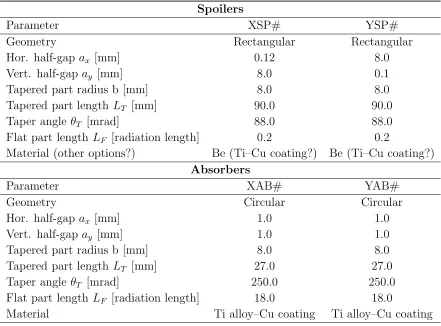
Table 3 shows the design parameters of the CLIC betatron spoilers and absorbers (of the baseline system) after optimisation.
2.2. Optics optimisation
By design the phase advance of the betatron spoilers respect to the FD and the IP has to be matched to allow an efficient collimation of the transverse halo. The transverse phase advance between the spoiler positions and the IP is generally set to be nπ or (1/2 +n)π, with n an integer. Figure 8 illustrates the design transverse phase advances
Table 3. Design parameters of the CLIC betatronic spoiler and absorbers.
Spoilers
Parameter XSP# YSP#
Geometry Rectangular Rectangular
Hor. half-gapax [mm] 0.12 8.0
Vert. half-gap ay [mm] 8.0 0.1
Tapered part radius b [mm] 8.0 8.0
Tapered part length LT [mm] 90.0 90.0
Taper angle θT [mrad] 88.0 88.0
Flat part length LF [radiation length] 0.2 0.2
Material (other options?) Be (Ti–Cu coating?) Be (Ti–Cu coating?)
Absorbers
Parameter XAB# YAB#
Geometry Circular Circular
Hor. half-gapax [mm] 1.0 1.0
Vert. half-gap ay [mm] 1.0 1.0
Tapered part radius b [mm] 8.0 8.0
Tapered part length LT [mm] 27.0 27.0
Taper angle θT [mrad] 250.0 250.0
Flat part length LF [radiation length] 18.0 18.0
Material Ti alloy–Cu coating Ti alloy–Cu coating
of the CLIC betatron spoilers. The IP is at π/2 phase advance from the FD, and the phase relationship between the betatron collimators and the FD is crucial. The spoilers XSP1 (YSP1) and XSP3 (YSP3) are set to collimate amplitudes at the FD phase, while the spoilers XSP2 (YSP2) and XSP4 (YSP4) collimate amplitudes at the IP phase.
In the CLIC lattice version 2008 the phase advances between the fourth set of spoilers (YSP4 and XSP4) and the FD were not an exact multiple ofπ/2: ∆µSP4→F D
x,y =
9.7π/2,10.6π/2. Starting from this original lattice, and following a similar phase optimisation procedure as it was used for the ILC [19, 20], we have investigated phase-matched solutions between the fourth set of spoilers and the FD in order to further improve the collimation performance of the system. In this study the software MAD [21] has been used to model the lattice and perform the phase matching. In total eight quadrupoles have been used for the matching: four of them (BTFQ1, BTFQ2, BTFQ3 and BTFQ4) at the end of the betatron collimation section (Fig. 3) and four quadrupoles (QMD11, QMD12, QMD13 and QMD14) at the beginning of the FFS. Here the quadrupoles are named as in the CLIC lattice repository of Ref. [22]
zero energy spread, was generated at the BDS entrance, uniformly distributed in the phase spaces x–x′
and y–y′
and extending to 1.5 times the collimation depth. The halo has been tracked from the BDS entrance to the IP, treating the collimators as perfect absorbers of any incident particle. A measure of the primary collimation efficiency is the number of particles outside the collimation depth at the FD. A phase-matched solution has been found at ∆µSP4→F D
x,y = 10π/2,11π/2, which reduces the “escaped
particles” (outside the collimation window) by 20% with respect to the original lattice. The strength values of the matching quadrupoles of the optimised lattice are shown in Table 4, compared with the initial values of the original lattice. The pole tip radius aperture for these quadrupoles is 8 mm. The effective lengths of the quadrupoles are 5 m for the BTFQ# type quadrupole and 1.63 m for QMD#. Figure 9 compares the halo x–y profile at the FD entrance for the original and the new matched lattices.
YSP2 XSP2
YSP3 XSP3
YSP4 XSP4 YSP1
XSP1
FD IP π/2
9π/2
3π/2 9π/2
π/2
3π/2
π/2
3π/2
π/2 ∆µx
∆µy
[image:11.612.123.464.297.393.2]π/2
[image:11.612.166.423.537.701.2]Figure 8. Schematic showing the design values of the phase advance between the betatron spoilers, FD and IP.
Table 4. Strength of matching quadrupoles in the transition region between the betatron collimation section and the final focus system for the original lattice and for the optimised lattice. K and B0 denote the integrated quadrupole strength and the
pole tip magnetic field, respectively.
Original Optimisation
Name K [m−1] B
0 [T] K [m
−1] B 0 [T]
BTFQ1 -0.0605 0.48432 -0.0669 0.5356
BTFQ2 0.0152 0.1217 0.0386 0.309
BTFQ3 0.0252 0.2017 0.0285 0.2281
BTFQ4 -0.0333 0.2666 -0.0731 0.5852
QMD11 0.0905 2.2224 0.1551 3.8087
QMD12 -0.1423 3.4944 -0.1023 2.5121
QMD13 0.1095 2.6889 0.0961 2.3599
QMD14 -0.0502 1.2327 -0.0736 1.8074
Figure 9. Beam halox–y profile at the entrance of the FD (Left) and after (Right) optimisation. In this example no beam energy spread has been considered. The black square contour represents the collimation window.
for collimation maintain good properties for beam luminosity. We have calculated the luminosity peak from beam-beam interaction simulations at the IP by using the code GUINEA-PIG [24] for both the original and the optimised lattices. For the tracking of a Gaussian core beam with a uniform energy distribution of 1 % full energy spread, results show that the luminosity peak of the optimised lattice (for betatron collimation) is 1.5 times smaller than the luminosity of the original lattice. In principle, the luminosity performance can be recovered by adjusting slightly the strengths of the final focus sextupoles as it was made for the ILC BDS optimisation [20]. For these tracking simulations and luminosity calculations the CLIC BDS lattice of L∗
= 3.5 m (available at the CLIC lattice repository [22]) has been used, where L∗
is the distance from the final quadrupole QD0 to the IP.
3. Wakefield effects
A charged particle moving in an accelerator induces electromagnetic fields which interact with its environment. Depending on the discontinuities and variations in the cross-sectional shape of the vacuum chamber, the beam self field is perturbed and can be reflected onto the beam axis and interact with particles in the beam itself. These electromagnetic fields, induced by the charged beam, are called wakefields, due to the fact that they are left mainly behind the driving charge (the source charge of the wakefield). In the limit of ultra-relativistic motion the wakefields can only stay behind the driving charge.
Wakefields in the BDS of the linear colliders can be an important source of emittance growth and beam jitter amplification, consequently degrading the luminosity. The main contributions to wakefields in the BDS are:
• Geometric and resistive wall wakefields of the tapered and flat parts of the collimators.
• Resistive wall wakes of the beam pipe, which are especially important in the regions of the final quadrupoles, where the betatron functions are very large.
• Electromagnetic modes induced in crab cavities. Crab cavities are needed to rotate the train bunches in order to compensate for the crossing angle at the IP, which is 20 mrad in the case of CLIC.
In this report we focus on single bunch effects of the collimator transverse wakefields. The main contribution to the collimator wakefields arises from the betatron spoilers, whose apertures (≈ 100 µm) are much smaller than the design aperture of the energy spoiler (3.5 mm), and much smaller than the aperture of the nearby vacuum chamber (8–10 mm radius).
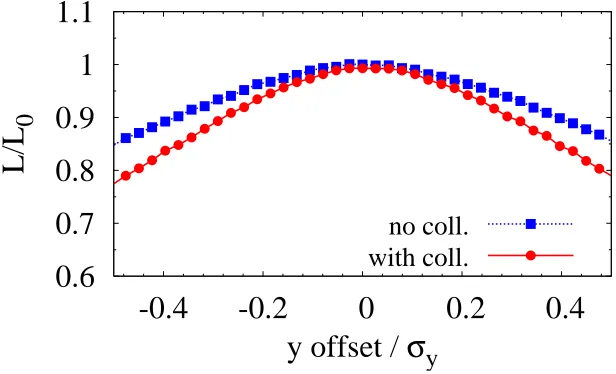
In order to study the impact of the CLIC collimator wakefields on the beam, a module for the calculation of the collimator wakefields in different regimes has been implemented in the PLACET tracking code [25]. Using this code the effects of the collimator wakefields on the luminosity have been evaluated for the design transverse collimation apertures 15 σx and 55 σy. Figure 10 compares the relative luminosity
degradation as a function of initial vertical position offsets at the entrance of the BDS with and without collimator wakefields. In this calculation the join effect of all the BDS collimators has been considered. For instance, for beam offsets of≈ ±0.4σy, the CLIC
luminosity loss was found to amount up to 20% with collimator wakefields, and up to 10% for the case with no wakefield effects.
The luminosity loss due to horizontal misalignments (with respect to the on-axis beam) of each horizontal spoiler and absorber is shown in Fig. 11 (Top). In comparison with the betatron collimators the energy spoiler (ENGYSP) and the energy absorber (ENGYAB) have been set with a large half gap, and practically do not contribute to the luminosity degradation by wakefields. On the other hand, for the horizontal betatron spoilers ≈20% luminosity loss is obtained for ≈ ±50µm bunch-collimator offset.
In the same way, Fig. 11 (Bottom) shows the relative luminosity as a function of the vertical bunch-collimator offset for each vertical betatron spoiler. The stronger wake kick effects arise from the spoilers YSP1 and YSP3. Approximately 20% luminosity loss is obtained for vertical bunch-collimator offsets of ≈ ±8 µm.
In order to optimise the spoiler design and thus reduce the wakefield effects, the following items could be investigated:
• Decreasing the geometrical wakes by optimising the spoiler taper angle.
0.6
0.7
0.8
0.9
1
1.1
-0.4
-0.2
0
0.2
0.4
L/L
0
y offset /
σ
y [image:14.612.132.440.101.288.2]no coll.
with coll.
Figure 10. Relative CLIC luminosity versus initial beam offsets for the cases with and without collimator wakefield effects.
• Exploring novel concepts, e.g. dielectric collimators [18].
3.1. Spoiler taper angle optimisation
Let us consider a beam with centroid offset y0 from the beam axis passing through a
symmetric spoiler of minimum half gap a. Assuming y0 ≪a, the mean beam deflection
due to spoiler wakefields can be expressed as follows:
hy′
i= reNe
γ κy0 , (5)
where re is the electron classical radius, Ne the number of particles per bunch and
γ ≡E/(mec2) the relativistic Lorentz factor, withE the beam energy,me the rest mass
of the electron and c the speed of light. In this equation the beam deflection has been given in terms of a transverse wake kick factor κ=κg+κr, which can be expressed as
the sum of a geometrical wake kick contribution,κg, and another kick factor taking into
account the resistive wall contribution, κr.
The spoilers are commonly designed with shallow taper angles in order to reduce the geometrical component of the wakefields. The taper angle is 88 mrad in the current design of the betatron spoiler (see Table 3). Here we investigate the possibility of reducing the wakefield effects by optimising the taper angle of the spoilers and, in consequence, to improve the luminosity performance.
0.2
0.4
0.6
0.8
1
-100
-50
0
50
100
L / L
0
x bunch-collimator offset [
µ
m]
ENGYSP ENGYAB XSP1 XSP2 XSP3 XSP4
0.75
0.8
0.85
0.9
0.95
1
-10 -8 -6 -4 -2 0 2 4 6 8 10
L / L
0
y bunch-collimator offset [
µ
m]
[image:15.612.132.444.102.488.2]YSP1 YSP2 YSP3 YSP4
Figure 11.Top: relative luminosity versus horizontal bunch-collimator offset for each rectangular horizontal collimator. Bottom: relative luminosity versus vertical bunch-collimator offset for each rectangular vertical bunch-collimator.
collimators [26]:
κg =
( √πθ
Th/(2σz) 1/a2−1/b2
for θT <3.12aσz/h2,
8/3pθT/(σza3) for 0.37 2
σz/a > θT >3.1 2
aσz/h 2
,
1/a2
for θT >0.372σz/a .
(6)
As before, b and a denote the maximum and minimum half gap of the collimator, respectively. Here, hdenotes the half width of the gap in the non-collimating direction. In Eq. (6) the limit θT <3.12aσz/h2 corresponds to the inductive regime; 0.372σz/a >
θT > 3.12aσz/h2 corresponds to the intermediate regime; and θT > 0.372σz/a the
(Table 3), Eq. (6) can be written as follows:
κg =
( √πθ
Th/(2σz) 1/a
2
−1/b2
for θT <7×10− 4
rad,
8/3p
θT/(σza3) for 0.06 rad> θT >7×10− 4
rad,
1/a2
for θT >0.06 rad.
(7)
For flat rectangular tapered spoilers the kick factor corresponding to the resistive component of the collimator wakefield can be approximate by the following expression for very small beam offsets [27]:
κr ≃
π
8a2Γ(1/4)
r
2 σzσZ0
LF
a +
1 θT
, (8)
where Z0 = 376.7 Ω is the impedance of free space and Γ(1/4) = 3.6256.
The wake kick generated by a CLIC betatron spoiler in the vertical plane as a function of the taper angle is represented in Fig. 12, where the geometric and the resistive contribution are shown separately. With taper angle 88 mrad the geometric kick is in the diffractive regime. One could expect to reduce the geometric wakes by reducing the taper angle. However, on the other hand, for CLIC the resistive wake kick is dominant, and it increases as 1/θT as the taper angle is decreased.
The total wake kick, adding both geometric and resistive contributions, is shown in Fig. 13. For taper angles < 0.01 rad the total wake kick strongly increases due to the resistive wake dominance. For angles >0.1 rad the wake kick is not very sensitive to the change in the taper angle and remains practically constant. In Fig. 13 one can also note that there is a minimum wake kick factor in between 0.01 and 0.02 rad. For example, in order to improve the performance of the system in terms of wakefields, a new taper angle of≈15 mrad could be selected. However, doing this, it is also necessary to increase the total longitudinal length of the spoiler, 2LT +LF, from 25 cm (for the
original taper angle 88 mrad) to ≈1 m for the new taper angle. Therefore, decreasing the taper angle one has to deal with a longer spoiler, and, given the tiny aperture of the betatron spoilers, tilt errors in the spoiler alignment could have much more negative effects on the beam stability than those affecting shorter spoiler.
3.2. Betatron spoiler design review with regard to wakefields
In previous sections both energy and betatron spoilers have been considered made of Be. Beryllium was selected due to its high thermo-mechanical robustness as well as its high electrical conductivity in comparison with other metals. However, due to the highly toxicity of Be dust, special care must be taken when machining the material.
103 104 105 106 107 108 109 1010 1011 1012 1013
10-7 10-6 10-5 10-4 10-3 10-2 10-1 100 101 102
wake kick factor [m
-2 ]
taper angle [rad]
inductive intermediate diffractive
[image:17.612.140.467.97.314.2]geometric kg resistive kr
Figure 12. Geometric and resistive wake kick factors versus spoiler taper angle calculated from Eq. (7) and Eq. (8), respectively. The x–axis and y–axis are on logarithmic scale. The different regimes for the geometric wakefields are indicated.
3 3.5 4 4.5 5 5.5 6 6.5 7
10-3 10-2 10-1 100 101 102
wake kick factor [10
8 m -2 ]
taper angle [rad]
geometric kg + resistive kr
Figure 13. Total wake kick factor versus spoiler taper angle. The x–axis is on a logarithmic scale.
Be is better conductor than Ti: the electrical conductivity of Be at room temperature (σ(Be) ≃ 2.3×10⁷ Ω−1
m−1
) is one order of magnitude higher than the Ti conductivity (σ(Ti) ≃ 1.8×10⁶ Ω−1m−1). Therefore, in terms of wakefields Be is a
[image:17.612.128.460.390.597.2]is given by κr ∝1/√σ. The resistive wakefield kick by a Ti spoiler is almost four times
bigger than the kick by a Be spoiler, κr(T i)/κr(Be) =
p
σ(Be)/p
σ(T i) ≃ 4. On the other hand, the resistive kick produced by a Be spoiler is almost two times bigger than the kick by a spoiler made of Cu, κr(Be)/κr(Cu) =
p
σ(Cu)/p
σ(Be)≃2. Betatronic spoilers made of Ti coated with Cu could be a good option to reduce the impact of wakefields.
Other line of investigation, aimed to minimise the collimator wakefields, has recently started the design of dielectric collimators for the CLIC BDS [18]. Dielectric collimators are currently being designed for the second phase of collimation of the Large Hadron Collider (LHC) [30]. The plan is to adapt this concept also to the CLIC requirements. In [18] preliminary wakefield calculations have been made considering a cylindrical geometry model consisting of double layer based on a dielectric material coated with an external layer of copper.
3.3. Deflection due to surface roughness
As seen in Section 2.1.3 (Part I), the impact of the full beam onto the Be spoiler might cause a permanent deformation of the spoiler surface. This could increase the wakefield effects and, therefore, to have negative consequences on the beam stability.
The average kick angle due to wakefield effects caused by the roughness of the spoiler/collimator surface can be estimated using the following expression for tapered surfaces [4]:
hx′
irough≃
4 3a2π3/2
Nere
γσz LF a + 1 θT
ζf αsx0 , (9)
where ζ is the characteristic size of the feature caused by the deformation, f is a form factor for the shape of the features, which is typically in the range between 1 and 20, αs is the fraction of the surface filled with the features, Ne is the bunch population, re
the electron classical radius, and x0 the offset of the beam centroid with respect to the
nominal beam axis. As in previous sections,aandbdenote the minimum and maximum spoiler half gap, respectively. While in Ref. [4] only the tapered contribution (1/θT) was
taken into account, here Eq. (9) takes into account the contributions from the tapered part and from the flat part (LF/a).
According the ANSYS results of Section 2.1.3 (Part I), horizontal deformation protuberances of aboutζ ≈1µm might be caused by tensile stress in the E-spoiler. We can roughly estimate the angular deflection using Eq. (9). For one hemispherical bump, the form factorf = 3π/2. For example, if we assumeαs ≈1/3 andx0 ≈1σx(withσx =
779 µm at the E-spoiler), we obtain hx′
irough≃4.8×10
−11
rad, which is approximately a factor 3 larger than the resistive wakefield kick hx′
iresistive≃1.8×10
−11
rad obtained from Eq. (8) for the same beam offset x0 ≈1σx and for the E-spoiler.
If now we assume the same hypothetical level of deformation in a CLIC vertical betatronic spoiler made of Be, according Eq. (9), one obtainshy′
irough≃3.6×10
−9 rad
24% of the value obtained for the resistive wake kick, hy′
iresistive ≃ 1.5×10⁻⁸ for the
same vertical beam offset.
4. Collimation system for CLIC at 500 GeV CM energy
The optics design of the CLIC BDS for 500 GeV CM energy can be found in the CLIC lattice repository of Ref. [22], where it is available in the format of the codes PLACET [10] and MAD [21]. For this energy option the collimation section is almost two times shorter than that of CLIC at 3 TeV. In total, the CLIC BDS length ratio for the options 0.5 TeV/3 TeV is 1.73 km/2.79 km.
[image:19.612.98.493.440.748.2]No optimisation of the collimation parameters has yet been made for this option. In principle, the same collimation depths as well as the same number of collimators have been assumed for both 500 GeV and 3 TeV. The betatron functions, horizontal dispersion and rms beam sizes at each collimator position for the 500 GeV case are shown in Table 5.
Table 5. Optics and beam parameters at collimator position for CLIC at 500 GeV CM energy: longitudinal position, horizontal and vertical β-functions, horizontal dispersion, horizontal and vertical rms beam sizes. ENGYSP and ENGYAB denote the energy spoiler and the energy absorber, respectively. SP# denotes vertical spoiler, XSP# horizontal spoiler, YAB# vertical absorber and XAB# horizontal absorber. The rms horizontal beam size at the energy collimators has been calculated assuming a uniform energy distribution with 1% full energy spread.
Name s [m] βx [m] βy [m] Dx [m] σx [µm] σy [µm]
ENGYSP 453.549 703.166 35340.91 0.231 670.939 42.5
ENGYAB 536.049 1606.516 19635.742 0.357 1034.994 31.676
YSP1 915.436 57.027 241.653 0. 16.726 3.514
XSP1 923.347 135.001 50.678 0. 25.734 1.609
XAB1 961.946 135.051 40.446 0. 25.739 1.438
YAB1 970.857 57.027 241.565 0. 16.726 3.513
YSP2 971.857 57.027 241.567 0. 16.726 3.513
XSP2 979.768 135.001 50.676 0. 25.734 1.609
XAB2 1018.368 135.052 40.478 0. 25.739 1.438
YAB2 1027.279 57.027 241.655 0. 16.726 3.514
YSP3 1028.279 57.027 241.653 0. 16.726 3.514
XSP3 1036.19 135.001 50.679 0. 25.734 1.609
XAB3 1074.789 135.051 40.446 0. 25.739 1.438
YAB3 1083.7 57.027 241.565 0. 16.726 3.513
YSP4 1084.7 57.027 241.568 0. 16.726 3.513
XSP4 1092.611 135.001 50.676 0. 25.734 1.609
XAB4 1131.211 135.052 40.478 0. 25.739 1.438
For the CLIC optics at 500 GeV the dispersion Dx at the energy spoiler and
absorber positions has been decreased ≈14% with respect to the 3 TeV optics. Taking into account that the emittance dilution due to incoherent synchrotron radiation scale as ∆(γǫx) ∝ E6Dx5/L5, where E is the beam energy and L the total length of the
collimation lattice, then for the 500 GeV case the relative emittance growth (∆ǫx/ǫx) in
[image:20.612.115.477.284.366.2]the collimation system is expected to be about four orders of magnitude smaller than for the 3 TeV case. Table 6 compares the horizontal emittances growth and luminosity loss for the 500 GeV and 3 TeV cases as calculated using Eqs. (1) and (2) of Part I.
Table 6. Radiation integral I5, relative emittance growth (∆ǫx/ǫx) and relative
luminosity loss (∆L/L) due to synchrotron radiation in the collimation system and in the total BDS calculated for CLIC at 3 TeV and 0.5 TeV CM energy.
CLIC 3 TeV CLIC 0.5 TeV
Variable Coll. system Total BDS Coll. system Total BDS I5 [m
−1
] 1.9×10⁻¹⁹
3.8×10⁻¹⁹
5.6×10⁻¹⁸
7.3×10⁻¹⁶
∆ǫx/ǫx [%] 13.5 27.3 0.0023 0.31
∆L/L [%] 6.1 11.4 0.0012 0.15
Comparing the two energy cases, the following observations can be made:
• For CLIC at 500 GeV the beam power is 4.8 MW, which is ≈ 66% lower than that for CLIC at 3 TeV. Therefore, for CLIC at 500 GeV the damage potential of the beam (250 GeV beam energy) is smaller than that for the 3 TeV case (1.5 TeV energy beam), and more relaxed survival conditions can be considered for the energy spoiler. In this respect, materials with a lower fracture limit than Be may be chosen. A possible canditate might be Ti alloy.
• In order to minimise the multi-bunch effects of resistive wall in the CLIC BDS, the beam pipe radius was set at b = 10 mm for the 3 TeV case. Since for the CLIC at 500 GeV the beam charge is higher, the beam pipe radius has been set at b = 12 mm [31].
• Considering the same collimation depths 15 σx and 55 σy, Table 7 compares the
collimator half gaps for both 500 GeV and 3 TeV options.
• The geometrical parameters of the collimators have to be calculated according the above minimum and maximum apertures. For instance, we can simply assume the same length for the collimators and then calculate the corresponding taper angles, θT = tan−1((b−a)/LT).
• In this preliminary design the collimators (spoilers and absorbers) have been assumed to be made of similar materials and with the same geometrical structure as described in Section 2.
Table 7. Half gaps of the CLIC post-linac collimators for the options at 3 TeV and 0.5 TeV CM energy. The values in parenthesis are new apertures suggested after optimisation.
CLIC 3 TeV CLIC 0.5 TeV
Collimator ax [mm] ay [mm] ax [mm] ay [mm]
ENGYSP (E spoiler) 3.51 (2.5) 8.0 3.0 12.0
ENGYAB (E absorber) 5.41 (4.0) 8.0 4.6 12.0
YSP# (βy spoiler) 8.0 0.1 12.0 0.19
YAB# (βy absorber) 1.0 1.0 1.0 1.0
XSP# (βx spoiler) 0.12 8.0 0.39 12.0
XAB# (βx absorber) 1.0 1.0 1.0 1.0
of Table 3, the geometric wakefields (from Stupakov’s criteria from Eq. (6)) are in the diffractive regime, near the border with the intermediate regime.
Taking into account the dependence of the resistive wake kick on the beam parameters and the collimator aperture (see Eq. (8)),hy′
i ∝Ne/(E√σza3), the resistive
kick from the vertical betatron spoilers for 0.5 TeV CM is approximately a factor 1.25 larger than the kick for 3 TeV CM, hy′
i0.5 TeV/hy
′
i3 TeV ≈1.25. On the other hand, for
the horizontal betatron spoilers the resistive kick ratio ishx′
i0.5 TeV/hx
′
i3 TeV ≈0.25.
No simulations have yet been carried out for the collimation performance study of the CLIC optics at 500 GeV CM. In this regard further work is needed.
5. Summary, conclusions and outlook
The post-linac collimation system of CLIC must fulfil two main functions: the minimisation of the detector background at the IP by the removal of the beam halo, and the protection of the BDS and the interaction region against miss-steered or errant beams.
Recently several aspects of the CLIC post-linac collimation system at 3 TeV CM energy have been optimised in order to improve its performance. This report has been devoted to explain the optimisation procedure and to describe the current status of the CLIC collimation system.
The CLIC collimation system consists of two sections: one for momentum collimation and another one for betatron collimation. Next, the conclusions for the betatron collimation system are summarised:
• The main function of the betatron collimation system is to provide the removal of those particles from the beam halo which can potentially contribute to generate experimental background at the IP.
through the BDS have shown a good collimation efficiency of the system.
• An optimisation of the phase advance between the betatron spoilers and the final doublet has led to an additional 20% improvement of the cleaning efficiency.
• The betatron spoilers have to be set to relatively very narrow gaps (∼100 µm) for efficient scraping of the transverse beam halo. Therefore, the surface of the jaws of these spoilers are very close to the beam axis, and can significantly contribute to the luminosity degradation by wakefields when the beam pass through them with a certain offset from the nominal beam axis. The luminosity loss due to collimator wakefields has been computed, using the codes PLACET [10] and GUINEA-PIG [24], and found to amount to up to 20% for vertical beam offsets of ≈0.4 σy. For
this calculation spoilers made of Be have been assumed. This study has to be extended to other possible material options.
• Reducing the taper angle the geometrical contribution of the collimator wakefields is reduced. However, for the CLIC spoilers the resistive part of the wakefields is dominant, and only a very modest improvement in the minimisation of the wakefield effects has been found by reducing the taper angle to approximately 15 mrad. This translates into a longer spoiler (of almost 1 m) than the original 88 mrad spoiler (of 25 cm). Longer spoilers introduce tighter tolerances in terms of alignment and tilt errors. Therefore, we have finally decided to maintain the original taper angle of 88 mrad.
• For CLIC the betatron spoilers have always been assumed to be made of Be. The main arguments to select Be were its high thermal and mechanical robustness and good electrical conductivity (to minimise resistive wakefields). Nevertheless, an important inconvenience is the toxicity of Be-containing dusts, and accidents involving Be might be a serious hazard. Since no survivability to the full beam power is demanded for the betatron spoilers (they are designed to be sacrificial or consumable), the robustness requirement of the material could be relaxed and different options other than Be could be taking into account. For example, Ti-Cu coating or Ti alloy-Cu coating could be good candidates.
more realistic model of the transverse halo would also be convenient. In this direction, notable progress has been made during the last years on the investigation and simulation of different mechanisms which generate transverse halo in both linac and BDS of the linear colliders. The code PLACET incorporates a module called HTGEN [34], which permits the simulation of the production of beam halo by beam-gas scattering and the tracking of this halo and the beam core along the lattice. For a more complete characterisation, we plan to apply all these simulation tools to the optimised collimation system.
Measurements of collimator wakefields will be useful to validate the analytical and simulation results. In the past, sets of measurements have been made for longitudinally tapered collimators at SLAC End Station A (ESA), see for example [35]. For the geometric wakefields, these measurements showed an agreement at the level of 20% with the simulation results and good qualitative agreement with the theory, although in many cases there was a quantitative discrepancy as large as a factor 2 between theory and measurement. Measurements of the resistive wakefields [36] showed notable discrepances with theory. New sets of measurements would be helpful, using available beam test facilities, such as ATF2 [37], ESTB (former ESA) [38], CALIFES [39] and FACET [40]. For instance, a possibility would be the use of the test facility FACET at SLAC, which will operate with longitudinally short bunches (20 µm bunch length) and bunch charge (1 nC) close to those of CLIC (44 µm bunch length and 0.6 nC bunch charge).
For the CLIC option at 500 GeV CM energy the collimation system design is still in a premature state. In this sense, further work has to be made for its optimisation and consolidation.
Acknowledgements
This work is supported by the European Commission under the FP7 Research Infrastructures project EuCARD, grant agreement no. 227579.
References
[1] R. Tom´as, “Overview of the Compact Linear Collider”, Phys. Rev. ST-AB13, 014801 (2010). [2] F. Teckeret al., “CLIC 2008 parameters”, CLIC-NOTE-764 (2008).
[3] D. Schulte and F. Zimmermann, “Failure Modes in CLIC”, Proceedings of PAC 2001, Chicago; CLIC-NOTE-492 (2001), CERN-SL-2001-034 (AP) (2001).
[4] NLC Design Group, “Zeroth-Order Design Report for the Next Linear Collider,” 573-574 (1996). [5] R. Assmannet al., “Overview of the CLIC Collimation Design”, Proceedings of PAC 2001, Chicago,
USA.
[6] R. Assmannet al., “Collimation for CLIC”, AIP Conf. Proc. Vo. 693, pp. 205-208, December 16,
2003.
[7] ILC Collaboration, “International Linear Collider Reference Desing Report. Volume 3: Accelerator”, ILC-REPORT-2007-001, August, 2007.
[8] I. Agapov et al., “Tracking studies of the Compact Linear Collider Collimation system”,
[9] L. Deaconet al., “Muon backgrounds in CLIC”, Proceedings of IPAC 2010, Kyoto, Japan, 2010.
[10] https://savannah.cern.ch/projects/placet.
[11] ILD Concept Group, “Letter of Intent for the International Large Detector”: http://www.ilcild.org/documents/ild-letter-of-intent.
[12] H. Aiharaet al., “SiD Letter of Intent”, arXiv:0911.0006 [physics.ins-det].
[13] Andr´e Sailer, private communication.
[14] P. Tenenbaum, “Studies of beam optics and scattering in the next linear collider post-linac collimation system”, Proceedings of LINAC 2000, MOA08, (2000).
[15] Particle Data Group, Physics Letters B667(2008), p. 271.
[16] J. C. Smith et al., “Construction and Bench Testing of a Rotatable Collimator for the LHC
Collimation Upgrade”, Proceedings of IPAC 2010, Kyoto, Japan, 2010.
[17] J. Frisch, E. Doyle and K. Skarpaas, “Advanced Collimator Prototype Results for the NLC”, SLAC-PUB-8463 (2000).
[18] A. Kanareykin et al., “Dielectric Collimators for Linear Collider Beam Delivery System”,
Proceedings of IPAC 2010, Kyoto, Japan, 2010.
[19] F. Jackson, “Collimation Optimisation in the Beam Delivery System of the International Linear Collider”, Proceedings of EPAC 2006, Edinburgh, Scotland, UK, 2006.
[20] F. Jackson at al., “Collimation Optimisation in the Beam Delivery System of the International Linear Collider”, Proceedings of PAC 2007, Albuquerque, New Mexico, USA, 2007; EUROTeV-Report-2007-045 (2007).
[21] H. Grote and F. C. Iselin, “The MAD Program, User’s Reference Manual”, CERN/SL/90-13 (AP) (1996); see the web site: http://mad.home.cern.ch.mad.
[22] http://clicr.web.cern.ch/CLICr/MainBeams/BDS/. [23] MERLIN homepage: http://www.desy.de/merlin/.
[24] D. Schulte, “study of electromagnetic and hadronic background in the interaction region of the TESLA collider”, Ph.D. Thesis, University of Hamburg, Hamburg, Germany (1996), TESLA-97-08.
[25] G. Rumolo, A. Latina and D. Schulte, Proceedings of EPAC 2006, Edinburgh, Scotland, UK, 2006; EUROTeV-Report-2006-026 (2006).
[26] G. V. Stupakov, “High-frequency impedance of small-angle collimators”, Proceedings of PAC 2001, Chicago.
[27] A. Piwinski, “Wake fields and ohmic losses in flat vacuum chambers”, DESY-HERA-92-04 (1992). [28] J. Resta-L´opez and J. L. Fern´andez-Hernando, “Review of the CLIC Energy Collimation System
and Spoiler Heating”, EUROTeV-Report-2008-050 (2008).
[29] J. L. Fern´andez-Hernando and J. Resta-L´opez, “Design of Momentum Spoilers for the Compact Linear Collider”, Proceedings of PAC 2009, Vancouver, Canada, 2009.
[30] E. Metralet al., “Impedance Studies for the Phase 2 LHC Collimators”, Proceedings of PAC 2009,
Vancouver, Canada, 2009.
[31] R. Mutzneret al., “Multi-bunch effect of resistive wall in the CLIC BDS”, Proceedings of IPAC
2010, Kyoto, Japan, 2010.
[32] I. Agapov, G. A. Blair, S. Malton and L. Deacon, “BDSIM: A particle tracking code for accelerator beam-line simulations including particle-matter interactions”, Nucl. Instrum. Methods Phys. Res. A,606, 708 (2009).
[33] G. Blairet al., “Simulation of beam halo in CLIC collimation system”, Proceedings EPAC 2008,
Magazzini del Cotone, Genoa, Italy (2008).
[34] H. Burkhardtet al., “Halo and Tail Generation Computer Model and Studies for Linear Colliders”,
EUROTeV-Report-2008-076;
Halo and tail generator packge HTGEN: http://hbu.home.cern.ch/hbu/HTGEN.html.
[35] P. Tenenbaum et al., “Direct measurement of the transverse wakefields of tapered collimators”,
Phys. Rev. ST-AB10(2007), 034401.
Collimators”, Proceedings of EPAC 2004, Lucerne, Switzerland, 2004.
[37] P. Bambade et al., “Present status and first results of the final focus beam line at the KEK
Accelerator Test Facility”, Phys. Rev. ST-AB13, 042801 (2010).
[38] R. Ericksonet al., “ESTB End Station Test Beam. A Proposal to Provide Test Beams in SLAC’s
End Station A”, July 31, 2009;
http://www-conf.slac.stanford.edu/estb2011/ESTB Proposal%080309.pdf.
[39] W. Faraboliniet al., “CTF3 Probe Beam Linac Commissioning and Operations”, Proceedings of
LINAC 2010, Tsukuba, Japan, 2010.