October 1982
/. ). ,J
glish Edition
European Communities
EUROPEAN PARLIAMENT
Working Documents
1982-1983
DOCUMENT 1-679/82
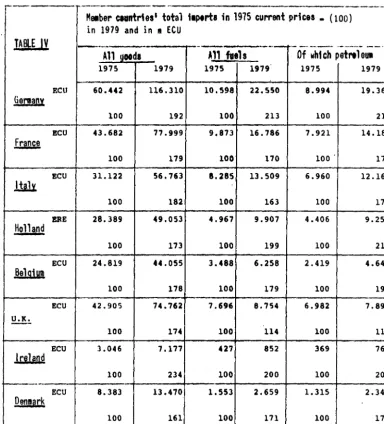
REPORT
drawn up on behalf of the Committee on Energy and Research
on
~n
approach to energy pricing structures
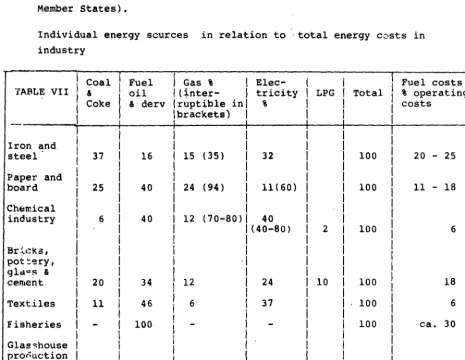
Rapporteur: Mr M. GALLAGHER
On 25 March 1981, the European Parliament referred a motion for a
resolution tabled, pursuant to Rule 25 of the former Rules of Procedure, by
Mr MORELAND and others on a common approach to energy pricing structures to the
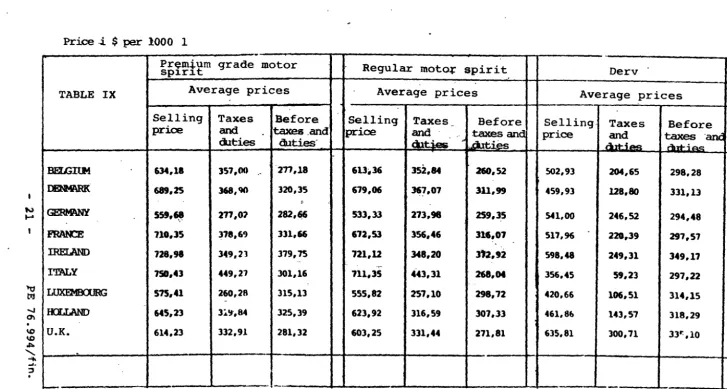
Committee on Energy and Research as the committee responsible and to the
Committee on Economic and Monetary Affairs for its opinion.
On 27 October 1981, the Committee on Energy and Research appointed
Mr GALLAGHER rapporteur.
On 25 November 1981, 30 April, 27 May -and 30 September 1982 the committee
considered the draft report. At the last·mentioned meeting, the committee adopted
the motion for resolution and the explanatory statement unanimously.
Participated in the vote: Mr SELIGMAN, acting chairman; Mr GALLAGHER,
rapporteur; Mr ADAM, Mr BOMBARD (replacing Mr ROGALLA>, Mr CALVEZ (replacing
Mr PINTAT), Mr FLANAGAN, Mr Karl FUCHS, Mr GHERGO (replacing Mr SASSANO>,
Mr LINKOHR, Mr MARKOPOULOS, Mr MEO, Mr NORMANTON, Mr PEDINI, Mr PERCHERON,
Mr PETRONIO, Mr PURVIS, Mr SCHMID, Mrs THEOBALD-PAOLI, Mr VIEHOFF <replacing
Mr PATTISON).
The opinion of the Committee on Economic and Monetary Affairs is
appended to this report.
C 0 N T E N T S
A. MOTION FOR A RESOLUTION
.
... .
5B. EXPLANATORY STATEMSNT 7 I BACKGROUND . • • . • . . . . • . • . . . • • . • • . • . • • • . • • • • . . . • • . . . 7
The Coauauni ty' s enerq.y •. pricing poU.cy ••••.•. ~ • • • • • . • . . . 7
The motion for a resolution . . . • . • . . • . . . • . . . 8
II THE COMMUNITY'~S ENERGY OB.JBC'l'IVBS • • • • . • • . • . • • . . • . . . • 8
III THE MEMBER STATES' ENERGY POLICIES 9 IV THE ENERGY SITUATION IN TH! MeMBER STATES ...•..•.•... 9
Comments • . • . . . • • . . . . • • • .. . • • • . . • • • • . . . • • . . . . 17
V ENERGY PRICES . . . • . . . . • • . • • • • • . • • • . . • • • • . • • • . . • • . . • • • . • . 18
A. Energy prices and operattng ~oats in industry in general .. , . • . . . • . . . . • • . . . • . . . 19
B. Oil and petroleum products ••...•...•... 20
C. Gas • . . • • . . • . . • . . . • . • • • • • • • • • • • • • • • . • . • . • • • • • • • . • . • . . . . 2 3 D . Coal . . . . . . . . . . • . . . . . . . . 2 4 E. The electricity market • . . . • . . . • . . . • • • . . . 24
VI COMPARISON OF ENERGY PRICES . . . . • . • • • • . • . . . . • . . • • . • . . . 2 5 VII PRICING PRINCIPLES
...
25VIii PRICE TRANSPARENCY
...
26IX DECLARATION ON THE MOliON FOR A RESOLUTION ••.•••••....•.. 27
ANNEX : Motion for a resolution Doc. 1-32/81 ••••••••••••.••.••..• 29
Opi~io~ of the Committee on Economic and Monetary Affairs •..•.•..• 30
A
The Committee on Energy and Research hereby submits to the European
Parliament the following motion for a resolution together with explanatory
statement:
~Q!!Q~_fQ~-!~~5§Qb~!!Q~
on a common approach to energy pricing
structu~esThe
European Parliament,
A.
having regard to the motion for a resolution tabled by Mr MORELAND
and others on a common approach to energy pricing structures,<ooc. 1-32/81>
B.
having regard to the report of the Committee on Energy and Research
and the opinion of the Committee on Economic and Monetary Affairs
(Doc. 1-679/82>
C.
whereas energy prices at both national and Community level must reflect
production and market conditions, but must also be fixed with a view to
obtaining the greatest possible security of supply in both the short and
the long term,
o. whereas security of supply will require real energy prices to be raised
to levels such as will ensure the development of new and alternative
energy sources and also adequate investment in the energy sector,
E.
considering that distinction must be made between energy prices and
energy pricing structures,
1. Believes therefore that energy pricing depends primarily on the production,
import and export of energy and the importance of the consumption of
individual energy sources to national
eco~omies;2. Notes that the pursuit of national energy policy objectives, which are
largely dictated by considerations of supply, has resulted in such widely
varying prices for individual energy resources;
3. Deprecates the distortion of energy pricing structures and therefore
of energy prices to Member States• industries and consumers which has
been caused by the differing
leve~sof Member States' aids granted to
particular energy carriers by the'differing levels of tax rates and the
differing approaches to energy price structures and individual prices
taken by Member States;
4. Considers it therefore unrealistic to believe that, in the short term,
the Community can change the Member States' energy pricing policies,
which vary in their structure, since energy and energy pricing policies,
especially in an econo•ic crisis, are vital factors in employment,
industrial, regional and
SQCil~policies and, in most cases, financial,
policy as well;
5. Stresses the urgency of
the
~~lttionpf the Coamission's proposals
to be
su~~itteqto the
P~rlia•entand the Council arising from its fuel
sector analysis called for by the Council at its meeting of 16 March 1982;
6. Believes
t~ata suitable balance must be found between, on the one hand,
the requirements of a
Comm~nityenergy saving policy, including a policy
designed to reduce
over~LL ~'''npfnd, on the other, the linkage of
al~energy carriers' prices
t~ro~~~ 1pricing structure that may undesirably
increase industrial and domestic energy costs and restrict freedom of
choice between energy source$.
7. Stresses, nevertheless, the
i~portanceof the efforts being made by
th~Commission and the Council to evolve a more uniform policy in this area,
while believing that, where cl,ar cates of distortion of the market by
artificially low energy prices are or have been seen to exist, the
Commission could and should have acted more resolutely, invoking the
provisions laid down in the Treaties;
8. Supports the Commission in its efforts to achieve the greatest
possible transparency in energy pricing, so as to enable the energy
consumer to make a real choice between energy sources and thus promote
the most rational use of tntrgy.
9. Instructs its President to forward this resolution to the Council and
Commission of the European Communities.
B
EXPLANATORY STATEMENT
:L BACKGROUND
1. This motion for a resolution, tabled ~n March 1981, has in certain respects been overtaken by events. In October 1981 the Commission submitted
a communication to the Council on ~ergy pricing- policy and transparency•. 1 The Council discussed this communication at its meeting of 27 October and at its next meeting of 4 December 1981 adopted the draft Council resolution contained in the communication.
Tt-a Community's energy pricing polliy
2. The followinq principles were to govern the Community's
energy-9ric,i.ng policy:
- consumer prices should reflect representative conditionH on world
~rk~, taking into account long-term trends;
one of the factors determining consumer prices should be the cost of replacing and developing energy resources;
- energy prices should be characterized by the greatest possible degree of transparency.
To implement these principles:
- consumer prices must ensure adequate investment in energy supply and encourage energy efficiency, and not prevent recognition of reliable market signals. Where differences in prices could not b~
justified by the existence of natural advantages or the pursuit of the Community's general energy objectives, they must be clearly identified, and reduced;
- price transparency, full knowledge of the factors and methods determining prices and tariffs was essential.
3. At the last Council meeting on 16.3.1982, the Commission was requested to continue its work on-the basis ·of tn~_ guidelines laid down in the
-i~so!ution a~d to anafyse.eacH-fuel-
sector
sep~~ateiy • .l COM(81) 539 final,
The motion for a resolution
4. While the Council and the Co~ission are thus concentrating on ways of encouraging price transparency in general - naturally with the longer-term aim of proposing more solidly-based Community rules - Mr MORELAND and others have tabled a motion for a resolution, more limited in scope but not in conflict with_the Council's recommendations. It points out that as energy is accounting for a growing share of industrial costs,
aP there are different approaches to pricing policy and in some cases various fr,cms of subsidy, pricing structures in the Community in some cases amount
to unfair competition.
5.
This committee will not concern itself with the question of whether the Treaty of Rome's provisions on competition should be applied to enforcem~re uniform pricing criteria, or the extent to which differences tn energy prices have given rise to distortions of competition
in t':te Community. It leaves these matters to the appropriate committee.
On the other han~, the Committee on Energy and Research will be examining tt.e problem of pricing in relation to the Community's and the individual
Member States' energy situation. Agreement in principle on Community ::uergy objectives and theit implementation may yet result in different
energy prices, primarily because of the widely varying energy situations in the individual Membe': States.
II, THE COMMUNiTY'S ENERGY OBJECTIVES
6. Although the Community's energy objectives are only too well known, we s!lall restate those t~hich are relevant to energy pricing.
In brief they are:
- reduced dependence on oil and thus reduced imports (target: oil no more than 40% of total energy consumption);
energy efficiency and energy saving;
more coal-fired and nuclear power generation, r~s~ng to 70-75%, including conversion of puwer stations to coal firing.
III. THE MEMBER STATES' ENERGY POLICIES
7. In the rapporteur's view the energy-pr~c!ng policies of the individual M3mber States depend primarily on the following (not in order of importance):
- the country's energy supplies;
- the country's domestic energy production;
- the country's energy consumption, dependent on the structure of its economy, and especially energy consumption in export industries;
- demand for energy for heating;
- other political objectives, e.g.:
- social policy, - employment policy, - economic policy,
- f i:scal policy,
and to be a little controversial
--possibly, the Community's energy policy objectives, where
they. can be complied with and coincide.with national interests
---
'( disr~garding. the Council's myriad resolution~ which can be described as at best the lowest common denominators).
IV. THE ENERGY SITUATION IN THE MEMBER STATES
8. The tables below illustrate what the rapporteur believes to be the
deciding factors in the individual country's energy policies and to a certain extent in their pricing policies,~dthrow into relief the relationship
betwe•.m industry and energy. (All statistics taken from the Statistical Yearbook for Energy ~979 and EURO~AT 1981).
r - · -
-
--M1111ber ceuntr1es
1total t1perta in 1975 current prices.
(100)in
1979and in
MECU
TABLE
IV
----
--
________
, _---
·---
·---A11 !IOOdl
A11 fuels
Of wh1ch petrtleUI
1975 1979 1975 1979 1975 1979
ECU 60.442 116.310 10.598 22.550 8.994 19.36'5
Si2r!JJlx
100 192 100 213 100 215
ECU 43.682 77.999 9.873 16.786 7.921 14.188
France
100 179 100 170 100 179
ECU 31.122 56.763 11.285 13.509 6.960 12.164
.!.!ili.
100 182 100 163 100 175
ERE 28.389 49.053 4.967 9.907 4.406 9.256
Holland
100 173 100 199 100 210
ECU 24.819 44.055 3.488 6.258 2.419 4.645
.w.u
100 178 100 179 100 192
ECU 42.905 74.762 7.696 8.754 6.982 7.894
U.K.
100 174 100 114 100 113
ECU 3.046 7.177 427 852 369 761
.!J:i1J.w!
100 234 100 200 100 206
r----·
ECU 8.383 13.470 1.553 2.659 1.315 2.341
Denmark
100 161 100 171 100 178
[image:15.574.75.460.31.455.2]-Total net produdftn
of
electl"''cal 111'111"9Y • % breakdtwn by source.wbl.V.
Nucl &ar Hard coal Brolin coal
Oil
Natural gas&
derivates1973 4,0 34,3 24,9 14,5
Gnany
1980 13,0 31,4 27,1 6,6 18,9
France 1973 8,0 15,2 0,4 39,5
1980 32,5 27,7 1,5 21,1 ·5,8
1973 2,2 1,2 0,8 60,5
Italy
1980 2,0 8,8 1,0 67,2 8,1
1973 2,0 2,9
-
1,2 79,3Holland
1980 7,7
g,a
-
37,6 40,1Belgfu• 1973 0,2 12,4
-
52,0Gas
1980 24,8 23;7
-
32,4 18,51973
-
0,6-
17,5 42,5Luxembourg
1980
-
3,5-
8,9 82,21973 9,3 62.4
-
24,7U.lt.
1980 14,9 71,9
-
11,71973
-
1,0 23,4 66,4 9,2Ireland (peat)
1980
-
1,0 24,3 56,5 15,41973
-
35,7-
64,2Den11ark
1980
-
81,0-
18,9Nuclear as % tf total electricity productfon
IA§!.E
VI
--
Gen~any France Italy Holland Belgium U.K.E.E.C.
-
---1
1980 11,9 23,5, 1,2 6,4 23,3 12,1
"·~
1981 14,3 37,7 1,5 5,7 25,3 12,7 16,7
- - - - · -
---
- - -
---·-·---1981:1980 + 20,1 + 71 19 HO + 2,5 + 2,8 + 34,2 '
I
:omments
~. The importance of the individual energy sources to the various countries is immediately apparent, in terms of both production and consumption.
Analysis of trends since 1973 (roughly speaking the beginning of the energy c~1sis) provides a fair quantitative idea of the various countries' energy policies. There have been two crucial factors: soaring energy prices and tne constraints or possibilities offered by domestic sources of energy.
10. Some comments:
Federal Republic of Germany
in L980 coal and liqnite accounted for over 70% of primary energy
p~oduction, but only 30% of qross consumption, which is dominatec by oil (48%),
-industrial energy consumption.is dominated by oil atalmost 30% (34.6 in 1975),
followed closely by gas and coal (barely 20%),
France
30' of energy production in 1980 was accounted for by coal and liqnite, a drop of 12% since 1975, while over the same period nuclear power generation has risen from 16 to 37%. However, oil still reoresents
60% of gross consumptfon
(a
drop ~fn
since 1973):industrial energy consumption is dominated by oil at 42% (49.6%
in 1975), followed by gas and electricity, (22% and 17% respectively):
- natural gas accounted for about 60% of production in 1980, but only 17% of gross consumption, which is completely dominated by oil at 71.3%
(73.5% in 1975),
- 42% of industrial enerqy consumption was met by oil (!QRO), as aga~nst
45.5% ~n 1975, followed by gas (26%) and electricity (21.7%):
Holland
gas account~d for 96% of production, but only 41% of gross consumption in 1980 (53.4% in 1975), 52% of consumption being covered by oil (up from
40.5% in 1975),
industrial consumption in 1980 was met·mainly' by gas (52%), oil accountinq for 22% (15% in 1975),
!!_elgium
- coal accounted for 59% of production in 1980 (72% in 1975). Nuclear power covered no less than 39% of energy production in· .1980 as against 26% in 1975. However 63X of gross consumption was met hv oil, followed by coal at
- 31% of ~!ldus_t_.j~l consumption of energy was met by coal, 19% by oil (26.2% in 1975) and 31% by natural gast
U.K.
·~ Coal accounted for 38% of energy production in 1980, as opposed to 64% in 197 5, oil accounted for 40.6% as a9ainst 1. 5%, and natural gas 16% as against 26.4%. 40\ of groes energy consumption was met by oil ftnd 35% by coal, while ene'rgy tor inqustrf was provided by natural gas
(36%) oil (32\ in 1980), and coal (14\)J
Ir<~land
- In 1975 peat accounted for 95% of energy production, but by 1980 this
had fallen to 57%. Peat met 14% pf gross enerqy consumption in 1980 (13% in 1975), oil being dominant with i7%,'a'decline from 80% in 1975.
Industrial energy consumption was also dominated by oil, .6,3~
-fii
19 80, aL against 83% in 1975, gas (19t) and electricity (14%)iD.:nmark
- Denmark is still almost completely dependent on imported energy (although a start has been made on oil and gas production). In 1980 70% of gross energy consumption was met by oil, a drop of 17% since 1975, the share taken by coal having risen from 12% to 30% over the same period,
~il continues to dominate energy consumption in industry, 53% in 1980 (70% in 1975), followed by coal at 14% (14.6% in 1975) and electricity
'lt. barely 13%.
11. In general : while oil consumption has declined as a percentage of total
.~onsumption in all Member States other than Italy and Holland, the quantities involved increased until 1979. This trend reversed in 1980 and 1981, in which oil consumption actually fell appreciably
Oil consumption by industry generally fell in &111 Member States by an
a•;t.rage of 3-7% between ·1975 and 1980, but by 15-20% in Ireland and Denmark
'!'rere has been a sh.~rp fall in the percentage of electricity generatiog___ b~ded on oil, albeit to a varying extent from one country to another.
Thr: substant:l.l'lll rise in the share held by· nucleaE_ oower between 1973 an,. 1981 3hoult ro;hnul d be noted,: Germany :U4. 3\) , Fr-ance ( 37.3%), Belgium ( 25.3%), and
the UK ( 12.7%), and the rising share taken by coal over the saute perioG in France (lQ .2%), Belgium (11.6%), the UK (5.6%) and--Denra.ark '(25.9%).
V. ENERGY PRICES
12. ·F.nergy prices in the Member States, where they are known, present a confused
plt.l•.:n:; the confusion is compounded if one attempts to compare price levels
for ~ndividual energy sources in the various countries. It is fairly clear, and 1-robably not surprising, that prices are' . prob~bly determined by
iS
\>thether or not the country concerned is' a producer, regardless of the
type of energy source concerned. Some comparisons are given below, broken down by energy source, concentrating on energy intensive industries in selected Member States1.
A. Energy prices and operating costs in industry in general
13. The example here is British industry (which may differ from the other Member States).
Individual energy scurces in relation to ··total energy c~sts in industry
I
CoalI
FuelI
Gas %I
Elec-I
I
!
TABLE VII
l
&1
oil l(;nter-
I
tricityI
LPGI
TotalI
I
Coke & derv lruptible inl %I
I
I
Fuel costs as % operating costs
I
i !brackets)!
!
!
I
---~---+---~---~---+---r---r---;
I
I
I
I
I
I
I
I ron and
I
I
I
I
I
I
steel
I
37I
16I
15 ( 35>
I
32I
I
100I
I
I
I
I
I
I
Paper and
I
I
I
I
I
I
l
board
I
25I
40I
24 (94)I ·
11(60)I
I
100Ch&mical industry
Br :~~~ 1< .s , pot!:':!ry, gla"'R & cen,ent
Textiles
I I I I I I
1 1
I
I
I
I
I
1
1
6I
40I
12 ( 70-80>I
40I
I
I
1
I
I
I (
40-80 >I
2I
1ooI
I
II
I
I II
II
I
I 11I
I
I
·I
I
I
I
I
I
I
I
I
I
I
I
20I
34I
12I
24I
10I
100I
I
I
I
I
I
I
1
I
11I
46I
6I
37I
I
100I
I
I
I
I
I
I
I
Fisheries
I -
I
100I -
I
-
I
I
10oI
I
I
I
I
I
I
Glasshouse I I I I I I 1
pror;uction I I
f
I
I 1(horbculture~
6I
93I
1 -I
100I
I
I
I
I
I
I
20 - 25
11 - 18
6
18
6
ca. 30
40
(a) Comments: There are wide variations between the energy intensive
industries. Rising energy prices will push up these percentages even more, which will affect their profitability; this becomes even more important in the case of export industries or industries competing with imports. (For example: Holland, as a major gas producer, supplies cheap gJ.s 1.0 its horticultural industry (an export: industry); this is understand-able, but unacceptable to her competitors).
Figures from the latest report by the Nati~ Economic Development Council, NEDC (81) 59); which is why mare information is available regarding the British situation
[image:19.577.25.491.170.530.2]Energy costs for British in~ustry ~s a whole account for no more than 4-S\ of total ~!+at~ng cqst~·
B. Oil and petroleum l-'rod:9cts
14. Without go~ng ~nto too m~c~ ~tail, t~e principal points to be noted are as follows:
prices for petrol~um PfQ~ucts in gener~lt including taxes and duties, have. befan highE!~ ~n the Ui thqn in the other countries since the end of 19SO.
Petrol: Conew-.r prices (including tax) in th~ UK are generally lower than in the other Member Stat~s. The s~e applies to before-tax prices.
~ieavy fuel oil
15. For:,most
of
1979 and l9,80c4~s~efFiC~sin
the UK (including tax) were higher than in the other Member States. The situation·in 1981 is shown in the table below, prices in $/~on to small consumers; the trends alone are indicated as exchange rate fluctuations make comparisons difficult1981 U.K. Germany France Italy
15 Jan. 241,8Q 228,65 219,48 209,56
15 Aug. 216,83 193,54 178,68 187,80
19 Oct. 226,00 212,31, 205,19. 201,68
16. Estimated prices for heavy fuel oil to the British steel industry between the 4th qqar~~r of 1980 and the Jrd quarter·of 1981, in £/ton
TABLE VIII 4tn quarter 3rd quarter average average
1980 1981 (incl. tax) (before tax)
U.K. 92.60 ll5.60 104.38 96.28
3e1gium 99.15 100.66 99.76 99.76
\iermany 90.76 108.46 101.85 98.62
~'ranee 100.62 103.09 101.66 101.58
Italy ~9.28 108.87 99.29 98.86
Holland ~4.81 108.63 99.17 96.24
17. Taxes and duties play a large part in determininy prices on the Community's oil ,marl~et, as shown in the table below (it shO\~ld
borne in mind that VAT rates vary too: UK, 15% - Belgium, 25% (17% on heating oil) Denmark, 22%- Germany, 13%- France, 17.6% - Ireland, 15% (on petrol only) - Italy, 15% {18% on petrol) - Uoll.:md 18%).
"_r: ••
....
0\
.
---
---
·---Real
nric~s ~sat
15.:.19a~---
-·----~-------·
Motor fuel
Price -i $ per 1000 1
Premium grade motor
sp1.r.1.t
Regular moto.t: spirit
Derv
TABLE
IXAverage prices
Average prices
Average prices
Selling Taxes
Before
Selling Taxes
-Before
Selling. Taxes
Before
price
and.
taxes
_andprice
and:taxes
andprice
andtaxes
-aru:
dlties
duties· cilt.ies- --' ~c:llties dnt-.i~dm:ia.c:
BEI.GilM 634,18 357,00 .- 271,18 6ll;,l6 352,84 210,52 502,93 204,65 298,28
DENMARK 689,25 l68,CMl 320,35 679,06 367,07 3ll,99 459,93 128,80 331,13
~
GERMM« SSt,~ 211,01 282,~ 533,33 273,98 259,35 S.tl,OO 246,52 294,48
FRAta: 110,35 378,6') 331,66 612,53 356,46 316,07 517,96 220~39 297,57
IRErAND 728,98 349,21 379,75 -- 721,12 348,20
n2,92
598,48 249,31 349,17~
rmLY 150,43 449,21 301,16 711,35 4U,31 268,ot 356,45 59,23 297,22
LtJXEMOC(JRG 515,41 260,28 315,13 555,82 257,10 298,72 420,66 106,51 314,15
-HeLLAND 645,23 3~~.84 325,39 623,92 316,59 307,33 461,8& 143,57 318,29
U.K. 614,23 332,91 281,32 603,25 331,44 271,81 635,81 300,71 33r.,1o
.
1---
I
--~-Exc~
rates
asat
15.2.19821 $ • 40,84 BF- 7,8490
dkr. -
2,3985 DM- 6,0815 FF- 6,815 E IRL. - 1279,25 Lire- 2,6285 FL- 0,5467£Eng.
[image:21.863.112.839.65.454.2]'
=
..
...
•
Price i $.
'J:7.\BLE X
8ELGnJM
G.F.L~ .
.
.
x· •....
FRAN:E IRELAND G.
K.
1'12\LY. G.
., F ~L;
PI
:I
I.UXFM30URG HeLLAND
U.K. G. F.L
Prices of
eatroleurn
procilctsReal
prices as
at15
.~.1982
Ol'HER FUELSHeating oil Heavy fuel
Oil~
(high sulphur)I
Heavy fuel oils (low sulphur).Average
prices
~~~~n~
!
Taxes and~~ic~ befor~
1ce Duties· ta11es and
Average prices Average prices
Se_llbg . pl'ice ..
Tax-es and
Du1:tes
fPriEe~fore
-selling Taxes and
~rice
beforeduti-es
ta/(es and . price Duties
r~axes
and--~~---~--
__ . _ __1
~~~~ies ----~~---t---·---r~wuu~~~w·~~---~
.
1u:6o
u,oo
.. 270,60115,13 45, 79· 269,34 177,42
-
177,42428,08 123,06 305,02 251,36 52,23 199,13 213,66 52,23 221,43
311,36 42,74 268,62 1",11 6,25 192,86
362,41
.
78,27 28.4,14 189,92 7,72 182,20 216,88 7,72 209,16 328,76 22,45 306,31353,33 22,45 330,88 232,70 14,96 217,74
342,17 57,37 284,80
258,30 38,95 219,35 175,73 0,79 174,94
313,66 14,93 298,73 178,94 2,45 176,49
363,40 68,52 294,88 199,31 4,23 195,08 356,68 14,08 349,60
372,41 4,02 368,39 219,79 14,65 205,14
0
Exchange rates ; _,. see table IX G •• Diesel oil
.
FL
=
Heavy-fuel oilOther factors which have a varying effect on prices include:
- the Lendency for rising prices to depress demand and divert it ~o
substitutes, i.e. lighter pl'Cd1cts:
- greater competition because of increased supply:
- the fact that, UK oil prices are more rigid because based more on annual contracts than continental practice:
the increasing influence of prices on'the spot market, within limits set by geographical and transport considerations.
C. GAS
In 1981 gas prices in the Community, which are largely determined by consumption, load factors and interruptible supplies, tended to converge, especially for large industrial consumers. Smaller consumers in the UK paid lower prices than on the continent. Large consumers in the UK with interruptible supplies paid less than their counterparts in the rest of the Community, by about 8 - 10%. Reasons for this price convergence included:
the freezing of gas pri~s in the UK (ceiling price for newly discovered gas), - general price rises in the rest of the Community,following rising fuel
oil prices,
rising export prices for Dutch gas.
D. COAL
20. British co~l is generally cn~~p,e~ than continental, although there are special price afraqgements for con~um~fS in coastal areas where there is competition from ~~orted coa1. It is also felt that retail prices in the UK are lower than in the rest of th~ Community.
Another point iS, tnat the U~ .imports fa,r less coal than do the other Community aoal~oducing co~nt~ies.
However the most strik~ng feature .ts the sUbsidization of coal production in the Community, which does however vary considerably, as the following table shows,
National subsidies to the coal industry in E million (1981)
UK BELGIUM FRANCE
1. Aid to current pr0duction
451
l52 218(£/tonne) (3,7) (24,9) (12,5)
2. Social security aids
49
380 7663. Other 23 52.
.
4. Total 529 532 1,036
(£/tonne) (4,2) (87,2) (59,2)
21. Productivity is another factor. The 1981 figures were:
Germany: 535 kilos per man/hour (-0.7 .. l98l/80}
UK 392 kilos per man/hour (t~.6% 1981/80)
France 380 kilos per man/hour (+8% 1981/80)
Belgium: 267 kilos per ~an/hour ~.3% 1981/80)
GERMANY
628
( 6, 7)
1,448
102
2,178
(23,3)
In 1981 the numbers employed in the four countries fell by 10,000,
of which 9,000 in the UK. Employment in Germany rose.
E. THE MARKET IN ELECTR!CITY
22. On average, the price paid by British industry for its electricity is similar to those paid in the other EEC countries, but there are some differences:
- prices in France are 10 - 30% lower than in the UK, depending on consumption (difference greater in the past),
- British consumers with high load factors pay 10 - 15% more than the largest German undertakings and up to 30% more than those with special arrangements;
- British prices are lower than Italian, other than for undertakings whose load factor is. over 80%.
2:i. The reasons for these differences and the shifts that have occ.urred
in them are as follows:
- prices have risen less steeply in the UK than in the other Community countries;
- lower prices in France may be ascribed to relatively high of hydroelectric and nuclear power generation;
percentages
favourable rates are granted to large undertak~ngs in Germany with
I
high load factors, and in the case of certain large consumers,with special supply contracts, especially in the steel industry. This also applies in Belgium.( The terms of these ~ontracts are regarded as commercially confidential information.)
VI. COMPARISON OF ENERGY PRICES
24. The price comparisons given above have been calculated on the basis
a
current exchange rates on the dates quoted. Exchange rate fluctuations m3y produce price variations apparent only on comparison (althought:hey do very much affect the individual countries' ··ability to compete).
VII. PRICING PRINCIPLES
25. Since the beginning of the energy crisis it has been clearly demon-strated that the trend in oil prices has been tHe major factor in determining energy prices in general, partly because of the limited opportunities
for substitution for oil, at least in the short term, and the fact that even where it is possible, conversion requires investment.
One general feature, which is not unique to energy, is that prices r:sc to the level the market will bear. The security of their markets
~s the only restraint on the energy producer~ i.e. what counts is the ability to compete with other sources of energy.
26. It is clear that a country's own production of an energy source is frequently sold at lower prices than prices for the same energy source abroad, perhaps by subsidies, either on the production or consumption side.
·t
27, !'1ajor consumers of a given ene·rgy source receive favourable treatment hy comparison with o'ther consumers (·tjene•ral mar·keting practic-e, not
restricted to energy").
28. Price d~fferences may ha~ dbj·ective caus·es (geographical proximity, higher productivity·, V'aryinq prO'fitability of various energy undertakings on account of e.g. their ratio bet~en overheads and operating costs).
29 •· .other factors may cotne i'nt-o play, pushing ·prices up or down. Some examples taken at random:
- fiscal policy. 'Energy saving' is frequently claimed as justification for taxes and levies. They might have that effect, but their real reason is frequently to replenish the ever-hungry national coffers;.·
- employment policy. There can be doubt that the need to support employ-ment, not simply in the energy industries but also in energy-intensive
industries (especially export industries) plays a major part and is crucial where energy prices are subsidized in various ways (especially at the production stage);
- economic and export policies. (see above)
One major factor in economic policy is the incidence of domestic energy production and imports on the sectors of the national economies.
30. Several other factors influencing pricing couln he mentione~; the list given above is far from exhaustive. PriceR ~rP. affected both as between and within individual countries. The picture is further
complicated by the varyinq energy supplies availablP. to the in~:!.vi~ual countries, so much so that a brief consideration
ol
energy policy objectives is enough to explain the Community's energy policy, or lack of one. This in turn brings distortions of the market in its train.VIII.~RICE TRANSPARENCY
31. It will be seen why your rapporteur takes a pessimistic view of the scope for uniform pricing methods in the Community (leaving aside their desirability). However, the lack of uniformity in pricing does not rule
o·~ price transparency in the energy market. It is both desirable and necessary. That is true at both national and Community level. The
co.mlunity's long-term energy policies can only be served by the competition
t~at only a knowledge of true energy prices and their composition can
m~ke possible. That must be the safest policy in the long term, whatever
M~.omber State is involved, and security of supplies could be the only possible constraint here.
32. The Committee on Energy and Research agrees with the authors of the motion that rising energy prices increase industrial costs, and share their concern over those cases where variations in energy prices are so wide 1as to lead to unfair competition.
The views of Parliament and the committee on electricity pricing structures in the Community are also clear1, as large consumers of electricity pay too little for the service they receive or smaller consumers pay too much. It is to be feared th~t existing electricity prices are not doing enough to encourage the rrtional use of energy, and that there is distortion of compP.tition.
31, The committee concurs with the autb.ors of the motion in their
• I
condemnation of artificially low prices and supports efforts to achieve fair competition. However it is clear that the term 'artificially low prices' must be qualified by an examination of how much of any energy price is 'real' (based on development, production, processing, marketing and delivery costs) and how much of what is no~ is artificial.
34. When the question of artificially high prX:es is raised, justifica-tions can always be found in energy policy objectives,e.g. need for invest-ment, production of substitute energy sources, import curbs, energy
savings etc.: but they frequently include .other factors such as.policies regarding employment, the collection of state revenue and the.like.
~he result is distortion of competition.
Artificially low prices occur when pr:oduction subsidies are given (to the coal industry for example~ operating subsidies to energy-intensive industries, favourable terms to customers depending on either the quantity or type of energy source used (where substitutes are available) etc.
Objectives not related to energy policy are involved in the pricing here, and the result is again distortion of competition.
35. Many important and frequently conflicting social policy factors pl~
a part in the approach to energy pricing, as is clear from comparisons betwe.en countries. The rapporteur therefore considers it unrealistic to hope that energy prices can be established throughout the Community which will not distort competition. This makes the introduction of price trans-parency even more important, offering consumers a real choice between real prices. The Committee on Energy and Research will support any action by
I
the Community towards this end.
1 ADAM report, OJ
c
144, 15.6.198136. In its opinion1, the Committee on Economic and Monetary Affairs does
l
not depart s.ubstant,ially from .. t,h~ \!iews exprt:::sscd by the Energy Commit tee; It recognizes t,Q.at tlup::e wi,ll b~ ~QoJ;mo~s d,if,ficulties in implementing common pricing pri,nci~l~Sl .a,qd stresses t;h~ d.ang,er of undermining the internal market unless th~r~ is intervent,ion, but is more optimistic as regards the P.Oss,ibi,l~:~Y. 91; q9p~t_I;'~qt;ivE; <;onununi,ty measures, at least in
the short t~rm.
.r
PE 77.079/fin., draftsman: Mr BEAZLEY
!h!_E~!Qe!!o_e!t!i!m!o!,
MOTION FOR A RESOLUTION <DOCUMENT 1-32/81)
tabled by Mr MORELAND, Mr PURVIS, Mr PRICE,
Mr SELIGMAN, Mr NORMANTON, Mr KELLETT-BOWMAN,
Mr BEAZLEY
pursuant to Rule 25 of the Rules of Procedure
on a Common Approach to Energy Pricing Structures
Concerned that the increasing cost of energy inevitably results in
energy contributing a growing share of industrial costs,
- Concerned at the diversity of
ene~gyprices between Community countries,
- Concerned that different approaches between Member States to energy pricing
policy conflicts with the basic principles of fair industrial competition
in the Community,
- Concerned, particularly, about the different approaches as regards
interruptible supplies, bulk users of energy .and off-peak pricing,
- Concerned at reports of artificially low prices being given to certain
users as, for example, in
t~ecase of
supp~iesof gas for Dutch
horticulture,
1. Urges the Commission to utilize the competition clauses of the Treaty
of Rome with more vigour to ensure that the variety of energy pricing
structures does not give artificial benefits to certain national
industries;
2. Asks the Commission to propose as a matter of urgency proposals for
Community legislation on pricing structures in the best interests of energy
conservation and fair competition;
3. Asks the President to forward this resolution to the Commission.
Draftsman: Mr
&~AtLEYAt its meeting on
2d-21
OctoBer,
1~$1
the Committee on Economic and
Monetary Affairs appointed Mr
Se~iley, draftsm~n
of the opinion for the
Committee on Energy and
ReseareH.
It considered the opinion
it
it$ melting
of
27-28 April 1982 and
adopted it on that
oec~sion by ~ uhirit~d~i ~oi~ ~ith 10abstentions.
Mr MOREAU, chairman, Mr BEAZLEY,
drifts~~n,Messrs. ALBERS Creptacing Wagner),
'
.
von BISMARCK, BONACCINI, CABOAN,
-CARdSSfNO
(r~~tacing
Fernandez>, Mrs DESOUCHES,
Messrs. DELOROZOY, ESTGEN
Creplacin~tollomb>,
FR~NZ,Mrs FORSTER, Messrs. GIAVAZZI,·
HERMAN, LEONARDI, MIHR, PAPANTONIOU,
PU~VIS,Sir Brandon RHVS WILLIAMS,
Messrs. ROGALLA (replacing Schinzel>, RUFFOLO, von ROMPUY, SEAL <replacing Rogers>,·
WEDEKIND <replacing Schnitker), WELSH.
1. TlE! need for a canron approach to be taken to energy pricing structures has
already been recognised by a n\lltler of reports subnitted by the Camlission
to the Council in the course of the past 2 years (see ll and 12 below).
2. The resolution (Doc. 1-32/81) examined by this opinion was tabled on 20 March
1981, whereafter the Camlission sul:lni.tted a camamication. to the Council
and a draft resolution~ (81) 539/final on 1 October 1981 entitled
"Energy pricing - policy and transparency".
3. TOP. resolution (Doc. l-32/81 in question urges the Commission to utilise i ... s CC~l\)etition policy to ensure that the varieties of eiJiergy pricing structures should not provide artificial benefits to certain national
industries. It also asks the Commission to make prqx>aal.s for Ccmnunity
'
legislation on pricing structures in the best interests pf energy conservation
and fair catpetition.
4. The Camlission, as indicated above has now already met this require.nent in
;:erms of general principles, which the Council accepted, on 3 DeCember 1981.
~ER will report to the Council meeting on 16 March 1982, when it is expected that the Council will call for the Commission to analyse the position of each
fuel sector by sector and to make detailed proposals on what action should
be taken in each case.
5.
The
prices considered however are pre-tax prices, It is clear that the different tax policies of Merlt.ler States themselves gre~tly add to market distortion.6. ~ran an econanic point of view the need - for a ccmoon I af>proach to energy pricing arises fran:
(i\ the necessity to ensure fair competition between Member Statesf
\ ii) the need to make faster progress in the creati<;>n of a real canoon market.
7. Different policy objectives pursued may clash with
one
another: for exarrple the de-sire to maintain high energy pricing to prarote energy conservation aRr.arpared with the need to reduce the cost of industry in order to re-stimulate
the econany.
8. ! .. ikt'Wise lack of transparency in pricing not only causes market distortion
b ?tll«!en producers but does not prarote a sufficiei'ltlY clear picture of the energy nurket that an individual producer can make a best choice between different types of fuel.
9. Finally, the camti.t~ ~ Econanic
a.n.d
~tary Affa,irs recognises the difficulty which the Commiss~on wil~ f~ in. achieving consistency in its detailed proposals fuel sector by f~ ~r - because of the differentfactors affecting oil ap9. <Ja.S on the. ~ hand and coal and nuclear power on the other - and in achieving energy ~rvation a~ an acceptable cost to energy users and so helping to st~ate the internal and external market.
10. The Committee is nevertheless convinced that a, ccmoon approach to energy pricing structures and transparency is an essential means of achieving both the aims of a ccmoon ·market and of an ener9,Y ~licy capable of praroting econanic growth. Jl.ccordingly it u,rges ~ Counci~ to inplemant the necessary proposals as soon as possible •
.:xM1UNITY INITIATIVES IN 'llfE FIELD OF ~ flUCitli
ll. A number of initiatives have been taken at Community level in recent years in the increasingly important policy area of energy pr1c1ng. In June ·1980 the Council, in an annex to its
~esolution (OJ C 149/3) concerning new lines of action by the Community in the field of energy saving established a set of energy pricing guidelines. Subsequently the Council also adopted a set of general guidelines on electricity tariff structures in the Community, and ways of putting these guidelines into practical
3~plication are currently being examined. Finally, and most
~ccently, the Council adopted a set of conclusions on December 3, 1981, on energy pricing on the basis of a Commission paper on "Energy pricing- policy and transparency" (COM (81) 539 fin.), and again a Council working party is currently examining ways of implementing these conclusions.
1~. The Commission has also emphasized the importance of establishing Community ground rules on energy pricing in its paper on Energy and Economic policy of 15 October, 1980 (COM (80) 583 fin.), in
~he 5th Medium-term programme (COM (81) 344 fin.) that it bUbmitted to the Council, and in its paper on the development of an energy strategy for the Community (COM (81) 540 fin.)
pre~ared in the context of the 30 May Mandate. Among the specific new 1n1tiatives being taken by the Commission are ways of improving
~ransparency of energy prices, proposals in the field of petroleum product taxation, and proposals for the harmonization of gas tariff structures.
l!. Energy pricing policy currently varies considerably between Member states of the Community and is responsive to a number of quite different policy objectives which often directly clash:
~~ergy policy objectives such as keeping oil prices high to promote conservation, stimulate the development 10f alternative energy so~rces, and reduce dependence on imported petroleum products;
social policy objectives such as establishing tariff structures
w~~ch discriminate in favour of lower-income consumers;
!iscal policy objectives such as the need to maximise government revenues through high excise taxes;
industr~al policy objectives such as enhancing the competitivity of specific industries by granting them exemptions or subsidies to reduce the energy price burden;
and also more general macro-economic goals such as the need to keep inflation in check.
The emphasis put on these various objectives, and the balance struck between them, clearly differs considerably in individual
M~mber states.
14. There are clearly valid reasons why prices for the different forms of energy should not be uniform in the Community. As the Council has itself acknowledged in its conclusions adopted on December 3, 1981, differences in prices may be justified by comparative
advantage or by the existence of national p'riorities consistent with +-.he Community's own objectives. And as the Colnmission further
pointed out in reply to a written question to Mr. Ansquer (62/81 in OJ C 153/17 of 22.6.81) "The cost o~ energy varies significantly both within and between Member states because of 1ifferences in transport and distribution costs, wage rates, productivity, and historic levels of investme~t" and" .•. the Commission does not therefore consider that uniform energy prices are either desirable or practicable."
15. The object of Community policy instead, should be to promote a
c·~mmon approach towards energy pricing policy, to establish guide-! :.nes in particular areas where necessary, and to identify
specific cases where distortions have been created, and also where prices have been deliberately held below economic levels,
~ither in general or to particular consumers.
lG. The Commission has identified a number of cases of departure from realistic pricing principles in its paper on "Energy pricing
-policy and transparency" (COM (81) 539 fin). It cites, for instance, individual large-scale consumers peing granted long-term contracts at very favourable prices, su~h ~s elec~ricity supply in the Ruhr in West Germany in th~ case of cer~ain contracts for the steel
and chemical industries, and coupter-inflationary strategies followed in some countries involving short-term restraints in the adjustment of prices in line with inflation, such as the freezes on gas and electricity prices in the United Kingdom in 1978-9 and in France
in 1981.
IL ~IHo cites domestic production of coal in certain Member Stales as often uncompetitive and highly subsidized, and estimates the budgetary cost of the subsidy in 1980 .as 2, 200 m ECU for the four Member states concerned.
Particular problems are also posed by state aids that are incompatible with the common market pursuant to Article 92 of the Treaty.
17. •rhe issues posed by the taxation of petroleum products are also explored in some detail in the Commission's paper (COM (81) 511 fin.) referred to above. Among the summary findings of the
Commission are that (paragraph 3.2) "certain differences in rates of taxation have provoked distortion of competition and have impeded the proper allocation of resources". The paper shows that the level and trend of excise duties for the different categories of petroleum products vary greatly between Member states. A btriking example is that of heavy fuel oils, which are exempt in
~0me countries and are subject to high duty in others, with obvious implications for competition between industries in the states
concerned.
S~bsidies and tax exemptions are indeed widespread. The Commission's pdper lists (page A-5) some of the special arrangements in force in the Member states for different types of use including aviation, the own use of oil proqucts by refineries and the petrochemical sector,
and public transport, and notes that the justifications for these various reductions is not always obvious.
18. A particular example of abuse is the case of energy subsidies to Dutch horticultural producers which is cited in the motion
for a resolution, under consideration. Parliament has on three occasions deplored the delays in removinq these subsidies (1). It
appears that the Dutch qovernment has still not acceoted the Commission's deadline.
19. The Commission is clearly faced with a difficult task in implementing the general energy pricing guidelines that have been set, and in determining which are justified and which are unjustified causes of energy price disparities., Member states who are prepared to endorse vague general principles will not be so cooperative in specific cases affecting their own national
interests. No-where will this be more true than in implementing
I he third general principle accepted by the Cou.ncil in ,June l'Jf!O (2)
Lhat energy prices on the market should be characterized by the
greatest possible degree of transparency. Without meaningful progress on this front it will be impossible to effectively w.onitor. the other guidelines.
(1) Paragraph 26 of its resolution on the tenth Commission report on competition policy (Cll/72 of 18.1.1982), a resolution on energy prices in the horticultural sector
(Cll/90 of 18.1.1982), and a further resolution tabled pursuantto Rule 49-5, and which obtained 218 signatures, on the subsidization of gas prices to DUtch
horticulturalists (Cll/83 of 18.1.1982).
( L l OJ C 149/3 cited above. The other two key principles
are that consumer prices should reflect representative conditions on the world market, taking account of longer-term trends, and that one of the factors delonger-termining consumer prices should be the cost of replacing and developing energy resources.
2~. The current situation as regards transparency as outlined hy the
Commission in its document on "Energy pricing - policy and transparency" (OP.Cit.) appears to be far from satisfactory in a number of respects jJarticularly with regard to prices to industry. For instance in the United Kingdom and in parts of Germany industrial gas
tariffs are not published. The Commission also receives no systematic data on industrial gas supplied under interruptible contracts, and no information of any kind on the price at which suppliers acquire gas nor on the costs of handling and
distribution (l) Transparency of electricity prices, especially
i~ the steel and chemical industries, is poor, and many electricity
~roducers publish no data on the costs of generation and distribution. Clearly the degree of transparency of energy pricing in all its aspects needs to be considerably improved.
CONCLUSIONS
21. 1'he Committee on Economic and Monetary Affairs points out the
d~ngers of unjustified disparities in energy prices between
M~mber states undercutting the internal market, and distorting competition within the Community. It, therefore, welcomes the energy pricing guidelines and recommendations that have bfen put forward by the Commission, and urges the Council to
ensure that the guidelines adopted are effectively inplemented without delay, in order to lead to a greater
consistency inenergy pricing policy within the Community as u whole. It points out that the Commission is faced with
~ major challenge in ensuring that these general principles are
~ot allowed to become a dead letter, and that specific cases of abuse are followed up, and made the subject of vigorous
action. The Committee deplores the fact that once again Member States hav~ not ... anagecl to pursue a common policy as regar·as supplies of raw materials, o1l, coal and gr~s.
U. 'l'h<~ camu.ttee turther endorses the objective of aiming for the fullest
p<Jss~blc trnnsparency ot energy p~ices as the first necessary step in identifying unjustified pricing disparities, and in ensuring conformity
(l) OP. Cit. Page 9