Rochester Institute of Technology
RIT Scholar Works
Theses Thesis/Dissertation Collections
8-2016
Moovy: Sensorial Communication Device
Mariana PinheiroFollow this and additional works at:http://scholarworks.rit.edu/theses
This Thesis is brought to you for free and open access by the Thesis/Dissertation Collections at RIT Scholar Works. It has been accepted for inclusion in Theses by an authorized administrator of RIT Scholar Works. For more information, please [email protected].
Recommended Citation
MOOVY
S
ENSORIAL
C
OMMUNICATION
D
EVICE
Mariana Pinheiro
Thesis submitted to the faculty of the
College of Imaging and Arts and Sciences
for degree of
Master of Fine Arts, Industrial Design
Rochester Institute of Technology
August 2016
Master of Fine Arts Industrial Design School of Design
Thesis Comities Approval Stan Rickel Chief Advisor Graduate Coordinator Associate Professor Industrial Design
College of Imaging Arts and Science
Rochester Institute of technology
Signature ________________________________________ Date ___________
Alex Lobos
Associate Professor
Industrial Design
College of Imaging Arts and Science
Rochester Institute of technology
Signature ________________________________________ Date ___________
Josh Owen
Professor
Department Chair
Industrial Design
College of Imaging Arts and Science
Rochester Institute of technology
ABSTRACT
Over time humans evolved and perfected their communication tools. The world
today is more connected than ever, and we are able to reach people all over the
world using handheld technology such as smartphones, computers, and tablets.
Society is living in a digital era and many negative side effects are being
identified. The excess of digital immersion can lead to physical harm, such as
neck injuries caused by poor postural habits, as well as psychological and social
consequences.
Inspired by the historical evolution of communication and concerned about the
impacts in social behaviors, this thesis proposes a new language of
communication using sensorial interactions. The research focuses in analyzing
social behaviorsof the Information Age and the positive impact that sensorial
interactions could have on the user's well-being. As results of this research this
thesis proposes a Sensorial Communication Device that promotes an engaging
communication experience.
Key-Words
TABLE OF CONTENTS
MOOVY SENSORIAL COMMUNICATION DEVICE ... 1
ABSTRACT ... 3
TABLE OF CONTENTS ... 4
01 HELLO ... 6
02 EVOLUTION OF COMUNICATION ... 8
INTERVIEWS ...8
COMMUNICATION DEVICES OVER TIME ... 15
03 COMMUNICATION TODAY ... 24
IMPACTS INTERNET ADOPTION ... 25
COMMUNICATION DEVICES AND OUR SENSES... 28
THE INTERNET OF THINGS ... 31
04 THESIS PROPOSAL ... 32
PROBLEM STATEMENT ... 32
PROJECT VISION ... 33
OBJECTIVES ... 33
06 DESIGN DEVELOPMENT ... 34
PROJECT BACKGROUND ... 34
BRAINSTORMING AND IDEATION ... 37
SENSORIAL EXPLORATION... 51
CONCEPT SELECTION ... 53
MOCKUPS AND POROTYPES ... 54
08 CONCLUSIONS ... 75
01
HELLO
Communication today is instant. The internet has forever changed the way
humans socialize. The evolution of human communication has scaled in ways
never imagined before. Keeping in touch with friends and loved ones has never
been easier. We are surrounded by smart devices that enable us to reach
information and people almost instantly. According to statistics from CTIA, an
international nonprofit organizations that represents the wireless
communication industries since 1984, over 560 billion texts are sent every
month worldwide. Just in the US, 6.3 billion text messages are sent per day,
which is an average of 20 text messages sent per person. However, before the
days of texting, people used to communicate differently.
Being social is a natural quality of humans that have allowed us to evolve and
grow as communities. The act of sharing information with others enables
communities to become smarter. Our ancestors painted on walls to tell stories
and share ideas, perhaps a primitive way of blogging. Chinese soldiers used
smoke signals to transmit long distance messages that could be seen as far as
750 km away, and carrier pigeons were sent to transport messages at even
greater distances. Eventually, networks of telegraph cables were installed all
over the globe, connecting cities, countries, and even continents, making the
world a smaller place. The telegraph, the grandfather of the internet, was the
first technology that enabled instant communication, it was the beginning of
Today, over 40% of the world’s population has access to the internet
(internetlivestats.com), and 33% of the world’s population now uses social
media as a communication tool. Texting, sharing images, exchanging voice
messages and making videos calls are now part of modern society.
Although these communication methods are very efficient, the heavy adoption
of the internet is resulting in major influences in society and in the human body.
According to the online journal PLoS One, 5 to 10% of internet users are unable
to control the amount of time they spend online.
Devices such as smartphones, tablets and computers are lacking on sensorial
stimulation. The devices we interact with are digital windows limited by the size
of the glass screen with poor tactile stimulation.
The main methods of communication today rely on the visual and auditory
senses, while ignoring smells, tastes, or touch. It’s common to see people
hunching over to immersing in their glass screens, barely paying attention to
their surroundings, resulting in social, psychological and physical harms.
It is important to be present in the moment and aware of our surroundings. Our
senses enable us to understand the external world in receive inputs from our
surroundings. Current technology does not motivate the user to move around
and explore their environment. It is doing the opposite. It invites the user to be
still while immersing and entertaining them with the infinite content that the
internet has to offer.
What will future communication be like? What if communication devices were
able to translate emotions and stimulate our senses while promote a greater
02
EVOLUTION OF COMUNICATION
INTERVIEWS
Grandma Ilva
Ilva Maria Leitão is my grandmother, she was born in 1939, a time where
communication was primarily done by letters. Over the course of her life she
was able to experience and see the way communication has evolved. From
writing letters and telegraph messages to telephone and cellphones calls. She
has even recently experienced her first video call using Skype (for this
interview).
Figure 1 – Ilva’s Skype interview
Grandma Ilva was born in a small city in the interior of Rio Grande do Sul, south
of Brazil. Back then, there were no technological communication methods
available. As a child, she recalls writing letter to her family and friends sharing
Theses letter could take up to 2 moths to reach its final destination. However,
time was not a problem. In the meantime, she used to play outside and interact
with her friends and family, sharing remarkable live moments.
When gramma Ilva started dating my grandfather, Raymundo, they used to
write letters every day to each other. They lived in cities that were close and
these letter were sent by the bus company every day. It was daily messages and
updates in a time where instant communication was still not invented.
The telegraph was used for quick messages grandma said. For notifications that
needed more urgency, like the announcement of the new born son or the death
of someone. These were short messages limited by the number of words (just
like Twitter). The message would be spoken to the operator that would then
type the message using Morse Code. This communication method uses
electrical signals to transmit encoded messages. Someone on the other side
would receive and decode it into words, passing along the message. It was the
beginning of the information era. The telegraph, grandfather of the internet.
It was when she was in her 20’s that the first telephone was installed in her city.
“Well, if the phone was for you, the operator would knock on your door and notify you that there was a call, or you could have also pre scheduled the call. It was a small city, so that was not a big
problem. “ Ilva Maria Leitão
With time, this technology got popular and telephones became a common
object of the household. “Everyone had them” she recalled. As technology
evolved she followed and adopted them. Different types of phones, modern
shapes and colors, some of them were even wireless that allowed you to talk
while walking around your house.
We ended our conversation talking about daily notes, the little notes that
people send to each other such as a reminder in the fridge door, or a love note
from someone special. It’s a quick way to manually share information and it is
used in many times as short reminders. These could be reminders of some
activity that needs to be done, or it could be an emotional reminder, of how
much you mean to someone. Expressing thought through the use of written
words is special, it’s intimate and allows us to express our feelings using manual
techniques.
Graciela Tocchetto
Graciela Tocchetto is a Brazilian Graphic Designer born in 1988. Throughout her life she has experienced different communication methods such as letter
writing, telephone calls, texting and of course, experienced the boom of the internet and instant communication. Gatti (Graciela) is my best friend for over 10 years now and we have used many different communication methods to
keep in touch over time. From letter writing to phone calls, texting, typing, and
now taking advantage of social media. I have interviewed Graciela about her
experience with these communications methods and she told me about her
thoughts on communication now and then.
Before the heavy adoption of the internet she used to communicate with friends
by sending handwritten letters. Graciela was one of those friends that I used to
exchange letters with every week. Those letters were to express our feelings
about the world, about school, about friends, about life. It was a good way to
pass our time, sharing our experiences and feelings through the use of written
words. It was almost like a secret “blog” between you and your letter friend. This
was what we did before adopting the internet. Graciela mentioned:
“My “conversation” was done at that moment, like I was telling you something, but by writing it on paper, without the concern about the time that you would take for you to respond.”
During the interview with Graciela, she mentioned that when her grandmother
traveled, she used to buy post cards and write something on them about her trip
to her grandsons. The most interesting part about it was that Graciela’s
independently of the delivery time. It’s about expressing feelings and sharing
moments, without the concerne immediate response.
“When my grandma traveled, she used to write postal cards and gave them to us only when she got back from her trip.”
Graciela Tochhetto
Today we have the advantage of sharing moments with friends and family in an
instant. Facebook, Instagram, Snapchat, are some of the many mediums we
have to communicate and share moments. We are now able to share any
moment of our day with the ones we love. But when it came to writing a letter,
you would filter only the most important things, only what mattered most.
“Writing letter had more “filters”. You would only talk about the most important things. We did not tell so many banalities like we do today. Perhaps that could be bad, because you share less, however you share only the most important.”
Graciela Tocchetto
Graciela also told me about her experience with the telephone. She recalled that
holding the telephone was something challenging for a long periods of time.
You would have to switch from one ear to another because it got kind of “hot”.
She mentioned that she also had to be in a specific place to make the phone call.
If it was with friends she would go to her room for a more casual talks. But in her
room she had to be near her desk to be on the phone because of the wire,
limiting her space and comfort.
dates was calling me for example, whoever picked up the phone knew who was
calling, it was less private in a way. Today no one knows who I’m talking to, I
think it is better she said.
“I usually did not spend that much time on the telephone. The majority of the time it was to schedule something with someone.” Graciela Tocchetto
Graciela mentioned that telephone calls were also something expensive.
Spending too much time on the phone could raise the telephone bill to high
numbers. Calling for cellphones were even more expensive. “Only for
emergencies” her mom used to say, “otherwise call on my office phone”. Today
we can talk unlimited, it’s more accessible with the use of the internet.
When the internet was first available in Brazil, the weekends were the best
times to access the internet. The internet pulse was cheaper during the
weekends, and that was when people mostly dedicated their hours to the
internet. Gatti remembers that she used to spend her Sundays talking to her
virtual friends.
She also remembers having fun with her computer without the use of the
internet. She used to download songs and lyrics that she would later use to sing
and have fun. With no internet she would also play games on her computer.
“On the other hand you get to “know” more a person even if you don't just by the amount of thing they share online. People give you “tips” about their opinions on life.”
Graciela and I had our firsts cellphones in the year 2000, and so did many of our
friends too. It was a Nokia 5110. Thinking back at that experience, Graciela
made me remember a very interesting behavior that kids at that time used to
do. Instead of calling someone on their mobile phone (it was expensive), we
used to ring the phone once and hang up! Just to have 1 missed call on the other
person’s phone. I was a way to send a short “code” or intention of message to
symbolize “hey, I was thinking of you”. It was used by everyone back then. We
even used it to message that we were on our way, or that we had arrived at
someone’s house. It varied from 1 missed call, to many in sequence (so much
fun!).
Graciela mentioned, you could send and “X” number of ring tones to someone,
but they did not mean anything specificity. It was just a way to maintain the
bond with someone. You would give a ring when you were close, maybe one
randomly during the day and even before bed at night. You would interpret it
the way you wanted, it was not a clear message, it was subjective an open of our
imagination and interpretation.
C
OMMUNICATION
D
EVICES
O
VER
T
IME
Over the course of my life, I have seen technology evolve and communication
methods change over time. The first communication device I had contact with
was a rotary phone. A shiny red rotary phone that would excite me as a child
every time I heard it ringing. I was always a surprise to hear the ring of the
phone. Who is calling? Who is it for? I can pick it up! There was a lot of
anticipation and excitement involved.
To a 5-year-old child this bright shiny red device was appealing and fun to use.
The rotary dialing system was a whole experience itself. Placing your fingers in
the round holes of the dialer and spinning the number was a fun and tactile. The
typical sounds of the phone rotating helped build up the expectation of the
moment of the call. Tuuuu……Tuuuuu…Hello?
This experience was remarkable to generations that grew up having a similar
device at home and the rotary phone is now part of history. With the attempt to
bring back the special experience of holding the phone against the shoulders
and playing with the fun wire is now available as accessories for smart phone.
Native Union, a design company that has it’s focus on the way user’s experience
their tech has designed the Pop Phone, a retro style hand set for smart phones.
The company Spark Fun Electronics once soled and now shares the process of
refurbishing a rotary phone. They call it the Port-O-Rotary. They have found
original old phones on Ebay and have embed the technology of a smartphone in
them. The telephone is able to receive and make calls with smart phone
technology. The tactile experience of interacting with this device is fully
functional. It rings the original sound of the loud metallic bells and even has a
Figure 3 - Spark Fun's Red Rotary Phone
The idea of downgrading smartphones into a rotary phone form is an attempt
enhance the user experience while performing a call and interacting with their
communication devices. These attempts to bring back the old days, old habits
are also seen in the Pop Phone accessory.
Figure 4 – Native Union’s Pop Phone
Over the course of time, telephones evolved and some of them were even fun to
have and use. Phones gained personality, different shapes and forms. As a
user’s personality and way of life. These were the devices used to connect to
friends and family.
Mobile phones over time became less and less tactile. Over the course of my life
I had the experience of “upgrading” my mobile devices at least 5 times. My first
mobile experience was with a Nokia 5110. I loved the idea of communication on
the go, and having these device was a remarkable experience. The simple phone
was very tactile, the buttons were easy to feel and soft to press. I used to spend
hours playing the only game the
device had, Snake, a simple arcade game.
Figure 5 – Nokia’s Snake game
According to report on the website The Telegraph, more than 350m Nokia users
around the world played Snake. This classic 1997 remarkable game brings back
nostalgic memories to many and there are many apps such as Snake ’97: retro
phone classic that have the attempt to bring back the experience of playing this
fun and simple arcade game. The app simulates the display with dot-matrix
in your fingers is not substituted but the use of the flat screen of current smart
phones.
Figure 6 – Snake ’97, iTunes screenshot
Nokia is known for creating long lasting designs and was the first company to
introduce colors to the world of black mobile devices. The Nokia 5110 became
popular with the new adopters of mobile phone users, specially the youth of
1998. I recall the experience of popping out the front cover of the mobile device
and changing it into different colors. The ability to change the mobile device’s
color was fun and reflected the user’s personality into the personal device. I even
had a gigantic tiger stuffed animal phone case that gave softness and humor to
Figure 7 – Nokia 5110 colored covers
The mobile phone industry was innovating and big companies were designing
for the future of mobile communication and predicting what behaviors would
look like with the use of this technology. In a promotional commercial of the
Sony Ercisson W380 mobile phone, the company expresses concepts of this new
emerging life style. The device is used as a communication tool to gather a
group of friends and play music, however the actual interactions are still
happening in the real world. Once all friends meet up in dance studio, the device
is set aside as a music player and friends are interacting with each other.
\
Figure 9 - Sony Ercisson W380 commercial
Figure 10 - Sony Ercisson W380 commercial
Over time, devices gained bigger screens and less tactile buttons. The smarter
the devices became, they gained flatter and bigger the screens. We are
currently interacting with big flat glass screens that are so powerful and
hypnotizing. We are deeply immersing in a digital world.
Computers also followed a similar evolution path. The fell of interacting with an
old-school computer was remarkable. The sound of the keys while typing the
big tactile letters, and the clicking of the mouse stimulated the user’s senses
promoting awareness of their interactions. Now everything is sleeker, more
silent.
Computers evolved from big stationary platforms to portable and “lightweight”
devices. What once took up the space of an entire desk filled with cords is now
portable and lighter. We use our computers on our laps, table tops, desks and
even on the go. They are easy to carry around.
The interface of these devices has also evolved and became more intuitive.
However, we are still being succeed in to this a digital world that consumes our
times and attentions.
From emails to messages, communication became typed and displayed in a
digital screen. The internet has changed our verbal communication with
increased physical separation.
Let’s bring back the simple tactile device experience, and enhance the way we
communicate.
Emotion + Icon
Emoticon is a typographic display of a facial representation, used to convey
emotion in a text only medium. In the year 1982 Scott Fahlman proposes the
first use of an symbolic emotional expression through on one of his email’s to
coworkers.
"I propose the following character sequence for jok markers: :-)
The intent of demonstrating felling through the use of typed characters was
highly adopted and has evolved over time.
Picture + Character
Emoji, perhaps and evolution of the Emoticon, are small digital images or icons
used to express ideas, emotions.
Figure 15 - Emojis - getemoji.com
They were designed not only to express feelings, but they also symbolize
objects and animals and body signs. This allows the user to communicate using
inly these icons. It is becoming a universal language. Emoji’s are now adopted by
millions of internet users and it is changing the way we communicate. Oxford
Dictionaries Word have even selected the Tears of Joy emoji the word of the
03
COMMUNICATION TODAY
The Information Age, also known as "Digital Age", Computer Age or New Media
Age, is characterized by a shift from a traditional industry to an economy based
on digital industry. In this age information is accessible all over the globe due to
the rise of the internet. The openness of information is allowing individuals to
express themselves, share moments and ideas and explore their personalized
needs using hand held devices.
“Technology has started to expand the body’s sensorial capacities and has become a new invisible prosthesis of human body that connect it with the entire world.”
I
MPACTS
I
NTERNET
A
DOPTION
Modern society has adopted smart devices and communication has become
instant. We are able to interact with friends by texting, messaging, tweeting,
sharing pictures and videos using the internet. However, smart devices are
stealing our attention from the ones right beside us.
Internet users spend hours of their day paying attention to the glass screen.
According to Pew Research Center survey
36% of 18- to 29-year-olds go online almost constantly and 50% go online
multiple times per day. This heavy adoption is leading to changes in social
behavior. On the streets people are walking and texting, barely paying
attention to environment around them, drivers are distracted by their phones
and the number of car accidents caused by the user of smartphones is
increasing. Families and relationships are also being affected by the heavy
adoption of the internet. It is common to see group of friends present in the
same room but lacking on real live social interactions, everyone is immersed in
the digital world. We are almost mission out on the world around us.
Incoming messages and alerts are constantly being show in their screens,
inviting them to stop whatever their doing to check their phones. This is leading
to shorten concentration spans and is affecting the way we operate.
Multitasking is increasing and is decreasing our attentions spans.
According to statisticbrain.com the average human’s attention span has
decreased from 9 to 8.25% between 2010 and 2015. This fact can de directly
related to the increase in the adoption of modern technology.
“Communicating in such a fast-paced environment means our attention spans are becoming increasingly diminished as we process vast quantities of information.”
- Jason King
But not everyone has adopted this fast paces communication devices. Sean
Doran is one of them. Living in the 21st century, surrounded by people on their
smart devices, he still uses his old school phone, with no “smartness”. However,
I would consider sit a smart move of Sean, it leaves him time to be more present
in the moment, without digital distractions.
"I have Started a long enough at the glowing flat rectangles of computer screens. let us give more time for doing things in the real world...plant a plant, walk the dogs, read a real book, go to the opera"
Steal like an Artist — Edward Tufte
Connectivity in the Computer Age is making our world smaller and reaching out
to people and data is easy and is part of the everyday life of many. According to
the website internetlivestats.com around 40% of the world population has an
internet connection today. However, studies have shown that 5 to 10% of
internet users are unable to control the amount of time they spend online. In
2010, a study by the UK Post Office revealed 53% of mobile phone users feel
anxious when losing their devices or run out or batteries. The research has
described this anxiety as no-mobile-phone phobia.
"Nomophobia is the fear of being out of mobile phone contact."
-Wikipedia
With the heavy adoption of the internet, and easy access to information has
allowed users to perform multiples task at the same time. Texting while
working, responding emails while on Facebook, and access to information and
data in an instant is causing users to switch between task more often.
Multitasking is a common behavior caused by quick access to information.
According to the American Psychological Association, switching between task
can cost as much as 40% of productive time.
The side effects of heavy internet usage are being still being studied and the
degradation of white matter in the regions of the brain that affect emotion,
attention and decision making. The way this works is that social media is
providing the user with instant "rewards" with very little effort, like a Facebook
"like" or a Instagram "heart". This excites the user's brain and makes it want
more and more, becoming and addictive habit.
“Brain areas involving pleasure and rewards mechanisms have more blood flow, and brain areas responsible for visual and audio processing have much less.”
- Sree Jadapalle of the Morehouse School of Medicine in Atlanta.
According to CNS Spectrums, The International Journal of Neuropsychiatric
Medicine, 1 in 8 Americans suffer from problematic Internet use. This number
can get even bigger in China, Taiwan and Korea, where up to 30% of the
population may have experienced problematic internet usage.
C
OMMUNICATION
D
EVICES AND OUR
S
ENSES
The communication devices we interact with today are lacking on sensorial
stimulation. A smartphone is composed by a plastic or metal shell and a flat
glass screen. It has very limited tactile stimulation. While high resolution
content is displayed, the user is simply interacting with a plain piece of glass and
are limited by the size of the screen. Over time screens got bigger and with
higher resolutions, but still they are causing bad postural habits on users. Users
Headphones and external speaker are accessories that can enhance the user’s
sense of hearing. On the other hand, the senses of smell and taste are
completely unexplored.
Accessories such as phone cases are used to personalize and create a stronger
connection between the user and their device. The sense of touch can he
enhanced by the use of these covers. I had the experience of using two very
interesting phone cases designed by Marc Jacobs. The silicone phone cases
were soft to touch and added a sense of grip to the slippery device. The phone
cases also had extensions on the “ears” of the phone character. This allowed me
to interact and play with the phone cover, and it even helped me to relive stress
and tension in many times.
T
HE INTERNET OF THINGS
The internet of things is defined as the network that enables objects to
communicate through the use of the internet. These smart objects are equipped
with sensors and electronics that allow for exchange of data remotely. Specially
in the house environment, the internet of thing is making our living
environments smarter. Lights are controlled remotely through an app, the heat
system are atomically adjusted according with the weather with smart devices
such as the Google Nest and intelligent guides such the Amazon Echo are
communicating with human using voice recognition to control environments
and free the user from ordinary task such as switching between soundtracks,
answering questions and controlling environments. By adding internet to things
and making object smarter allows the user to be more free from hand held
devices such as smartphones and tablets, improving their well-being.
04
THESIS PROPOSAL
PROBLEM STATEMENT
Current communication devices are lacking on sensorial stimulation and are
hypnotizing the users into digital worlds behind glass screens. By immersing in
digital screens users are less likely to pay attention to their surroundings and
social interaction can be limited to the interaction with the device. It is common
to see groups of people on their phones having tons of social interactions
digitally, but lacking on real world interactions and experiences.
Technology has evolved and allowed for instant communication and access to
data, however, the devices available in the market today were not designed to
explore human’s full sensorial capacities. We are interacting with a glass screen
that has no tactile stimulation. We are curving our bodies to immerse more and
more in these screens and this can lead to bas postural habits that in a long term
could lead to serious neck injuries. We are also loosing awareness of our
surroundings. Mobile devices are gaining bigger screens that invite the user to
immerse in a digital world while forgetting about their surroundings.
Access to technology in the 21st century is changing social behaviors and could
lead negative impacts physically and mentally.
Instant communication can get overwhelming, and incoming notification at all
times constantly catches the user’s attention which can lead to less productive
PROJECT VISION
I wanted to expand the bodies capacities, expose emotions and translate them
into beautiful colors and patterns. Wanted to bring colors to our surroundings
and invite the user to be aware of their environment. However, these would not
be random colors, but colors that come from emotions and body movement.
Emotions are complex and hard to express. So why not abstract them?
“Emotions are a matrix of feelings in your body, a rich complex matrix of feelings.”
actualized.org
I also wanted to feel more. Feel my environment change according to my mood
and watch it respond back. Perhaps the user would not be feeling great one day,
and the environment would recognize that and respond back with motivational
environments. I believe that we reflect to our surroundings all that is within us,
and that we should be aware and present in the real world. With the use of the
internet of things, smart devices can be designed to promote more freedom and
self-awareness to their users.
O
BJECTIVES
The objective of my thesis is to design a tactile device that allows for
communication through sensorial interactions, promoting an awareness of the
06
DESIGN DEVELOPMENT
P
ROJECT
B
ACKGROUND
It all started with the idea of expanding digital interfaces into the environment.
In 2013, I was taking a specialization course in Surface Design where I was
carefully studying and understanding the importance of the surfaces around us.
I spent a year and a half immersed in colors, paints, drawings, sketches,
designing surfaces for fabrics, ceramics, papers and objects. It was a time for
self-expression and tons of manual processes. Handmade patterns were
replicated digitally and seeing this beautiful work on a screen made me realize
the importance of digital surfaces as well. We are surrounded by digital surfaces
in which we interact with every day.Televisions, computers, tablets and
smartphones, all virtual windows fileld with digital surfaces.
For my final Surface Design Specialization project, I created a collection digital
wallpapers that would virtually decorate your home environment. The concept
of a remote device was designed to connect to digital platforms such as
televisions, monitors and computers turning them into digital frames.
The patterns on the screen would influence on the user’s environment, changing
it according to their daily activities. The patterns were created to relax,
energize, and impact in the user’s well-being. This digital interference in the
environment would promote greater awareness of the user’s surrounding
boosting their daily activities while stimulating their sense of sight. In addition,
on top of the device an aroma diffusor would heat up aromatic oils that would
emit scents to stimulate the user’s sense of smell and audio would be played to
enhance the sensorial experience using the sense of hearing.
I’ve also created illustrated characters that I envisioned as digital “avatars”. A
little digital character that would float around your “screens” and interact with
you daily. It would know you and make suggestions to improve your day.
Perhaps it was a rainy day out and your personal guide would suggest your red
rainy boots with that dress you love. All these ideas come about the urge to
expand our screens and free the user from hand held devices.
It was when I started my master’s at RIT that I realized that technology goes
way beyond the frame of a digital screen. I was fascinated to learn about
projections, holograms, augmented reality, and even virtual reality.
This gave me a whole new perspective on the infinite possibilities of designing.
During the first semester of the graduate program, professor Dan Harel gave
our class the challenge to envision the future of elementary school classrooms. I
envisioned an environment with projections on walls and holographic objects to
interact with. The result of this research was Rooby. Rooby is a concept of a
classroom guide that would engage children in discovering and learning by
exploration while interacting with a fun and friendly guide. Rooby has
technologies such as laser projections and holographic images. It would project
content into the surface of a desk. Using pens, pencils and paint, children would
interact and learn in a mixed media environment, where digital and manual
come together. Rooby also had a scanner that would identify things in nature,
such as plants, bugs, and rocks, in addition to teaching other interesting
exploration subjects. It would invite the child to step outside and discover their
world beyond their screens and textbooks. This project was envisioning a future
where technology is highly present but in a subtle and constructive way.
Creating behavior of self-knowledge and environmental exploration.
B
RAINSTORMING AND
I
DEATION
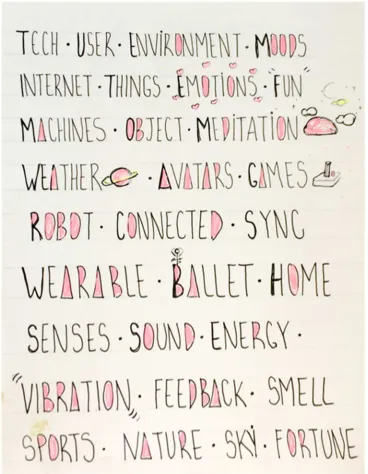
The design process began with a mind map filled with ideas and directions. I
wanted to study the relationship between humans and computers today and
design a new direction for current technology. In parallel to that I was also
fascinated to design objects that would emotionally speak to the user. I began
to deconstruct my thoughts and map out ideas.
I knew I wanted to design an object with technology that would enhance daily
activities and improve the user’s well-being. Stimulating senses and promoting
an awareness of the user’s surrounding where requirements for this new design.
I wanted to expand digital screen into the environment while inviting the user to
be more present in the moment. As a continuation of my Specialization Course
in Surface design, I wanted to create digital interactions by using projections
and animation on walls. I had the intent of designing virtual decorations objects
and create atmospheres that would interact and enhance the user’s well-being.
These animations would be displayed in the user’s surrounding according to
their activities. The environment would change colors and project animated
objects to relax, entertain and invite the user to be present in the moment.
Aware of their surroundings. The idea to expand these digital interactions to the
environment would allow the user to relax and not be worried about checking
their hand held devices for incoming notifications or to seek information of
entertainment. The environment itself would to this job.
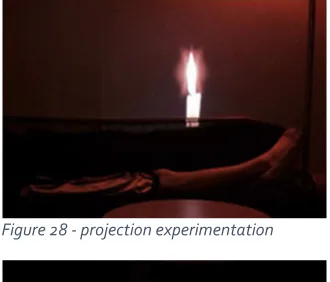
During this process I have tested and experimented with projections, holograms
and hue lights. I sinuated environments that were meant to relax, such a virtual
burning candle, engage and entertain with games on the wall and to inform and
alert with weather forecast and daily remainders. But the tactile interaction was
still missing. The objects were still very digital and two dimensional. There was
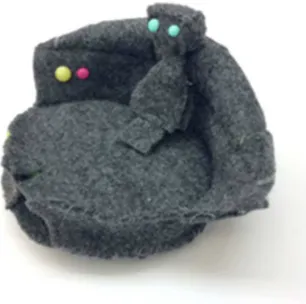
[image:41.612.147.312.425.566.2]no real interaction between the user and the interface. It was still virtual and
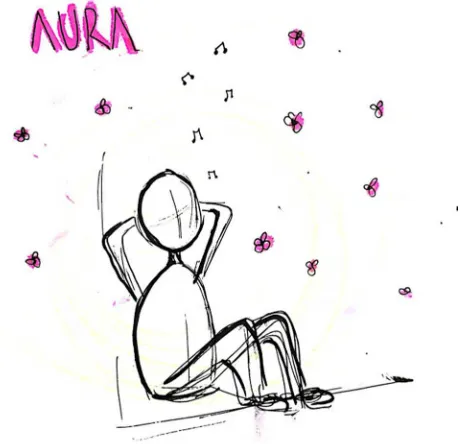
Aura - Sensing the user
Figure 29 - aura concept
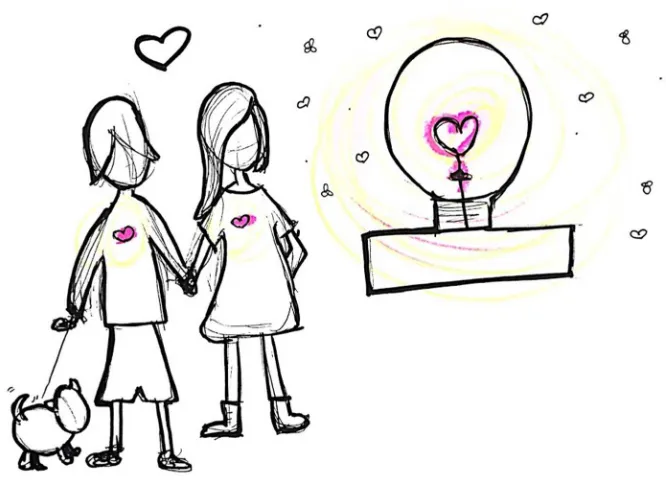
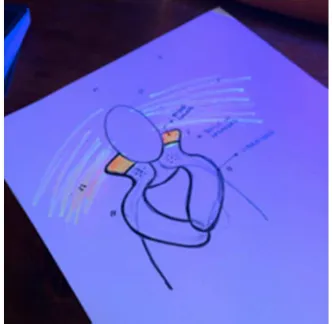
Aura is concept of a wearable device that uses sensors to capture vital signs such
as heart beat and translate them into colors and patterns in the environment.
Translating and exposing these vital signs promotes would self-awareness and
invite the user to reflect about their inner feelings. The wearable device would
measure the user's vital signs such as temperature and pulse and sends that
information to a color changing lamp. This lamp would then reflect the user's
“mood” into their environment, changing colors and beating according to the
user’s emotions.
I have imagined Aura for moments of relaxation, where the users would sit back,
relax and see it’s body expand into their surroundings. I imagined colors and
Figure 30 - aura meditation
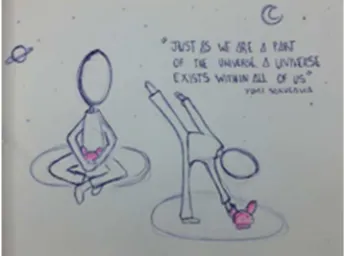
I have also imagined Aura for meditation. While you practice mindfulness, your
environment gently changes according to your level of relaxation. This can help
the user to be aware of their body and work towards a relaxing state of mind.
This also would promote a relaxing atmosphere that would help decrease the
level of stress, which is very common with the fast-paced lifestyle of modern
society.
Aura would also combine the mood of whoever was in the environment.
Blending colors and emotions. The objective of this was to create an
environment that reflects those who are present, creating a fun and engaging
Figure 31 - aura combines color
Mood rings inspired aura. As a teen I used to have and love mood rings. It was
exciting to see the ring change of color according to my body’s temperature.
Even though I knew that those “moods” and meaning were not truly reflecting
my emotions, it was still fun to be surprised by the different colors during my
day. It was something special to look at and promoted a moment of
self-reflection. How am I feeling right now? What are my emotions?
Sensorial Couch – Filtering interactions
The Sensorial Couch is conceptual smart couch developed to morph according
the Sensorial Couch is connected to the internet, and according the user's
activities it filters virtual interactions.
The Couch has 3 set up modes: Social, Chill and Don't bug me.
The Social mode was designed for activities where the user is available for
interactions, in the real and as well as in the virtual world. The couch is set up in
a "open" format which allows the users to look around and interact with their
surroundings. In this mode the couch is programed to receive notifications from
[image:45.612.156.309.305.457.2]the internet at any time, allowing the user to be fully connected.
The Chill mode is appropriate for times where the user just wants sit
back, relaxed enjoy the moment, but does not want to be totally disconnected
from the world. The couch expands its back, giving the user a greater sense of
comfort and privacy without totally enclosing him from the environment. The
virtual interactions will be limited to only important notifications, allowing the
user to have time to take a break from the world without missing any important
messages.
The Don't bug me mode is designed to bring total privacy to the user. For those
times where it is needed to "escape from the world", even if it is only for a few
minutes. The couch completely encloses the user, and invites them for a
amazing sensorial experience with no disturbance form the physical
surroundings as well as virtual.
Sensorial Vest
The concept of a wearable vest was designed to enhance the user’s sensations.
The vest is equipped with technology such as speakers, lights, and sensors that
measure the user’s vital signs. The vest would reflect the user’s emotions by
changing colors and creating an
atmosphere of self-reflection. A high quality speaker would bring sounds closer
to the user’s body, allowing them to feel the vibration of sound directly into
their body. The vest would also have the function to alert and notify the user of
incoming messages. However, not all messages would be notified, only the
pre-selected ones, the wearable would filter notifications and alert the user of only
the ones that most matter.
[image:47.612.146.312.441.603.2]Figure 34 - sensorial couch - don't bug me mode
Notification Buddies – Filtering notifications
The Notification Buddies is a series of glass figures that were conceptually
designed during my Glass elective at RIT. The concept behind these buddies is
that they are able to "sense" that a close friend is sending a message and alerts
you with light patterns. The buddies are able to filter incoming messages from
your phone and only lets you know of the ones that most matter.
The Buddies are connected to an app that allows the user
to filter notifications by creating groups of people. Each time someone special
sends a message, The Notification Buddy will shine and bring color to its
surroundings. The user can also link colors to each friend for easier
identification. This concept allows the user to enjoy they daily activities without
being concerned to check their mobile phones for notifications from those they
[image:48.612.149.341.129.272.2]love.
[image:48.612.148.343.587.731.2]Smart Toys
The concept of designing smart toys came from the idea of promoting a more
intimate experience between the user and their technological devices. Smart
Toys was a concept inspired in the Designer Toy or Art Toy movement that has
started in the 1990’s. Designers and artist tell stories by designing collectible toy
characters most of the time designed for ages 14 and up. These toys are usually
design with the concept of juxtaposition, where elements that don’t belong
together are seen in the same toy. These pieces are fun, they tell a story and
communicate something special to those who have them. Using a similar
concept, the creation of the Smart Toys concept would also follow the principal
of bringing fun and exciting stories to everyday objects.
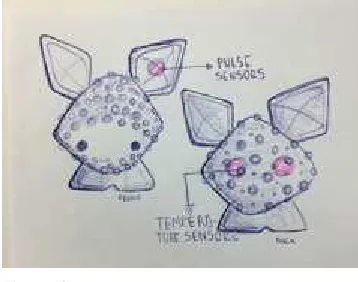
I designed a character name Long Ears. Long years is a technological toy that
would engage the user to explore their surroundings and interact with a fun
object. This toy would have sensors such ad temperature and pulse and while
the user is interacting, squeezing and feeling the toy, it would be sensing the
user’s vital signs and would invite them for activities that enhance their
well-being. These activities could range from exercises that would encourage the
[image:49.612.147.326.409.550.2]user to move around or relaxing moments of self-awareness.
This physical interaction between the toy and the user would promote affection
for the object and this would encourage the use of the device and practices that
enhance the well-being.
“As an owner uses an object and interacts with it more and more over time, so this personal attention applied to the object endows it with a special meaning for the owner.”
— Love + Sex With Robots - David Levy
“As the owner invest more “psychic energy” in an object, more meaning is attached to the object, it becomes more important to its owner, and the stronger is the attachment that the owner feels for the object.”
[image:50.612.147.319.159.287.2]— Love + Sex With Robots - David levy
S
ENSORIAL
E
XPLORATION
“And I found that of all the senses the eye was the most
superficial, the ears the most haughty, smell the most
voluptuous, taste the most superstitious, touch the most
profound and philosophical.”
— Diderot, 'Letter on the Blind', 1749
As part of my thesis research, I've performed a sensorial test with a group of five
participants. This experiment was made with the intent of understanding
preferences and reactions to the textures I had designed. Four different textures
were made out of clay for this experiment. The users were asked to describe
what they were feeling and what words popped into their minds as they
[image:52.612.139.336.230.381.2]interacted with the pieces.
I set up a dark room with only a hue light. Individually the participants were
invited to come in the room and pick a color that would represent their feelings,
mood, or a color that simply spoke to them at that moment. The color blue
was used to describe serenity, greens and yellows were used when representing
tiredness and purple was comforting.
The participants were asked to interact with the objects in front of them and say
out loud the words that came out of their head while feeling each of the stones.
During this interaction, the participants used many words related to nature,
animals and landscape to describe the textures. The different types of bumps
were noticed and the preference was for textures that allow the hand to flow
easily, like the "wavy" texture.
Textures that, at first glance, seemed more "aggressive" were surprisingly well
accepted once the user started interacting with them, being described
as fun and good for squeezing and scratching. At the end of each session the
participants were asked to give a name to each texture pebble. Some names
were repeated by the users, such as boomerang wave and sunflower.
Figure 44 - sensorial experiment names
C
ONCEPT SELECTION
After months of experiments and concept creation, I have selected the concept
of designing hand held device that would allow the user to communicate
through the use of sensorial interactions. I was set to design a tactile hand held
device that would be playful and fun to interact with. This device would be
connected to your environment and communication would happened between
M
OCKUPS AND POROTYPES
Figure 45 - mockups
Clay modeling
Clay models were designed to study ergonomics and the comfort of the device. I
designed different shapes and textures and using Sculpey clay. I was able to play
with forms and test how they felt in the hand. This technique gave me quick
answers on what felt good in the hand and I was also able to understand the
scale of the product.
I was able to study the way different shapes behaves with interaction such as
pressing to activate buttons, squeezing and the potential flexibility of the forms.
The “bunny” shaped form was the most appealing to all those criteria. It was fun
to play with, had different ways of activating the device and had a lot of
Figure 47 - comfort test
Figure 49 - comfort test
Silicone molding and casting
With the selected form made out of clay, I was able to create silicone molds and
cast flexible silicone copies of it. I made the “ears” of the device solid and the
body of it hollow to fit the components. The solid part of the device was playful
and good to press. The hollow body was squishy and similar to a stress ball.
During this process I learned and develop techniques of mold making. The
biggest challenge was to make the device hollow. I used to spin the mold around
for 3 min so the silicone would cover the surface around the device leaving the
middle hollow for components.
Figure 51 - first silicone model
Engineering
In parallel to playing with silicone molding and clay models, I was also learning
about engineering. I had the pleasure to collaborate with Thiago Lima, an
Electrical Engineering Graduate Student. Thiago introduced me to the basic
coding language. I was then able to understand, create and modify basic tests
for the development of the Sensorial Communication Device. I experimented
[image:58.612.143.287.91.279.2]It was on a Saturday afternoon in a cold winter day that at the Construct Lab,
RIT, when Thiago helped me to design the first prototype for the Sensorial
Device. We used a Light Blue Bean with an RGB light that would change
according to the temperature. This was designed to “sense” the user’s
temperature and reflect a color that represent that body temperature. It also
had a list of friends that the prototype would identify while detecting
movement. Throwing the device up X numbers of time would reach a specific
friend. Ex. To reach AJ, throw the device up 3x.
With the porotypes in hand I was and test the variation of temperature and
colors and study the relationship between mood and body heat. I tested a group
of 6 people using the temperature sensor of the prototype, a Fit Bit heartbeat
[image:59.612.146.275.577.747.2]monitor and a Plutchik Wheel of Emotions
This wheel is an infographic that uses colors to illustrate variations and
intensities of human emotions. I measured the participant’s temperature
through the use of the prototype, its heart beat using the Fit Bit and asked them
to pick a color/emotions from the wheel to describe the moment. I was able to
detect that user’s that selected feelings such as fear and apprehension had
lower body temperature at the moment then when feeling, love or serenity.
These were simple experiments that have no scientific proof to them, but it was
important to evaluate the reactions of the users while interaction with the
prototype and picking and identifying their emotions. Many of them found it
hard to pick a color on the wheel that represented their mood. I have learned
that sensing only the body temperature of the user’s hand is not enough to
evaluate mood changes. With the use of more accurate sensor such as skin
conductance, variations in stress levels and mood swings could be identified
easier. By analyzing the variation of the sweet of the hand skin conductance can
be a measure of emotional and sympathetic responses. This would be the ideal
technology to use in the development of this product.
During the Spring semester I was immersed in a Physical Interface class with
professor Shaun Foster in which I was able to continue to develop porotypes and
test concepts for this thesis. I continued to develop and refine the physical
prototype, adding a pulse sensor to enhance the reading of vital signs as well as
a Neopixel ring to visually enhance the effect of the device’s lights.
[image:60.612.149.302.651.744.2]It was interesting to see that the mass of silicone helped diffuse the light and it
sped over more evenly. However, the variation of colors and the visual effect
were still limited by the number of LEDs. During my research for electrical
components I learned about Neopixel Rings. These rings are composed by 12
LEDs that are all connected together and are all controlled individually using
only one pin of the microcontroller. This optimized the amount of internal
connections and allows for playful and fun visual effects. The blending of the
colors mixing and changing created a very appealing visual effect when placing
the ring on the silicone device.
It was clear that the Neopixel Ring would allow for the creation of infinite color
combinations that would swirl, mix and create effects that would stimulate the
user’s senses.
I was also very interested in capturing vital signs and reflecting them into the
physical world. Using a pulse sensor and an Arduino Uno microcontroller I was
able capture my heart beat and link it to colored lights. The lights were
programed to flash and beat according to my pulse rate.
I was also able to visualize the frequency of the beat through the use of a serial
monitor on the computer screen. Having this technology, I was able to
experiment and test the variation of my heart beat while visualizing it live. The
last step of this process was to embed the components into the silicone shell.
Pulse sensors are more accurate when reading from the tip of the finger, so I
casted the pulse sensor directly into the “ears” of the device where the user
could place their fingers comfortably.
For future development of the device I want to partner with engineers and
developers to continue the development of the prototype. I want to explore
different movements and program that to become a new communication
language. I also would like to refine the vital signs sensing capabilities of the
prototype by incorporating skin conductance sensors.
[image:62.612.150.311.296.511.2]07
[image:63.612.143.488.182.638.2]INTRODUCING MOOVY!
Moovy is a “sensorial communication device” that allows the users to express
and share their emotions with the ones they love through sensorial interactions.
The device is equipped with an accelerometer that detect the user’s
movements. It recognizes movements such as throwing the device up, spinning,
shaking and squeezing. Moovy also has sensors such as pulse and temperature that measures the user’s well-being.
Figure 60 - movement interactions
Figure 61 - Moovy's movements
Through the use of Bluetooth technology, the device is connected to the
environment’s light. Using an innovative light system such as Philip’s HUE light,
the user’s interactions are directly reflected into the environment in the form of
light patterns. The user’s entire environment changes according to movement
and vital signs. This experience promotes awareness of user’s feelings and their
surroundings. These interactions could also be shared. Imagine sending your
heart beat to the ones you love, and sharing your environment’s color with
those who are far.
Moovy was designed for close relationships, for the ones that matter most. To add a friend is simple. First, the user connects Moovy to the application through a Bluetooth connection.
Figure 64 - movement code - squeeze
Once the Movement Code is performed, the user can then share interactions with that friend. Movements can be programed to signify interaction, perhaps waving the device is an indication of a Hello. It is up to the user’s creativity and interactions to create codes that speak to the other side of the “line”.
[image:67.612.144.545.445.673.2]Vital signs could also be shared. It is promoting a more intimate communication
between the user and their friends, it is like sharing their emotions in an abstract
[image:68.612.144.537.158.399.2]and fun way.
Figure 66 - sensing pulse
In the “ears” of the device there have flexible sensors that are used as “buttons”
to send or receive a messages. The user can flex the silicone device 2 times and
Figure 67 - flexible sensor - sending message
On the other side of the “line”, when a message is received, the user’s entire
environment changes colors to alert about the incoming message. This allows
the user to engage in their activities without the worry about checking their
smartphones constantly. The environment itself will be the one preforming the
Figure 68 - notification in the environment
When the user that is receiving the message accepts it, their whole environment
changes colors and reacts to express the incoming message.
[image:70.612.144.555.417.647.2]Moovy was designed to be a personal device that engages the user to interact
and be aware of their feelings and surroundings. It’s soft silicone body promotes
a tactile sensorial experience and is inspired by stress balls. With squeezing and
manipulating the device, the user is able to relax and feel their “moods” in their
surroundings.
“As an owner uses an object and interacts with it more and more over time, so this personal attention applied to the object endows it with a special meaning for the owner.
— Love + Sex With Robots - David Levy
The app also collects data on the interactions and places it into a timeline of
emotions. This data can be accessed by the user and they are able to have a
[image:71.612.146.305.335.494.2]greater understanding of their interaction and well-being.
“You need to find a way to bring your body into your work. Our nerves aren’t a one-way street - our bodies can tell our brains as much as our brain tell our bodies.”
[image:72.612.144.520.236.505.2]Steal like an Artist — Edward Tufte
U
SER SNEARIOS
Moovy’s main application is to create unique communication moments between
friends and loved ones. Moovy was designed for home environments, where
family and friends can communicate through the use of sensorial interactions.
Perhaps mom has baked a cake and instead of screaming that the cake is ready,
she can send a pulsing light that would alert her family of the goodness she has
prepared. It can also be used to enhance communication for long distance
relationships. Imagine feeling the heartbeat of the one you love in your
environment, or sending a sweet remainder in the form of a color to say
goodnight.
Moovy can also be used for therapy. This tactile device can engage users to
communicate using non-verbal languages. The device can be relaxing and stress
reliving and can promote moments of self-regulation. An example could be
children with Autism, that have a hard time expressing emotions and
communicating, by interacting with Moovy their “feelings” could be exposed by
colors and therapist could understand the best way to approach their patients.
The device can also be used to help the user to calm down in stressful situations.
Let’s say that the user is nervous before an important presentation or speech.
They can reach to their pockets and interact with Moovy. The device would
react back with calming lights and vibration patters that can help the user’s to
By adding other technology to the device, such as a GPS tracker, Moovy can be
used to share locations. Let’s say that you are going to visit a friend, instead of
texting that you are on your way, or getting close to your friend’s house, Moovy
would send a light signal that could get more intense the closer you are to your
friend’s house.
[image:74.612.138.261.89.252.2]These and many other applications could be applied to this product. We are
Figure 72 - calming Moovy
[image:74.612.148.284.425.604.2]a tactile device that uses the user’s senses to communicate and promote
awareness to their surrounding could be beneficial to the future of
communication devices. By using Moovy to communicate the user is free of
digital screens and more present in the moment. I hope that this device will
inspire desigenrs and creators to design product that engange the users to be
08
CONCLUSIONS
The development of this thesis research is proposing a new language for the
future of communication through the use of tactile devices. Today, technology
allows us to be connected with the entire world using smart devices, but they
limit the user’s ability to express themselves. Bringing motion and movement to
communication will allow for more intimate and “real” interactions.
I believe that through the use of sensorial interaction such as the one proposed
in this paper, users will be more aware of their surroundings and more present in
the moment. I hope to inspire designers, engineers and those who love to dream
BIBLIOGRAPHY
Uğur, Seçil. Wearing Embodied Emotions: A Practice Based Design Research on
Wearable Technology
American Psychological Association (APA)." Accessed July 03, 2016.
www.apa.org
“Text Message Statistics." Statistic Brain. Accessed July 08, 2016.
www.statisticbrain.com.
CTIA - Everything Wireless." CTIA - Everything Wireless. Accessed July 08, 2016.
http://www.ctia.org/.
“Number of Internet Users." Accessed July 08, 2016.
www.internetlivestats.com/internet-users/.
Levy, David N. L. Love Sex with Robots: The Evolution of Human-robot
Relations. New York: HarperCollins, 2007.
Kleon, Austin. Steal like an Artist: 10 Things Nobody Told You About Being
Creative. New York: Workman Pub., 2012.
“BusinessZone." BusinessZone. Accessed July 22, 2016.
www.businesszone.co.uk
“Informate | Mobile Intelligence." Informate | Mobile Intelligence. Accessed July
23, 2016. www.informatemi.com
Accessed July 23, 2016.
http://study.com/academy/lesson/robert-plutchiks-wheel-of-emotions-lesson-quiz.html.
"Smart Connected Lighting - This Is Philips Hue | Philips." Smart Connected
Lighting - This Is Philips Hue | Philips. Accessed July 24, 2016.
www.usa.philips.com.
"Portable Rotary Phone - Red." Portable Rotary Phone. Accessed August 01,
2016. https://www.sparkfun.com/products/retired/287.
BigTimeWireless. "Sony Ericsson W30i GSM cell phone Walkman promo demo
advertisement commercial." YouTube. 2009. Accessed August 02, 2016.
https://www.youtube.com/watch?v=bzvjz5j9gbM.
"A Colourful History of Nokia Phones." Microsoft Devices Blog A Colourful
History of Nokia Phones Comments. 2013. Accessed August 02, 2016.