Randomized, Controlled Trial
Evaluating a Baby Wash Product on
Skin Barrier Function in Healthy,
Term Neonates
Tina Lavender, Carol Bedwell, Stephen A. Roberts, Anna Hart, Mark A. Turner, Lesley-Anne Carter, and Michael J. Cork
Correspondence Tina Lavender, DBE, PhD, MSC, RM, RGN, School of Nursing, Midwifery and Social Work, The University of Manchester, Manchester, UK.
Keywords randomized term neonates wash product neonatal skin care transepidermal water loss noninferiority trial
ABSTRACT
Objectives:To examine the hypothesis that the use of a wash product formulated for newborn (<1 month of age) bathing is not inferior (no worse) to bathing with water only.
Design:Assessor-blinded, randomized, controlled, noninferiority trial.
Setting:A teaching hospital in the Northwest of England and in participants’ homes.
Participants:Three-hundred-and-seven healthy, term infants recruited within 48 hours of birth.
Method:We compared bathing with a wash product (n=159) to bathing with water alone (n=148). The primary out-come was transepidermal water loss (TEWL) at 14 days postbirth; the predefined difference deemed to be unimportant was 1.2. Secondary outcomes comprised changes in stratum corneum hydration, skin surface pH, clinical observations
of the skin, and maternal views.
Results:Complete TEWL data were obtained for 242 (78.8%) infants. Wash was noninferior to water alone in terms of TEWL (intention-to-treat analysis: 95% confidence interval [CI] for difference [wash–water, adjusted for family history of
eczema, neonate state, and baseline]−1.24, 1.07; per protocol analysis: 95% CI−1.42, 1.09). No significant differences were found in secondary outcomes.
Conclusion:We were unable to detect any differences between the newborn wash product and water. These findings provide reassurance to parents who choose to use the test newborn wash product or other technically equivalent
cleansers and provide the evidence for health care professionals to support parental choice.
JOGNN, 42, 203-214; 2013.DOI: 10.1111/1552-6909.12015
Accepted November 2012
Tina Lavender, DBE, PhD, MSC, RM, RGN, is a professor of midwifery and director for the Midwifery Research Group, School of Nursing, Midwifery and Social Work, The University of Manchester, Manchester, UK.
(Continued)
I
nfant skin has several important functions, in-cluding prevention of infection, maintenance of a stable water content level, and reduction of the penetration of allergens and irritants (Holbrook, 2000). These functions depend on the mainte-nance of an effective skin barrier with an optimum pH (Cork et al., 2008). A neonate’s skin remains immature for some time following birth; it has been demonstrated that the stratum corneum continues to develop until at least age 12 months (Nikolovski, Stamatas, Kollias, & Wiegand, 2008). The normal skin pH at the surface of the stratum corneum af-ter the first year of life is around 5.5. This low pH is important for maintaining low protease activity and enhancing the synthesis of the lipid lamellae, which are central to the maintenance of a normal skin barrier (Danby & Cork, 2011).The most common skin diseases during this first year of life are napkin/diaper dermatitis, skin in-fections, and atopic dermatitis (AD) (Atherton & Mills, 2004). Atopic dermatitis occurs as a result of gene–environment interactions leading to skin barrier breakdown (Cork et al., 2009). Soap and harsh surfactants play an important role in facili-tating skin barrier deterioration and triggering AD onset (Danby & Cork, 2011). The optimal wash product for a neonate should have a pH around 5.5 and some buffering capacity to maintain skin pH around this level. This was the pH of the wash product used in this trial. At the other end of the spectrum, a soap bar can raise the pH of the skin above 8.0. This leads to enhanced protease activ-ity and inhibits the synthesis of the lipid lamellae, resulting in breakdown of the skin barrier (Cork
et al.; Danby & Cork). When oils are reacted with a solution of sodium hydroxide, they break down to form glycerol and the sodium salts of their fatty acids. These salts are used as soap, which are an example of an anionic surfactant. Surfac-tants have varying effects on skin barrier integrity (Goffin, Paye, & Pi ´erard, 1995). Surfactants with a negative charge (e.g., sodium dodecyl [lauryl] sulphate) have greater skin irritation potential com-pared with glycosylated surfactants (Ananthapad-manabhan, Moore, Subramanyan, Misra, & Meyer, 2004), the latter of which were used in the study wash product.
Atopic dermatitis is a significant health care bur-den and impairs the quality of life of infants (Lewis-Jones, Finlay, & Dykes, 2001) and their parents (Lawson, Lewis-Jones, Finlay, Reid, & Owens, 1998). Such problems highlight the need for suit-able skin care regimens. As a result, water alone has been suggested as the least harmful method for newborn cleansing in many countries (National Institute for Health and Clinical Excellence [NICE], 2006). However, the buffering capacity of water has been questioned, as it may increase the skin surface pH from 5.5 to 7.5 (Tsai & Maibach, 1999). A pH of 7.5 is likely to increase skin protease ac-tivity and inhibit the synthesis of the lipid lamellae, leading to a breakdown of the skin barrier (Tsai & Maibach). Water alone has been identified as an ineffective cleanser, as it fails to remove fat-soluble substances such as feces and sebum (Gelmetti, 2001). This is an issue highlighted as particularly important by mothers (Lavender et al., 2009).
Carol Bedwell, RGN, RM, LLB (Hons), is a lecturer of midwifery in the School of Nursing, Midwifery and Social Work, The University of Manchester, Manchester, UK.
Stephen A. Roberts, BSc, PhD, is an applied biostatistician and senior lecturer in biostatistics in the School of Medicine, The University of Manchester, Manchester, UK.
Anna Hart, BA (Cantab), MSc, is statistician in the Lancaster Medical School, The University of Lancaster, Lancaster, UK.
Mark A. Turner, BSc, MBChB, is a consultant neonatologist in the Institute of Translational Medicine, University of Liverpool/Liverpool Women’s Hospital, Liverpool, UK.
Lesley-Anne Carter, BSc, MSc, is a postgraduate student in the School of Medicine, The University of Manchester, Manchester, UK.
Michael J. Cork, BSc, MB, PhD, FRCP, is professor and head of academic dermatology research and honorary consultant dermatologist for Sheffield Children’s Hospital NHS Foundation Trust and Sheffield Teaching Hospitals NHS Foundation Trust, The University of Sheffield, Sheffield, UK.
Although guidelines exist for the treatment of atopic eczema (NICE, 2007), there are no guide-lines for primary prevention of atopic eczema. Within the United Kingdom, national postnatal care guidelines recommend bathing with water alone in the early postnatal period (NICE, 2006). However, neonatal skin care guidelines in the United States (Lund et al., 2007) recommend the use of warm tap water for bathing with the option to use a mild cleanser that has a neutral pH (5.5 to 7.0). The ab-sence and inconsistencies in guidelines are likely to be the result of a dearth of robust evidence from which to inform practice. [Correction added after online publication 19 Feb 2013: In the pre-vious two paragraphs, the NICE references were erroneously listed as “NIHCE.” This has been cor-rected here and in the reference list.]
In a recent systematic review (Crozier & Macdon-ald, 2010) of newborn cleansing products versus
water, of nine studies identified, only two were el-igible for inclusion. A meta-analysis was not car-ried out because of the heterogeneity of trial pro-tocols. The first study by Garcia Bartels et al. (2010) included 64 full-term newborns in Berlin and aimed to test the hypothesis that twice-weekly bathing with a commercially available wash gel and additional cream would not harm the natural adaptation of the skin barrier in healthy newborns. Participants were randomized to one of the four following trial arms: bathing twice weekly with commercially available wash gel product; bathing twice weekly with clear water, then applying a commercially available body cream; bathing with wash gel and applying cream after bathing; and bathing with clear water only. The second study included in the systematic review (Dizon, Gal-zote, Estanislao, Mathew, & Sarkar, 2010) was a three-armed trial conducted in the Philippines, which compared two different liquid cleansers with water alone; 60 infants were randomized in each arm. Authors of both studies concluded that neonatal skin barrier function was not harmed by the tested skin care regimens in healthy, full-term infants. However, neither provided an a pri-ori primary outcome or sample size, nor did they follow the Consolidated Standards of Reporting Trials (CONSORT) guidelines (Begg et al., 1996) for reporting. Thus, the authors of the systematic review concluded that there is currently insufficient evidence on which to base practice.
Methods
Ethical approval was obtained from the Cheshire Research Ethics Committee. All participants gave written and verbal consent to participate. Between February 2010 and March 2011, we recruited healthy newborn infants born at 37 weeks gesta-tion or more from a teaching hospital in the North-west of England. We excluded infants if they were admitted to the neonatal unit; were receiving pho-totherapy; had limb defects, nontraumatic impair-ment of epidermal integrity, or evidence of skin disorder at first visit. We also excluded infants with a chromosomal abnormality or other syndromic di-agnosis and infants going for adoption.
Pregnant women of potentially eligible infants were supplied study information in the antenatal period via community and hospital clinics. In the postna-tal period, the attending clinical midwives sought verbal permission for a research midwife to ap-proach women who had been given prior infor-mation. The research midwife collected baseline details from all women supplying verbal and writ-ten consent, using a self-administered question-naire. Family history of atopic eczema also was established at this stage (defined as at least one of father, mother, or sibling who has had a medical diagnosis of atopic eczema and who has had top-ical steroid treatment). Interpreters were available for non-English speaking women.
Randomization and Follow-Up
Infants were randomized to a bathing regimen us-ing a newborn wash product or water alone be-fore their first bath. Randomization was by con-secutively numbered, sealed, opaque envelopes held by the research manager at the study hos-pital. The randomization sequence was in uneven blocks and stratified according to whether there was a family history of atopic eczema. All women were given written instructions on how to bathe their infants. Parents were requested not to use any additional products, such as oils, sponges, and wipes. Participating mothers were instructed to bathe their neonate at least 3 times per week and to avoid rubbing of the skin. Those allocated to bathe their neonate in water alone (control) were not provided with any products. If these moth-ers wished to use shampoo on their neonates’ hair, they were requested to do this outside of the bath, and to ensure that the neonate’s body was wrapped in a towel, to prevent contact with the skin. Those allocated to the wash product (ex-perimental) were provided with sufficient newborn wash and advised to dilute the product at a ratio
Mothers have expressed concern that water alone is an
ineffective cleanser, but evidence on appropriate newborn
bathing has been insufficient to inform practice.
of three squirts per bath. On the day of assess-ment, mothers were requested to delay bathing their neonate until measurements had been taken.
The chosen commercially available wash prod-uct, Johnson’s Baby Top-to-Toe Bath (Johnson & Johnson Limited, Maidenhead SL6 3UG, UK), is a soap-free liquid cleanser designed for new-borns’ skin. It is sodium lauryl sulphate-free and consists of a proprietary blend of nonionic and amphoteric surfactants that when combined re-sult in large micelles that clean via dispersal of fats without disrupting the skin barrier. The for-mula contains well-tolerated preservatives and a low level of fragrance; it is pH-adjusted (around 5.5) and hypoallergenic. The International Nomen-clature Cosmetic Ingredients list comprised aqua, coco-glucoside, cocamidopropyl betaine, citric acid, Acrylates/C10–30 Alkyl Acrylate Crosspoly-mer, sodium chloride, glyceryl oleate, p-Anisic acid, sodium hydroxide, phenoxyethanol, sodium benzoate, and parfum.
Outcome Measures
London, UK). The pilot study (Lavender et al., 2011) found no important differences in TEWL measurements between body parts; therefore, we analyzed an average assessment score.
Secondary outcomes comprised TEWL at 4 weeks postbirth, skin surface pH using a Courage + Khazaka Skin-pH-MeterR PH 900, and stratum corneum hydration scores using CorneometerRCM 820 (Courage+Khazaka elec-tronic GmbH, Cologne, Germany) from baseline (within 48 hours of birth). Because of the sensi-tivity of the neonate’s skin in the early weeks fol-lowing birth, this is an ideal time to investigate the effect of wash products. Any differences in these outcomes are likely to be greater than later in an infant’s life when the skin barrier is more stable.
These secondary outcomes were measured at 2 and 4 weeks postbirth. Anatomical markers were used to ensure assessments were consistent. Two measurements were taken at each site; mean scores were used in analysis. Skin measurement instruments were calibrated before recruitment, during the recruitment period, and following the last follow-up assessment.
Clinical measures comprised observations of the skin daily by the mother from first assessment to 4 weeks postbirth; a semistructured diary was used to record observations. Observations were made by the midwife at the times of assess-ment and were recorded with the aid of a vali-dated skin assessment scale (Lund & Osborne, 2004) that included a scale for erythema, excori-ation, and dryness. For each component an aver-age grade was obtained across body parts. This scale has been used in a number of compara-tive studies (Brandon, Coe, Hudson-Barr, Oliver, & Landerman, 2010; Garcia Bartels et al., 2011). Mothers’ satisfaction with their allocated cleans-ing regimen was obtained uscleans-ing a specifically designed questionnaire that had been evaluated for content validity through earlier qualitative work (Lavender et al., 2009).
Blinding
The research midwives carrying out the mea-surements were blinded to treatment allocation. Women were asked not to reveal their allocation to the midwife assessing the neonate in their home. The research assistant telephoned women on the day of assessment to remind them to remove visible signs of products prior to the midwife’s arrival.
Compliance
To optimize compliance levels, weekly telephone contact with participating women was maintained. Participants were requested to keep a cleansing diary for the study duration. It was prespecified that we would assess the impact of any noncom-pliance on the primary outcome using five cate-gories.Strict compliancewas defined as nonuse of any additional products on the areas of the body under assessment or any products likely to cause contamination (e.g., talcum powder).Mostly com-pliantandpartially compliantwere defined as the nonuse of additional products in the week before the assessment, with no more than two product deviations and more than two product deviations, respectively.Rarely compliant andnoncompliant were defined as use of additional products on the areas of the body being measured or any products likely to cause contamination during the week of assessment with no more than two product de-viations and more than two product dede-viations, respectively.
Statistical Analysis
Data were analyzed using Stata 11 (StataCorp LP, College Station, TX) following double entry of all data, with the statistician blinded to the true treat-ment allocation. Two data sets were defined that were used for analysis. The intention-to-treat (ITT) data set includes all the participants who have data for the primary outcome. The per protocol (PP) data set excludes participants satisfying ITT who were classified as rarely compliant or non-compliant.
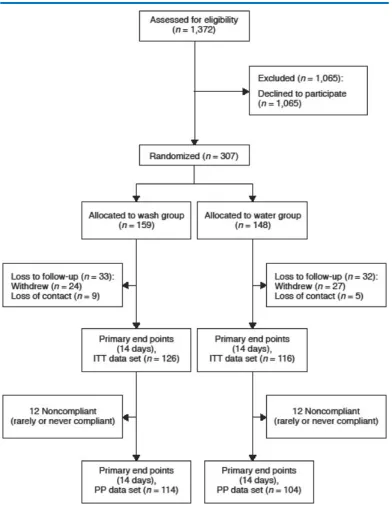
Figure 1. Participant flow during the study.
Multiple sensitivity analyses were carried out to test the effect of data and analysis assumptions and where any imbalance in demographic or baseline data was found.
One extreme outlying TEWL value (255) was as-sumed to be an instrument error and was treated as missing. Four neonatal states were missing at the 2-week follow-up and were assumed to be
awake and calm. Sensitivity analysis investigated to what extent these assumptions affected the re-sults. All significance levels are presented without adjustment for multiple testing.
Sample Size
by experienced clinicians on the trial management group and Data Monitoring Committee. Assuming a common standard deviation is 3 and allowing for a very small actual difference of up to 0.2 units, favoring water, a sample size of between 100 and 140 per group would have 80% power to reject the null hypothesis that the test and standard are not equivalent (the average TEWL value for product is at least 1.2 units greater than that for water), based on a two-group, 2.5%, one-sidedttest. Assuming a 10% dropout over 4 weeks, and an actual differ-ence of 0.1 units we aimed for 120 completers per group by recruiting at least 133 participants per group at baseline. Because the loss to follow-up was greater than anticipated, we over-recruited to compensate.
Results
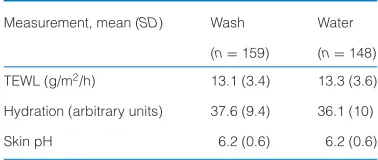
Overall, 307 infants were randomized and the par-ticipation rate was 22.4% (307/1372). The over-all loss to first follow-up was 65/307 (21.2%); 33 (10.7%) in the wash group and 32 (10.4%) in the water group. Participant flow can be seen in Fig-ure 1. By first follow-up, 109/159 participants in the wash group were strictly compliant with the study protocol, 10 were mainly compliant, 3 were partially compliant, 9 were rarely compliant, and 4 were noncompliant; one participant complied with the wrong treatment allocation. In the water group, 92/148 participants were strictly compliant, 11 were mainly compliant, 5 were partially compli-ant, 9 were rarely complicompli-ant, and 3 were noncom-pliant; one participant complied with the wrong treatment allocation. Similar baseline characteris-tics (Table 1) and all first skin assessment mea-sures also were comparable between randomized groups (Table 2).
Primary Analysis
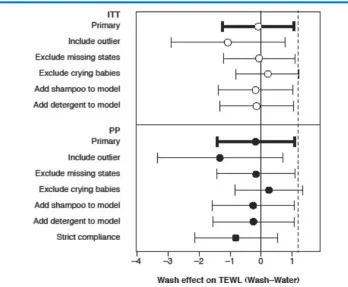
There was very little difference between the wash and water groups in terms of TEWL (Table 3), and the upper limit of the 95% confidence interval of the difference did not reach the prespecified non-inferiority margin. The location of the 95% con-fidence interval (CI) in relation to the prestated noninferiority value shows that the study was ad-equately powered. Following the primary analy-sis, sensitivity analysis was carried out including the one outlying TEWL value (deemed to be an instrument error); excluding the four with miss-ing neonatal state (assumed to be awake and calm); excluding all crying infants, further adjust-ing for shampoo and detergent use at first
follow-Table 1: Baseline Characteristics of Partici-pants by Randomized Group
Characteristic Wash Water
(n=159) (n=148)
Family history of atopic eczema 42 (27) 42 (29)
Maternal age (years), mean (SD) 28.6 (5.6) 28.2 (6.1)
Maternal ethnicity
White, British 128 (81) 132 (89)
Black and ethnic minority 16 (10) 14 (10)
Other 15 (9) 2 (1)
Maternal parity
Primiparous 79 (50) 76 (51)
Multiparous 80 (50) 72 (49)
Birth mode
Normal vaginal 115 (72) 99 (67)
Instrumental 20 (13) 25 (17)
Caesarean section 22 (14) 24 (16)
Vaginal breech 2 (1) 0 (0)
Infant’s gender
Male 80 (50) 78 (53)
Female 79 (50) 70 (47)
Birth weight, g 3435 (429) 3445 (525)
Feeding method
Breast 65 (41) 53 (36)
Bottle 76 (48) 80 (54)
Mixed 18 (11) 15 (10)
[image:6.604.345.531.106.474.2]Note.Values aren(%) unless stated otherwise.
Table 2: First Skin Assessments by Ran-domized Group
Measurement, mean (SD) Wash Water
(n=159) (n=148)
TEWL (g/m2/h) 13.1 (3.4) 13.3 (3.6)
Hydration (arbitrary units) 37.6 (9.4) 36.1 (10)
Skin pH 6.2 (0.6) 6.2 (0.6)
Note. TEWL=transepidermal water loss.
[image:6.604.344.533.543.623.2]Table 3: Comparison of Primary Outcome Measure (TEWL) at Follow-Up by Randomized Group Under ITT and PP Analyses
Analysis Wash (n=126) Water (n=116) Wash–water adjusted difference p-value
Mean (SD) Mean (SD) in means (95% CI)a
ITT 12.8 (4.5) 12.5 (5.6) −0.08 (−1.24, 1.07)a .89
PP 12.8 (4.6) 12.6 (5.9) −0.17 (−1.42, 1.09)a .79
Note.CI=confidence interval; ITT=intention-to-treat; PP=per protocol; TEWL=transepidermal water loss.
aControlling for family history of eczema, infant state at 2 weeks and baseline, and baseline TEWL.
Secondary Analyses
Tables 4, 5, and 6 present the secondary out-comes that detail the biophysical assessment, clinical observations, and maternal views.
Biophysical Assessments. Skin assessment re-sults are presented in Table 4. No significant dif-ferences were found in the pH measurements at 14 days, as well as no significant difference in TEWL at 28 days. Differences were found in stra-tum corneum hydration that was higher in the wash group at 14 days. However, after adjustment for multiple testing, this difference would not be con-sidered statistically significant and was reduced at 28 days.
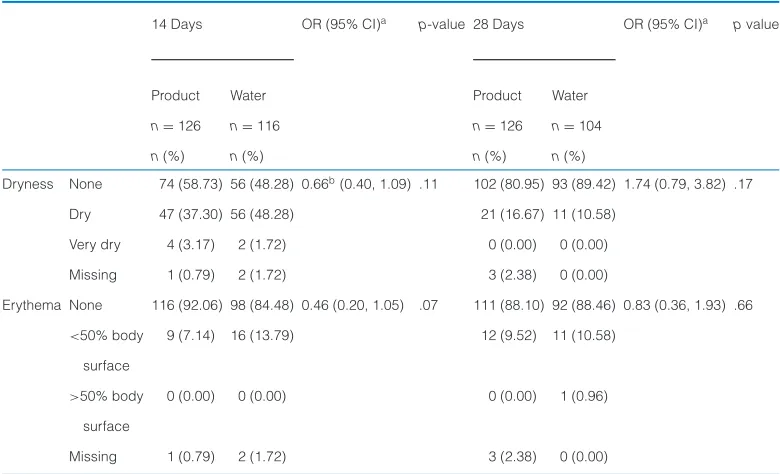
Clinical Observations.Clinical observation results are presented in Table 5. Observations of dry and very dry skin were merged for analysis because of the limited information that the very dry category held. No significant differences between groups were found when observing for dryness or ery-thema, and no excoriation was observed in either group.
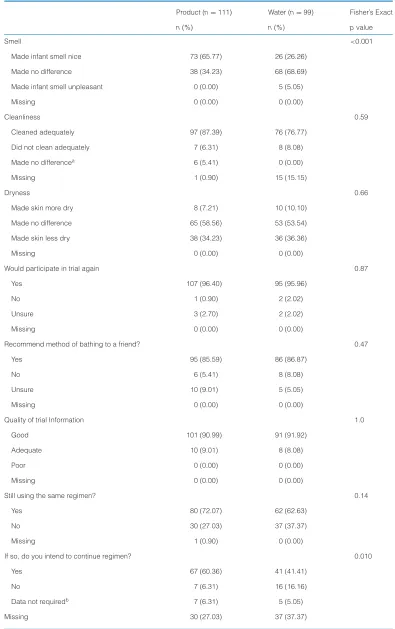
[image:7.604.90.438.404.691.2]Maternal Views. Mothers’ perception of their al-located skin regimen, gathered using diaries for the intervention period and questionnaires at 8 weeks, are presented in Table 6. Two-hundred-and-ten participants responded; 68.4% of the initial 307 in the trial. The response was
Table 4: Comparison of Secondary Biophysical Outcomes at Follow-Up by Randomized Group (ITT Analyses)
Analysis, mean (SD) Wash Water Wash–water adjusted difference pvalue
(n=126) (n=116) in means (95% CI)a
14 Days
pH 5.5 (0.5) 5.5 (0.5) 0.05 (−0.07, 0.17) .40
Hydration 49.7 (9.2) 46.7 (8.4) 2.9 (0.43, 5.47) .022
28 Days
TEWL 12.6 (5.2) 13.6 (5.4) −0.90 (−2.20, 0.40) .17
pH 5.8 (0.5) 5.3 (0.4) 0.03 (−0.09, 0.16) .60
Hydration 54.1 (9.9) 54.7 (9.3) 2.4 (−0.40, 5.20) .093
Note.CI=confidence interval; ITT=intention-to-treat; TEWL=transepidermal water loss.
aControlling for family history of eczema, infant state at 2 weeks and baseline, and baseline TEWL.
representative of the original sample, with ap-proximately 53% in the product arm and 47% in the water arm (compared with 52% and 48% in the original sample). Differences between groups were only found in two items assessed by moth-ers. Mothers were more likely to state that using a bathing product left their neonate smelling good (p< .001). This echos the findings of previous
qualitative work, in which mothers indicated that smell was a factor in product choice (Lavender et al., 2009). Mothers in the wash group who con-tinued their allocated regimen post 28 days were more likely to maintain the same bathing regimen following study completion (p=.010). There were no differences in overall satisfaction scores, as as-sessed by a 10-cm visual analog scale.
Table 5: Comparison of Clinical Observations by Randomized Group (ITT Analyses)
14 Days OR (95% CI)a p-value 28 Days OR (95% CI)a pvalue
Product Water Product Water
n=126 n=116 n=126 n=104
n(%) n(%) n(%) n(%)
Dryness None 74 (58.73) 56 (48.28) 0.66b(0.40, 1.09) .11 102 (80.95) 93 (89.42) 1.74 (0.79, 3.82) .17
Dry 47 (37.30) 56 (48.28) 21 (16.67) 11 (10.58)
Very dry 4 (3.17) 2 (1.72) 0 (0.00) 0 (0.00)
Missing 1 (0.79) 2 (1.72) 3 (2.38) 0 (0.00)
Erythema None 116 (92.06) 98 (84.48) 0.46 (0.20, 1.05) .07 111 (88.10) 92 (88.46) 0.83 (0.36, 1.93) .66
<50% body 9 (7.14) 16 (13.79) 12 (9.52) 11 (10.58)
surface
>50% body 0 (0.00) 0 (0.00) 0 (0.00) 1 (0.96)
surface
Missing 1 (0.79) 2 (1.72) 3 (2.38) 0 (0.00)
Note.CI=confidence interval; ITT=intention-to-treat; OR=odds ratio.
aWash relative to water.
[image:8.604.143.533.432.669.2]Table 6: Maternal Views of Bathing Regimen (ITT Analyses)
Product (n=111) Water (n=99) Fisher’s Exact
n(%) n(%) pvalue
Smell <0.001
Made infant smell nice 73 (65.77) 26 (26.26)
Made no difference 38 (34.23) 68 (68.69)
Made infant smell unpleasant 0 (0.00) 5 (5.05)
Missing 0 (0.00) 0 (0.00)
Cleanliness 0.59
Cleaned adequately 97 (87.39) 76 (76.77)
Did not clean adequately 7 (6.31) 8 (8.08)
Made no differencea 6 (5.41) 0 (0.00)
Missing 1 (0.90) 15 (15.15)
Dryness 0.66
Made skin more dry 8 (7.21) 10 (10.10)
Made no difference 65 (58.56) 53 (53.54)
Made skin less dry 38 (34.23) 36 (36.36)
Missing 0 (0.00) 0 (0.00)
Would participate in trial again 0.87
Yes 107 (96.40) 95 (95.96)
No 1 (0.90) 2 (2.02)
Unsure 3 (2.70) 2 (2.02)
Missing 0 (0.00) 0 (0.00)
Recommend method of bathing to a friend? 0.47
Yes 95 (85.59) 86 (86.87)
No 6 (5.41) 8 (8.08)
Unsure 10 (9.01) 5 (5.05)
Missing 0 (0.00) 0 (0.00)
Quality of trial Information 1.0
Good 101 (90.99) 91 (91.92)
Adequate 10 (9.01) 8 (8.08)
Poor 0 (0.00) 0 (0.00)
Missing 0 (0.00) 0 (0.00)
Still using the same regimen? 0.14
Yes 80 (72.07) 62 (62.63)
No 30 (27.03) 37 (37.37)
Missing 1 (0.90) 0 (0.00)
If so, do you intend to continue regimen? 0.010
Yes 67 (60.36) 41 (41.41)
No 7 (6.31) 16 (16.16)
Data not requiredb 7 (6.31) 5 (5.05)
In the largest randomized trial of healthy newborns, no
differences were found between using a specified proprietary
wash product and using water alone.
Discussion
We reported findings from the largest random-ized clinical trial of healthy newborn infants and bathing, demonstrating that the cleansing prod-uct tested in our trial is not inferior (no worse) to bathing with water alone, as assessed by TEWL. Maintenance of correct water balance is one of the key functions of the epidermis (Harpin & Rut-ter, 1983; Hoath & Narendran, 2001). Increased TEWL precedes the development of AD in those with a genetic predisposition to the development of AD and is therefore a clinically relevant mea-sure (Flohr et al., 2010). Despite stratifying for a family history of atopic eczema, we found no dif-ference in TEWL measurements between those bathed in water alone or with a cleansing uct, offering reassurance that the cleansing prod-uct was not influencing skin barrier integrity. This study demonstrates that the product tested in this trial is acceptable and safe for use on newborn skin.
In our earlier work (Lavender et al., 2011), moth-ers raised concerns regarding skin dryness; this was not raised as an issue in this trial. Although there are known changes in hydration as the in-fants’ skin matures (Nikolovski et al., 2008), this was a randomized, controlled trial; and these changes were expected to be similar between trial groups. Stratum corneum hydration was higher in the wash group at 14 days, which appears significant on an unadjusted basis; however, this difference would not be considered statistically significant after adjustment for multiplicity. Fur-thermore, any differences observed had disap-peared by 28 days, suggesting that this may be
an unimportant or even a chance finding. This is an area that warrants further study, especially as bathing the skin in water may elute out natu-ral moisturizing factor (NMF) from the skin. Nat-ural moisturizing factor has an important role as a humectant, retaining water within the stratum corneum. Natural moisturizing factor also contains several acids, including lactic acid, urocanic acid, and sodium pyrrolidone carboxylic acid. These acids keep the pH of the stratum corneum low, which is important for the maintenance of the nor-mal skin barrier. In order to reduce the eluting of NMF from the stratum corneum, bathing should be restricted to the shortest period possible (e.g., 5 minutes).
Overall, maternal satisfaction between trial arms showed no differences. However, importantly, more than two thirds of women who were cated to the wash group were still using their allo-cated regimen at 8 weeks postbirth. Of these, 60% intended to continue with this regimen, suggest-ing satisfaction with the product. Moreover, it con-firms our earlier findings (Lavender et al., 2009) that many parents prefer to use bathing prod-ucts versus water alone. These findings offer evi-dence to recommend that parents should be sup-ported to use their preferred method of neonatal bathing.
[image:10.604.140.534.615.679.2]We found no evidence of harm with the use of the product evaluated in this study. These find-ings resonate with those of other recent trials (Di-zon et al., 2010; Garcia Bartels et al., 2010) that also failed to find evidence of harm when us-ing modern cleansus-ing products. Unlike the pre-vious studies, this trial stated an a priori pri-mary outcome, ensured the study was adequately powered, and was distinguished from previous work by quality and sample size. Our work is a significant advancement in the evaluation of skin care in the month after birth.
Table 6: Continued
Mean (SD) Mean (SD) ttest
Satisfaction rating 0.15
10 cm visual-analogue scale 9.12 (1.52) 8.82 (1.56)
Missing 2 (1.80%) 1 (1.01%)
Note.ITT=intention-to-treat.
aThis category was omitted from the statistical comparison as its meaning is ambiguous.
This study was conducted in one hospital set-ting. Nevertheless, this setting supports women from diverse sociocultural backgrounds and our data reflect this; findings are likely to be transfer-able to other settings. However, further research may be needed in settings where cultural prac-tices, environmental conditions, or water condi-tions are different; all of which may influence TEWL measurements.
Parents are faced with a multitude of commercial products and have to navigate the complex in-gredient information and influential branding be-fore making purchasing choices. Although the choice of products can vary around the world, certain minimum criteria should be met when they are indicated for use in newborns and in-fants. These include not only appropriateness of pH, around 5.5, and documented skin safety, but also more importantly, ocular safety because cleansers can often be inadvertently splashed into a neonate’s developing eyes during routine use. Increasingly, parents are seeking the evidence to support their child care practices, evidenced by the increasing numbers of websites and parental “hits.” The termclinically tested, which appears on many neonatal products, covers a range of testing and fails to provide accurate detail on the rigor of such investigations. New regulations are needed to cover the claims that can be made for a particular product in relation to the quality of the clinical trial evidence. This would allow par-ents to identify the best products and encourage companies to invest in producing the best for-mulations and evaluating them in appropriately powered clinical trials. In our opinion, to ensure that truly informed decisions are made, parents should be informed of neonatal products that have been tested in robust randomized clinical trials. Nurses and midwives have a key role in provid-ing such information durprovid-ing parent education ses-sions. Nurses have a professional responsibility to critique new evidence, which sometimes su-persedes national guidelines, particularly when the guidelines have been based on low levels of evidence.
Acknowledgment
The authors thank the staff of Liverpool Women’s Hospital Foundation Trust, Anita Greaves-Boyce, Ediri O’Brien, Professor James Mason, Dr. Kevin Hugill, and Annette Briley.
The findings of this trial will enable health professionals to
provide women with evidence on which to base their choice for
newborn cleansing.
REFERENCES
Agren, J., Sj ¨ors, G., & Sedin, G. (2006). Ambient humidity
in-fluences the rate of skin barrier maturation in extremely
preterm infants. Journal of Pediatrics, 148(5), 613–617. doi:10.1016/j.jpeds.2005.11.027
Ananthapadmanabhan, K. P., Moore, D. J., Subramanyan, K., Misra,
M., & Meyer, F. (2004). Cleansing without compromise: The
impact of cleansers on the skin barrier and the technology
of mild cleansing.Dermatologic Therapy,17(Suppl 1), 16–25. doi:10.1111/j.1396-0296.2004.04S1002.x
Atherton, D., & Mills, K. (2004). What can be done to keep babies’ skin
healthy?RCM Midwives,7(7), 288–290.
Begg, C., Cho, M., Eastwood, S., Horton, R., Moher, D., Olkin, I.,
. . . Stroup, D. F. (1996). Improving the quality of reporting of
randomized controlled trials: The CONSORT statement. Jour-nal of the American Medical Association, 276(8), 637–639. doi:10.1001/jama.1996.03540080059030
Brandon, D. H., Coe, K., Hudson-Barr, D., Oliver, T., & Landerman, L. R.
(2010). Effectiveness of No-Sting skin protectant and Aquaphor
on water loss and skin integrity in premature infants.Journal of Perinatology,30(6), 414–419. doi:10.1038/jp.2009.174 Cork, M. J., Danby, S., Vasilopoulos, Y., Moustafa, M., Macgowan, A. L.,
Varghese, J., . . . Ward, S. J. (2008). Epidermal barrier
dysfunc-tion. In S. Reitamo, T. A. Luger, & M. Steinhoff (Eds.),Textbook of atopic dermatitis(pp. 35–57). London, UK: Informa Healthcare. Cork, M. J., Danby, S. G., Vasilopoulos, Y., Hadgraft, J., Lane, M. E.,
Moustafa, M., . . . Ward, S. J. (2009). Epidermal barrier
dysfunc-tion in atopic dermatitis.Journal of Investigative Dermatology,
129(8), 1892–1908. doi:10.1038/jid.2009.133
Crozier, K., & Macdonald, S. (2010). Effective skin-care regimes for
term newborn infants: A structured literature review.Evidence Based Midwifery,8(4), 128–135.
Danby, S. G., & Cork, M. J. (2011). The skin barrier in atopic dermatitis.
In A. Irvine, P. Hoeger, & A. Yan (Eds.),Harper’s textbook of pediatric dermatology(3rd ed., Vol.1,2, pp. 317–335). Oxford, UK: Blackwell.
Dizon, M. V., Galzote, C., Estanislao, R., Mathew, N., & Sarkar, R. (2010).
Tolerance of baby cleansers in infants: A randomized controlled
trial.Indian Pediatrics,47(11), 959–963. doi:10.1007/s13312-010-0161-8
Flohr, C., England, K., Radulovic, S., McLean, W. H., Campbel, L. E.,
Barker, J., . . . Lack, G. (2010). Filaggrin loss-of-function
mu-tations are associated with early-onset eczema, eczema
sever-ity and transepidermal water loss at 3 months of age.British Journal of Dermatology,163(6), 1333–1336. doi:10.1111/j.1365-2133.2010.10068.x
Garcia Bartels, N., R ¨osler, S., Martus, P., Stroux, A., L ¨onnfors, S.,
Reis-shauer, A., & Blume-Paytavi, U. (2011). Effect of baby swimming
and baby lotion on the skin barrier of infants aged 3–6 months.
Journal der Deutschen Dermatologischen Gesellschaft,9(12), 1018–1025. doi:10.1111/j1610-0387.2011.07710.x
Garcia Bartels, N., Scheufele, R., Prosch, F., Schink, T., Proquitt ´e,
H., Wauer, R. R., & Blume-Paytavi, U. (2010). Effect of
stan-dardized skin care regimens on neonatal skin barrier
Gelmetti, C. (2001). Skin cleansing in children.Journal of European Academy Dermatology and Venereology,15(Suppl 1), 12–15. doi:10.1046/j.0926-9959.2001.00003.x
Goffin, V., Paye, M., & Pi ´erard, G. E. (1995). Comparison of in
vitro predictive tests for irritation induced by anionic
surfac-tants. Contact Dermatitis, 33(1), 38–41. doi:10.1111/j.1600-0536.1995.tb00445.x
Harpin, V. A., & Rutter, N. (1983). Barrier properties of the
new-born infant’s skin. Journal of Pediatrics, 102(3), 419–425. doi:10.1016/S0022-3476(83)80669–6
Hoath, S. B., & Narendran, V. (2001). Development of the epidermal
barrier.NeoReviews,2(12), e269–e281. doi:10.1542/neo.2-12-e269
Holbrook, K. (2000). Embryogenesis of the skin. In J. Harper & A.
Oranje (Eds.),Textbook of pediatric dermatology(Vol.1, pp. 3–42). Oxford, UK: Blackwell Science.
Lavender, T., Bedwell, C., O’Brien, E., Cork, M. J., Turner, M., & Hart,
A. (2011). Infant skin-cleansing product versus water: A pilot
randomized, assessor-blinded controlled trial.BMC Pediatrics,
11, 35. doi:10.1186/1471-2431-11-35
Lavender, T., Bedwell, C., Tsekiri-O’Brien, E., Hart, A., Turner, M., &
Cork, M. (2009). A qualitative study exploring women’s and
health professionals’ views of newborn bathing practices. Ev-idence Based Midwifery,7(4), 112–121.
Lawson, V., Lewis-Jones, M. S., Finlay, A. Y., Reid, P., & Owens,
R. G. (1998). The family impact of childhood atopic
der-matitis: The Dermatitis Family Impact Questionnaire. British Journal of Dermatology,138(1), 107–113. doi:10.1046/j.1365– 2133.1998.02034.x
Lewis-Jones, M. S., Finlay, A. Y., & Dykes, P. J. (2001). The
In-fants’ Dermatitis Quality of Life Index. British Journal of
Dermatology,144(1), 104–110. doi:10.1046/j.1365–2133.2001. 03960.x
Lund, C. H., Kuller, J., Raines, D. A., Ecklund, S., Archambault, M. E.,
& O’Flaherty, P. (2007).Neonatal skin care(2nd ed.). Washing-ton, DC: Association of Women’s Health, Obstetric and Neonatal
Nurses.
Lund, C. H., & Osborne, J. W. (2004). Validity and
reliabil-ity of the neonatal skin condition score. Journal of Ob-stetric, Gynecologic & Neonatal Nursing, 33(3), 320–327. doi:10.1177/0884217504265174
National Institute for Health and Clinical Excellence. (2006). Post-natal care: Routine postPost-natal care of women and their ba-bies. London, UK: National Collaborating Centre for Women’s and Children’s Health. Retrieved from http://www.nice.org.uk/
nicemedia/live/10988/30144/30144.pdf
National Institute for Health and Clinical Excellence. (2007).Atopic eczema in children: Management of atopic eczema in chil-dren from birth up to the age of 12 years. London, UK: National Collaborating Centre for Women’s and
Chil-dren’s Health. Retrieved from http://www.nice.org.uk/nicemedia/
live/11901/38597/38597.pdf
Nikolovski, J., Stamatas, G. N., Kollias, N., & Wiegand, B. C. (2008).
Barrier function and water-holding and transport properties of
infant stratum corneum are different from adult and continue to
develop through the first year of life.Journal of Investigative Dermatology,128(7), 1728–1736. doi:10.1038/sj.jid.5701239 Rogiers, V., & EEMCO. (2001). EEMCO guidance for the assessment of
transepidermal water loss in cosmetic sciences.Skin Pharma-cology and Applied Skin Physiology, 14, 117–128.
Tsai, T. F., & Maibach, H. I. (1999). How irritant is water? An overview.