RUNNING HEAD: Real-time grammar processing
Real-time grammar processing by native and non-native speakers: Constructions unique to the second language*
This paper is published as:
Trenkic, D., Mirkovic, J., & Altmann, G. (2014). Real-time grammar processing by native and non-native speakers: Constructions unique to the second language. Bilingualism: Language and Cognition, 17(2), 237-257. 10.1017/S1366728913000321
Danijela Trenkic, University of York Jelena Mirkovic, University of York Gerry T. M. Altmann, University of York
* This research was supported by the University of York grant to the first author. We thank Craig Chambers for sharing the sentential stimuli from Chambers et al. (2002) with us. We are grateful to Jakke Tamminen, Lauren Davies, Xierong Liu, Chris Rowson and Gitte Joergensen for their assistance in stimulus preparation and participant testing.
Address for correspondence: Danijela Trenkic
Department of Education University of York York, YO10 5DD United Kingdom
Abstract
We investigated second language (L2) comprehension of grammatical structures that are unique to the L2, and which are known to cause persistent difficulties in production. A visual-world eye-tracking experiment focused on on-line comprehension of English articles by speakers of the article-lacking Mandarin, and a control group of English native speakers. The results show that non-native speakers from article-lacking backgrounds can
incrementally utilise the information signalled by L2 articles in real-time to constrain referential domains and resolve reference more efficiently. The findings support the hypothesis that second-language processing does not always over-rely on pragmatic
affordances, and that some morpho-syntactic structures unique to the target language can be processed in a targetlike manner in comprehension – despite persistent difficulties with their production. A novel proposal, based on multiple meaning-to-form, but consistent form-to-meaning mappings, is developed to account for such comprehension-production asymmetries.
Real-time grammar processing by native and non-native speakers: Constructions unique to the second language
Learning the grammar of another language is a challenging task, especially for late second language (L2) learners (e.g. DeKeyser, 2005; Johnson & Newport, 1989). While grammatical accuracy in L2 production generally improves with the overall proficiency, a degree of variability seems to persist even in advanced L2 users, at least for some aspects of grammar (e.g. Lardiere, 1998; Trenkic, 2009; White, 2003). One of the central questions of second language research is why the grammatical production of non-native speakers differs, often in systematic ways, from that of native speakers, and why some differences persist even in highly proficient L2 users. This issue is complicated further by the fact that despite their persistent non-targetlike production, some aspects of L2 morphosyntax can be comprehended in a targetlike manner (e.g. Tokowitz & MacWhinney, 2005).
In this paper, we focus on English articles (the, a) as an aspect of morphosyntax known to be especially difficult for L2 learners who come from language backgrounds without articles. In their production these L2 speakers often omit articles (e.g. “*Pass me mug”), or choose an inappropriate article for the context (e.g. “Pass me the mug” in the
context of two identical mugs) (e.g. Ionin, Ko & Wexler 2004; Jarvis 2002; Luk & Shirai 2009; Ringbom 1987; Trenkic 2002, 2007; Young 1996; Žegarac, 2004). Much less is known about how these grammatical constructions are processed by L2 speakers in comprehension. Here we explore how adult, intermediate Mandarin learners of English process English articles using fine-grained measures of online language comprehension. We sought to
Non-targetlike processing of L2 grammar
A vast body of literature suggests that late second language learners often show inability to process L2 morphosyntactic information in a targetlike manner (e.g. Chen, Shu, Liu, Zhao & Li, 2007; Hahne & Friederici, 2001; Jiang 2004, 2007; Johnson & Newport, 1989; Lew-Williams and Fernald, 2010; Ojima, Nakata & Kakigi, 2005; Sabourin, Stowe and de Haan, 2006; Sanders & Neville, 2003; Sanders, Neville & Woldorff, 2002; Su, 2001a, 2001b; Weber-Fox & Neville, 1996).
Structures that are difficult to process in comprehension are often the same ones with which L2 users struggle in production. For example, L1 Chinese / L2 English speakers, who have difficulties in plural noun marking (cats) and subject-verb agreement (the cat is asleep, the cats are asleep) in production at even advanced proficiency levels (Lardiere, 1998) are also less sensitive to plural marking and number agreement violations in comprehension, as shown in both self-paced reading tasks (Jiang 2004, 2007) and on ERP measures (Chen et al., 2007). Furthermore, when learners are trained how to process an aspect of L2 grammar in comprehension, this often results in gains not only in comprehension but production as well (VanPatten & Cadierno, 1993; VanPatten, 1996; 2002). This suggests that problems in L2 production may be related to the processing strategies used in comprehension which may lead to the development of non-targetlike underlying representations of the L2 grammar (Kroll & Dussias, 2004).
Chinese, Japanese and Korean learners of L2 English are well known learner populations from first language backgrounds without articles who experience considerable problems with appropriately using these grammatical elements in English (e.g. Luk & Shirai, 2009). It has been argued that such L2 users will have learned, through the experience with their article-lacking first language, to infer referential definiteness from other sources, such as discourse, lexical information, and broader context (i.e. pragmatic affordances). When they encounter English articles, lexical and pragmatic cues may overshadow the article and lead L2 users to ignore it, thus blocking the creation of new associations and representations as a result of “automatically learned inattention” (Ellis, 2006, p.178).
In addition to the L1-specific transfer effects, second language processing may generally be less automatic and more resource-draining than first language processing. Proposals such as the Shallow Structure Hypothesis (Clahsen & Felser, 2006) argue that, compared to native speakers, L2 users are less able to use morphosyntax in real-time sentence processing and that they compensate by more extensively relying on lexical, pragmatic and contextual cues. While the original hypothesis makes this claim for long distance
dependencies only, some studies suggest that it may be applicable to simpler structures as well (e.g. Roberts, Gullberg & Indefrey, 2008; Scherag, Demuth, Fösler, Neville & Röder, 2004).
Targetlike processing of L2 grammar
Not all grammatical processing in a second language, however, appears to be non-targetlike. Age is one factor known to impact how second language is processed, with those starting at a younger age usually exhibiting more targetlike patterns of processing than late starters (e.g. Weber-Fox & Neville, 1996). The effects of age, however, are modulated by the context of learning: unlike in naturalistic, immersion environments (e.g. after immigration to a country where the L2 is spoken), the age of first exposure does not seem to play such a central role in instructional, foreign-language settings (e.g. Muñoz, 2008). Indeed, there are studies suggesting that it is the achieved level of proficiency, rather than how or when the learning happened, that makes most difference in how L2 is processed (e.g. Perani, Paulesu, Galles, Dupoux, Dehaene, Bettinardi, Cappa, Fazio & Mehler, 1998; see also Steinhauer, White & Drury, 2009 for a review).
In addition to the above, second language processing can be modulated by structural similarities between the first and the second language via language transfer (see reviews in van Hell & Tokowicz, 2010 and Tolentino & Tokowicz, 2011). Similarities in L2 and L1 processing have been predominantly reported for constructions that are similar in the two languages. For example, even beginner adult L1 English / L2 Spanish learners show implicit on-line sensitivity to copula omission in Spanish sentences such as *Su abuela cocinando muy bien (“*His grandmother cooking very well”; the correct Spanish sentence is Su abuela está cocinando muy bien, “His grandmother is cooking very well”), as measured by
event-related potentials (ERPs, Tokowicz & MacWhinney, 2005).
boy / the-PL boys”). While English does have number agreement on determiners, it marks it only with demonstratives (this / these), but not with articles. This is another case where overshadowing and blocking have been invoked as an explanation: Tokowicz and MacWhinney (2005) propose that because English articles do not provide number information, English speakers learn to actively suppress any expectations regarding the number of the following noun when they encounter an article in their L2 Spanish.
An interesting special case are grammatical structures that are unique to the second language. While some results suggest that such structures are difficult to process in a
targetlike way (see Jiang, 2004; 2007; Chen et al., 2007 above), other studies suggest that this can be achieved. For example, ERP studies on grammatical gender show that speakers of L1 English (with no grammatical gender on articles and nouns) can show sensitivity to violations in gender agreement in L2 Spanish (Tokowicz & MacWhinney, 2005), L2 French (Frenck-Mestre, 2004) and an artificial language with this category (Morgan-Short, Sanz, Steinhauer & Ullman, 2010; but see contradictory results for L2 Dutch in Sabourin, 2003). In self-paced reading studies, Jackson (2008) and Jackson and Dussias (2009) show that advanced L1 English learners of L2 German can process nominal case marking, not present in their L1, in a way not different from German native speakers.
An explanation for such target-like processing of unique-to-L2 structures proposed by Tokowicz and MacWhinney (2005) is based on the principles of the Competition Model (MacWhinney, 1987, 2005; MacWhinney & Bates, 1989). These authors argue that for structures unique to the L2, second language processing is not affected by either L1 transfer (there is nothing to transfer) or on-line competition, thus allowing for targetlike patterns to emerge. The Competition Model thus makes a different prediction from both the
Hypothesis (Clahsen & Felser, 2006), specifically with regards to processing of unique-to-L2 structures in comprehension.
In the study presented below we investigated the predictions of these different theoretical accounts using the visual-world eye-tracking paradigm, a paradigm which allows assessing the processing of well-formed sentences. So far, target-like processing of unique-to-L2 structures has been observed primarily in experiments measuring participants’ sensitivity to grammatical violations (for example, ERPs in response to, or reading times of ungrammatical sentences). Being able to detect violations in ungrammatical sentences, however, is not the same as being able to facilitatively utilise grammatical information in the processing of well-formed sentences. In fact, the results of studies which asses L2 processing of well-formed sentences have either been contradictory or inconclusive. For example, unlike the ERP studies reviewed above (e.g. Frenck-Mestre, 2004, Tokowicz & MacWhinney, 2005), visual world eye-tracking studies suggest that the same learner populations may not actually be able to utilise grammatical information in L2 in real time (e.g. Grüter, Lew-Williams & Fernald, 2012; Lew-Williams & Fernald, 2010).
We specifically focus on English article comprehension in intermediate non-native speakers from an article-lacking L1 background, in order to examine how a population of learners known to have persistent difficulties with these constructions in production uses them in on-line comprehension. Based on the Competition Model, one might expect targetlike processing of English articles by speakers of article-lacking languages to be possible, despite the frequently attested difficulties in production even at advanced stages of proficiency (e.g. García Mayo & Hawkins, 2009; Goad & White, 2004; Huebner, 1983; Ionin, Ko & Wexler 2004; Jarvis 2002; Master, 1990; Ringbom 1987; Tarone, 1985; Thomas, 1989; Trenkic 2002, 2007; Žegarac, 2004). This would contrast with the predictions of the
Hypothesis (Clahsen & Felser, 2006), which would suggest more extensive reliance on lexical and pragmatic factors at the expense of grammatical information.
We first provide a brief description of the English article system and its role in referential processing, as revealed by previous visual-world eye-tracking studies.
English articles in referential expressions: evidence from the visual world paradigm studies
In definite and indefinite referential expressions in English (e.g. the mug, a mug) the head noun (with any complements and modifiers) provides a description of the intended referent, while the articles signal its definiteness status. The definite article signals that the referent is definite, i.e. that it can be uniquely identified (it exists and is unique) in the context, as in (1) (cf. Hawkins, 1991; Lyons, 1999):
(1) Pass me the mug. [e.g. “the only mug that is present”]
The indefinite article signals that the referent is not definite, i.e. that it cannot be uniquely identified. This can be either because the referent is not unique in the context (2), or because it doesn’t yet exist in a pragmatically delimited domain mutually manifest to the
speaker and the hearer (3).
(2) Pass me a mug. [“one of the mugs”]
Traditionally, articles (and the linguistic class of determiners to which they belong) have been seen as doing the principal work in “determining (i.e. restricting or making more
precise) the reference of the noun phrase in which they occur” (Lyons, 1977, p. 452). More recent psycholinguistic evidence suggests, however, that language comprehenders utilise a much broader array of both linguistic and non-linguistic information, as it becomes available, to restrict the range of potential referents and resolve reference at the earliest opportunity. Most of this evidence comes from studies using the visual world eye-tracking paradigm. In this paradigm participants typically look at pictures or displays of objects and listen to sentences related to them. The speed with which their looks towards the objects are initiated are closely time-locked to the linguistic input, and this research offers valuable insights into sentence processing mechanisms.
For example, when presented with spoken instructions of the type Touch the plain red square (Eberhard, Spivey-Knowlton, Sedivy & Tanenhaus, 1995) while looking at a visual display, listeners use each modifier as it is encountered to narrow down the referential domain and initiate looks to the target as soon as sufficient information is accumulated (e.g., after hearing plain if only one of the objects was plain, after red if there were more than one object that were plain but a single object that was red, and only after square, if there were two objects that were both plain and red, but only one that was also square).
Crucially, the incrementality and predictiveness in reference resolution is not limited to the accumulation of information within the referring noun phrase only. Information
extracted from other words preceding the noun phrase is also used to predict which entity will be referred to. For example, on hearing an instruction with a prepositional phrase such as Put the whistle inside the can, at inside listeners’ attention is taken away from non-container
diverge from the looks to other objects as early as the offset of the preposition inside
(Chambers, Tanenhaus, Eberhard, Filip & Carlson, 2002). Similarly, on hearing the sentence
The boy will eat the cake in a scene with several objects where the cake is the only edible item, listeners start to fixate the cake during the verb eat (Altmann & Kamide, 1999), i.e. before the onset of the noun phrase. In fact, even broader general knowledge of what is likely to happen in a particular situation can influence the timecourse of reference resolution. For example, Kamide, Altmann and Haywood (2003) show that on hearing ride in sentences The man will ride the motorbike and The girl will ride the carousel while looking at a scene depicting these protagonists and objects, listeners show more anticipatory looks towards the motorbike after the man will ride than after the girl will ride, and more looks towards the carousel after the girl will ride than after the man will ride.
This evidence suggests that reference resolution is a highly incremental, predictive and cumulative process: information extracted from lexical items both within and outside of a referential phrase, together with object affordances and the general knowledge of what might happen in a given situation, are all utilised in real time to constrain referential domains and they all contribute towards successful reference resolution. Thus in situated language use it is possible to identify the intended referent even in the absence of articles (Brown, 1973;
Hawkins, 2004). However, even though this research indicated that English articles do not do the PRINCIPAL work in restricting the reference of the noun phrase in which they occur, as suggested by traditional accounts, it remained unclear what their specific role in on-line processing was, if any. The first study to shed light on this question was Chambers at al. (2002).
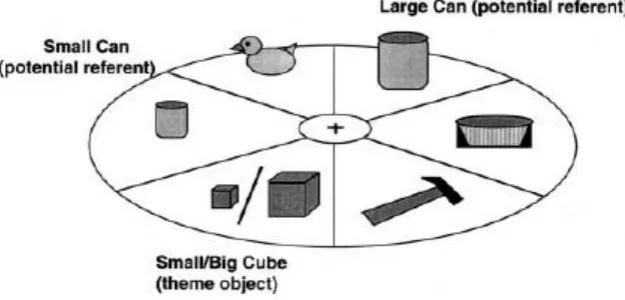
can. The visual display accompanying these instructions (Figure 1) contained a cube, two cans of different sizes, one other container object and two unrelated non-containers. Additionally, the cube was either small so that it could fit into either of the cans (two-compatible referent condition), or large so that it could fit only into the larger can (one-compatible referent condition). The linguistic manipulation (the definiteness of the nominal phrase (NP) referring to the target) was crossed with object affordances (the number of potential target referents). The results showed that participants indeed utilised in real time the information signalled by articles to anticipate the forthcoming referent, in that their looks toward the target diverged faster from other possible referents when the information signalled by the article matched the object affordances than when it mismatched it. Specifically, on hearing inside the can, where the definite NP signals that the referent is uniquely identifiable, participants resolved reference sooner when there was a single pragmatically appropriate target in the display (large cube fitting only the larger can) than when there were two (small cube fitting both cans). At the same time on hearing inside a can, where the indefinite NP can implicate non-uniqueness, reference resolution was facilitated when there were two objects compatible with the instruction compared to when there was only one compatible object in the display. These findings clearly demonstrate that while non-linguistic information such as object affordances can be exploited early to predict which entity will be referred to, in
Figure 1. Experimental display from Chambers et al. (2002), Experiment 2.
In sum, psycholinguistic research has shown that articles are not the be all and end all in determining the reference of a noun phrase, but it has also demonstrated that for native speakers of English they do constrain the set of candidates considered as a potential referent. The question we asked in the present study was whether speakers of English as a second language, particularly when they come from L1s without articles, are also able to utilise potentially informative articles to circumscribe referential domains in real time. Specifically, do L2 speakers from article-lacking L1 backgrounds rely on lexical and pragmatic
information and ignore articles due to the “automatically learned inattention” (Ellis, 2006, p.178), as the overshadowing and blocking account (Luk & Shirai, 2009) and the Shallow Structure Hypothesis (Clahsen & Felser, 2006) would predict? Or could these
morphosyntactic cues be processed efficiently by both native and non-native speakers, as long as the learners’ L1 does not have a different morphosyntactic realisation of this feature,
as the Competition Model (MacWhinney, 2005) would predict?
non-linguistic information in the context (e.g. lexical information, object affordances) along the same lines described for English above (cf. Chen, 2004; Luk & Shirai, 2009). As in the studies described above, the online use of pragmatic, lexical and morphosyntactic
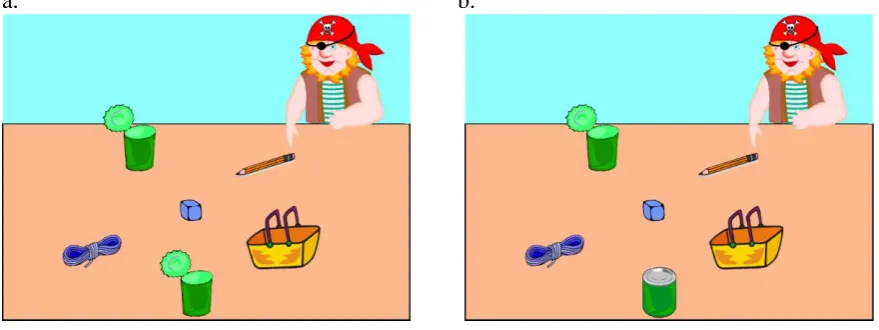
information was investigated using the visual world paradigm which allows studying real time language processing in a relatively naturalistic setting. The sentential stimuli from Experiment 2 in Chambers et al. (2002) were adapted to Clipart-based scenarios instead of real objects (Figure 2). We recorded participants’ eye movements while they viewed visual displays and simultaneously listened to sentences related to the scenes ((4), (5)). The sentential stimuli manipulated the definiteness status of the target NP, while the visual displays manipulated pragmatic affordances in the scene.
(4) The pirate will put the cube inside the can. (5) The pirate will put the cube inside a can.
The manipulation of pragmatic affordances was similar to Chambers et al. (2002) in that in the two-compatible referent condition (Figure 2a) the cube could fit both cans, whereas in the one-compatible referent condition (Figure 2b) it could fit only one of them. This
manipulation was achieved by varying the properties of the container (one closed and one open, or both open) rather than the size of the cube. If non-native speakers are able to make use of L2 articles in real time due to the lack of competition from a similar morphosyntactic feature in their L1, we would expect to replicate the original findings from Chambers et al. (2002). In other words, we would expect looks toward the target to start to diverge from looks towards the competitor faster in the linguistically and pragmatically matched conditions (the
+ one-compatible referent condition; a + two-compatible referent condition) than in
condition). If, however, non-native speakers from the article-lacking L1 overrely on
pragmatic affordances and cannot successfully process articles in real time, we might expect that they would resolve reference faster when there is only one available referent in the scene (Figure 2b) than when a choice between two referents needs to be made (Figure 2a),
irrespective of the definiteness status of the target NP.
a. b.
[image:15.595.71.511.245.410.2]
Figure 2. Example visual stimuli for the two-compatible-referent condition (a), and the one-compatible-referent condition (b).
With its ability to measure fine-grained time course of on-line comprehension, the visual world paradigm has been crucial in resolving theoretical debates related to lexical access in a second language (e.g. Chambers & Cooke, 2009; Kaushanskaya & Marian, 2007; Marian & Spivey, 2003; Marian, Spivey & Hirsch, 2003; Spivey & Marian, 1999; Weber & Cutler, 2004). While this paradigm has the potential to do the same for debates in L2
visual-world study that focuses on English as a second language, and which uses this paradigm to explore how second language users utilise both grammatical (articles) and pragmatic (object affordances) information in online language comprehension.
Method
Participants
Fifty seven L1 Mandarin / L2 English speakers and 59 native English speakers, students at the University of York, were recruited through posted notices. Data from four L2 participants were removed because their accuracy scores in the eye-tracking experiment were low (below 60%). Data from another five L2 participants and from three L1 participants were also removed to maintain a full counterbalancing of the stimuli; these participants had the lowest accuracy scores in their respective groups / lists. Data analyses were conducted on the remaining 48 L2 participant and 56 L1 participants.
We recruited Mandarin speakers of intermediate proficiency in English (IELTS score of at least 6, which is necessary to gain entry for a study at a UK university), as this
however, in non-immersion settings; there was no correlation between the age of first
exposure and the proficiency score in our sample (r = .04, p > .05). Most L2 participants were newly arrived international students, with the median length of stay in an English-speaking country of 2 months; 8 participants, however, reported being in the country for more than a year (range: 4 days to 5 years). There was no correlation between the length of stay and the proficiency score (r = .05, p > .05).
Participants received course credit or were remunerated for their time.
Materials
Visual materials consisted of Clipart-based pictures such as Figure 2. Each picture consisted of a human agent, and six objects arranged in a roughly circular display, with one object in the centre, and five objects on the periphery. On critical trials, three objects were containers (e.g. the cans and the basket in Figure 2), and three were non-containers (cube, pencil, rope). Of the three non-container objects, the object in the centre of the scene was the theme object of the description (cube; see below for the description of auditory stimuli). The two other non-container objects were not related to the description in any way. Of the three container objects, two were the potential goal referents (e.g. the two cans). The third container object was of a different type and served as distractor to reduce the likelihood of participants expecting that they should make a decision between the pair of identical containers. The relative positions of the two potential goal referents and the distractor were counterbalanced. The potential goal referents were separated by at least one object on one side and two on the other side.
goal referents (Figure 2a). In the one-compatible-referent condition (Figure 2b), the two container objects of the same name differed in that one of them was depicted as closed (e.g. the can above) or full, so that in the context of the description it could not serve as the goal referent. The pictures were 800 x 600 pixels in size.
There were 24 experimental descriptions in total, 12 in each definiteness condition. All experimental items were of the form “The [agent] will put the [theme] inside the/a [goal]” (e.g. for Figure 2: The pirate will put the cube inside the/a can). The sentences were digitally recorded by a native speaker of British English (GTMA) in a sound attenuated booth,
sampling at 44.1 KHz. All visual and sentential stimuli are provided in the Appendices. The definiteness of the noun phrase (the/a can) was crossed with the object
affordances in the scene (one vs. two potential goal referents), resulting in four experimental conditions. Four lists of trials were constructed, each containing 12 experimental trials, 3 in each condition (two-referent, indefinite; two-referent, definite; referent, indefinite; one-referent, definite). Participants were randomly assigned to a list. Thus each participant was presented with three items in each of the four conditions, but they never saw the experimental pictures in more than one experimental condition. Across the four lists each picture was presented with each definiteness condition.
condition, 6 from the two-referent condition), so that all pictures, both filler and experimental ones, appeared twice in the experiment. The filler sentences with experimental pictures used the preposition beside and none referred to the theme or goal referents of the experimental sentence. For example, for Figure 2a the filler sentence was The pirate will put the basket beside the rope. Filler trials were randomly intermixed with the experimental trials.
Procedure
L2 speakers were tested in two sessions: in Session 1, participants completed two computer-based tasks: the Quick Placement Test (2001) measuring English language proficiency, and a language background questionnaire. In Session 2 participants completed the eye-tracking experiment. Native speakers were tested in one session when they completed the eye-tracking experiment. All participants signed a consent form and were tested
individually in a quiet room.
For the eye-tracking experiment, participants were seated in front of a 22-inch display monitor, with their eyes approximately 60 cm away from the monitor. They wore an EyeLink II head-mounted eye-tracker, sampling at 250 Hz. The auditory stimuli were presented via two loudspeakers located at each side of the display screen.
Participants were told that they would see some pictures and hear the descriptions about what is going to happen in the picture. Using an example item which was similar to the items presented in the experiment (but not presented during the experiment), they were
screen until the mouse- click (or for 2000 ms post sentence offset, if there was no click). A 9-point calibration procedure was performed after every 6 trials to ensure the accuracy of measurements3. There were 4 practice trials before the main experimental block. There was a short break after 30 trials. The entire session lasted approximately 45 minutes.
Data analysis
Trials on which participants did not click on one of the objects on the screen were excluded from the analyses. This excluded 0.5% and 2% of the total number of experimental trials for L1 and L2 speakers respectively.
We included only the correct trials in the analyses of eye movements. In the one-compatible-referent condition this included trials where participants clicked on the goal container, whereas in the two-referent condition this included trials where participants clicked on either of the goal containers. The container on which the participant clicked was labelled as the target, and the second container (possible goal referent) as the competitor. One item was excluded from all analyses due to low accuracy levels in both native and non-native speakers, which was caused by the poor rendering of the competitor container in the one-referent condition (item 10 in Appendix B).
movements that could have plausibly been launched on the basis of the information contained in the determiners and the following speech were included in the analyses.
Results
Accuracy
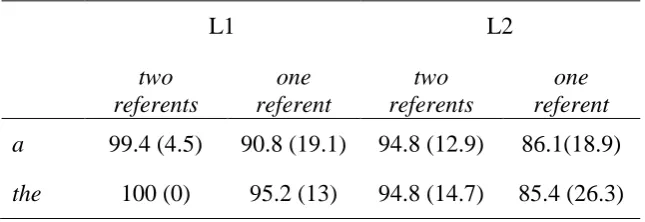
[image:21.595.137.460.583.694.2]Overall, both native and non-native speakers found the task easy. The average accuracy (percentage of mouse clicks on the goal referent) across all four conditions for native speakers was 96%, and for non-native speakers 90%, a reliable difference (F1(1, 102) = 16.08, p < .001; F2(1, 10) = 7.17, p < .02). Both groups of participants were more accurate in the two-compatible referent condition than in the one-compatible referent condition as shown in Table 1 (F1(1, 102) = 28.79, p < .001; F2(1, 10) = 23.90, p = .001). There were no other main effects or interactions.
Table 1. Accuracy rates (percentage of mouse clicks on the target referent) for native (L1) and non-native (L2) speakers, across two types of visual displays and two definiteness
conditions.
L1 L2
two referents
one referent
two referents
one referent
a 99.4 (4.5) 90.8 (19.1) 94.8 (12.9) 86.1(18.9)
Eye-movement analyses
For each experimental condition, cumulative proportions of looks to objects in the scene were calculated, across 25ms windows from the onset of the target noun (e.g. can). In the one-compatible-referent condition, the container that could serve as the goal referent (e.g. the open can in Figure 2b) was labelled as the target, and the container of the same name which pragmatically could not serve as the goal referent (the closed can) as the competitor. In the two-compatible-referent condition (Figure 2a), whichever of the two potential goal referents the participant clicked on was labelled as the target, and the other as the competitor.
The analyses sought to determine the earliest point in time at which the proportion of looks to the target becomes reliably greater than looks to the competitor. Within-subject analyses of variance (ANOVAs) were conducted separately for each condition to determine this point. We used planned contrasts whereby the difference was considered reliable if it was statistically significant in three consecutive time windows (cf. Chambers et al., 2002).
Arcsine transformed cumulative proportions of looks to the target and the competitor across the trials were used as the dependent variable. The graphs represent the raw, untransformed proportions for ease of exposition. The full vertical line marks the noun offset, and the
intermittent vertical line indicates the earliest point at which looks to the target diverged from looks to the competitor.
Native Speakers
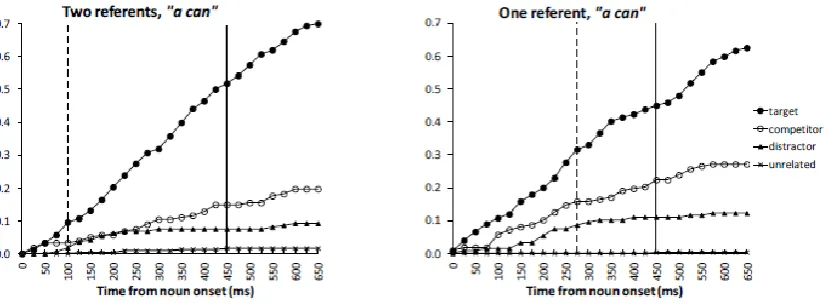
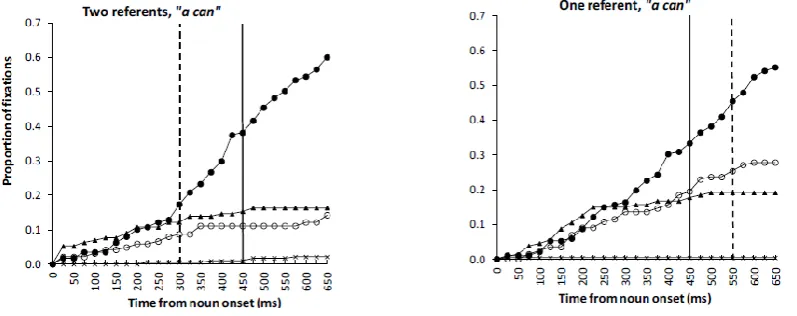
reference resolution (earlier divergence between looks to the target and the competitor) when the linguistic and the pragmatic contexts matched. With an indefinite noun phrase,
participants were faster to resolve referential ambiguity when there were two possible
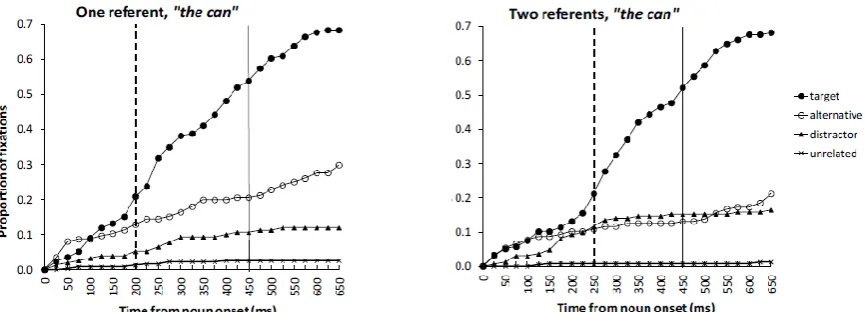
[image:23.595.96.510.382.536.2]referents in the display (Figure 3): fixations to the target diverged from the competitor within 100ms after the onset of the noun in the two-referent condition (Figure 3, left panel), and at 275ms in the one-referent condition (Figure 3, right panel). Similarly with the definite noun phrase, native speakers were faster in resolving referential ambiguity when the pragmatic and linguistic context matched: fixations to the target referent in the one-referent condition diverged from the competitor earlier (at 200ms post-noun onset, Figure 4, left panel) than in the two-referent condition (at 250ms post-noun onset, Figure 4, right panel).
Figure 4. Native speakers: Cumulative proportion of fixations in the definite noun phrase condition ((..)put the cube inside the can): one-referent display (left panel), and two-referent display (right panel), synchronised to the noun onset. The dotted line represents the first point in time when the looks to the target referent are significantly larger than the looks to the alternative. The full line represents the average noun offset.
These findings were confirmed by within-subjects ANOVAs with object (target goal referent vs. competitor) and time window (25ms intervals from noun onset until 650 ms post-noun onset) as independent variables, and arcsine transformed cumulative proportion of fixations across trials as the dependent variable, performed separately for the different pragmatic and linguistic contexts.
two-referent condition (F1(1, 55) = 6.77, p < .05, F2(1, 10) = 7.36, p < .05), whereas in the one-referent condition there was a delay, with the difference emerging at 275ms post noun onset (F1(1,55) = 5.28, p < .05; F2(1, 10) = 3.02, p > .05; the item analysis was significant only at 550ms post noun onset: F2(1,10) = 5.46, p < .05). Conversely, with a definite NP, the
[image:25.595.44.564.474.628.2]difference between fixations to the target goal referent and the competitor emerged earlier, at 200ms post noun onset, in the one-referent condition (F1(1, 55) = 4.61, p < .05; F2(1,10) = 12.36, p < .05 at 200ms, but also F2(1,10) = 5.41, p < .05 from 125ms, suggesting a really fast resolution), and only at 250ms post-noun onset in the two-referent condition (F1(1,55) = 7.72, p < .05; F2(1,10) = 21.20, p < .05).
Table 2. Native speakers: F and p values for the main effects of time period (25ms intervals from noun onset until 650ms post noun onset), and object (target goal referent vs.
competitor), and their interaction. (Greenhouse-Gisser correction was used when the
sphericity assumption was violated.)
Time Object Time x Object
two-referents, a can F1(3.51, 192.97)=109.38, p<.001
F2(25,250)=131.89, p<.001
F1(1,55)=50.12, p<.001
F2(1,10)=78.77, p<.001
F1(4.45, 244.77)=38.64, p<.001
F2(25,250)=16.78, p<.001
one-referent, a can F1(3.69, 202.95)=91.19, p<.001
F2(25,250)=82.65, p<.001
F1(1,55)=17.97, p<.001
F2(1,10)=35.95, p<.001
F1(2.94, 161.51)=8.79, p<.001
F2(25,250)=2.48, p<.001
two-referents, the can F1(25,1375)=97.37, p<.001
F2(25,250)=51.78, p<.001
F1(1,55)=41.21, p<.001
F2(1,10)=22.64, p<.01
F1(25,1375)=52.03, p<.001
F2(25,250)=35.67, p<.001
one-referent, the can F1(3.08, 169.45)=94.32, p<.001
F2(25,250)=145.83, p<.001
F1(1,55)=28.03, p<.001;
F2(1,10)=18.31, p<.001
F1(3.46, 190.53)=23.46, p<.001
F2(25,250)=10.81, p<.001
Second language learners
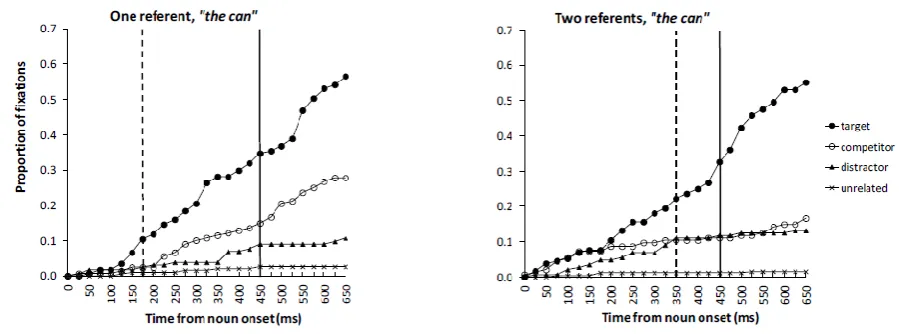
Similar to native speakers, second language learners were faster to resolve referential ambiguity when the linguistic and the pragmatic context matched. With the indefinite noun phrase and two compatible goal referents in the display, second language learners’ looks to the target referent started diverging from the competitor 300ms post noun onset, whereas with one compatible referent they only diverged at 550ms post noun onset (Figure 5). Conversely, in the definite noun phrase condition the looks to the target referent diverged from the
[image:26.595.113.512.374.532.2]competitor sooner with only one compatible goal referent in the display (at 175ms post noun onset) than with two compatible referents (at 350ms post noun onset, Figure 6).
Figure 6. Second-language learners: Cumulative proportion of fixations in the definite noun phrase condition ((..)put the cube inside the can): one-referent display (left panel), and two-referent display (right panel), synchronised to the noun onset. The dotted line represents the first point in time when the looks to the target referent are significantly larger than the looks to the competitor. The full line represents the average noun offset.
These findings were confirmed by within-subjects ANOVAs with object and time window as independent variables, and arcsine transformed cumulative proportion of fixations as the dependent variable.4
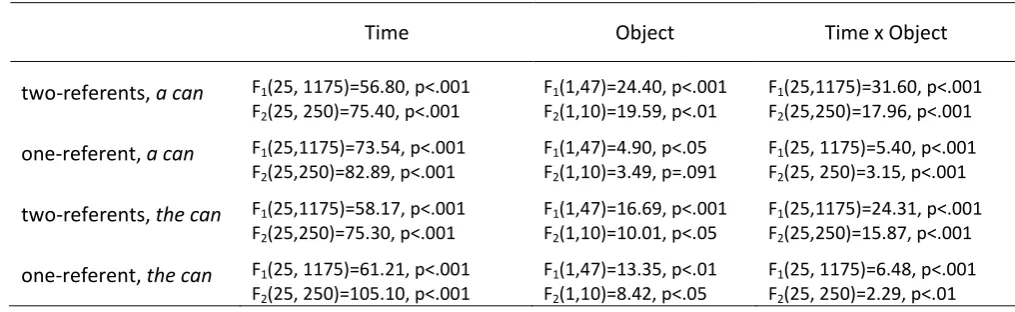
In all conditions there was a main effect of time with overall proportion of fixations increasing as the noun unfolded (see Table 3 for F and p values). There was also a main effect of object with overall more fixations to the target goal referent than the competitor (Table 3). As with native speakers, this was characterized by the object by time interaction. Planned contrasts in the indefinite NP, two-referent condition, indicated that the difference in looks between the two objects started to emerge starting from 300ms post noun onset
indicated that the looks to the two objects diverged starting from 175ms post noun onset with one compatible referent in the display (F1(1,47) = 6.69, p< .05; F2(1,10) = 11.09, p < .05), whereas only starting from 350ms post noun onset with two compatible referents in the display (F1(1,47) = 5.66, p < .05; marginally significant by items: F2(1,10) = 4.47, p = .061).
Table 3. Second language learners: F and p values for the main effects of time period (25ms intervals from noun onset until 650 ms post noun onset), and object (target goal referent vs.
competitor), and their interaction.
Time Object Time x Object
two-referents, a can F1(25, 1175)=56.80, p<.001
F2(25, 250)=75.40, p<.001
F1(1,47)=24.40, p<.001
F2(1,10)=19.59, p<.01
F1(25,1175)=31.60, p<.001
F2(25,250)=17.96, p<.001
one-referent, a can F1(25,1175)=73.54, p<.001
F2(25,250)=82.89, p<.001
F1(1,47)=4.90, p<.05
F2(1,10)=3.49, p=.091
F1(25, 1175)=5.40, p<.001
F2(25, 250)=3.15, p<.001
two-referents, the can F1(25,1175)=58.17, p<.001
F2(25,250)=75.30, p<.001
F1(1,47)=16.69, p<.001
F2(1,10)=10.01, p<.05
F1(25,1175)=24.31, p<.001
F2(25,250)=15.87, p<.001
one-referent, the can F1(25, 1175)=61.21, p<.001
F2(25, 250)=105.10, p<.001
F1(1,47)=13.35, p<.01
F2(1,10)=8.42, p<.05
F1(25, 1175)=6.48, p<.001
[image:28.595.41.549.316.472.2]F2(25, 250)=2.29, p<.01
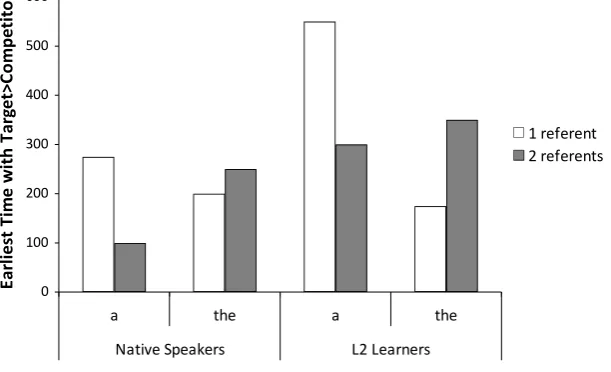
Figure 7. The earliest point of divergence of looks to the target and the competitor referents across experimental conditions.
Discussion
Morphosyntax vs pragmatic affordancesin L2 processing
This research set out to investigate whether in L2 processing, a morpho-syntactic structure unique to the target language, known to cause considerable difficulties in production, can nevertheless be utilised in real time to aid sentence comprehension. We employed the visual world eye-tracking paradigm to specifically explore whether L1 Mandarin / L2 English speakers have the ability to make use of English articles in reference resolution, or whether they predominantly rely on pragmatic affordances (what is possible in the context),
effectively ignoring the information signalled by the articles.
The results indicate that, just like native speakers of English, intermediate Mandarin-speaking learners of English do not over-rely on pragmatic considerations in reference resolution in English. The task in hand – and the nature of referential processing more generally – was such that participants could have successfully completed it relying solely on
0 100 200 300 400
a the a the
Native Speakers L2 Learners
the available lexical information and object affordances: in the one-compatible referent condition, there was ever only one possible outcome (only the open can could accommodate the cube); in the two-compatible referent condition, two solutions were equally plausible and a choice had to be made. If participants were over-relying on object affordances, we might have expected reference resolution always to be faster when there was only one compatible referent in the scene, compared to when a choice had to be made between two compatible referents. Instead, we found that the linguistic information signalled by the articles and pragmatic affordances (the number of compatible referents) interacted: with the definite noun phrase, both groups of participants indeed resolved reference sooner when there was only one compatible referent in the scene (only one can open); critically, however, with the indefinite noun phrase, reference was resolved sooner when there were two compatible referents in the scene (two open cans).
These results have important implications for models of L2 processing. They add to a growing body of evidence suggesting that at least some structures unique to the target
language can be processed in a targetlike way. The participants in our study didn’t ignore English articles in comprehension, as would be predicted by the overshadowing and blocking account (Ellis, 2006; Luk & Shirai, 2009), nor did they over-rely on pragmatic affordances, as the Shallow Structure Hypothesis (Clahsen & Felser, 2006) would predict. Instead, they appeared sensitive to the information signalled by the articles, in line with the Competition Model (MacWhinney, 1987; 2003) which predicts that morphosyntactic cues can be processed efficiently by non-native speakers, as long as their first language does not have a different morphosyntactic realisation of the same grammatical category. Crucially, while targetlike processing of unique-to-L2 structures has been previously observed in self-paced reading tasks and on ERP measures typically using grammatical violations, here we
paradigm matches much more closely situated language use and as such it shows that L2 users can actively integrate morpho-syntactic information unique to the L2 in real time to facilitate grammatical sentence processing.
Incremental sentence processing in the L2
The results of our study also provide converging evidence for incremental processing in reference resolution (e.g. Altmann & Kamide, 1999; Chambers et al., 2002; Eberhard et al., 1995), and demonstrate that like L1 speakers, L2 users also utilise a variety of information, linguistic and non-linguistic, as it becomes available to resolve reference at the earliest opportunity. For example, by the time they have encountered the nominal following the preposition inside, both groups in our study looked only at the container objects in the scene, paying minimal attention to the non-container objects. Furthermore, in the definite NP
noun; on hearing a, they expected there to be more than one object of the same name present.5
While L2 speakers appear able to engage in incremental processing, and furthermore utilise morpho-syntactic cues unique to the L2, this is not to say that there is no cost to L2 processing. Non-native speakers are generally slower than native speakers in on-line sentence processing, as demonstrated across a variety of tasks and linguistic structures (e.g. Hahne & Friederici, 2001; Lew-Williams & Fernald, 2010; Sanders & Neville, 2003). In our study this is evident by the typically later point at which the looks towards the target diverge from the competitor compared to native speakers, and generally fewer and slower looks to all objects in the scene. Yet, slower processing did not prevent the L2 speakers from resolving reference with greater efficiency when the article matched the pragmatic affordances in the context. This suggests that slower processing per se does not inevitably lead to the inability to employ L2 morphosyntactic cues incrementally in sentence comprehension.
Interestingly, native speakers resolved reference the fastest when the indefinite article was used in the two-compatible referent condition (a can with two cans open), whereas L2 speakers were the fastest when the definite article was used in the one-compatible referent condition (the can with one open can) (Figure 7). One possibility is that L2 users find the
easier to process than a because of its more consistent interpretation in discourse (signalling a uniquely identifiable referent in the context, vs. multiple readings of the indefinite article – see section on English article in referential expressions above). Consistency in form-meaning mapping has been shown to be one of the factors impacting the ease with which grammatical morphemes are learned (Goldschneider & DeKeyser, 2001). The more efficient processing of
Comprehension vs production
Previous research has demonstrated that second language speakers from L1s without articles often show persistent variability in L2 article production. Chinese learners of English are a population on which this issue has often been illustrated (e.g. Díez-Bedmar & Papp, 2008; Han, 2009; Lardiere, 2004; Lu, 2001; Robertson, 2000; Trenkic, 2008). Our current findings, however, suggest that such learners may nevertheless be sensitive to the information signalled by articles in real time comprehension. In addition, while variability in production has been reported even with very advanced learners, the sensitivity to articles in
comprehension is here detected with late bilinguals of only an intermediate level of English proficiency. These findings are in line with the literature that developmentally production often lags behind comprehension (e.g. Gaer, 1969 for L1 development; Swain, 1985 for L2 development). In future studies it would be interesting to examine how early in their
development second language learners become capable of utilising articles in comprehension. In sum, the outcome of our study suggests that whatever problems intermediate (and advanced) Mandarin speakers of English experience in article production, these are unlikely to be directly associated with inappropriate processing strategies in comprehension. We outline here a novel proposal that reconciles the two sets of findings, illustrating how the same grammatical representations may lead to different behavioural outcomes in production and in comprehension.
Our results indicate that through their exposure to English, Mandarin learners can establish the requisite form-meaning connections for English articles the and a. Specifically, they show evidence of understanding that the “the + NP” construction in English maps onto a referent that exists and is unique in a context, whereas the “a + NP” sequence maps onto a
with no elements from the L1 competing with the L2 articles, ensure that articles are processed in a targetlike manner in comprehension.
The lack of competition in comprehension, however, does not in itself rule out
competition in production. Unlike comprehension, production involves making choices about which lexical items, structures, etc. to use to express a message (e.g. Bock & Levelt, 1994), and bilinguals’ experience with two languages makes such choices even more complex.
Extensive evidence suggests that two language systems in a bilingual are active and compete for selection. This has been predominantly demonstrated in research on lexical access (e.g. Abutalebi & Green, 2007; Green, 1998; Hermans, Bongaerts, de Bot & Schreuder, 1998; Kaushanskaya & Marian, 2007; Kroll, Bobb & Wodniecka, 2006; Kroll, Sumutka & Schwartz, 2005; Kroll & Stewart, 1994; Spivey & Marian, 1999), but we make here an important further suggestion that the competition occurs at the structural level as well.
At the level of grammatical encoding of a referent, Mandarin speakers’ experience
with L2 English may activate the “Art + NP” structures to refer to countable concepts. But the much longer experience with their article-lacking L1 is likely to favour the selection of bare NP forms. For example, in wishing to refer to a single can (e.g. Can you pass me the can, please?), both the L1-licensed can, and the L2-licensed the can (and a can) will be
competing for selection (Figure 8). The model accounts straightforwardly for cases of article omissions (they are the cases where the L1-licensed bare nominal gets selected). Furthermore, the problems in choosing an appropriate article for the context (substituting the for a and vice versa) may also be an indirect consequence of the cross-linguistic competition. The knock-on effect that the competition from the L1 has on the speed of processing and the available resources may adversely affect the bilinguals’ ability to integrate syntactic and pragmatic
In sum, we propose that persistent variability in L2 production may be related to the structural competition from the L1 (cf. Trenkic, 2009; Trenkic & Pongpairoj, 2013). This is in line with constraint satisfaction models in (L1) sentence comprehension and production (e.g. Haskell & MacDonald, 2003), which also explain variability in responses as a
consequence of competition.
conceptual level (sense)
lemma level 罐; can
structural level NP; Art + NP
phonological level (English only)
[image:35.595.111.352.251.491.2]“can”; “the can”; “a can” CAN
Figure 8. Competition between L1-licensed and L2-licensed structures in bilingual referential production.
“the can”
“can”
can exists unique
can exists unique
no problems in comprehension
[image:36.595.79.463.87.184.2]Little sensitivity to article absence in comprehension
Figure 9. Predictions for L2 reference resolution arising from the structural competition model.
While we do not have data to speak to this prediction, it seems consistent with the findings indicating the lack of sensitivity to grammatical violations of some unique-to-L2 structures, such as plural marking (Jiang, 2004; 2007) and third person singular -s in English (Ojima et al., 2005). For example, as our model would predict, the results of Jiang (2007) suggest that Chinese learners of L2 English, who do not mark plural on nouns in their first language, may, in the appropriate context, map singular nouns in English (e.g. coin) to conceptually plural representations, failing to detect the violation (e.g. *The visitor took several of the rare coin in the cabinet). Further research is needed, using methodologies appropriate for detecting on-line sensitivity to structural violations (e.g. ERPs) to establish whether the prediction of the structural competition model regarding L2 referential resolution described above also holds true.
successfully established. What remains to be established is whether the sensitivity of L2 learners to structural violations involving such structures (e.g. absence of articles) can also be developed. Our model predicts that L2 users’ grammar may indeed be non-targetlike in that respect.
Similar to the Processing Deficit Approach (e.g. Prevost & White, 2000), our model assumes that production errors are the outcome of processing difficulties in production, but unlike it, we do not suggest that these are entirely L2-generic and uninfluenced by the learners’ L1. Consistent with the view that language systems within a bilingual mind cannot
be kept fully apart, we argue that persistent problems in production are best explained by grammatical competition between L1 and L2 structures. While both accounts could in
principle explain L2 production, the prediction regarding L2 comprehension arising from our model is that L2 users would be insensitive to structural violations in the L2 which are compatible with their L1 (e.g. bare NPs referring to countable objects). The Processing Deficit approach which assumes fully targetlike knowledge does not predict such insensitivity in comprehension.
References
Abutalebi, J., & Green, D.W. (2007). Bilingual language production: The neurocognition of language representation and control. Journal of Neurolinguistics,20 (3), 242–275. Altmann, G.T.M, & Kamide, Y. (1999). Incremental interpretation at verbs: Restricting the
domain of subsequent reference. Cognition, 73 (3), 247–264.
Bates, E. & MacWhinney, B. (1989). Functionalism and the Competition Model. In B.
MacWhinney & E. Bates (Eds.), The cross-linguistic study of sentence processing (pp. 3-73. Cambridge: Cambridge University Press.
Bock, K., & Levelt, W. J. M. (1994). Language production: Grammatical encoding. In M.A. Gernsbacher (ed.), Handbook of Psycholinguistics, pp. 945-984. London: Academic Press.
Brown, R. (1973). A first language. Cambridge, MA: Harvard University Press.
Chambers, C.G. & Cooke, H. (2009). Lexical competition during second-language listening: sentence context, but not proficiency, constrains interference from the native lexicon.
Journal of Experimental Psychology: Learning, Memory and Cognition, 35 (4), 1029-1040.
Chambers, C.G., Tanenhaus, M.K., Eberhard, K.M., Filip, H., & Carslon, G.N. (2002).
Circumscribing referential domains during real-time language comprehension. Journal of Memory and Language, 47 (1), 30–49.
Chen, L., Shu, H., Liu, Y., Zhao, J. & Li, P. (2007). ERP signatures of subject-verb agreement in L2 learning. Bilingualism: Language and Cognition, 10 (2), 161–174.
Chen, P. (2004). Identifiability and definiteness in Chinese. Linguistics, 42 (6), 1129–1184. Clahsen, H., & Felser, C. (2006). How native-like is non-native language processing? Trends in
DeKeyser, R.M. (2005). What makes learning second-language grammar difficult? A review of issues. Language Learning, 55 (S1), 1–25.
Díez-Bedmar, M., & Papp, S. (2008). The use of the English article system by Chinese and Spanish learners. In G. Gilquin, S. Papp & M. Díez-Bedmar (eds.), Linking up Contrastive and Learner Corpus Research, pp. 147-176. Amsterdam: Rodopi. Dulay, H. C., & Burt, M. K. (1974). Natural sequences in child second language acquisition.
Language Learning, 24 (1), 37–53.
Dussias, P.E. (2010) Uses of eye-tracking data in second language sentence processing research. Annual Review of Applied Linguistics, 30, 149-166.
Eberhard, K.M., Spivey-Knowlton, M.J., Sedivy, J., & Tanenhaus, M.K. (1995). Eye
movements as a window into real-time spoken language processing in natural contexts.
Journal of Psycholinguistic Research, 24 (6), 409-436.
Ellert, M. (2011). Ambiguous pronoun resolution in L1 and L2 German and Dutch. Unpublished PhD Thesis, Radbound University Nijmegen.
Ellis, N.C. (2006). Selective attention and transfer phenomena in L2 acquisition: Contingency, cue competition, salience, interference, overshadowing, blocking, and perceptual learning. Applied Linguistics, 27 (2), 164–194.
Frenck-Mestre, C. (2004). Grammatical gender agreement in French for article-noun agreement in native and non-native speakers: Evidence from ERPs. Presented at the Cognitive Neuroscience Society conference, San Francisco.
Gaer. E.P. (1969). Children’s understanding and production of sentences. Journal of Verbal
Learning and Verbal Behavior, 8 (2), 289-294.
García Mayo, M. P., & Hawkins, R. (eds.). (2009). Second language acquisition of articles: Empirical findings and theoretical implications. Amsterdam: John Benjamins. Goad, H., & White, L. (2004). Ultimate attainment of L2 inflections: Effects of L1 prosodic
structure. In S. Foster-Cohen, M. Ota, M.A. Sharwood Smith & A. Sorace, A. (eds.),
EUROSLA Yearbook Vol. 4, pp. 119–145. Amsterdam: John Benjamins. Goldschneider, J.M., & DeKeyser, R.M. (2001). Explaining the “natural order of L2
morpheme acquisition” in English: A meta-analysis of multiple determinants.
Language Learning, 51 (1), 1-50.
Green, D. (1998). Mental control of the bilingual lexico-semantic system. Bilingualism: Language and Cognition,1 (2), 67–81.
Grüter, T., Lew-Williams, C., & Fernald, A. (2012) Grammatical gender in L2: A production or a real-time processing problem? Second Language Research 28 (2), 191-215. Hahne, A. & Friederici, A.D. (2001). Processing a second language: Late learners’
comprehension mechanisms as revealed by event-related brain potentials.
Bilingualism: Language and Cognition, 4 (2), 123–141.
Han, Z. (2009). Grammatical morpheme inadequacy as a function of linguistic relativity. A longitudinal case study. In Z. Han & T. Cadierno (eds.) Linguistic relativity in second language acquisition, pp.154–182. Clevedon: Multilingual Matters.
Haskell, T.R., & MacDonald, M.C. (2003). Conflicting cues and competition in subject-verb agreement. Journal of Memory and Language, 48 (4), 760–778.
Hawkins, J.A. (1991). On (in)definite articles: implicatures and (un)grammaticaility predictions. Journal of Linguistics,27 (2), 405–42.
Hawkins, R., & Chan, C.Y.-H. (1997). The partial availability of Universal Grammar in second language acquisition: The ‘failed functional features hypothesis’. Second
Language Research, 13 (3), 187–226.
van Hell, J.G., & Tokowicz, N. (2010). Event-related brain potentials and second language learning: Syntactic processing in late L2 learners at different L2 proficiency levels.
Second Language Research, 26 (1), 43-74.
Hermans, D., Bongaerts, T., de Bot, K., & Schreuder, R. (1998). Producing words in a foreign language: Can speakers prevent interference from their first language?
Bilingualism: Language and Cognition,1 (3), 213–229.
Hopp, H. (2012). The on-line integration of inflection in L2 processing: Predictive processing of German gender. In A.K. Biller, E.Y. Chung & A.E. Kimball (Eds.) Proceedings of the 36th Boston University conference on language development (pp. 226-245). Somerville, MA.: Cascadilla Press.
Huebner, T. (1983). A longitudinal analysis of the acquisition of English. Michigan: Karoma. Ionin, T., Ko, H., & Wexler, K. (2004). Article semantics in L2 acquisition: The role of
specificity. Language Acquisition, 12 (1), 3–70.
Jackson, C.N. (2007). The use and non-use of semantic information, word order, and case marking during comprehension by L2 learners of German. Modern Language Journal, 91 (3), 418–432.
Jackson, C.N., & Dussias, P.E. (2008). Cross-linguistic differences and their impact on L2 sentence processing. Bilingualism: Language and Cognition, 12 (1), 65–82.
Jarvis, S. (2002). Topic continuity in L2 English article use. Studies in Second Language Acquisition, 24 (3), 387–418.
Jiang, N. (2007). Selective integration of linguistic knowledge in adult second language acquisition. Language Learning, 57 (1), 1–33.
Johnson, J.S. & Newport, E.L. (1989). Critical period effects in second language learning: The influence of maturational state on the acquisition of English as a second language.
Cognitive Psychology, 21 (1), 60–99.
Kamide, Y., Altmann, G.T.M., & Haywood, S.L. (2003). Prediction and thematic information in incremental sentence processing: Evidence from anticipatory eye movements.
Journal of Memory and Language,49 (1), 133–156.
Kaushanskaya, M., & Marian, V. (2007). Bilingual language processing and interference in bilinguals: Evidence from eye tracking and picture naming. Language Learning, 57
(1),119–163.
Kroll, J.F., Bobb, S.C., & Wodniecka, Z. (2006). Language selectivity is the exception, not the rule: Arguments against a fixed locus of language selection in bilingual speech.
Bilingualism: Language and Cognition, 9 (2), 119–135.
Kroll, J.F., & Dussias, P. (2004). The comprehension of words and sentences in two languages. In T.K. Bhatia & W.C. Ritchie (eds.), The handbook of bilingualism, pp.169-200. Oxford: Blackwell.
Kroll, J.F., Sumutka, B. M., & Schwartz, A. I. (2005). A cognitive view of the bilingual lexicon: Reading and speaking words in two languages. The International Journal of Bilingualism, 9 (1), 27–48.
Kroll, J.F., & Stewart, E. (1994). Category interference in translation and picture naming: Evidence for asymmetric connections between bilingual memory representations.
Lardiere, D. (1998). Dissociating syntax from morphology in a divergent L2A end-state grammar. Second Language Research,14 (4), 359–375.
Lardiere, D. (2004). Knowledge of definiteness despite variable article omission in SLA. In E. A. Brugos, L. Micciulla & CE Smith (eds.), Proceedings of the 28th Boston University Conference on Language Development (BUCLD 28), pp.328–229. Somerville MA: Cascadilla Press.
Larsen-Freeman, D. E. (1975). The acquisition of grammatical morphemes by adult ESL students. TESOL Quarterly, 9 (4), 409–419.
Lew-Williams, C., & Fernald, A. (2010). Real-time processing of gender-marked articles by native and non-native Spanish speakers. Journal of Memory and Language, 63 (4), 447-464.
Lu, C.F.-C. (2001). The acquisition of English articles by Chinese learners. Second Language Studies, 20 (1), 43-78.
Luk, Z.P., & Shirai, Y. (2009). Is the acquisition order of grammatical morphemes impervious to L1 knowledge? Evidence from the acquisition of plural –s, articles and possessive ‘s.
Language Learning, 59 (4), 721–754.
Lyons, C.G. (1999). Definiteness. Cambridge: Cambridge University Press. Lyons, J. (1977). Semantics: 2. Cambridge: Cambridge University Press.
MacWhinney, B. (1987). The competition model. In B. MacWhinney (ed.), Mechanisms of language acquisition, pp.249-308. Mahwah, NJ. Erlbaum.
MacWhinney, B. (2005). A unified model of language acquisition. In J. Kroll & A.M.B. de Groot (eds.), Handbook of bilingualism: Psycholinguistic approaches, pp.49-67. Oxford: Oxford University Press.
Marian, V., & Spivey, M. (2003). Bilingual and monolingual processing of competing lexical items. Applied Psycholinguistics, 24 (2), 173-193.
Marian, V., Spivey, M., & Hirsch, J. (2002). Shared and separate systems in bilingual
language processing: Converging evidence from eyetracking and brain imaging. Brain and Language, 86 (1), 70-82.
Master, P. (1990). Teaching English articles as a binary system. TESOL Quarterly, 24 (3), 461– 478.
Matin, E., Shao, K. & Boff, K. (1993). Saccadic overhead: information processing time with and without saccades. Perception & Psychophysics, 53 (4), 372-380.
Morgan-Short, K., Sanz, C., Steinhauer, K., & Ullman, M.T. (2010). Second language acquisition of gender agreement in explicit and implicit training conditions: An event-related potential study. Language Learning, 60 (1), 154–193.
Muñoz, C. (2008). Symmetries and asymmetries of age effects in naturalistic and instructed L2 learning. Applied Linguistics, 29 (4), 578-596.
Odlin, T. (1989). Language transfer: Cross-linguistic influences in language learning. Cambridge: Cambridge University Press.
Ojima, S., Nakata, H. & Kakigi, R. (2005). An ERP study of second language learning after childhood. Effects of Proficiency. Journal of Cognitive Neuroscience, 17 (8), 1212–1228.
Perani, D., Paulesu, E., Galles, N.S., Dupoux, E., Dehaene, S., Bettinardi, V., Cappa, S.F., Fazio, F. & Mehler, J. (1998). The bilingual brain: Proficiency and age of acquisition of the second language. Brain, 121 (10), 1841-1852.
Quick Placement Test (2001). CD ROM Pack. Oxford: Oxford University Press.
Ringbom, H. (1987). The role of the first language in foreign language learning. Clevedon, UK: Multilingual Matters.
Roberts, L. (2012). Review article: Psycholinguistic techniques and resources in second language acquisition research. Second Language Research, 28 (1), 113-127.
Roberts, L., Gullberg, M., & Indefrey, P. (2008). Online pronoun resolution in L2 discourse: L1 influence and general learner effects. Studies in Second Language Acquisition,30
(3), 333–357.
Robertson, D. (2000). Variability in the use of the English article system by Chinese learners of English. Second Language Research,16 (2), 135–72.
Sabourin, L. (2003). Grammatical gender and second language processing: An ERP study. Ph.D. dissertation, Rijksuniversiteit Groningen.
Sabourin, L., Stowe, L.A. & de Haan, G. J. (2006). Transfer effects in learning an L2 grammatical gender system. Second Language Research. 22 (1), 1-29.
Sanders, L.D., & Neville, H.J. (2003). An ERP study of continuous speech processing II. Segmentation, semantics, and syntax in non-native speakers. Cognitive Brain Research, 15 (3), 215–227.
Sanders, L.D., Neville, H.J., & Woldorff, M.G. (2002). Speech segmentation by native speakers: the use of lexical, syntactic, and stress-pattern cues. Journal of Speech, Language and Hearing Research, 45 (3), 519–530.
Scherag, A., Demuth, L., Rösler, F., Neville, H.J., & Röder, B. (2004). The effects of late acquisition of L2 and the consequences of immigration on L1 for semantic and morpho-syntactic language aspects. Cognition, 93 (3), B97–B108.
Sharwood Smith, M.A. (1980). Strategies, language transfer and the simulations of learners’
Spivey, M., & Marian, V. (1999). Crosstalk between native and second languages: Partial
activation of an irrelevant lexicon. Psychological Science, 10 (3), 281-284.
Steinhauer, K., White, E.J., & Drury, J.E. (2009). Temporal dynamics of late second
language acquisition: Evidence from event-related brain potentials. Second Language Research, 25 (1), 13–41.
Su, I-R. (2001a). Transfer of sentence processing strategies: A comparison of L2 learners of Chinese and English. Applied Psycholinguistics,22 (1), 83-112.
Su, I-R. (2001b). Context effects on sentence processing: A study based on the Competition Model. Applied Psycholinguistics, 22 (2), 167-189.
Swain, M. K. (1985). Communicative competence: Some roles of comprehensible input and comprehensible output in its development. In S. M. Gass & C.G. Madden (Eds.),
Input in second language acquisition (pp.236-244). Rowley, MA: Newbury House. Tarone, E. (1985). Variability in interlanguage use: a study of style-shifting in morphology
and syntax. Language Learning, 35 (3), 373–404.
Thomas, M. (1989). The acquisition of English articles by first and second language learners.
Applied Psycholinguistics, 10 (3), 335–355.
Tokowicz, N., & MacWhinney (2005). Implicit and explicit measures of sensitivity to violations in second language grammar. An event-related potential investigation.
Studies in Second Language Acquisition, 27 (2), 173–204.