R E S E A R C H A R T I C L E
Open Access
Zero adjusted models with applications to
analysing helminths count data
Michael G Chipeta
1*, Bagrey M Ngwira
2, Christopher Simoonga
3and Lawrence N Kazembe
4Abstract
Background: It is common in public health and epidemiology that the outcome of interest is counts of events occurrence. Analysing these data using classical linear models is mostly inappropriate, even after transformation of outcome variables due to overdispersion. Zero-adjusted mixture count models such as zero-inflated and hurdle count models are applied to count data when over-dispersion and excess zeros exist. Main objective of the current paper is to apply such models to analyse risk factors associated with human helminths (S. haematobium) particularly in a case where there’s a high proportion of zero counts.
Methods: The data were collected during a community-based randomised control trial assessing the impact of mass drug administration (MDA) with praziquantel in Malawi, and a school-based cross sectional epidemiology survey in Zambia. Count data models including traditional (Poisson and negative binomial) models, zero modified models (zero inflated Poisson and zero inflated negative binomial) and hurdle models (Poisson logit hurdle and negative binomial logit hurdle) were fitted and compared.
Results: Using Akaike information criteria (AIC), the negative binomial logit hurdle (NBLH) and zero inflated negative binomial (ZINB) showed best performance in both datasets. With regards to zero count capturing, these models performed better than other models.
Conclusion: This paper showed that zero modified NBLH and ZINB models are more appropriate methods for the analysis of data with excess zeros. The choice between the hurdle and zero-inflated models should be based on the aim and endpoints of the study.
Keywords: Excess zeros, Zero–inflated, Two–part model, Count data, Statistical methods, Hurdle, Negative binomial
Background
It is common in public health and epidemiology that the outcome of interest is counts of occurrence of events. In human helminth disease research, such as hookworms or Schistosoma haematobiumstudies, the outcome of inter-est includes number of egg counts in a urine or stool of a human sample. Such count data are typically very skewed and exhibit many zero count observations [1]. It is well known that analysing these data using classical linear models is mostly inappropriate, even after transformation of outcome variables [1-3].
*Correspondence: [email protected]
1Malawi Liverpool – Wellcome Trust Clinical Research Programme, PO Box 30096, Blantyre, Malawi
Full list of author information is available at the end of the article
The natural choice for count data analysis is the Poisson regression [4,5]. However, the underlying Poisson distri-bution has several limitations that are often neglected, including lack of allowance for over-dispersion [4,5]. One frequent manifestation of lack of allowance for over-dispersion is that the incidence of zero counts is greater than expected for the Poisson distribution. The excess zeros can occur as a result of clustering. Therefore, it is worthwhile to consider the mechanism by which over-dispersion occurs and use more flexible models such as the heterogeneous Poisson models and zero-modified models. The most commonly used heterogeneous Poisson distribution is the negative binomial [2,6,7] which loosens Poisson restrictions by allowing the expected number of events to be a function of some unobserved random variable that follows a gamma distribution [8]. Alterna-tively, to overcome this violation we extend the Poisson
model to have an over-dispersion parameter, through a hierarchical model that introduces a gamma prior on the mean parameter [5].
One could also use zero-adjusted mixture models such as zero-inflated (ZI) and hurdle count models [8,9] which are applied to count data when over-dispersion exists and excess zeros are indicated [5,6,10,11]. ZI models include zero inflated Poisson (ZIP) [12] and zero inflated negative binomial (ZINB), whereas hurdle models include Poisson logit hurdle (PLH) and negative binomial logit hurdle (NBLH) [5]. The PLH is also known as zero altered Poisson (ZAP). The PLH and NBLH can be consid-ered as mixture models in which the complete distribution of the outcome is represented by two separate compo-nents, a first part modelling the probability of excess zeros and a second part accounting for the non-excess zeros and non-zero counts [13], thus estimating two equations. In contrast to ZI models, the zero and non-zero counts are separated in hurdle models. More specifically, in both zero-modified models, a logit model with binomial assumption is used to determine which of the two pro-cesses generates an observation [2]. A further extension to hurdle models is developed in [14], in which the pro-cesses generating zeros and positives are not constrained to be the same, and that hurdles may not be restric-tively be at zero. The NB regression models have been widely used to analyse human helminths infection inten-sity data [15,16], but recently, there is more and more research that is analysing human helminth data using zero-modified models highlighted above. Be that as it may, these models offer a natural epidemiological interpreta-tion of disease infectivity and transmission intensity as we expand below. For instance, one may assume that a pro-portion of individuals have no chance of being infected, as they are not exposed. In other words, there is a pro-cess which determines whether an individual is likely to be infected at all (infection probability) and a sec-ond process determining the number of excreted eggs among those who are at risk of infection (infection inten-sity) [17]. ZIP models assume that number of excreted eggs follows a Poisson distribution. ZINB models assume that the number of eggs among those who are at risk of infection has a negative binomial distribution [11]. The hurdle model has an interpretation as a multiple-part model, the simplest being the two-part model; the first part as binary outcome model and the second part as a truncated count model. Such a partition permits the inter-pretation that positive observations arise from crossing a zero hurdle or zero threshold. In principle, the thresh-old need not be at zero; it could be any value. Further, it need not be treated as known. The zero value has special appeal, however, because in many situations it partitions the population into sub-populations in a mean-ingful way [13]. In contrast to the ZI model, zero and
non-zero counts are separated into hurdle models [1], a fact that makes them very useful in epidemiological studies.
The main objective of the research reported in this arti-cle is to apply zero-adjusted mixture count data models to analyse risk factors associated with human helminths (S. haematobium) particularly in a case where there is a high proportion of zero counts. Two actual data sets, one from Malawi and another from Zambia, with different lev-els of zero counts were used in the current analysis, and they corresponded to eggs (counts) excreted by an indi-vidual. Poisson, negative binomial, and two zero modified (ZI and hurdle) parameterisations for the Poisson and negative binomial distributions were fitted to both data sets and results were compared.
Methods
Count data models
Various statistical models have been developed to model S. haematobiumdisease burden. These are Poisson, neg-ative binomial (NB), ZI (Poisson and negneg-ative binomial), logit hurdle (Poisson and negative binomial). Below, a brief outline for each of the models mentioned above is given.
Poisson model
Poisson regression is traditionally conceived as the basic count model upon which a variety of other count models are based [5,18]. Poisson distribution is characterized as:
f(k;λ)=P(Y=k)= e −λλk
k! , k=0, 1, 2,. . .;λ >0 (1)
where random variablekis the count response and param-eter λ is the mean. Unlike most other distributions, Poisson does not have a distinct scale parameter.
Poisson regression model derives from Poisson distribu-tion and relatesλ,β, andxthrough:
log(λ)=xβ. (2)
Here,xβ is the linear predictor, which is also symbol-ized asηwithin the context of generalized linear models (GLM).
Negative binomial model
The NB model is employed as a distribution form that relaxes the equidispersion restriction of the Poisson model [19]. The NB distribution is given by:
P(Y=k)= (k+τ) k!(τ)
τ
τ+λ
τ λ
λ+τ k
k=0, 1, 2,. . .
(3)
where random variable Y has a NB distribution with parametersτ ≥0 andλ ≥ 0. Its mean and variance are given by:
E(Y)=τλ (4)
and
Var(Y)=τλ(1+λ)=E(Y)(1+λ) (5)
Sinceλ ≥ 0, the variance of NB distribution generally exceeds its mean (“over-dispersion”) [20]. It has since been proposed to model excessive variation in helminth egg counts [21]. NB regression models have been widely used to analyse helminths infection intensity data [7,15,16]. However, distributional problems affect both models (Poisson and NB) such as over-dispersion resulting from specification errors in the systematic part of the regression model, hence NB models themselves may be overdis-persed [5]. Nevertheless, both models can be extended to accommodate any extra correlation or dispersion in the data that result in a violation of distributional properties of each respective distribution. The enhanced Poisson or NB model can be regarded as a solution to a violation of distributional assumptions of the primary model (1). For a better fit, an overdispersed model that incorporates excess zeros should serve as an alternative [6]. Zero modified models such as ZI and hurdle count models are capable of incorporating excess zeros. They are applied to count data when over-dispersion exists and excess zeros are indicated [5,10].
Zero inflated poisson
In ZIP regression, the countsYi equal 0 with probability pi and follow a Poisson distribution with mean λi, with probability 1 -pi wherei = 0, 1, 2,. . ., n. ZIP model can
thus be seen as a mixture of two component distributions, a zero part and no-zero components, given by:
Pr(Yi=0)=pi+(1−pi)exp(−λi) (6)
Pr(Yi=k)=(1−pi)exp(−λi)λki/k! , k=1, 2, 3,. . . (7)
From Equation (6), zero observations arise from both zero-component distribution and Poisson distribution. The zero-component distribution is therefore related to modeling ‘excess’ or ‘inflated’ zeros that are observed in addition to zeros that are expected to be observed under the assumed Poisson distribution. To assess impact of covariates on the count distribution in a ZIP model,piand λican be explicitly expressed as a function of covariates. The most natural choice to model probability of excess zeros is to use a logistic regression model:
logit(pi)=xiβ (8)
where xi represents a vector of covariates andβ a vec-tor of parameters. The effect of covariates on count data excluding excess zeros can be modeled through Poisson regression:
log(λi)=ziγ (9)
Mean and variance of ZIP model are:
E(yi|xi,zi)=λi(1−pi) (10)
V(yi|xi,zi)=λi(1−pi)(1+λipi) (11)
Zero inflated negative binomial
The ZINB distribution is a mixture distribution assigning a mass ofpto ‘extra’ zeros and a mass of (1 -p) to a neg-ative binomial distribution, where 0 ≤ p≤1. The ZINB distribution is given by:
P(Y =k)=
⎧ ⎨ ⎩
p+(1−p) τ+τλ
τ
, k=0
(1−p)(τk!(τ)+k) τ+τλ
τ λ λ+τ
k
k=1, 2,. . .
(12)
The mean and variance of the ZINB distribution are:
E(Y)=(1−p)λ (13)
Var(Y)=(1−p)λ
1+pλ+ λ τ
(14)
Observe that this distribution approaches the zero inflated Poisson distribution and the negative binomial distribution asτ −→ ∞andp−→0, respectively. If both
1
Poisson distribution. The ZINB regression model relates pandλto covariates, that is,
log(λi)=xiβ (15)
and
logit(pi)=ziγ (16)
where i = 1, 2,. . .,n and xi and zi are d- and q-dimensional vectors of covariates pertaining to the ith subject, and withβ andγ the corresponding vectors of regression coefficients, respectively.
Poisson logit hurdle
PLH model is a two-component model comprising of a hurdle component models zero versus non-zero counts, and a truncated Poisson count component is employed for the non-zero counts:
Pr(Yi=0)=pi (17)
Pr(Yi =k)=(1−pi)
exp(−λi)(λi)k/K! 1−exp(−λi)
, k=1, 2, 3,. . ..
(18)
pi models all zeros. For PLH model, the most natural choice to model probability of zeros is to use a logistic regression model:
logit(pi)=xiβ (19)
while the effect of covariateszi on strictly positive (that is, censored) count data are modeled through Poisson regression:
log(λi)=ziγ (20)
Negative binomial logit hurdle
Similarly, for the hurdle models, the NBLH can be used instead of Poisson distribution above in case of over-dispersion:
Pr(Yi=0)=pi (21)
Pr(Yi=k)=(1−pi) ( k+τ) (k+1)(τ)
×(1+τλ)−(k+τ)τkλk 1−(1+τλ)τ
(22)
where k=1, 2, 3, ...
The most natural choice to model probability of excess zeros is to use a logistic regression model:
logit(pi)=xiβ (23)
Impact of covariates on count data modeled through NB regression:
log(λi)=xiγ (24)
Given π = Pr(Y > 0), the probability of a nonzero response withηas given in the follow up to Equation 2, the expected value and the corresponding variance are given by:
E(Y)=η= πλ
1−p(0;τ) (25)
Var(Y)=η(λ−η)+ πσ
2
1−p(0;τ) (26)
While both ZI and hurdle models need distributional assumptions for their count component, both classes dif-fer with respect to their dependencies of estimation of parameters of “zero” component on these assumptions [1]. Unlike ZI model, estimation of parameters β related to piin the hurdle model is not dependent on estimation of parameters γ related toλi. Hence, if assumptions about the (truncated) Poisson/negative binomial model are vio-lated (for example due to extreme outlying observations), the hurdle model will, in contrast to ZI model, still yield consistent estimators for parameters in the logit part of the model (if correctly specified) [1]. Much as the hur-dle model will be consistent in the absence of a good model for the non-zero counts, however, one of its weak-nesses is that it assumes all zeros to come from a single population.
Model comparison
For comparison of non-nested models based on maxi-mum likelihood, to choose the best fitting model, Akaike’s information criterion (AIC) has been proposed for model selection criteria based on the fitted log-likelihood func-tion [13,22,23]. As a measure of the relative goodness of fit of a statistical model, AIC not only rewards goodness of fit, but also includes a penalty that is an increasing func-tion of the number of estimated parameters. Since the log-likelihood is expected to increase as parameters are added to a model, the AIC criteria penalize models with largerq. This penalty function may also be a function ofn, the number of observations [13]. This penalty discourages over-fitting. The AIC is specified as:
AIC= −2 log(L)+2q (27)
in the residuals. A model with lowest AIC is preferred [22]. Several alternatives of AIC also exist, viz Bayesian information criteria (BIC) and Consistent Akaike’s infor-mation criterion (CAIC) [13]. AIC is optimal in selecting the model with the least mean squared error while BIC is not asymptotically optimal [24]. An AIC, CAIC or BIC difference of less than 4 indicates that the two competing models are indistinguishable, while a value difference of 4 to 10 suggests moderate superiority of one model against the other, and an AIC, CAIC or BIC difference of greater than 10 implies that for two competing models, one model is better than the other [23].
Applications
Case data
Two datasets were used as a case study in the analysis of count data on human helminths. The first data set came from a study carried out in 2004 in Chikwawa dis-trict, in the Lower Shire Valley-southern Malawi. The Chikwawa data were collected from a rural population mainly engaged in subsistence farming. The area lies between 100 and 300m above sea level. The rainy sea-son extends from December to March. Temperatures can rise up to 50°C in months preceding rainy season. The design and methods for data collection are described in [25,26].
Briefly, data were collected in eighteen (18) villages, purposively selected from the control and intervention arms of a cluster randomized study design. There was only one round of treatment following community based and house to house approaches for mass drug adminis-tration (MDA). Over 90 percent of the eligible population were treated. All infected participants in non-intervention arm received appropriate treatment. After the follow-up assessment, both arms had mass treatment. In the study, polyparasitism was considered basing on the num-ber of species an individual was hosting. The focus was on S.haematobium,S.mansoni, hookworm andAscaris. Poly-parasitism is the epidemiology of multiple species parasite infections [26]. Ten percent of the households were ran-domly selected from the villages for baseline survey using random number tables [25].
Subjects for geo-helminth survey were selected using a two stage-design. In short, at first stage villages were selected, then at second stage, sample of households was listed and chosen. In the selected households, all members aged one year and above were invited to participate. Con-senting individuals had their demographic details com-pleted and were given full body clinical examinations (except genitals for females) for chronic manifestations of human helminths. In addition they had anthropometric measurements taken and were asked to provide a single fresh stool and urine sample. All individuals (aged >1 year) were requested to provide a finger prick blood sample
[21]. All body samples were analyzed in the laboratory using Katz test to determine geohelminth infection and intensity. Further details are provided in [25].
The second data, was school-based, collected in a cross-sectional study that was carried out in Kafue and Luangwa Districts of Lusaka province, Zambia in 2004. The two districts were selected on the basis of their ecological rep-resentativeness of the country in general [27]. In each of these districts, ten (10) primary schools were selected. Approximately 100 schoolchildren, aged 6 to 15 years, were recruited from every school. The altitude and geo-graphical location (longitude, latitude) of the surveyed schools were obtained from the archives of the Zambian Survey Department (2003). Further details of the study design are given elsewhere in [27].
Data onS.haematobiumprevalence and intensity were obtained using a Quantitative Filtration technique [28] to process duplicate urine samples collected about mid-morning. Two laboratory technicians prepared and read specimen filters. Both technicians read each specimen independently. This was useful in increasing sensitivity of the technique, particularly where egg intensity was low. All pupils found infected were treated with prazi-quantel (40 mg/kg body weight). Individual data sheets were used to collect ancillary information on each child examined.
In addition, data on intermediate host snails were also obtained through field collections and laboratory-based species identification. Sampling of potential schis-tosomiasis transmission sites was done based on water body proximity to respective primary school, that is, the nearest likely infection source. These water points were also qualified by relevant local people as the most fre-quented water contact points for both domestic and/or livestock [27].
Statistical fitting for all models was carried out using Political Science Computational Laboratory (PSCL) pack-age [29] in R statistical software (The R Foundation for Statistical Computing, Version 2.14.0).
Ethical approval
parent/guardian if an individual was aged <16. Registers were kept for documentation whereby, for each individual in the selected household, a column was kept to indicate whether an individual had orally consented to participate in the study or not. Similarly, in the Zambia study, ethical approval for data collection on urinary Schistosomiasis in school children was received from University of Zambia Ethics Committee [27].
Results
S. haematobiumin Chikhwawa District, Malawi
[image:6.595.57.289.298.732.2]Table 1 gives summary statistics for study participants who had outcomes of interest. The study had 1642 par-ticipants of which 55.4% were female. The mean age
Table 1 Characteristics forS. Haematobiumparticipants
(N=1642) in Chikwawa, Malawi
Variable Mean (Std. Dev) Number (%)
Outcome
S. Haematobium 233 (19.35)
S. Mansoni 71 (5.02)
Hookworm 324 (22.9)
Age (years) 32.36 (22.79)
Sex
Female 909 (55.36)
Male 733 (44.64)
Education level
None 745 (45.37)
Primary 850 (51.77)
Secondary 47 (2.86)
Village type
Intervention 831 (50.61)
Control 811 (49.39)
Fishing
Yes 1,421 (86.54)
No 221 (13.46)
Garden
Yes 960 (58.47)
No 682 (41.53)
Occupation
Farmer 733 (44.64)
Other 909 (55.36)
Polyparasitism
None 807 (49.15)
One 594 (36.18)
Two 200 (12.18)
Three 38 (2.31)
Four 3 (0.18)
(years) of 32.4 (standard deviation: 22.8). Of these, 324 had hookworm representing 19.7% of sample popula-tion, 71 of these had S. mansoni representing 4.3% and 233 had S. haematobium representing a prevalence of 14.2%.
Figure 1 shows that a large proportion of individuals i.e. 85.8% forS. haematobiumwere “zero egg excretors”. The likelihood ratio test for over-dispersion between Poisson and Negative binomial at α = 0.05 showed a critical value test statistic=2.7 with aχ2test statistic=10606.5, p-value<0.001. Indeed, there was overwhelming evidence of overdispersion. This was confirmed by the presence of excess zeros (Figure 1).
Model comparison
[image:6.595.304.536.528.706.2]Using the AIC and zero capturing, the predicted counts using the ZINB and NBLH indicate a closer fit with the observed values. In Table 2, AIC results show that the ZINB and NBLH are similar and offer a better fit com-pared to using Poisson Logit Hurdle (PLH) or a negative binomial (AIC=3,482 for NBLH; AIC=3, 484 for ZINB whereas AIC =6,854 for PLH and AIC=3,576 for NB respectively). With regards to zero capturing, the Poisson model was again not appropriate as it could only capture 515 of the zeros whereas the zero adjusted based mod-els were much better in capturing the zero counts. The following models performed relatively similar: Negative Binomial, ZIP, ZINB, PLH with NBLH model capturing 971 zeros which were equal to the observed (Table 3). From these results, NB modified based models (NBLH and ZINB) offered the best fit to zero inflated helminth data in terms of the AIC (minimum value for all the models fitted) and are indistinguishable with respect to fit, AIC difference of less than 4 between the two (see Table 2). NBLH was used for fitting a final model to model
Table 2 Model comparison using Akaike Information Criterion (AIC) for Malawi study data
Poisson Neg. Bin. ZIP ZINB PLH NBLH
AIC 14,182 3, 576 6, 854 3, 484 6, 854 3, 482
helminth infection intensity and determination of factors that foster infections due to its ease of implementation and its direct link with the observed data. Besides, NBLH has an advantage over ZINB as it has the lowest AIC despite the difference of less than 4.
Modelling and interpreting main effects
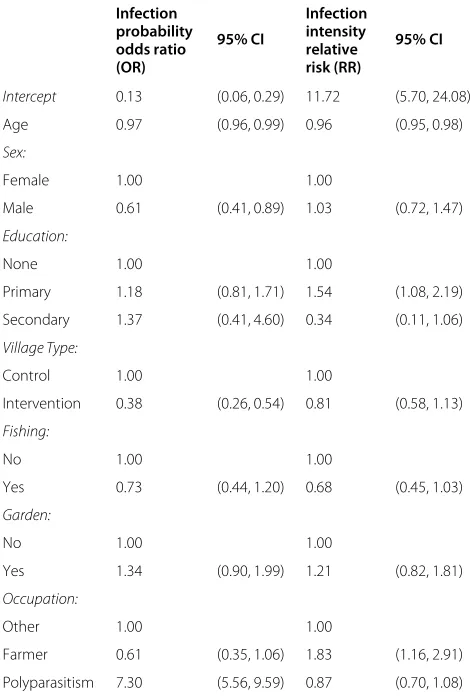
Fixed effects: infection probability Table 4 provides estimates for the fixed effects from the hurdle model, with significant factors at 5% significance level given in bold type. The probability of infection was found to be associated with age (Odds Ratio [OR]=0.97, 95% Con-fidence Interval [CI]: 0.96–0.99), the risk of infection decreased with age. The risk of infection was low in males than in females (OR= 0.61, 95% CI: 0.41–0.89). Infec-tion probability was also found to be associated with village type; whether one was in the intervention area or control area (OR = 0.38, 95% CI: 0.26–0.54). Those in the intervention area were at a reduced chance of infection relative to those in control area. We also noted that chances of infection were increasing with number of parasites an individual was hosting (OR=7.30, 95% CI: 5.56–9.59).
Fixed effects: Infection intensity From Table 4, it was observed that infection intensity reduced with an increase in age (Relative Risk (RR) = 0.96, 95% CI: 0.95–0.98). There was no difference in terms of infection inten-sity between males and females (RR = 1.03, 95% CI: 0.72–1.47). Primary school children showed a high infec-tion intensity relative to those that are in pre-school level (RR = 1.54, 95% CI: 1.08–2.19) whereas those in secondary level showed a reduced infection intensity (RR=0.34, 95% CI: 0.11–1.06) but not significant at 5% level. A positive association was also observed between those who did fishing in Shire river relative to those who did not fish (Table 4). We observed an increased risk of infection intensity farmers compared to non-farmers (RR=1.83, 9% CI: 1.16–2.91).
S. haematobiumin school children in Lusaka Province, Zambia
[image:7.595.58.293.112.140.2]Table 5 gives characteristics of study population. A total of 2040 school children aged 6 to 15 years were enrolled
Table 3 Zero count capturing in the Malawi study model
Observed Poisson Neg. Bin ZIP ZINB PLH NBLH
971 515 968 970 969 970 971
Table 4 Fixed effects estimates for NBLH model for S. Haematobiumin Malawi study
Infection probability odds ratio (OR)
95% CI
Infection intensity relative risk (RR)
95% CI
Intercept 0.13 (0.06, 0.29) 11.72 (5.70, 24.08)
Age 0.97 (0.96, 0.99) 0.96 (0.95, 0.98)
Sex:
Female 1.00 1.00
Male 0.61 (0.41, 0.89) 1.03 (0.72, 1.47)
Education:
None 1.00 1.00
Primary 1.18 (0.81, 1.71) 1.54 (1.08, 2.19)
Secondary 1.37 (0.41, 4.60) 0.34 (0.11, 1.06)
Village Type:
Control 1.00 1.00
Intervention 0.38 (0.26, 0.54) 0.81 (0.58, 1.13)
Fishing:
No 1.00 1.00
Yes 0.73 (0.44, 1.20) 0.68 (0.45, 1.03)
Garden:
No 1.00 1.00
Yes 1.34 (0.90, 1.99) 1.21 (0.82, 1.81)
Occupation:
Other 1.00 1.00
Farmer 0.61 (0.35, 1.06) 1.83 (1.16, 2.91)
Polyparasitism 7.30 (5.56, 9.59) 0.87 (0.70, 1.08)
into the study from 20 selected primary schools in the two districts, Kafue and Luangwa, 1909 (93.5%) pro-vided urine samples for parasitological examination. The remaining children 131 (6.5%) did not provide urine sam-ples for examination. OverallS. haematobiumprevalence rate for two districts was 9.6% (range: 0 – 36.1). Infec-tion intensity had a mean of 31.4 eggs/10 ml (range: 0 – 120 eggs/10 ml). However there was a significant difference in the mean intensity of infection, with 40.2 (range: 3 – 53.1 eggs/10 ml) observed in Kafue district and 22.6 (range: 0 – 116.0 eggs/10 ml) in Luangwa district. For Schistosomiasis, a large proportion of individuals were “non egg excretors” (84.6%).
[image:7.595.56.294.703.731.2]Table 5 Characteristics and intensity of infection withS. haematobiumin 2040 children from 20 schools in Lusaka Province, Zambia, 2004
Variable Mean (std. dev) Number (%)
Intensity of infection
No infection (0 eggs/ml: epm) 1726 (84.6)
Light infection (1-100 epm) 139 (6.8)
Mod/heavy infection (> 100 epm) 44 (2.2)
Age (years) 9.98 (2.14)
6-9 years 1130 (55.4)
10-15 years 900 (44.1)
Sex
Female 1027 (50.4)
Male 1000 (49.0)
Altitude
Plateau 723 (35.4)
Valley 1316 (64.5)
NDVI 138.2 (5.1)
TMAX 19.6 (2.9)
Snail abundance (B. globosus) 25.3 (29.9)
vegetation index (NDVI) (t = 1280.47, p-value <0.001) showed a significant impact on urinary Schistosomiasis. Again, Tmax (t=282.26) and snail abundance (t=30.82) both with p-values<0.001 also showed significant impact on urinary Schistosomiasis.
Model comparison
[image:8.595.57.291.123.362.2]Using the AIC and zero capturing, AIC results show that the NBLH and ZINB offer a better fit compared to using Poisson Logit Hurdle (PLH) or a negative binomial (AIC = 3,230 for NBLH and 3,232 for ZINB; whereas AIC =14,8734 for PLH and AIC=3,250 for NB respec-tively), see Table 6. With regards to zero capturing, the Poisson model was again not appropriate as it could only capture 183 of the zeros whereas the zero adjusted mod-els were much better in capturing the zero counts. The NBLH, ZINB, PLH and ZIP models captured 1705 zeros which were equal to the observed (Table 7). Since NB modified based models (NBLH and ZINB) offered the best fit to zero inflated helminth data in terms of the AIC (minimum value for all the models fitted), NBLH there-fore was used for fitting a final model to model helminth
Table 6 Model comparison using Akaike Information Criterion (AIC) for Zambia study data
Poisson Neg. Bin. ZIP ZINB PLH NBLH
[image:8.595.304.539.492.731.2]AIC 351,690 3,250 148,734 3,232 148, 734 3,230
Table 7 Zero count capturing in Zambia study model
Observed Poisson Neg. Bin ZIP ZINB PLH NBLH
1705 183 1704 1705 1705 1705 1705
infection intensity and determination of factors that foster infections.
Modelling and interpreting main effects
Fixed effects: Infection probability From Table 8, sig-nificant factors at 5% significance level are given in bold type. The probability of urinary Schistosomiasis infec-tion was shown to have a significant associainfec-tion with age (OR=0.69, 95% CI: 0.50–0.94) with lower risk in younger children. Infection probability showed a positive associ-ation with sex (OR = 1.17, 95% CI: 0.86–1.60) though not significantly different between females and males. We observed a negative association between infection prob-ability and altitude (OR=0.37, 95% CI: 0.25–0.53) with those in the valley at an increased risk of infection. Max-imum temperature (TMAX) showed an association with probability of infection though not significant at 5% level (OR = 0.99, 95% CI: 0.94–1.04). We also observed a positive relationship between snail abundance and risk of infection, (OR = 1.01, 95% CI: 1.00–1.01). Marginal positive association was observed between urinary Schis-tosomiasis and NDVI (the mean Dec–Nov biannual com-posites of NDVI) (OR=1.04, 95% CI: 1.00–1.07).
Table 8 Probability and intensity of infection withS.
haematobiumin 2040 children from 20 schools in Lusaka Province, Zambia, 2004
Infection probability odds ratio (OR)
95% CI
Infection intensity relative risk (RR)
95% CI
Intercept 0.01 (0.00, 0.65) 13.03
Age:
10-15 years 1.00 1.00
6-9 years 0.69 (0.50, 0.94) 0.55 (0.25, 1.19)
Gender:
Female 1.00 1.00
Male 1.17 (0.86, 1.60) 1.28 (0.57, 2.87)
Altitude:
Plateau 1.00 1.00
Valley 0.37 (0.25, 0.53) 0.11 (0.04, 0.28)
TMAX 0.99 (0.94, 1.04) 0.84 (0.75, 0.94)
NDVI 1.04 (1.00, 1.07) 1.07 (0.99, 1.16)
[image:8.595.55.293.702.732.2]Fixed effects: infection intensity From Table 8, we observed that infection intensity was marginally asso-ciated with age (RR = 0.55, 95% CI: 0.25–1.19). It was observed that temperature was negatively asso-ciated with urinary Schistosomiasis intensity (RR = 0.75, 95% CI: 0.75–0.94), as well as altitude (RR= 0.11, 95% CI: 0.04–0.28). Snail abundance was marginally asso-ciated with infection intensity (RR=1.00, 95% CI: 0.99– 1.01). We also observed a positive association between infection intensity and NDVI (mean Dec-Nov biannual composites of NDVI) (RR=1.07, 95% CI: 0.99–1.16) as well as gender (RR=1.28, 95% CI: 0.57–2.87) albeit both not significant at 5% level.
Discussion
This paper considered several count data models to quan-tify factors associated with prevalence and intensity of S. haematobium infection using two different datasets inflated with zeros. Factors considered include such as age, sex, education level, village type, fishing in rivers, working in gardens, occupation and polyparasitism. All the models considered modelled intensity by using the actual egg counts as the response. An alternative approach to modelling intensity of infection is derived by catego-rizing egg-counts into groups of no infection, light and moderate/high infection based on egg counts in the urine samples. The competing models were compared to each other in terms of AIC, estimated regression coefficients and zero count capturing.
Results from model comparison and selection showed that NB modified based models (NBLH and ZINB) are better for modeling excess zeros as they competed well in terms of both AIC as well as zero count capturing. Our results illustrate, for the observed data, that the ZINB and NBH models are preferred but these models are indis-tinguishable with respect to fit. Choosing between the zero-inflated and hurdle modeling framework, assuming Poisson and NB models are inadequate because of excess zeros, should generally be based on the study design and purpose [1]. If the study’s purpose is inference then mod-eling framework should be considered. For example, if the study design leads to count endpoints with both structural and sample zeros then generally the zero-inflated mod-eling framework is more appropriate, while in contrast, if the endpoint of interest, by design, only exhibits sam-ple zeros (e.g., at-risk participants) then the hurdle model framework is generally preferred. Conversely, if the study’s primary purpose it is to develop a prediction model then both the zero-inflated and hurdle modeling frameworks should be adequate.
Cameron and Trivedi [13] report that ZINB and NBLH are a reparameterization of each other for a binary predic-tor. Again, in practice, there is no or little difference in AIC between the NB hurdle model and zero-inflated NB model
[1]. However, it should be noted that NBLH which allows for over-dispersion and also accommodates presence of excess zeros, is more appropriate among all zero-adjusted models [9].
In the current paper, we only considered a single hur-dle on infection and non infection for the study sub-jects for the hurdle negative binomial model. It should be noted that these can be extended to multiple hur-dles [30] for the inclusion of measurement (i.e. kato-katz,quantitative filtration techniqueor other measures) error for instance, among other hurdles. The hurdle models can also be extended to capture spatial hetero-geneity by introducing covariates and random effects [31]. We are currently working on multiple hurdles extension models.
In general, common factors to influence S. haemato-biuminfection intensity and prevalence in both Malawi and Zambia studies. We found thatS. haematobium infec-tion intensity reduced with age, this confirms what previ-ous studies found. In common intestinal helminths such asAscaris lumbricoides(large roundworms) andTrichuris trichiura(whipworm) and also Schistosomiasis, children are more heavily affected and infected than adults [32]. Several other studies have reported that school-aged children show high infection intensity and prevalence [33-35]. Fishing in Shire river and working in gardens along the river were potential risk factors for exposure to Schistosomes and subsequent infection because trans-mission requires contact with the aquatic habitat of inter-mediate host snails [36]. This is in line with results from a study that was conducted in western Africa [37], that contact with water bodies that are a habitat for interme-diate host snails is one of the main risk factors. Results showed low probability of infection for males compared to females. This could be explained by a number of fac-tors including that Malawi being an agriculture based economy, and that mainly agricultural activities are car-ried out by females, hence they are more exposed to risk factors such as working in gardens and farming. Schistosomiasis is water dependent disease and the inci-dence is usually more amongst people who constantly get into contact with the schistosome infected waters through activities such as farming, fishing, swimming and washing [36].
for helminths to areas with diseases burden in order to reduce and/or eradicate the infections - more especially towards school age children. Studies have shown that having one infection, is a risk factor for having other infections [41]. It is conceivable that the first parasite that establishes an infection may modulate the immune response in such a way that it makes it easier for the next [25].
We believe that the apparent dominance of agricultural, socioeconomic and demographic factors in determiningS. haematobiuminfection risk in the villages carries impor-tant implications for disease surveillance and control strategies. Prevalence ofS. haematobiumwas associated with age of an individual as well as working in the garden and also number of parasites an individual hosted. Fur-thermore,S. haematobium infection intensity was asso-ciated with gender, education level, garden, occupation and village type (intervention). Cercariae control con-trol through environmental modifications and strategies involving socio-economic status improvement and MDA may be more promising approaches to disease control in this setting.
Conclusion
The research reported in this article showed that the zero modified negative binomial logit hurdle (NBLH) and zero inflated negative binomial (ZINB) models are more appro-priate methods for the analysis of data with an excess of zeros. These methods provide an alternative for analysing count data with more zeros than expected and eliminates the burden of data transformation to allow traditional methods of count data work. There are an increasing number of examples in the published literature where these “two-part” methods are being used for ZI data for helminths disease control planning and implementation programmes.
Ease of implementation and straightforward interpre-tation of the components and its direct link with the observed data used here, make the NBLH model par-ticularly a valuable alternative for researchers analysing zero-inflated count data. It represents a key advance in the analysis of helminth disease data inflated with zeros.
Competing interests
The authors declare that they have no competing interests.
Authors’ contributions
Conceived and designed the experiments: BMN and CS. Performed the experiments: BMN and CS. Contributed reagents/materials/analysis tools: MGC BMN CS LNK. Analyzed the data: MGC and LNK. Wrote the paper: MGC BMN CS LNK. All authors read and approved the final manuscript.
Acknowledgements
Data collection was supported by PhD studentships to: Dr. Bagrey M. Ngwira through the Lymphatic Filariasis support Centre at the Liverpool School of Tropical Medicine, UK and Dr. Chris Simoonga through Danish Bilharziasis
Laboratory (DBL) – Centre for Health Research and Development, University of Copenhagen, Denmark. Data analysis was supported by an MSc fellowship to Michael Chipeta through the Health Research Capacity Strengthening Initiative (HRCSI) funded by the Wellcome Trust and DFID. The first author is grateful to Dr Ngwira and Dr Simoonga for providing the data and to Prof. Lawrence Kazembe for guidance through the MSc training. The funders had no role in study design, data collection and analysis, decision to publish, or preparation of the manuscript.
Author details
1Malawi Liverpool – Wellcome Trust Clinical Research Programme, PO Box
30096, Blantyre, Malawi.2Community Health Department, University of Malawi, College of Medicine, P/Bag 360, Blantyre, Malawi.3Ministry of Health, PO Box 30205, Lusaka, Zambia.4Department of Statistics and Population Studies, University of Namibia, Windhoek, Namibia.
Received: 5 September 2013 Accepted: 6 November 2014 Published: 27 November 2014
References
1. Loeys T, Moerkerke B, Smet O, Buysse A:The analysis of zero inflated count data: Beyond zero-inflated poisson regression.Br J Math Stat Psychol2011,65(1):163–180.
2. Gonzales-Barron U, Kerr M, Sheridan JJ, Butler F:Count data distributions and their zero-modified equivalents as a framework for modelling microbial data with a relatively high occurrence of zero counts.Int J Food Microbiol2010,136:268–277.
3. O’Hara RB, Kotze JD:Do not log-transform count data.Methods Ecol Evol2010,1:118–122.
4. Agresti A:Categorical Data Analysis. 2nd edn. New Jersey: Wiley -Interscience; 2002.
5. Hilbe JM:Negative Binomial Regression. USA: Cambridge University Press; 2011.
6. Famoye F, Singh KP:Zero-inflated generalized poisson regression model with an application to domestic violence data.J Data Sci2006, 4:117–130.
7. Ridout M, Demetrio CGB, Hinde J:Models for count data with many zeros.InProceedings of the XIX International Biometric Conference: Cape Town International Biometric Society; 1998:179–192.
8. Mullahy J:Specification and testing of some modified count data models.J Econometrics1986,33:341–365.
9. Gurmu S, Trivedi PK:Excess zeros in count models for recreational trips.J Bus Econ Stat1996,14(4):469–477.
10. Flynn M, Francis LA:More flexible glms zero-inflated models and hybrid models.Casualty Actuarial Soc2009,2009:148–224. 11. Vounatsou P, Raso G, Tanner M, N‘goran E, Utzinger J:Bayesian
geostatistical modelling for mapping schistosomiasis transmission. Parasitology2009,136:1695–1705.
12. Lambert D:Zero-inflated poisson regression with an application to defects in manufacturing.Technometrics1992,34:1–14.
13. Cameron C, Trivedi PK:Regression Analysis of Count Data. New York: Cambridge University Press; 1998.
14. Cragg JG:Some statistical models for limited dependent variables with application to the demand for durable goods.Econometrica 1971,39:829–844.
15. Utzinger J, Vounatsou P, N‘Goran EK, Tanner M, Booth M:Reduction in the prevalence and intensity of Hookworm infections after praziquantel treatment for Schistosomiasis infection.Int J Parasitol 2002,32:759–765.
16. Brooker S, Alexander N, Geiger S, Moyeed RA, Standerd J, Fleming F, Hotez PJ, Correa-Oliveira R, Bethony J:Contrasting patterns in the small-scale heterogeneity of human helminth infections in urban and rural environments in Brazil.Int J Parasitol2006, 36(10-11):1143–1151.
17. Chipeta MG:Analysis of zero altered and inflated data: Application to human helminths.InMaster’s thesis. Chancellor College, Zomba: University of Malawi; 2012.
18. Greene W:Functional form and heterogeneity in models for count data.Foundations Trends Econometrics2005,1(2):113–218.
20. Winkelmann R:Econometric Analysis of Count Data. 5th edn. Berlin Heidelberg: Springer; 2008.
21. Cohen JE:Mathematical models of Schistosomiasis.Annu Rev Ecol Syst 1977,8:209–233.
22. Akaike H:Information theory and an extension of the maximum likelihood principle.InSecond International Symposium on Information Theory. Edited by Petrov BN, Csaki F. Budapest: Akademiai Kiado; 1973:267–281.
23. Pan W:Akaike’s information criterion in generalized estimating equations.Biometrics2001,57(1):120–125.
24. Burnham KP, Anderson DR:Multimodel inference: understanding AIC and BIC in model selection.Soc Methods Res2004,33:261–304. 25. Ngwira B:The epidemiology and control of lymphatic filariasis and
intestinal helminths in the lower shire valley-Chikwawa district southern Malawi.2005.PhD thesisLiverpool: University of Liverpool. 26. Chipeta MG, Ngwira B, Kazembe LN:Analysis of Schistosomiasis
haematobium infection prevalence and intensity in Chikhwawa, Malawi: an application of a two part model.PLoS Neglected Tropical Dis 2013,7(3):2131.
27. Simoonga C, Kazembe LN, Kristensen TK, Olsen A, Appleton CC, Mubita P, Mubila L:The epidemiology and small-scale spatial heterogeneity of urinary schistosomiasis in Lusaka province, Zambia.Geospatial Health 2008,3(1):57–67.
28. Mott KE:Schistosomiasis: new goal. Geneva, Switzerland: Technical report, World Health Organization; 1984.
29. Jackman S:pscl: Classes and methods for r developed in the political science com-putational laboratory, stanford university. Stanford, California: Department of Political Science, Stanford University; 2008. R package version 0.95; http://CRAN.R-project.org/package=pscl.
30. Carlevaro F, Croisasant Y, Hoareau S:Multiple Hurdle Tobit Models in R : The mhurdle Package.2009.
31. Neelon B, Ghosh P, Loebs PF:A spatial poisson hurdle model for exploring geographic variation in emergency department visits.J R Stat Soc Series A, (Statistics in Society)2013,176(2):389–413.
32. Chan MS, Bradley M, Bundy DAP:Transmission patterns and the epidemiology of Hookworm infection.Int J Epidemiol1997, 26(6):1392–1400.
33. Bowie C, Purcell B, Shaba B, Makaula P, Perez M:A national survey of the prevalence of Schistosomiasis and soil transmitted helminths in Malawi.BMC Infect Dis2004,4(49):49.
34. Saathoff E, Olsen A, Magnussen P, Kvalsvig JD, Becker W, Appleton CC: Patterns of Schistosoma Haematobium infection, impact of praziquantel treatment and re-infection after treatment in a cohort of school children from rural KwaZulu-Natal/South Africa.BMC Infect Dis2004,4:40.
35. Midzi N, Mtapuri-Zinyowera S, Mapingure MP, Paul NH, Sangweme D, Hlerema G, Mutsaka MJ, Tongogara F, Makware G, Chadukura V, Brouwer KC, Mutapi F, Kumar N, Mduluza T:Knowledge attitudes and practices of grade three primary school children in relation to
Schistosomiasis, soil transmitted helminthiasis and malaria in Zimbabwe.BMC Infect Dis2011,11(1):169.
36. Amhanyunonsen JA:Ecological correlates of schistosomiasis incidence and access to PHC delivery in Etsako East lga, Edo state, Nigeria.InColloque International; 2009:1–46. Niamey: Community of Practice EcoHealth for West and Central Africa.
37. Clements A, Firth S, Dembele R, Garba A, Toure S, Sacko M, Landouré A, Bosqué-Oliva E, Barnett AG, Brooker S, Fenwick A:Use of Bayesian geostatistical prediction to estimate local variations inSchistosoma haematobium, infection in Western Africa.Bull World Health Org2010, 87:921–929.
38. Kirwan P, Asaolu SO, Molloy SF, Abiona TC, Jackson AL, Holland CV: Patterns of soil-transmitted helminth infection and impact of four-monthly albendazole treatments in preschool children from semi-urban communities in Nigeria: a double-blind
placebo-controlled randomised trial.BMC Infect Dis2009,9:20. 39. Hodges MH, Dada N, Warmsley A, Paye J, Bangura MM, Nyorkor E, Sonnie
M, Zhang Y:Mass drug administration significantly reduces infection of Schistosoma mansoni and hookworm in school children in the national control program in Sierra Leone.BMC Infect Dis2012,12(1):16. 40. Roberts M, Buttterworth AE, Kiman G, Kamau T, Fulford AJC, Dunne DW,
Ouma JH, Sturrock RF:Immunity after treatment of human
schistosomiasis: association between cellular responses and resistance to reinfection.Infect Immunity1993,61(12):4984-4993. 41. Cassia R, Silva R, Barreto ML, Assis AMO, de Santana MLP, Parraga IM, Reis
MG, Blanton RE:The relative influence of polyparasitism, environment, and host factors on schistosome infection.Am J Trop Med Hyg2007,77(4):672–675.
doi:10.1186/1756-0500-7-856
Cite this article as:Chipetaet al.:Zero adjusted models with applications to analysing helminths count data.BMC Research Notes20147:856.
Submit your next manuscript to BioMed Central and take full advantage of:
• Convenient online submission
• Thorough peer review
• No space constraints or color figure charges
• Immediate publication on acceptance
• Inclusion in PubMed, CAS, Scopus and Google Scholar
• Research which is freely available for redistribution