Closing the gap: test
and learn
Technical annex B: provider perspectives
2
Contents
1 Intervention provider perspectives 3
1stClass@Number 3
Growth Mindsets 6
Numicon Intervention Programme 13
Research Lesson Study 18
Response to Intervention: breakthroughs in literacy (RTI) 26
3
1 Intervention provider perspectives
Reflecting the collaborative nature of the project, intervention providers were given the opportunity to contribute their own perspectives through an online survey report. These verbatim reports were taken into account in the overall conclusions of the programme, and in one case with regard to the conducting of additional analyses. The reports are
presented as they were supplied, with only minor house style, proofreading and privacy-related modifications.
1stClass@Number
Name of intervention provider: Every Child Counts
Qualitative questions
Please summarise whatever evidence you have that is related to the effect of
1stClass@Number on pupil attainment. This can include a wide range of sources and references.
Over 45,000 children in years 1 to 11 have been supported by 1stClass@Number in 3,500 schools.
They have made an average number age gain of 12 months in only 3.5 months – over three times the expected progress using the Sandwell early numeracy test.
Please summarise any evidence related to the use of 1stClass@Number on pupil motivation.
93 per cent of pupils showed more interest and confidence in learning mathematics in class after the intervention, according to surveys of the class teacher.
Describe the ways that you would expect 1stClass@Number to affect teacher learning and professional development.
Many teaching assistants reported that the professional development was extremely effective in increasing their confidence and improving their ability to support mathematics in lessons.
What is your view of the role of research more generally, including action research, and other qualitative research, in developing teaching and learning, and/or in school
leadership?
4 1stClass@Number
Has involvement in the RCT changed the ways that you approach decision-making in your organisation? If so, please describe what has happened.
No
What is your view of the value of randomised controlled trials in developing teaching and learning, and/or in school leadership and school improvement?
RCTs are very useful to bring external evaluation to the interventions. Use this box to tell us anything else you want to say.
Quantitative questions
Fidelity of treatment delivery
These questions ask you to evaluate the fidelity with which you think schools implemented the intervention in the trials. The data will be used to see if there is a relationship between delivery and attainment across the whole intervention group and are in no way judgmental of individual schools, nor will they be used in any way that is not anonymous.
To what extent do you think schools implemented 1stClass@Number consistently according to the recommendations of you, the intervention provider?
1 – Never 2 3 4 5 6 7 – Always
Comments: We do not have the information to answer this question.
To what extent do you think schools delivered 1stClass@Number regularly and according to the recommendations of you, the intervention provider?
1 – Never 2 3 4 5 6 7 – Always
Comments: We do not have the information to answer this question.
To what extent do you think schools implemented 1stClass@Number to the standard of practice that you think you, the intervention provider, would deliver it?
1 – Never 2 3 4 5 6 7 – Always
5 1stClass@Number
Treatment practicality questions
These questions will be used to assess if there is a relationship between the practicality of the intervention and attainment.
In terms of timetabling and staffing, how practical do you think it is for schools to integrate 1stClass@Number into their work?
1 – Not practical at all 2 3 4 5 6 7 – Completely practical Comments:
1stClass@Number has been developed in liaison with schools to ensure that it is
straightforward to implement. A senior teacher from each school is trained to manage its effective implementation.
In terms of ease of method and training of staff, how practical do you think it is for schools to integrate 1stClass@Number into their work?
1 – Not practical at all 2 3 4 5 6 7 – Completely practical Comments:
Detailed lesson plans are provided and the extensive training enables teaching
assistants to understand them and to develop the subject knowledge to adapt them to pupils’ needs.
In terms of classroom resources, how practical do you think it is for schools to integrate 1stClass@Number into their work?
1 – Not practical at all 2 3 4 5 6 7 – Completely practical Comments:
6 Growth Mindsets
Name of intervention provider: Growing Learners, University of Portsmouth
Qualitative questions
Please summarise whatever evidence you have that is related to the effect of Growth Mindsets on pupil attainment. This can include a wide range of sources and references. A common belief in our society is that people with high ability and self-belief in that ability are likely to embrace the challenges that they tackle in life with high levels of resilience, determination and thus success. However, it is not ability or belief in that ability that predicts resilience and perseverance in the face of challenge and failure (Dweck, 1999); rather it is the individual’s belief about the nature of ability (referred to as self-theory of intelligence also known as mindset).
Interventions related to ‘mindset’ have been rolled out widely in the USA and its
effectiveness is well-evidenced. It is based on implicit self-theories of intelligence, which identifies two types of intelligence belief, namely incremental (or growth mindset) and entity (or fixed mindset). Individuals with a growth mindset believe that they can develop their intelligence, while individuals with a fixed mindset believe that their intelligence is innate (i.e. I was born this way/this is what I am).
Importantly, having a growth mindset creates resilience to failure or difficulties in learning. A growth mindset sends a child positive messages about effort and strategy, leading pupils to try harder, or to try a different strategy for learning (rather than avoid the task in order to avoid damage to their self-esteem). In comparison, for children with a fixed mindset, failure will send a negative message about who they are. This will damage their self-esteem and is likely to lead them to avoid the same task in the future, disrupt it or give up trying at the earliest opportunity in order to avoid this impact to their self-esteem, often characterised by cognitions such as ‘if I don’t try then I can’t be seen to have failed because I’m not clever’.
7 Growth Mindsets
failure (Dweck, 1999; 2007).
These differences in learning orientation are reported to be due to the difference in
children’s meaning systems; failure has different meanings for fixed and growth theorists. For those with a growth mindset effort is seen as a necessity in order to achieve in life (Dweck, 1999). However, fixed theorists believe that high effort indicates low ability and are therefore fearful of being perceived in these terms, avoiding persistent effort, leading them to sabotage long term goals (Dweck, 1999). For those with a fixed mindset failure is attributed not to effort but to their own ability, thus failure is damaging to self-esteem. This is a negative state that can be evaded by avoidance of the task or avoidance of effort in the task if forced to confront it. Thus the individual protects themselves from future failures that can be attributed to their ability (by themselves or others).
Resilience to challenge and failure is a fundamental aspect of success. Licht and Dweck (1984) revealed that when students, with a helpless orientation, were confronted with a confusing passage of a task only 35.6 per cent of students mastered the task compared to 71.9 per cent of mastery orientated children. Diener and Dweck (1978) explored the differences between helpless children and mastery orientated children in fifth and sixth grade (UK years 5 and 6). This study was based on anagrams, the first eight anagrams were possible to solve but the next four anagrams were far too difficult for children of their age. As expected the helpless children attributed their failure to lack of ability and quickly doubted their intelligence when faced with failure. They lost their motivation to perform the task. It is clear that having a helpless orientation to learning can hinder an individual’s ability to work to their full potential.
Blackwell, Trzesniewski and Dweck (2007) followed American school children as they made the transition to seventh grade (equivalent to year 8 in England) and found that pupils with an existing growth mindset outperformed those with a fixed mindset in maths and that, despite all pupils entering the seventh grade with similar past attainment, this gap continued to grow over the two-year period of the study.
8 Growth Mindsets
Furthermore, mindset has been shown to have a predictive value (of academic
performance) greater than that of intelligence (as measured by IQ) (Kornilova, Kornilov & Chamakova, 2009). Even beyond school and into the workplace research findings
demonstrate that the more growth minded a manager was, the better they were at recognising good and bad performance and the more highly rated they were as
managers (Heslin, Latham, VandeWalle, 2005). Finally Hong, Chiu, Dweck, Lin, and Wan (1999) revealed that differential patterns of response for incremental and entity theorists measured in childhood remain in young adults.
Finally, in another US study, an experiment was performed to test a method of helping students resist responses to stereotypes about ability and ethnicity (Aronson, Fried and Good, 2001). Specifically, students in the experimental condition of the experiment were encouraged to see intelligence – the object of the stereotype – as a malleable rather than fixed capacity. This growth mindset was predicted to make students’ performances less vulnerable to stereotype threat and help them maintain their psychological engagement with academics, both of which could help boost their college grades. Results were consistent with predictions. The African American students encouraged to view
intelligence as malleable reported greater enjoyment of the academic process, greater academic engagement, and obtained higher grade point averages than their counterparts in two control groups. These results are extremely promising. This supports the value of such interventions in that growth mindsets can be developed. In addition the evidence presented suggests that these changes can be sustained without further intervention, can have long-term impacts on achievement and can close gender and ethnicity gaps in achievement.
In summary, many years of research (pioneered by the American psychologist, Carol Dweck and her colleagues) has shown that:
• Children with a growth mindset do better at school.
• Children can be taught a growth mindset.
• Changes in mindset as a result of intervention have been maintained in up to eight weeks after intervention (no research has tested the longevity of change beyond this period).
• Teaching a growth mindset raises motivation and achievement, especially in traditionally difficult subjects (eg mathematics) and across difficult school transitions.
• These impacts on attainment occur as positive upward spirals via enhanced
9 Growth Mindsets
thus changes in mindset would be expected to last beyond eight weeks.
• Different patterns in mindset (naturally occurring) in childhood persist into
adulthood and have an impact beyond educational attainment. Thus changes in mindset due to intervention should also last into adulthood.
There is no work yet exploring the impact of mindset interventions delivered via teacher training.
Please summarise any evidence related to the use of Growth Mindsets on pupil motivation.
As above.
Describe the ways that you would expect Growth Mindsets to affect teacher learning and professional development.
We would expect teachers to: adapt their language around ability to focus on learning process, the product/outcome, the strategy and effort instead of ability or intelligence; set higher expectations for all pupils, and reconsider reward systems and ability setting. We would expect to see them setting more challenging work for pupils and allowing more space for practice, supported challenge and learning through failure, embracing
challenge and failure as learning opportunities enabling learners to explore the strategies that work for them.
What is your view of the role of research more generally, including action research, and other qualitative research, in developing teaching and learning, and/or in school
leadership?
Any type of research is of use within a school (even if it does not reach the empirical standards required for peer reviewed publication) to stimulate reflection and discussion, provided it is not used for purposes beyond this. Change in policy, practice or curriculum would be better limited to research findings that have undergone scrutiny regarding the quality of data, analysis and interpretation. To achieve this, teachers without social science research training will need guidance and support, or additional training. Has involvement in the RCT changed the ways that you approach decision-making in your organisation? If so, please describe what has happened.
We further developed our intervention based on what we learned from the teachers that we worked with.
10 Growth Mindsets
learning, and/or in school leadership and school improvement?
In order for it to be of value, teachers need to be trained to deliver interventions so that the intervention can exist beyond the research/intervention team’s involvement with a school. However, this is challenging in terms of fidelity – as below. Thus initial RCTs could be smaller scale and delivered by a consistent intervention team (normally those that developed the intervention) to ensure fidelity. Should the intervention demonstrate efficacy, a larger scale feasibility trial can follow. In this case the RCT, run across a larger number of schools and delivered by teachers trained in the intervention, can ascertain the scalability of the intervention.
Use this box to tell us anything else you want to say.
RCTs are incredibly useful but very difficult to manage in an applied setting. Here, I am concerned about the contamination of the control schools/pupils. Teachers have been asked to deliver the intervention to free school meals (FSM) eligible pupils only.
However, we know from our training sessions with teachers that they are in fact planning to deliver to all their pupils – thus there is no real pupil control. In addition control schools communicated to us during their training (as part of a waiting control group) that they had become excited about mindset work and began their work on this in school early, before their main training on the intervention - thus many control schools were not without existing mindset intervention. Overall, we are concerned that there is no genuine control group in this RCT.
Quantitative questions
Fidelity of treatment delivery
These questions ask you to evaluate the fidelity with which you think schools implemented the intervention in the trials. The data will be used to see if there is a
relationship between delivery and attainment across the whole intervention group and are in no way judgemental of individual schools, nor will they be used in any way that is not anonymous.
To what extent do you think schools implemented growth mindsets consistently according to the recommendations of you, the intervention provider?
1 – Never 2 3 4 5 6 7 – Always Comments:
11 Growth Mindsets
intervention after attending training.
To what extent do you think schools delivered growth mindsets regularly and according to the recommendations of you, the intervention provider?
1 – Never 2 3 4 5 6 7 – Always Comments:
As above
To what extent do you think schools implemented growth mindsets to the standard of practice that you think you, the intervention provider, would deliver it?
1 – Never 2 3 4 5 6 7 – Always Comments:
As above, very mixed. Thus there should be some school-level variable in the final analysis.
Treatment practicality questions
These questions will be used to assess if there is a relationship between the practicality of the intervention and attainment.
In terms of timetabling and staffing, how practical do you think it is for schools to integrate growth mindsets into their work?
Not practical at all - 1 2 3 4 5 6 7 – Completely practical Comments:
It has been designed to be flexible and low-impact in terms of time for delivery and
requires no additional planning since all lesson plans and learning materials are provided. In terms of ease of method and training of staff, how practical do you think it is for schools to integrate growth mindsets into their work?
Not practical at all - 1 2 3 4 5 6 7 – Completely practical Comments:
12 Growth Mindsets
provided). Changing school culture is also possible but much more complex and would be part of a longer term programme in schools, as well as buy in form the school
leadership team.
In terms of classroom resources, how practical do you think it is for schools to integrate growth mindsets into their work?
Not practical at all - 1 2 3 4 5 6 7 – Completely practical Comments:
13 Numicon Intervention Programme
Name of intervention provider: Numicon Intervention Programme – Oxford University Press
Qualitative questions
Please summarise whatever evidence you have that is related to the effect of numicon intervention programme on pupil attainment. This can include a wide range of sources and references.
NIP has a proven positive effect on pupil attainment. Case studies are summarised here from a range of sources.
http://fdslive.oup.com/www.oup.com/oxed/primary/maths/numicon/k51355_numicon_imp act_study_web.pdf?region=uk
14 Numicon Intervention Programme
Please summarise any evidence related to the use of numicon intervention programme on pupil motivation.
Part of the NIP data collection is to gain the child’s view of themselves as a learner of mathematics and how they feel about the subject prior to the intervention beginning and then again on exit from the programme. Schools report that the NIP approach and the intervention programme both have a considerable impact on pupil motivation. Some of the current closing the gap: test and learn programme schools have reported informally:
‘Both TAs, that have delivered the programme, are delighted with the children’s growth in confidence.’
‘… the children’s increased confidence is evident – looking forward to
sessions, asking to use it in the classroom for maths tasks etc. I know this is all qualitative but nevertheless the gains are visibly evident.’
Describe the ways that you would expect the numicon intervention programme to affect teacher learning and professional development.
Teacher learning is the key focus for NIP professional development and of the associated teaching resources. The teaching resources focus on the teacher’s own awareness and practical application of mathematical concepts, subject knowledge and pedagogical approaches. This is discussed in depth and practically addressed through professional development offered to schools. W ith sustained focus and support teacher learning can be enriched and developed over time, which has a greater impact on the transformation in teacher practice.
For schools that book training packages from NIP programme, part of this work is with subject leaders or the senior leadership team to ensure the NIP approach and resources are embedded in the teacher’s mathematical teaching and learning for all children. What is your view of the role of research more generally, including action research, and other qualitative research, in developing teaching and learning, and/or in school
leadership?
Research is key to continued development and learning. Action research in particular can be a powerful tool in developing policy, practice and pedagogy. Research based in the education establishment itself is more focused and relevant to practitioners and school leadership as it is within the context of the environment and individuals who then have the power to change and improve, based on their own data and findings.
15
Please summarise any evidence related to the use of numicon intervention programme on pupil motivation.
your organisation? If so please describe what has happened.
Yes, the project has made us acutely aware of the importance of information sharing and communication, also clarity of a project and the criteria within it.
What is your view of the value of randomised controlled trials in developing teaching and learning, and/or in school leadership and school improvement?
Randomised controlled trials can, and do, have a positive impact on developing teaching and learning and school leadership / school improvement. However, the criteria for randomised controlled groups may be at odds with the criteria of programmes, resources or intervention programmes trialled within the research study; for example the NIP is designed for children in year 2 working below age-related expectation. If a child cannot answer the first question in the diagnostic assessment then testing is suspended as the intervention is deemed inappropriate. Randomised selection would not take this into account. Control groups also need to be carefully set up as using a different year group or group of vastly differing ability may not allow for relevant comparisons to be made. Use this box to tell us anything else you want to say.
Quantitative questions
Fidelity of treatment delivery
These questions ask you to evaluate the fidelity with which you think schools implemented the intervention in the trials. The data will be used to see if there is a
relationship between delivery and attainment across the whole intervention group and are in no way judgemental of individual schools, nor will they be used in any way that is not anonymous.
To what extent do you think schools implemented numicon intervention programme consistently according to the recommendations of you, the intervention provider? Never – 1 ☐ 2 3 ☐ 4 ☐ 5 ☐ 6 ☐ 7 ☐ – Always
Comments:
16
Please summarise any evidence related to the use of numicon intervention programme on pupil motivation.
across those schools taking part can be made.
To what extent do you think schools delivered numicon intervention programme regularly and according to the recommendations of you, the intervention provider? Never – 1 ☐ 2 ☐ 3 ☐ 4 5 ☐ 6 ☐ 7 ☐ – Always
Comments:
Most schools managed to deliver the appropriate number of intervention lessons.
Although the time period was between 6 and 18 weeks so therefore no comparable data between schools.
To what extent do you think schools implemented numicon intervention programme to the standard of practice that you think you, the intervention provider, would deliver it? Never – 1 ☐ 2 3 ☐ 4 ☐ 5 ☐ 6 ☐ 7 ☐ – Always
Comments:
Due to problems with schools not running appropriate, consistent and high quality intervention, nor successfully training within their own settings, we do not believe that many schools ran the NIP to the standard we would expect. This feedback is also
apparent in over 50 per cent of the responses we received from our own Survey Monkey report.
Much of this is due to the time lapse between initial testing, beginning the intervention lessons and the re-testing – some of which were months, not weeks. There is no consistency in the time lapse of schools between the progress in maths (PiM) and the NIP programme.
Treatment practicality questions
These questions will be used to assess if there is a relationship between the practicality of the intervention and attainment.
In terms of timetabling and staffing, how practical do you think it is for schools to integrate numicon Intervention Programme into their work?
17
Please summarise any evidence related to the use of numicon intervention programme on pupil motivation.
The NIP approach and resources were written and designed to be used in whole class teaching. The resources, approach and practical application can be used across all ages and abilities and this is where success is greatest.
In terms of ease of method and training of staff, how practical do you think it is for schools to integrate numicon intervention programme into their work?
Not practical at all – 1 ☐ 2 ☐ 3 ☐ 4 ☐ 5 ☐ 6 7 ☐ – Completely practical Comments:
The NIP has been revised and published as an online resource in February 2015. This was not during the course of training for this research project and any limitations that schools found in using the teaching guides for planning intervention lessons have been addressed. The revised suite of resources is compiled to enable each school to extract specific lessons according to the diagnostic; and these are also linked and laid out in conjunction / matching the core teaching resources for NIP.
In terms of classroom resources, how practical do you think it is for schools to integrate numicon intervention programme into their work?
Not practical at all – 1 ☐ 2 ☐ 3 ☐ 4 ☐ 5 ☐ 6 ☐ 7 – Completely practical x Comments:
NIP is designed to be a whole class suite of resources including practical apparatus, for children to be taught whole class, and through any intervention, with an approach that encapsulates a mastery of teaching and learning, progressive based on mathematical concepts, linked to our national curricula and easily integrated into a school curricula, fully supported with long, medium and short term planning, interwoven assessment
18 Research Lesson Study
Name of intervention provider: CUREE
Qualitative questions
Please summarise whatever evidence you have that is related to the effect of research lesson (RLS) study on pupil attainment. This can include a wide range of sources and references.
According to the data captured via the Centre for the Use of Research and Evidence in Education (CUREE) surveys asking participating schools to report on various areas of impact based on the evidence they said:
For both reading and writing, the majority of the schools (three quarters or more) that carried out the intervention and responded to the survey (response rate in year 2 was around 55 per cent) reported positive impact of the intervention. Around a quarter of respondents reported that the impact was significant. A small minority (one school in both cases) reported that there was no impact on their pupils’ reading or writing respectively. Around two thirds of schools noted improvements in their pupils’ vocabulary and
grammar. A small proportion reported significant impact and a similar group reported no impact on their pupils’ vocabulary or grammar.
Around half of the schools who reported to us noted improvements in (secondary) subject knowledge; just under a quarter thought the impact was significant and a similar
proportion reported that there was no impact.
NB: None of the schools that reported ‘no impact’ on particular aspects of literacy had these areas as the focus of their RLS.
‘The RLS had a positive impact on both teaching practice and the outcomes for the vulnerable learners.’
‘In both groups there was a... significant positive impact on the lower [ability students].’
Please summarise any evidence related to the use of research lesson study on pupil motivation.
75 per cent of those surveyed by CUREE saw a positive impact of RLS on pupil engagement and motivation; half of them said the impact was significant.
19 Research Lesson Study
and longer engagement.’ Another school reported:
‘...level of engagement in comprehension activities of the whole class increased as a result of using these graphic organisers. This was further supported by the positive feedback we gained from the pupils involved (sample questionnaires are available to support this). It was perhaps most obvious with our pupil premium pupils, whose work and questionnaires clearly reflected increased levels of motivation.’
Describe the ways that you would expect research lesson study to affect teacher learning and professional development.
Some of the areas, where participating practitioners noticed learning and positive changes, included improvements in:
• in-depth understanding of their pupils’ barriers to learning, both related to literacy and wider
• clarity about literacy and skills that comprise it, strategies for developing writing skills and comprehension in particular
• effective use of group work
• effective feedback and in particular seeking feedback from pupils and supporting them to offer ‘valuable’ feedback to each other
• better understanding of progression in learning and sequencing learning activities appropriately.
Specific comments included:
‘Literacy focus in all lessons has changed. Found the whole process really valuable and we are going to use it both within the college and in my teaching school role.’
‘We found the process of working together a positive experience and professionally rewarding. One teacher remarked that in his 15 years at the school it is the first time he has observed another member of staff teach.’
20 Research Lesson Study
leadership?
We are strongly in favour of this.
Has involvement in the RCT changed the ways that you approach decision-making in your organisation? If so please describe what has happened.
We are involved in a number of these. This experience has increased our understanding of both the strengths and weaknesses of RCTs as a methodology and it is helping us design support for future research and development (R&D) programmes using a broader canvas of methodologies.
What is your view of the value of randomised controlled trials in developing teaching and learning, and/or in school leadership and school improvement?
It has an important part to play alongside other methodologies and this programme has been helpful in introducing a significant number of schools to much deeper diagnostic assessments with genuine diagnostic power.
Use this box to tell us anything else you want to say.
The use of teaching school alliance (TSA)-based R&D leads has been important in achieving a critical mass of interest / engagement but it has also created some very extended lines of communication which have not always worked well. Schools were very noticeably more stressed by changes in the system, particularly assessment in year 2 and R&D leads participating in training told us it had been much harder to secure participation in any intervention.
Quantitative questions
Fidelity of treatment delivery
These questions ask you to evaluate the fidelity with which you think schools implemented the intervention in the trials. The data will be used to see if there is a
relationship between delivery and attainment across the whole intervention group and are in no way judgemental of individual schools, nor will they be used in any way that is not anonymous.
To what extent do you think schools implemented research lesson study consistently according to the recommendations of you, the intervention provider?
21 Research Lesson Study
It is challenging to provide a meaningful average as many schools implemented the intervention precisely as designed, some made adaptations for context or in response to pragmatic challenges and a minority of three schools chose to make such significant alterations that what they did could not be described as RLS (see list below); others take various positions in between the two extremes.
The training is designed to enable us, as providers, to monitor the fidelity and quality of the implementation during the initial stages of the intervention delivery. So, for example, all participating schools are required to bring the evidence of them having planned the delivery of the intervention in accordance with its design to day 2 of the training. During training day 2 and subsequent liaison with the participating schools, their
completed key tools (such as close case analysis document and the nested diagram of their plans for working with the target pupils) were checked for:
• all elements/stages of RLS being present
• collaborative approach (RLS cannot be done by a single colleague)
• literacy focus
• literacy strategies being evidence based
• tight focus on target pupils within RLS
• appropriate number of sessions being planned to deliver.
Whilst scaffolded via tools and training, appropriate implementation of the intervention is beyond our control. We know from evidence submitted to us that there were schools that did not implement the approach as designed. Most commonly:
• colleagues were unable to carry out RLS as a collective practice development experience (which is its fundamental feature)
• they did not carry out all elements of RLS (eg the ‘observation’ element did not happen)
• colleagues did not focus their work on literacy or target pupils, which are key features of RLS.
22 Research Lesson Study
schools.
School A
Only involved in one lesson study cycle. (The recommended number was three and minimum two.)
School B
Colleagues involved met infrequently (once a month or less often) throughout each lesson cycle to plan and discuss notes / evidence.
School C
The length of the intervention was insufficient: the school ran RLS for less than four weeks.
School D
The intervention started very late due to staffing and other reasons. Colleagues involved only had brief staff room / corridor conversations every 2–3 weeks to plan and discuss notes / evidence during each lesson study cycle. Colleagues involved felt they did not have time to debrief their experience throughout the intervention, and were not able to observe lessons (neither live nor via video).
School E
The intervention started very late due to staffing and other reasons.
The RLS team also changed during the training and intervention period (meaning untrained colleagues delivered the intervention).
They did not focus their RLS on literacy.
School F
Colleagues involved met infrequently (once a month or less often) throughout each lesson cycle to plan and discuss notes/evidence.
Colleagues were unable to plan the lessons together.
23 Research Lesson Study
Never – 1 ☐ 2 ☐ 3 ☐ 4 5 ☐ 6 7 ☐ – Always 1see below
Whilst overall the schools appeared to deliver sessions frequently and for a substantial period of time, several schools delivered the interventions for a shorter period than recommended or less frequently than advised. See previous question for detailed information.
1For the first group of schools we would assess this as six.
1For those where we have direct evidence about problems with intensity / regularity we
would estimate this as four.
NB: we did not have evidence from all the participating schools; some evidence (rarely a comprehensive set) was submitted by around half of the participating schools.
To what extent do you think schools implemented research lesson study to the standard of practice that you think you, the intervention provider, would deliver it?
Never – 1 ☐ 2 ☐ 3 ☐ 4 ☐ 5 ☐ 6 ☐ 7 ☐ – Always Comments:
This is not a question that can be averaged in this way. Where we have detailed evidence of implementation from schools (such as planning notes, new learning materials being developed, pupils’ work, etc) these suggest good standard of practice when delivering RLS but has been noted in other schools, there is strong evidence that it was not at all implemented with fidelity. A correct response to our question would tick all boxes – for different schools. Our intuitive estimate given above indicates that we think around two thirds of the schools delivered the intervention to an acceptable standard of practice.
Treatment practicality questions
These questions will be used to assess if there is a relationship between the practicality of the intervention and attainment.
In terms of timetabling and staffing, how practical do you think it is for schools to integrate research lesson study into their work?
Not practical at all – 1 ☐ 2 ☐ 3 ☐ 4 ☐ 5 ☐ 6 ☐ 7 ☐ – Completely Practical Comments:
24 Research Lesson Study
colleagues’ time for planning, teaching, observing and debriefing lessons. To ensure it is appropriately delivered and embedded, RLS has an element of leadership support, and monitoring built into it. Practitioners reported that in many cases RLS champions did help with logistics, further development and practicalities (eg arranging time and space for the team to do RLS). However there were instances when schools reported challenges in this respect, for example:
‘The process was very time-intense. As a team, we really struggled to find time to meet, plan and evaluate the research lessons. Furthermore, it was not always possible for two colleagues to observe the research lesson, due to pressures on the timetable.’
Aware of the potential demands on colleagues carrying out RLS (particularly if little
leadership support was in place) CUREE strongly advised schools throughout the training to use video rather than live observations and many of them found this to be a
significantly easier approach to manage.
70 per cent of those surveyed said they were planning to use RLS again next year. These schools noted how they had invested in video technology for their classrooms, or were going to run in-house RLS sessions to help support staff to carry out action research. In terms of ease of method and training of staff, how practical do you think it is for schools to integrate Research Lesson Study into their work?
Not practical at all – 1 ☐ 2 ☐ 3 ☐ 4 ☐ 5 ☐ 6 ☐ 7 ☐ – Completely Practical Comments:
We know from evidence collected that most schools contributing evidence integrated RLS into their work by continuing to deliver the intervention and extending it to classes and subject areas not initially involved in the trial. For example, according to the CUREE survey of the participating schools, around three quarters of the respondents were planning to use RLS next academic year. Specific comments included:
‘We will run our own in house RLS sessions to encourage and provide guidance on how to carry out action research.’
In terms of classroom resources, how practical do you think it is for schools to integrate Research Lesson Study into their work?
25 Research Lesson Study
Comments:
26
Response to Intervention: breakthroughs in literacy (RTI)
Name of intervention provider: CUREE
Qualitative questions
Please summarise whatever evidence you have related to the effect of RTI:
Breakthroughs in Literacy on pupil attainment. This can include a wide range of sources and references.
According to the data captured via CUREE surveys asking participating schools to report on various areas of impact based on the evidence they said:
• All schools who responded (response rate around 30 per cent in both years) noted positive impact of the intervention on reading in general and
comprehension in particular. Around three quarters reported the impact being significant for reading and three quarters for comprehension. The pattern was virtually identical in years 1 and 2.
• Schools that chose to focus on phonics all noted positive impact, with it being significant in approximately a third of instances.
• The picture was similar for grammar. There was, however, a slight difference between the two cohorts: a higher proportion (around half) of the schools involved in year 1 thought impact on their pupils’ grammar was significant. There was also a very small proportion of those who were unsure.
• In year 2, the majority of those who focused on fluency and vocabulary saw positive impact; around two thirds of them reported it as significant. In year 1, the numbers of those who reported significant impact on pupils’ vocabulary were lower (around a quarter).
• In terms of writing, the majority of those who focused on it saw positive impact on pupils’ ability to construct paragraphs and texts. Significant impact was noted by around a third of schools in year 1 and three quarters in year 2.
• Impact on spelling was identified as minor in both years.
Several schools carried out an analysis of their quantitative data and qualitative evidence and wrote it up as reports or presentations. Examples included:
27
Response to Intervention: breakthroughs in literacy (RTI)
times the amount and although a number of the students involved have struggled to attain their end-of-year target they have made positive progress. Evidence also suggests that these interventions have had a positive impact on progress across the curriculum. For example, in geography, on average
students in the intervention group achieved four sublevels of progress and those in the control group achieved two sublevels of progress.’
‘[Evidence] showed... the majority of learners improving significantly and many closing the gap with their peers in mainstream lessons.’
Please summarise any evidence related to the use of RTI: Breakthroughs in Literacy on pupil motivation.
In years 1 and 2, the majority of those surveyed by CUREE saw a positive impact of RTI: Breakthroughs in Literacy on pupil engagement and motivation. In year 1 around half of the schools reported the level of impact as significant; in year 2 this rose to at least three quarters. There was, however, one school which noticed no impact of the intervention on pupil motivation.
Describe the ways that you would expect RTI: Breakthroughs in Literacy to affect teacher learning and professional development.
Some of the areas where participating practitioners noticed learning and positive changes included improvements in:
• clarity about literacy and skills that comprise it
• effective use of group work and pupil peer learning strategies
• challenging pupils appropriately
• literacy interventions they can select from, based on the needs of their pupils
• use of assessment, evaluation and monitoring in interventions. Specific comments included:
‘We now understand the elements of reading.’
‘Fuller recognition of peer to peer tutoring. Used this approach in other lessons.’
28
Response to Intervention: breakthroughs in literacy (RTI)
be using that going into next year.’
What is your view of the role of research more generally, including action research and other qualitative research, in developing teaching and learning, and/or in school
leadership?
We are strongly in favour of this.
Has involvement in the RCT changed the ways that you approach decision-making in your organisation? If so please describe what has happened.
We are involved in a number of these. This experience has increased our understanding of both the strengths and weaknesses of RCTs as a methodology and it is helping us design support for future R&D programmes using a broader canvas of methodologies. What is your view of the value of randomised controlled trials in developing teaching and learning, and/or in school leadership and school improvement?
It has an important part to play alongside other methodologies and this programme has been helpful in introducing a significant number of schools to much deeper diagnostic assessments with genuine diagnostic power.
Use this box to tell us anything else you want to say.
The use of TSA-based R&D leads has been important in achieving a critical mass of interest / engagement but has also created some very extended lines of communication which have not always worked well. Schools were very noticeably more stressed by changes in the system, particularly assessment in year 2, and R&D leads participating in training told us it had been much harder to secure participation in any intervention.
Quantitative questions
Fidelity of treatment delivery
These questions ask you to evaluate the fidelity with which you think schools implemented the intervention in the trials. The data will be used to see if there is a relationship between delivery and attainment across the whole intervention group and are in no way judgemental of individual schools, nor will they be used in any way that is not anonymous.
29
Response to Intervention: breakthroughs in literacy (RTI)
Never – 1 ☐ 2 ☐ 3 ☐ 4 ☐ 5 ☐ 6 ☐ 7 ☐ – Always Comments:
It is impossible to provide a meaningful average as many schools implemented the intervention precisely as designed, a small minority did not and others took various positions in between the two extremes. This diversity and range means that it is important to investigate cases of possible violations of intervention fidelity before
interpreting the results, on a case by case basis, rather than via judgements being made either way for the entire cohort of schools.
The training is designed to enable us, as providers, to monitor the fidelity and quality of the implementation during the initial stages of the intervention delivery. So, for example, all participating schools are required to bring the evidence of them having planned the delivery of the intervention in accordance with its design to day 2 of the training.
Both for years 1 and 2 of delivering RTI: breakthroughs in literacy, during training day 2 and subsequent liaison with the participating schools, their completed key tools (such as close case analysis document and the nested diagram of their plans for working with the target pupils) were checked for:
• the presence of the tiered approach to ensure holistic and comprehensive nature of the intervention
• clarity and appropriateness of the intervention foci for individual pupils and their groups
• selection of strategies to be used at different levels to ensure they are evidence-based
• planned frequency of sessions at different levels
Whilst scaffolded via tools and training, appropriate implementation of the intervention is beyond our control. We know from evidence submitted to us in the early stages of
implementation that in both years there were schools that did not implement the
approach as designed. Most commonly, they did not implement the tiered aspect of the intervention. This is a serious problem because if the interventions are only used in tier 1, ie in whole class settings, teachers may be offering what is in effect remedial teaching to whole classes. We know, and reported to you, examples of this in year 1 and so we warned schools explicitly about this in year 2. The other main fidelity challenge visible in the early, monitored stages occurred where schools were unable to deliver the
30
Response to Intervention: breakthroughs in literacy (RTI)
at various stages across the interventions. So the evidence below is based both on early monitoring and our later survey.
NB: the lists below are not exhaustive but are based on the evidence we were able to secure from the participating schools; less than half of the schools submitted the required evidence to us. You may have responses from other schools.
Year 1
School G
The intensity of the intervention may have been insufficient (target pupils were involved in only one lesson per week), no tiered approach to intervention delivery (focus was on whole class – although the school believed that their close case analysis justified this).
School H
Planned for tiered approach using the tools, but reported lack of intensity and some of tier 2/3 work not happening due to staff illness.
School I
No tiered approach to intervention delivery (focus on whole class).
RTI team changed between the training and intervention period so an untrained supply teacher attempted to deliver RTI in one of the classes using the materials supplied.
School J
No tiered approach: chose 12 pupils across 2 classes, mainly worked in small groups for 50 minutes. No holistic approach to tackling literacy gaps: focus on comprehension only.
School K
No tiered approach: intervention carried out in a withdrawal group of 18 struggling pupils; intensity of sessions insufficient.
The school commented:
31
Response to Intervention: breakthroughs in literacy (RTI)
School L
One of the trial teachers switched between classes half-way through the intervention period, so neither experienced it for a sufficiently long period of time.
The second teacher did not use the approach or any of the tools (developed to ensure implementation fidelity) provided.
Year 2
School M
No tiered approach to intervention (focus on small groups, tier 2, only). An exclusive focus on tier 2 is less problematic than an exclusive focus on tier 1 because it is targeted.
School N
The intervention started very late because of staffing and other problems. One of the teachers involved was unable to attend all of the training sessions.
School O
No tiered approach to intervention (focus on whole class). Ran RTI with both intervention and control pupils in their class. No holistic approach to tackling literacy gaps: focused on comprehension only.
School P
The RTI champion was unable to attend all the training sessions. The intervention was started very late because of staffing and other reasons. Ran RTI with both intervention and control pupils in their class.
School Q
Didn’t do any tier 3 work (1:1) which may not be an issue if there was plenty of targeted tier 2 work.
School R
32
Response to Intervention: breakthroughs in literacy (RTI)
School S
The intervention started very late because of staffing and other problems. The length of the intervention was potentially insufficient: the school only ran RTI for just over five weeks.
School T
Didn’t do any tier 3 work (1:1) which may not be an issue if there was plenty of targeted tier 2 work.
Most importantly, changes to the randomisation process in year 2 resulted in additional challenges to RTI implementation by the schools.
According to the evidence collected during the initial training days, the participating teachers from 15 schools were concerned because they worked with both intervention and control pupils (sometimes these were in the same class) or they did not know about who their target pupils were.
In all cases schools were advised to urgently contact CfBT Education Trust
(CfBT)/National College for Teaching and Leadership (NCTL) but we have no information about whether all potential pollution issues were resolved.
Based on the analysis of the questionnaires submitted to us by approximately a third of the participating schools, three schools definitely had control and intervention pupils in classes being offered tier 1 (whole-class) interventions.
The situation with the remainder is unclear and needs investigating before interpreting the results, particularly in those cases where the differences between the target and control pupils are small and tier 1 interventions were chosen on the basis of close case analysis.
If we had to make an estimate that averages such dissimilar cases we might estimate this as at most a 4 – largely because of how little we know about what happened to the significant queries about randomisation.
To what extent do you think schools delivered RTI: breakthroughs in literacy regularly and according to the recommendations of you, the intervention provider?
33
Response to Intervention: breakthroughs in literacy (RTI)
Whilst overall the schools appeared to deliver sessions frequently and for a substantial period of time, several schools in both years 1 and 2 delivered the interventions for a shorter period than recommended or less frequently than advised. See previous question for detailed information.
For the first group of schools we would assess this as 6. For those where we have direct evidence about problems with intensity/regularity we would estimate this as 5.
NB: we did not have evidence from all the participating schools; some evidence (rarely a comprehensive set) was submitted by less than half of the participating schools.
To what extent do you think schools implemented RTI: breakthroughs in literacy to the standard of practice that you think you, the intervention provider, would deliver it? Never – 1 ☐ 2 ☐ 3 ☐ 4 ☐ 5 ☐ 6 ☐ 7 ☐ – Always
Comments:
This is not a question that can be averaged in this way. Where we have detailed evidence of implementation from schools (such as planning notes, new learning
materials being developed, pupils’ work, etc) these suggest a good standard of practice when delivering RTI: Breakthroughs in Literacy. But as has been noted, in other schools there is strong evidence that it was not at all implemented with fidelity. A correct
response to our question would tick all boxes – for different schools. An intuitive estimate would suggest that perhaps half the schools in year 1 and two thirds in year 2
implemented RTI: Breakthrough in Literacy as we would deliver it – although we still have concerns about cross-contamination in small schools where control and intervention pupils were being taught tier 1 RTI: Breakthroughs in Literacy interventions together in the same class.
Treatment practicality questions
These questions will be used to assess if there is a relationship between the practicality of the intervention and attainment.
In terms of timetabling and staffing, how practical do you think it is for schools to integrate RTI: breakthroughs in literacy into their work?
Not practical at all – 1 ☐ 2 ☐ 3 ☐ 4 ☐ 5 ☐ 6 ☐ 7 ☐ – Completely practical Comments:
34
Response to Intervention: breakthroughs in literacy (RTI)
of holistic literacy skills development and needs of the pupils it targets. To ensure it is appropriately delivered and embedded, RTI: breakthroughs in literacy has an element of leadership support and training built into it. RTI champions attend the training alongside classroom practitioners and then support them in making it work in their schools. This proved to be an effective approach. In the minority of schools where, for internal reasons, champions are unable to fulfil their role as defined within RTI: breakthroughs in literacy, classroom practitioners can struggle to deliver the intervention in its entirety.
In terms of ease of method and training of staff, how practical do you think it is for schools to integrate RTI: breakthroughs in literacy into their work?
Not practical at all – 1 ☐ 2 ☐ 3 ☐ 4 ☐ 5 ☐ 6 x 7 ☐ – Completely practical Comments:
We know from evidence collected over two years that most schools that take part in the training integrate RTI: breakthroughs in literacy into their work by continuing to deliver the intervention and extending it to classes and subjects areas not initially involved in the trial. For example, according to the CUREE survey of the participating schools (response rate approx 30 per cent in both years), around three quarters of the participating schools were planning to use RTI: breakthroughs in literacy next academic year and the
remainder were planning to use some of its elements. Specific comments included: ‘I would like to run this again this year as a short-term intensive intervention but get more departments involved... The reading comprehension whole class activities worked very well so we’ll keep these along with the guided reading idea. I am meeting with the senior leadership team (SLT) member in charge of pupil premium and closing the gap in the school and the head to see if, in light of the changes to special educational needs (SEN), if we have capacity to complete more intensive 1:1 and small group work.’
‘[We will be] rolling out a scheme of work next year embedding tools within mainstream curriculum [and] staff training to develop and use more
home/school packs’
‘We will use some RTI again when we can look at another class for six weeks.’
‘We will use the strategies in other groups.’
‘We are going to use the idea with lower sets in KS3 English.’
35
Response to Intervention: breakthroughs in literacy (RTI)
curriculum because of the structure of the training and resources and the extent to which the intervention impacted on pupils’ literacy skills rather than ease of method and
training. Other common factors behind schools embedding RTI: breakthroughs in literacy include:
• the intervention’s ability to pull together and build on, as well as sufficiently extend and deepen, schools’ existing literacy work
• it being used as a successful parental engagement strategy.
In terms of classroom resources, how practical do you think it is for schools to integrate RTI: breakthroughs in literacy into their work?
Not practical at all – 1 ☐ 2 ☐ 3 ☐ 4 ☐ 5 ☐ 6 7 ☐ – Completely practical Comments:
36 Achievement for All response August 2015
Name of intervention provider: Achievement for All
Qualitative questions
Please summarise whatever evidence you have that is related to the effect of
Achievement for All on pupil attainment. This can include a wide range of sources and references.
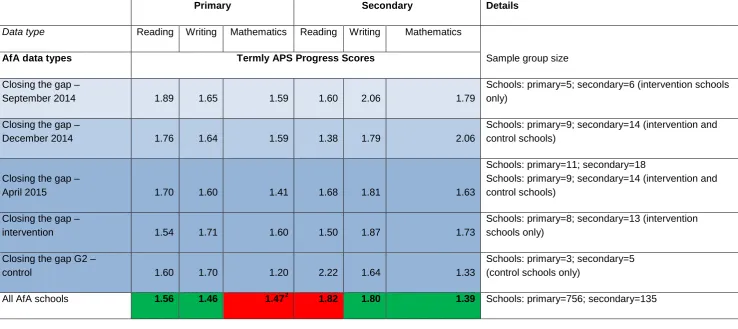
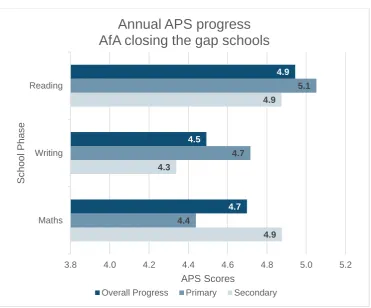
We have impact data that shows average point score (APS) progress for target cohort pupils in reading, writing and mathematics (see appendix A). Our data shows that target cohort pupils in the participant schools made:
• 5.0 APS progress annually in reading
• 4.9 APS progress annually in writing
• 4.8 APS progress annually in mathematics
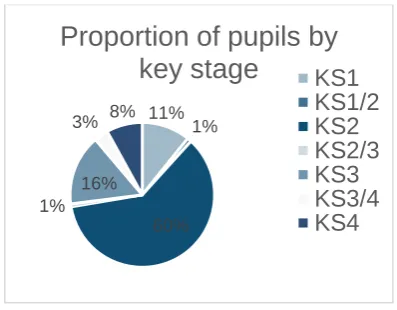
The information in these tables also shows data by key stage and that 44 per cent of the pupils were those on FSM.
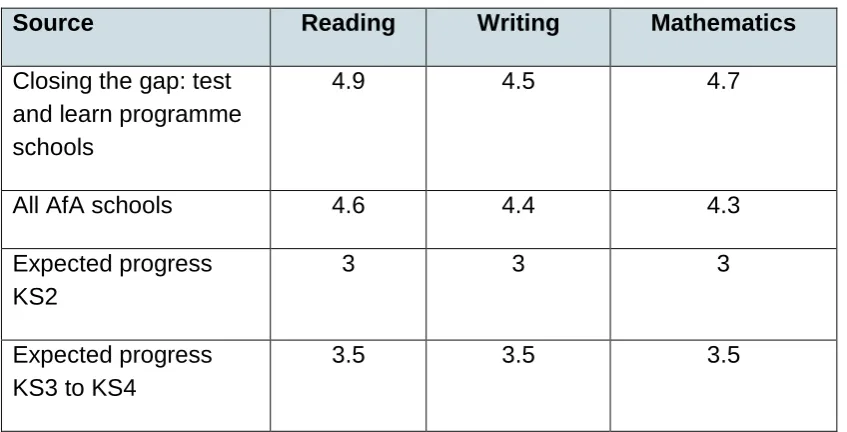
We also have impact data that shows APS progress data (see appendix B) for target cohort pupils was greater when compared with:
• All pupils nationally at key stage 2 and key stages 3 and 4
• All pupils vulnerable to underachievement at key stage 2 and key stages 3 and 4 Please summarise any evidence related to the use of Achievement for All on pupil
motivation.
We do not collect this information specifically but our programme is designed to improve the access, aspiration and achievement of the most vulnerable and disadvantaged children and young people. A key part of this includes working with schools to raise the motivation of these young people. The impact is evidenced in the improvement in their attendance, reading, writing and mathematics. Independent research by PwC to be published in September 2015 shows an increase in both teacher and parent confidence and perception across aspiration and pupil engagement and wider outcomes and opportunities. (We can share the PwC report upon its publication to provide further details of this information in September 2015.)
37 Achievement for All response August 2015
The achievement coach working with the school provides appropriate continuous professional development (CPD) and coaching linked to the school’s action plan to enable the school to make improvements. A quality framework is followed but the delivery is bespoke and tailored to the needs of the school, staff and pupils.
What is your view of the role of research more generally, including action research, and other qualitative research, in developing teaching and learning, and/or in school
leadership?
New, well-funded and well-designed research is always useful if it provides evidence of effective practice that can be used to improve teaching and learning and / or school leadership. We also believe that there is significant merit in capturing ‘data’ via case studies in our experience to specifically pinpoint learning in a vastly diverse and varied environment such as education settings.
Has involvement in the RCT changed the ways that you approach decision-making in your organisation? If so please describe what has happened.
For projects where a programme or service is being offered free we now consider the implications and in particular the effect on the organisations’ engagement if they have not had to pay for it. We also do far more to ensure that schools are aware of the requirements of the programme before they register and embark upon the programme. In addition we have reviewed and improved the way we monitor coaching delivery and ensure quality assurance processes are in place throughout the entire duration of the programme.
What is your view of the value of randomised controlled trials in developing teaching and learning, and/or in school leadership and school improvement?
RCTs are a useful way of comparing approaches or interventions over time; however, the measures used to assess impact need to be appropriate and if comparing different approaches they need to be broadly similar in their aims. For example, it would be a good way of comparing a range of mathematics interventions or whole school
development programmes but not so appropriate for comparing interventions with different aims, objectives and areas of focus.
Use this box to tell us anything else you want to say.
The robust, successful overall/general management of projects of this nature are critical to ensuring that the research accurately assesses the various interventions being
38 Achievement for All response August 2015
that have impacted on this project creating additional variables (eg schools not fully understanding the nature and required commitment and therefore not fully undertaking the intervention that is being measured) which may impact on the ability of Achievement for All (AfA) being able to successfully deliver the schools’ programme in the usual planned, quality way it would do and expects to be measured on.
Quantitative questions
Fidelity of treatment delivery
These questions ask you to evaluate the fidelity with which you think schools implemented the intervention in the trials. The data will be used to see if there is a relationship between delivery and attainment across the whole intervention group and are in no way judgemental of individual schools, nor will they be used in any way that is not anonymous.
To what extent do you think schools implemented Achievement for All consistently according to the recommendations of you, the intervention provider?
Never – 1 ☐ 2 ☐ 3 ☐ 4 ☐ 5 6 ☐ 7 ☐ – Always Comments:
The extent to which schools engaged with the programme and worked with the coach to make changes identified in their needs analysis and action plan varied considerably. Some were engaged from the start and undertook actions, developed the way they did things, trained staff etc. Others were slow to engage and some never really engaged with the programme. These schools often delayed or cancelled visits and made slow progress in taking action needed as identified in their action plan or by the coach. The degree of engagement and willingness to make changes has an impact on the results achieved.
To what extent do you think schools delivered Achievement for All regularly and according to the recommendations of you, the intervention provider?
Never – 1 ☐ 2 ☐ 3 ☐ 4 ☐ 5 ☐ 6 ☐ 7 ☐ – Always Comments:
AfA is not a programme that is ‘delivered regularly’. It is a whole school improvement programme requiring ongoing action and review.
39 Achievement for All response August 2015
practice that you think you, the intervention provider, would deliver? Never – 1 ☐ 2 ☐ 3 ☐ 4 ☐ 5 6 ☐ 7 ☐ – Always Comments:
Coaches make regular visits to schools and are in contact in between visits, but schools are expected to work through strategies and processes so that capacity in school grows as the programme develops. This varied from school to school and depended on their commitment to making changes and improvements.
Treatment practicality questions
These questions will be used to assess if there is a relationship between the practicality of the intervention and attainment.
In terms of timetabling and staffing, how practical do you think it is for schools to integrate Achievement for All into their work?
Not practical at all – 1 ☐ 2 ☐ 3 ☐ 4 ☐ 5 ☐ 6 7 – Completely practical Comments:
The AfA school programme is a framework which helps schools to identify what they need to do to improve the aspirations, access and achievement of vulnerable and
disadvantaged pupils. To be successful, schools need to work with their coach to identify where they need to develop and make changes and then to take action. Schools need to ensure that they have a champion who is a senior member of staff who has the time and commitment necessary. As long as a school is committed then it is entirely practical to integrate the work needed into the school development plan. Our experience shows that our programmes help schools become more efficient and effective in their management and therefore create more time.
In terms of ease of method and training of staff, how practical do you think it is for schools to integrate Achievement for All into their work?
Not practical at all – 1 ☐ 2 ☐ 3 ☐ 4 ☐ 5 ☐ 6 7 – Completely practical Comments:
40 Achievement for All response August 2015
far as parental engagement is concerned. This is difficult to manage initially but in time is a fundamental contributor to accelerated levels of pupil progress.
In terms of classroom resources, how practical do you think it is for schools to integrate Achievement for All into their work?
Not practical at all – 1 ☐ 2 ☐ 3 ☐ 4 ☐ 5 ☐ 6 7 – Completely practical Comments:
The AfA schools programme is not a classroom-based programme per se, however coaches are tasked with supporting classroom practice and regularly undertake learning walks and observations to support good-to-outstanding classroom practice. This
41
2 Achievement for All – additional provider report (May
2015)
Executive summary
AfA has been delivering its schools programme in schools from TSAs across the country as part of the NCTL closing the gap: test and learn programme. The aim is to compare the impact of the programme to other interventions using the new group reading test (NGRT). AfA is currently working with 26 intervention schools that started in late autumn 2013/early 2014 and 18 control schools that started in autumn 2014.
The AfA schools programme is an integrated programme that helps schools improve outcomes for vulnerable and disadvantaged pupils, including those from low-income families, those identified with special educational needs, and children who are cared for. This includes improving outcomes in writing and mathematics as well as reading. Rather than focusing on short-term interventions, the programme aims to ensure that schools make lasting changes and improvements in their leadership, teaching and learning, parental engagement, wellbeing of learners, behaviour and attendance.
APS scores data indicates that target pupils in closing the gap: test and learn programme primary and secondary schools are making better than expected progress in reading, writing and mathematics.
AfA has also found that, when compared to other AfA schools results show greater progress for target pupils, suggesting that this particular approach to delivering the programme provides improved results for the charity.
Schools have also reported a wide range of other improvements as a result of the implementation of the AfA programme.
Introduction
The NCTL contracted with AfA in 2013 to deliver the schools programme in a selection of schools from TSAs across the country. The aim is to compare the impact of the
programme to other interventions using the NGRT.
AfA anticipated that around 80 schools would be involved. The list sent by NCTL originally contained 66 schools, made up of:
42
• 30 control schools – these schools were due to start the programme in September/October 2014
AfA is currently working with 44 schools: 26 intervention schools and 18 control schools.
Overview of work undertaken
Registering schools
All schools were registered centrally to avoid delays, as schools were not able to register themselves until after they had been informed of whether they were in the control or intervention group.
Coach preparation and quality project management
AfA undertook a robust and detailed preparation exercise to ensure that all schools were allocated an experienced, trained and approved achievement coach who was fully
informed about the requirements of the programme. Achievement coaches attended briefing sessions led by AfA’s training manager and the project manager. Information and presentation slides were also sent to all coaches following the briefings.
To ensure a quality management and quality assurance process was in place, additional coach teleconferences were held periodically to check on progress, and to address and overcome issues. Regular updates were sent to regional directors who have oversight for the quality assurance of the delivery of the programmes.
Delivering the programme
Following the AfA schools programme framework, achievement coaches undertook the following in schools:
• Working with colleagues from across the school community, the achievement coach and school champion completed the needs analysis and developed an action plan to support the development of the four elements of the schools programme:
1. leadership
2. teaching and learning