FLUIDIZED BED GRANULATION PROCESS :
STUDY ON AIRFLOW EFFECT ON UREA GRANULE
PHYSICAL PROPERTIES
This report submitted in accordance with requirement of the Universiti Teknikal Malaysia Melaka (UTeM) for the Bachelor Degree of Manufacturing Engineering
(Manufacturing Process) (Hons.)
by
LOH MUN KONG B051310073 930214-01-5103
DECLARATION
I hereby, declared this report entitled “Fluidized Bed Granulation Process : Study on Airflow Effect on Urea Granule Physical Properties” is the results of my own
research except as cited in reference.
Signature :
Author’s Name : LOH MUN KONG
APPROVAL
This report is submitted to the Faculty of Manufacturing Engineering of Universiti Teknikal Malaysia Melaka as a partial fulfilment of the requirements for the degree of
Bachelor of Manufacturing Engineering (Manufacturing Process) (Hons.).
……… (Principal Supervisor) –Signature & Stamp
i
ABSTRAK
ii
ABSTRACT
iii
DEDICATION
Only
my beloved father, Loh Yong Hwa my appreciated mother, Chong Yoke Gee
my adored sister and brother, Shea Ting, Chun Kong and Shea Jing
iv
ACKNOWLEDGMENT
First and foremost, I would like to express my sincerest gratitude to my supervisors, Dr. Mohamad Ridzuan bin Jamli and Encik Mohd Fairuz bin Dimin @ Mohd Amin, who have mentored me throughout this project. With their guidance and knowledge, they can help me to find the solutions when I face difficulty.
Furthermore, I would like to give a special thanks to Encik Mohammad Anas bin Zainal Abidin and Encik Muhammad Akmal bin Mohd Zakaria. Encik Anas has taught me how to set up and control the machine in the early stage of experiment. While, Encik Akmal, a postgraduate in UTeM, for helping me to understand the concept on analysis of variance (ANOVA) and how to apply it correctly when analyzing the data collected.
v
TABLE OF CONTENT
Abstrak...i
Abstract………....…..ii
Dedication....………...……. iii
Acknowledgement………..………...iv
Table of Content...v
List of Tables...viii
List of Figures ... ix
List of Abbreviations ... xi
List of Symbols ... xii
CHAPTER 1: INTRODUCTION 1.1 Research Background ... 1
1.2 Problem Statement ... 3
1.3 Objectives ... 3
1.4 Scopes of Research ... 4
CHAPTER 2: LITERATURE REVIEW 2.1 Granulation ... 5
2.2 Fluidization ... 7
2.3 Fluidized Bed Granulation ... 9
vi
2.4 Parameters in Fluidized Bed Granulation ... 12
2.4.1 Material parameters ... 12
2.4.1.1 Urea ... 12
2.4.1.2 Binder concentration... 14
2.4.2 Process parameters ... 16
2.4.2.1 Wind velocity ... 16
2.4.2.2 Spray pressure ... 18
2.4.2.3 Bag shake duration ... 19
2.5 Air Flow Pattern ... 20
2.5.1 Normal ... 20
2.5.2 Spiral ... 21
CHAPTER 3: METHODOLOGY 3.1 Flowchart of Research ... 23
3.2 Response Surface Methodology ... 24
3.3 Material Preparation ... 26
3.4 Equipment and Experimental Setup ... 28
3.5 Analysis of Output Traits ... 30
3.5.1 Distribution of granules size ... 30
3.5.2 Granules density ... 31
3.5.3 Granules hardness ... 32
CHAPTER 4: RESULTS AND DISCUSSIONS 4.1 Effect Of Airflow Pattern And Process Variables On Granule Size ... 33
4.2 Effect Of Airflow Pattern And Process Variables On Granule Density... 38
vii
4.3 Effect Of Airflow Pattern And Process Variables On Granule Hardness...45
4.3.1 Analysis on granule hardness………..45
4.4 Process Validation and Optimization...53
4.4.1 Validation and optimization for granule density and hardness (spiral) ...53
4.4.1.1 Validation...………...53
4.4.1.2 Optimization………....………...54
4.4.2 Validation and optimization for granule density and hardness(normal)...55
4.4.2.1 Validation……….55
4.4.2.2 Optimization………....….56
4.5 Correlation Coefficient (R) Between Actual and Experimental Value………57
4.5.1 Correlation coefficient (R) in granule density and hardness results……...…57
CHAPTER 5: CONCLUSION 5.1 Conclusion ... 60
5.2 Recommendation ... 61
5.3 Sustainability ... 62
REFERENCES ... 63
APPENNDICES A Gantt Chart of FYP I ... 68
viii
LIST OF TABLES
2.1 Advantages and disadvantages of fluidized bed granulation 10
2.2 Experimental Test Matrix 14
2.3 Study of wind velocity in fluidized bed granulation from different authors 17
3.1 DOE layout for urea granulation using RSM 25
4.1 Effect of spiral airflow in the production of desired granule size 34 4.2 Effect of normal airflow in the production of desired granule size 34 4.3 Effect of airflow pattern under same process conditions ongranule density 38 4.4 ANOVA for different process conditions ongranule density (spiral) 40 4.5 ANOVA for different process conditions on granule density (normal) 40 4.6 Effect of airflow pattern under same process conditions ongranule
hardness 45
4.7 ANOVA for different process conditions ongranule hardness (spiral) 45 4.8 ANOVA for different process conditions ongranule hardness (normal) 46
4.9 Validation result for granule density (spiral) 53
4.10 Validation result for granule hardness (spiral) 54
4.11 Goal and constraint for the inputs and outputs (spiral) 54 4.12 Optimization solution for granule density and hardness (spiral) 54
4.13 Validation result for granule density (normal) 55
4.14 Validation result for granule hardness (normal) 55
4.15 Goal and constraint for the inputs and outputs (normal) 56 4.16 Optimization solution for granule density and hardness (normal) 56
ix
LIST OF FIGURES
2.1 Three key mechanisms of granulation 7
2.2 Schematic representation of fluidization regimes 8
2.3 Granules growth in the fluidized bed granulation 11
2.4 Influence of initial size of urea particle on the average size of urea granule
formed to initial size of urea particle ratio at different moisture content 13 2.5 Geometric mean diameter (D50) versus time with different concentration of
PVP K-30 solutions 15
2.6 Effect of concentration of urea solution on efficiency of granulation 16 2.7 Geometric mean diameter (D50) versus time for different binder spray
pressure and spray rate 18
2.8 Effect of spray pressure and flow rate of binder on binder solution needed 19
2.9 Normal air flow 20
2.10 Perforated plate 20
2.11 Spiral air flow 21
2.12 Multi-horizontal nozzle distributor 21
3.1 Flow chart of research 23
3.2 Interface of CCD in RSM 24
3.3 Equipment for material preparation: 26
(a) Urea N46 granule (b) Blender (c) Sieve shaker
3.4 Hot plate stirrer 27
3.5 Fluidized bed granulator 28
3.6 Chamber parts: (a) Top chamber (b) Bottom chamber (c) Filter bags 29 3.7 Equipment and experimental setup for fluidized bed granulation 29
3.8 Peristaltic pump 30
3.9 Sieve tray with mesh size of different diameter 31
3.10 Electronic densimeter 32
3.11 Portable Tablet Hardness Tester 32
x 4.2 Urea granules formed:
(a) Undersize (b) Oversize (c) Desire granule size (d) Lump 36 4.3 Problems in fluidized bed granulation process:
(a) Particles remained at filter bags (b) Particles adhere to chamber wall 37 4.4 Effect of airflow pattern on granule density under same process conditions 38 4.5 Diagnostic plots for granule density:
(a) Normal probability plot (b) Predicted versus actual (c) Outlier T versus run order
42
4.6 One factor plots for granule density (spiral):
(a) Spray pressure (b) Bag shake duration 43
4.7 Surface plots and interaction graphs of variables on granule density (normal):
(a) Wind velocity and spray pressure (b) Spray pressure and bag shake duration
44
4.8 Diagnostic plots for granule hardness:
(a) Normal probability plot (b) Predicted versus actual (c) Outlier T versus run order
47
4.9 Surface plots and interaction graphs of variables on granule hardness (spiral):
(a) Wind velocity and spray pressure (b) Wind velocity and bag shake duration (c) Spray pressure and bag shake duration
49
4.10 Surface plots and interaction graphs of variables on granule hardness (normal):
(a) Wind velocity and bag shake duration (b) Spray pressure and bag shake duration
51
xi
LIST OF ABBREVIATIONS
ASTM - American Society for Testing and Materials
AWS - Airtight Wind Shield
CCD - Central Composite Design
D50 - Geometric Mean Diameter
DOE - Design of Experiment
FAO - Food and Agriculture Organization of the United Nations
PCs - Personal Computers
PLCs - Programmable Logic Controllers
xii
LIST OF SYMBOLS
°C - Degree Celsius
µm - Micrometre
g - gram
g/cm3 - Gram Per Cubic Centimetre g/min - Gram Per Minute
kg/cm2 - Kilogram Per Square Centimetre m/s - Meter Per Second
ml - Millilitre
ml/min - Millilitres Per Minute
mm - Millimetre
MPa - Mega Pascal
N - Newton
rpm - Revolution Per Minute
s - Second
1
CHAPTER 1
INTRODUCTION
This chapter will introduce about the problem statement, objectives and scope of study.
1.1 Research Background
The development of fluidized bed granulation was begun when Wurster reported his fluid bed experiments were success to prepare the compressed tablets using air suspension in 1960. Fluidization is a process which subjects a granular material in solid state to behave like a fluid. While, granulation is an enlargement process that gathers fine particles into a larger mass of aggregates by spraying binder solution to the dry powder bed (Roy et al., 2009b).
Granulation process can be categorized into two types, wet granulation and dry granulation. With the used of liquid binder, the granulation is classified as a wet process. The binder solution is sprayed onto the solid particles to agglomerate them and the formed granules are then going through the drying process to extract the excess solvent to form permanent bonds between particles (Villa et al., 2016). Additives such as starch can add into the binder solution to speed up the processing time and improves the properties of the granules formed
2
commonly applied in granulation process while the fluid bed bottom spray is normally applied in industry of pharmaceutical to make film coating and layering with superior properties (Srivastava & Mishra, 2010). The top spray fluidized bed granulation has been applied in a lot of different processing industries such as detergent, agrochemical, food industries and pharmaceutical due to its versatility. Mixing, granulating and drying the materials all can be done in the same apparatus. This can save the process time, labour cost and reduce material handlings.
The raw material used is commercial urea fertilizer granules with chemical formula CO(NH2)2. It is an odourless, colourless and non-toxic dry organic compound with minimum about 46% of nitrogen content based on the data from Petronas Chemical Fertilizer. Pure binder solution without any additives is applied in this study although the addition of this granulating aids can improve the crystallisation process and provide a greater hardness value to granules of fertilizer. This is due to the addition of additives will increase the cost of production of the fertilizer.
The main focus of this study is to identify the effect of the normal and spiral airflow pattern and optimize the value of input parameters such as wind velocity, spray pressure and bag shake duration to obtain the required physical properties of the urea granules formed such as the size, density and hardness. A lot of previous study needs to be referred to determine the suitable range of input values for each parameter. However, it is still lacking of information about the influence of different air flow pattern with the input parameters especially the bag shake duration to the physical properties of granules formed.
3
1.2 Problem Statement
Nowadays, fluidized bed technology has found in a wide range of applications such as chemical, pharmaceutical and food industries. It plays an important role especially in powder processing and pharmaceutical process which aimed to provide a well heat and mass transfer and help in the particle formation. However, it is very difficult to operate the process of granulation in fluidized bed granulator. A lot of parameters need to be control and the interaction between the parameters has to be understood in detail, otherwise the granulation process is easy to fail and bring to the problems such as formation of lumps, caking and non-uniform structure of the granules. The conditions influence the granulation process should be optimized in order to produce the granules with required properties especially in the size, density and hardness. Low density granules are easy to dissolve in water. More storage spaces are needed for granules weak in strength due to breakage problems. The products cannot stack together in one place. Hence, optimization of process is necessary to reduce the failure products formed and this can save processing time and the production cost for related industry. The factors that need to count in this study are pattern of airflow, binder spray pressure, wind velocity and shake duration of filter bags. However, there is no similar study that relates all these factors together, so through this study, some guidelines can be provided when designing fluidized bed granulation process.
1.3 Objectives
The objectives of the study are as shown:
i. To identify the effect of different airflow pattern and process variables on the size, density and hardness of urea granules formed in a fluidized bed granulator.
ii. To design the experiment using Respond Surface Methodology (RSM).
4
1.4 Scopes of Research
5
CHAPTER 2
LITERATURE REVIEW
This chapter is to introduce the theory and research about the fluidized bed granulation process that has been applied in many different industries. The granulation process, air flow pattern, input parameters (wind velocity, spray pressure, bag shake duration) and output results (size, density, hardness) on the urea granule formed will be studied by referring to previous work that done by numerous researchers.
2.1 Granulation
Granulation is a granule forming process that gathers fine particles to change into a greater mass of aggregates by spraying binder solution to the dry powder bed (Roy et al., 2009b). The three main elements that needed to produce well granules in granulation are initial seeds, good mixing of particles and binder solution (Cotabarren et al., 2015). Granulation process is able to produce the granules with desired properties especially in obtaining better shape and size distribution and moreover can easier their handling for many different field of industries such as pharmaceutical, fertilizer, chemical, food industries and so on. However, the problems encountered for each field are totally different although the granulation theories applied are similar. For example, the production rate for pharmaceutical industries are made in kg/day while for detergent and fertilizer industries, the production rate is measured in tons/h (Mort, 2005).
6
it is considered as wet granulation. Before the granulation process is conducted, mechanical agitation of the seeds is necessary. This aimed at reducing its particle size and for easier the binder distribution (Veliz Moraga et al., 2015). The collision of the wet particles creates liquid bridges between them and the particles will start to combine and nucleate the granules. The agglomerates are then created by converting the liquid bridges to solid bridges through the evaporating of binding agent by hot air (Ziyani & Fatah, 2014).
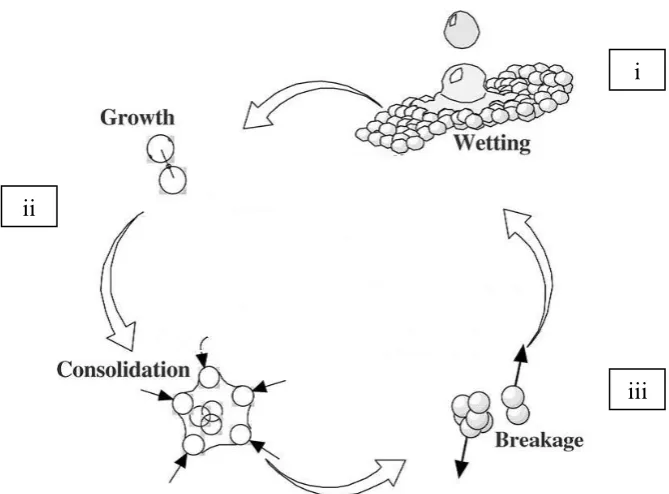
In modern theories of granulation, Iveson et al. (2001) indicated that it was more easier to view the granulation as three key mechanisms if compared with traditional description which in terms of a number of different mechanisms. The three key mechanisms as shown in Figure 2.1 are:
i. Powder wetting and nucleation
Binding agent will spray onto the bed and wet the particles. This makes a well distribution between nuclei granules. Granulation will start with the adhesion between particles due to liquid bridges and the particles then combine to form pendular state. Transition from pendular to capillary state if the agitation is continued.
ii. Granule growth and consolidation
Granules will collide with other particles to form larger granules in coalescence. If the granule collides with the wall of the equipment’s chamber, the granule will consolidate. It releases the air trapped inside the granule and reduces the size of granule.
iii. Granule attrition and breakage
7
Figure 2.1: Three key mechanisms of granulation. Modified from (Mehta et al., 2005).
2.2 Fluidization
The operation that delivers the air or liquid upward and pass through the packed bed of particles to make the solids to behave like fluid is known as fluidization. Fluidization is normally applied in chemical/physical-based operations. In chemical operations, it is used to know the solid-gas reaction; in physical operations, it can be used for transportation, heating and mixing of fine powder, combustion of coal and so on.
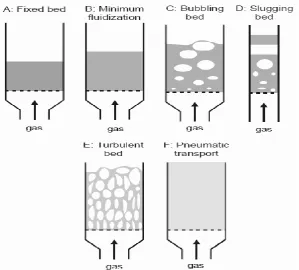
The changes in the parameters such as the gas velocity, size and density of particles will change the behaviour of fluidized bed. According to Smith (1980), the bed considered as fluidized only if the gas velocity was reached the incipient fluidization point. It is the point at which the pulling force was equal or greater than the force of gravitation. Hence, we can divide the fluidized bed into different kinds of fluidization regimes based on the gas velocity, for instance fixed bed, minimum fluidization, bubbling bed, slugging bed, turbulent bed and pneumatic transport. The schematic representation about this six different regimes as presented in Figure 2.2.
i
ii
8
[image:23.595.155.455.338.608.2]In fixed bed, the pulling force is too weak to lift the bed, particles only vibrate but continue to remain as the same level with the bed. When the gas velocity is increased to minimum fluidized velocity, the pulling force is balanced with the particles weight, the bed becomes fluidized and this starting the minimum fluidization. If the gas velocity is further increased, bubbles will form and the bubbling fluidized bed occurred. Hence, any addition of gas travels through the bed will become bubbles beyond the minimum fluidization velocity. Formation of slugging bed is determined when the size of bubbles become almost equal to the diameter of bed. The rising bubbles at this stage will combine and grow. The slugging bed is then transitioned into turbulent bed in which the voids of gas are no longer the same shape and size bubbles. The fluidized bed is finally becomes an entrained bed with increasing the gas velocity to superficial. Pneumatic transport of solids are formed (Cocco et al., 2014; Kruggel-Emden and Vollmari, 2016).
9
2.3 Fluidized Bed Granulation
Granulation process that utilized the technology of fluidized bed is known as the fluidized bed granulation. The development of fluidized bed granulation was began when Wurster reported his fluid bed experiments succeeded to prepare the coating compressed tablets using air suspension method in 1959 (Wurster, 1959). There were a lot other researchers studied in this field ever since the present of Wurster report. For instance, Rankell et al. (1964) has studied the effect of powder and liquid feed rates, temperature of inlet hot air and location of nozzle to properties of granule formed by applying the granule screen analysis, compressibility test and moisture content to appraise the granulated product. Furthermore, Vengateson and Mohan (2016) focused their study on the effect of binder flow rate and fluidizing air velocity to the granule size. Other process variables, such as atomizing pressure, air temperature in chamber, pattern of air flow were also studied.
Fluidized bed equipment is suitable to perform the wet granulation and it has been used in different kind of industries for more than 40 years, especially in pharmaceutical manufacturing. In fluidized bed granulation, particles are dispersed throughout the bulk of liquid which spraying from the top of the granulator. The particles are fluidized by the stream of air created by turbine fan suction and heated through air handling unit. The hot air is then blow through the distributor plate which locate at the base of vessel. The smaller the size of particles used, the better the performance of fluidized bed granulation. This statement was proved by the previous study that investigated by Roy et al. (2009a). It stated that if tiny solid particles are used, surface area of the particles exposed to the gas will become larger and this will easier the solid-gas heat and mass transfer.