Int. J. Electrochem. Sci., 6 (2011) 6115 - 6122
International Journal of
ELECTROCHEMICAL
SCIENCE
www.electrochemsci.orgProton Exchange Membrane Fuel Cell Working at Elevated
Temperature with Ionic Liquid as Electrolyte
Jian Gao, Jianguo Liu*, Wenming Liu, Bo li, Yuchen Xin, Ying Yin, Jungu, Zhigang Zou** Eco-materials and Renewable Energy Research Center, Department of Materials Science and
Engineering, Department of Physics and National Laboratory of Solid State Microstructures, Nanjing University, 22 Hankou Road Nanjing 210093 China. P.R.C
*
E-mail: [email protected]. **
E-mail: [email protected]
Received: 21 September 2011 / Accepted: 30 October 2011 / Published: 1 December 2011
Ionic liquid (IL) of 1-ethyl-3-methylimidazolium hydrogen sulfate ([Emim]HSO4) free of halide was prepared. The IL was absorbed on a piece of porous asbestos film and used as the electrolyte to fabricate a fuel cell, which was tested in the temperatures ranging from 30 to 168 oC. A maximum power density of 0.6 mW.cm-2 was obtained at 168 oC. The conductivity of the composite IL membrane was measured at various temperatures and the increasing conductivity with temperature was observed. The results indicate that it is promising to apply ionic liquid as the electrolyte for PEMFC to work at elevated temperature, especially at temperature higher than 145 oC, which is critical to wave off problems related to the poisoning of trace amount of CO in the reformed hydrogen from methanol or methane.
Keywords: Ionic liquid; High-temperature PEMFC; [Emim]HSO4; Non-halide ionic liquid.
1. INTRODUCTION
A promising approach to solve the CO related problem is to elevate PEMFC operating temperature since higher temperature operation can mitigate the CO negative effects on platinum catalysts [5].
The CO tolerable concentration of platinum catalysts can be elevated from 10 to 100 ppm when the temperature is higher than 145oC [6], making it possible for the hydrogen from reformed fuels to be fed directly to PEMFC. There are still other benefits justifying the efforts devoted to elevating the operating temperature such as improving the overall fuel cell efficiency, simplifying the heat management and increasing the electrode reaction speed. However, perfluorinated sulfonic acid membranes (such as Nafion membrane), the typical electrolyte for PEMFC, can not work at elevated temperature due to its high dependence on water in it to transfer proton properly [7]. As water boils at 100 oC under ambient pressure, the Nafion membrane protonic conductivity decreases unacceptably at temperature higher than 100 oC and leads to PEMFC failure. Addition of SiO2, TiO2 particles, etc to Nafion membrane can promote its water retention ability so as to work at temperature a little bit higher than 100 oC [5-14].
However, these membranes are still vulnerable to the loss of conductivity upon loss of water [15]. Therefore, the ultimate method to solve this problem is to develop electrolyte that can work at elevated temperature independent of water.
Recently, ionic liquids (ILs) have been investigated as electrolytes for various devices including the PEMFC. ILs are a kind of salts with low melting point and other unique properties such as low melting point, considerable ionic conductivity and broad electrochemical windows [16, 17]. For these properties, application of ILs has been studied in PEMFC and several works have been reported. [Pmim]H2PO4 was proposed as electrolyte for fuel cell, but no fuel cell test was carried out [15]. [Bmim]BF4and [Bmim]PF6were studied in commercial alkaline fuel cell [18], but no fuel cell test was carried out at elevated temperature. 2,3-dimethyl-1-octylimidazolium triflate ([Dmoim]Tf ) was synthesized and tested in a single fuel cell at 100 oC and a power density of 1 mW.cm-2 was obtained, but no fuel cell test at temperature higher than 140oC was conducted [19]. [Emim](FH)2.3F was tried as electrolyte in fuel cell at 120 oC [20], unfortunately the IL was not stable enough and HF, which is highly toxic and erosive, was generated in the testing process. Diethylmethylammonium trifluoromethanesulfonate ([Dema]Tfo ) was tested as electrolyte and a power density of 100 mw.cm-2 was obtained at 80oC. But no test was carried out at higher temperature [21]. Our group reported a work about applying [Emim]H2PO4 as electrolyte for fuel cell to work at 120oC[22]. All these works shed some light on the idea of elevating operation temperature for PEMFC with IL as electrolyte. However, fuel cell tests with IL are still scarce [23], especially that carried out at temperature higher than 145oC. This is important since 145 oC is critical for fuels with CO to be fed to the fuel cells directly as reported [6].
This work aims to study the feasibility for PEMFC with IL as electrolyte to operate at temperature higher than 145 oC. Thus, [Emim]HSO4 was synthesized and characterized. Then a fuel cell was fabricated with the IL carried on porous asbestos membrane as electrolyte. The fuel cell was tested atvarioustemperatures.
2. EXPERIMENTAL
2.1 IL synthesis
The IL was prepared according to our recently submitted work [24] basing on the solubility differential of KOH, [Emim]EtOSO3 and KEtOSO3 in ethanol. The process is briefly summarized hear. Firstly, IL [Emim]EtOSO3 was prepared according to the reported procedure [25]. The obtained IL as precursor was dissolved in ethanol. The resulted solution was then added to KOH dissolved in ethanol. White precipitation was generated and filtered. The filtrate of [Emim]OH solution was neutralized with H2SO4 dissolved in water. The final product shall be obtained when most of the water and ethanol was vaporized and dried at 60℃ for around 6 hours and then 120℃ for 24 hours in vacuo. The whole process was depicted in Fig. 1.
N
N
CH3
+ CH3CH2OSO3CH2CH3
N
N
CH3
CH2CH3
+ KOH +
-OSO3CH2CH3
N
N
CH3
CH2CH3
-OSO
3CH2CH3
In ethanol In ethanol
N
N
CH3
CH2CH3
In ethanol
KOSO3CH2CH3
OH
-(1)
(2)
N
N
CH3
CH2CH3
In ethanol
OH- + H
2SO4
In water
+
N
N
CH3
CH2CH3
H2O
HSO4
[image:3.596.101.496.289.625.2]-(3)
Figure 1. Synthesis process of [Emim]HSO4.
2.2 IL characterization
conductivity meter (Orion Star and Plus meter) and viscosity meter (Vibro Viscometer SV-1A Japan), respectively.
2.3 Fuel cell test and membrane specific conductivity
A piece of porous asbestos membrane of 45 mm×45 mm was immersed in IL [Emim]HSO4for 24 hours at 60oC in vacuo. The mass ratio of IL to asbestos membrane was measured to be around 12:1. The membrane was then sandwiched between two electrodes with platinum loading of 0.5 mg.cm-2 to prepare membrane electrode assembly (MEA), which was then assembled between two graphite plates with serpentine flow fields to fix a fuel cell with fasten pressure of 0.25 MPa. The fuel cell performance was tested on an electronic load tester (KIKUSUI PLZ7OUA Japan) at various temperatures which was controlled with two electric heaters and a thermal couple. The flow rate of dry O2 and H2 was kept 20 and 10 ml.mim-1, respectively. All the tests were conducted without any humidification under ambient pressure.
The conductivity for membrane containing IL was measured with a PARSTAT 2273 electrochemical station in the temperature range of 30 oC to 168oC when the fuel cell test was over for each temperature. Three data were measured for each temperature and the average value was used. The specific conductivity (σ)was calculated by formula (2), where l is the thickness of the membrane and A is the valid area of the membrane.
A
lG/
(2)3 RESULTS AND DISCUSSION
20 30 40 50 60 70 80 90
2 4 6 8 10 12 14 16 18
Temperature/oC
Sp
ec
if
ic
con
du
ct
iv
ity
/m
S.c
m
-1
0 100 200 300 400 500 600
V
iscosit
y
[image:4.596.133.476.487.736.2]/cP
The obtained samples can be confirmed as the expected IL as shown in our submitted work [24]. The viscosity and conductivity were measured and given here in Fig. 2. It can be observed that as the temperature increased from 25 oC to 85oC, the viscosity decreases from 600 to 50cP while the conductivity increases from 2 to 16 mS.cm-1. The measured conductivity range agrees with the reported value for imidazolium based ILs [26-28]. The increase in conductivity is favorable for the IL to work as electrolyte at elevated temperature since higher ionic conductivity usually means lower inner resistance.
Fig. 3 shows the specific conductivity of the asbestos membrane containing IL in the temperature range of 25 oC to 150oC. An increase of conductivity with increase in temperature was observed, and the increase may be a result of the increase of conductivity of pure IL. The result implies that the specific conductivity of the asbestos membrane containing IL is lower than that of pure IL, but a specific conductivity of 2.8 mS.cm-1 can be observed at 150 oC. This is comparable with the specific conductivity of membranes based on ILs [15]. While that for Nafion membrane, although specific conductivity in low temperature range is much higher, about 100 mS.cm-1 [29] under humidity condition, shall decrease quickly once the temperature is higher than 80oC, and the membrane shall suffer irreversible specific conductivity decay as the temperature continues to elevate [30], rendering the Nafion membrane useless for fuel cell at elevated temperature.
20 40 60 80 100 120 140 160 180
0.0 0.5 1.0 1.5 2.0 2.5 3.0
C
o
n
d
u
ct
iv
it
y
/
m
S.cm
-1
Temperature /oC
Figure 3. Variation of specific conductivity for asbestos membrane containing [Emim]HSO4 with temperature.
[image:5.596.144.453.388.621.2][image:6.596.160.439.138.330.2]
to work at temperature higher than 140 oC, and it is believed that this is high enough to avoid poisoning of Pt from CO in the fuel stream [30].
[image:6.596.166.442.397.590.2]Figure 4. Variation of cell power density and voltage with current density at high temperature
Figure 5. Variation of cell power density and voltage with current density at low temperature
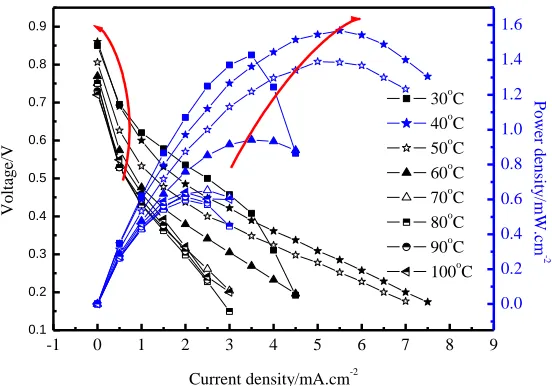
Tests at temperatures lower than 100 oC were also conducted and the results are presented in Fig. 5. Unlike that for high temperature range, a decrease in both OCV and MPD was observed with increase in temperature.
Fig. 4 and Fig 5 imply that the performance for the fuel cell is influenced by the operating temperature. The alternative behavior of the fuel cell is a result of several influencing factors. The catalyst activity can be promoted by elevated temperature and as a result the performance is promoted [31]. On the other hand, increase in temperature leads to IL viscosity decrease. This makes it difficult
0.0 0.5 1.0 1.5 2.0 2.5 3.0
0.1 0.2 0.3 0.4 0.5 0.6 0.7 0.8
168oC 160oC 150OC 140
O
C 130OC 120OC 110oC
Current density/mA.cm-2
Voltag e/V 0.0 0.1 0.2 0.3 0.4 0.5 0.6 Pow er density /m W. cm -2
-1 0 1 2 3 4 5 6 7 8 9
0.1 0.2 0.3 0.4 0.5 0.6 0.7 0.8 0.9
30oC 40oC 50oC 60oC 70oC 80oC 90oC 100oC
Current density/mA.cm-2
for the IL to distribute uniformly in the membrane. As a result, most IL in the membrane shall collect at the bottom of the fuel cell, decreasing the valid fuel cell area as the dry asbestos membrane can not work as electrolyte, and the fuel cell performance is jeopardized. This means that temperature influences the fuel cell performance in a complex way.
The maximum power density was observed to be 0.6 mW.cm-2 at 168oC. This is in consistent with the most reported results with ionic liquid as electrolyte [19, 32, 33]. However, the temperature herein is much higher. All the results show that the fuel cell can work but at low current. One cause for the poor performance is the fuel cell structure, optimally designed for fully hydrated Nafion membrane, is not suitable to work with IL. During the tests, leaching of IL was observed at the cell gas exits. What is more, most of the IL was found to collect at the bottom part, and this cause valid area decrease for the membrane. The carbon support is another suspect to cause MPD decrease as it can not work properly at elevated temperature. The strong acidity of IL may be another cause for the low power density since it is well known that acid condition is unfavorable for electrode reaction [34]. The low selective proton transport may be another cause for the poor performance [35]. There are still other causes resulting in the low OCV and power density. Thus, more study on fuel cell performance is necessary. One important work is to design and synthesis suitable IL, which must be high in ionic conductivity, and this is possible since the number of it is huge. There are also many more works other than designing and synthesizing of IL. Such as to designing of novel flow fields, seek or design more suitable support for catalyst and so on, further study is in progress in our group.
4. CONCLUSION
Ionic liquid of [Emim]HSO4 free of halide was applied as electrolyte carried on porous asbestos membrane. A fuel cell was fabricated with the membrane as electrolyte and tested at various temperatures in the range of 30~168 oC The results imply that the fuel cell with [Emim]HSO4 as electrolyte can work at elevated temperatures higher than 145oC. This temperature was believed to be critical to avoid the CO problem for Pt catalysts. The membrane carrying the IL was also measured for ionic conductivity as a function of temperature. The results show the feasibility of using ILs as electrolyte for fuel cell to work at elevated temperatures although more improvements are still in need.
ACKNOWLEDGMENTS
This work was financially supported by National High Technology Research and Development Program of China (2011AA11A271), Natural Science Foundation of China (21176111, 20906045), Fundamental Research Funds for the Central Universities (1106021341), and Priority Academic Program Development of Jiangsu Higher Education Institutions.
References
1. D. C. Huang, P. J. Yu, F. J. Liu, S. L. Huang, K. L. Hsueh, Y. C. Chen, C. H. Wu, W. C. Chang and F. H. Tsau, INT. J. ELECTROCHEM SC,6 (2011) 2551.
3. B. C. H. Steele and A. Heinzel, Nature,414 (2001) 345.
4. X. Cheng, Z. Shi, N. Glass, L. Zhang, J. J. Zhang, D. T. Song, Z. S. Liu, H. J. Wang and J. Shen, J. Power Sources,165 (2007) 739.
5. P. Costamagna, C. Yang, A. B. Bocarsly and S. Srinivasan, Electrochim. Acta,47 (2002) 1023. 6. V. Ramani, H. R. Kunz and J. M. Fenton, Electrochim. Acta,50 (2005) 1181.
7. P. L. Antonucci, A. S. Arico, P. Creti, E. Ramunni and V. Antonucci, Solid State Ionics,125 (1999) 431.
8. M. A. Navarra, C. Abbati and B. Scrosati, J. Power Sources,183 (2008) 109.
9. T. Jian-Hua, G. Peng-Fei, Z. Zhi-Yuan, L. Wen-Hui and S. Zhony-Qiang, Int. J. Hydrogen Energy,33 (2008) 5686.
10. S. Y. Chen, C. C. Han, C. H. Tsai, J. Huang and Y. W. Chen-Yang, J. Power Sources,171 (2007) 363.
11. C. W. Song, T. H. Wang, X. Y. Wang, J. S. Qiu and Y. M. Cao, Sep. Purif. Technol.,58 (2008) 412.
12. J. T. Wang, R. F. Savinell, J. Wainright, M. Litt and H. Yu, Electrochim. Acta,41 (1996) 193. 13. J. O. Jensen, Q. Li, R. He, C. Pan and N. J. Bjerrum, J. Alloys Compd.,404 (2005) 653. 14. J. B. Rollins and J. C. Conboy, J. Electrochem. Soc.,156 (2009) B943.
15. H. Ye, J. Huang, J. J. Xu, N. K. A. C. Kodiweera, J. R. P. Jayakody and S. G. Greenbaum, J. Power Sources,178 (2008) 651.
16. H. Tokuda, K. Hayamizu, K. Ishii, M. A. B. H. Susan and M. Watanabe, J. Phys. Chem. B,109 (2005) 6103.
17. H. Tokuda, K. Ishii, M. A. B. H. Susan, S. Tsuzuki, K. Hayamizu and M. Watanabe, J. Phys. Chem. B,110 (2006) 2833.
18. R. F. de Souza, J. C. Padilha, R. S. Goncalves and J. Dupont, Electrochem Commun,5 (2003) 728. 19. S. S. Sekhon, B. S. Lalia, J. S. Park, C. S. Kim and K. Yamada, J Mater Chem,16 (2006) 2256. 20. J. S. Lee, T. Nohira and R. Hagiwara, J. Power Sources,171 (2007) 535.
21. S. Y. Lee, T. Yasuda and M. Watanabe, J. Power Sources,195 (2010) 5909.
22. J. Gao, J. G. Liu, W. M. Liu, J. L. Ye, Y. Zhou, J. Gu, T. Yu and Z. G. Zou, Chinese. J. Inorg. Chem,25 (2009) 2016.
23. Q. T. Che, R. H. He, J. S. Yang, L. Feng and R. F. Savinell, Electrochem. Commun.,12 (2010) 647.
24. J. Gao, J. G. Liu, B. Li, W. M. Liu, Y. Xie, Y. C. Xin, Y. Yin, X. Jie, J. Gu and Z. G. Zou ,Green Chemistry (Submited) (2011).
25. E. Gomez, N. Calvar, A. Dominguez and E. A. Macedo, J. Chem. Thermodyn.,42 (2010) 1324. 26. W. Ogihara, H. Kosukegawa and H. Ohno, Chem. Commun. (2006) 3637.
27. A. Fernicola, B. Scrosati and H. Ohno, Ionics,12 (2006) 95.
28. M. Galinski, A. Lewandowski and I. Stepniak, Electrochim. Acta,51 (2006) 5567. 29. M. Rikukawa and K. Sanui, Prog. Polym. Sci.,25 (2000) 1463.
30. G. Alberti, M. Casciola, L. Massinelli and B. Bauer, J. Membr. Sci,185 (2001) 73.
31. C. Yang, P. Costamagna, S. Srinivasan, J. Benziger and A. B. Bocarsly, J. Power Sources,103 (2001) 1.
32. S. S. Sekhon, P. Krishnan, B. Singh, K. Yamada and C. S. Kim, Electrochim. Acta,52 (2006) 1639.
33. B. S. Lalia, K. Yamada, M. S. Hundal, J. S. Park, G. G. Park, W. Y. Lee, C. S. Kim and S. S. Sekhon, Appl. Phys. A,96 (2009) 661.
34. S. Keskin, D. Kayrak-Talay, U. Akman and O. Hortacsu, J. Supercrit. Fluids,43 (2007) 150. 35. M. Yoshizawa-Fujita, K. Fujita, M. Forsyth and D. R. MacFarlane, Electrochem. Commun.,9
(2007) 1202.
![Figure 1. Synthesis process of [Emim]HSO4.](https://thumb-us.123doks.com/thumbv2/123dok_us/1940707.154041/3.596.101.496.289.625/figure-synthesis-process-of-emim-hso.webp)
![Figure 2. Variation of conductivity and viscosity of [Emim]HSO4 with temperature.](https://thumb-us.123doks.com/thumbv2/123dok_us/1940707.154041/4.596.133.476.487.736/figure-variation-conductivity-viscosity-emim-hso-temperature.webp)
![Figure 3. Variation of specific conductivity for asbestos membrane containing [Emim]HSO4 with temperature](https://thumb-us.123doks.com/thumbv2/123dok_us/1940707.154041/5.596.144.453.388.621/figure-variation-specific-conductivity-asbestos-membrane-containing-temperature.webp)