Experimental and Thermodynamic Studies of Upper Mantle
Phase Relations
by
Stephan Klemme
A thesis submitted for the degree of
Doctor of Philosophy
of the Australian National University
D eclaration
This thesis contains the results of research done in the Research School of Earth Sciences, Australian National University between July 1995 and December
1998. Except where mentioned in the text or the acknowledgments, the research described in this thesis is my own. No part of this thesis has been submitted to any other University.
0U \.
\J J J U A A I U .< L
Stephan Klemme
ABSTRACT
The upper mantle predominantly consists of spinel lherzolite at lower pressures and of garnet lherzolite at higher pressures. The present study investigates the
transition from spinel lherzolite to garnet lherzolite in the simple system CaO-MgO- Al20 3-S i0 2 (Chapter 1). High-pressure high-temperature experiments were performed at temperatures from 1200°C to 1500°C and pressures from 18 to 26 kb. A second set of reversal experiments were conducted to study the near-solidus solubility of alumina in pyroxenes at 23 kb pressure and temperatures between 1400°C to 1500°C. The transition from spinel to garnet lherzolite at elevated temperatures (T>1200°C) occurs at higher pressures than predicted by a straight extrapolation of previous studies, thus providing further insight in the region in pressure-temperature space relevant for mantle melting.
Although minor elements such as Fe and Cr have substantial effect on the position of the gamet-spinel transition, the overall position of the garnet-spinel lherzolite transition in nature will be significantly higher than previously estimated (e.g. Hirschmann and Stolper 1996). Implications for the genesis of mid-ocean-ridge basalts will be discussed.
Based on the experimental results in conjunction with experimental data from literature, a comprehensive thermodynamic model for subsolidus equilibria in the system C a0-M g0-A l20 3-S i0 2 has been developed (Chapter 5). A computer algorithm based on the thermodynamic model utilises free energy minimisation techniques and successfully reproduces the present results as well as data of several other reversal studies.
In the second chapter the thermodynamic properties of MgCr20 4 were
by ~14 J K 1 mol'1, probably due to magnetic ordering of the Cr3+ ions at temperatures below which the existing low-temperature heat capacity measurements were made.
To investigate this further, the low-temperature heat capacity of MgCr20 4 was measured at temperatures between 1.5 and 340 K. The measurements indicate a large Cp-anomaly at 12.5 K, interpreted to be due to an antiferromagnetic transition. The entropy at 298.15 K was calculated from the Cp-data and resulted in S298 of 118.3 ± 1.2 J m o l'K '1 indicating a magnetic contribution to the entropy in the order of 12 J m ol'1 K '1. The resulting S°298 for MgCr20 4 is in good agreement with the experimental results presented in Chapter 2 (S°298 of 119.6 ± 0.9 J m o l'K '1 and AjH0^ of -1762 ±
1.4 kJ m ol'1), taken into account the new thermochemical data for Cr20 3 (c.f. Chapter 3).
The low-temperature heat capacities of Cr20 3 and FeCr20 4 were also measured from 1.5 to 339 K and 2.4 K to 337 K, respectively. For FeCr20 4, three heat capacity anomalies are observed peaking at 36.5 ± 0.2 K, 68.7 ± 0.2 K and 124.1 ± 0.2 K. The anomalies are interpreted to correspond to a magnetic transition at the Neel temperature TN = 36.5 ± 0.1 K, to a Curie-Weiss transition at TCurie = 68.7 + 0.1 K and to a phase transition due to the Jahn-Teller effect at TD=124.1 ± 0.1 K.
The two Cp-anomalies at higher temperatures have been observed previously by a number of workers, but the Cp-anomaly at 36.5 K had not previously been
measured calorimetrically, although the existence of such an anomaly was predicted by Shirane et al. (1964) and Sack and Ghiorso (1991a). Integration of the low-
temperature Cp-data results in standard thermodynamic data for the entropy of FeCr20 4 at 298 K of 152.2 ± 1.5 J m ol'1 K '1. The estimate of S298 for FeCr20 4 is 6 J m ol'1 K 1 higher than the previously published value of S298 = 146.1 ± 1.7 J m ol'1 K 1 (Shomate
1944).
For Cr20 3, the measurements show a broad heat capacity anomaly peaking at the Neel temperature about 305.5 K, in good agreement with results of Bruce and Cannell (1977). The present heat capacity data lie considerably below the curve of Volger (1952) and higher than the curve of Anderson (1937). Integration of the low- temperature Cp data yields an entropy at 298.15 K for Cr20 3 = 82.8 ± 0.8 J m ol'1 K'1.
spinel stability field only as the solubility of alumina in pyroxenes in equilibrium with spinel and olivine is much larger as in equilibrium with garnet and is, therefore, most sensitive to the influence of Cr. The experiments indicate that the amount of alumina dissolved in orthopyroxene is reduced with increasing Cr content of the system. The reduction of the alumina content of orthopyroxene is a function of temperature and also slightly depends on pressure. The partitioning of Cr and A1 between coexisting
pyroxenes and spinels, however, is virtually independent of pressure and temperature. Based on the present experiments and on experiments in the Cr-free systems MgO- Al20 3-S i0 2, C a0-M g0-A l20 3-S i0 2 and Na^-CaO-M gO-A^Oj-SiC^, a
thermodynamic model for Cr-bearing orthopyroxenes has been developed.
Based on the experimental and thermodynamic data in MASCr and the new thermodynamic properties for MgCr20 4, a thermodynamic model has been developed that enables calculations of phase equilibria in the system MASCr. Chapter 6 describes the calibration of the model and the argumentation for a solid solution model for binary garnets on the join Mg3Al2Si30 12 - Mg3Cr2Si30 12. Thermodynamic calculations in the system MASCr have been performed to investigate the transition from spinel to garnet peridotite as a function of the Cr-content of the bulk. Further calculations in MASCr show that the divariant field where garnet and spinel coexist is rather narrow at ratios of Cr/(Cr+Al)<0.1, but broadens non-linearly with increasing Cr content of the bulk. The calculations also indicate that present geothermobarometers (e.g. Nickel and Green
ACKNOWLEDGMENTS
I would like to thank my supervisors Dr Hugh StC O ’Neill and Professor David H. Green for guidance and support throughout the course of my studies.
Special thanks to the RSES high-pressure team Bill Hibberson, Paul Willis, Alan Major and Dean Scott for the introduction to the mystics of high-pressure experimental work.
Thanks to Martin and Ivana Cmfral, Steve Eggins, John and Sarah Mavrogenes and Andrew Berry for friendship. Also, thanks to my office mates Paul Hoskin, Sergey Matveev, Jörg Hermann and Alistair Hack who coped with my German accent and all the others that have contributed to my well being in Canberra: Uli and Nyssa (+ Georgia) Faul, Uli Troitzsch, Yax, the Delaney’s, my housemate Marcel, Rommy, Chris Ballhaus and many more especially the group members of Petrochemistry and Experimental Petrology...
Many thanks also to Malcolm Sambridge and Paul Johnston for their patient help with the computer modelling and Walter Schnelle and Eberhard Gmelin (Max- Planck Institut für Festkörperphysik) for collaboration on the heat capacity
measurements in Stuttgart. Thanks to Andrina and Paul Norden for sandwiches and Friday party pies. The present work was carried out under a ANU PhD scholarship. Finally, I would like to thank my parents and Jette Lamberth Nielsen for continuous
INTRODUCTION
0.1
Background
The Earth’s upper mantle consists of plagioclase lherzolite at low pressure, spinel lherzolite at medium pressures and garnet lherzolite at high pressures.
Most natural samples of upper mantle material that have been transported to the surface as xenoliths in alkali-basalts and related magmas (basanites, nephelinites) are spinel- lherzolites (e.g. Nickel and Green 1984), although rarely garnet lherzolites (Ionov et al. 1993) also occur. Many of the latter also contain spinel (Ai 1992, Ionov et al. 1993). Gamet lherzolites are commonly found in kimberlites and lamproites, which sample deeper within the Earth’s mantle.
The study of mantle xenoliths provide useful information on phase relations and compositions of phases at the pressure and temperature conditions of each
individual rock fragment. These xenolitic rocks do not provide a priori information on the pressure and temperature of equilibration.
Experiments at high pressure and high temperatures have provided further insight into phase relations of mantle rocks as a function of pressure, temperature and composition. There are, in principle, two ways to investigate upper mantle processes experimentally.
Experiments can be conducted in complex multielement compositions intended to simulate natural compositions. For example, Green and Ringwood (1967)
successfully demonstrated the relations between spinel and garnet lherzolite as a function of pressure and temperature. These experiments have the advantage of being close to compositions found in natural lherzolites, there are, however, disadvantages: With a complex chemical composition it is difficult to unravel chemical processes from these experiments that are caused by a particular element. It may also not be possible to extrapolate experimental results to different pressures, temperatures or
compositions.
information may then, in principle, be used for rigorous extrapolation to different pressures, temperatures, and compositions. On the other hand, this approach has the disadvantage that chemical compositions of simple systems are sometimes too far removed from compositions of natural rocks, thus extrapolation from simple systems to natural rocks has the inherent danger of misinterpretation, especially when elements not present in the simple system, have a substantial effect on phase relations in nature.
This study follows, in principle, the simple system approach. Firstly
experiments were conducted investigating the transition from spinel lherzolite to garnet lherzolite in the system C a0-M g0-A l20 3-S i0 2 (CMAS). The new experimental results on both the transition (which is univariant in CMAS) and on the solubility of alumina in pyroxenes were used in conjunction with selected data from the literature to develop an internally consistent thermodynamic model for equilibria in the part of CMAS relevant for the upper mantle. The thermodynamic dataset was used as input for a free- computer algorithm based on free energy minimisation techniques which enables calculation of phase equilibria at pressure, temperature and different compositions.
In order to understand the effects of additional components, the complexity of the simple system must then be increased. Consequently, the next chapters of this thesis investigate the influence of Cr on upper mantle phase relations.
Literature research indicated that thermodynamic properties of Cr-bearing spinels (i.e. MgCr20 4) might be in error, as calorimetric measurements, used to measure the heat capacity of phases and subsequently the entropy of a phase as a function of temperature, could have missed some substantial portion of the entropy of MgCr20 4 due to phase transitions at very low temperatures.
To investigate the thermodynamic properties of MgCr20 4, the univariant equilibrium Cr20 3 + M g S i0 3 = MgCr20 4 + S i0 2 was investigated at high pressures and high temperatures. The experimental results were used to extract thermodynamic data for MgCr20 4, assuming thermodynamic properties of the other three phases were sufficiently well known. Results indicate that, indeed, the previous results in the literature have underestimated the entropy of MgCr20 4 (at room temperature) by more than 12 J mol'1 K'1, which is enough to significantly affect calculated phase relations in a thermodynamic model.
These measurements indicate excellent agreement between the present experimental results and the calorimetry, confirming the new thermochemical data for MgCr20 4.
As a further step to investigate the influence of Cr on phase relations of the upper mantle, the partitioning of Cr and A1 between spinels and orthopyroxenes was investigated in the system M g0-A l20 3-S i0 2-Cr20 3. High-pressure high-temperature experiments were conducted at pressures from 5 to 54 kbar and temperatures between
1300°C and 1500°C. Most experiments were conducted in the spinel stability field only as the solubility of alumina in pyroxenes is much larger as in equilibrium with garnet, the effects of Cr on the solubility of alumina in pyroxenes can, therefore be better studied in the spinel stability field. The experiments indicate a strong reduction of dissolved alumina in orthopyroxene with increasing Cr content of the bulk. This reduction depends on temperature and slightly, on pressure. Thermodynamic properties of Cr-bearing orthopyroxenes have been derived from these experiments.
The new thermochemical data for MgCr20 4 and the information on the thermodynamics of Cr-Al bearing pyroxenes were then used for thermodynamic calculations in Cr-bearing systems. These calculations were used to evaluate the influence of Cr on the transition from spinel to garnet peridotite and the widths of the divariant field where spinel and garnet co-exist. The calculations can also be used to assess the accuracy of geothermobarometers based on the solubility of alumina in orthopyroxene in equilibrium with either spinel or garnet peridotite.
0.2 Remarks on the structure of the thesis
Table of Contents
Introduction
0.1 Background 7
0.2 Remarks on the structure of the thesis 9
PART I: EXPERIMENTS
CHAPTER 1.
The near-solidus transition from garnet lherzolite to spinel lherzolite:
Experiments in the system C a0-M g0-A l20 3-S i0 2
1.1 Introduction 13
1.2 Experiments 18
1.3 Experimental Results 24
1.4 Comparison with Previous Studies and Discussion 25
1.5 Conclusions and Implications 29
1.6 Analytical Results 31
CHAPTER 2.
The reaction MgCr20 4 + S i0 2 = Cr20 3 + M gSi03 and the free energy of
formation of magnesiochromite (MgCr20 4)
2.1 Introduction 33
2.2 Symbols, Abbreviations and Constants 35
2.3 Experimental and Analytical Techniques 35
2.4 Experimental Results 40
2.5 Thermodynamic Evaluation 43
2.6 The magnetic contribution to the entropy of MgCr20 4 46 2.7 Comparison with previous measurements of the enthalpy 47
CHAPTER 3.
The heat capacity of M gCr20 4, FeCr20 4 and Cr20 3 at low tem peratures and derived therm odynam ic properties
3.1
Introduction
50
3.2
Experimental
53
3.3
Results and Thermodynamics
57
3.4
Conclusions
63
CHAPTER 4.
The partitioning of chrom ium and alum inium between orthopyroxene and spinel: Experim ents and therm odynam ics
4.1
Introduction
65
4.2
Experimental and analytical techniques and procedures
69
4.3
Experimental results
73
4.4
Thermodynamic evaluation of results
76
4.5
Details of the fitting procedure
79
4.6
Discussion
82
4.7
Conclusions
86
4.8
Table 4: Analytical Results
87
PART II
THERMODYNAMIC MODELLING
CHAPTER 5.
Therm odynam ic m odelling in the system C a 0 -M g 0 -A l20 3- S i 0 2
5.1
Introduction
90
5.2
Free energy minimisation
91
5.3
Thermodynamic background
93
5.4
Calibration of the thermodynamic model: Criteria and
procedures
98
5.5.3 The system M g0-A l20 3-S i0 2 106
5.5.4 The system C a0-M g0-A l20 3-S i0 2 113
5.6 Tests of the thermodynamic model 122
5.7 Conclusions 125
CHAPTER 6.
Thermodynamic modelling in the system M g0-A l20 3-S i0 2-Cr20 3 with
implications for the transition from spinel peridotite to garnet peridotite
6.1 Introduction 127
6.2 Thermodynamic database and calibration of the model 129
6.3 Applications 138
6.3.1 The transition from spinel peridotite to garnet peridotite 138 6.3.2 The width of the field where spinel and garnet coexist 140 6.3.3 Garnet - orthopyroxene geothermobarometry 142
6.4 Conclusions and future work 143
Conclusions and future work
145
7. APPENDIX A
Activity-composition relations in Al-Cr solid solutions
149
8. APPENDIX B
Results from low-temperature calorimetry
155
CHAPTER 1
The near-solidus transition from garnet lherzolite to spinel lherzolite:
Experiments in the system Ca0-Mg0-Al20 3-Si02
1 .1
INTRODUCTION
There is evidence that mid-ocean ridge basalts (MORB) are generated in the presence of garnet (Klein and Langmuir 1987, Hirschmann and Stolper 1996), e.g. depletion of heavier rare earth elements relative to lighter rare earth elements (Kay and Gast 1973), depletion in 177Lu/176Hf (Salters and Hart 1989) and elevated 230Th/238U ratios (Beattie 1993 a, Beattie 1993 b, La Tourette et al. 1993), generally referred to as the ‘garnet signature’ in MORB. If melting started in the garnet lherzolite stability field, simple melting models (e.g. Klein and Langmuir 1987, McKenzie and Bickle
1988, Iwamori et al. 1995) predict a thickness of the oceanic crust much greater than the average crust measured at 7±1 km by seismological studies (e.g. White et al.
1992).
Several possible solutions have been put forward to resolve this apparent conflict, including reduced melt productivity of up welling peridotite (Asimov et al.
1995) or variations in depth of melting on the top of the melting zone beneath ridges (Shen and Forsyth 1995) or partial melting of small amounts of garnet assemblages in veins such as garnet pyroxenites or eclogites (among others: Wood 1979, Allegre et al.
1984).
However, in order to model the processes of mantle melting in the case of mid ocean ridge basalts, reliable data on the exact position of the transition from spinel lherzolite to garnet lherzolite are indispensable.
The approach chosen here is to investigate the transition in a chemical system that contains all relevant mantle phases and closely approximates upper mantle composition.
The system CaO-MgO-Al20 3-S i0 2 (CMAS) is an excellent starting point because its composition represents more than 90% of the upper mantle’s composition and it contains all major mineral phases olivine, garnet, spinel, orthopyroxene and clinopyroxene. In contrast to experiments in natural, complex compositions, the attainment of equilibrium in simple systems can be rigorously assessed and extraction of thermodynamic data for mineral endmembers is facilitated.
The equilibrium that defines the phase transition from spinel to garnet lherzolite in the system M g0-A l20 3-S i0 2 (MAS) may in essence be written as follows:
2 M g2Si20 6 + MgAl20 4 = M g2S i0 4 + Mg3Al2Si30 12
opx spinel olivine garnet
This equilibrium is also univariant in the system CaO-MgO-Al20 3-S i0 2 (CMAS) if a calcium-containing phase, here clinopyroxene, is present to buffer the chemical potential of CaO.
There are, in principle, two ways to investigate the aforementioned univariant equilibrium:
clinopyroxene.
The equilibrium that controls the alumina content in equilibrium with garnet (reaction B) has a positive slope in P-T space, whilst the equilibrium controlling the alumina content of pyroxenes in equilibrium with spinel (A) is almost independent of pressure. The position of the transition from garnet lherzolite to spinel lherzolite can be determined indirectly in pressure-temperature space, i.e. where equilibria A and B intersect.
This study investigates the transition of garnet to spinel lherzolite near the solidus using both approaches. The position of the univariant reaction in CMAS was directly reversed and the solubility of A120 3 in pyroxenes near the solidus has been investigated.
The solubility of alumina in orthopyroxene in particular is important for the geothermobarometry of upper mantle rocks. This will be reviewed in the next section.
Pyroxene thermobarometry in the system C a0-M g0-A l20 3-S i0 2
Pyroxene compositions are very sensitive to varying pressure-temperature conditions. Thus, mineral assemblages containing orthopyroxene and clinopyroxene are widely used as indicators of pressure and temperature in ultramafic rocks such as in orogenic peridotites and mantle derived xenoliths, much effort has been put into
investigation of the phase equilibria involving orthopyroxenes and clinopyroxenes.
The simplest system containing both orthopyroxene and clinopyroxene is the enstatite - diopside join in the system CaO-M gO-Si02 (CMS). Since firstly suggested for use for geothermometry by Leon Atlas (1952), numerous experimental studies have shown that the shape of the miscibility gap between enstatite and diopside is mainly a function of temperature and not of pressure. Phase relations and
thermodynamic models of the diopside-enstatite system have been reviewed by Lindsley et al. (1981), Nickel and Brey (1984) or Carlson and Lindsley (1988).
MgAl20 4 + Mg2Si20 6 = MgAl2S i0 6 + Mg2S i0 4 (A),
Mg3Al2Si30 12 = Mg2Si20 6 + MgAl2S i0 6 (B).
The A120 3 exchange between orthopyroxene and garnet (B) is sensitive to pressure as well as temperature and is commonly used for geothermobarometry (e.g. Wood and Banno 1973, Brey et al. 1986, Nickel and Green 1985). The exchange of A120 3 between the orthopyroxene solid solution and spinel (A), however, is believed to be mainly sensitive to temperature and has found application in the geothermometry of ultramafic rocks (e.g. Gasparik and Newton 1984, Witt-Eickschen and Seek 1991). The alumina content of orthopyroxene coexisting with olivine and spinel has proven to be almost independent of pressure in the system M g0-A l20 3-S i0 2 (MAS) (e.g.
Gasparik and Newton 1984, Dankwerth and Newton 1978) as well as in the system C a0-M g0-A l20 3-S i0 2 (CMAS) (Obata 1976, Fujii 1977). Gasparik (1984) claimed that the presence of Ca in the CMAS system appears to reduce the amount of A120 3 in orthopyroxene (Gasparik 1984).
The presence of minor components such as Fe, Cr, Na and Ca can have an substantial effect on the subsolidus equilibria (e.g. O ’Neill 1981). In order to
extrapolate results from simple system experiments to the more complex compositions of natural occurring rocks thermodynamic models are needed to account for the influence of minor components on our results. For instance, the influence of
1 .2
EXPERIMENTS
This section gives a detailed description of how ‘direct approach’ and ‘indirect approach’ experiments were designed, what starting materials were used, how
experimental run products were analysed and how the attainment of equilibration was assessed.
Equilibria in the system CMAS such as the transition from garnet lherzolite to spinel lherzolite are well known for their slow kinetics (O’Neill 1981, Nickel et al.
1985). In order to overcome this problem, lengthy experimental run duration were found to be necessary in our experiments (Table 2). However, conducting high- pressure experiments at high temperatures for many hours or days leads to another problem: Thermocouples that are used for temperature control in the high-pressure high-temperature experiments can drift to lower or higher temperatures due to contamination (“thermocouple poisoning”), or due to element migration within the thermocouple material itself. That has been a particular problem in the past with the usual types of thermocouples used in experimental petrology, namely type S (Pt- Pt90R hi0).
In order to prevent thermocouple contamination in the lengthy experiments of this study, care was taken to prepare a ‘clean’ assembly (c.f. Experimental
Techniques). Most experiments were conducted with two different thermocouple wires to monitor possible thermocouple drift due to contamination. Details are given in the ‘Experimental Techniques' section.
“Direct Approach” Experiments
“Indirect Approach” Experiments
A second series of experiments has been conducted at a pressure of 23 kbar and temperatures between 1400°C and 1500°C, again with rather lengthy run times. Experiments were duplicated with two different starting mixtures: One starting
material contained pyroxenes with high Al20 3-content (10 wt.% A120 3), the other with only half of the Al20 3-eontent. Equilibrium was, therefore, reversed in terms of the alumina content of the pyroxenes, i.e. approached from different sides.
The information derived from these reversal experiments in the spinel lherzolite stability field is used in conjunction with literature data to determine the position of alumina isopleths of orthopyroxene in pressure-temperature space and, therefore, to indirectly constrain the position of the boundary' between garnet lherzolite and spinel lherzolite.
In the thermodynamic section of this thesis (PART II) a thermodynamic model has been developed that reproduces the experimental results presented here as well as results from other experimental studies. This model enables extrapolation and interpolation of experimental results and modelling of the position of the transition from garnet to spinel lherzolite in CM AS.
Starting Materials
All experiments were conducted with mixtures of crystalline starting materials. The choice of crystalline starting material in contrast to glass or gel as starting material circumvents nucleation problems of garnets and spinel and also prevents formation of pyroxenes, unrealistically high in A120 3, known from unreversed synthesis
experiments (c.f. Howells and O’Hara 1978 , Nickel et al. 1985).
Starting materials of the ‘direct approach’ experiments designed to bracket the position of the garnet-spinel boundary contained synthetic mineral mixtures consisting of all five phases, both minerals on the low pressure sides and the high pressure side of the reaction: Thus, the starting material contained olivine, clinopyroxene,
orthopyroxene, garnet and spinel.
30 kb for 12 hours. These synthesis runs also contained minor amounts of olivine. Mixtures SM 6/9 and 15 are identical.
The “direct approach” experiments contained synthesized garnets with two different compositions: SM 3 consisted of garnets with 20 mol % grossular component and SM 4 garnets with 10 mol % grossular component. Five grams of each garnet for the starting mix were synthesised separately at 1400°C, 30 kb for 24 hours in a large capacity piston-cylinder apparatus at the Research School of Earth Sciences.
TABLE 1 STARTING MATERIAL
wt. % SM 6/9/15 SM 25 SM 28
MgO 30.7 36.4 39.6
CaO 6.9 5.5 6.2
S i0 2 39.7 36.5 38.1
A120 3 22.7 21.4 16.1
SM 6, SM 9 and SM 15 are of identical composition, consisting of MgAl20 4 (spinel), Mg2S i0 4 (forsterite), SMI (orthopyroxene and clinopyroxene), and two different garnet compositions (SM 3 and SM 4, see text). SM 25 and SM 28 consist of MgAl20 4, Mg2S i0 4 and orthopyroxene and clinopyroxenes. Pyroxenes in SM 25 have twice the A120 3 (ca. 10 wt.%) content compared to pyroxenes of SM 28 (ca 5 wt%).
The starting material of the ‘near-solidus solubility’ (indirect approach) experi ments contained pure forsterite and spinel. These experiments also contained both orthopyroxenes and clinopyroxenes. Experiments were duplicated: Once with high alumina starting material orthopyroxenes and clinopyroxenes (SM 25) with approxi mately 10 % (wt.) A120 3 in both pyroxenes, once with starting material pyroxenes (SM 28) that contained only - 5 % (wt.) A120 3. SM 25 and SM 28 were synthesised at
Attainment of equilibrium in the experiments
There are several lines of evidence for the attainment of equilibrium in the present experiments. Firstly, low standard deviations in mineral analyses indicate homogenous phase compositions providing evidence for chemical equilibration and also suggests that temperature gradients in the experimental charges were negligible. Secondly, two different garnet compositions were chosen as starting materials in the “direct approach” experiments, i.e. garnets with low and high contents of grossular component, respectively. Homogenous garnet compositions throughout the charge were taken as evidence that garnets reached equilibrium in the experiment. Equilibrium in the ‘indirect approach’ experiments is reversed in terms of the alumina content of the pyroxenes as explained above.
In order to obtain further evidence for the attainment of equilibrium in the run products we make use of Fick’s second law, h = VD • t (Spear, 1993), where D is the diffusion coefficient at P and T, h the radius of the analysed mineral in an experimental charge and t the time. Assuming a diffusion coefficient D for A1 diffusion in pyroxene of ca. 10'16 m2/s needed to homogenise a crystal of 10 pm at 1400°C (Sautter et al.
1988), the equilibration time can be estimated to be in the order of a few days.
Experimental techniques
High-pressure, high-temperature experiments were carried out in a
conventional piston-cylinder apparatus (Boyd and England 1960) using a 1/2" diameter assembly. The assembly consists of two inner parts of MgO (66% density)
surrounded by three concentric shells: a graphite heater, a glass tube (Pyrex) and an outermost sleeve of NaCl, pressed to >95% of the theoretical density. This low- friction assembly is thought not to require a pressure correction and pressures can therefore be controlled more accurately than in talc-pyrex assemblies (Green et al.
to soften the pyrex, later the pressure was increased up to ca. 0.5 kbar higher than the desired pressure, the temperature increased to the nominal temperature of the run and the pressure lowered to the required pressure.
As a check on pressure calibration, the position of the univariant reaction Fe2S i0 4 + S i0 2= 2 F eS i0 3 was reversed, as described in more detail in Chapter 2.
Temperatures were measured with Pt94Rh6-Pt70Rh30 thermocouples (type B) inserted axially into the assembly inside two- or four-bore high purity A120 3 tubing. Type B thermocouples are much more resistant to contamination at high temperature than the more commonly used Pt-Pt90R h10 (Type S) or Pt-Pt87R h13 (Type R)
thermocouples, although they are somewhat less sensitive. Nevertheless, because thermocouple drift due to contamination is always a potential hazard in piston-cylinder experiments at high temperatures (Holloway and Wood 1988), temperatures in some runs (particularly the higher temperature ones) were additionally monitored with a second thermocouple of W 75Re25-W97Re3 (type C), using four-holed high purity A120 3 thermocouple tubing. Temperatures as measured by the two thermocouples differed only by a maximum of 10°C. The sample was placed in the hot spot of the assembly which as found in previous calibrations in this laboratory (W.O. Hibberson, pers. comm.). This assembly has also previously been tested for temperature against the melting point of gold (cf Mirwald and Kennedy 1979). Possible pressure effects on the emf of thermocouple pairs was neglected. The temperature uncertainties are estimated to be less than ±10 °C at lower temperatures, increasing to about ±15 °C at
1500°C.
In order to minimise contamination of thermocouples in the lengthy runs it was found necessary to use high purity inner components in the run assemblies. In this study inner parts of the pressure assembly consisted of high purity A120 3 thermocouple sleeves, believed to be superior to mullite sleeves because they reduce the possibility of thermocouple contamination (W.O. Hibberson, personal communication).
Analytical Techniques
JEOL 6400 scanning electron microprobe (SEM) in energy dispersive mode (EDS) at the Electron Microprobe Unit (EMU) at ANU. Analyses were performed using the quantitative mode. Accelerating voltage was 15 keV, ZAF correction was applied in all analyses (Ware, 1991). Starting material composition were also analysed using
1 .3
EXPERIMENTAL RESULTS
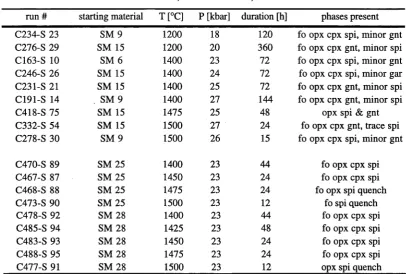
This study investigates the transition from garnet lherzolite to spinel lherzolite in the system CM AS. Table 2 compiles experimental conditions, start material information and results. Analytical results are presented in the end of this chapter (Table 3 - Analytical results). The direct approach experiments are listed on top of the table, followed by the indirect approach experiments.
TABLE
2 start materials, run conditions, resultsrun # starting material T[°C] P [kbar] duration [h] phases present C234-S 23 SM 9 1200 18 120 fo opx cpx spi, minor gnt C276-S 29 SM 15 1200 20 360 fo opx cpx gnt, minor spi C163-S 10 SM 6 1400 23 72 fo opx cpx spi, minor gnt C246-S 26 SM 15 1400 24 72 fo opx cpx spi, minor gar C231-S 21 SM 15 1400 25 72 fo opx cpx gnt, minor spi C191-S 14 SM 9 1400 27 144 fo opx cpx gnt, minor spi C418-S 75 SM 15 1475 25 48 opx spi & gnt C332-S 54 SM 15 1500 27 24 fo opx cpx gnt, trace spi C278-S 30 SM 9 1500 26 15 fo opx cpx spi, minor gnt
C470-S 89 SM 25 1400 23 44 fo opx cpx spi C467-S 87 SM 25 1450 23 24 fo opx cpx spi
C468-S 88 SM 25 1475 23 24 fo opx spi quench
C473-S 90 SM 25 1500 23 12 fo spi quench
C478-S 92 SM 28 1400 23 44 fo opx cpx spi C485-S 94 SM 28 1425 23 48 fo opx cpx spi C483-S 93 SM 28 1450 23 24 fo opx cpx spi C488-S 95 SM 28 1475 23 24 fo opx cpx spi
C477-S 91 SM 28 1500 23 12 opx spi quench
[image:24.521.72.479.225.499.2]1 .4
COMPARISON WITH PREVIOUS STUDIES AND DISCUSSION
This section will briefly review experimental results from the literature, then compare new experimental results from the present study with literature data.
The transition form garnet lherzolite to spinel lherzolite was first investigated in CMAS by MacGregor (1965) in the temperature range from 1100°C to 1500°C. A similar study by Kushiro and Yoder (1966) (1 175°C-1500°C) yielded only slightly differing results, probably due to the pressure correction applied. Both MacGregor (1965) and Kushiro and Yoder (1966) proposed a straight line of the univariant
reaction in P-T space, in contrast to subsequent work. Detailed studies by Jenkins and Newton (1979) and O ’Neill (1981) found in well reversed experiments a strong
curvature below temperatures of 1300°C, resulting in a slope of the reaction that was nearly parallel to the temperature axis. That had the consequence that garnet lherzolite could never be stable at crustal pressures (c.f. O ’Neill 1981). Patera (1982) presents a reversal at 1200°C and between 17 and 18.7 kb, corrected for the rigid talc-pyrex assembly used (as cited in Wood and Holloway 1984).
However, the information on the high-temperature part of the univariant reaction in CMAS is much less abundant and, unfortunately, controversial.
MacGregor (1965) and O’Hara et al. (1971) performed bracketing experiments but microprobe analyses of the experimental charges were not possible so that the attainment of equilibrium could not be assessed. Kushiro and Yoder (1966)
determined approximate stability fields of spinel and garnet lherzolite, respectively, but their experiments remained unreversed. Besides, uncertain pressure corrections in the different solid-media pressure devices further complicated inter-laboratory comparison of early experimental results (Koziol and Newton 1988).
The only experimental datum on the transition from spinel lherzolite to garnet lherzolite in the CMAS system at temperatures higher than 1200°C which is both reversed and analysed with electron microprobe stems from a study from Gasparik (1984). Recently, Milholland & Presnall (1998) reported a experimental datum at
35
s
I 20173 on <U
£
J________ 1
700 800 900 1000 1100 1200 1300 1400 1500 1600 Temperature [°C]
Figure 2 The transition from garnet lherzolite to spinel lherzolite in the system CM AS. Experimentally derived brackets from this study (arrows) are compared with results by O’Neill (1981) and one datum from Milholland & Prcsnall (M&P) (1998) and Gasparik (1984), respectively. The present results agree well with brackets (see text) in the low-temperature part of the diagram (800°C-\200°C) but for higher temperatures there are considerable differences between the present results and a published datum from Gasparik (1984). A recent datum by Milholland and Presnail (1998), however, is in perfect agreement with the position of the current univariant curve. The transition curve in this diagram is eye-fitted. The dry solidus is taken from Gudfinnsson and Presnail (1996) and Presnail et al. (1979).
As depicted in Figure 2, this study investigates the transition from spinel lherzolite to garnet lherzolite in proximity to the dry solidus, i.e. at temperatures bet ween 1200°C and 1500°C. The present experimental brackets agree well with extra polation of results from the studies in the low-temperature part (800°C - 1100°C) of the univariant reaction (c.f. O ’Neill 1981, Jenkins and Newton 1979, Patera 1982) and results from Milholland and Presnall (1998). The studies in the low-temperature range from 800-1100°C agree well with each other, provided that a pressure correction of -10 % is applied to O ’Neill’s (1981) data because of the rigid talc-pyrex assembly he used (Green et al. 1966).
[image:26.521.78.450.75.363.2]empirical pressure correction in his experiments, not found to be necessary for the assembly he used (Green et al. 1966). However, this does not fully explain the discrepancy between the results of Gasparik (1984) and this study. Gasparik’s study focuses on the solubility of alumina in pyroxenes, the reversal of the garnet spinel boundary is only a minor part of the study (Gasparik 1984). Run durations of Gasparik’s experiments might not have been long enough to reverse the reaction, whereas the reversals of the alumina content of pyroxenes are in good agreement with the results of our study (Figure 3).
The aforementioned ‘indirect approach’, has first been taken by Obata (1976) who used the experimentally determined isopleths of A120 3 in orthopyroxene in the system (MAS), both in the garnet stability and the spinel lherzolite stability field, to deduce the position of reaction (1) from the intersection of the isopleths. Herzberg (1978) investigated in an analogous study the isopleths of alumina of clinopyroxene, coming to somewhat different conclusions. Both studies suffered from a lack of microprobe analyses in the original experimental studies and the experiments were not reversed.
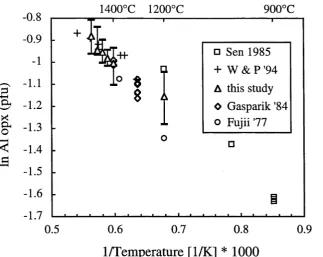
1400°C 1200°C 900°C
□ Sen 1985 + W & P '94
A this study
O Gasparik '84
o
Fujii'77 < -1.4 [image:28.521.78.402.70.327.2]1/Temperature [1/K] * 1000
Figure 3 depicts the solubility of alumina in orthopyroxene (Al pfu: A1 atoms calculated per formula unit of 6 oxygens) in equilibrium with spinel lherzolite in the system CM AS. Compared are experimental results from reversed studies of Gasparik (1984), Sen (1985) and this study. Also depicted are experimental results of an unreversed study of Walter and Presnail (1994) [W&P 94], that were derived from experiments in the system Na20-C a0-M g0-A \20 3-S i02. Walter and Presnall’s (1994) results agree well with my experiments and with those of the other studies, indicating that there is only a minor influence of sodium on the solubility of alumina in orthopyroxene. Sen (1985) presents reversal experiments from 900°C - 1200°C. Good agreement is found between his results and experimental results of this study. One of Sen’s data at 1200°C, however, considerably disagree with the results presented and with combined results from the other studies. Experiments depicted in this diagram were performed at a range of different pressures, thus indicating that the alumina solubility in orthopyroxene does not significantly depend on pressure.
Only experiments by Fujii (1977), Gasparik (1984) and Sen (1985) in the spinel lherzolite stability field were reversed and analysed with electron microprobe.
report (Carnegie Institution Yearbook) and does neither quote numbers nor
uncertainties and might be in agreement with Gasparik’s (1984) study, if errors had been quoted. If we compare one of my results at 1200°C, 18 kb (0.31 ± 0.04 N A1 opx pfu = number of A1 atoms in orthopyroxene based on a formula unit of six
oxygens) with the datum of Fujii at 1200°C 15 kb (0.26 N A1 opx pfu), one might find reasonable agreement assuming an error of approximate 0.02 (N A1 pfu of 6 oxygens) for the datum of Fujii (1977). Note, however, on the large uncertainty of the present datum. However, run durations in Fujii’s (1977) experiments are very short (a few hours). Comparing his run durations with the present experience with reaction rates in CM AS, a lack of complete equilibrium in his experiments remains possible.
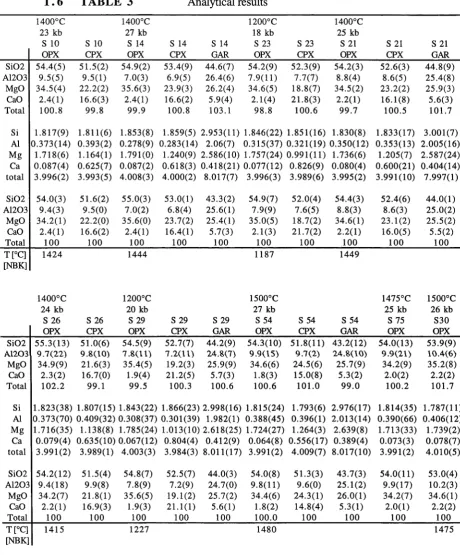
As a further test for consistency, nominal experimental temperatures (this study) were compared to calculated temperatures based on the exchange of Ca and Mg between orthopyroxene and clinopyroxene, using the thermometric formulation of Nickel et al. (1985). Results of the thermometry (Table 3) indicate excellent agreement between the present experiments and Nickel et al.’s (1985) formulation.
As mentioned in the introduction, the aim of the following chapters of this thesis is to calibrate a thermodynamic model based on the new experimental results from this study as well as on literature data. The current experiments in both the spinel lherzolite stability field as well as reversals in the garnet lherzolite stability field (from the literature) will be used to calibrate a thermodynamic model for the system CMAS that reproduces the experimental data set presented here.
1 .5
CONCLUSIONS AND IMPLICATIONS
This study presents new and reversed experimental results on the transition from garnet lherzolite to spinel lherzolite in a simplified system. The transition at temperatures close to the solidus is found to be substantially higher than previously estimated.
almandine and fayalite (“eulysites”) occur in regionally metamorphsed crustal rocks of the amphibolite facies (e.g. Woodland et al. 1995).
Chapter 2, 3, 4 and 6 investigate the influence of Cr on subsolidus equilibria and the reader is referred to these chapters for a more detailed discussion.
However, although Cr and Fe shift the reaction to higher or lower pressures, the relative position of the transition in natural compositions has to be substantially higher than in some recent estimates (e.g. Hirschmann and Stolper 1996) but consistent with other studies in natural compositions (Green and Falloon 1998).
The results of this study further complicate the interpretation of the so-called ‘garnet signatures’ in MORB, as the stability of garnet is shown here to be less than what has hitherto been assumed. Melting in the presence of garnet peridotite would begin even deeper, thus leading to an expected thickness of the oceanic crust even greater than previously predicted by melting models.
There are several apparent solutions to this conflict: either the rather simple melting models are in error, maybe because of the assumption of a linear increase in melt productivity or melting does indeed not start in the garnet lherzolite stability field, but in equilibrium with spinel lherzolite.
1.6
TABLE
3 Analytical results1400°C 23 kb
S 10 OPX
S 10 CPX
1400°C 27 kb
S 14 OPX
S 14 CPX
S 14 GAR
1200°C 18 kb S 23 OPX
S 23 CPX
1400°C 25 kb
S 21 OPX
S 21 CPX
S 21 GAR
S i02 54.4(5) 51.5(2) 54.9(2) 53.4(9) 44.6(7) 54.2(9) 52.3(9) 54.2(3) 52.6(3) 44.8(9)
A1203 9.5(5) 9.5(1) 7.0(3) 6.9(5) 26.4(6) 7.9(11) 7.7(7) 8.8(4) 8.6(5) 25.4(8)
MgO 34.5(4) 22.2(2) 35.6(3) 23.9(3) 26.2(4) 34.6(5) 18.8(7) 34.5(2) 23.2(2) 25.9(3)
CaO 2.4(1) 16.6(3) 2.4(1) 16.6(2) 5.9(4) 2.1(4) 21.8(3) 2.2(1) 16.1(8) 5.6(3)
Total 100.8 99.8 99.9 100.8 103.1 98.8 100.6 99.7 100.5 101.7
Si 1.817(9) 1.811(6) 1.853(8) 1.859(5) 2.953(1 1) 1.846(22) 1.851(16) 1.830(8) 1.833(17) 3.001(7) A1 0.373(14) 0.393(2) 0.278(9) 0.283(14) 2.06(7) 0.315(37) 0.321(19) 0.350(12) 0.353(13) 2.005(16) Mg 1.718(6) 1.164(1) 1.791(0) 1.240(9) 2.586(10) 1.757(24) 0.991(11) 1.736(6) 1.205(7) 2.587(24) Ca 0.087(4) 0.625(7) 0.087(2) 0.618(3) 0.418(21) 0.077(12) 0.826(9) 0.080(4) 0.600(21) 0.404(14) total 3.996(2) 3.993(5) 4.008(3) 4.000(2) 8.017(7) 3.996(3) 3.989(6) 3.995(2) 3.991(10) 7.997(1)
Si02 54.0(3) 51.6(2) 55.0(3) 53.0(1) 43.3(2) 54.9(7) 52.0(4) 54.4(3) 52.4(6) 44.0(1)
A1203 9.4(3) 9.5(0) 7.0(2) 6.8(4) 25.6(1) 7.9(9) 7.6(5) 8.8(3) 8.6(3) 25.0(2)
MgO 34.2(1) 22.2(0) 35.6(0) 23.7(2) 25.4(1) 35.0(5) 18.7(2) 34.6(1) 23.1(2) 25.5(2)
CaO 2.4(1) 16.6(2) 2.4(1) 16.4(1) 5.7(3) 2.1(3) 21.7(2) 2.2(1) 16.0(5) 5.5(2)
Total 100 100 100 100 100 100 100 100 100 100
T[°C] [NBK]
1424 1444 1187 1449
1400°C 24 kb
S 26 OPX
S 26 CPX
1200°C 20 kb
S 29 OPX
S 29 CPX
S 29 GAR
1500°C 27 kb
S 54 OPX
S 54 CPX
S 54 GAR
1475°C 25 kb
S 75 OPX
1500°C 26 kb
S30 OPX
Si02 55.3(13) 51.0(6) 54.5(9) 52.7(7) 44.2(9) 54.3(10) 51.8(11) 43.2(12) 54.0(13) 53.9(9)
A1203 9.7(22) 9.8(10) 7.8(11) 7.2(11) 24.8(7) 9.9(15) 9.7(2) 24.8(10) 9.9(21) 10.4(6)
MgO 34.9(9) 21.6(3) 35.4(5) 19.2(3) 25.9(9) 34.6(6) 24.5(6) 25.7(9) 34.2(9) 35.2(8)
CaO 2.3(2) 16.7(0) 1.9(4) 21.2(5) 5.7(3) 1.8(3) 15.0(8) 5.3(2) 2.0(2) 2.2(2)
Total 102.2 99.1 99.5 100.3 100.6 100.6 101.0 99.0 100.2 101.7
Si 1.823(38) 1.807(15) 1.843(22) 1.866(23) 2.998(16) 1.815(24) 1.793(6) 2.976(17) 1.814(35) 1.787(11) A1 0.373(70) 0.409(32) 0.308(37) 0.301(39) 1.982(1) 0.388(45) 0.396(1) 2.013(14) 0.390(66) 0.406(12) Mg 1.716(35) 1.138(8) 1.785(24) 1.013(10) 2.618(25) 1.724(27) 1.264(3) 2.639(8) 1.713(33) 1.739(2) Ca 0.079(4) 0.635(10) 0.067(12) 0.804(4) 0.412(9) 0.064(8) 0.556(17) 0.389(4) 0.073(3) 0.078(7) total 3.991(2) 3.989(1) 4.003(3) 3.984(3) 8.01 1(17) 3.991(2) 4.009(7) 8.017(10) 3.991(2) 4.010(5)
S i02 54.2(12) 51.5(4) 54.8(7) 52.5(7) 44.0(3) 54.0(8) 51.3(3) 43.7(3) 54.0(11) 53.0(4)
A1203 9.4(18) 9.9(8) 7.8(9) 7.2(9) 24.7(0) 9.8(11) 9.6(0) 25.1(2) 9.9(17) 10.2(3)
MgO 34.2(7) 21.8(1) 35.6(5) 19.1(2) 25.7(2) 34.4(6) 24.3(1) 26.0(1) 34.2(7) 34.6(1)
CaO 2.2(1) 16.9(3) 1.9(3) 21.1(1) 5.6(1) 1.8(2) 14.8(4) 5.3(1) 2.0(1) 2.2(2)
Total 100 100 100 100 100 100.0 100 100 100 100
T[°C] 1415 1227 1480 1475
[image:31.521.30.491.77.633.2]1500°C 1400°C 1400°C 1425°C 1450°C 1450°C
26 kb 23 kb 23 kb 23 kb 23 kb 23 kb
S30 S 89 S 89 S 92 S 92 S 94 S 94 S 87 S 87 S 93
CPX OPX CPX OPX CPX OPX CPX OPX CPX OPX
Si02 51.0(13) 54.3(4) 52.0(6) 53.8(5) 51.3(8) 53.6(5) 51.5(4) 53.6(5) 50.8(7) 54.0(5) A1203 10.1(7) 9.6(5) 9.2(7) 8.9(8) 8.9(5) 9.3(5) 9.6(1) 9.7(6) 10.1(6) 9.6(5)
MgO 23.9(11) 34.6(5) 22.1(6) 34.1(4) 22.1(21) 33.6(2) 22.5(6) 33.5(3) 23.1(10) 34.0(3) CaO 15.1(9) 2.2(2) 17.0(4) 2.1(1) 16.4(13) 2.2(1) 15.9(10) 2.2(1) 15.2(11) 2.3(1) Total 100.1 100.7 100.3 98.9 98.7 98.8 99.5 99.0 99.2 99.9
Si 1.783(21) 1.816(13) 1.820(18) 1.830(15) 1.826(46) 1.826(6) 1.812(18) 1.822(10) 1.792(29) 1.818(7) Al 0.416(13) 0.376(16) 0.379(19) 0.357(26) 0.371(4) 0.375(14) 0.398(1) 0.388(18) 0.418(12) 0.381(14) Mg 1.245(11) 1.725(3) 1.153(8) 1.728(1 1) 1.168(64) 1.706(12) 1.180(13) 1.697(9) 1.214(16) 1.707(10) Ca 0.565(1 1) 0.079(6) 0.637(0) 0.076(2) 0.624(23) 0.08(2) 0.599(26) 0.079(3) 0.574(24) 0.084(4) total 4.009(14) 3.996(6) 3.990(9) 3.991(2) 3.989(44) 3.987(1) 3.989(19) 3.985(1) 3.999(23) 3.991(0)
Si02 51.0(7) 54.0(5) 51.9(6) 54.4(5) 52.1(16) 54.3(2) 51.8(7) 54.2(3) 51.2(11) 54.0(2) A1203 10.1(3) 9.5(4) 9.2(5) 9.0(7) 9.0(1) 9.4(4) 9.6(1) 9.8(4) 10.1(3) 9.6(4)
MgO 23.9(2) 34.4(1) 22.0(1) 34.5(2) 22.3(11) 34.9(2) 22.6(2) 33.9(2) 23.3(2) 34.0(2) CaO 15.1(3) 2.2(2) 16.9(0) 2.1(1) 16.6(5) 2.2(1) 16.0(6) 2.2(1) 15.3(6) 2.3(1)
Total 100 100 100 100 100 100 100 100 100 100
T [°C] 1415 1423 1440 1456 1440
[NBK]
1450°C 1475°C 1475°C 1500°C
23 kb 23 kb 23 kb 23 kb
S 93 S 88 S 88 S 95 S 95 S 91
CPX OPX MELT OPX CPX OPX
Si02 51.5(4) 53.7(9) 49.3 53.8(4) 51.7(3) 53.7(6) A1203 9.5(6) 10.0(12) 22.1 9.6(2) 9.2(6) 10.5(11)
MgO 21.9(7) 34.1(5) 15.6 33.6(2) 23.5(5) 33.7(5) CaO 15.9(8) 2.0(2) 8.0 2.4(\) 15.0(6) 2.4(1) Total 98.9 99.8 94.9 99.4 99.4 100.3
Si 1.822(26) 1.811(19) 1.822(2) 1.816(22) 1.804(20) Al 0.398(16) 0.396(36) 0.382(3) 0.382(18) 0.414(32) Mg 1.156(11) 1.712(21) 1.698(3) 1.230(3) 1.687(10) Ca 0.604(17) 0.072(5) 0.086(2) 0.564(14) 0.085(1) total 3.979(18) 3.991(1) 3.987(1) 3.993(13) 3.989(4)
Si02 52.1(9) 53.9(6) 54.1(1) 52.0(8) 53.6(6) A1203 9.6(4) 10.0(9) 9.6(1) 9.3(4) 10.4(8) MgO 22.2(1) 34.1(4) 33.8(1) 23.6(0) 33.6(2) CaO 16.1(4) 2.0(1) 2.4(1) 15.1(3) 2.4(0)
Total 100 100 100 100 100
T[°C] [NBK]
1471
CHAPTER 2
The reaction MgCr20 4 + Si02 = Cr20 3 + MgSi03 and the free energy of
formation of magnesiochromite (MgCr20 4) 1
2 .1
INTRODUCTION
Cr20 3 is the sixth most abundant oxide component in the Earth’s Upper Mantle (McDonough and Sun 1995). At lower and moderate mantle pressures Cr20 3 is largely contained in spinels i.e. as the end member component magnesiochromite (MgCr20 4). During partial melting in the mantle, the strong partitioning of Cr into spinel can greatly stabilise spinel relative to garnet or aluminous pyroxenes (Wood
1978; O ’Neill 1981), and thus influence the trace element characteristics of melts as a function of the pressure of melt segregation. Thermodynamic modelling of the phase relations of Cr in mantle assemblages requires accurate thermodynamic data for M gCr20 4. These, however, are much less well known than what might be expected for such a key geological substance, which is also a commercially important refractory material and the sole commercially exploited ore for Chromium on Earth (Duke 1983; Pearce et al. 1984). Low-temperature heat capacity measurements for MgCr20 4 have only been performed down to 52K (Shomate, 1944), and the entropy at 298K (106 J K 1 m ol'1) was obtained by semi-empirical extrapolation of these measurements to 0 K without considering the magnetic or electronic ordering contributions to the entropy. Subsequent magnetic measurements at low temperature reveal that the Neel
temperature, at which magnetic ordering of the Cr3+ ions in MgCr20 4 occurs, is at ~15K. Hence a substantial contribution to the entropy of MgCr20 4 has been missed.
In this study the thermodynamic properties of MgCr20 4 were determined by investigating the position of the univariant reaction MgCr20 4 + S i0 2 = M gSi03 + Cr20 3 in P-T space
have been combined with literature values of the thermodynamic properties of M gS i03 (orthoenstatite) and S i0 2 (ß-quartz) from Holland and Powell (1990) and Cr20 3
2.2
SYMBOLS, ABBREVIATIONS AND CONSTANTS
TP
S° ° 298 Al-J°1 f,298
a g°t
Chr Esk En Qz R
C p
V a ß
Absolute temperature in Kelvin [K] Pressure in [bar]
Entropy at 1 bar and 298 K [J m ol'1 K '1]
Enthalpy of formation from the elements at 1 bar and 298 K [J mol'1]
Gibbs free energy change for a reaction among pure end members at the pressure and temperature of interest [J m ol'1]
MgCr20 4 - magnesiochromite Cr20 3 - eskolaite
M gSi03 - enstatite S i0 2 - quartz
Gas constant 8.3143 [J K 1 m ol'1] Heat capacity Cp =a + bT + cT~2 + dT'°5 Volume at 1 bar and 298 K [J kbar'1 m ol'1] Coefficient of thermal expansion [ K 1]
Coefficient of isothermal compressibility [b a r1]
2.3.
EXPERIMENTAL AND ANALYTICAL TECHNIQUES
Experiments
High-pressure, high-temperature experiments were carried out in a
conventional piston-cylinder apparatus (Boyd and England 1960) using a 1/2" diameter assembly. The assembly consists of two inner parts of MgO (66% density)
surrounded by three concentric shells: a graphite heater, a glass tube (Pyrex) and an outermost sleeve of NaCl, pressed to >95% of the theoretical density. This low- friction assembly is thought not to require a pressure correction (Green et al. 1966). Starting materials were sealed in platinum capsules which were insulated from the graphite heater by a small A120 3 sleeve and separated from the thermocouple tip by a 0.5 mm A120 3 disc.
Runs were performed using the “piston-out” routine. First, a pressure of -0.25 GPa was applied. Then the sample was heated up to 823 K to soften the glass. During the compression to the final run pressure temperatures did generally not exceed
reaction was bracketed between 1.60 and 1.65 (±0.03) GPa. This reaction has previously been determined by Bohlen et al. (1980) who report the bracket to lie between 1.48 and 1.50 GPa at this temperature, using a K N aC l assembly and the “piston-in” technique. However, these results include a -6% correction for friction; without this correction, the bracket would be 1.57 and 1.59, in good agreement with the result from this study (taking into account our estimated uncertainty in pressure). More recent reversal experiments on the reaction Fe2S i0 4 + S i0 2 = 2 F eS i0 3 by Koch- Müller et al. (1992) between 1073 and 1273 K using a 26 mm NaCl cell and the “piston-in” technique, with no pressure correction, extrapolate to a pressure of 1.57 (probably ±0.03) at 1323K, also in agreement with the results of this study.
Temperatures were measured with Pt94Rh6-Pt70Rh30 thermocouples (type B) inserted axially into the assembly inside two- or four-bore high purity A120 3 tubing. Type B thermocouples are much more resistant to contamination at high temperature than the more commonly used Pt-Pt90R h10 (Type S) or Pt-Pt87R h13 (Type R)
thermocouples, although they are somewhat less sensitive. Nevertheless, because thermocouple drift due to contamination is always a potential hazard in piston-cylinder experiments at high temperatures (Holloway and Wood 1988), temperatures in some runs (particularly the higher temperature ones) were additionally monitored with a second thermocouple of W 75Re25-W97Re3 (type C), using four-holed high purity A120 3 thermocouple tubing. Temperatures as measured by the two thermocouples differed
only by a maximum of 10K. The sample was placed in the hot spot of the assembly which was found in previous calibrations (Hibberson, pers. comm.). This assembly has also previously been calibrated for temperature against the melting point of gold (cf. Mirwald and Kennedy 1979). Possible pressure effects on the em f of
thermocouple pairs were neglected. The temperature uncertainties are estimated to be less than ±10 K at lower temperatures, increasing to about ±15 K at 1773 K.
Starting materials
atmospheric pressure in air. This material, which transforms rapidly to orthoenstatite at high pressures, was used in the higher temperature runs (1473 - 1773 K). For lower temperature mns (< 1473 K), orthoenstatite was used in the starting mixture, synthesised from oxides at 1423 K and 2.0 GPa in a graphite capsule. Synthesis experiments were carried out for ~24 hours.
Preliminary experiments established that the reaction proceeds very sluggishly near the univariant reaction boundary. It was, therefore, considered necessary to enhance reaction rates with a flux. At low temperature (1173 to 1373 K), the flux was de-mineralised H20 . Although H20 is well known to greatly enhance reaction rates in experimental studies, here it proved rather ineffective. It was still not possible to establish the direction of reaction satisfactorily at 1173 K, despite mn times of -120 hours, and at 1273 K the extent of the reaction in run C 443-S 81 was only very slight. Adding excess H20 to the system at temperatures higher than -1373 K is undesirable due to the very high solubilities of S i0 2 and M gSi03, and the low melting point of the M g S i0 3-S i0 2-H20 system. Therefore, at temperatures of 1373 - 1773 K, other fluxes were used: from 1473 - 1773 K, a mixture of BaO (78% wt.) and B20 3 (22% wt.) (Linares 1962; von Seckendorff and O ’Neill 1993) was found to be effective. At 1373 K the BaO - B20 3 flux apparently failed to melt, and a K20 -B 20 3 flux was employed instead. BaO, K20 and B20 3 enter into the solid phases present only in trace (ppm) levels; neither Ba nor K was detectable in any phase in the experimental mn products with electron microprobe techniques, and a substantial body of previous work in the literature of the crystal growth of silicate and oxide phases with borate fluxes has failed to detect any significant substitution of B in these phases - e.g., Barks and Roy (1967) report 50 ppm B in bulk spectroscopic analyses of Cr20 3 grown from K20 -B 20 3- containing fluxes (this should be considered a maximum level of B substitution, as some of the analysed B may be incorporated in the crystals as flux inclusions). Such trace levels of Ba, K or B as may be present in the solid phases of the mn products are insufficient to perturb the equilibrium subsolidus phase relations. A proportion of approximately 5% (wt.) flux was used in all experiments. For experiments at 1473 K a small amount of H20 was added in order to enable melting of the BaO - B20 3
mixture.
either K20 -B 20 3 or BaO - B20 3 fluxes was determined by examination by electron microscopy (see below). In all these cases, the direction could be determined unambiguously.
Analytical Procedures
Experimental run products from the higher temperature runs were cut into halves using a low speed diamond saw and mounted in epoxy resin for electron microscopy and microprobe analysis. Mounts were polished in several steps using sand paper and diamond paste of different grain sizes. The final polish was performed with 0.3 pm Linde B polishing powder.
[image:38.521.19.509.28.646.2]Energy and wavelength dispersive analysis were obtained with a Jeol 6400 Scanning Electron Microscope at the Electron Microscopy Unit (EMU) at the
2 .4
EXPERIMENTAL RESULTS
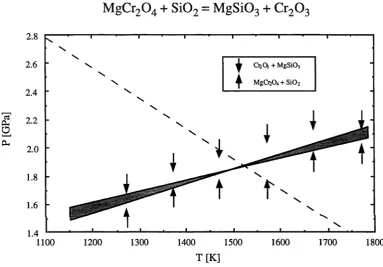
The results of all experiments are given in Table 1 and the experiments which most closely bracket the equilibrium are shown graphically in Figure 2. The reaction MgCr20 4 + S i0 2 = Cr20 3 + M g S i0 3 has a small positive slope in pressure-temperature space. This nearly flat slope means that experimental errors in temperature
measurement have almost negligible influence on the results.
MgCr20 4 + S i02 = MgSi03 + Cr20 3
T [K]
[image:40.521.79.463.216.483.2]TABLE 1 Results of Piston - Cylinder Experiments
Run # T[K] P [GPa] t [h] Result Flux
C 374-S 64 1323 1.6 24 Ferrosilite h2o
C 375-S 65 1323 1.65 24 Fayalite + Quartz h2o
C 424-S 76 1173 1.5 120 no reaction h2o
C 425-S 77 1173 1.6 120 no reaction h2o
C 414-S 74 1273 1.6 48 CHR + QZ h2o
C 443-S 81 1273 1.65 135 slight increase of ESK + EN h2o
C 412-S 73 1273 1.7 48 ESK + EN, minor CHR h2o
C 397-S 69 1373 1.7 552 CHR + QZ k2o - b2o3 C 444-S 82 1373 1.75 48 growth of CHR + QZ h2o
C 394-S 70 1373 1.8 408 ESK + EN, minor CHR k2o - B20 3 C 245-S 25 1473 1.6 120 CHR + QZ BaO - B20 3 + H20 C 304-S 39 1473 1.8 240 CHR + QZ, no EN BaO - B20 3 + H20 C 359-S 57 1473 1.9 174 ESK + EN, no CHR BaO - B20 3 + H20 C 322-S 46 1473 2.0 300 ESK + EN, minor CHR BaO - B20 3 + H20 C 283-S 34 1573 1.8 120 CHR + QZ, no EN BaO - B20 3 C 281-S 33 1573 2.0 120 ESK + EN, no CHR BaO - B20 3 C 267-S 27 1673 2.0 120 CHR + QZ, no EN BaO - B20 3 C 361-S 58 1673 2.1 30 ESK + EN, no CHR BaO - B20 3 C 317-S 42 1673 2.2 120 ESK + EN, no CHR BaO - B20 3 C 307-S 40 1673 2.4 150 ESK + EN, no CHR BaO - B20 3 C 330-S 52 1773 2.0 24 CHR + QZ, no EN BaO - B20 3 C 447-S 83 1773 2.05 24 CHR + QZ, minor EN BaO - B20 3 C 365-S 59 1773 2.1 24 ESK + EN, no CHR BaO - B20 3 C 318-S 43 1773 2.2 24 ESK + EN, no CHR BaO - B20 3 C 319-S 44 1773 2.4 24 ESK + EN, no CHR BaO - B20 3 C 320-S 45 1773 2.6 24 ESK + EN, no CHR BaO - B20 3
CHR=magnesiochromite (MgCr20 4), ESK=eskolaite (Cr20 3), EN=enstatite (M gSi03), QZ=quartz (S i02), t [h]=run duration.
M gCr3+2/3 □ 1/3 0 6, (or a combination). As far as can be judged, the amount of Si in the magnesiochromite is < 0.02 atoms per formula unit of 4 oxygens, implying a mole fraction of MgCr20 4 of > 0.98, while for the orthopyroxene, the mole atomic fraction of Cr/(Cr+Mg) is also -0.02 (±0.01), implying a mole fraction of M g S i0 3 also of 0.98.
TABLE 2 Electron microprobe analyses of selected run products
Run # S i0 2 Cr20 3 MgO total Si Cr Mg total
2 .5
THERMODYNAMIC EVALUATION
The general condition of equilibrium can be expressed as:
p
ArG T p = 0 = ArG:ribar + 1 AVT(P)dP + RT ln K 1
opx esk
w here k =
~SP . P qz
a M gC r204 a Si0 2
(
2
)(
1
)The experimental half brackets define points in free energy - temperature - pressure space at which ArG T p> 0 (low pressure half-bracket) and ArG T p < 0 (high pressure half-bracket).
We assume a^02 = a“k20, = 1 while (conveniently) a„pgSi03 = aSgCr204 = 0.98, and thus K = 1, in all runs, and that, therefore, the term in RT ln K is negligible.
Splitting ArG^ lbar into the entropy and the enthalpy terms gives: ArG ^ lba, = A rH ^ - T A Ä .
1
Inserting A,[Hp - H 298] = | A rC p(T)dT
298
and A rS^ = A rS°298 + J we have
298L
ArCp(T)
1 1
AjG^j bar = ArH 298 + J ArC°p(T)dT - TArS298 - T J
298 298
ArCp(T)
(3)
(4)
(5 ) ,
(
6
)Using expressions for the thermal expansivity a and the compressibility ß , for each phase we have:
j VT (P) dP = [V298 + aV (T - 298)] P - ^ P 2 (7)
i 2
1 1
ArH"w - T A rS“298J= - j A rC p d T + t J ArCp d T
-298 298
V2°98 + aV (T - 298) - - j - P
(
8
)Using available thermodynamic data for high temperature heat capacities, molar volumes, thermal expansivities and compressibilities (Table 3), the half brackets can then be considered as defining maximum and minimum values of the quantity
( ArH 298 ! - TArS°298 1) at each experimental temperature. These are plotted in Figure 3. To allow for experimental uncertainties in pressure, 0.03 GPa were subtracted from the low pressure half brackets and added 0.03 GPa to the high pressure half brackets.
As shown in Figure 3, the brackets constrain ArS298, to lie between 11.76 and 13.77 J K 1 m ol'1, i.e., 12.77 ± 1.01 J K 1 m ol'1. The corresponding value of ArH 298 1 is -1504 ± 1364 J mol'1 (the uncertainty is highly correlated with the uncertainty in
26000
24000 -■
min slope
AjH°298 = 140.16
A ,S 0298 = 11-76
22000 - ■
20000
-18000 -■
16000
--max slope
A.H°?go =-2867.2 4S°298 = 13.77 14000 -•
12000
-10000
1800 1900 2000
1000 1100 1400 1500
Figure 3 Constraints on the values of ArH°298 - T ArS°298 from the experimental half brackets for the reaction MgCr20 4 + S i0 2 = Cr20 3 + M g S i0 3. The intercept gives the maximum and minimum value of A,.H0298 of the reaction, the slope gives the maximal
and minimal entropy change (ArS°298) of the reaction. Arrows correspond to constraining experiments (with ± 0.03 GPa added or subtracted, as appropriate, to allow for experimental uncertainty in pressure).
Using values of ArH°298 and S°298 data for eskolaite from Holzheid and O ’Neill (1995), and for orthoenstatite and ß-quartz from Holland and Powell (1990), ArH 298 = -1759.2 ± 1.5 kJ m ol'1 and S298 = 122.1 ± 1.0 J K '1 m ol'1 are obtained for MgCr20 4. This is some 16 J K mol'1 more than the calorimetrically determined value of 106 J K 1 mol'1 (Shomate 1944). The thermodynamic data for M g S i0 3 and S i0 2 are well- known, but there remains some doubt regarding the data for Cr20 3, since the value of
2 .6
THE MAGNETIC CONTRIBUTION TO THE ENTROPY OF
MgCr20 4
The low temperature heat capacity measurements for magnesiochromite from which the calorimetric entropy is derived only extend down to 53 K (Shomate 1944). Subsequently, magnetic susceptibility measurements have shown that MgCr20 4 undergoes a paramagnetic to antiferromagnetic transition at ~15 K, caused by ordering of the magnetic spins of the Cr3+ ions (Blasse and Fast 1963). The antiferromagnetic character of MgCr20 4 at 4.2 K was confirmed by Plumier (1968). Hartmann-Boutron et al. (1969) studied the transition using X-ray diffraction and Mössbauer, and
concluded that the transition is first-order (i.e., is accompanied by a change in crystallographic symmetry'). A similar magnetic transition has also been observed in ZnCr20 4 at ~10 K (Hartmann-Boutron et al. 1969; Kino and Liithi 1971).
MgCr20 4 has the spinel crystal structure, which consists of a cubic close- packed array of anions with half of the octahedral interstices and one-eighth of the tetrahedral interstices occupied by cations. These are commonly referred to as the B and A sites, respectively. MgCr20 4 is a normal 2:3 cubic spinel with essentially all Mg2+ ions on A-sites and all Cr3+ on B-sites (O’Neill and Dollase 1994). Short range antiferromagnetic order between Cr3+ ions in B-sites is possible since their t2g orbitals are directed towards each other (Dunitz and Orgel 1957).
The maximum contribution to the magnetic entropy of MgCr20 4 (S ) is given by 2R ln (2S+1), where S is the spin quantum number. Because Cr3+ has three unpaired d-electrons, S is 3/2, and the maximum magnetic contribution to the entropy is 2R In 4, or 23.05 J K '1 m o l1.
2 .7
COMPARISON WITH PREVIOUS MEASUREMENTS OF THE
ENTHALPY AND FREE ENERGY OF FORMATION OF MgCr20 4
The value of ArH°298 of -1504 ± 1364 J m ol'1, combined with the standard enthalpies of formation of M gSi03, S i0 2, Cr20 3 and MgO (Table 3) leads to a value of the standard enthalpy of formation of MgCr20 4 from the oxides (Afox H°298 ,) of -32.9 kJ m ol'1. This is considerably less negative than the value of -44.4 kJ m ol'1, from Midler and Kleppa (1973), obtained from oxide melt solution calorimetry at 1173 K (Afox H °1173! = -46.3 ± 0.8 kJ mol'1, corrected to 298 K using the heat capacities in Table 3). The reason for this discrepancy is not known.
MgO + Cr20 3 = MgCr20 4
AG R obieetal. (1979) AG Jacob (1977) AG (this study)
-10
-200 400 600 800 1000 1200 1400 1600 1800
T [K]
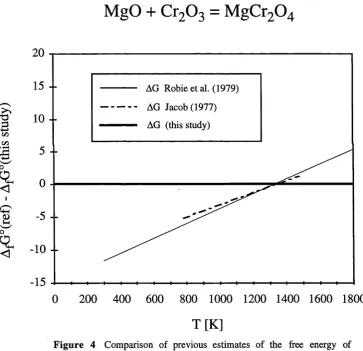
[image:47.521.80.444.288.639.2]The results of this study for the free energy of formation of MgCr20 4 are compared with the values tabulated by Robie et al. (1979), essentially from
calorimetric data, in Figure 4. These tabulated data are clearly not compatible with the reversals of the MgCr20 4 + S i0 2 = Cr20 3 + M gS i03 equilibrium (as also illustrated in Figure 2).
TABLE 3 Thermodynamic data from the literature
V [J bar'1] S°298[J m ol'1 K '1] AfH° (xlO3) [KJ mol"1]
M gSi03 6.262 132.5 -3089.38
S i02 (ß) 2.367 43.54 -909.07
Cr20 3 2.9051 86.65 -1124.9 ¥
MgCr20 4 4.356
MgO -601.41
a b (x l0 '2) c (xlO3) d
M gSi03 356.2 -0.299 -596.9 -3185.3
S i02 (ß) 97.9 -0.335 -636.2 -774
Cr20 3 108.734 1.184 -2348.54 27 8.44
MgCr2C>4 196.14 0.54 -3126 -616.88
MgO
ocV (xlO'5) ßV (xlO'6) source
M gSi03 18 4.6 H&P (‘90)
S i02 (ß) 0 2.6 H&P (‘90)
Cr20 3 5.43 0 .9 2 * H&ON (‘95)
MgCr20 4 7.23 1.92 * Rob (‘79)
MgO H&P (‘90)