HUMAN-ROBOT INTERACTION (HRI) FOR REHABILITATION
PATIENTS WITH AN ANIMAL ROBOT USING IMAGE
PROCESSING
This report is submitted in accordance with requirement of the University Teknikal Malaysia Melaka (UTeM) for Bachelor Degree of Manufacturing Engineering
(Robotics and Automation) (Hons.)
by
MOHAMAD NORIMAN BIN SANTA B051310104
930627-12-6071
Disahkan oleh:
_____________________________ ______________________________ Alamat Tetap: Cop Rasmi:
_____________________________ _____________________________ _____________________________
Tarikh: _______________________ Tarikh: _______________________
*Jika Laporan PSM ini SULIT atau TERHAD, sila lampirkan surat daripada pihak berkuasa/organisasi berkenaan dengan menyatakan sekali sebab dan tempoh laporan PSM ini perlu dikelaskan sebagai SULIT atau TERHAD.
UNIVERSITI TEKNIKAL MALAYSIA MELAKA
BORANG PENGESAHAN STATUS LAPORAN PROJEK SARJANA MUDA
Tajuk: HUMAN-ROBOT INTERACTION (HRI) FOR REHABILITATION PATIENTS WITH AN ANIMAL ROBOT USING IMAGE PROCESSING
Sesi Pengajian: 2016/2017 Semester 2
Saya MOHAMAD NORIMAN BIN SANTA (930627-12-6071)
mengaku membenarkan Laporan Projek Sarjana Muda (PSM) ini disimpan di Perpustakaan Universiti Teknikal Malaysia Melaka (UTeM) dengan syarat-syarat kegunaan seperti berikut:
1. Laporan PSM adalah hak milik Universiti Teknikal Malaysia Melaka dan penulis. 2. Perpustakaan Universiti Teknikal Malaysia Melaka dibenarkan membuat salinan
untuk tujuan pengajian sahaja dengan izin penulis.
3. Perpustakaan dibenarkan membuat salinan laporan PSM ini sebagai bahan pertukaran antara institusi pengajian tinggi.
4. *Sila tandakan (√)
(Mengandungi maklumat yang berdarjah keselamatan atau kepentingan Malaysiasebagaimana yang termaktub dalam AKTA RAHSIA RASMI 1972)
(Mengandungi maklumat TERHAD yang telah ditentukan oleh organisasi/ badan di mana penyelidikan dijalankan)
SULIT
TERHAD
DECLARATION
I hereby, declared this report entitled “human-robot Interaction (HRI) for Rehabilitation Patients with an Animal Robot using Image Processing” is the result of my own research
except as cited in references.
Signature : ………
Author’s Name : MOHAMAD NORIMAN BIN SANTA
APPROVAL
This report is submitted to the Faculty of Manufacturing Engineering of Universiti Teknikal Malaysia Melaka as a partial fulfilment of the requirement for Degree of Manufacturing Engineering (Robotics and Automation) (Hons). The member of the
supervisory committee is as follow:
i
ABSTRAK
ii
ABSTRACT
iii
DEDICATION
This project is dedicated to
my beloved father, Hj Santa bin Amir Husin my appreciated mother, Hjh Jumdariah binti Ali Baradun
my siblings my housemates
for giving me moral support, financial support, cooperation, encouragement and also understanding
iv
ACKNOWLEDGEMENT
In the name of ALLAH, the most gracious, the most merciful, with the highest praise to Allah that I manage to complete my final year project without any difficulty.
I would like to thank Dr. Syamimi binti Shamsuddin for her concern and care as my supervisor for this project, advice and guidance as well as exposing me with meaningful experiences so that I will be able to complete my final year project successfully.
Next I would like to thank to my beloved parents. My father, Hj Santa bin Amir Husin and my mother Hjh Jumdariah binti Ali Baradun for their understanding, patience and great support for me whenever it is need most.
v
TABLE OF CONTENTS
Abstract ii
Dedication iii
Acknowledgement iv
Table of Content v List of Table viii
List of Figures ix
List of Abbreviation xii
CHAPTER 1: INTRODUCTION 1.1 Research Background 1
1.1.1 What is a Robot? 2
1.1.2 History of Human-robot Interaction (HRI) 4
1.1.3 What is Human-robot Interaction (HRI)? 6
1.1.4 Types of Robot in Human-robot Interaction 8
1.2 Problem Statement 10
1.3 Objectives 11
1.4 Scope 12
1.5 Report Outline 13
1.6 Gantt Chart 14
CHAPTER 2: LITERATURE REVIEW 2.1 Human-robot Interaction (HRI) 17
2.2 Application of Human-robot Interaction 18
2.3 Depression 23
2.3.1 Types of Depression 26
2.3.2 Types of Therapy for Depression 27
2.4 Robot Assisted Therapy (RAT) 30
2.5 PARO the Seal Robot 33
vi
2.7 Review of Previous Study 37
2.8 Summary 39
CHAPTER 3: METHODOLOGY 3.1 Overall Flowchart of Project Methodology 40
3.1.1 Stage 1: Preliminary Study and Experimental Setup 41
3.1.2 Stage 2: Experimental 42
3.1.3 Stage 3: Data Analysis 43
3.2 Experimental Tools and Subject 43
3.2.1 PARO Robot 44
3.2.2 Psychological Tools 45
3.2.3 Patients with Depression 47
3.2.4 Location and Therapy Room for the Experiment 49
3.3 Experimental Setup 50
3.4 Interaction between Patient and PARO Robot 51
3.5 Summary 52
CHAPTER 4: EXPERIMENTAL RESULTS AND DISCUSSION 4.1 Development of OpenCV Codes for Smile Detection 53
4.2 Actual Experiment Setup at Therapy Room 57
4.3 Data Collection 58
4.3.1 Video Analysis 58
4.3.2 Survey Results (HRI survey) 61
4.3.3 Psychological Tools 63
4.4 Discussion 65
CHAPTER 5: CONCLUSION AND RECOMENDATION 5.1 Conclusion 66
5.2 Recommendation for Future Works 67
vii
REFERENCES 69
viii
LIST OF TABLES
1.1: Summary for the project element and scope covered 12
2.1: Comparison between MATLAB and OpenCV 36 2.1: Literature review on previous study 37
3.3: Features and function of the robot that is suitable in therapy applications 45 (Wada et al., 2004)
ix
LIST OF FIGURES
1.1: Interaction of NAO robot with human (Griffiths, 2014) 1 1.2: Therapeutic robot PARO (Shibata et al., 2014) 2
1.3: Different forms of: (a) I-Cybie (Tiger Electronics): 3 (b) NeCoRo (Omron); (c) Humanoid robot - P3 (Honda) (Fong et al., 2002)
1.4: Representative types of robots. In clockwise order beginning in the upper left: 5 Robota; SonyAIBO; A sophisticated unmanned
underwater vehicle; Shakey; Kismet; Raven; iRobot_ PackBot (Goodrich and Schultz, 2007)
1.5: Spatial classification of HRI (Bani Hashim, 2016) 6 1.6: Mobile robot working on aircraft wing (Brumson, 2012) 8
1.7: ASIMO, a two-legged robot developed by Honda 9 (Encyclopaedia Britannica, Inc., 2016)
1.8: Tekno's toyetic interaction offers many emotions such as barking 10 crying, whimpering, and expressive eye patterns to share his feelings
(Tekno Robotic, 1999).
1.9: PARO opens its eyes as it reacts to an elderly user's hand 10 (Subbaraman, 2013)
1.10: People find real comfort in artificial companionship 11 (Subbaraman, 2013)
2.1: An example of an HRI testbed: a humanoid torso on a mobile 18 platform, and a simulation of the same. (Feil-Seifer and Matari´c, 2009)
2.2: Quince is a robot that use in exploring a building or a 19 underground facility partially collapsed by a severe disaster (Nanjo, 2012)
2.3: The “wheelbarrow” bomb disposal robot in action (Hirst, 2014) 19 2.4: Humanoid robot NAO has won the hearts of classes and 20
teachers from infant schools through to universities (Tie, 2014)
x
2.6: Acrobot sculptor robot used for cam correction surgery 21 (Masjedi et al., 2013)
2.7: Keepon's simple yet dynamic design opens a space for human-robot 22 interaction (HRI), especially in autism research (Reed, 2016)
2.8: The symptoms that can be clearly seen on a person who 23 having a depression (SimpleeKafe Health Pvt Ltd, 2016)
2.9: Lifecycle, biological, hormonal, and psychological factors 25 that are unique to woman can be linked to higher depression rate (Lansky, 2013) 2.10: Men can become discouraged, frustrated, angry, irritable, and 25
sometimes abusive when they are depressed (DeBoni, 2014)
2.11: Parental depression linked to troubling behaviour in kids 26 (Psychiatry Advisor, 2015)
2.12: The terms psychological treatments and psychotherapy 28 (Sometimes shortened to therapy) cover a wide range of talking treatments
(Mulholland, 2016)
2.13: Bottles of antidepressant pills that used in medical treatment 28 for depression (Bhatia, 2016)
2.14: Electroconvulsive therapy (ECT) for depression is the only 29 treatment that is usually stopped when the patient has recovered
(RAMI et al., 2008)
2.15: Animals not only bring a sense of companionship but also 30 require responsibility, teach empathy, instill trust, bring happiness
and give a sense of purpose to one’s daily life (Fuller, 2014)
2.16: Examples of animal robot used in Robot Assisted Therapy 31 (Australian Government Department of Health and Ageing, 2012)
2.17: Aibo and elderly of long-term care facility (Banks et al., 2007) 32 2.18: Interaction between Elderly People and Animal robot that 32
been used in Animal Assisted Therapy (Wada et al., 2005)
2.19: PARO robot win an award of Robot of the Year in 2006 by 33 Japan’s Economy, Trade and Industries Ministry (Balik, 2008)
2.20: All sensors that therapeutic robot PARO has (WADA et al., 2004) 34 2.21: Example of application of image processing for personal photo 35
xi
3.1: Flowchart of the overall research method 41
3.2: Main sensors that embedded PARO robot has (Wada et al., 2004) 44
3.3: Sample of patient consent form 48
3.4: Plan Setup for experiment 50
3.5: Flowchart for the first session where PARO was introduce to all patients 51
3.6: Flowchart for the second session where patients interact with PARO 52
4.1: Example of smile detection using OpenCV 54
4.2: Coding to import library 54
4.3: Coding to Import Data Structure for Face and Smile 54
4.4: Coding to set the variable for face 55
4.5: Coding to set the variable 55
4.6: Coding to Draw Rectangle around the Face 55
4.7: Coding to Draw Rectangle to Detect Smile 56
4.8: Coding to Open New Interface for Smile Detection 56
4.9: Setup during interaction at therapy room 57
4.10: Actual Setup for Experiment 58
4.11: Image processing system detect the smile for Patient A 59
4.12: Image processing system detect the smile of the patient 59
4.13: Graph for number of smile with and without PARO robot for Patient A 60
4.14: Graph for number of smile with and without PARO robot for Patient B 61
4.15: Graph for score HRI survey for Patient A 62
xii
LIST OF ABBREVIATION
HRI - Human-robot Interaction
AAT - Animal Assisted Therapy
MATLAB - Matrix Laboratory
SAR - Search and Rescue
STEM - Science, technology, engineering and math
RET - Robot-enhance Therapy
MDD - Major Depressive Disorder
SAD - Seasonal affective disorder
ECT - Electroconvulsive Therapy
CBT - Cognitive Behavior Therapy
IPT - Interpersonal Therapy
MBCT - Mindfulness-based Cognitive Therapy
RAT - Robot Assisted Therapy
RAM - Random Access Memory
1
CHAPTER 1
INTRODUCTION
1.1 Research Background
Human-robot interaction (HRI) is the interdisciplinary study of interaction dynamics between humans and robots. Researchers and practitioners specializing in HRI come from a variety of fields, including computer science, engineering, humanities, and social. HRI has continued to be a topic of education and popular culture interest. In fact, existence of real-world robots have come long after movies, plays, and novels developed them as notions and start to make inquiries on how peoples and robots would cooperate, and what their particular parts in public area would be. Figure 1.1 shows the interaction between robot and human.
Figure 1.1: Interaction of NAO robot with human (Griffiths, 2014)
2
[image:18.595.197.441.257.387.2]Nowadays, animal therapy is becoming more popular for its positive mental effects on patients with psychological problems such as dementia and autism (include suitable citation here). This therapy is also known as animal assisted therapy (AAT) or pet therapy. Barker and Dawson (1998) claimed that this treatment alludes to interaction with therapeutic goals between a person or group of individuals for whom the treatment is planned, and a prepared an animal encouraged by its handler. Animal that always been used in animal assisted therapy include cats, dogs or birds, for some reason other animals such as horses, rabbit and fish also can be used and it depending on personal client needs.
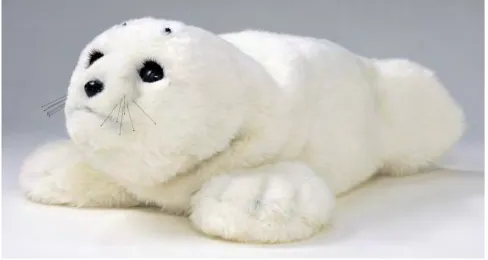
Figure 1.2: Therapeutic robot PARO (Shibata et al., 2014)
In this project, PARO the same therapy will be used for therapy but this time it focus on patients who are receiving treatment at a rehabilitation centre and this study covers the application of a therapeutic animal robot to give comfort and alleviate stress for patients receiving treatment at a rehabilitation centre.
1.1.1 What is a Robot?
Robotic is a parts of modern technology in which it combine few types of engineering field. Robotics is a science-based technology, where it relates to the application robotic system and theory (Tsai, 1999).
3
resembling a human being and able to replicate certain human movements and functions automatically”.
Flanagin, 2011 stated that robotics is differing territory of study with applications in various fields and parts of society. Properly designed robotic systems that take into account how they benefit human users make use of multiple methods of evaluation. Flanagin defined robotics as a mechanical framework controlled by installed or PC systems with reason for improving human task
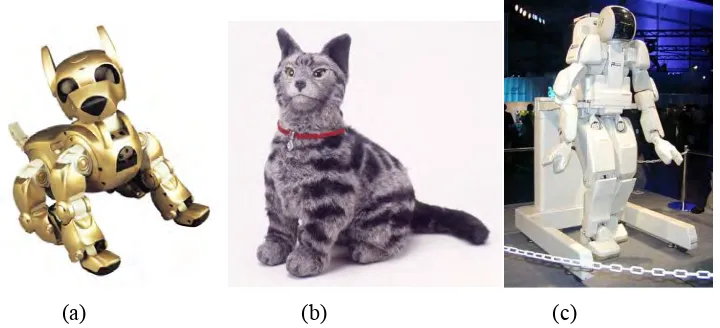
Robot can come in many different forms such as humanoid, arm robot, animal and etc. as shown in Figure 1.3. A robot is developed replication of something that use robotic technology with the end goal of mirroring something else of accomplishing a task. Robot can be control by an outside control device or the control might be implement inside the robot.
[image:19.595.126.486.401.565.2](a) (b) (c)
4 1.1.2 History of Human-robot Interaction (HRI)
In 1980s, robotics was perceived as on a very basic level interdisciplinary, with major commitments from mathematics, biology, computer science, control theory, electrical engineering, mechanical engineering, and physics. By the 1990s, robots were progressively required in mechanized assembling situations, in deep-sea and space investigation, in military operations, and in lethal waste administration. Predictions abounded that robots would get to be distinctly vital in home and office situations too. Toward the start of the twenty-first century, we are nearer to the day when different robot substances might be coordinated into individuals’ day by day lives (Anna, 2016).
Similarly as computers started as scholarly and research-related computational devices however got to be distinctly individual electronic frill for the overall population, robots now can possibly serve not just as cutting edge workhorses in logical attempts additionally more personalized appliances and assistants for ordinary people. In any case, while the study of human-computer interaction has a moderately long history, it is just as of late that adequate advances have been made in automated discernment, activity, thinking, and programming to permit researchers to start genuine thought of the intellectual and social issues of human-robot interaction (Anna, 2016).
A leap forward in independent robot innovation happened in the middle 1980s with work in conduct base on mechanical technology. A moment critical achievement for robotic as it applies to HRI is the rise of hybrid architecture; these designs all the while permit refined receptive practices that give central robot capacities alongside the abnormal state psychological thinking required for unpredictable and persevering collaborations with people. Robot practices at first centered on mobility, yet later commitments look to create exact anthro209 pomorphic practices, adequate practices of family unit robots, and alluring practices for robots that take after, pass, or approach Humans (Goodrich and Schultz, 2007).
5
[image:21.595.121.527.235.445.2]comprise of abnormal state supervision and course of the robot, with the human giving objectives and the robot keeping up information about the world, the assignment and its limitations. Also, the collaborations might be through perception of nature and understood correspondences by, for instance, the robot reacting to what its human companion is doing. Taking an extremely wide and general perspective of HRI, one should seriously think about that it incorporates creating calculations, programming, testing, refining, handling, and keeping up the robots (Goodrich and Schultz, 2007).
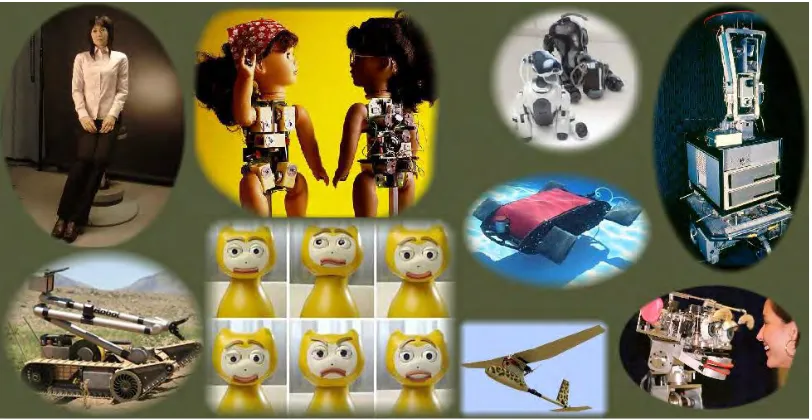
Figure 1.4: Representative types of robots. In clockwise order beginning in the upper left: Robota; SonyAIBO; A sophisticated unmanned underwater vehicle; Shakey; Kismet; Raven; iRobot_
PackBot (Goodrich and Schultz, 2007)
For this situation, communication comprises basically in finding and diagnosing issues, taking care of these issues, and afterward reconstructing (or rewiring) the robot. The contrast between this sort of "programmingbased" interaction and advanced HRI is that the field right now underscores proficient and dynamic collaborations instead of simply rare interactions.
6 1.1.3 What is Human-robot Interaction (HRI)?
Human-robot interaction (HRI) is fields of study committed to design, understand, and examines the framework of robotics for use by humans (Bani Hashim, 2016).
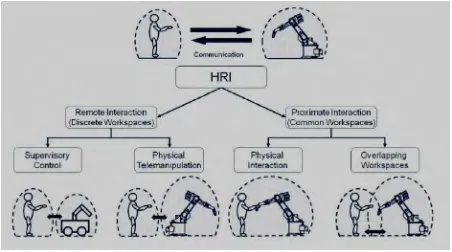
Interaction, means that a communication between human and robot. It may happen in many forms, but the forms are usually changed if the human and the robot are in close proximity to each other or not. Hence, there are two types of communication between human and robot, Figure 1.5 shows spatial classification of HRI.
a) Remote interaction – The human and the robot are not arranged and are isolated spatially or even transiently.
[image:22.595.84.536.394.646.2]b) Proximate interaction – The people and the robots are assembled.
7
In this general class, it is valuable to separate between function that required social collaboration, versatility, or physical control. Remote cooperation with versatile robots is usually referred to a supervisory control or teleoperation, and remote connection with a physical controller is regularly referred as tele-control.
Proximate interaction with versatile robots may appear as a robot aide, and proximate association may incorporate a physical cooperation. Social communication incorporates social, emotive, and psychological parts of association. In social collaboration, the people and robots connect as associates or colleagues. Imperatively, social connections with robots give off an impression of being proximate as opposed to remote due the volume of work in social associations is unfathomable (Goodrich and Schultz, 2007).
It has been a theme for human-robot interaction in hypothesis and sci-fi even before the robot itself exist. Various parts of HRI are continuations of human correspondences subjects that are more seasoned than apply autonomy, since HRI depend on information of (at times regular) human correspondence. The HRI origin as a discrete trouble was reported by 20th –century author Isaac Asimov in 1941, in his novel I, Robot. He states the Three Laws of Robotics as (Feil-Seifer and Matari´, 2009):-
a) A robot may not injure a human being or, through inaction, allow a human being to come to harm.
b) A robot must obey any orders given to it by human beings, except where such orders would conflict with the First Law.
c) A robot must protect its own existence as long as such protection does not conflict with the First or Second Law.
8
1.1.4 Types of Robot in Human-robot Interaction
There are several types of robot used in HRI with different application such as mobile robot, humanoid robot and animal robot. This robot either for military, service, hospitality, and etc.
Autonomous mobile robots are the realization of the technology of mobility and task's execution techniques. The technology of movement is the mechanisms that allow a mobile robot to move through a real-world environment that includes locomotion, sensing, localization, and motion planning (Bani Hashim, 2016)
Mobile robot is a robot that can move from one place to another without any assistance from human operator (Figure 1.6). Mobile robot have a special feature which it can move freely within a predefine workspace to achieve the desired goal unlike industrial robot that can only move in a specific workspace. This capability make mobile robot suitable for a large repertory of application structure or unstructured environments (Tzafestas, 2014).
Figure1.6: Mobile robot working on aircraft wing (Brumson, 2012)
Siegwart et al. (2011) states that mobile robots need locomotion mechanisms that enables it to move unbounded throughout its environment.