This is a repository copy of The Influence of Color on Impulsivity and Arousal: Part 1 – Hue.
White Rose Research Online URL for this paper: http://eprints.whiterose.ac.uk/123160/
Version: Accepted Version
Article:
Duan, Y, Rhodes, PA and Cheung, V (2018) The Influence of Color on Impulsivity and Arousal: Part 1 – Hue. Color Research and Application, 43 (3). pp. 396-404. ISSN 0361-2317
https://doi.org/10.1002/col.22201
© 2018, Wiley. This is the peer reviewed version of the following article: Duan, Y, Rhodes, PA and Cheung, V (2018) The Influence of Color on Impulsivity and Arousal: Part 1 – Hue. Color Research and Application, 43 (3). pp. 396-404 , which has been published in final form at http://dx.doi.org/10.1002/col.22201. This article may be used for non-commercial purposes in accordance with Wiley Terms and Conditions for Self-Archiving.
[email protected] https://eprints.whiterose.ac.uk/
Reuse
Items deposited in White Rose Research Online are protected by copyright, with all rights reserved unless indicated otherwise. They may be downloaded and/or printed for private study, or other acts as permitted by national copyright laws. The publisher or other rights holders may allow further reproduction and re-use of the full text version. This is indicated by the licence information on the White Rose Research Online record for the item.
Takedown
If you consider content in White Rose Research Online to be in breach of UK law, please notify us by
The Influence of Color on Impulsiveness and Arousal:
Part 1 – Hue
Yiting Duan*a, Peter A. Rhodes b, Vien Cheung b
a Faculty of Materials and Textiles, Silk Institute, Zhejiang Sci-Tech University, 928 Second
Avenue, Xiasha Higher Education Zone, Hangzhou, 310018, China
b School of Design, University of Leeds, Leeds LS2 9JT, United Kingdom
*Corresponding author: Yiting Duan, [email protected]
Peter A. Rhodes: [email protected]; Vien Cheung: [email protected]
Abstract
Impulsiveness and arousal are two similar yet distinct emotional and behavioral states that have been shown to be influenced by color in many fields, such as clothing and environment design. This series of studies investigates the fundamental theory of how color impacts on people’s impulsiveness and arousal states. To achieve this goal, psychophysical
methods were used to examine the impact of color environment on impulsiveness and arousal. Two main factors were used to quantify them: response time and error rate in problem solving. The psychophysical experiment was designed to examine whether, in a particular color environment, the response time and error rate were different. Participants sat in front of a large TV screen showing different colored backgrounds against which a range of psychometric tests were completed. The color backgrounds varied in hue. During the experiment, participants were required to give their responses to each of the psychometric tests as quickly and accurately as possible. The results showed that different colors can significantly influence
Key words: impulsiveness; arousal; hue; Color psychology.
Introduction
Color can impact on not only aesthetics and meaning within design, but may also be used to support design with a scientific basis. Taking sportswear as an example, research has shown that the color of apparel can influence an athlete’s performance.1-3 Thus, in professional sports games, clothing color
may be a deciding factor when competitors have similar abilities. Color's influence on behavior can also be found in environmental design. For example, vivid colors used in learning environments led to significantly higher reading scores.4 The differentiation in wall color is related to higher levels of
cooperative behavior among pre-school children.5 Beyond these clear target
application areas, research exploring the fundamental theory of how color influences behavior, especially impulsiveness and arousal, is limited.
Impulsiveness
Although there is evidence that color can influence emotional states,6-8
research into how color influences mental state and bodily behavior is lacking. Impulsiveness is the behavioral ability to respond quickly and without mental reflection, which is highly related to the control of thoughts and behavior.9-10
Impulsiveness can be classified into three types: motor impulsiveness, such as
acting without thinking, taking evasive action while driving to avoid an animal; cognitive impulsiveness, such as making quick conscious decisions; and
non-planning impulsiveness, such as a lack of concern for the future.11
Arousal
Arousal is the physiological and psychological state of being awoken, such as the sudden confrontation with danger.12 Literally, arousal defines a situation
extreme effort or intense alertness.13 From daily life, to be aroused means to
be wide-awake, alert, vigorous, excited and full of pep; whereas to be less aroused means to be sleepy, sluggish, tired and relaxed.14 In many situations,
impulsiveness and arousal may conflate. For example, being suddenly confronted by a snake would result in significantly increased arousal and could
also lead to impulsive action such as jumping to one side.
Measuring Impulsiveness and Arousal
Whether color can impact on people’s impulsiveness and arousal is a relatively unexplored area of research. The measurements of impulsiveness and arousal are actually very similar. Four types of data are normally collected to assess a person’s impulsiveness state and usually three types of data are collected to measure arousal. They have been classified by Barratt10 and
Andrea13 as follows:-
Measuring Impulsiveness
1) Everyday life experiences, such as peer ratings, hobbies or family relationships;
2) Psychometric and psychiatric interviews, such as Barrat Impulsiveness Scale (BIS scale);
3) Laboratory behavioral measures, for example classical eye-blink conditioning and two-dimensional tracking;
4) Psychophysiological or neuro-physiological measures, such as heart rate, cortical evoked potentials, Galvanic Skin Response (GSR) and so forth.
Measuring Arousal
1) Self-reporting method, such as verbal scales, non-verbal scales; 2) Psychophysical measures, such as the paper-folding and cutting task; 3) Psychophysiological measures, such as EEG, heart rate, and EDA, or
This study used the laboratory psychophysical behavioral measures as its main method as these are more quantifiable and practical. A more objective way of measuring impulsiveness and arousal can be applied to the later stages of research to support the findings from the behavioral measures.
Relationship between Impulsiveness and Arousal
According to the literature, typical laboratory-type tests designed for adults to measure impulsiveness are psychometric-related, such as the Porteus Maze Test, Matching Familiar Figures Test, Trail Making Test, Wisconsin Card Sorting Task, Circle Tracing, and Rorschach Test. In most of these tests, response time and error rate are the key data collected to judge impulsiveness.15-17,8 In this study, there is a need to establish a reliable method
for measuring both impulsiveness and arousal. Based on the literature, psychophysical measures are also suitable to measure arousal, for example
the Paper-folding and Cutting Task.13 The often-used indicators for measuring
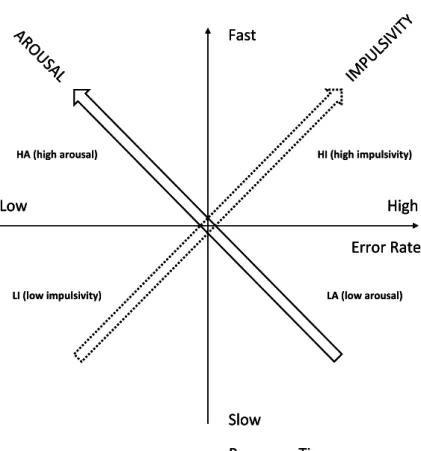
arousal are also response time and error rate. The theory of four quadrants of impulsiveness using response time and error rate as its coordinates is a suitable starting point to build on.18-19 The four quadrants of impulsiveness
defined by Kagan are:-
1) Quick response, many errors (High Impulsiveness). 2) Quick response, few errors (Medium Impulsiveness). 3) Slow response, many errors (Medium Impulsiveness). 4) Slow response, few errors (Low Impulsiveness).
a quick response with fewer errors in performance (awoken, excited); and low arousal showing a slow response and a higher error rate (sleepy, tired). Therefore, it is appropriate to improve Kagan’s four impulsiveness quadrants theory to an error/speed theory which can clearly explain both impulsiveness and arousal. Figure 1 shows an example of the error-speed space designed
for this study.
(Figure 1 is about here.)
This research intends to study the impact of color on impulsivity and arousal in a more fundamental method. The starting point for this research was using colors on a TV screen. In later research, the conditions can be extended to
colored lighting in an actual working environment.
Methods
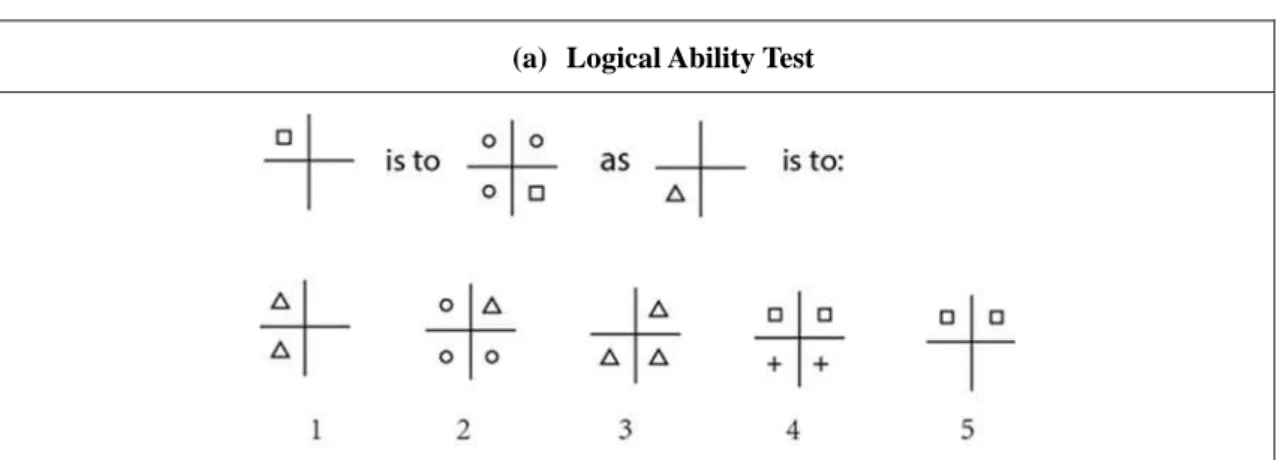
The overall goal of this study is to investigate the influence of color on impulsiveness and arousal. An initial psychophysical experiment was conducted to explore hue influence. Six types of psychometric tests were used in the hue experiment: logical rule, spatial structure, rotation, mathematics sequence, odd one out, and same detail. Table 1 describes the six types of tests. There were three repeats for each test type, therefore in total each
participant needed to complete 126 (6 tests 7 colors 3 repeats) psychometric trials in one experiment. The influence of hue on impulsiveness and arousal has also been compared between the genders.
(Table 1 is about here.)
Color Samples
reference white color (used as a control) were studied in the experiment. The CIELAB values of the seven colors were measured using a CS-1000 spectroradiometer. The L* and C* values of all seven colored backgrounds were both fixed at around 66 (± 2). The detailed characteristics of these seven colors are given in Table 2.
(Table 2 is about here.)
Participants
A total of 27 participants (14 females and 13 males) took part in the experiment. As all subjects were Chinese, so cultural difference was a controlled factor. They were all university students, having various educational backgrounds,
aged between 20 and 38. All participants had normal color vision according to the Ishihara Color Vision Test.20 Based on the error rate and response time
results of each participant, four impulsiveness/arousal states (High Impulsiveness: HI; High Arousal: HA; Low Impulsiveness: LI and Low Arousal: LA) have been classified.
Experimental Procedure
The psychophysical experiments were conducted in a dark room with individual participants. Upon entering the room for the first time, they were required to complete the Ishihara Color Vision Test. After passing this test, they
The settings used throughout were high contrast, medium brightness, medium color and cool color temperature.
During the experiment, participants were asked to focus on the reference white background for two minutes to adapt to the experiment environment before
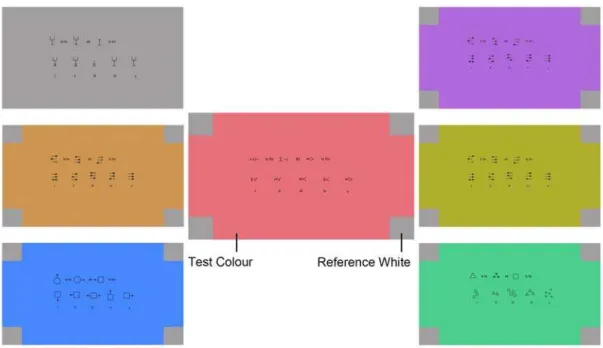
each test. For each test, they were required to speak out the answer with no opportunity to change their minds. After responding, participants then moved on to the next test. Participants solved tests with the reference white background first, followed by the other six colored backgrounds (with four reference white patches in the corners) in a random sequence. The whole experiment took approximately one hour for each observer. Every day after finishing all the experiments, the seven background colors were re-measured at the same distance from the display as participants (75 cm) to ensure the repeatability of the colored backgrounds. Figure 2 shows an example of seven colored screens from this experiment. Two weeks after the first experiment
(which worked as a wash-out period to reduce carry-over effect from one experiment to the next), they were required to repeat the experiment once more to evaluate their repeatability.
(Figure 2 is about here.)
Results
The experimental data collected from the experiments were each participant’s response time and the number of errors. The combination of these two indicators can measure participants' performance. These two sets of data
collected from the psychophysical experiments will be discussed by color and by gender respectively in the following sections.
Participant Performance
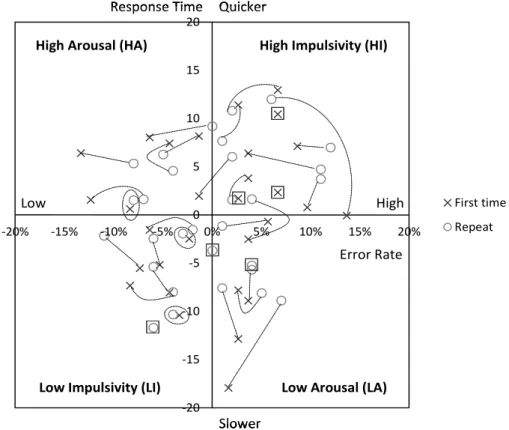
impulsiveness state between the first and repeat experiments. The participant’s impulsiveness was determined as: LI, longer response time and smaller error rate; HI, shorter response time and higher error rate; HA, quicker and smaller error rate; and LA, slower and higher error rate (all compared with mean). Figure 3 depicts the four impulsiveness/arousal states in this
experiment. Results showed that all participants did not have a big jump in impulsiveness states between the first and repeat experiments. (A big jump means from LI to HI or vice versa.) This indicates that participants do not need long-term training to complete the psychometric tests and their impulsiveness states were stable. Consequently, both data sets can be used in the study.
(Figure 3 is about here.)
The mean four-state categories are summarized in Table 3. HI was the biggest group among the four (16 participants). Participants who were high in impulsiveness normally spent around 20 seconds on each test, while their error rate was 26%. The second largest group was LI, which includes 14 participants. On average, participants in this group spent 11 more seconds for each test than those in the HI group; however, the error rate was nearly halved (14%). Participants with low arousal and high arousal states were fewer in number than those with high impulsiveness and low impulsiveness. The response and error rate for the LA group were 34 ± 2 seconds and 23% ± 1%
respectively, which means participants in this group were the slowest to respond and their error rate was fairly high. The response time and error rate for the HA group were very similar to the HI group (21 seconds and 14% respectively).
General Trend
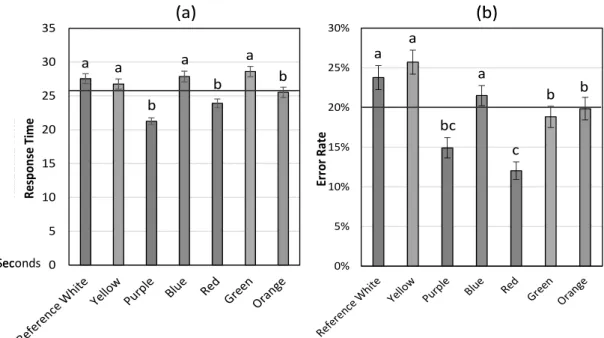
Hue influences on impulsiveness and arousal were judged by the response time and error rate of participants according to the different hue backgrounds used. While looking at these two factors together (Figure 4), participants were slower to respond, but their error rate was fairly high with yellow and blue
backgrounds. The influences of these two colors were similar. This indicates that participants had a LA (low arousal) state when they performed on yellow and blue backgrounds. For purple, red and orange backgrounds, participants reacted significantly quicker than with yellow, blue and green. In addition, they made fewer mistakes for purple, red and orange backgrounds. The difference between yellow or blue backgrounds and purple, red or orange backgrounds is significant. This suggests that participants found them highly arousing, with HA (high arousal) state on purple and red backgrounds. Furthermore no significant difference between these two colors' influence on arousal was found. Orange is the only color that crossed the average line for both error rate and reaction
time, which suggests that this is a relatively impulsive color that can influence participants to react moderately quickly but with more mistakes. However, the difference between the influence of purple, red, green and orange on error rate is not significant. This shows that error rates do not differ significantly across the four hues. For individual colors, the error bars for error rate are generally higher than those of the response time. This suggests that error rate is quite variable (noisy) but nonetheless is a better reflection of impulsiveness; and response time is more reliable but, on the other hand, it is a weaker reflection of impulsiveness.
(Figure 4 is about here.)
calculate the dimensionless quantities. The method used to make the data dimensionless was the extremum method:
where are the dimensionless data, is the maximum value of the
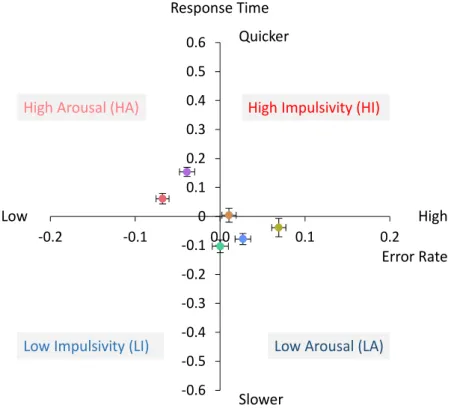
whole data set of response time or error rate. The error-speed space of dimensionless values is shown in Figure 5.
(Figure 5 is about here.)
Figure 5 depicts the six colors' positions in error-speed space. The figure reveals that impulsiveness has an increasing trend from the bottom-left to top-right quadrant. Arousal has an increasing trend from the bottom-right to top-left quadrant. Most of the hues are located in HA and LA quadrants, which means that hue influences arousal more than impulsiveness. Orange is located on the boundary of the HI quadrant, whilst it is not the color having neither the quickest response time nor the highest error rate. Yellow is also on the boundary of the HI quadrant, however it produces the highest error rate. Therefore, orange and yellow can be considered as two relatively “impulsive colors” (that is leading to impulsiveness) within the six hues. Green is the least
impulsive color according to its impulsiveness coordinates; it touches the boundary of the LI quadrant. Red and purple are located in the HA quadrant and can influence participants to perform quicker with fewer errors. Participants performed worse with blue and yellow backgrounds (they are located in the LA quadrant) as they required more time to think but still made more mistakes.
order of these six colors according to their influence on impulsiveness state. This is because error rate has a positive correlation with impulsiveness, whilst response time has a negative correlation. The relationship between response time and error rate can be determined by the indicator: E/R (where E is error rate and R is response time). The impulsiveness state increased with the value
of this indicator. Error rate and response time all have negative correlations with arousal, therefore the relationship between response time, error rate and arousal can be determined by the indicator: 1-ER (ER=E times R). The arousal state increases with the value of this indicator. The E/Rvalue and 1-ER (ER=E times R) values for the six colors are summarized in Error! Referencesource
not found.4. From high impulsiveness to low impulsiveness, the six colors'
impulsiveness and arousal order are summarized in Figure 6.
(Table 4 is about here.)
(Figure 6 is about here.)
From Figure 6 it can be seen that yellow can influence people to exhibit the highest impulsive state; red gives rise to the least impulsiveness among the six. On the other hand, red highly arouses performance while yellow gives rise to the least arousal. Orange can influence people in both a relatively high impulsive and aroused state; green results in both a relatively low impulsive and arousal state.
To investigate hue influence on impulsiveness and arousal, the six hues’ impulsiveness and arousal values are plotted on the hue diagram shown in
occurred with colors having a hue between 210° to 240° (greenish blue colors) and 0° to 30° (reddish colors). Moreover , the highest arousal state was located at around 300° to 330° (reddish and reddish -purple colors). The reddish color can influence people to be more aroused but less impulsive. Greens at 180° have an equal influence on impulsiveness and arousal. Greenish blue and
bluish colors between 210° to 240° can influence people to be both low in impulsive and aroused.
(Figure 7 is about here.)
Color Influence on Impulsiveness and Arousal by Gender
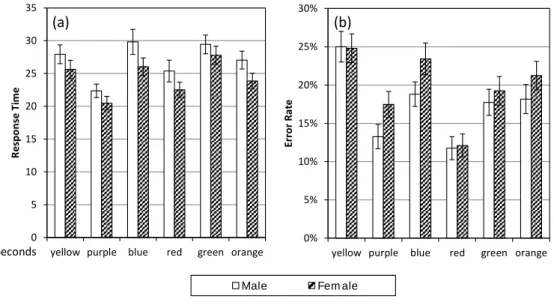
A tendency was found that females responded quicker yet made more
mistakes throughout all colored backgrounds. This means female participants seemed to perform more impulsively than males in this experiment (as shown in Figure 8). Since most of the error bars overlap, this trend cannot be regarded as significant for all colors. Blue, however, may marginally increase the response time for males (30 seconds for males, 27 seconds for females) while decreasing their error rate (19% for males, 24% for females) since the error bars for response time and error rate do not overlap. This indicates that there is a gender-specific influence for blue which was not seen with the other colors. No gender difference can be seen for hue’s influence on arousal.
(Figure 8 is about here.)
between arousal order for males and females is that the highest arousal color for males is purple and the second red whereas the highest arousal color for females is red and the second is purple.
(Figure 9 is about here.)
Summary
This study has investigated the influence of hue on impulsiveness and arousal.
Some novel findings from this experiment are summarized as follows:-
Hue seems to have a greater influence on arousal than impulsiveness.
Reddish colors, including yellowish red (orange) and bluish red (purple), can all influence people to exhibit a highly-aroused state.
Yellow leads to the least aroused state. While it is also the color that influences people to be the most impulsive.
Yellow, blue and green result in significantly slower response times compared with purple, red and orange.
Yellow and blue induced participants to make the most errors. Red and purple backgrounds resulted in the fewest errors.
Differential hue influence on gender was not significant, however females tended to respond more quickly with more mistakes (more impulsive) than males on all color backgrounds.
Hill and Barton reported that wearing red sports attire has a positive impact on athlete’s scores in combat sports such as tae kwon do and wrestling.2 Jacobs
and Hustmyer also stated that red is the most arousing color followed by green, yellow and blue.21 Physical strength may be increased in a red office
compared with a blue one because strong colors such as red can put the brain into a more excited state.8 From the experimental data collected in the hue
be relatively more aroused in solving psychometric tests than most of other colors as it led to participants performing with the fewest errors and the second-shortest response time. This is in agreement with the present study and confirms that red can influence people to be more aroused and perform well (with a low error rate and short response time). This phenomenon was
explained by Berlyne22 as being because red and purple have the emotional
meaning of danger, speed, blood, fire and so forth. These colors can lower people’s blood pressure and heart rate, which also have the function of arousal. Blue and green are the colors prevalent in nature; they also have an association with calm, peace and so on, which can influence people to be less aroused. Moreover, this study finds that not only pure red, but also yellowish red (orange) and bluish red (purple) can also lead to a high aroused state.
This experiment has some limitations. Firstly, it is possible that participants may tire during the experimental period or even that their performance may
improve as the task continued. For this reason, the order of the six colored backgrounds was varied randomly for each participant. This was to avoid bias. However, the reference white was always the first condition that participants encountered. It is therefore difficult to compare performance on a colored background with performance on a white background because there could have been some temporal bias. The white background was used first so that participants could adapt to the viewing conditions. Also, the ages of participants were between 20 and 38; thus, the findings might not be generalizable to children and the elderly. Finally, only six hues were used in this experiment. It is difficult to use these six colors to predict the whole trend
of hue’s influence on impulsiveness, so this should be further studied in the future.
References
[1] Rowe C, Harris M, Roberts S, Seeing red? Putting sportswear in context. Nature. 2005; 437: E10.
[2] Barton A, Hill A. Red enhances human performance in contests. Nature. 2005; 435: 293.
[3] Iwase M, Nishida Y, Kitaguchi S, Sato T, Ou, L, Luo, MR. Visual impression of the Color of football uniforms: investigation using moving and static images of football games. Color: Design and Creativity. 2010; 7 (4): 1-15.
[4] AL-Ayash A, Kane RT, Smith D, Green-Armytage P. The influence of color on student emotion, heart rate, and performance in learning environments. Color Research and Application. 2015; 41 (2): 196-205. [5] Read MA, Sugawara AI, Brandt JA. Impact of space and color in the
physical environment on preschool children's cooperative behavior. Environment and Behavior. 1999; 31 (3): 413-328.
[6] Valdez P, Mehrabian A. Effects of color on emotions. Journal of Experimental Psychology: General. 1994; 123 (4): 394-409.
[7] Ou L, Luo MR, Woodcock A, Wright AA. A study of color emotion and color preference. Part I: Color emotions for single colors. Color Research and Application. 2004; 29 (3): 232-240.
[8] Küller R, Mikellides B, Janssens J. Color, arousal, and performance - A comparison of three experiments. Color Research and Application. 2009; 34 (2): 141-152.
[9] Murray H. Explorations in Personality. Oxford University Press, New York; 1938.
[10] Barratt E. Anxiety and impulsiveness: Toward a neuropsychological model. In Spielberger C. ed., Anxiety: Current trends in theory and research. New York: Academic Press; 1972.
[11] Barratt E. Impulsiveness and Aggression. In Monahan J, Steadman HJ, ed., Violence and mental disorder. Chicago and London: The University of Chicago Press; 1994.
[12] Colman AM. A Dictionary of Psychology. 4th ed. Oxford: Oxford University Press; 2015.
[13] Andrea GK. Arousal and consumer in-store behavior. Brain Research Bulletin, 2005; 67: 428-437.
[14] Duffy D. Therapeutic Risk and Care Planning in Mental Health. In Hall A, Wren M, Kirby SD. Care planning in mental health: promoting recovery. Oxford; Malden, MA: Blackwell Pub; 1962.
[15] Barratt E. Factor analysis of some psychometric measures of impulsiveness and anxiety. Psychological Reports. 1965; 16: 547-554. [16] Husain G, Thompson WF, Schellenberg EG. Effects of musical tempo
and mode on arousal, mood, and spatial abilities. Music Perception. 2002; 20 (2): 151-171.
gamepad. CHI 2003: New Horizons. 2003; 732-733.
[18] Kagan J, Rosman BL, Day D, Albert J, Phillips W. Information processing in the child: significance of analytic and reflective attitudes. Psychological Monographs, 1964; 78 (1): 1-37.
[19] Kagan J, Impulsive and reflective children: significance of conceptual tempo. In Krumboltz JD, ed., Learning and the Educational Process. Chicago: Rand-McNally; 1965.
[20] Ishihara S. Ishihara's Tests for Color-Blindness. Tokyo: Plate Edition; 1993.
[21] Jacobs KW, and Hustmyer FE. Effects of four psychological primary colors on GSR, heart rate, and respiration rate. Perceptual and Motor Skills, 1974; 38: 763-766.
[22] Berlyne DE. Conflict, arousal and curiosity. 1960; New York: McGraw-Hill.
Biographies
Dr Yiting Duan is a textile design lecturer in Faculty of Material and Textile,
Silk Institute, Zhejiang Sci-Tech University. Her research areas are related to color psychology, color design, textile and fashion product design. She was awarded a PhD from University of Leeds for her thesis "The Impact of Colour on Impulsivity, Arousal and Emotion", which proposed a possible beginning of research between color and two emotional and bodily response: impulsivity and arousal. She was awarded the Palmer Award from The Colour Group Great Britain (CGGB) in 2013 for her research in color and textile design.
Dr Peter A. Rhodes is a lecturer in color imaging at the School of Design,
Education, he is actively engaged in a number of commercially-oriented research and development projects.
Dr Vien Cheung currently holds an academic post as Associate Professor in
Color and Imaging Science at the University of Leeds. Her research interests
Figures:
Figure 1 The error-speed space for predicting impulsiveness and arousal status. IMPU LSIV ITY ARO U SAL Fast Slow High Low
Response Time
Error Rate HI (high impulsivity) HA (high arousal)
LI (low impulsivity) LA (low arousal)
IMPU LSIV ITY ARO U SAL Fast Slow High Low
Response Time
Error Rate
IMPU LSIV ITY ARO U SAL Fast Slow High Low
Response Time
Error Rate HI (high impulsivity) HA (high arousal)
Figure 3 The Error-Speed space and participants’ performance in the hue experiment. 20 15 10 5 0 5 10 15 20
20% 15% 10% 5% 0% 5% 10% 15% 20%
First time Repeat
Slower
Error Rate
High Impulsivity (HI)
Low Impulsivity (LI) High Arousal (HA)
High Low
Response Time
Low Arousal (LA)
Quicker 20 15 10 5 0 5 10 15 20
20% 15% 10% 5% 0% 5% 10% 15% 20%
First time Repeat
Slower
Error Rate
High Impulsivity (HI)
Low Impulsivity (LI) High Arousal (HA)
High Low
Response Time
Low Arousal (LA)
Quicker 20 15 10 5 0 5 10 15 20
20% 15% 10% 5% 0% 5% 10% 15% 20%
First time Repeat
Slower
Error Rate
High Impulsivity (HI)
Low Impulsivity (LI) High Arousal (HA)
High Low
Response Time
Low Arousal (LA)
Figure 4 (a) Response time by background color; (b) Error rate by background color. The red lines in (a) and (b) represent the mean. The error bars are standard errors. Letters a-c refer to data sets shown to be significantly
different to each other (at the P=0.05 level). 0% 5% 10% 15% 20% 25% 30% E rr o r R a te Background Colour 0.00 5.00 10.00 15.00 20.00 25.00 30.00 35.00 Re sp o n se T im e Background Colour a b
a a a
b b bc b a a a c b (a) (b) 0 5 10 15 20 25 30 35 Re sp o n se T im e Seconds 0% 5% 10% 15% 20% 25% 30% E rr o r R a te Background Colour 0.00 5.00 10.00 15.00 20.00 25.00 30.00 35.00 Re sp o n se T im e Background Colour a b
a a a
Figure 5 Six hues plotted in error-speed space. 0.6
0.5 0.4 0.3 0.2 0.1 0 0.1 0.2 0.3 0.4 0.5 0.6
0.2 0.1 0.0 0.1 0.2
Slower
Error Rate
High Impulsivity (HI)
Low Impulsivity (LI)
High Arousal (HA)
Low Arousal (LA) Quicker
High Low
Figure 6 The six colors impulsiveness and arousal order.
Low
Impulsivity
High
Arousal
Figure 8 (a) Response time by gender; (b) Error rate by gender. 0.00 5.00 0.00 5.00 0.00 5.00 0.00 5.00
yellow purple blue red green orange 0 5 10 15 20 25 30 35 R e sp o n se T im e 0% 5% 10% 15% 20% 25% 30%
yellow purple blue red green orange
E rr o r Ra te (a) (b)
Ba ck gr ou n d colou r
Male Fem ale
Figure 9 The order of hue impact on impulsiveness and arousal by gender. Low
Impulsivity High
Low
Impulsivity High
Male Female
Low Arousal High
Low Arousal High
Tables:
Table 1
(a) Logical Ability Test
Logical Rule: In this type of test, you are required to choose, from a set of alternatives, which diagram
will complete a similar analogy to the first example.
Mathematics Sequence: In this type of test, you are given a string of numbers. You have to work out
the number that is missing from the string (marked ?).
(b) Spatial Imagination Ability Tests
Spatial Structure: In this type of test, you need to look at the unfolded shape, and then choose which
of the objects below would best represent the first object if it were folded.
other shapes. You have to decide which of the alternatives is identical to the original shape. It will still
be identical to the original if it has been turned around. It will not be the same as the original if it has
been turned over, or the proportions, parts have been changed.
(c) Detail Ability Tests
Odd One Out Test: In this type of test, you need to decide which of the objects is the "odd one out".
Same Detail Test: In this type of test, you are shown a pattern in the middle of the page. Below they
are five other patterns. You have to decide which of the alternatives is exactly the same as the original
Table 2
colors L* h (°) C* a* b*
Visual Reference White 69.71 29.10 0.48 0.42 0.23
Red 69.63 34.24 68.58 56.69 38.59
Yellow 70.71 98.78 70.97 -10.83 70.14
Blue 67.29 286.76 67.11 19.36 -64.25
Green 67.73 176.98 68.33 -68.24 3.60
Orange 71.17 67.83 67.07 25.31 62.11
Purple 67.96 321.03 68.17 53.00 -42.88
Table 3
Variables Impulsiveness Status Number Mean± STD error
Response time (sec)
LI 14 31±1
HA 13 21±1
HI 16 20±1
LA 11 34±2
Error rate (%)
LI 14 14±1
HA 13 14±1
HI 16 26±1
LA 11 23±1
Abbreviations: LI, Low Impulsiveness; HI, High Impulsiveness; HA, high arousal; LA, low
Table 4
Indicators red purple green blue orange yellow
E/R 0.57 0.79 0.74 0.87 0.88 1.07