This is a repository copy of
Turning capabilities into functionings : practical reason as an
activation factor
.
White Rose Research Online URL for this paper:
http://eprints.whiterose.ac.uk/150947/
Version: Accepted Version
Article:
Austin, A. orcid.org/0000-0003-0128-7018 (2018) Turning capabilities into functionings :
practical reason as an activation factor. Journal of Human Development and Capabilities,
19 (1). pp. 24-37. ISSN 1945-2829
https://doi.org/10.1080/19452829.2017.1364225
This is an Accepted Manuscript of an article published by Taylor & Francis in Journal of
Human Development and Capabilities on 5th October 2017, available online:
http://www.tandfonline.com/10.1080/19452829.2017.1364225
[email protected] https://eprints.whiterose.ac.uk/ Reuse
Items deposited in White Rose Research Online are protected by copyright, with all rights reserved unless indicated otherwise. They may be downloaded and/or printed for private study, or other acts as permitted by national copyright laws. The publisher or other rights holders may allow further reproduction and re-use of the full text version. This is indicated by the licence information on the White Rose Research Online record for the item.
Takedown
If you consider content in White Rose Research Online to be in breach of UK law, please notify us by
Turning Capabilities into Functionings: Practical Reason as an Activation
Factor
Abstract
Practical reasoning is central to the capabilities approach. This paper sets out an account of the role of practical reasoning in capability. Practical reasoning involves the development and evolution of an individual’s conception of the good – the kind of life she values and has reason to value. It is developed through socialization, and is subject to background social conditioning that may be empowering or constraining. As such, practical reasoning can be a subjective constraint on capability. This paper introduces a distinction between a person’s objective capability set and her effective capability set. Objective capabilities are determined by a configuration of commodities and conversion factors at the individual, social and environmental levels. Practical reasoning guides the act of choice that determines which element of the objective capability set will be actualized; effective capabilities are the real opportunities available to a person, given the filtering effects of her mode of practical reasoning. Practical reason can be conceptualised as an “Activation Factor” that mediates between hypothetical capability and achieved functioning. The paper concludes that practical reasoning deserves particular attention in social evaluations in the capability space: acknowledging the role of practical reasoning can help to illuminate gaps between freedom in principle and real positive freedom.
Keywords: Practical Reason; Capabilities Approach; Socialization; Aspiration; Opportunity; Positive freedom.
Acknowledgements
The author gratefully acknowledges comments and feedback on this paper from Stephen Jeffares, Hillel Steiner, two anonymous reviewers, and participants at the 2015 Human Development and Capabilities conference in Washington DC
Turning Capabilities into Functionings: Practical Reason as an Activation
Factor
Introduction
Practical reasoning is central to the capabilities approach (Sen 1999; Nussbaum 2000). The
capabilities approach (CA) conceptualises well‐being and social justice in terms of people’s freedom
to live “the kinds of lives they value and have reason to value” (Sen 1999), with practical reasoning
integral to the development of a person’s conception of value. The aim of this paper is to develop an
account of the role of practical reasoning in capability: where and how does practical reasoning
enter into the development and exercise of capability, and how can it be incorporated into
evaluations of well‐being and justice in the capability space? Nussbaum gives practical reason a
special role in her capabilities approach, conceptualising it as a kind of organizing principle. However,
there is no general account of the formal role of practical reasoning in the CA ‐ a significant gap in
capability theory. This paper aims to fill that gap, and to flesh out the somewhat vague notion of
practical reason “organizing and suffusing” other capabilities (Nussbaum 2000, 82).
Particular attention is paid to the social nature of practical reasoning, and the circumstances that
influence young people’s deliberations about their lives, and their “capacity to aspire” (Appadurai
2004). The paper demonstrates how a capabilities approach with a carefully specified role for
practical reasoning can help to illuminate aspects of intergenerational social mobility and justice that
risk being missed by other approaches.
Section 1 defines practical reason and its role in capability. Section 2 develops a new account of the
role of practical reasoning in capability. Section 3 discusses the implications of the new account for
the CA and for other conceptions of justice. The paper concludes that practical reasoning deserves
special attention: evaluations of well‐being and justice in the capability space should include
practical reasoning as an “activation factor” that mediates between capability and functioning.
1. Practical reason and its role in capability
In the simplest terms, practical reasoning is deliberation about what it would be best to do, both in
particular situations, and with reference to one’s life as a whole. Practical reasoning involves
deliberation about ends (Richardson 1993), that is, the development of a conception of the good life,
including reasons for valuing a certain kind of life and being a certain kind of person (Korsgaard
of the capability for practical reason is: “Being able to form a conception of the good and to engage
in critical reflection about the planning of one’s life.”
Sen emphasises the importance of practical reasoning in the CA during his discussion of agency:
agency freedom is “the freedom to achieve whatever the person, as a responsible agent, decides
that he or she should achieve” and, he says, the conception of the person must include what Rawls
terms “the moral power to have a conception of the good” (Sen 1985b: 186‐204). Practical reasoning
also comes into Sen’s approach in the conceptualisation of capability as the freedom to live the kinds
of lives people “value and have reason to value” (Sen 1999, 18). This can be read as referring to both
an individual’s own subjective reasons for valuing a certain kind of life, and the objective reasons
that, independently of the individual’s own personal reasons, make that kind of life a good and
flourishing life (Austin 2016). This reflects the distinction between “motivating reasons” and
“normative reasons” (Smith 1994); practical reasoning involves deliberation about normative
reasons and the development of motivating reasons for the kind of life one values and the actions
one will take to achieve it.
Practical reasoning is a formative part of the life‐trajectory of a person, since it involves deliberation
about long‐term goals and life plans. Practical reasoning during formative years is especially
significant in shaping a life. It is during this period of socialization and enculturation that young
people develop “embodied cultural capital” (Bourdieu 1979); that is, the “skills, knowledge, attitudes,
values, and motives current in the groups of which they are or will become members” (Sewell 1963).
Practical reasoning can be conceptualised as the central element of a person’s “habitus”, defined by
Bourdieu (2000, 19) as:
a set of dispositions, reflexes and forms of behaviour that people acquire through acting in
society. It reflects the different positions people have in society, for example, whether they
are brought up in a middle class environment or in a working class suburb.
Practical reasoning is essentially social. The social, political and economic environment in which a
person grows up, and the practices and norms of her immediate and wider social groups, are
primary influences on the development of her mode of practical reasoning ‐ the basic structure of
her personal conception of value. On a social definition of personhood, such as that adopted by
Aristotle (e.g. Nichomachean Ethics 1097b11), the development and on‐going exercise of practical
reasoning can be seen as embedded in sociality; practical reasoning is not individualistic, but social‐
being influenced in one way or another by the society around him or her.” Social relationships
provide the narrative web that enables a person to make sense of herself; a person’s self‐concept is
derived from and sustained by her social relationships, and the goals and life plans a person
develops are shaped by these fundamental influences.
The value commitments formed during the formative life‐stage generally persist into adulthood
(Inglehart 1977; Mannheim 1952; Van den Broek 1999) and the decisions made by “emergent adults”
about the life paths they will strive to follow have great significance for their own future well‐being,
as well as that of their children and even grandchildren (e.g. Celhay and Gallegos 2015); from the
point of view of social justice, intergenerational social mobility is at stake. It is therefore important
to consider the background influences on why and how these formative decisions are made.
The next section outlines where practical reasoning fits into Sen’s and Nussbaum’s capability approaches.
Practical reason: Process Freedom and Internal Capability
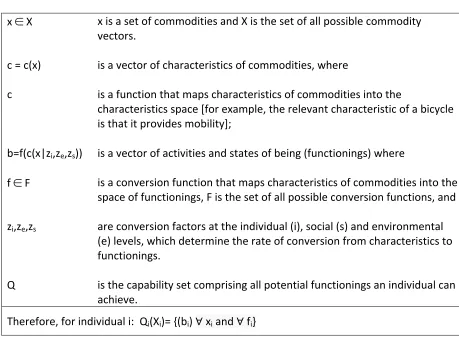
The classical model of capabilities (Sen 1985a) involves, in outline, a person possessing a set of
commodities, which have various characteristics (for example, a bicycle has the characteristic of
providing mobility). A set of conversion factors at the individual, social and environmental levels
determine the rate of conversion of these commodities into valuable beings and doings
(functionings); the set of all potential functionings that an individual can achieve, given her particular
configuration of commodities and conversion factors, is her capability set – the set of freedoms from
which she can choose. The more diverse and valuable the options in a person’s capability set, the
better off she is said to be; human development involves the enlargement of people’s capabilities
(Sen 1999). These principles can be summarised formally as shown in Figure 1: (Sen 1985a,
summarised by Kuklys and Robeyns 2005):
Figure 1: Sen’s Capabilities Approach
x
∈
X
x is a set of commodities and X is the set of all possible commodity
vectors.
c = c(x)
is a vector of characteristics of commodities, where
c
is a function that maps characteristics of commodities into the
characteristics space [for example, the relevant characteristic of a bicycle
is that it provides mobility];
b=f(c(x|z
i,z
e,z
s))
is a vector of activities and states of being (functionings) where
f
∈
F
is a conversion function that maps characteristics of commodities into the
space of functionings, F is the set of all possible conversion functions, and
z
i,z
e,z
sare conversion factors at the individual (i), social (s) and environmental
(e) levels, which determine the rate of conversion from characteristics to
functionings.
Q
is the capability set comprising all potential functionings an individual can
achieve.
Therefore, for individual i: Q
i(X
i)= {(b
i)
!
x
iand
!
f
i}
Sen discusses both the opportunity and process aspects of freedom (Sen 2004). The opportunity
aspect relates to people’s freedom to achieve that which they value and have reason to value. The
process aspect of freedom concerns people’s ability to freely exercise their practical reasoning and
make choices about their way of living. This involves “personal process concerns” such as a person’s
deliberations about her agency goals, as well as “systematic process concerns”, which include the
social and political institutions and norms that support or impede functioning (Sen 2004). For Sen,
then, practical reasoning is a personal process aspect of freedom.
Nussbaum’s parallel approach distinguishes between internal capabilities (I‐capabilities) and the
external conditions that enable or block successful functioning (Nussbaum 1987). I‐capabilities are
the internal powers of a person, which result from the person being trained and educated to realize
her innate (“basic”) human capabilities; they are “developed states of the person herself that are, so
far as the person herself is concerned, sufficient conditions for the exercise of the requisite functions”
(Nussbaum 2000:84). The interaction of internal capabilities and suitable external conditions results
in “combined capabilities” (Nussbaum 2000). Unlike Sen, Nussbaum does not distinguish between
are co‐constituents of overall combined capability. The capability for practical reasoning is defined
by Nussbaum as a basic capability of all human beings, which can (and should) be trained and
developed into an I‐capability – it is part of internal capability (Austin 2016). The capability for
practical reason also depends on features of the external environment, requiring at least “protection
for the liberty of conscience and religious observance” (Nussbaum 2000, 79); practical reasoning is a
combined capability. This paper will show that focusing on this particular constituent of internal
capability can be useful in diagnosing the reasons why individuals may “neglect to avail themselves
of opportunities that they in some sense have” (Nussbaum 2000:68).
Practical reason, choice and capability
Evaluations of well‐being in the capabilities space often focus on how configurations of commodities
and conversion factors result in capability sets of different size and quality. Inequalities in capability
and functioning are often traced back to inequalities in commodities and conversion factors, such as
income poverty (e.g. Robeyns 2005; Tiwari 2014), lack of education (e.g. Unterhalter 2005), weak
institutions (e.g. Tsai 2011; UNDP 1993), and other socio‐environmental constraints (e.g. Lehtonen
2004; Smith 2015). There is often a special focus on injustices involving the constraining of
capabilities by external forces beyond the control of the individual (e.g. Nussbaum 2001; Sen 1999).
However, while commodities and conversion factors provide the basic parameters of capabilities,
this is only part of the story, since nothing has yet been said about the act of choice that will select,
from the set of possibilities, a particular option to be actualized (transformed into an achieved
functioning).
The importance of the choice stage of capability has often been emphasised since the early
development of the CA. Sen (1992) states that “We do, of course, need to know what is chosen from
each set” (emphasis added) and Robeyns (2005) observes that:
…in real life two people with identical capability sets are likely to end up with different types
and levels of achieved functionings, as they make different choices following their different
ideas of the good life…
The act of choice that selects particular functionings from the capability set is guided by practical
reasoning, through which a person develops, and strives to live in accordance with, her conception
of the good.
It is important to notice that there are at least two possible sources of unfreedom in the act of
If I have never seen or heard a piano, I am unlikely to form the goal of becoming a concert
pianist…if no‐one in my family has ever been to university, it is much less likely (although of
course not impossible), that I will set myself the objective of obtaining a degree.
This quote illustrates two different scenarios. In the first case, the individual is not prevented from
becoming a pianist by some external barrier (for example, a physical impairment or a shortage of
pianos), but by an internal, conceptual barrier, namely her ignorance of pianos. In the second case,
the concept of university may be available to her, but the option simply does not fall within her
horizon of ambition, due to her mode of practical reasoning and practical identity considerations. It
is the latter form of constraint on which this analysis will focus.
Practical reason, practical identity and socialization
Consider two young people, Deborah and Christine, who are facing the decision of what to do when
they leave school. Deborah and Christine have equal natural talent in terms of achievements in
school performance and examination grades, despite coming from very different home backgrounds.
The set of opportunities hypothetically open to both, given their exam results, include going to
university, studying for a vocational qualification, or looking for unskilled work. For Deborah, the
choice is simple – all her life, it has been expected (perhaps even assumed) that she will follow in her
parents’ footsteps and go to university. She duly completes the application forms and wins a place.
For Christine, the situation is different. No one she knows well has ever been to university, and it has
never been discussed as an option for her. If anyone among her family and friends had thought
about it, it would be argued that getting into such great debt simply isn’t worth it, and that it would
be much better to start working as soon as possible. There may also be prejudice among her family
and friends that university is not for people “like us”. Christine leaves school and gets a job in a call‐
centre.
The story of Deborah and Christine highlights the distinction between opportunities that are
objectively available to an individual, and opportunities that are effectively available, given the
filtering effect of socially shaped practical reasoning. The option of going to university, although
objectively available to Christine (there were no external obstacles to her applying), was simply not
within her imagined horizon of possibility – this option did not fit with her practical identity, and
therefore fell outside of her practical reasoning about what constitutes a good and worthwhile life.
Her practical reasoning had filtered out the university option, and left it outside the bounds of
university – both had the required qualifications, both were healthy, no one was physically
preventing them from applying. However, it seems that their capability sets were importantly
different, due to their different modes of practical reasoning.
This section has made the case that practical reasoning deserves special attention in evaluations in
the space of capabilities and functionings. The next section shows how practical reasoning can be
formally incorporated into the theoretical framework of the CA.
2
!
Objective and Effective capabilities
The example of Deborah and Christine involves the domain of education; this is a particularly
appropriate example since education has a long‐term multiplier effect on a person’s freedoms and
opportunities. More generally, an individual’s configuration of commodities and conversion factors
provide the external parameters of her choice set – I will term these her Objective Capabilities. The
set of objective capabilities is the set of potential functionings: it is dormant or hypothetical until a
specific functioning is “activated” by an act of choice. The act of choice is guided by practical
reasoning: as Nussbaum (2000) argues, practical reason plays a central organizing role in the
capability to live a good life.
The story of Deborah and Christine suggests that practical reasoning may be best thought of as an
activation factor. At the first stage, commodities are converted into capabilities via conversion
factors at the individual, social and environmental levels. Then, at the second stage, once the
capability set is thus determined, an act of choice causes the “activation” of one of the potential
options in the capability set, setting in motion a chain of actions designed to lead to its
transformation into an actually achieved functioning. Practical reasoning is therefore the mediator
between a capability set and an achieved functioning; an act of practical reasoning is normally a
necessary condition for a particular achieved functioning to result from the hypothetical capability
set.
It follows from this that a full definition of capability should incorporate the potentially constraining
effects of practical reasoning, and the forces that shape what individuals have (motivating) reasons
to value. Evaluations that omit the influence of practical reason may miss important information
about the true effective freedom of the individual to achieve valuable beings and doings.
A possible objection to the distinction between objective and effective capabilities relates to the
door to innumerable factors that cause people to choose as they do: some worry that including
mental states and dispositions in individual‐level internal capabilities would eventually lead to the
collapse of the capability set into a single functioning vector, because we would end up concluding
that “the only option an individual could have chosen, given all of the external and internal factors
operating on them, was the one they in fact chose” (Burchardt 2009:16). However, the aim of
distinguishing between objective and effective capabilities is to highlight the importance of a
particular kind of mental state and process – those involved in practical reasoning – in determining
real freedom. The claim here is that there is theoretical value in distinguishing formally between
what Sen calls freedom “in principle” and freedom “in fact”. Moreover, it would certainly be possible
to distinguish empirically between effective capabilities and achieved functionings, since the former
remain hypothetical, while the latter are actually realized. Hence, the distinction between objective
and effective capabilities is useful in both theory and in practice.
An updated conceptualisation of Sen’s capability approach that incorporates practical reasoning can
be outlined as follows:
a) Commodities (resources) subject to conversion factors (individual, social and environmental
variables) create a set of opportunities. These will be termed Objective Capabilities.
These opportunities are hypothetical or dormant, and represent the set of potential
functionings from which the person can choose.
b) An act of choice is required to select a particular functioning from the set of potential
functionings. This act of choice is guided by practical reasoning.
Practical reason acts as a filter: it determines which of the objective opportunities are
“visible” to the person; that is, which are considered to be consistent with her conception of
value and practical identity. The filtered set will be termed Effective Capabilities.
c) The act of choice selects and activates a particular option from the set of possibilities which,
in the presence of suitable external circumstances and all else being equal, will result in
achieved functioning.
This outline highlights the distinction between (1) objective capabilities (determined by commodities
and conversion factors) and (2) effective capabilities, defined as objective capabilities subject to
practical reasoning. The term “effective capabilities” echoes Sen’s own use of the term “effective”,
the real freedoms that people in fact (not just ‘in principle’) enjoy. If social conditioning
makes a person lack the courage to choose (perhaps even to ‘desire’ what is denied but
would be valued if chosen), then it would be unfair to make the ethical assessment assuming
that she does have that effective choice. It is a matter of concentrating on the real freedoms
actually enjoyed, taking note of all barriers ‐ including those of ‘social discipline’. (Sen 1992:
149, emphasis in original).
My proposal is that practical reasoning can be conceptualised as an activation factor. Just as
commodities and conversion factors act as constraints on the external opportunities available to a
person, practical reasoning represents an internal, value‐based constraint on what an individual can
imagine as a realistic opportunity for herself. As a result, two people with the same objective
capabilities may have different effective capabilities, due to their different modes of practical
reasoning. The mere presence of an objective opportunity is not sufficient to give a person the real
freedom to choose it.
Of course, two people with the same effective capability sets might still choose different options,
due to differences in what they have reason and reasons to value, just as two people with different
effective capability sets might choose the same option. For example, Deborah, having carefully
considered all her options, might have reasonably decided that she valued her family and friends
above all else, and therefore decided not to go to university, but to take a job at the same call centre
as her friend Christine. The issue raised by the example of Deborah and Christine concerns the
nature of the background influences on their reasoning and reasons, and the extent to which those
background influences are constraining or enabling. In the case of Christine, the background
influences were constraining, causing her to have a smaller effective capability set than Deborah.
The nature of the background influences on a person’s practical reasoning is therefore of great
importance from a moral point of view, since just as Sen’s fasting monk is better off in a morally
significant way than his starving counterpart, Deborah is better off than Christine: even if Deborah
and Christine both ended up at the call centre, Deborah would have chosen this option from a wider
set of valuable alternatives – she had greater effective freedom, which has intrinsic value in a life.
Figure 2 below shows an updated version of the formal notation set out in Sen 1985a (see Figure 1
above), which brings in the role of practical reasoning as an Activation Factor.
Figure 2: An Updated Capabilities Approach
x
∈
X
x is a set of commodities and X is the set of all possible commodity
vectors.
c = c(x)
is a vector of characteristics of commodities, where
c
is a function that maps characteristics of commodities into the
characteristics space [for example, the relevant characteristic of a bicycle
is that it provides mobility];
b=f(c(x|z
i,z
e,z
s))
is a vector of activities and states of being (functionings) where
f
∈
F
is a conversion function that maps characteristics of commodities into the
space of functionings, F is the set of all possible conversion functions, and
z
i,z
e,z
sare conversion factors at the individual (i), social (s) and environmental
(e) levels, which determine the rate of conversion from characteristics to
functionings.
OC
is the objective capability set comprising all potential functionings an
individual can achieve: for individual i: OC
i(X
i)= {(b
i)
!
x
iand
!
f
i}.
p
is the mode of practical reasoning of the individual, which motivates the choice of potential functioning to be actualized (gives each potential functioning a probability of being selected, e.g. for Christine, the probability of choosing university was very low).
pr
∈
PR
pr is an activation function that maps objective capabilities into the space of functionings in accordance with p. PR is the set of all possible activation functions
EC Is the set of Effective Capabilities, comprising all potential functionings an individual can achieve, given her configuration of commodities and conversion factors, AND the filtering effect of her mode of practical reasoning:
EC
i(X
i)= {((b
i)
!
x
iand
!
f
i)pr
i}
Note: applying the notation according to Nussbaum’s logic gives:
EC
i(X
i)= {(b
i)
!
x
iand
!
f
iand p
i}
Applying the updated conceptual model to Deborah and Christine in the domain of education, we
can see that the option of going to university lies in the Objective Capability set of both young
people; it is a freedom that is available, in principle, to both. For Deborah, this option is fully “visible”
and available – it is part of her Effective Capability set (her objective and effective capabilities in this
Capability set (EC) is smaller than her Objective Capability set (OC), and also smaller than Deborah’s
Effective Capability set: the option of going to university falls beyond the boundary of her imagined
world of possibility; this option is therefore not realistically available to her (in the absence of some
kind of intervention).
More generally, when a person’s objective capabilities are curtailed by practical reasoning, her
effective capability set is smaller than her objective capability set (EC<OC). If her effective capability
set is larger than her objective capability set (EC>OC), the person might be described as deluded or
narcissistic. If EC=OC, the person might be said to be in sound prudential form. We might also say
that she holds the virtue of phronesis, or practical wisdom.
This is not to say that a person should not have aspirations that extend beyond her objective
capability set. On the contrary, aspirations are an important source of motivation to plan and
perform actions to expand one’s effective capabilities. However, when EC>OC, we might say the
person has made a mistake in his practical reasoning that has led him to over‐estimate or inflate his
effective capability set, perhaps by attributing to himself powers that he does not have, or by
misreading the external conditions. For example, a businessman of great wealth but lacking the
virtues of intellect, empathy, openness and diplomacy may believe that his wealth qualifies him to
be a successful and legitimate political leader. However, he is either erroneously attributing these
characteristics to himself, or he has misinterpreted what the role of political leader entails.
3. Discussion
This section focuses on three discussion points: (1) the connection between practical reasoning,
capability and achieved well‐being; (2) the relationship to the problem of adaptive preferences; and
(3) some implications of my account for other theories of social justice, in particular, Rawls’ ideal of
Fair Equality of Opportunity.
Practical reasoning and capability
The act of choice is of central theoretical and practical importance to the CA. There is a substantial
body of literature on capability and agency (e.g. Fukuda‐Parr 2003; Sen 1985b), and the influence of
background conditions on preferences, choices and goals (e.g. Burchardt 2009; Nussbaum 2001; Sen
1999). All of this concerns practical reasoning. However, despite it being singled out as having special
status (e.g. Nussbaum 2000), there has been, to date, no detailed account of the role of practical
This paper has shown how practical reasoning can be formally and explicitly incorporated into the
theoretical framework of the CA. I have proposed that practical reasoning can be conceptualised as
an activation factor that mediates between capability and functioning. Alternatively, it can be
thought of as a constituent of internal capability. This account based on a relational
conceptualisation of practical reasoning and practical identity, which recognises that these are
socially constructed and constituted, and located within relationships of belonging and solidarity.
The story of Deborah and Christine demonstrates that practical reasoning is an important part of
what Sen calls “real opportunity”, or what might be termed true positive freedom (Berlin 1969). It is
not external impediment or fear of punishment that prevents Christine having access to the
capability of going to university, and there are no deliberate attempts to manipulate her desires.
Rather, the constraining factor is what Lukes (1974, 23) calls the “mundane” processes of
socialization that shape a person’s values and goals. The connection between practical reason and
freedom means that the background influences that shape practical reasoning and acts of choice are
of central relevance to the CA. A dynamic and socialized view of capability can accommodate the
idea that background inequalities in socio‐economic and cultural capital can be a source of injustice,
which can result in diminished capability; that is, diminished effective capability.
Practical Reasoning and Adaptive Preferences
The issue under discussion – I shall call it the Problem of Conditioned Reasoning ‐ is closely related to
the Problem of Adaptive Preferences. The problem of Adaptive Preferences is defined as “the
adjustment of people’s aspirations to feasible possibilities” (Elster 1982, 219) or, in Sen’s (1987, 11)
terms, the disciplining of desires in response to deprivation or oppression. The problem of
Conditioned Reasoning is a subset of the wider problem of adaptive preferences. While “Adaptive
Preferences” often refer to the adjustment of existing goals and desires, the problem of Conditioned
Reasoning relates to background inequalities in how those goals and desires are shaped originally,
and the circumstances that moulded the person’s basic mode of practical reasoning. Sen (e.g. 2003)
highlights gender conditioning as a paradigmatic example of this kind of “disciplining” or oppressive
influence on people’s desires and life plans. The problem of Conditioned Reasoning is therefore prior
to the problem of adaption of existing preferences; it is a preliminary stage of the disciplining of
desires, making it worthy of separate analysis.
The Problem of Conditioned Reasoning is relevant principally to the early stages in the life course.
Youth is a formative period because it is during this stage that, through socialization and
trajectory. For young people, then, these fundamental value commitments and projects have
important implications for future capability and functioning. They constitute the person’s mode of
practical reasoning, and are the guiding principles that underpin goals, life plans, decision‐making
and action (Austin 2016).
The formative years in a human life are therefore crucial in a person’s “capacity to aspire”
(Appadurai 2004). Background inequalities in socio‐economic, human and cultural capital are likely
to lead to unequal capacity for sound practical reasoning, resulting in inequalities in capability and
functioning in early life stages, with potentially life‐long consequences for the individual, as well as
intergenerational consequences for social mobility, as the conditions of ‘social discipline’ are
reproduced. Sound practical reasoning here refers to the capability to correctly identify one’s
objective capability set, such that effective capabilities are identical to objective capabilities. The
capability for sound practical reasoning should be conceptualised not solely as a feature of an
individual, for which she can be praised or blamed, but as a combined capability, which is socially
embedded and subject to the influences of unchosen structural and background circumstances.
Social scientific evidence concerning external influences on practical reasoning confirms that the
formative years are a particularly vulnerable life‐stage. For example, Austin (2016) shows that
economic crisis can lead to young people in their formative years downgrading their goals and
ambitions; compared to the previous formative generation, young people socialized during the
economic crisis of 2007‐2010 gave increased priority to values relating to security, stability and
conformity, to the detriment of the wider horizons of higher agency goals such as creativity and
personal development. While the basic values developed during the formative life stage tend to
persist into adulthood, it is also the case, of course, that with intervention, experience and learning,
goals and ambitions change and develop. People are not always and necessarily permanently
constrained by restrictive socialization. The proposal here is not that socialization is strongly
deterministic. Rather, the argument is that socialization shapes the initial conditions in which a
person starts out in life, and the potential for constrained practical reasoning and subjective
constraints on capability is, at least, a live possibility that is worth consideration.
It is also important to note that the Problem of Conditioned Reasoning is based on the assumption
that practical reasoning is developed through affiliation and socialization, and in that sense, all
practical reasoning in every human being is “conditioned.” The problematic aspect is not the social
nature of practical reasoning, but unfair inequalities in the background conditions that constitute the
Implications for the CA
The discussion above has implications for both the theory and practice of the CA. First, it brings a
new perspective to the debate about the best metric of well‐being in the capability space. While a
focus on functionings alone neglects the value of freedom in a human life (Sen 1985a), a focus on
capabilities alone has been criticised for over‐prioritising freedom at the expense of other goods and
the actual quality of people’s lives (e.g. Khader 2016; Reader 2006). This is recognised by Sen (1992,
51), who states that “we do, of course, need to know what is chosen from each set, and not just
what the set is from which the choice is being made.” He defines this intersection of functioning and
capability as “refined functioning” ‐ the measurement of achieved functionings with alternative
possibilities and acts of choice taken into account (that is, (1) the vector of achieved functionings
along with (2) the set from which the vector was chosen). In his later work (e.g. The Idea of Justice),
Sen employs the related notion of “comprehensive outcomes”, which are contrasted with
“culmination outcomes”. A comprehensive outcome includes not only the actual (“culmination”)
outcome, but also the processes by which it occurred, with a special focus on failures or violations of
negative freedom by external agencies. Like “refined functionings”, this concept encompasses a
richer information set than functionings or capabilities alone.
Refined functionings are considered by some (e.g. Fleurbaey 2006) to provide the most complete
informational basis for social evaluation in the capabilities space. By distinguishing between
objective and effective capabilities, this paper suggests a further layer of refinement to the concept
of refined functionings. A more detailed specification of the concept would include (1) the
functioning vector; (2) the set from which it was chosen; and (3) the mode of practical reasoning
that guided this choice, and was therefore the bridge between capability and functioning. This
recognises that the set from which the functioning vector was chosen (the effective capability set) is
subject to the internal influence of practical reasoning, and that a person’s socially conditioned
reasoning and reasons can prevent her from taking up opportunities (can prevent her from
activating capabilities) that are, in principle, available to her.
Second, from a practical point of view, the identification of practical reasoning as a separate
activation factor will help to enhance evaluations of well‐being and guide the design of interventions.
By distinguishing between objective and effective capabilities, human development programmes
and initiatives could gain an extra level of insight into another factor that can constrain capability.
new perspective on human development as the enlargement of effective capabilities, and focuses
attention on an additional stage at which interventions may be possible.
Implications for other theories of justice
Finally, the account developed in this paper of the role of practical reason in capability can also help
to illuminate wider issues of justice. The concept of capability is often linked to the idea of equality
of opportunity (e.g. Roemer 1994). Fair equality of opportunity (Rawls 1999) is the ideal that, not
only should socially advantageous positions be open to all, but that all should have “a fair chance to
attain them” (Rawls 1999, 73). Fair equality of opportunity (FEO) shares many conceptual features
with capability. Both FEO and capability recognise the joint importance of individual and social
factors in creating not just formal opportunity, but real opportunity. Like capability, the concept of
FEO is designed to provide a broad framework within which practical reasoning and agency can be
well exercised.
FEO provides a foundation for upward social mobility; it requires that people with equal talent and
equal ambition should have an equal chance of obtaining socially advantageous positions, regardless
of their socio‐economic background:
“those who are at the same level of talent and ability, and have the same willingness to use them, should have the same prospects of success, regardless of their initial place in the social system…The expectations of those with the same abilities and aspirations should not be affected by their social class.” (Rawls 1999, 73).
However, the analysis in this paper suggests that FEO does not go far enough as an ideal of social
justice. While FEO recognises that both individual and social factors have a role in determining real,
fair opportunity, the “ambition” clause is conceptualised in terms of a person’s “willingness” to use
their talents (see Rawls quote above). This individualized conception of ambition falls short, since it
fails to recognise the the processes of socialization that set the terms of a person’s horizons of
ambition, and inform the kinds of goals and plans the person makes for herself.
Inequality in background social influences therefore pose a problem for FEO as set out above. During
socialization, characteristics of a person that ought to be irrelevant to her life opportunities and
outcomes can come to dominate the formation of her goals and ambitions. For example, gender
norms within families are an important background influence in shaping social roles, beliefs, and
aspirations (Okin 1991). This is apparent in persistent gender inequalities in school subject choices
(Riddell 2012) and occupations (e.g. Dwyer 2013). The consequences of the background influence of
on women’s material well‐being (e.g. Lips 2013) and health (e.g. Borrell et al 2014). More generally,
a narrow definition of ambition as a purely individual characteristic fails to recognise the social
embeddedness of the person, and the ways in which norms, expectations and narratives in the
private sphere of home and the public sphere of society shape practical reasoning and ambition. Fair
equality of opportunity requires that two people with equal ability and equal ambition have equal
chances of success. This formulation neglects unfair inequalities in cultural capital (or “horizons”)
due to a person’s initial position in the social order. A social account of capability containing a
carefully specified role for practical reasoning can solve this problem.
Conclusion
In conclusion, this paper offers a new account of the role of practical reasoning in capability. I have
adopted a socialized conception of practical reasoning that is embedded in affiliation, developed
through mechanisms of social enculturation, and subject to background inequalities relating to the
social and cultural norms and practices of a person’s social group, particularly during early life stages.
Practical reasoning and the background influences on it are acknowledged implicitly in much
capabilities scholarship; however, this paper has singled it out for explicit and separate analysis, in
order to show that practical reasoning can be a subjective constraint on real freedom, and therefore
that including it in evaluations in the capabilities space can add a valuable analytical dimension.
References
Appadurai, A. 2004. “The Capacity to Aspire: Culture and the Terms of Recognition." In Culture and
Public Action, edited by V. Rao and M. Walton. Stanford: Stanford University Press.
Austin, A. (2016) “Practical Reason in Hard Times: The Effects of Economic Crisis on the Kinds of Lives People have Reason to Value.” Journal of Human Development and Capabilities 17(2): 225‐244.
Borrell, C., L. Palència, C. Muntaner, M. Urquía, D. Malmusi, and P. O'Campo. 2014. “Influence of Macrosocial Policies on Women's Health and Gender Inequalities in Health.” Epidemiologic
reviews, 36(1), 31‐48.
Bourdieu, P. 1979. “3 Stages of Cultural Capital.” Actes de la Recherche en Sciences Sociales (30): 3‐6. Bourdieu, P. 2000. “The Politics of Protest. An Interview with Kevin Ovenden.” Socialist Review #42 Burchardt, T. 2009. “Agency Goals, Adaptation and Capability Sets.” Journal of Human Development
and Capabilities, 10(1), 3‐19.
Dwyer, R. E. 2013. “The Care Economy? Gender, Economic Restructuring, and Job Polarization in the US Labor Market.” American Sociological Review 78(3), 390‐416.
Finnis, J. 1980. Natural Law and Natural Rights. Oxford: Clarendon Press.
Inglehart, R. 1977. The Silent Revolution: Changing Values and Political Styles among Western
Publics. Princeton: Princeton University Press.
Khader, S. 2016. “Beyond Autonomy Fetishism: Affiliation with Autonomy in Women's Empowerment.” Journal of Human Development and Capabilities 17(1): 125‐139.
Korsgaard, C. 2009. Self‐constitution: Agency, Identity, and Integrity. Oxford: Oxford University Press. Kuklys, W. and I. Robeyns. 2005 “Sen's Capability Approach to Welfare Economics.” In Amartya
Sen's Capability Approach: Theoretical Insights and Empirical Applications , edited by W.
Kuklys. Berlin: Springer.
Lips, H. M. 2013. “The Gender Pay Gap: Challenging the Rationalizations. Perceived Equity, Discrimination, and the Limits of Human Capital Models.” Sex Roles, 68(3‐4): 169‐185. Lukes, S. 1974. Power: A Radical View. Basingstoke, Palgrave Macmillan
Mannheim, K. 1952. “The Problem of Generations” in P. Kecskemeti (ed) Essays on the Sociology of
Knowledge. London: Routledge & Kegan Paul (first published 1923).
Nussbaum, M. 1988. “Nature, Function and Capability: Aristotle on Political Distribution.” Oxford
Studies in Ancient Philosophy Supplementary Volume 1: 145‐184.
Nussbaum, M. 2000. Women and Human Development: The Capabilities Approach. Cambridge: Cambridge University Press.
Nussbaum, M. 2001. The Fragility of Goodness: Luck and Ethics in Greek tragedy and philosophy (2nd Edition). Cambridge: Cambridge University Press.
Okin, S. M. (2008). Justice, Gender, and the Family. New York: Basic Books.
Reader, S. 2006. “Does a Basic Needs Approach Need Capabilities?” Journal of Political Philosophy 14(3): 337‐350.
Robeyns, I. (2005). ÒThe Capability Approach: A Theoretical Survey.Ó Journal of Human Development, 6(1), 93-117.
Roemer, J. E. 1994. “Review of Inequality Reexamined by Amartya Sen.” The Philosophical Review 103:554‐57.
Riddell, S. 2012. Gender and the Politics of the Curriculum (Vol. 74). London and New York: Routledge.
Sen, A. 1985b. “Wellbeing, Agency and Freedom.” Journal of Philosophy 82(4): 169‐221. Sen, A. 1987. The Standard of Living. Cambridge: Cambridge University Press.
Sen, A. 1992. Inequality Reexamined. Cambridge, MA: Harvard University Press Sen, A. 1999. Development as Freedom. Oxford: Oxford University Press.
Sen, A. 2002. “Response to Commentaries.” Studies in Comparative International Development 37(2):78‐86
Sen, A., Agarwal, B., Humphries, J., & Robeyns, I. (2003). “Continuing the Conversation.” Feminist
Economics, 9(2‐3): 319‐332.
Sen, A. 2004. Rationality and Freedom. Cambridge, MA: Harvard University Press. Sen, A. 2011. The Idea of Justice. Cambridge: MA: Harvard University Press.
Sewell, W. H. 1963. “ Some Recent Developments in Socialization Theory and Research.“ Annals of
the American Academy of Political and Social Science (340):163‐181.
Smith, M. 1994. The Moral Problem. Oxford: Basil Blackwell.
Smith, A.F. 2015. “Food Deserts, Capabilities, and the Rectification of Democratic Failure.” Journal of
Human Development and Capabilities, 17(2):178‐190.
Van den Broek, A. 1999 “Does Differential Cohort Socialization Matter? The Impact of Cohort Replacement and the Presence of Intergenerational Differences in the Netherlands.”
Political Psychology 20(3):501‐523.