Int. J. Electrochem. Sci., 10 (2015) 7380 - 7391
International Journal of
ELECTROCHEMICAL
SCIENCE
www.electrochemsci.org
A Simple Process for Fabricating Organic/TiO
2Super-Hydrophobic and Anti-Corrosion Coating
Chunyan Mo1, Yansheng Zheng1,2,*, Falong Wang1,Qian Mo1
1
College of Biological and Chemical Engineering, Guangxi University of Science and Technology, Liuzhou 545006, Guangxi, PR China
2
Lushan College of Guangxi University of Science and Technology, Liuzhou 545616, Guangxi, PR China
*
E-mail: [email protected]
Received: 2 June 2015 / Accepted: 9 July 2015 / Published: 28 July 2015
Fluoro-methylhydro-silicone oil was blended with nano TiO2 particle after it was prepared by
methylhydro-silicone oil and dodecafluoroheptyl-propyl-trimethoxysilane as raw materials. The Organic/TiO2 composite coating was fabricated on steel substrate by sol-gel method. The
hydrophobicity and surface structure of composite coating were described by Infrared spectroscopy, Scanning electron microscopy, thermogravimetric analysis and Contact angle analyzer. In addition, Electrochemical methods were measured in order to characterize the corrosion of the as-prepared coating. The results indicated that the final composite coating with rich surface structure had a good anti-corrosion performance and exhibited superhydrophobic.
Keywords: Organic/TiO2 composite coating; super-hydrophobic; anti-corrosion
1. INTRODUCTION
metal anti-corrosion[9], self-cleaning[10,11], building waterproof[12], fluid drag reduction[13] and anti-fouling[14] as well owing to their peculiar and improved features.
As we all know, numerous of coating techniques for fabricating super-hydrophobic surfaces have been reported, including chemical vapor deposition, phase separation, sol-gel process, electro-spinning and etching (plasma etching, photo etching, acid etching ) method[15-18]. The principle of all the methods mentioned above in fabricating super-hydrophobic surfaces is widely accepted as either creating the rough structure on the surface of hydrophobic materials directly or modifying a rough surface by materials with low surface free energy, or combining both[19-21]. Some materials such as glass, wood, cotton cloth, paper, plastics and metals are used as substrates to create artificial superhydrophobic surfaces[22-24]. In the meantime, a large number of chemical substances including Silane[25], Fluoroalkylsilane[26] and Teflon[15] are used to modify the surface with micro/nanometer scale during the modification process. Thanks to the special apparatus for limited base materials, rigorous conditions and multi-step, the cost of most techniques seems to be unacceptable and the time consuming seems to be impractical [27]. How to develope preparation process, especially easy-to-prepare, high-efficiency, low-cost and large-scale, plays a key role in fabricating super-hydrophobic surfaces. And, for now at least, much effort has been put toward expanding applications of artificial superhydrophobic surfaces[28].
In the few past decades, composite material has attracted considerable attention within fundamental research as well as potential application industry because of its special advantages[26]. In addition, it had an incredible tremendous progress in such a short period of time because of the huge demand for more functional and advanced materials. Compared with the properties of a single material, composite materials have more advantages including higher thermal stability, better dimensions, better mechanical behavior[29,30]. For instance, as a new composite between organic polymer and inorganic polymer, the organic-inorganic nano-meter composite material can overcome the disadvantages of single organic or inorganic nano-particle in order to satisfy utilization requirements. For now, the composite material have concurrently characteristic of inorganic-organic matter. What’s more, the organic-inorganic nano-meter composite material with special functions has been widely used in many applications. Throughout this process, nano-meter inorganic powders are usually used as filling materials to be combined with organics by chemical bound in order to endued the product with excellent properties such as super-hydrophobic performance because of its micro/nano secondary structure. As super-hydrophilic substance, the nano-particles of titanium dioxide has a large number of hydroxyl groups on its surface, they are easily agglomerated in the water emulsion due to the high surface energy, in fact, the modification of nano-titanium dioxide powder is necessary so that the super-hydrophobic coating can be obtained. Silane coupling agent and fatty acids are the common modifiers. Hu et al.[31] fabricated the nano-titanium dioxide (nano-TiO2)
super-hydrophobic surface on Hastelloy substrate after suitable thermal treatment through simple dip-coating. The nano-TiO2 solution was used as precursor solution and fluorinealkylsiloxane was used as
formed in different solvents had same static contact angle as high as 160°but different adhesion and contact angle hystersis. Based on a convenient and controllable strategy, Wang et al.[33] prepared a superhydrophobic TiO2 film on glass substrate followed by thermal treatment and modification with
stearic acid, the as-prepared film exhibited improved transparency, good bounce performance and high superhydrophobicity, the water contact angle as high as 157◦, in contract, the low roll-off angle was 2◦. In this letter, we developed a simple method for fabricating superhydrophobic and anti-corrosive composite coating by nano modified TiO2 and Fluoro-methylhydro-silicone oil. the CA is up to 151.5°
± 1° and SA is down to 6°. The morphological and wetting properties of the coating surfaces are investigated as well as the anticorrosion performance of the composite coating. The results show the composite had rough surface with rich structure and good anticorrosion performance.
2. EXPERIMENTAL DETAILS
2.1 Materials
TiO2 with average particle size 10-30 nm was purchased from Shanghai jiang titanium dioxide
chemical products co., LTD. Methylhydro-silicone oil with hydroxylgroup content between 6 and 10 was obtained from Jinan heng Feilong chemical co., LTD. Stearic acid was obtained from Guangdong Shantou Xilong chemical plant. Dodecafluoroheptyl-propyl-trimethoxysilane (DFPT) was obtained from Haerbing Xeogia fluoro-silicone Chemical Reagent Co.,Ltd. Sodium Dodecyl Benzene Sulfonate (SDBS) was obtained from Shantou guanghua chemical plant. ammonia solution (NH3H2O) and
ethanol were analytical grade and used as received.
2.2 Modification of nano TiO2 particles
First of all, orderly add TiO2 (5g) and stearic acid (0.4 g) that was well dissolved in ethanol (40
mL) into 40 mL of DI water under magnetic stirring for more than 2h at 80 °C followed by adding suitable SDBS. The pH of TiO2 hybrid emulsion was adjusted to 5.0 by the addition of acetic acid.
Finally, the modified-nano TiO2 was dried at the temputure of 130 °C for 2 h。
2.3 Fabrication of fluoro-methylhydro-silicone oil
2.4 Fabrication of superhydrophobic composite coating
The as-prepared modified TiO2 powder was slowly added into solution A as well as
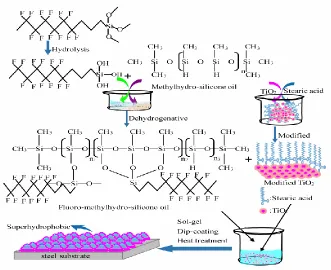
silane coupling agent (3-(Methylacryloxyl) propyltrimethoxy silane ) and two drops of catalyst (ammonia solution). Followed, a homogeneous white viscous liquid was obtained after the mixture had been stirred for 4 h and aged at room temperature for 12 h. Based on the combined effect of the chemical bonding force among particles and the absorption force of substrate surface, the Organic/TiO2 coatings were directly made on cleaned substrate after dip-coating and a series of
[image:4.596.132.463.262.532.2]heat-treatment process. Fig. 1 shows the schematic illustration of preparing superhydrophobic composite coating.
Figure 1. The process of formating the composite coating
2.5 Characterization
3. RESULTS AND DISCUSSION
3.1 FT-IR spectra
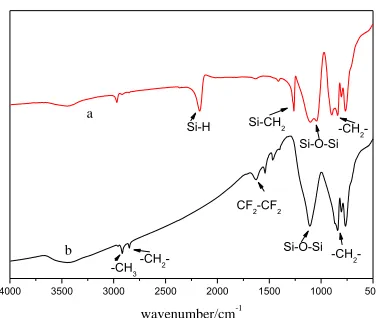
Fig. 2 shows the FTIR spectras of original and fluorinated methylhydro-silicone oil with DFPT. In the low frequency region, the Si-O-Si group and -CH2- group stretching vibration peaks appear at
around 800 cm-1 and 1100 cm-1 in both methylhydro-silicone oil and fluoro-methylhydro-silicone oil spectra. The -OCH3 group in DFPT will be hydrolyzed into hydroxyl radica(-OH) and then reacted
with the Si-H group in methylhydro-silicone oil when the catalyst Karstedt exists[34], so the presence of the absorption band at 2167 cm-1 in methylhydro-silicone oil spectra which is atrributed to Si-H stretching vibration disappears after the reaction with DFPT. What’s more, The two other absorption bands at 1710 cm-1 and 2925 cm-1 in fluoro-methylhydro-silicone oil are due to the stretching vibration of -CH3 and CF2-CF2 groups[35]. The results further confirm that the methylhydro-silicone oil has
been successfully fluorinated.
4000 3500 3000 2500 2000 1500 1000 500
-CH2 -Si-O-Si
wavenumber/cm-1
Si-H Si-CH2
Si-O-Si
-CH3-CH2
-CF2-CF2 a
b
-CH2
-Figure 2. The infrared spectrograms of samples: (a) methylhydro-silicone oil; (b) fluoro-methylhydro-silicone oil
3.2 Thermal analysis
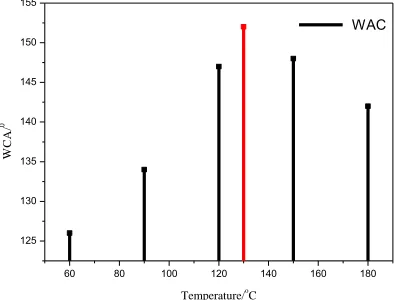
As we all know, heat treatment has an effective influence on surface chemical composition and the microstructure of composite particles[36]. Furthermore, both surface chemical composition and microstructure will determine the wettability of the composite coating[37,38]. Reacting process of the composite particles with temperature is understood through determining its thermal analysis curves. Fig. 3 shows the effect of heat treatment on the hydrophobicity of the TiO2
[image:5.596.204.392.324.483.2]
mainly due to the microscopic chemical reagents and physical absorbed water’s desorption behaviours. In addition, The obvious exothermic phenomenon and mass-loss rate of composite particles achieves when the temperature is between 300 °C and 800 °C especially at about about 670 °C, which mean the composite particles are suffering from damage thermally during this period. This may because of the oxidative and decomposition of stearic acid, alkyl groups, organofluorine and other organic material.
60 80 100 120 140 160 180 125
130 135 140 145 150 155
W
C
A
/
0
Temperature/o
C
[image:6.596.194.391.175.325.2]WAC
Figure 3. Effect of heat treatment on water contact angle
0 100 200 300 400 500 600 700 800 -0.5
0.0 0.5 1.0 1.5 2.0
DSC/(mW/mg)
T/O
C
86 88 90 92 94 96 98 100 102 TG/%
exo
Figure 4. Thermal analysis curves of as-prepared composite particles
3.3 Morphological studies
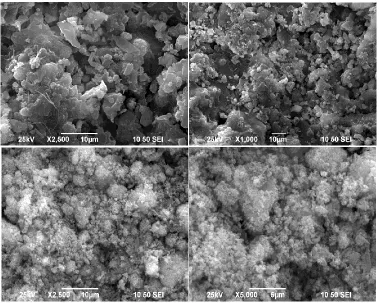
Wettability of solid surface is governed by both the chemical composition and the surface microstructure roughness. Fig.5 shows the microstructures of the as-prepared samples in our case. The fluoro-methylhydro-silicone oil particles showed in Fig. 5a-b exhibit unique hierarchical soft air-cushion structures that can adsorb a large fraction of air. After reacted with nano-modified TiO2,
[image:6.596.199.403.391.542.2]
closely related to the micro/nano double structures on the hierarchically rough surface, is required for superhydrophobicity. This configuration is described by the following Eq. (1): cosθCB
=ƒcosθ+ƒ-1(1)[39-42]. Where θCB and θ respectively denote the contact angle of a water droplet on a rough
surface and on a smooth surface, ƒ is the liquid-solid surface fraction. It is easy to deduce from Eq. (1) that the more hydrophobic the composite coating appears as the CA of the rough surface (θCB) increase
and the liquid-solid surface fraction (ƒ) decrease. In our study, the images of the super-hydrophobic properties of the uncoated and coated coatings are showed in Fig.6, showing the water contact angle of TiO2/fluoro-methylhydro-silicone oil composite coating reaches 151.5 ± 1° .
Figure 5. SEM images of the samples:(a-b) fluoro-methylhydro-silicone oil particles, (c-d) modified nano TiO2/fluoro-methylhydro-silicone oil composite particles
Figure 6. Images of the water droplets on the as-prepared coating surface: (a) TiO2
/fluoride-methylhydro-silicone oil particles, (b) uncoated steel substrate
151.5±1°
[image:7.596.111.490.232.535.2] [image:7.596.95.511.614.695.2]
3.4 Electrochemical measurements
The anti-corrosion performance of five different samples were described based on a series of electrochemical measurements in order to further examine their corrosion behaviors. All samples were tested after being immersed in 3.5 wt% NaCl aqueous for 48 h under air-open condition with a three-electrode system at room temperature. The coating specimen was used as the working three-electrode. A saturated calomel electrode and a platinum electrode were used as reference electrode and auxiliary electrode,respectively.[19,43] The polarization measurements were conducted at a scanning rate of 5 mV/s, the potential range was from -1.4 to 0.6 V.
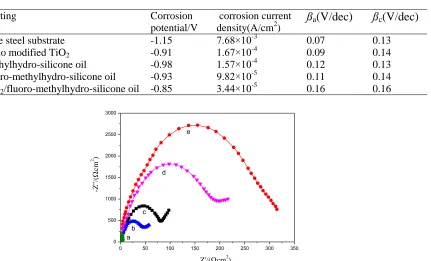
Fig. 7 shows the Tafel plots of uncoated/coated steel samples and the parameters obtained from potentiodynamic polarization measurements including corrosion potential (Ecorr), corrosion current
density (jcorr), anodic and cathodic Tafel constants (ßa and ßc ) are given in Table 1. According to Fig. 7
and table 1, Ecorr increased to -0.91 V, -0.98 V and -0.93 V from -1.15 V for bare steel after being
coated with modified nano-TiO2, methylhydro-silicone oil and fluoro-methylhydro-silicone oil,
respectively. We can also observed that TiO2/fluoro-methylhydro-silicone oil exhibited the most
positive Ecorr compared to the other samples. It’s corrosion potential was -0.85 V. These positive
shifted in Ecorr confirms the protection of steel substrate surface when the composite was coated on.
someone believed that the shifts in Ecorr might due to the development of more stable passive films,
similar to anodic protection.[44,45] In addition, the similar trend was observed in ßa and ßc. Compared
with the bare steel substrate, the samples coated with modified nano-TiO2, methylhydro-silicone oil
and fluoro-methylhydro-silicone oil, respectively showed a rising trend in whole though with a minor fluctuation. This may account for the positive shifts in Ecorr. Morever, according to Table 1, the
corrosion current density (jcorr) of TiO2/fluoro-methylhydro-silicone oil was 3.44×10⁻⁵ A/cm2, which
was 223.26, 4.85, 4.56, 2.85 times lower than that of uncoated, TiO2, methylhydro-silicone oil and
fluoro-methylhydro-silicone oil films. The significant decrease in jcorr suggested that the organic/ TiO2
composite coating was of good sealing type.[46]
The Nyquist plots of the measured samples are showed in Fig. 8, Where Z' ( Z") mean the real (imaginary) part of the impedances. The charge transfer resistance, which can be obtained from the diameter of the EIS curve, is used to evaluate wether the coating exhibit good anti-corrosion performance or not[42,47]. Generally, the slower corrosion rate is, the higher corrosion resistance is, the bigger charge transfer resistance with higher corresponding curve radius is, and vise verse. As easily unsterstood from Fig. 8, the diameter of the EIS curve of bare steel substrate was much smaller than other samples. The methylhydro-silicone oil showed similar anti-corrosion performance compared with pure modified TiO2 coating but poorer than fluoro-methylhydro-silicone oil. what’s more, the
diameter of the EIS curve of TiO2/fluoro-methylhydro-silicone oil was the highest one.
Based on the results above, we do believe that the TiO2/Organic coating exhibited the best
corrosion protection on steel substrate, which may due to the effective interactions between fluoro-methylhydro-silicone oil organic macromolecule and nano-TiO2 inorganic powders. the presence of
TiO2 nanoparticles significantly improved a micro/nano double rough surface[48], which created a
composite structure. What’s more, the organic macromolecule fluoro-methylhydro-silicone oil with hydrophobic alkyl groups and a network of Si-O groups can decreases the effective area for corrosion reaction by blocking the reaction sites in order to prevent the substrate being corroded. the anti-corrosive mechanism of as-prepared Organic/TiO2 composite coating is showed in Fig.9. However,
both methylhydro-silicone oil and fluoro-methylhydro-silicone oil were somhow more sticky to water as well as the pure TiO2 film, thus showed poorer anti-corrosion performance (higher jcorr and lower
Ecorr) than TiO2/organic composite coating. Last but not least, the bare steel substrate was immersed in
corrosive medium directly so it is unable to protect itself from being corroded.
-1.4 -1.2 -1.0 -0.8 -0.6
-7 -6 -5 -4 -3 -2 -1 lo g [ j /A .c m -2)]
Potential(E vs.SCE/V) a
b
c d
e
Figure 7. Tafel plots of steel specimens: (a) uncoated; coated with: (b) modified TiO2, (c) pure
methylhydro-silicone oil, (d) fluoro-methylhydro-silicone oil, (e) TiO2
[image:9.596.193.397.227.363.2]/fluoro-methylhydro-silicone oil in 3.5% NaCl solution
Table 1. Corrosion potentials and corrosion current densities of different samples
0 50 100 150 200 250 300 350 0 500 1000 1500 2000 2500 3000
Z'/(Ω.cm2)
-Z ''/ (Ω .c m 2 ) a c d e b
Figure 8. EIS curves of steel specimens:(a) uncoated; coated with: (b) modified TiO2, (c) pure
methylhydro-silicone oil, (d) fluoro-methylhydro-silicone oil, (e) TiO2
-fluoro-methylhydro-silicone oil in 3.5% NaCl solution
Coating Corrosion
potential/V
corrosion current
density(A/cm2)
ßa(V/dec) ßc(V/dec)
Bare steel substrate
Nano modified TiO2
methylhydro-silicone oil fluoro-methylhydro-silicone oil
TiO2/fluoro-methylhydro-silicone oil
[image:9.596.96.527.446.707.2]
Figure 9. Anti-corrosive mechanism of TiO2/ organic composite coating
4. CONCLUSION
In this paper, we fabricated TiO2/fluoro-methylhydro-silicone oil composite coating with
abundant surface microstructures via a simple method by using nano-TiO2 particle and
methylhydro-silicone oil as raw materials. The hydrophobicity and surface structure of the composite coating were described by thermo gravimetric analysis, Scanning electron microscopy, Fourier transform infrared and Contact angle analyzer. The results showed the final composite coating exhibits superhydrophobic performance with a static contact angle of 151.5 ± 1° and a rolling angle of 6°. The corrosion of the hybrid coating was characterized by electrochemical methods, such as polarization curve measurement and Electrochemical impedance measurements. The results indicated that the TiO2
/fluoro-methylhydro-silicone oil composite coating both had good hydrophobicity and anti-corrosion performance.
References
1. A. M. Escobar, N. Llorca-Isern. Applied Surface Science, 305 (2014) 774-782.
2. K. Yanagisawa, M. Sakai, T. Isobe, S. Matsushita, A. Nakajima. Applied Surface Science, 315 (2014) 212-221.
3. F J Wang, T H Shen, C Q Li, W Li, G L Yan. Applied Surface Science, 317 (2014) 1107-1112. 4. S Q He, J Q Wei, H F Wang, D S Sun, Z H Yao, C S Fu, R Q Xu, Y Jia, H W Zhu, K L Wang, D
H. Wu. Nanoscale Research Letters, 8 (2014) 412-417.
5. W Lei, Z H Jia, J C He, T M Cai. Applied Thermal Engineering, 62 (2014) 507-512.
6. J Li, Z J Jing, Y X Yang, Q T Wang, Z Q Lei. Surface & Coatings Technology, 258 (2014) 973-978.
7. J Li , X H Liu , Y P Ye, H D Zhou, J M Chen. Colloids and Surfaces A: Physicochemical and Engineering Aspects, 384 (2011)109-114.
8. Shi Xiaofeng F, Lu Shixia, Xu Wenguo. Materials Chemistry and Physics, 134 (2012) 657-663. 9. M. Ramezani, M. R. Vaezi, A. Kazemzadeh. Applied Surface Science, 317 (2014) 147-153. 10.Y Liu, J D Liu, S Y Li, Y M Wang, Z W Han, L Q Ren. Colloids and Surfaces A: Physicochem.
Eng. Aspects, 466 (2015) 125-131.
11.B Xu, J Ding, L Feng, Y Y Ding, F Y Ge, Z S Cai. Surface & Coatings Technology, 262 (2015) 70-76.
13.N Wang, D S Xiong. Applied Surface Science, 305 (2014) 603-608.
14.X Zhang, Y G Guo, Z J Zhang, P Y Zhang. Applied Surface Science, 284 (2013) 319-323. 15.Y Liu, S Y Li, J J Zhang, Y M Wang, Z W Han, L Q Ren. Chemical Engineering, 262 (2015)
70-76.
16.H Li, C Y Huang, L Zhang, W Q Lou. Applied Surface Science, 467 (2015) 224-232. 17.Z Q Dong, X H Ma, Z L Xu, W T You, F B Li. Desalination, 347 (2014) 175-183.
18.D L Zang, F Liu, M Zhang, X G Niu, Z X Gao, C Y Wang. Chemical Engineering Journal, 262 (2015) 210-216.
19.J Liang, Y C Hu, Y Q Wu, H Chen. Surface & Coatings Technology, 240 (2014) 145-153. 20.Z Yu, W Song, L Chen, Y. Park, B Zhao, Q Cong. Colloids and Surfaces A: Physicochem. Eng.
Aspects, 467 (2015) 224-232.
21.L T Yin, J Yang, Y C Tang, L Chen, H Tang, C S Li. Applied Surface Science, 316 (2014) 259-263.
22.W W Zhang, P Lu, L Y Qian, H N Xiao. Chemical Engineering Journal, 250 (2014) 431-436. 23.Z W Wang, Q Li, Z X She, F N Chen, L Q Li, X X Zhang, P Zhang. Applied Surface Science, 271
(2013) 182-192.
24.R M Wu, G H Chao, H Y Jiang, Y Hu, A Q Pan. Material Letters, 142 (2015) 176-179. 25.Y F Wang, B X Li, T X Liu, C Y Xu, Z W Ge. Colloids and Surfaces A: physicochem.
Eng.Aspects, 441 (2014) 298-305.
26.P P Li, X H Chen, G B Yang, L G Yu, P Y Zhang. Applied Surface Science, 300 (2014) 184-190. 27.Annaso B. Gurav, Q F Xu, Sanjay S. Latthe, R.S. Vhatkar, S H Liu, Hyun Yoon, Sam S. Yoon.
ScienceDirect Ceramics International, 41 (2015) 3017-3023.
28.K. Nakano, S. Akita, M. Yamanaka. Colloid Polymer Science, 292 (2014) 1475-1478. 29.A. Siddaramanna, N. Saleema, D.K. Sarkar. Applied Surface Science, 311 (2014) 182-188. 30.J Z Ma, Y H Liu, Y Bao, J L Liu, J Zhang. Advances in Colloid and Interface Science, 197-198
(2013)118-131.
31.Y W Hu, S Y Huang, S Liu, W Pan. Applied Surface Science, 258 (2012) 7460-7464. 32.R. Ramanathan, D. E. Weibel. Applied Surface Science, 258 (2012) 7950-7955.
33.Y F Wang, B X Li, T X Liu, C Y Xu, Z W Ge. Colloids and Surface A: Physicochemical and Engineering Aspects, 441 (2014) 298-305.
34.A. Safaee, D. K. Sarkar, M. Farzaneh. Applied Surface Science, 254 (2008) 2493-3498. 35.Y S Zheng, Y He, Y Q Qing, Z H Zhuo, Q Mo. Applied Surface Science, 258 (2012) 9859-63. 36.J. MacMullen, Z Y Zhang, J. Radulovic, C. Herodotou, M. Totomis, H. N. Dhakal, N. Bennett.
Energy and Buildings, 52 (2012) 86-92.
37.X M Shi, T. A. Nguyen, Z Y Suo, J L Wu, J Gong, R. Avci. Surface & Coating Technology, 206 (2012) 3700-3713.
38.D. S. Kim, B. K. Lee, J. Yeo, M. J. Choi, W. Yang, T. H. Kwon. Microelectronic Engineering, 86 (2009) 1375-1378.
39.B. Bhushan, Y. C. Jung. Progress in Materials Science, 56 (2011) 1-108. 40.I. Yilgor, S. Bilgin, M. Isik, E. Yilgor. Polymer, 53 (2012) 1180-1188.
41.W Y Liu, Y T Luo, L Y Sun, R M Wu, H Y Jiang, Y J Liu. Applied Surface Science, 264 (2013) 872-878.
42.T C Wang, L J Chang, B. Hatton, J Kong, G Chen, Y Jia, D S Xiong, C P Wong. Materials Science and Engineering C, 43 (2014) 310-316.
43.Z Z Zhang, X T Zhu, J Yang. Materials Science Processing Applied Physics A, 108 (2012) 601-606.
44.H. Hammache, L. Makhloufi, B. Saidani. Corrosion Science, 45 (2003) 2031-2042. 45.J. R. Santos Jr., L. H. Mattoso, A. J. Matheo, Electrochimica Acta, 43 (3-4) (1998) 309.
47.B.H. Kim, K. S. Yang, H.G. Woo, K. Oshida. Synthetic Metals, 161 (2011) 1211-1216.
48.Y Q Qing, C N Yang, Y Shang, Y Z Sun, C S Liu. Colloid and Polymer Science, 293 (2015) 1809-1816.
49.C B Hu, Y S Zheng, Y Q Qing, F L Wang, C Y Mo, Q Mo. Journal of Inorganic and Organometallic Polymer and Materials, 25 (2015) 583-592.
© 2015 The Authors. Published by ESG (www.electrochemsci.org). This article is an open access article distributed under the terms and conditions of the Creative Commons Attribution license (http://creativecommons.org/licenses/by/4.0/).