The portion size effect and overconsumption
–
towards downsizing solutions for children
and adolescents
–
An update
M. M. Hetherington
University of Leeds, Leeds, UK
Abstract
The portion size effect (PSE), where more is eaten when large amounts areoffered, is robust, reliable and enduring. Although it is not known what drives the PSE, amount served may act as a guide to how much should be eaten. Over time, consumers become accustomed to particular amounts of food as the ‘social norm’ and so large portion sizes are treated as typical. For children and adolescents who are forming eating habits, long-term exposure to large portion sizes of snacks and meal items may encourage overconsumption. Therefore, offering smaller portions to suit the age and stage of children and young people should offer a potential solution to the PSE. We have developed a series of downsizing strategies to test the effect of providing smaller portions of snacks and meal items in pre-school children, adolescents and families. One potential consequence of downsizing is that compensation may occur, in which smaller portion sizes drive intake of other foods. Therefore, in examining downsizing strategies, measures of compensation elsewhere in the meal or across the overall diet are important. Our studies indicate that it is both feasible and desirable to offer ‘me-sized’, smaller portions for children to facilitate portion control as food preferences and eating habits are developed. However, strategies for young adults and adolescents are more challenging and require further investigation.
Keywords: adolescents, children, energy density, food intake, portion size, snacks
Introduction
Portion size has been identified as a potential contrib-utor to the overconsumption of high energy density
(HED) foods (Zuraikatet al.2019). Laboratory based,
systematic studies with adults have demonstrated that providing large portions of energy dense foods pro-motes greater energy intake relative to small portions
(Rolls et al. 2006, 2007). Eating more when more is
offered is known as the portion size effect (PSE). The
PSE is reliable, robust and enduring (see Hetherington & Blundell-Birtill 2018) and has been well charac-terised across meal and snack items, age groups and contexts (Steenhuis & Poelman 2017). For example, a systematic research review and meta-analysis compar-ing the PSE between unit and amorphous foods found that the magnitude of the PSE was similar between
these food forms (Reale et al. 2018). The PSE may be
explained, in part, by characteristics of the food (e.g.
palatability, energy density); it may also relate to the state (hunger) and trait (e.g. enjoyment of food, satiety responsiveness) characteristics of the consumer, as well
as prevailing social norms (see Zuraikat et al. 2019
Correspondence:Professor Marion M. Hetherington, School of Psychology, University of Leeds, Leeds LS2 9JT, UK.
for a review). In general, the PSE is greater for HED than for low energy density (LED) foods; HED foods tend to be more liked than LED and so the PSE is greater for foods which are highly liked. Environmen-tal influences such as the typical serving size in small or large amounts set a consumption norm among con-sumers (Robinson & Kersbergen 2018). Food environ-ments presenting consumers with large sizes of highly liked, HED foods may encourage overconsumption
(Zuraikatet al.2019).
On average, doubling a portion of snack food increases intake by 37% compared with other foods (27%) and in adults the increase in intake is 39%
compared to 20% for children (Zlatevskaet al.2014).
Rolls and her colleagues have shown that large
por-tions presented consistently over 2 or 11 days
increased food intake, producing an additional energy
intake of 423 kcal per day (Rollset al. 2006, 2007). It
has always been assumed that young children may be less susceptible to these longer term manipulations due to an innate capacity to self-regulate energy intake (McCrickerd 2018). This means that when children are given larger or smaller amounts of food, they will adjust their later intake accordingly, so a larger amount of food eaten will reduce later amount eaten within the same or subsequent meals. However, until recently no study had been conducted to test systemat-ically over time how young children respond to large
portion sizes. Smethers et al. (2019) have recently
examined the long-term effects of offering pre-school children large portion sizes of foods and milk on total weight consumed and total daily energy intake across 5 days. The researchers provided breakfast, lunch, afternoon snack and dinner across consecutive days using a crossover design. Children were served 100% portion sizes for one phase of the different daily menus and 150% portion sizes of the same menus for the other phase, with a washout period of 2 weeks. The order of the experimental periods (100% vs. 159%) was counterbalanced. Although the 5-day per-iod should have been sufficient for self-regulation of energy intake to occur, offering the large portions of foods and milk resulted in an additional 16% weight of food consumed and 18% of energy intake each day. There was a linear increase in intake across the 5-day period, suggesting sustained increases in intake with no compensation. Of particular interest was the observation that individual differences were important in the response to the PSE, with bodyweight status and eating traits (lower satiety responsiveness and higher food responsiveness) predicting greater
suscepti-bility to the PSE (Smetherset al.2019).
A potential solution to the PSE is to offer small por-tions of HED foods as children and adolescents are developing food preferences, establishing eating habits and learning about the consumption norms for partic-ular foods (Hetherington & Blundell-Birtill 2018). If children are offered smaller sized snacks or meal items, they may learn to accept this over time, setting a new consumption norm for these foods. However, offering smaller portions than are typical could leave children feeling hungry and drive further intake during that specific eating occasion or later in the day. There-fore, in assessing the impact of portion downsizing it is important to consider how feasible and acceptable this strategy is alongside any potential compensation effects.
Downsizing snacks for young children
Parents report using a number of portion control
strategies for snacks with their children (Fisher et al.
2015), describing snacks as ‘something small’ and a means to curb appetite or to help with behavioural
control (Fisheret al. 2015). In interviews with parents
of pre-school children, the use of measuring cups, scales and hand measures to adjust for child size
por-tions was reported (Blake et al. 2015). However,
par-ents also describe these efforts as inconvenient, often relying on pre-packaged items to determine the
appro-priate amount to serve children (Curtis et al. 2017).
As packages for HED snacks are generally developed with adults in mind, an appropriate portion size for a child may indeed involve downsizing the contents of the pack.
In our first study, we set out to explore the feasibil-ity, acceptability and preliminary efficacy of two strategies of reducing portion sizes of snacks for pre-schoolchildren. The first strategy involved replacing the HED snack for LED foods such as fruit, vegeta-bles and a small starchy food. The second strategy involved providing the HED snacks in half the typical packaged size. For this study, families with pre-schoolchildren were enrolled in a 3-week intervention
(ClinicalTrials.gov NCT03339986; Reale et al. 2018).
In total, 46 families with children aged between 24 and 46 months were recruited with 24 randomised to the snack replacement and 22 randomised to the snack reduction arms of the trial. During the first week of the study, families simply consumed and recorded their habitual diet using a 4-day weighed food diary. During the second week, families were provided with a range of typical sweet and savoury
groups. Then for the third week, families in the replacement group gave LED snacks including fruit (apple, banana, grapes and pear) and vegetables (car-rot, cucumber, cherry tomatoes and peppers) plus a single starch-based food (breadstick, rice cake or cracker bread) in place of all HED snacks. For the reduction group, children were given 50% of the pre-vious HED snacks (so half-size sweet and savoury snacks such as biscuits, crisps, cheese crackers or chocolate cookies). Mothers could offer this down-sized portion either in the original packaging or emp-tied on to a bowl or plate.
During interviews, mothers described both strategies as feasible and acceptable. They favoured snack replacement over reduction, but overall reported that their child’s hunger was satisfied by the snacks pro-vided during the test phase. More children in the reduction group were described as happy with the snacks they received compared to the replacement group. In terms of overall compensation, children in the reduction group had a similar daily energy intake across the 3 weeks of the study. This suggests that the children compensated for the smaller size snacks by increasing intake during meals since the number of snacks did not increase from week 2 to week 3. In contrast, daily energy intake decreased by week 3 in the replacement group (see Fig. 1). The decreased energy intake through replacement was likely due to the significant increase in total vegetable intake and a decrease in total fat intake. Again this was not due to changes in the number of snacks eaten. What this study tells us is that while both strategies were feasible to achieve and acceptable, mothers favoured the replacement strategy and benefits to the overall diet were greater for this strategy relative to reduction. Further studies of downsizing snacks are required to confirm these results and to extend the period of study beyond 3 weeks.
Downsizing meal items
Downsizing snacks may be easier to achieve than for meal items since snacks involve discrete eating epi-sodes between meals. Downsizing meal items is chal-lenging because children’s energy requirements vary by age, sex and activity levels. However, a study by Sav-age et al. (2011), in which the size of the main meal item of macaroni and cheese was varied between 100 and 400 g, demonstrated that the smaller portions of pasta were associated with greater intakes of apple-sauce and green beans offered as side dishes. There-fore, by varying the size of the HED meal component,
children compensated for the smaller size by eating more of the LED components of the meal.
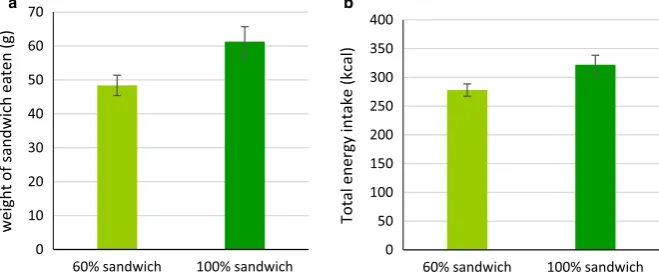
In a second study on downsizing portions in pre-schoolchildren, we reduced the HED component of a sandwich meal and offered a variety of vegetables as
the side dish (Carstairset al.2018). Lunches containing
a sandwich component are a typical meal served in the pre-school setting, and so this study was conducted using a standard (100%) or downsized (60%) portion of a HED cheese sandwich. As the sandwich is a unit food (easily counted), sandwiches in both conditions were served as eight quarters. To test for compensation, the meal was served with a side dish of either one of three familiar vegetables (single veg condition) or all three at the same time (variety condition). If children remain hungry after the downsized portion, they may offset this with an increase in intake of the side dish. Since variety is known to stimulate food intake (Rolls et al. 1981), it was expected that any offsetting effect would be greater in the variety compared to the single veg condition. To test these predictions, a fully facto-rial, within-subjects design was used which included eight conditions. These conditions consisted of the stan-dard or small sandwich served with each one of the three single vegetables (tomatoes, cucumber and car-rots) or all three vegetables together. In all conditions, a dessert (grapes and yogurt) was served with lunch. Given the influence of individual differences, such as bodyweight status and eating traits, on food intake (Llewellyn & Wardle 2015), these were measured to test the association between downsizing, variety, child BMI and eating traits. In total, 43 children aged 3-5 years participated in the study, and parents provided reports of their child’s eating traits using the Child
Eat-ing Behaviour Questionnaire (CEBQ) (Wardle et al.
2001). Weights and heights of the children to determine BMI were measured in the pre-school setting.
the portion size served and confirms the findings of
Smetherset al. (2019) that poor satiety responsiveness
predicts greater intake when large portions are served. Future studies should be conducted to replicate these findings and to extend measurement of energy intake beyond the meal to subsequent meals and snacks. Nevertheless, this strategy of downsizing at lunch appeared to be effective and may be particularly indicated for children who are more sensitive to the portion size served.
Downsizing using nudging for adolescents
In a third study on downsizing, attention was turned away from young children towards an older age group of adolescents and young adults. This age group is of interest since they are no longer dependent on adults
to purchase and prepare foods, and are capable of making their own decisions about which foods to eat and what amounts are ideal for them. Several studies have shown a tendency for adolescents to consume large portions of HED foods and small (or few) por-tions of LED foods. For example, evidence drawn
from the nationally representative UK National Diet
and Nutritional Survey (NDNS) indicates that large portions of some HED foods are linked to a higher
BMI in adolescents (Albaret al. 2014). An association
between large portions of HED foods and BMI does not infer causality, but there is also evidence that this age group tends to eat more HED, low nutrient dense
snack and fast foods than older adults (Bauer et al.
2009). At the same time, this age group tends to eat too little of the LED, high nutrient dense foods such
as fruit and vegetables (Larsonet al.2007).
0 200 400 600 800 1000 1200 1400 1600
Reducon Week 1 (baseline, habitual
snacks)
Reducon Week 2 (habitual snacks
replaced with study snacks)
Reducon Week 3 (study snacks reduced by 50%)
Replacement Week 1 (baseline,
habitual snacks)
Replacement Week 2 (habitual
snacks replaced with study snacks)
Replacement Week 3 (study snacks replaced
with F&V)
Mean daily
energy intake (kcal)
[image:4.595.128.460.65.229.2]* **
Figure 1Mean (SD) daily energy intake reported from 4-day food weighed food diaries by mothers enrolled in either the reduction (light green; snack size halved) or replacement (dark green; high energy dense snack replaced with low energy dense snack) arms of the snack downsizing trial.*P=0.04; between week 2 and week 3;**P=0.003; between week 1 and week 3. F&V; fruit and vegetables. [Colourfigure can be viewed at wileyonlinelibrary.com]
0 10 20 30 40 50 60 70
60% sandwich 100% sandwich
weight of
sandwich
eaten (g)
0 50 100 150 200 250 300 350 400
60% sandwich 100% sandwich
Total energy
intake (kcal)
a b
[image:4.595.129.459.528.668.2]Downsizing strategies for this age group must be sensitive to both the greater autonomy which can be exercised by this group compared to young children and greater peer pressure faced by this group com-pared to older adults. Peer pressure is felt by young people across various domains including health beha-viours (Rivis & Sheeran 2003). In this study, we set out to use social media as a platform to ‘nudge’ young people to select smaller ‘ideal’ (for them) portion sizes of both HED snacks and sugars-sweetened beverages (SSBs).
Across two pilot interventions, participants were exposed to images presented by ‘peers’ of the
recom-mended portion sizes of biscuits and SSBs (Sharpset al.
2019). Peers were confederates chosen by the research team to present images of their snacks via Instagram. In the first study, 20 young adults (aged 18–20 years) viewed posts on Instagram from peers of three snack images and three snack information images, presenting information on energy density, sugar content and por-tion size. Then in week 2, ‘peers’ posted images of small portion sizes of their SSBs. At the end of the study, self-reported ideal portion sizes of HED snacks and SSBs were smaller than at baseline as were the ideal portion sizes selected by participants for their own peers. How-ever, this pilot lacked a comparison no-intervention group and so a further study was conducted in a younger age group that included a control group.
In the second pilot, 44 adolescents (13–16 years-old) completed the study from an original sample size of 104 initially enrolled. Of the participants who com-pleted, 23 had been randomised to the active interven-tion and 21 to the control group. This interveninterven-tion lasted for 4 weeks. In the control group, participants were emailed online quizzes on healthy snacking and had no intervention between the ratings on ideal por-tion size which occurred at week 0 (baseline) and week 4. For the active intervention, the first 2 weeks were identical to the earlier pilot study with images posted of downsized cookies and then SSBs. In weeks 3 and 4, the ‘peers’ posted images of their downsized savoury snacks, then confectionery snacks. As before, all participants completed a questionnaire at baseline and at the end of the intervention to examine whether the intervention influenced participants self-reported ideal portions of HED snacks and SSBs. No significant differences were found for ideal portions sizes between baseline and post-intervention within the intervention group nor between this group and the control. It could be that the duration of the study (4 weeks) was too long to maintain interest among the groups or that downsizing was not effective in this social media
context. The loss of more than half of the originally recruited sample indicates both the challenge of work-ing with adolescents and the need to ensure that nudges are sufficiently engaging to maintain interest. Future studies of downsizing in this age group would benefit from involving adolescents in the design of the study, using a shorter duration of intervention, and more interactive platform to encourage young people to have greater ‘ownership’ of the strategy and better engagement with the target population.
Discussion and future directions for
downsizing
Strategies to downsize portions of HED snack or meal items in young children were effective in different ways. Replacement of snacks with fruit and vegetables produced a greater benefit to diet quality compared to
downsized snacks (Reale et al. 2018). Offering
pre-schoolchildren LED, high nutrient density foods in place of HED snacks resulted in a net reduction in daily energy intake with no compensation. In addition, replacement lowered total fat intake and increased vegetable intake by around 21 g per day, thereby dou-bling daily intake of vegetables. Clearly from this study, the preliminary recommendation to parents is to swap out HED snacks for fruit and vegetables (see Fig. 3).
and vegetables, become the social norm is yet to be tested. However, this PHE initiative gives considerable visibility to the idea of small, ‘me-sized’ snacks for children and has started the conversation with families on a high profile platform.
Downsizing meal items is more difficult to achieve than for snacking, since this involves consideration of each child’s needs for energy and nutrition within the complexity of different components of meals relative to snacks. In the study described earlier, a downsized sandwich meal component reduced both the weight of sandwiches consumed and total energy intake, calcu-lated across all components of the meal. Therefore, the decrease in intake linked to the downsized sand-wich was not then offset by greater intake of the
accompanying dishes (Carstairs et al.2018).
Nonethe-less, offering children a variety of vegetables as a side dish increased intake of the vegetable component rela-tive to the single vegetable. This is a relarela-tively easy method to encourage children to eat more vegetables, but will depend on liking and preference. In a study
with adults, Meengs et al.(2012) showed that
provid-ing a variety of vegetables with a pasta meal increased vegetable intake by more than half a serving relative to offering a single vegetable. This was the case even when comparing intake in the variety condition with intake when a single, but preferred vegetable was offered. Similarly, downsizing systematically the pasta component of a meal in pre-school children resulted in a greater intake of the fruit and vegetable side dishes
of the meal (Savage et al. 2011). Therefore, a
recom-mendation from these studies is that offering a variety of preferred LED foods, such as fruit and vegetables, encourages children to select more of these foods (Fig. 3). Offering large portions of highly liked, HED
items may ‘compete’ with the less liked LED compo-nent, thereby reducing intake of these nutrient dense foods. There is considerable potential to both down-size HED meal components and increase LED compo-nents in order to achieve a lower total energy intake and a higher nutrient quality of the meal.
At least in the short-term, these interventions appeared to be feasible and confirm previous research on the importance of shaping children’s eating through offering more LED foods at the same time as fewer or smaller HED items. In contrast to the preliminary success of downsizing or replacement for children, adolescents may be more resistant to efforts to present smaller portion sizes as normal. Social media remains a potentially influ-ential platform to nudge behaviour change in this age
group (Maheret al.2014). However, interventions may
need to be user-generated with ‘buy-in’ and ownership from young people as well as having the input of market-ing techniques that are used so successfully to raise brand
awareness for foods (Klassenet al.2018).
New guidance from the British Nutrition Founda-tion provides examples of how to achieve a balanced diet with recommended portion sizes for adults (Bene-lam & Wiseman 2019; https://bit.ly/2FywMF4). How-ever, the amounts served to young children depend on parents and caregivers. It is known that parents lack confidence in what portion sizes to offer children
(Curtis et al. 2017) and so offering support through
portion size guidance for meals as well as snacks is needed for children.
Future research on recommended portion sizes for children is welcome but strategies to downsize must be evidence based and more trials are required to build the research described here. The take home mes-sages from our preliminary studies include:
Recommendaons for
Smart snacking for children
• Aim for at least 5 A DAY fruit and vegetables within snacks
• Swapping high energy density items such as sweet and savoury packaged snacks for a variety of fruit and vegetables helps to achieve 5 A DAY
• If replacing snacks with fruit and vegetables is not an opon for some snack occasions, offer half-size packaged snacks
• Using bowls or plates to present small, downsized snacks will reduce children’s awareness that the snacks are smaller than adult size
• Ensure snacks are ‘me-sized’ - offer small amounts using your hand or a scoop from a family size package (use Change4Life healthier snack suggesons and the Eatwell Guide)
Downsizing meal items for children
• Aim for at least 5 A DAY fruit and vegetables within meals
• Offering smaller amounts of high energy density items and larger amounts of nutrient dense fruit and vegetables helps to achieve 5 A DAY
• Providing a varietyof fruit and vegetables will help to account for children’s preferences
• Use the USDA MyPlate as an example of providing proporoning (half the plate for fruit and vegetables) and the Eatwell Guide for porons of each food group for meal mes
• Aim for a balance of nutrious and sustainable foods for child health, growth and wellbeing
•
replacing HED snacks with a variety of LED foods such as fruit and vegetables;•
providing smaller sizes of snacks over the long-termto adjust consumption norms for non-core foods; and
•
providing a variety of fruit and vegetables toaccom-pany downsized meal items to give balance within the meal.
Taken together, these strategies could help parents to achieve a better balance across the day (meals and snacks) and ultimately improve dietary quality of their child’s diet. These efforts are contingent on children not compensating elsewhere for swaps and reduced sized snacks or meal items, and so further research is warranted to investigate the long-term effects of downsizing on dietary intakes.
Acknowledgements
The author wishes to acknowledge the Biological and Biotechnology Sciences Research Council (BBSRC) Diet and Health Research Industry Club (DRINC) for the support of the project ‘Downsizing: using environmental prompts to understand healthy portion control and appropriate food servings in children, adolescents and caregivers’ (BB/M027384/1, 2015-2018).
Conflict of interest
The author has no conflict of interest to declare.
References
Albar SA, Alwan NA, Evans CEet al.(2014) Is there an association between food portion size and BMI among British adolescents?
British Journal of Nutrition112: 841–51.
Bauer KW, Larson NI, Nelson MCet al.(2009) Fast food intake among adolescents: secular and longitudinal trends from 1999 to 2004.Preventive Medicine48: 284–7.
Benelam B & Wiseman M (2019) Size matters: developing portion size guidance for consumer.Nutrition Bulletin44: 4–6. Blake CE, Fisher JO, Ganter Cet al.(2015) A qualitative study of
parents’ perceptions and use of portion size strategies for pre-school children’s snacks.Appetite88: 17–23.
Carstairs S, Caton S, Blundell-Birtill Pet al.(2018) Can reduced intake associated with downsizing a high energy dense meal item be offset by increased vegetable variety in 3–5-year-old children?
Nutrients10: 1879.
Curtis K, Atkins L & Brown K (2017) Big hearts, small hands: a focus group study exploring parental food portion behaviours.
BMC Public Health17: 716.
Fisher JO, Wright G, Herman ANet al.(2015) “Snacks are not food”. Low-income, urban mothers’ perceptions of feeding snacks to their preschool-aged children.Appetite84: 61–7.
Hetherington MM & Blundell-Birtill P (2018) The portion size effect and overconsumption–towards downsizing solutions for children and adolescents.Nutrition Bulletin43: 61–8. Klassen KM, Douglass CH, Brennan Let al.(2018) Social media
use for nutrition outcomes in young adults: a mixed-methods sys-tematic review.International Journal of Behavioral Nutrition and Physical Activity15: 70.
Larson NI, Neumark-Sztainer D, Hannan PJet al.(2007) Trends in adolescent fruit and vegetable consumption, 1999–2004. Ameri-can Journal of Preventive Medicine32: 147–50.
Llewellyn C & Wardle J (2015) Behavioral susceptibility to obesity: gene–environment interplay in the development of weight. Physi-ology & Behavior152: 494–501.
Maher CA, Lewis LK, Ferrar Ket al.(2014) Are health behavior change interventions that use online social networks effective? A systematic review.Journal of Medical Internet Research16: e40.
McCrickerd K (2018) Cultivating self-regulatory eating behaviours during childhood: the evidence and opportunities.Nutrition Bul-letin43: 388–99.
Meengs JS, Roe LS & Rolls BJ (2012) Vegetable variety: an effective strategy to increase vegetable intake in adults.Journal of the Academy of Nutrition and Dietetics112: 1211–5.
PHE (Public Health England) (2016)The Eatwell Guide. Available at: www.gov.uk/government/publications/the-eatwell-guide (ac-cessed 1 February 2019).
PHE (Public Health England) (2019)Change4Life 100 calorie snack. Available at: www.nhs.uk/change4life/food-facts/healthier-snacks-for-kids/100-calorie-snacks (accessed 1 February 2019).
Reale S, Kearney C, Hetherington Met al.(2018) The feasibility and acceptability of two methods of snack portion control in Uni-ted Kingdom (UK) preschool children: reduction and replacement.
Nutrients10: 1493.
Rivis A & Sheeran P (2003) Descriptive norms as an additional pre-dictor in the theory of planned behaviour: a meta-analysis. Cur-rent Psychology22: 218–33.
Robinson E & Kersbergen I (2018) Portion size and later food intake: evidence on the “normalizing” effect of reducing food por-tion sizes.American Journal of Clinical Nutrition107: 640–6. Rolls BJ, Roe LS & Meengs JS (2006) Larger portion sizes lead to a
sustained increase in energy intake over 2 days.Journal of the American Dietetic Association106: 543–9.
Rolls BJ, Roe LS & Meengs JS (2007) The effect of large portion sizes on energy intake is sustained for 11 days.Obesity15: 1535–
43.
Rolls BJ, Rowe EA, Rolls ET, Kingston B, Megson A & Gunary R. (1981) Variety in a meal enhances food intake in man.Physiology & Behavior26: 215–221.
Savage JS, Fisher JO, Marini Met al.(2011) Serving smaller age-appropriate entree portions to children aged 3–5 y increases fruit and vegetable intake and reduces energy density and energy intake at lunch.American Journal of Clinical Nutrition95: 335–41. Sharps MA, Hetherington MM, Blundell-Birtill Pet al.(2019) The
effectiveness of a social media intervention for reducing portion sizes in young adults and adolescents.Open Science Framework Preprints. Available at: https://osf.io/7qwmt/ (accessed 28 February 2019). Smethers AD, Roe LS, Sanchez CEet al.(2019) Portion size has
sus-tained effects over 5 d in preschool children: a randomized trial.
Steenhuis I & Poelman M (2017) Portion size: latest developments and interventions.Current Obesity Reports6: 10–7.
Wardle J, Guthrie CA, Sanderson Set al.(2001) Development of the children’s eating behaviour questionnaire.Journal of Child Psychology Psychiatry42: 963–70.
Zlatevska N, Dubelaar C & Holden SS (2014) Sizing up the effect of portion size on consumption: a meta-analytic review.Journal of Marketing78: 140–54.