
Repository optimisation & techniques to improve discoverability
and web impact: an evaluation
George Macgregor
http://purl.org/g3om4c
11
University of Strathclyde, Glasgow, Scotland UK
2018-08-28
Abstract
In this contribution we experiment with a suite of repository adjustments and improvements per-formed on Strathprints, the University of Strathclyde institutional repository powered by EPrints 3.3.13. These adjustments were designed to support improved repository web visibility and user engagement, thereby improving usage. Although the experiments were performed on EPrints it is thought that most of the adopted improvements are equally applicable to any other repository platform. Following preliminary results reported elsewhere, and using Strathprints as a case study, this paper outlines the approaches implemented, reports on comparative search traffic data and usage metrics, and delivers conclusions on the efficacy of the techniques implemented. The evaluation provides persuasive evidence that specific enhancements to technical aspects of a repository can result in significant improvements to repository visibility, resulting in a greater web impact and consequent increases in content usage. COUNTER usage grew by 33% and traffic to Strathprints from Google and Google Scholar was found to increase by 63% and 99% respectively. Other insights from the evaluation are also explored. The results are likely to positively inform the work of repository practitioners and open scientists.
1
Introduction
Significant resource has been invested over the past decade to expose rich digital collections using a variety of repository technologies. This investment has resulted in unprecedented usage of institutional repositories, as evidenced in the UK by services such as IRUS-UK which, at time of writing, has recorded 146,398,650 COUNTER compliant downloads from participating repositories since 2013 (1). However, many institutions continue to demonstrate limited commitment to ensuring their scholarly content is exposed optimally. This also extends to a failure to ensure their repository is as usable as possible. In fact, many repositories have not undergone development beyond their original establishment and the ongoing maintenance of its scholarly collection. The reasons for this inertia are complex and it is not the purpose of this paper to explore them. However, it is sufficient to state that such institutions may attempt to promote their repository content but if few attempts have been made to optimise for discovery, then these repositories may find themselves under exposed (2) and under used.
In this contribution we experiment with a suite of repository adjustments and improvements performed on Strathprints (4), the University of Strathclyde institutional repository powered by EPrints 3.3.13. These adjustments were designed to support improved repository web visibility and user engagement, thereby improving usage. Although the experiments were performed on EPrints it is thought that most of the adopted improvements are equally applicable to any other repository platform. Following preliminary results reported elsewhere (5), and using Strathprints as a case study, this paper will outline the approaches implemented, report on comparative search traffic data and usage metrics, and deliver conclusions on the efficacy of the techniques implemented. The results are likely to positively inform the work of repository practitioners and open scientists.
2
Background
Given the importance of institutional repositories in promoting open scholarly communication and the dis-covery of open research content, it is perhaps surprising to note that only a limited amount of prior work has been documented on repository discoverability approaches and their evaluation. Many contributions note the importance of repository discoverability and report on some of the factors that should be addressed (6), but few then evaluate the impact of these factors. Most recently, however, the Code4Lib Journal published a contribution on the use of microdata within institutional repositories as a “low barrier” means of better exposing contents to Google (7). This work described the implementation of Schema.org within DSpace. It is a notable contribution owing to the fact that repository support for Schema.org is a feature of the COAR Next Generation Repositories agenda (8). The author reported generally positive results but conceded that demonstrating its impact was difficult.
Kelly and Nixon reported on the use of general SEO techniques on three separate UK repositories (2). This work relied on analytics services and tested early data indicating the importance of blogs in driving repository web traffic. The authors reported mixed results and therefore concluded that further work was required in order to refine their methodology and better understand search engine behaviour. In a poster presented at the 2017 Repository Fringe Conference (5), the present author evaluated the preliminary results derived from a series of repository enhancements designed to improve web impact and discoverability. While some encouraging evidence was reported about the impact of specific repository enhancements, the small nature of the evaluation prohibited any wider conclusions to be drawn.
Others have focused on hypothesised impediments to repository discoverability. For example, Tonkin et al. explored the significance of repository coversheets in disrupting the bot crawling potential of repositories in some cases (9), a practice also considered by Anurag Acharya of Google Scholar as undesirable (10). Better supporting Google Scholar indexing was addressed by Arlitsch and O’Brien (11), who noted variable indexing coverage of repositories on GS and evaluated the effects of adjusting in-page metadata on GS indexing penetration. Arlitsch and O’Brien highlight the dangers of paying insufficient attention to discoverability and propose corrective actions for repository managers to perform.
3
Promoting repository discovery
Whilst many of the prominent repository platforms (e.g. EPrints, DSpace, Digital Commons, OJS, etc.) now provide basic out-of-the-box support for discovery and interoperability with key academic tools, including meeting Google Scholar inclusion guidelines, there remains wide variation on the relative visibility and discoverability of repository content. The question of repository discoverability is therefore something which has attracted significant attention at the University of Strathclyde as the institution seeks to ensure its internationally significant research (12), much of it available open access via Strathprints, can be found easily.
impact monitored during 2016/2017, and again in 2017/2018. Process improvements were also implemented. The changes could be said to fall into one of two categories: improvements, and; adjustments. “Improve-ments” were changes that resulted in substantive modifications to repository functionality, while “adjust-ments” included actions that sought to refine existing aspects of the repository. As noted below, much of the motivation for these improvements and adjustments came from the broader literature on web publication best practice and SEO; although some were gleaned from the repository best practice literature (10).
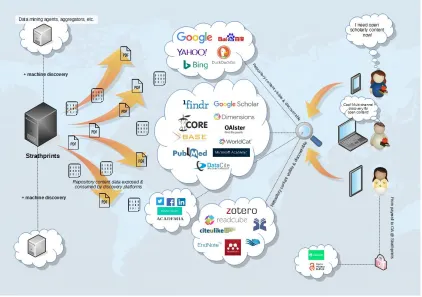
Figure 1: Discovery paths for content stored in the Strathprints repository.
4
Technical changes
4.1
Improvements
The principal improvements made included:
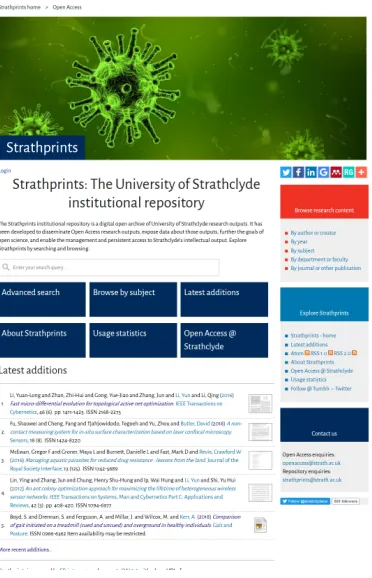
• Implementation of a refreshed Strathprints user interface (UI). Many repositories continue to demon-strate low levels of usability (12)(13). Low levels of usability can result in the users’ abandonment of a website or of system sessions (14)(15)(16). An heuristic evaluation (17) of Strathprints user interface (UI) was therefore undertaken in early 2016 to direct UI changes intended to improve usability and user engagement (Figures 2 & 3);
Figure 2: Strathprints UI (homepage).
Figure 3: Strathprints UI for abstract pages.
• “White hat” improvements (20) to the way Strathprints functions. This included improvements to internal linking (e.g. navigation, hyperlink labels, etc.) and content improvements including promotion of user interaction through support for the Core Recommender and AltMetric, both of which refer users to additional Strathprints content;
• Improved integration with social tools, including growth in social interactions which are the result of Tweets about recently deposited Strathprints content;
• Implementation of a “connector-lite” configuration actioned to cultivate Strathprints as a full-text des-tination for users and machines alike (21). Within the currently scholarly communication landscape it is not uncommon for institutional repositories to now operate in parallel with the local Current Research Information System (CRIS). This so-called “connected” configuration enables metadata and digital content exchange from the CRIS to the repository. It is a configuration that applies to Strath-prints, which is no longer a point of entry for staff wishing to deposit content in Strathprints; instead users deposit via the CRIS which then automatically writes metadata and content to Strathprints. “Connector-lite”, however, enables greater control over what is written to Strathprints by the institu-tional CRIS (21).
4.2
Adjustments
[image:4.612.74.260.106.395.2]• Adjustments to the file-naming conventions used for deposited full-text files in order to render them more crawler friendly. For example, adoption of descriptive file naming convention with proactive use of hyphens to separate words in the filename (18);
• Gradual cleaning of broken links within Strathprints thereby improving the “content health” of Strath-prints and, again, triggering important signals in PageRank (18). Like many repositories of its type, Strathprints has been operating in one form or another for over 10 years and during that time has accumulated its fair share of “link rot”;
• “Minification” of all relevant repository files (e.g. CSS, JS, etc.) to deliver increased page loading speeds. Minification refers to the process of removing superfluous or redundant data without affecting how the resource is processed by browsers, e.g. code comments, formatting, white space characters, unused code, using shorter variable names, etc. This superfluous data may aid the human readability of the code but is not needed for the code to execute efficiently.
• Rationalisation of all CSS and Javascript (JS) files in order to remove unused rules and variables. This can be performed manually but there are automatic tools which can analyse websites to determine which CSS rules are actually being applied to a given website, thus allowing redundant rules to be deleted. Similarly, there are code quality tools for JS.
• Asynchronous loading of JS resources: Render-blocking JS is probably the single most difficult obstacle to overcome when attempting to deliver repository speed improvements (see (22) for further details). A repository like Strathprints, like most others, will require the loading of many JS resources in order to deliver important functionality. For Strathprints this includes native JS resources but also third-party JS such as the Google JSAPI, AltMetric API, analytics from Google Analytics and AddThis, as well as for any EPrints plugins that have been installed from the EPrints Bazaar. However, some simple experimentation can deduce whether it is necessary for JS to be loaded at the same time as the page itself since in many cases JS can actually be deferred until after page rendering (23). HTML5 introduced the async attribute to be used with <script>. This Boolean attribute indicates that the browser should, if possible, execute the script asynchronously. For example:
<script type="text/javascript" async="async" src="https://www.google.com/jsapi"><!--padder--></script>
• GZIP compression: gzip is a file format and software application used for file compression and decom-pression. All modern browsers support and automatically negotiate gzip compression for all HTTP requests and, where used, gzip can compress the size of the transferred response by up to 90%. This significantly reduces the amount of time needed to download resources, reduces data usage for users, and improves the first render time repository pages. Enabling gzip, however, is an infrastructural task as it necessitates adjusting the repository server configuration so that it returns ”gzipped” content to compliant browsers. gzip implementation is described in more details at (22).
• Revisiting image optimisation: The question of optimising images for delivery over the web will vary from repository to repository and, in fact, many repositories have very little visual content at all. Strathprints uses large banner images which, when not sufficiently compressed, were found to negatively influence page loading times. All image resources were therefore compressed and optimised accordingly.
• Migration to InnoDB as the MySQL storage engine in order to improve repository performance: EPrints generally runs on MySQL, using MyISAM as the default storage engine, but table locking was found to be a DB performance issue thereby inhibiting the execution of simultaneous queries. InnoDB demonstrates concurrency, locking only the row(s) which are relevant to the DB query, leaving the rest of the table available for CRUD operations.
be explored in future. Instead Google Data Highlighter a pattern matching tool for structured data on websites - was deployed as a substitute (23).
5
Data and results
The impact of the repository changes were monitored and measured using a variety of metrics, including search traffic data from Google Search Console (18), COUNTER compliant usage data from IRUS-UK (1), Google Analytics (24) tracking data and routine statistical data from Strathprints itself. The periods examined were the year up to end July 2016 (Year 1 - Y1), prior to the changes being implemented; and the years up to end July 2017 (Year 2 Y2), after improvements were deployed, and end July 2018 (Year 3 Y3), after the adjustments were implemented.
5.1
Traffic
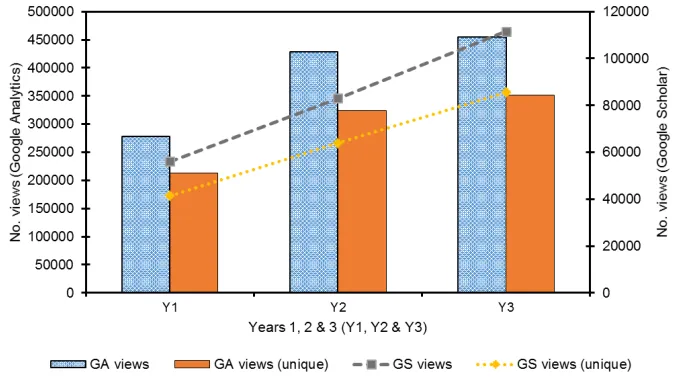
Web traffic, as measured by Google Analytics (GA), grew by 150,408 in Y2 to 428,407, equivalent to a 54% improvement when compared to Y1. A 52% improvement in unique traffic was also observed during the same period. An increase in traffic in Y3 was less than Y2 (6%) but was still in excess of Y2 (n = 454,318), meaning that the total percentage growth in traffic during the entire reporting period was 63% and 65% for traffic and unique traffic respectively.
[image:6.612.137.475.492.683.2]As might be expected, Google was found to be the largest referral source, accounting for 55% of all traffic in Y3; but thereafter GS was found to be the most significant referral source, accounting for 25% of all web traffic in Y3 and growing by 99% during the entire reporting period. Traffic in Y2 grew by 48% (n = 83,045) and 34% (n = 111,563) in Y3. 77% of all this traffic in both Y2 and Y3 was unique. This is at variance with previously reported results emerging from a preliminary evaluation (25), in which GS traffic was found to have declined slightly as a proportion of total web traffic (by 3%). In fact, this present evaluation, using a more comprehensive dataset, found the percentage of total traffic to Strathprints from GS to have increased by 5%, with almost all of these gains achieved during Y3. Thus, the percentage traffic gains achieved from GS during the reporting period (99%) grew even quicker than the broader gains achieved from other web traffic sources (63%). Repositories serving more content enjoy deeper indexing by Google Scholar (GS) (10).
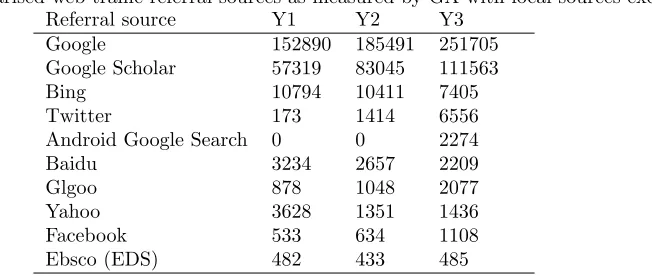
Table 1: Summarised web traffic referral sources as measured by GA with local sources excluded.
Referral source Y1 Y2 Y3
Google 152890 185491 251705 Google Scholar 57319 83045 111563
Bing 10794 10411 7405
Twitter 173 1414 6556
Android Google Search 0 0 2274
Baidu 3234 2657 2209
Glgoo 878 1048 2077
Yahoo 3628 1351 1436
Facebook 533 634 1108
Ebsco (EDS) 482 433 485
The principal referral sources remained largely unchanged during the reporting period, with both Google and GS referring the majority of the traffic. However, the proportion of the overall traffic referred to Strathprints by Google and GS grew by 18% between Y2 and Y3 such that 80% of all repository traffic was referred by either Google or GS. The remaining 20% comprised a long tail of services. The nature of this growth can be observed in Figure 4, with GS demonstrating steeper growth. Table 1 summarises the top ten referral sources (with local sources excluded). A 29% decrease in Bing referrals between Y2 and Y3 is noted, as is a larger decrease for Yahoo! (which shares the Bing index). Reasons for this are suggested later in this paper but essentially relate to search interference arising from the institutional CRIS. However, given the small contribution to traffic made by Bing and Yahoo! and the far larger increases in referral traffic from other sources (including within the long tail) this decrease is more than cancelled out. An interesting observation relates to the increase in referrals from social sources, such as Twitter and Facebook. Again, this traffic remains small in relation to the volume of total traffic but massive percentage increases can nevertheless be observed. For example, traffic from Twitter increased by 3700% between Y1 and Y3 as improved social media interaction opportunities were implemented.
5.2
Discovery
A more appropriate measure of repository discoverability lies in search metrics. Google Search Console was used to gather search data during the reporting period, thereby allowing the effect of the repository changes to be examined on Google search queries. Search Console makes the distinction between data pertaining to “impressions” and “clicks”. Impressions are defined as occurring when “A link URL record ... appears in a search result for a user”, while a click is “any click that sends the user to a page outside of Google Search” (18)).
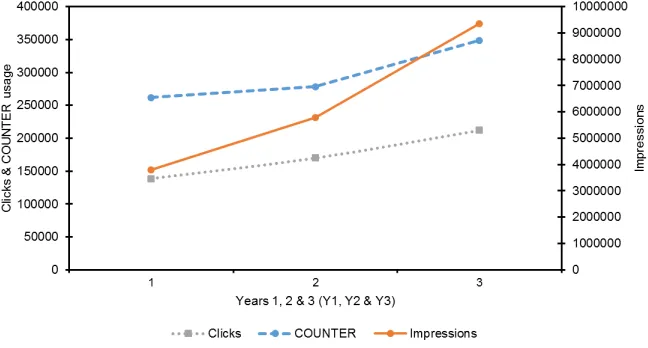
Improvements in impressions and clicks were observed in Y2 at 52% (n = 5,795,781) and 23% (n = 169,720) respectively when compared to the Y1 period. This upwards trend continued in Y3 at 61% (n = 9,357,582) and 25% (n = 212,148), and a general upwards trend in impressions and clicks can be observed in the graph profile of Figure 3, with impressions and clicks demonstrating particular growth from early 2017 onwards. The total percentage growth in impressions and clicks during the entire reporting period was 146% and 53% respectively. Figure 6 provides a summary of the increase in clicks, impressions and COUNTER usage, with steeper increases in impressions and clicks noted between Y2 and Y3.
Figure 5: Strathprints COUNTER usage during Y1, 2 and 3 and Google clicks impressions during the same period.
Figure 6: Charted data on observed clicks, impressions and COUNTER usage during reporting period. the number of deposits in Y3 actually declining by 19% while increasing by a similar proportion in Y2. Usage therefore generally increased greater than the number of deposits but in the first year this was not observed. It is also noteworthy recalling that Google search referrals and GS traffic demonstrated growth well in excess of the 19% full-text deposit rate, as per Figure 4. In other words, the percentage of users being referred increased at a greater rate than the percentage grown rate of full-text.
[image:8.612.145.469.316.490.2]narrowed considerably for Y3 (r2 = 0.934) with a strong linear relationship between variables noted
such that 94% of the unique variance in COUNTER usage could be directly attributed to Google clicks. This narrowing in variation can also be observed from Figure 7.
5.3
Dwell time
By exposing their content to disparate search services, and the nature of repository content itself, repositories encourage and are conducive to “horizontal” information seeking strategies [19]. These types of information seeking strategy typically correspond with the relatively high ”bounce rates” that repositories experience. Bounce rates are calculated by GA as “a session that triggers only a single request to the Analytics server, such as when a user opens a single page on your site and then exits without triggering any other requests ... during that session” (26). The bounce rate in this study remained relatively unchanged, fluctuating across reporting periods at circa 75%. However, the average time users spent on Strathprints upon arrival increased, up from 01:13 in Y1 to 01:54 in Y2 and then 01:59 in Y3. Although users were continuing to bounce, they were typically spending longer on Strathprints, indicative perhaps that improvements to the UI and Strathprints functionality was enough to persuade users to defer their bounce. In other words, it was possible to improve users’ dwell time on Strathprints by 61% between Y1 and Y3.
Dwell time therefore suggests itself as a more accurate indicator of repository engagement than bounce rates, which experienced only marginal change during the reporting period. Bounce rates are not necessarily a reliable metric within models of information seeking behaviour. For example, a user might spend 25 mins reading content on a repository, taking notes and chaining references, but then they might leave. In this example the user “bounced” because they failed to navigate to another page on the repository. But, in repository terms, the user spent 25 mins consuming repository content and found that content sufficiently useful that they “dwelled” for 25 mins. Dwell time is therefore critical to understanding repository engagement. Interestingly, it is for this reason that many search services, Google and Bing included, factor “dwell time” into their relevance rankings (27)(28). Like PageRank more generally, the way in which search tools calculate dwell time, or the weighting it is assigned in computing algorithms such as PageRank, is unknown; but it is clearly a variable in calculating relevance and is therefore a metric institutions and repository managers should monitor. Similarly, the significance of dwell time in this evaluation is impossible to calculate. It is only possible to state that it would have positively influenced the visibility of Strathprints in the search results of services such as Google and Bing.
6
Conclusion and future work
[a]
[b]
[image:10.612.178.431.177.586.2][c]
Y3. User “dwell time” was also found to have increased, suggesting longer interaction sessions by users when consuming content on the repository.
Of course, as with any experiments attempting to effect change on third party systems, it is impossible to control for all variables hypothesised to influence web visibility. It is not claimed that every known variable has been addressed in this instance. The approach adopted here of delivering repository adjustments and improvements was a holistic one, and was intended to address as many as possible. The approach could therefore be described as pursuing the accumulation of marginal gains; identifying numerous minor optimisations that can be implemented which, when taken in aggregate, effect further significant improvements. Data will continue to be monitored into Y4 with the hope of exploring how additional adjustments could improve visibility on other search discovery tools, thereby providing the basis for greater longitudinal analysis.
Although the experiments were performed on EPrints it is thought that most of the adopted improve-ments are equally applicable to most repository platforms. There is, in fact, potential for others to improve the impact of the approach. For example, it was noted in the literature that coversheets are considered to be disruptive to the bot crawling potential of repositories and it has been suggested that repositories disable such repository functionality (9). Based on local experimentation and the need to ensure accurate attribution of repository outputs, coversheets remained enabled in Strath-prints and continue to remain enabled. This therefore highlights a possible limitation. However, there are also potential additional improvements to be gained by other repositories willing to develop their own alternative approaches (e.g. watermarking attribution details) or disabling coversheets altogether. Furthermore, owing to the existence of Strathprints within a connected CRIS configuration, the present author noted issues of the CRIS front-end interfering with the visibility of Strathprints in some cases. Again, this interference was almost impossible to quantify and appeared to particularly affect Bing and Yahoo! Searches; but for those repositories operating outside of a CRIS environment or functioning as the de facto CRIS front-end, considerable additional opportunities are available vis--vis promoting the discoverability and web impact of repository content.
Data statement- Data underpinning this work are available under a Creative Commons Attribution (CC-BY) license at: https://doi.org/10.5281/zenodo.1411207
This preprint is distributed under the terms of the Creative Commons Attribution License (CC-BY).
Please cite as: Macgregor, G. (2018). Repository optimisation techniques to improve discoverabil-ity and web impact: an evaluation. (pp. 1-13). Glasgow: Universdiscoverabil-ity of Strathclyde [Strathprints repository]. Available: https://doi.org/10.17868/65389/
References
[1] IRUS-UK, “IRUS-UK,” 2018. [Online]. Available: http://www.irus.mimas.ac.uk/
[2] B. Kelly and W. Nixon, “SEO analysis of institutional repositories: Whats the back story?” in Open Repositories 2013. University of Bath, Jul. 2013. [Online]. Available: http://opus.bath.ac.uk/35871/
[3] G. Macgregor, “The long read: Why do institutional repositories remain one of the only viable options for Green Open Access?” Nov. 2016. [Online]. Available: https://perma.cc/G52J-2FSG [4] “Strathprints: The University of Strathclyde institutional repository,” 2018. [Online]. Available:
http://strathprints.strath.ac.uk/
[6] A. M. Tmava and D. G. Alemneh, “Enhancing Content Visibility in Institutional Repositories: Overview of Factors that Affect Digital Resources Discoverability [Poster],” Feb. 2013. [Online]. Available: https://digital.library.unt.edu/ark:/67531/metadc146593/
[7] S. Pekala, “Microdata in the IR: A Low-Barrier Approach to Enhancing Discovery of Institutional Repository Materials in Google,” Code4Lib Journal, no. 39, Feb. 2018. [Online]. Available: https://journal.code4lib.org/articles/13191
[8] COAR, “Next Generation Repositories: Behaviours and Technical Recommendations of the COAR Next Generation Repositories Working Group,” COAR, Gttingen, Tech. Rep., Nov. 2017. [Online]. Available: https://www.coar-repositories.org/files/NGR-Final-Formatted-Report-cc.pdf
[9] E. L. Tonkin, S. Taylor, and G. J. L. Tourte, “Cover sheets considered harmful,” Information Services & Use, vol. 33, no. 2, pp. 129–137, Jan. 2013. [Online]. Available: https://doi.org/10.3233/ISU-130705
[10] A. Acharya, “Indexing repositories: pitfalls and best practices,” Jun. 2015. [Online]. Available: https://media.dlib.indiana.edu/media objects/9z903008w
[11] K. Arlitsch and P. OBrien, “ USInvisible institutional repositories: addressing the low indexing ratios of IRs in Google Scholar,” USLibrary Hi Tech, vol. 30, no. 1, pp. 60–81, Mar. 2012. [Online]. Available: https://scholarworks.montana.edu/xmlui/handle/1/3193
[12] D. Shirlaw, “University of Strathclyde research rankings rocket,” Dec. 2014. [Online]. Available: https://perma.cc/9CNK-8Z53
[13] T. Zhang, D. Maron, and C. Charles, “Usability evaluation of a research repository and collaboration website,” Journal of Web Librarianship, Jan. 2013. [Online]. Available: http://docs.lib.purdue.edu/lib fsdocs/51
[14] Z. Wang and D. Phan, “Using page speed in mobile search ranking,” Jan. 2018. [Online]. Available: https://perma.cc/8QKP-NE5S
[15] K. D. Pendell and M. S. Bowman, “Usability Study of a Library’s Mobile Website: An Example from Portland State University,”Information Technology and Libraries, vol. 31, no. 2, pp. 45–62, Jun. 2012. [Online]. Available: https://ejournals.bc.edu/ojs/index.php/ital/article/view/1913 [16] A. Everard and S. McCoy, “Effect of Presentation Flaw Attribution on Website Quality, Trust,
and Abandonment,” Australasian Journal of Information Systems, vol. 16, no. 2, Mar. 2010. [Online]. Available: http://journal.acs.org.au/index.php/ajis/article/view/516
[17] J. Nielsen and R. Molich, “Heuristic Evaluation of User Interfaces,” inProceedings of the SIGCHI Conference on Human Factors in Computing Systems, ser. CHI ’90. New York, NY, USA: ACM, 1990, pp. 249–256. [Online]. Available: http://doi.acm.org/10.1145/97243.97281
[18] Google, “Search Engine Optimization (SEO) Starter Guide,” 2018. [Online]. Available: https://perma.cc/8CT3-UAV5
[19] K. Kloboves, “Continuing to make the web more mobile friendly,” Mar. 2016. [Online]. Available: https://webmasters.googleblog.com/2016/03/continuing-to-make-web-more-mobile.html
[20] L. Moreno and P. Martnez, “Overlapping factors in search engine optimization and web accessibility,” Jun. 2013. [Online]. Available: https://e-archivo.uc3m.es/handle/10016/20175 [21] G. Macgregor, “Feeding the beast: workloads in a hybrid IR / CRIS environment,” Apr. 2017.
[22] ——, “Demonstrating the need for speed: improving page loading and rendering in repositories,” Oct. 2017. [Online]. Available: https://perma.cc/DCM7-TS7B
[23] Google, “About Data Highlighter,” 2018. [Online]. Available: https://perma.cc/92DY-MFZP [24] ——, “Google Analytics,” 2018. [Online]. Available: https://marketingplatform.google.com/
about/analytics/
[25] G. Macgregor, “Reviewing repository discoverability : approaches to improving repository visibility and web impact,” in Repository Fringe 2017, John McIntyre Conference Centre, University of Edinburgh, Aug. 2017. [Online]. Available: https://strathprints.strath.ac.uk/61333/ [26] Google, “Google Search Console,” 2018. [Online]. Available: https://www.google.com/
webmasters/tools/home
[27] Microsoft, “How To Build Quality Content,” Aug. 2011. [Online]. Available: https: //perma.cc/X2U7-QMPJ
![Figure 7: Coefficient of determination (r squared) for Y1 [a], Y2 [b] and Y3 [c] (clicks and COUNTERusage).](https://thumb-us.123doks.com/thumbv2/123dok_us/1395953.92685/10.612.178.431.177.586/figure-coecient-determination-squared-y-y-clicks-counterusage.webp)