City, University of London Institutional Repository
Citation
:
Corr, P. J., Stoeber, J. and Saklofske, D. (2017). Perfectionism and personality. In: Stoeber, J. (Ed.), The Psychology of Perfectionism. (pp. 68-88). London: Routledge. ISBN 9781138691032This is the accepted version of the paper.
This version of the publication may differ from the final published
version.
Permanent repository link:
http://openaccess.city.ac.uk/16952/Link to published version
:
Copyright and reuse:
City Research Online aims to make research
outputs of City, University of London available to a wider audience.
Copyright and Moral Rights remain with the author(s) and/or copyright
holders. URLs from City Research Online may be freely distributed and
linked to.
City Research Online: http://openaccess.city.ac.uk/ [email protected]
applications. London: Routledge.
Perfectionism and Personality
Joachim Stoeber, Philip J. Corr, Martin M. Smith, & Donald H. Saklofske
Overview
This chapter provides a synopsis of research on where multidimensional perfectionism “fits” within the broader framework of contemporary personality theory. Focusing on Hewitt and Flett’s (1991) model of perfectionism—differentiating self-oriented, other-oriented, and socially prescribed perfectionism—the chapter presents a summary and critical discussion of how
multidimensional perfectionism relates to the dimensions and facets of two major structural models of personality (the five-factor model and the HEXACO model) and one
neuropsychological model of personality (reinforcement sensitivity theory). Implications of the findings for multidimensional theories and models of perfectionism, as well as future
perfectionism research, are discussed.
Introduction
Perfectionism is best conceptualized as a multidimensional personality disposition, which is important because perfectionism’s multiple dimensions show different, sometimes opposite, relationships with adaptive and maladaptive psychological processes and outcomes (see Chapters 1-3). For a complete understanding of multidimensional perfectionism, however, it is important to know not only how different perfectionism dimensions are related to processes and outcomes, but also how they are related to stable personality characteristics. Furthermore, it is important to know where perfectionism and its different dimensions “fit” within broader frameworks of personality
To provide answers to these questions, we reviewed the research literature looking for studies that have investigated perfectionism’s relationships with structural (trait) and
neuropsychological models of personality. In this search, we focused on Hewitt and Flett’s (1991) tripartite model of multidimensional perfectionism which differentiates three forms of perfectionism: self-oriented, other-oriented, and socially prescribed. Self-oriented perfectionism reflects beliefs that striving for perfection and being perfect are important. Self-oriented
self-critical if they fail to meet these demands. In contrast, other-oriented perfectionism reflects beliefs that it is important for others to strive for perfection and be perfect. Other-oriented perfectionists have exceedingly high standards for others, expect others to be perfect, and are highly critical of others who fail to meet these expectations. Finally, socially prescribed perfectionism reflects beliefs that striving for perfection and being perfect are important to others. Socially prescribed perfectionists believe that exceedingly high standards are being imposed on them. They believe others expect them to be perfect, and think that others will be highly critical of them if they fail to meet their expectations (Hewitt & Flett, 1991, 2004).
There were a number of reasons why we focused on Hewitt and Flett’s (1991) model. First, the model is one of the most widely used in perfectionism research, and there are many studies that have investigated how this model’s dimensions relate to broader personality dimensions. Second, the model includes the two superordinate dimensions that can be regarded as key indicators of perfectionistic strivings and perfectionistic concerns. Self-oriented perfectionism is
a key indicator of perfectionistic strivings, and socially prescribed perfectionism a key indicator of perfectionistic concerns (Frost, Heimberg, Holt, Mattia, & Neubauer, 1993; Stoeber & Otto, 2006). Consequently, examining how self-oriented and socially prescribed perfectionism relate to personality gives us an indication of how perfectionistic strivings and perfectionistic
concerns—and other dimensions that are key indicators of perfectionistic strivings and perfectionistic concerns—relate to personality. Third, perfectionism is a personality characteristic that has personal and social aspects (which we will see is important when
examining perfectionism’s relationships with personality), and Hewitt and Flett’s model clearly differentiates personal and social aspects. Moreover, the model was the first to suggest that other-oriented perfectionism is an important dimension of perfectionism, which is recently seeing a reinvigorated interest from psychological research. Moreover, other-oriented perfectionism plays a central role in dyadic perfectionism (Stoeber, 2012) and is a defining component of narcissistic perfectionism (see Chapter 6). Hence, we wanted to make sure that other-oriented perfectionism played a prominent role in our review of how perfectionism relates to personality, which should begin with looking at structural models of personality.
Structural Models of Personality
(McAdams, 2006; Pervin, Cervone, & John, 2005). These models aim to provide a complete description of personality, that is, they seek to capture all relevant traits. At the same time, the models aim to be economical and avoid redundancy, and they try to do so by capturing broad, non-overlapping traits that are relevant to most people most of the time. To find these traits, structural models of personality rely on a statistical procedure called “factor analysis” (Ashton, 2013).1
The Five-Factor Model (FFM)
The five-factor model (FFM) of personality is a structural model of personality that evolved from psycholexical analyses of traits (e.g., Allport & Odbert, 1936; Norman, 1963) followed by factor analyses (Ashton, 2013; Pervin et al., 2005). According to the “lexical
hypothesis,” the descriptive terms for all traits that are relevant to describe individual differences are communicated between people (e.g., “Sam is organized”) and are therefore represented in their language’s lexicon as adjectives (e.g., “organized”). Consequently, a list of all adjectives in a lexicon will contain descriptors of all relevant traits and—once synonyms and rarely used adjectives are removed—can be administered as self-report questionnaires to large samples of participants with instructions to rate how accurately each adjective describes them. These ratings are then subjected to factor analyses with the aim to find the basic dimensions (“factors”) that explain individual differences in people’s self-ratings. The resulting factors then represent the structure of personality.
Beginning with numerous earlier studies of personality trait descriptions following, for example, Cattell (1943), Norman (1963), and Eysenck (1991; see also Bowden, Saklofske, van de Vijver, Sudarshan, & Eysenck, in press), converging evidence published by a number of prominent personality researchers showed a growing agreement on a model (the FFM) according to which five broad dimensions are sufficient to describe the basic structure of personality: neuroticism, extraversion, openness to experience (or openness for short), agreeableness, and conscientiousness (McCrae & Costa, 1999; see John & Srivastava, 1999, for a comprehensive review of the history of the FFM). These five personality dimensions—also referred to as the “Big Five”—are sometimes described as bipolar dimensions (e.g., neuroticism vs. emotional
1For a “gentle introduction” to factor analysis in personality research—what it is, what it
stability, extraversion vs. introversion) or may appear under different names (e.g., extraversion may be called surgency, openness may be called intellect), but they all represent essentially the same five broad dimensions of personality as the FFM. Consequently, our review used the FFM as a frame of reference.
According to Pervin et al. (2005), the five factors can be described as follows. Neuroticism captures individual differences in psychological maladjustment versus emotional stability and identifies individuals who are prone to psychological distress, dysfunctional beliefs, and maladaptive coping responses. Typical adjectives describing people high in neuroticism are moody, nervous, anxious, touchy, and emotional (Saucier & Goldberg, 1996). Extraversion captures individual differences in the quantity and intensity of interpersonal interaction, activity level, need for stimulation, and—importantly—the capacity for joy. Typical adjectives
describing people high in extraversion are talkative, sociable, assertive, enthusiastic, and
energetic. Openness captures individual differences in the proactive seeking and appreciation of experience for its own sake and the toleration for and exploration of the unfamiliar. Typical adjectives describing people high in openness are inquisitive, intellectual, philosophical, innovative, and unconventional. Agreeableness captures individual differences in the quality of people’s interpersonal orientation along a continuum from social antagonism to compassion. (Note the difference to extraversion which captures the quantity of interpersonal interactions.)
Typical adjectives describing people high in agreeableness are kind, warm, considerate, helpful, and generous. Finally, conscientiousness captures individual differences in the degree of
organization, persistence, and goal-directed behavior. Typical adjectives describing people high in conscientiousness are organized, responsible, thorough, efficient, and self-disciplined.
Multidimensional Perfectionism and the FFM
FFM dimensions. To gauge how multidimensional perfectionism relates to the broad
Gralnick, 2016; Stairs, Smith, Zapolski, Combs, & Zettles, 2012; Stoeber, in press; Stoeber, Otto, & Dalbert, 2009).2 When summarizing these findings in the following sections, we adopted
Cohen’s (1992) guidelines and regarded correlations with absolute values of .10, .30, and .50 as small, medium-sized, and large. In addition, we referred to medium-sized and large correlations as “substantial.”
As regards neuroticism, socially prescribed perfectionism was the only perfectionism
dimension of Hewitt and Flett’s (1991) model that consistently showed substantial positive correlations, suggesting that socially prescribed perfectionism is a neurotic form of perfectionism (cf. Hamachek, 1978). In comparison, self-oriented perfectionism did not always show positive correlations with neuroticism. Whereas a number of studies found positive correlations (e.g., Enns & Cox, 1999; Molnar et al., 2012; Smith et al., 2016), other studies found nonsignificant correlations (e.g., Hewitt & Flett, 2004; Hill, McIntire, & Bacharach, 1997; Stoeber et al., 2009). Moreover, the studies that found positive correlations consistently found these correlations to be smaller than those for socially prescribed perfectionism (e.g., Rice et al., 2007; Smith et al., 2016). This indicates that—although self-oriented perfectionists may have neurotic tendencies— neuroticism is not characteristic of self-oriented perfectionism to the same degree as it is
characteristic of socially prescribed perfectionism. In contrast, other-oriented perfectionism usually showed near-zero correlations with neuroticism (e.g., Hewitt & Flett, 2004; Hill, McIntire, & Bacharach, 1997; Rice et al., 2007).
For extraversion, approximately half of the reviewed studies found socially prescribed
perfectionism to show negative correlations (e.g., Molnar et al., 2012; Sherry et al., 2007; Stoeber et al., 2009) whereas the other half found nonsignificant correlations (e.g., Dunkley & Kyparissis, 2008; Hewitt & Flett, 2004; Rice et al., 2007). This indicates that socially prescribed perfectionism is negatively related to extraversion, but the relationship is much weaker than the positive relationship that socially prescribed perfectionism shows with neuroticism. Still, the findings suggest that socially prescribed perfectionists tend to be less talkative, sociable, assertive, enthusiastic, and energetic, and—importantly—may show a reduced capacity for joy. In contrast, self-oriented perfectionism and other-oriented perfectionism showed no consistent
2Stairs et al. (2012) were included because they measured “perfectionism toward others”
pattern of relationships with extraversion. Indeed, the majority of studies found nonsignificant correlations, which suggests that both self-oriented and other-oriented perfectionism are largely unrelated to extraversion.
The reviewed studies on openness suggest that this FFM dimension does not play a
significant role in multidimensional perfectionism. Whereas there are singular studies reporting small negative correlations between socially prescribed perfectionism and openness (e.g., Stoeber et al., 2009), the vast majority of studies examining the perfectionism dimensions of Hewitt and Flett’s (1991) model failed to find any significant correlations with openness (e.g., Hewitt & Flett, 2004; Hill, McIntire, & Bacharach, 1997; Rice et al., 2007). Hence, perfectionists do not appear to be less open to experience than non-perfectionists.
As regards agreeableness, the case was different. In particular, other-oriented
perfectionism showed substantial negative correlations with agreeableness across studies (e.g., Hewitt & Flett, 2004; Hill, McIntire, & Bacharach, 1997; Stoeber, in press) which indicates that social antagonism (low agreeableness) is highly characteristic of other-oriented perfectionists. Socially prescribed perfectionism was also negatively correlated with agreeableness, but these correlations were often considerably smaller than those of other-oriented perfectionism (e.g., Hill, McIntire, & Bacharach, 1997) and sometimes nonsignificant (e.g., Hewitt & Flett, 2004). In contrast, self-oriented perfectionism appeared to be largely unrelated to agreeableness. Except for one study finding a negative correlation (Stoeber et al., 2009), all other studies found self-oriented perfectionism to show nonsignificant correlations with agreeableness (e.g., Dunkley & Kyparissis, 2008; Hewitt & Flett, 2004; Rice et al., 2007).
Turning to conscientiousness, all reviewed studies found self-oriented perfectionism to
show positive and often substantial correlations with this personality factor (e.g., Hewitt & Flett, 2004; Hill, McIntire, & Bacharach, 1997; Rice et al., 2007). This was not the case for the other two perfectionism dimensions. Other-oriented perfectionism showed only small positive correlations with conscientiousness that were significant in approximately half of the reviewed studies (e.g., Hill, McIntire, & Bacharach, 1997; Rice et al., 2007) and nonsignificant in the other half (e.g., Molnar et al., 2012; Nathanson et al., 2006). In contrast, socially prescribed
perfectionism showed mostly nonsignificant correlations (e.g., Dunkley & Kyparissis, 2008; Hill, McIntire, & Bacharach, 1997) except for a few studies that found significant negative correlations (e.g., Hewitt et al., 2004; Molnar et al., 2012).
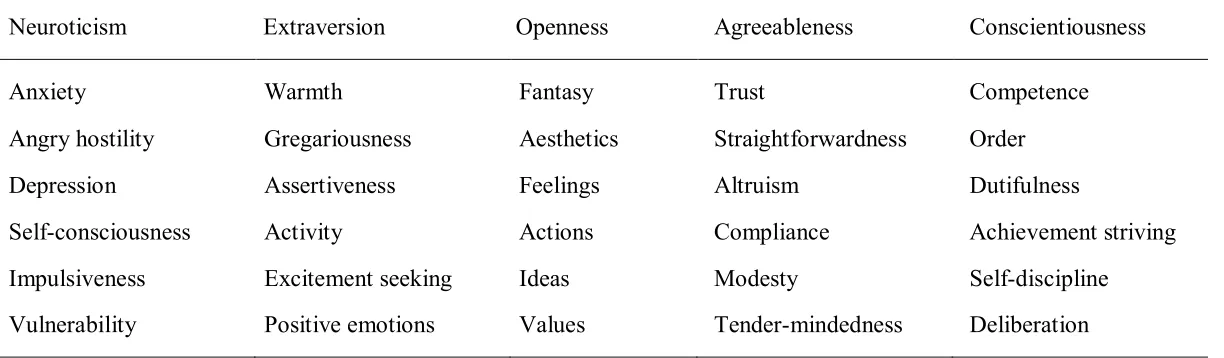
framework for an economical analysis of individual differences in personality traits—the model also allows for a more fine-grained analysis. The reason is that the FFM is conceptualized as a hierarchical model in which each of the five broad dimensions (domain level) is composed of a number of lower-level dimensions that are more specific (facet level). The most widely used measure to examine the FFM at the facet level is the NEO Personality Inventory-Revised (NEO PI-R; Costa & McCrae, 1992) which assesses six facets for each of the five dimensions.3 Table 1
shows the NEO-PI-R dimensions and facets (see also Costa & McCrae, 1995a). [Insert Table 1 about here]
Three studies have examined how Hewitt and Flett’s perfectionism dimensions relate to the NEO PI-R facets. Unfortunately, only two of the studies included other-oriented perfectionism (Hewitt & Flett, 2004 [Table 6.19]; Hill, McIntire, & Bacharach, 1997) whereas the third examined self-oriented and socially prescribed perfectionism only (Dunkley & Kyparissis, 2008). When we reviewed these studies focusing on the convergent findings—that is, the correlations that were significant across the studies—the following picture emerged.
As regards the neuroticism facets, self-oriented perfectionism showed nonsignificant
correlations across all studies, confirming again that self-oriented perfectionism has no strong links with neuroticism. The same applied to other-oriented perfectionism with the notable exception that both studies including other-oriented perfectionism found a positive correlation with angry hostility, which dovetails with the FFM findings linking other-oriented perfectionism to social antagonism (low agreeableness). In contrast, socially prescribed perfectionism showed positive correlations with five of the six neuroticism facets—anxiety, angry hostility, depression, self-consciousness, and vulnerability—across all three studies,4 and positive correlations with the
remaining neuroticism facet—impulsiveness—across two of the studies (Dunkley & Kyparissis, 2008; Hewitt & Flett, 2004). This again demonstrates that socially prescribed perfectionism shares the strongest and most consistent links with neuroticism.
3Successively an improved NEO-PI-R version was developed called the NEO-PI-3
(McCrae, Costa, & Martin, 2005).
4The minus sign before the correlation of socially prescribed perfectionism and anxiety in
Regarding the extraversion facets, it is noteworthy that self-oriented perfectionism showed
positive correlations with two facets—assertiveness and activity—across all studies. This finding indicates that self-oriented perfectionists may not be more extraverted than others in general, but may be more assertive and active. Moreover, it also demonstrates the value of examining FFM facets in addition to FFM dimensions. Other-oriented perfectionism also showed positive correlations with activity across the two studies that included other-oriented perfectionism, but not with assertiveness which was surprising given that other-oriented perfectionists tend to report high self-esteem (e.g., Flett, Hewitt, Blankstein, & O’Brien, 1991). In contrast, socially
prescribed perfectionism showed negative correlations with the positive emotions facets across all studies, suggesting that socially prescribed perfectionists have a lower capacity to experience positive emotions. There are studies indicating that low positive emotionality is a risk factor for depression (Khazanov & Ruscio, 2016), and thus the finding of socially prescribed perfectionism showing negative correlations with positive emotions dovetails with the finding of socially prescribed perfectionism showing positive correlations with depression (e.g., Hewitt & Flett, 2004; Smith et al., 2016). Furthermore, the finding suggest that socially prescribed perfectionists may not be less extraverted than others in general, but may have a lower capacity for joy.
Turning to the openness facets, there was only one correlation significant across studies:
Socially prescribed perfectionism showed a negative correlation with openness to values. This indicates that socially prescribed perfectionists may not be generally less open to experience than others, but they may be less open-minded regarding values, ideas, and principles and less willing to accept that values, ideas, and principles may be relative and open to change and different interpretations.
The agreeableness facets and self-oriented perfectionism did not show any significant
correlations across studies. This finding is in line with the domain-level findings indicating that self-oriented perfectionism is largely unrelated to agreeableness. In contrast, other-oriented perfectionism showed significant negative correlations with five of the six facets—trust,
straightforwardness, altruism, compliance, and modesty—across the two studies including other-oriented perfectionism, which further corroborates the strong links of other-other-oriented
level, socially prescribed perfectionism is not as strongly linked to low agreeableness as other-oriented perfectionism, but shows much stronger links with neuroticism.
Finally, as regards the conscientiousness facets, self-oriented perfectionism showed
significant negative correlations with five of the facets—competence, order, dutifulness, achievement striving, and self-discipline (but not deliberation)—across all three studies. Moreover, the correlation with achievement strivings was always larger than the other correlations, indicating that achievement striving is the conscientiousness facet most closely related to self-oriented perfectionism. In contrast, neither other-oriented perfectionism nor socially prescribed perfectionism showed any correlations with the conscientiousness facets that were significant across studies.
Summary. The finding from the studies examining how the perfectionism dimensions of
Hewitt and Flett’s (1991) model relate to the FFM dimensions and facets demonstrate that the three perfectionism dimensions have a unique personality profile for four of the five FFM dimensions: neuroticism, extraversion, agreeableness, and conscientiousness (but not openness).
Self-oriented perfectionism is primarily characterized by high conscientiousness. This suggests
self-oriented perfectionists tend to show a high degree of organization, persistence, and goal-directed behavior, and can be regarded as organized, responsible, thorough, efficient, and self-disciplined. Furthermore, self-oriented perfectionists may show higher levels of extraversion regarding assertiveness and activity. Other-oriented perfectionism is primarily characterized by
low agreeableness. This suggests that other-oriented perfectionists show a high degree of social antagonism (i.e., the opposite of agreeableness) and may be unsympathetic, uncooperative, egotistical, cold, and impersonal (cf. Saucier & Goldberg, 1996). Furthermore, other-oriented perfectionists may show higher levels of neuroticism regarding angry hostility which is in line with other-oriented being a socially antagonistic form of perfectionism (Hewitt & Flett, 1991; Stoeber, 2014a, 2014b). Socially prescribed perfectionism is primarily characterized by high
antagonistic. We should note, however, that the negative relationships with extraversion tended to be small and were often nonsignificant; and the negative relationships with agreeableness tended to be weaker than those found for other-oriented perfectionism. Consequently, low levels of extraversion and agreeableness seem to characterize socially prescribed perfectionism to a lesser extent than high levels of neuroticism. Furthermore, low levels of agreeableness seem to be more characteristic of other-oriented perfectionism than socially prescribed perfectionism.
The HEXACO Model
Another important structural model of personality based on psycholexical analyses is the HEXACO model (Ashton & Lee, 2007; Ashton et al., 2004). The main difference to the FFM is that the HEXACO model suggests that the FFM is missing an important dimension of
personality labelled honesty-humility. Honesty-humility differentiates people who are sincere, honest, faithful, loyal, modest, unassuming, and fair-minded from those who are sly, greedy, pretentious, hypocritical, boastful, and pompous. Consequently, the HEXACO model comprises six broad personality dimensions: honesty-humility (H), emotionality (E), extraversion (X), agreeableness (A), conscientiousness (C), and openness (O). Emotionality, conscientiousness, and openness are supposed to correspond to FFM neuroticism, conscientiousness, and openness, but agreeableness has different characteristics than FFM agreeableness: HEXACO agreeableness differentiates people who are patient, tolerant, peaceful, mild, agreeable, lenient, and gentle from those who are ill-tempered, quarrelsome, stubborn, and choleric (Ashton & Lee, 2007).
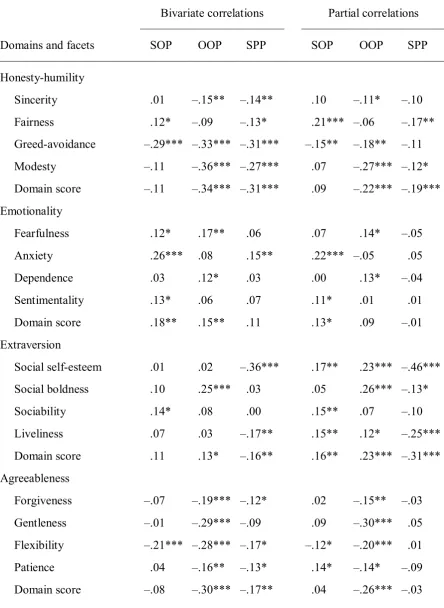
Like the FFM, the HEXACO is conceptualized as a hierarchical model because each of the six broad dimensions (domain level) is comprised of a number of lower-level dimensions (facet level). To assess these facets, Ashton and Lee developed a 100-item version of the HEXACO Personality Inventory-Revised (HEXACO-PI-R) assessing four facets for each of the six dimensions (Lee & Ashton, n.d.). Table 2 shows the HEXACO-PI-R dimensions and facets. (Note that Lee and Ashton consider perfectionism to be a unidimensional facet of
conscientiousness.)
[Insert Table 2 about here]
Multidimensional Perfectionism and the HEXACO Model
(2014a) are reproduced here with facet scores included (see Table 2). In addition, Table 2 presents partial correlations controlling for the overlap between the three perfectionism
dimensions to examine the dimensions’ unique relationships with the HEXACO dimensions and facets (cf. Stoeber & Gaudreau, 2017).
Honesty-humility and self-oriented perfectionism were not significantly correlated.
However, a unique positive relationship was observed of self-oriented perfectionism with fairness and a unique negative relationship with greed-avoidance, suggesting that self-oriented perfectionists value fairness but may be greedy. In contrast, other-oriented perfectionism showed a unique negative relationship with the domain score, sincerity, greed-avoidance, and modesty. This suggests that other-oriented perfectionists may not only be greedy (like self-oriented
perfectionists), but generally manifest a deficit in honesty/sincerity and humility/modesty, which dovetails with studies linking other-oriented perfectionism to callousness and narcissistic
grandiosity (Smith et al., in press; Stoeber, 2015; Stoeber, Sherry, & Nealis, 2015). Also, socially prescribed perfectionism showed a unique negative relationship with the domain score and modesty, but—differently from the other perfectionism dimensions—also showed a unique negative relationship with fairness. It appears that socially prescribed perfectionists do not value fairness, and that socially prescribed perfectionists are perfectionists who “don’t play nicely with others” (Sherry, Mackinnon, & Gautreau, 2016).
As regards emotionality, the pattern of correlations was unexpected because self-oriented
perfectionism showed a unique positive relationship with the domain score whereas socially prescribed perfectionism did not. This stands in stark contrast to the FFM studies in which socially prescribed perfectionism showed consistent positive correlations with neuroticism whereas self-oriented perfectionism did not. Also, as regards the emotionality facets, the pattern of correlations was unexpected. Self-oriented perfectionism had unique positive relationships with anxiety and sentimentality, and other-oriented perfectionism had unique positive
relationships with fearfulness and dependence. In contrast, socially prescribed perfectionism was not significantly correlated with any emotionality facets once the overlap with the other two perfectionism dimensions was partialled out. Whereas the correlations that other-oriented perfectionism showed are odd and not in line with previous findings that other-oriented
perfectionism is unrelated to neuroticism, there are findings linking self-oriented perfectionism to anxiety (e.g., Hewitt & Flett, 2004; Klibert, Langhinrichsen-Rohling, & Saito, 2005).
attachment, and self-oriented perfectionism shares positive relationships with nurturance and intimacy (Stoeber, 2014a). Nevertheless, the present findings do not align with Ashton and Lee’s (2007) assertion that emotionality is comparable to neuroticism. However, further research on multidimensional perfectionism and emotionality is needed before firm conclusions can be drawn.
The pattern of correlations for extraversion showed close correspondence with the
findings from the FFM studies including analyses at the facet level. Self-oriented perfectionism had unique positive relationships with the domain score, social self-esteem, sociability, and liveliness, which corresponds to the finding that self-oriented perfectionism showed positive correlations with the FFM extraversion facets of assertiveness and activity. Other-oriented perfectionism showed unique positive relationships with the domain score, social self-esteem, and social boldness whereas socially prescribed perfectionism showed unique negative
relationships with the domain score, social self-esteem, social boldness. Also, these findings highlight the close correspondence to the findings with the FFM extraversion facets.
Furthermore, the negative correlation with social self-esteem replicates previous research
indicating that socially prescribed perfectionists have low social self-esteem (Flett, Hewitt, & De Rosa, 1996).
Regarding agreeableness, self-oriented perfectionism did not show a unique relationship
with the domain score but showed a unique negative relationship with flexibility, and a unique positive relationship with patience. Whereas this finding dovetails with the FFM findings that self-oriented perfectionism shows no consistent relationships with agreeableness, it suggests that self-oriented perfectionists may lack flexibility in social relations, but show patience when interacting with other. In contrast, other-oriented perfectionism had unique negative relationships with both the domain score and all facets—forgiveness, gentleness, flexibility, and patience— which is in line with the FFM findings that other-oriented perfectionism shows consistent
negative relationships with agreeableness. Conversely, socially prescribed perfectionism showed no significant unique relationships—neither with the domain score nor with any of the facets— which again demonstrates that socially prescribed perfectionism is less strongly and less consistently linked to low agreeableness than other-oriented perfectionism.
As regards conscientiousness, self-oriented perfectionism showed large-sized positive
conscientiousness. As expected, there were no significant relationships between other-oriented perfectionism and conscientiousness or any of the facets scores once the overlap with the other perfectionism dimensions was controlled. In contrast, socially prescribed perfectionism showed unique negative relationships with the domain score and all facet scores once the overlap with the other two perfectionism dimensions was controlled. This suggests that socially prescribed perfectionists are not very conscientious, and corroborates the studies that found socially prescribed perfectionism to show significant negative correlations with FFM conscientiousness (e.g., Hewitt et al., 2004; Molnar et al., 2012).
Finally, as regards openness, no perfectionism dimension showed any significant unique
relationships with the domain score or any of the facet scores, except that socially prescribed perfectionism showed a small negative partial correlation with creativity. This finding is in line with the FFM findings indicating that multidimensional perfectionism is largely unrelated to openness, but if perfectionism shows small negative relationships with openness and its facets, it is most likely socially prescribed perfectionism that will show these relationships.
Overall, the findings with the HEXACO dimensions and facets show considerable
correspondence with the findings from studies of the FFM dimensions and facets with respect to extraversion, openness, agreeableness, and conscientiousness (but not emotionality). Going beyond the FFM, the HEXACO findings indicate that both other-oriented perfectionism and socially prescribed perfectionism are associated with low honesty-humility (even though they showed somewhat different relationships with the honesty-humility facets). This suggests that not only other-oriented perfectionism is a personality disposition that has “dark” features (cf. Marcus & Zeigler-Hill, 2015), but so also is socially prescribed perfectionism, which
complements prior findings that socially prescribed perfectionism showed unique positive relationships with callousness and deceitfulness (Stoeber, 2014b, 2015).
Neuropsychological Models of Personality
In contrast to structural models of personality, neuropsychological models of personality aim to provide an account of the underlying emotion, motivation, and learning bases of
individual differences and, more specifically, to provide neuropsychologically anchored
Eysenck’s PEN Theory
A prominent neuropsychological model of personality is Eysenck’s PEN theory (Eysenck, 1970). Whereas the PEN theory also functions as a structural model of personality, it is not based on psycholexical analyses, but on theory and research on individual differences in
neuropsychological functioning (Eysenck & Eysenck, 1985).
The PEN theory differentiates three broad personality dimensions: psychoticism (P), extraversion (E), and neuroticism (N). Factor analytic studies suggest that the PEN dimensions of extraversion and neuroticism closely correspond to the FFM dimensions of extraversion and neuroticism, whereas psychoticism appears to be a combination of low agreeableness and low conscientiousness (Costa & McCrae, 1995b). Unfortunately, there is only one study (Hewitt, Flett, & Blankstein, 1991) examining how Hewitt and Flett’s three perfectionism dimensions are related to psychoticism (as conceptualized by Eysenck’s PEN theory), and the findings were mixed: In male participants, perfectionism showed no significant correlations with psychoticism, whereas self-oriented and socially prescribed perfectionism showed a positive correlation in female students and other-oriented perfectionism showed a positive correlation in female patients. Still, Eysenck’s PEN theory of personality is important in the present context because the E and N factors of the theory (regarding the neuropsychological foundations of extraversion and neuroticism) laid the foundation for Gray’s reinforcement sensitivity theory (Gray, 1982; Gray & McNaughton, 2000; for a review, see Corr, 2008).
Reinforcement Sensitivity Theory (RST)
The reinforcement sensitivity theory (RST) is a prominent neuropsychological theory of personality explaining individual differences in avoidance- and approach-related, and related conflict, behaviors. It assumes the existence of three emotional-motivational systems: one approach system (the behavioral approach system [BAS]) and two avoidance systems (the behavioral inhibition system [BIS] and the fight-flight-freeze system [FFFS]). The most distinctive features of the two avoidance systems are emotional output and defensive direction: The BIS activates behavioral repertoire when moving toward threat, eliciting the emotional state
of anxiety; in contrast, the FFFS activates behavior that moves the individual away from threat,
in seven RST components: four components of the BAS (reward interest, goal-drive persistence, reward reactivity, and impulsivity) plus BIS, FFFS, and a separate factor of defensive fight.
Three studies have investigated how the three dimensions of Hewitt and Flett’s model relate to the components of revised RST. The first study (Randles, Flett, Nash, McGregor, & Hewitt, 2010) examined two samples of university students using Carver and White’s (1994) BIS/BAS Scales to differentiate five RST components: BAS drive, BAS fun seeking, BAS reward responsiveness, the BIS, and the FFFS.5 Across the two samples, self-oriented
perfectionism showed positive correlations with BAS reward responsiveness, BAS drive, and the BIS whereas socially prescribed perfectionism only showed a positive correlation with the BIS. Otherwise, findings were mixed. In particular, other-oriented perfectionism did not show a clear pattern of significant relationships across the two samples. The second and third study (Stoeber & Corr, 2015, 2017) also examined university students, but this time used Corr and Cooper’s RST-PQ differentiating all seven components of revised RST. Moreover, the studies not only examined bivariate correlations, but also computed multiple regressions to examine the perfectionism dimensions’ unique relationships with the RST components. If we focus on the unique relationships that were significant across both studies, the following picture emerges. Self-oriented perfectionism showed unique positive relationships with BAS goal-drive persistence, BAS reward reactivity, and BIS. Other-oriented perfectionism showed a unique positive relationship with defensive fight, and a unique negative relationship with the BIS. In contrast, socially prescribed perfectionism showed unique positive relationships with BAS impulsivity and the BIS, and a unique negative relationship with BAS goal-drive persistence.
Taken together, the studies examining multidimensional perfectionism from the
perspective of revised RST suggest that the three perfectionism dimensions of Hewitt and Flett’s model have unique profiles of relationships with emotional-motivational systems and associated approach- and avoidance-related behaviors. Self-oriented perfectionists appear to be highly goal-directed—driven by goals and persistent in the pursuit of goals—while at the same time highly reactive to both positive and negative reinforcing stimuli, but not to positive stimuli.
5Note that the BIS/BAS Scales are based on the old, unrevised RST and do not
Furthermore, their approach-related behaviors do not seem to be driven by goals, but appear impulsive. By contrast, other-oriented perfectionists appear to show a reduced reactivity to negative reinforcing stimuli, which differentiates them from other perfectionists. Whereas both self-oriented and socially prescribed perfectionism were associated with higher BIS levels (suggesting that they are prone to experience anxiety), other-oriented perfectionists reported lower BIS levels (suggesting they are unlikely to experience anxiety). In addition, other-oriented perfectionism was the only dimension that showed a unique positive relation with defensive fight. This suggests that other-oriented perfectionists may become highly defensive when attacked, and will attack back. The combination of an overactive defensive fight system with an underactive BIS (indicating a reduced sensitivity to negative reinforcers) dovetails with findings that other-oriented perfectionism shows links with aggression and psychopathy (Stoeber, 2014b, 2015).
Furthermore, these results show that it is important to go beyond structural models of personality (like the FFM and the HEXACO model) and also examine neuropsychological models if we want to gain a deeper understanding of how multidimensional perfectionism is linked with emotional-motivational systems that directly feed into approach- versus avoidance-related behavior. This is important because different dimensions of perfectionism show different profiles of relationships with approach and avoidance motivation (see Chapter 2). Moreover, individual differences in the sensitivity to positive and negative reinforcers may determine whether perfectionism takes on forms that have adaptive aspects, or forms that are maladaptive and lacking any adaptive aspects (Slade & Owens, 1998).
Open Questions and Future Research
In concluding this chapter, it is important to point out that our review focused on Hewitt and Flett’s (1991) tripartite model of perfectionism. On the one hand, this focus provided us with a coherent framework when reviewing the different relationships of different perfectionism dimensions with the FFM and HEXACO dimensions and facets and with the revised RST components. On the other hand, it also presented a limitation as there are other prominent multidimensional models of perfectionism, most notably those of Frost et al. (Frost, Marten, Lahart, & Rosenblate, 1990), Slaney et al. (Slaney, Rice, Mobley, Trippi, & Ashby, 2001), and Hill et al. (Hill et al., 2004). We note, however, that self-oriented perfectionism is a key indicator of perfectionistic strivings, and socially prescribed perfectionism a key indicator of
indicators in these other models to show comparable patterns of relationships with the FFM, HEXACO model, and revised RST dimensions, facets, and components. In particular, personal standards (Frost et al., 1990), high standards (Slaney et al., 2001), and striving for excellence (Hill et al., 2004) are key indicators of perfectionistic strivings, and should show similar relationships as self-oriented perfectionism. As well, concern over mistakes (Frost et al., 1990; Hill et al., 2004) and discrepancy (Slaney et al., 2001) are key indicators of perfectionistic
concerns and should show similar relationships as socially prescribed perfectionism. Two studies employing the FFM confirm this expectation (Cruce, Pashak, Handal, Munz, & Gfeller, 2012; Rice et al., 2007). In contrast, for both the HEXACO model and revised RST, this is an open question that needs to be answered in future research.
There are further questions that remain to be answered. One question regarding the FFM findings concerns the degree to which the overlap between the three perfectionism dimensions of Hewitt and Flett’s model influenced the findings. Self-oriented, other-oriented, and socially prescribed perfectionism show substantial overlap: Intercorrelations are often in the .40s, but can be in the .50s (e.g., Hewitt & Flett, 2004). Consequently, when this overlap is controlled and unique relationships are regarded, the findings may be different (Stoeber & Gaudreau, 2017). For example, socially prescribed perfectionism tends to show significant negative correlations with agreeableness, but this may be due to its overlap with other-oriented perfectionism (which shows consistent negative correlations with agreeableness). Once this overlap is removed, socially prescribed perfectionism may show nonsignificant relationships with FFM agreeableness, as was the case for HEXACO agreeableness (see Table 2). Furthermore, socially prescribed
perfectionism tends to show nonsignificant correlations with conscientiousness, but this may be due to its overlap with self-oriented perfectionism (which shows consistent positive correlations with conscientiousness). Once this overlap is removed, it remains to be seen if socially
prescribed perfectionism is negatively related with conscientiousness, as was the case for HEXACO conscientiousness (see again Table 2).
perspective. They found that male self-oriented perfectionists tended to be arrogant-calculating whereas female self-oriented perfectionists tended to be warm-agreeable (cf. Chapter 6) which suggests that there also may be gender differences in how self-oriented perfectionism relates to agreeableness.
Finally, the perhaps most important question is whether individual differences in personality contribute to the development of individual differences in perfectionism. Flett, Hewitt, Oliver, and Macdonald (2002) provided a comprehensive analysis of potential factors contributing to the development of perfectionism, and one factor they suggested to play a role was the child’s “temperament.” If we replace “temperament” with “personality,” this would suggest that personality contributes to the development of perfectionism. Furthermore, the findings presented in this chapter suggest that different personality dimensions contribute to the development of different perfectionism dimensions. This suggestion was put to the test in a two-wave longitudinal study examining whether the FFM dimensions predicted changes in
adolescents’ self-oriented and socially prescribed perfectionism (Stoeber et al., 2009). In line with cross-sectional findings linking self-oriented perfectionism with conscientiousness and socially prescribed perfectionism with neuroticism, conscientiousness was expected to predict increases in self-oriented perfectionism, and neuroticism was expected to predict increases in socially prescribed perfectionism. Even though the study found support only for one of the expectations—conscientiousness predicted increases in self-oriented perfectionism, but
neuroticism did not predict increases in socially prescribed perfectionism—the study is important as it is the first to demonstrate that personality may play a role in the development of
perfectionism. Unfortunately, longitudinal studies examining developmental antecedents of perfectionism are scarce and usually focus on parental factors, but do not include measures of the child’s personality (Stoeber, Edbrooke-Childs, & Damian, in press). Further longitudinal
References
Allport, G. W., & Odbert, H. S. (1936). Trait-names: A psycho-lexical study. Princeton, NJ:
Psychological Review Company.
Ashton, M. C. (2013). Individual differences and personality (2nd ed.). London: Academic
Press.
Ashton, M. C., & Lee, K. (2007). Empirical, theoretical, and practical advantages of the
HEXACO model of personality structure. Personality and Social Psychology Review, 11,
150-166.
Ashton, M. C., Lee, K., Perugini, M., Szarota, P., de Vries, R. E., Di Blas, . . . De Raad, B. (2004). A six-factor structure of personality-descriptive adjectives: Solutions from psycholexical studies in seven languages. Journal of Personality and Social Psychology, 86, 356-366.
Bowden, S. C., Saklofske, D. H., van de Vijver, F. J. R., Sudarshan, N. J., & Eysenck, S. B. G. (in press). Cross-cultural measurement invariance of the Eysenck Personality
Questionnaire across 33 countries. Personality and Individual Differences.
Campbell, J. D., & Di Paula, A. (2002). Perfectionistic self-beliefs: Their relation to personality and goal pursuit. In G. L. Flett & P. L. Hewitt (Eds.), Perfectionism: Theory, research, and treatment (pp. 181-198). Washington, DC: American Psychological Association.
Carver, C. S., & White, T. L. (1994). Behavioral inhibition, behavioral activation, and affective responses to impending reward and punishment: The BIS/BAS Scales. Journal of
Personality and Social Psychology, 67, 319-333.
Cattell, R. B. (1943). The description of personality: Basic traits resolved into clusters. Journal of Abnormal and Social Psychology, 38, 476–506.
Cohen, J. (1992). A power primer. Psychological Bulletin, 112, 155-159.
Corr, P. J. (Ed.) (2008). The reinforcement sensitivity theory of personality. Cambridge, UK:
Cambridge University Press
Corr, P. J., & Cooper, A. (in press). The Reinforcement Sensitivity Theory of Personality Questionnaire (RST-PQ): Development and validation. Psychological Assessment.
Corr, P. J., DeYoung, C. G. & McNaughton, N. (2013). Motivation and personality: A
neuropsychological perspective. Social and Personality Psychology Compass, 7, 158-175.
UK: Cambridge University Press.
Corr, P. J., & McNaughton, N. (2012). Neuroscience and approach/avoidance personality traits: A two stage (valuation–motivation) approach. Neuroscience and Biobehavioral Reviews, 36, 2339-2354.
Costa, P. T., Jr., & McCrae, R. R. (1992). Revised NEO Personality Inventory (NEO PI-R) and NEO Five-Factor Inventory (NEO-FFI). Odessa, FL: Psychological Assessment
Resources.
Costa, P. T., Jr., & McCrae, R. R. (1995a). Domains and facets: Hierarchical personality assessment using the Revised NEO Personality Inventory. Journal of Personality Assessment, 64, 21-50.
Costa, P. T., & McCrae, R. R. (1995b). Primary traits of Eysenck’s P-E-N system: Three- and five-factor solutions. Journal of Personality and Social Psychology, 69, 308-317.
Cruce, S. E., Pashak, T. J., Handal, P. J., Munz, D. C., & Gfeller, J. D. (2012). Conscientious perfectionism, self-evaluative perfectionism, and the five-factor model of personality traits.
Personality and Individual Differences, 53, 268-273.
Davis, C., Karvinen, K., & McCreary, D. R. (2005). Personality correlates of a drive for muscularity in young men. Personality and Individual Differences, 39, 349-359.
Dunkley, D. M., Blankstein, K. R., & Berg, J.-L. (2012). Perfectionism dimensions and the five-factor model of personality. European Journal of Personality, 26, 233-244.
Dunkley, D. M., & Kyparissis, A. (2008). What is DAS self-critical perfectionism really
measuring? Relations with the five-factor model of personality and depressive symptoms.
Personality and Individual Differences, 44, 1295-1305.
Enns, M. W., & Cox, B. J. (1999). Perfectionism and depressive symptom severity in major depressive disorder. Behaviour Research and Therapy, 37, 783-794.
Enns, M. W., Cox, B. J., & Clara, I. P. (2005). Perfectionism and neuroticism: A longitudinal study of specific vulnerability and diathesis-stress models. Cognitive Therapy and Research, 29, 463-478.
Eysenck, H. J. (1970). The structure of human personality (3rd ed.). London: Methuen.
Eysenck, H. J. (1991). Dimensions of personality: 16, 5 or 3?—Criteria for a taxonomic paradigm. Personality and Individual Differences, 12, 773-790.
Flett, G. L., Hewitt, P. L., Blankstein, K., & O’Brien, S. (1991). Perfectionism and learned resourcefulness in depression and self-esteem. Personality and Individual Differences, 12,
61-68.
Flett, G. L., Hewitt, P. L., & De Rosa, T. (1996). Dimensions of perfectionism, psychosocial adjustment, and social skills. Personality and Individual Differences, 20, 143-150.
Flett, G. L., Hewitt, P. L., Oliver, J. M., & Macdonald, S. (2002). Perfectionism in children and their parents: A developmental analysis. In G. L. Flett & P. L. Hewitt (Eds.),
Perfectionism: Theory, research, and treatment (pp. 89-132). Washington, DC: American
Psychological Association.
Frost, R. O., Heimberg, R. G., Holt, C. S., Mattia, J. I., & Neubauer, A. L. (1993). A comparison of two measures of perfectionism. Personality and Individual Differences, 14, 119-126.
Frost, R. O., Marten, P., Lahart, C., & Rosenblate, R. (1990). The dimensions of perfectionism.
Cognitive Therapy and Research, 14, 449-468.
Gray, J. A. (1982). The neuropsychology of anxiety: An enquiry into the functions of the septo-hippocampal system. New York: Oxford University Press.
Gray, J. A., & McNaughton, N. (2000). The neuropsychology of anxiety: An enquiry into the functions of the septo-hippocampal system. Oxford: Oxford University Press.
Hamachek, D. E. (1978). Psychodynamics of normal and neurotic perfectionism. Psychology, 15(1), 27-33.
Hewitt, P. L., & Flett, G. L. (1991). Perfectionism in the self and social contexts: Conceptualization, assessment, and association with psychopathology. Journal of Personality and Social Psychology, 60, 456-470.
Hewitt, P. L., & Flett, G. L. (2004). Multidimensional Perfectionism Scale (MPS): Technical manual. Toronto: Multi-Health Systems.
Hewitt, P. L., Flett, G. L., & Blankstein, K. R. (1991). Perfectionism and neuroticism in
psychiatric patients and college students. Personality and Individual Differences, 12,
273-279.
Heym, N., Ferguson, E., & Lawrence, C. (2008). An evaluation of the relationship between Gray’s revised RST and Eysenck’s PEN: Distinguishing BIS and FFFS in Carver and White’s BIS/BAS scales. Personality and Individual Differences, 45, 709-715.
Assessment, 82, 80-91.
Hill, R. W., McIntire, K., & Bacharach, V. R. (1997). Perfectionism and the Big Five factors.
Journal of Social Behavior and Personality, 12, 257-270.
Hill, R. W., Zrull, M. C., & Turlington, S. (1997). Perfectionism and interpersonal problems.
Journal of Personality Assessment, 69, 81-103.
John, O. P., & Srivastava, S. (1999). The Big Five trait taxonomy: History, measurement, and theoretical perspectives. In L. A. Pervin & O. P. John (Eds.), Handbook of personality: Theory and research (2nd ed., pp. 102-138). New York: Guilford.
Khazanov, G. K., & Ruscio, A. M. (2016). Is low positive emotionality a specific risk factor for depression? A meta-analysis of longitudinal studies. Psychological Bulletin, 142,
991-1015.
Klibert, J. J., Langhinrichsen-Rohling, J., & Saito, M. (2005). Adaptive and maladaptive aspects of self-oriented versus socially prescribed perfectionism. Journal of College Student Development, 46, 141-156.
Lee, K., & Ashton, M. C. (n.d.). HEXACO-PI-R self-report form, English, 100-item version.
Retrieved from http://hexaco.org/hexaco-inventory
Marcus, D. K., & Zeigler-Hill, V. (2015). A big tent of dark personality traits. Social and Personality Psychology Compass, 9, 434-446.
McAdams, D. P. (2006). The person: A new introduction to personality psychology (4th ed.).
Hoboken, NJ: Wiley.
McCrae, R. R., & Costa, P. T., Jr. (1999). A five-factor theory of personality. In L. A. Pervin & O. P. John (Eds.), Handbook of personality: Theory and research (2nd ed., pp. 139-153).
New York: Guilford.
McCrae, R. R., Costa, P. T., Jr., & Martin, T. A. (2005). The NEO-PI-3: A more readable revised NEO Personality Inventory. Journal of Personality Assessment, 84, 261-270.
McNaughton, N., & Corr, P. J. (2004). A two-dimensional view of defensive systems: Defensive distance and fear/anxiety. Neuroscience and Biobehavioral Reviews, 28, 285-305.
Molnar, D. S., Sadava, S. W., Flett, G. L., & Colautti, J. (2012). Perfectionism and health: A mediational analysis of the roles of stress, social support and health-related behaviours.
Psychology & Health, 27, 846-864.
Educational Psychology, 31, 97-122.
Nealis, L. J., Sherry, S. B., Sherry, D. L., Stewart, S. H., & Macneil, M. A. (2015). Toward a better understanding of narcissistic perfectionism: Evidence of factorial validity,
incremental validity, and mediating mechanisms. Journal of Research in Personality, 57,
11-25.
Norman, W. T. (1963). Toward an adequate taxonomy of personality attributes: Replicated factor structure in peer nomination personality ratings. Journal of Abnormal and Social
Psychology, 66, 574-583.
Pervin, L. A., Cervone, D., & John, O. P. (2005). Personality: Theory and research (9th ed.).
Hoboken, NJ: Wiley.
Randles, D., Flett, G. L., Nash, K. A., McGregor, I. D., & Hewitt, P. L. (2010). Dimensions of perfectionism, behavioral inhibition, and rumination. Personality and Individual
Differences, 49, 83-87.
Rice, K. G., Ashby, J. S., & Slaney, R. B. (2007). Perfectionism and the five-factor model of personality. Assessment, 14, 385-398.
Saucier, G., & Goldberg, L. R. (1996). Evidence for the Big Five in analyses of familiar English personality adjectives. European Journal of Personality, 10, 61-77.
Sherry, S. B., Hewitt, P. L., Flett, G. L., Lee-Baggley, D. L., & Hall, P. A. (2007). Trait perfectionism and perfectionistic self-presentation in personality pathology. Personality and Individual Differences, 42, 477-490.
Sherry, S. B., Hewitt, P. L., Sherry, D. L., Flett, G. L., & Graham, A. R. (2010). Perfectionism dimensions and research productivity in psychology professors: Implications for
understanding the (mal)adaptiveness of perfectionism. Canadian Journal of Behavioural Science, 42, 273-283.
Slade, P. D., & Owens, R. G. (1998). A dual process model of perfectionism based on reinforcement theory. Behavior Modification, 22, 372-390.
Slaney, R. B., Rice, K. G., Mobley, M., Trippi, J., & Ashby, J. S. (2001). The revised Almost Perfect Scale. Measurement and Evaluation in Counseling and Development, 34, 130-145.
Smith, M. M., Sherry, S. B., Chen, S., Saklofske, D. H., Flett, G. L., & Hewitt, P. L. (in press). Perfectionism and narcissism: A meta-analytic review. Journal of Research in Personality.
controlling for neuroticism? A meta-analysis of 10 longitudinal studies. European Journal of Personality, 30, 201-212.
Stairs, A. M., Smith, G. T., Zapolski, T. C. B., Combs, J. L., & Settles, R. E. (2012). Clarifying the construct of perfectionism. Assessment, 19, 146-166.
Stoeber, J. (2012). Dyadic perfectionism in romantic relationships: Predicting relationship satisfaction and longterm commitment. Personality and Individual Differences, 53,
300-305.
Stoeber, J. (2014a). How other-oriented perfectionism differs from self-oriented and socially prescribed perfectionism. Journal of Psychopathology and Behavioral Assessment, 36,
329-338.
Stoeber, J. (2014b). Multidimensional perfectionism and the DSM-5 personality traits.
Personality and Individual Differences, 64, 115-120.
Stoeber, J. (2015). How other-oriented perfectionism differs from self-oriented and socially prescribed perfectionism: Further findings. Journal of Psychopathology and Behavioral Assessment, 37, 611-623.
Stoeber, J. (in press). Comparing two short forms of the Hewitt–Flett Multidimensional Perfectionism Scale. Assessment.
Stoeber, J., & Corr, P. J. (2015). Perfectionism, personality, and affective experiences: New insights from revised Reinforcement Sensitivity Theory. Personality and Individual Differences, 86, 354-359.
Stoeber, J., & Corr, P. J. (2017). Perfectionism, personality, and future-directed thinking: Further insights from revised Reinforcement Sensitivity Theory. Personality and Individual
Differences, 105, 78-83.
Stoeber, J., Edbrooke-Childs, J. H., & Damian, L. E. (in press). Perfectionism. In R. J. R. Levesque (Ed.), Encyclopedia of adolescence (2nd ed.). New York: Springer.
Stoeber, J., & Gaudreau, P. (2017). The advantages of partialling perfectionistic strivings and perfectionistic concerns: Critical issues and recommendations. Personality and Individual Differences, 104, 379-386.
Stoeber, J., & Otto, K. (2006). Positive conceptions of perfectionism: Approaches, evidence, challenges. Personality and Social Psychology Review, 10, 295-319.
Differences, 47, 363-368.
Table 1
FFM Domains and Facets
Neuroticism Extraversion Openness Agreeableness Conscientiousness
Anxiety Warmth Fantasy Trust Competence Angry hostility Gregariousness Aesthetics Straightforwardness Order Depression Assertiveness Feelings Altruism Dutifulness
Self-consciousness Activity Actions Compliance Achievement striving Impulsiveness Excitement seeking Ideas Modesty Self-discipline Vulnerability Positive emotions Values Tender-mindedness Deliberation
Table 2
Multidimensional Perfectionism: Correlations with the HEXACO Model of Personality Domains and Facets
Bivariate correlations Partial correlations
Domains and facets SOP OOP SPP SOP OOP SPP
Honesty-humility
Sincerity .01 –.15** –.14** .10 –.11* –.10 Fairness .12* –.09 –.13* .21*** –.06 –.17** Greed-avoidance –.29*** –.33*** –.31*** –.15** –.18** –.11 Modesty –.11 –.36*** –.27*** .07 –.27*** –.12* Domain score –.11 –.34*** –.31*** .09 –.22*** –.19***
Emotionality
Fearfulness .12* .17** .06 .07 .14* –.05 Anxiety .26*** .08 .15** .22*** –.05 .05 Dependence .03 .12* .03 .00 .13* –.04 Sentimentality .13* .06 .07 .11* .01 .01 Domain score .18** .15** .11 .13* .09 –.01
Extraversion
Social self-esteem .01 .02 –.36*** .17** .23*** –.46*** Social boldness .10 .25*** .03 .05 .26*** –.13* Sociability .14* .08 .00 .15** .07 –.10 Liveliness .07 .03 –.17** .15** .12* –.25*** Domain score .11 .13* –.16** .16** .23*** –.31***
Agreeableness
Conscientiousness
Organization .41*** .05 .03 .45*** –.05 –.15** Diligence .60*** .17** .04 .65*** .07 –.33*** Perfectionism .67*** .15** .13* .69*** –.04 –.23*** Prudence .35*** .02 –.05 .42*** –.02 –.22*** Domain score .64*** .12* .05 .70*** –.02 –.32***
Openness
Aesthetic appreciation –.04 –.14* –.10 .02 –.11 –.03 Inquisitiveness –.06 –.09 –.09 –.02 –.04 –.04 Creativity .04 –.03 –.12* .10 .02 –.14** Unconventionality –.05 –.02 –.07 –.03 .03 –.06 Domain score –.04 –.10 –.13* .03 –.04 –.09
Note.N = 321 university students (50 male, 271 female). SOP = self-oriented perfectionism,
OOP = other oriented perfectionism, SPP = socially prescribed perfectionism. Partial correlations = correlations of SOP controlling for OOP and SPP, SPP controlling for SOP and OOP, and OOP controlling for SOP and SPP. Domain score = total score aggregated across the four facets. Data from Stoeber (2014a, Study 2).