ARTIFICIAL INTELLIGENCE FOR EARLY DESIGN OF SPACE MISSIONS IN
SUPPORT OF CONCURRENT ENGINEERING SESSIONS
F. Murdaca (1), A. Berquand (1), A. Riccardi(1), T. Soares(2), S. Gerené(3), N. Brauer(5),K. Kumar(5)
(1) University of Strathclyde, Glasgow, UK (2) ESA, Noordwijk, the Netherlands (3) RHEA group, Leiden, the Netherlands
(4) AIRBUS, Bremen, Germany
(5) Spacejunkies V.O.F. (satsearch), Noordwijk, the Netherlands
ABSTRACT
A feasibility study is usually the first step of the space mission lifecycle. At the era of Big Data experts involved in feasibility studies could benefit from artificial intelligence (AI) to capitalise on the accumulated knowledge in the field of space mission design. This paper describes the early stages of the development of an AI-based agent, called Design Engineering Assistant (DEA), to support Human experts during concurrent engineering (CE) sessions. The paper details how an AI-based agent could be integrated into the CE process, how it could support experts and interact with them. The DEA preliminary architecture and main identified challenges are also presented here. The DEA is a non-intrusive decision support tool aiming to enhance the expert perception of different design alternatives and past decisions outcomes. The study leverages Natural Language
Processing, Machine Learning, Knowledge
Management and Human-Machine Interaction (HMI) methods.
1. INTRODUCTION
Knowledge Management (KM) strategies are critical for organisations to prevent internal knowledge discontinuities, enhance the efficiency by flowing knowledge and lessons learned between employees and develop the innovation potential by building on
previous knowledge [1]. Mismanagement of
knowledge within an organisation results in knowledge loss, also called “corporate amnesia” [1], and can lead to an efficiency decrease and waste of opportunities and money.
However, even when well stored, the amount of data accumulated in a field of expertise can be too cumbersome or time consuming to search through. An Expert System (ES) is an Artificial Intelligence (AI) program that contains the knowledge from a specific field. An ES has three main components: the Knowledge Graph (KG), the Inference Engine (IE) and the User Interface (UI). The KG contains the knowledge from the specific domain while the IE reasons on it to generate answers. The UI allows the User to query the KG and supports the HMI.
This paper focuses on the preliminary work done to develop an ES to support the KM in the field of space
mission design by assisting experts for feasibility studies in the context of concurrent engineering (CE) sessions.
2. INTEGRATION OF AN ARTIFICIAL-INTELLIGENT AGENT FOR
CONCURRENT ENGINEERING STUDIES
The use of AI is today one of the solution put forward to relieve Human workload related to the data mining of space data [2] and act as an enabler for new technologies development at different levels of the mission lifecycle [3].
Integrating expert systems to the design process of space missions is an idea already formulated by [4] in a paper describing the early beginnings of concurrent engineering at the NASA Jet Propulsion Lab (JPL) center. At the time however, in the late 90s, expert systems were still at the beginnings of their development. As mentioned by the author: “Presently such agents do not exist, nor is there much effort directed at developing them” and “the ability to ‘capture’ the knowledge of design experts is lacking”.
Although we still cannot expect today that an expert system could fully replace the judgement of a Human expert, the potential implementation of powerful expert systems now appears more doable considering the recent AI progresses. Today algorithms can more
effectively and efficiently process information
including taking into account uncertainties (e.g. fuzziness) into the decision making process.
In the context of the early design of space missions, and especially during concurrent engineering studies, the fuzzy aspects of inputs and design parameters is particularly dominating. The second subsection will ponder the potential of integrating an AI-based agent into the concurrent engineering process for feasibility studies of space missions.
2.1. Context of Concurrent Engineering
CE methods were introduced at NASA and ESA in the
90s, to accelerate the processes of the mission
definition and preliminary conceptions for new mission
proposals with a growing complexity [4].
A
s definedby ESA: “Concurrent Engineering is a systematic
embodies team values of cooperation, trust and sharing in such a manner that decision making is by consensus, involving all perspectives in parallel, from the beginning of the product life-cycle.” [5].
CE involves the simultaneous participation of all main disciplines related to the mission design, including cost, risk and programmatic. The multidisciplinary team usually works in parallel during live study sessions and is preferably physically located in the same facility. The early designs are iterated based on inputs and discussions from all the team encouraging communication, teamwork and information sharing. Clients and industrial partners can also be involved into the study. Enhanced communication and data sharing framework have led to high reduction of study length and therefore a reduction of cost and an increase in the number of studies performed per year in a concurrent engineering facility. In the case of ESA, the study time has been reduced by 4 and the customer cost by 2 compared to traditional pre-Phase A studies (i.e. done in non-concurrent ways) [6].
With the expected future increase of systems complexity and amount of data generated [7], new methods and tools (i.e. wikis, expert systems, tools integration) are needed to relieve the Human experts’ workload and furthermore improve their work process and contribution to CE studies. In this context, the following subsections will describe why and how an AI-agent could be integrated to the CE process to support the Human experts.
2.2. Incentives for integrating an AI-agent into a CE process
The existing corpus of data generated by previous design studies (i.e. analyses, data sheets, design
parameters, figures of merit or any other
documentation) may be already diverse and detailed enough to define a wide variety of models and architectures. Reusing past study models can prevent unnecessary additional model creation during a new design study. This is an idea put forward at least by Team X from JPL in [8]. Another analysis from [7] also underlines that smart application and re-use of accumulated knowledge from previous designs can speed up the study process by avoiding to “reinvent the wheel” and improve the output quality. As underlined in [9], algorithms that will have the potential to automatically extract and facilitate the knowledge transfer from former related design exercises have an immense potential to contribute to efficiently design future designs. Indeed, such algorithm could provide critical information to the Human experts while relieving their workload. Conclusions from [7] also steer the future of CE in the direction of the development of dedicated knowledge databases equipped with an inference engines able to generate recommendations. An interface and a smart query engine are then used to collect the queries, structure the
knowledge extracted to be provided back to the User as well as support the HMI.
2.3. Artificial Intelligence tools in the process of space mission design
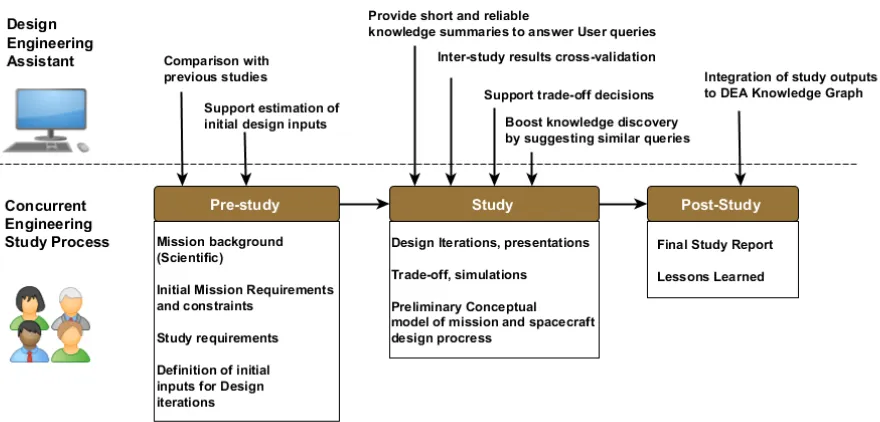
Based on the literature ([6], [10]) a concurrent engineering study is usually divided into three main phases: an initiation or preparation phase, a study phase and a post processing phase.
The preparation phase is a first point of contact with the study clients and the team leading the CE study. The mission background is introduced and the mission
objectives and requirements are defined. All
information at that stage is provided in natural language. Depending on the preparation phase duration, initial inputs for the study phase are prepared (i.e. mission analysis, budget envelopes). The bulk of the design work is done during the study phase with the entire experts’ team. This phase can last from 3 to 6 weeks [6]. Finally during the post study phase, the study outputs are summarised in a final report (or other formats depending on the facility process).
The following subsections will clarify how an AI-based agent could contribute to these different phases.
2.3.1. Preparation Phase
The mission background, objectives, requirements and initial design inputs are examples of study inputs usually discussed during a preparation phase a few weeks prior to the study sessions. The commitment to the preparation phase has a direct impact on the evenness of the consecutive study phases (i.e. the more accurate the initial inputs estimation the faster the convergence of the design parameter). In some cases, unless the experts involved in this phase already have the heritage knowledge, it might become too time-consuming and demanding to thoroughly search through a database of previous missions looking for similarities with the present study. An AI agent could, in lieu of the Human experts, search through the large corpus of documents and promptly provide an overview of similar studies, if they exist. Implementing a smart quick search over past missions and studies could contributes to facilitate the background research done during the preparation phase and potentially widen the comparison scope by underlining similarities with less-known missions or studies. By achieving a faster and wider comparison with previous studies, the Human experts could eventually have a better support to define the initial design parameters required to initiate the design loop at the start of the study sessions.
2.3.2. Study Phase
knowledge and the need for information encountered by Human experts. If an experts needs to confirm a parameter estimation or information he or she remembers from a past mission, the AI agent can quickly provide the information without breaking for too long the momentum of the study. The experts could then have more time to focus on performing new simulations and interacting with other team members. Knowledge discoveries will also be boosted by making the experts aware of other design options followed or considered in past studies via a recommender system integrated into the query manager.
2.3.3. Post Processing Phase
After the study the final report will be integrated into the knowledge base and processed by the DEA to carry on with its learning process of space mission design. Without a continuous updating of the knowledge graph the tool would risk to become obsolete with regard to certain design aspects.
Figure 1 summarises the potential input points of a design assistant into the CE study process. The integration of an AI-based agent into the CE process will be refined during summer and fall 2018 with the support of experts from the ESA Concurrent Design Facility (CDF).
2.4. Summary
Chapter 2 described the potentials for implementing an AI-agent in the early stages of space mission design. The advantages are numerous, from supporting knowledge management strategies to ensuring a better
reuse of past knowledge and lessons learned to eventually contribute to increase the quality and reliability of feasibility studies. The next chapter will describe the initial efforts led by two PhDs of the Strathclyde University to develop a smart Design Engineering Assistant (DEA) for Space Mission Design.
3. THE DESIGN ENGINEERING ASSISTANT PROJECT
The DEA project was initiated in January 2018 and involves two PhD students, working on two complementary part of the project and supported by the ESA CDF and industrial partners: AIRBUS, RHEA and satsearch. This chapter will give an overview of the project, its current status and finally the main challenges identified by the team.
3.1. Mission Definition
The DEA project aims to study whether or not a smart design assistant, based on an expert system architecture, having access to a consequent amount of accumulated data related to space mission design, can support the design of present space missions design.
[image:3.595.78.518.495.706.2]Expected project outputs are the testing, integration and validation of an expert system, the DEA, to answer the above interrogation. The DEA performances will be evaluated over several study cases provided by the project partners. The preliminary DEA process and architecture presented in the following subsection result from the project first 6 months of collaboration.
3.2. DEA Preliminary Architecture
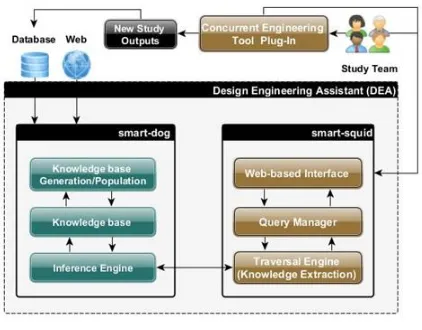
Figure 2 displays a preliminary, high-level,
architecture of the DEA. The architecture also illustrates the tasks separation between the two PhDs respectively named smart-dog and smart -squid.
Figure 2. DEA architecture
3.2.1. Smart-squid: User Interfaces, Knowledge Extraction and Feedback loop
The User will be able to access the DEA either directly via a web-based interface either indirectly via a plug-in embedded into a concurrent engineering work environment (e.g. the OCDT for by ESA CDF [6]). Both interfaces (i.e. web-based and plug-in) should support the submission of new inputs to the KG. The submitted inputs (i.e. recent study outputs) will undergo uncertainty quantification to verify its reliability before integration to the KG.
The User will enter a query in natural language via the web-based interface, called SQUIDke. The range of queries accepted by the tool will be defined in the later stages of the project, in summer and fall 2018. The query entered by the User will be handed over to a query manager. The latter will decompose the initial complex query into a set of basics queries that can be submitted by the traversal engine to extract knowledge from the KG.
After the candidate facts (i.e. the basics queries outputs) have been received, the query manager
undertakes a reconstruction work to produce
knowledge summaries. The latter will be the actual outputs presented to the User via the web-based interface. The ranking of the candidate facts is based on weights rules depending on uncertainty, relevance and User feedback parameters. The web-based interface will also include Human Machine Interaction (HMI) features more thoroughly presented in Chapter 4. The User interface will also display recommended similar outputs to push the experts to explore other design paths and boost knowledge discovery. The
recommendation generation is based on a
recommender system algorithm.
3.2.2. Smart-dog: Knowledge Graph Generation, Population and Inference Engine
The DEA knowledge graph (KG) will contain the knowledge about the space mission design. This component is tightly connected to the inference engine that needs to be able to reason on the knowledge accumulated. The generation and population of the KG are two separated tasks. Before populating the KG with data, it is important to select a model for the structure and a language that allows reasoning on it. When the structure is ready, the population task can take place. In both tasks uncertainty needs to be taken into account. These tasks will be performed by the smart-dog tool, which will rely on structured, semi-structured and mainly unstructured data publicly available or provided by the project partners, available internally or found online. The generation of the ontology is critical and it needs to rely on variety of documents to acquire the semantic and the notions of the space mission design (e.g. books, datasheets, mission reports, etc.).
Moreover, Machine Learning (ML) methods
performances depends on the amount of data available for the training of the algorithms. Therefore not only the variety but also the quantity of documents required for the accuracy of the tool is a fundamental requirement. In the frame of the DEA, this will benefit the users of the expert system because they can count on a wider corpus.
3.3. Main challenges
This subsection focuses on the main challenges or issues to be taken into account for the development of the DEA.
3.3.1. KG Generation and Population
The generation and population of the expert system KG is usually challenging and fundamental for the success of the application. These tasks can be performed manually but they are too time-consuming, prone-error and subjective. The DEA project aims at building a space mission design KG in the most automatic way, using Ontology Learning techniques and following the Ontology Learning Cake model [11], [12], [13]. The selection of the corpus is crucial for these phases.
3.3.2. Expressivity of the language, Time-response and Scalability
accurately defined because they are working in synergy to provide the answers in the correct way and in a reasonable time. This choice will take into account also the scalability issue in the development of the KG because it will be dynamically increased.
3.3.3. Uncertainty and Evaluation
Uncertainty affects the reliability and accuracy of the answers provided. In the generation and population tasks an inconsistency engine will provide checks for the KG with the use of the inference engine. There are several type of uncertainties to be considered especially for the unstructured data. An uncertainty check will be run also by the query manager as additional safeguard against unreliability.
The ontology evaluation task is fundamental to obtain a consistent and reliable KG. There are several methodologies that can be used. The one applicable in this case is the application-based approach in which the KG is validated iteratively relying on the application for which it is developed (e.g. expert system).
3.3.4. Ensuring Data Security
Ensuring the data security of the information provided to the project by the partners is a priority of the DEA. Users with different affiliations might not be allowed to access sensible information provided by another partner but enclosed in a part of the KG. A similar issue was encountered by the NASA JPL foundry as described in [8]. In that case a Security layer was implemented to oversee all the applications to ensure the safety of all the data. A single sign-on was used to access all the applications reinforced by a role-based control of access to the data. In the case of the DEA, different level of accessibility to the knowledge graph will be devised (i.e. a log-in could be implemented on the User interface to identify the User affiliation and to which part of the KG the User can have access).
3.3.5. Understanding the User intent
Unlike traditional search engines, Semantic Search Engines (SSEs) go beyond simple query keywords matching. The output of SSEs intends to grasp the context, concepts and the actual meaning of the User query. This is called contextual analysis rather than syntactic analysis [14]. The DEA query manager will intend to grasp the context of the User query, a task more challenging than a simple keyword matching but closer to the User’s needs.
3.3.6. Generating the knowledge summaries
The assembly of candidate facts extracted from the KG generates a set of consecutive challenges from
managing uncertainties to transforming raw
information into relevant “knowledge summaries”. To reinforce the confidence in the outputs, the knowledge summary should include traceability to the original
data (i.e. cite the mission report or provide the exact report extract). In a similar effort to reinforce the tool transparency, the DEA should be able to explain the candidate facts selection process, for instance, by displaying the different ranking weights. Finally, Machine-Learned Ranking (MLR) algorithms similar to Rankbrain developed by Google or RankNet by Microsoft Research [15] will be use to improve the ranking of candidate facts presented to the User. The ranking of the candidates facts extracted from the knowledge graph will be based on uncertainty (i.e. reliability), relevance and User feedback factors. The User feedback loop will be detailed in the next chapter.
4. DEA HUMAN-MACHINE INTERACTION
The two major types of knowledge are identified as tacit and explicit knowledge. This differentiation is supported by [1] and quite widely accepted in this field. Explicit knowledge includes all content from concrete media such as reports, videos, etc. whereas tacit knowledge refers to unspoken rules of know-hows, implicitly known by experts. While the KG population is based on elicit knowledge, focusing on a dynamic HMI via the User interface could allow to capture some of the tacit knowledge of the users. The first part of the chapter will detail furthermore the DEA HMI while the second subsection will tackle a pillar for the HMI definition: the experts’ involvement into the project requirements definition.
4.1. The Human experts feedback loop
The DEA HMI should not be seen as a one way interaction only, i.e. machine-to-human. The experts should have the possibility to provide feedback on the knowledge provided by the DEA. For a real Human-Machine collaboration, they should be able to “answer” to the DEA, injecting some of their own expertise or judging the information provided.
This feedback loop will enhance the User experience and also benefit the DEA. By ensuring an efficient feedback via the interface, the DEA will be able to elicit some part of the experts’ tacit knowledge to contribute to its evolution. The User feedback will be used to influence the candidate facts ranking by the query manager based on the weighting rates system described in paragraph 3.3.7. As the number of users increases the variety of feedback the DEA will obtain will develop as well. Manually collecting feedbacks from experts would not be feasible in the PhD timeframe. For this reason designing an efficient feedback loop is an essential aspect to prepare the DEA to “learn” during the operational phase and continuously enhance its performances.
4.2. Integrating the Human experts to the Requirement definition
The DEA is meant to support the Human experts in a non-intrusive way and in no case intend to replace them into the design process. Yet convincing the Human experts to “trust” the DEA and integrate it into their work routine will be one of the main challenges of the DEA HMI. Experts working in a CE environment have already made a first step diverging from classical design environments. At times where augmented reality (AR) [16] and AI-based decision making support tools are becoming part of our daily life, modern engineering design processes must also adapt to take advantage of the newest technology improvements. To prepare this step and to ensure a successful tool integration, a solution is to involve in its development the experts since the beginning.
To do so, a knowledge elicitation protocol to approach the experts needed to be defined. In the frame of this project the chosen Knowledge Elicitation (KE) method falls into the category of natural methods as described in [17]. Natural methods correspond to informal behaviours the experts may spontaneously adopt while performing expertise. On the contrary, contrived elicitation methods involve setting the expert in an unfamiliar work environment (i.e. concept sorting). Natural techniques include interviews or observation of experts during a problem solving exercise. Interviews are the most commonly used KE techniques [17]. Running a set of experts’ interviews seemed as well the most intuitive choice in the case of this study. The elicitation protocol was defined with the support of ESA CDF team during an internship at ESA in summer 2018. The initial pool of experts was based on ESA experts but is to be widen during a demo at SECESA 18.
The goals of the experts’ interviews are to define the interface requirements: identify the preliminary range of queries, discuss the interface preferences and initiate the drafting of feedback loops options. The definition of the interface requirements will have cascading effects on the definition of the query manager, KG and IE requirements. The interviews are also an opportunity to raise awareness on the topic of AI based HMI for space mission design. The experts will be informed on the advantages that an AI-agent could bring to their daily work life in the context of CE studies. It will also be critical for the DEA team to fully understand the CE study process and how the assistant could be integrated to it. In this context, passive attendance to ESA CE studies will be organised during fall 2018.
The design of a dynamic HMI could highly enhance the assistant performance as well as increase its chance to be successfully integrated into the experts daily work life.
5. CONCLUSION
The present paper introduced the potential for integrating an AI-based decision making support tool into the process of the CE study process. The initial preliminary architecture of the DEA as well as a few challenges and issues identified in the initial phases of the project were displayed The last chapter focused on the criticality of the HMI design to eventually generate a highly collaborative DEA- Human experts frame of work.
This paper has made clear the potential to relieve the experts’ workload and enhance their work outputs via the implementation of the DEA in the CE process. Semi-automatic extraction of the information contained in the accumulated explicit knowledge is a novel approach to bypass the arduous manual extraction. The integration of a feedback loop will reinforce the Human-Machine collaboration and provide a platform to elicit the experts’ tacit knowledge.
6. REFERENCES
1. Dalkir, K. (2017). Knowledge Management in
Theory and Practice, 3rd ed. The MIT Press
2. Foslien,W., Guralnik, V. and Haigh,K. Z. (2004).
Data Mining For Space Applications
3. Girimonte, D. & Izzo, D. (2007). Artificial
Intelligence for Space Applications. In ‘Intelligent Computing Everywhere.’
4. Smith,J. L. (1997). Concurrent Engineering in the
Jet Propulsion Laboratory Project Design Center.
5. Bandecchi, M., Melton, B., Gardini,B. &
Ongaro,F. (2000) The ESA/ESTEC Concurrent Design Facility. In Proc. ‘2nd Concurrent Engineering Conference (EuSEC).’
6. Pickering, A. (2017) ESA Concurrent Design
Facility Infopack.
7. Verhagen, W. J. C. , Stjepandić, J. & Wognum, N. (2015). Chapter 28 - Challenges of CE. In ‘Concurrent Engineering in the 21st Century’ (Eds. Springer).
8. Blossom, J., Johnson, G., Kolar, M., Chase, J. &
Case,K. (2016). JPL’s Foundry Furnace: Web-based Concurrent Engineering for Formulation
9. Tan, A., Min, W. & Sagarna, R. (2017)
Knowledge Transfer Through Machine Learning in Aircraft Design,
10. Braukhane, A. (2011) The DLR Concurrent
Engineering Facility (CEF)
11. Baclawski, K., Bennett, M., Berg-Cross, G.,
Fritzsche, D., Schneider, T., Sharma, R., Sriram, R.D. & Westerinen, A. (2017). Ontology
12. Staab, S. & Studer (2007). Handbooks on Ontologies.
13. Petasis, G., Karkaletsis, V., Paliouras, G.,
Krithara, A. & Zavitsanos, E. (2011).Ontology Population and Enrichment: State of the Arts.
14. Shah, V., Shah,A. & Deulkar, K. (2015)
Comparative Study Of Semantic Search Engines.
International Journal Of Engineering And Computer Science, vol. 4.
15. Richardson,M., Prakash, A. & Brill, E. (2006). Beyond PageRank: Machine Learning for Static Ranking. In Proc. ‘International World Wide Web Conference, WWW 2006’.
16. Cipriano, A., (2018). A survey of Augmented
Reality use in the Concurrent Design Facility. In Proc. ‘SECESA 18’.
17. Shadbolt, N. R. & Smart, P. R. (2015).