JOURNAL OFVIROLOGY, May 1992, p.3236-3240 0022-538X/92t053236-05$02.00/0
Copyright ©D 1992, American Society for Microbiology
Transactivation of Human
Immunodeficiency
Virus
Type
1
Long
Terminal Repeat-Directed Gene Expression by
the Human
Foamy
Virus bell Protein
Requires
a
Specific
DNA
Sequence
ANN HWEELEE,' KIJEONG LEE,' SUNYOUNG KIM,2ANDYOUNG CHUL
SUNG`*
Department of Life Science, PohangInstituteof Science and Technology, Pohang, Republic of Korea,1and
New
England
DeaconessHospital,
Harvard MedicalSchool, Boston,
Massachusetts 022152Received 20September 1991/Accepted 14January1992
Human foamy virus (HFV) encodes the transcriptional transactivator bell. The bell protein transactivates
HFVlong terminalrepeat(LTR)-directedgeneexpression by recognizingaregion in U3. It also transactivates
humanimmunodeficiency virustype 1(HIV-1) LTR-directedgeneexpression in transient transfectionassays.
To identify the specific region in HIV-1 LTR responsible for bell action,we examined the effect of bell on
chloramphenicol acetyltransferase (CAT) gene expression in transfected cells with a series ofmutant HIV-1
LTR/CAT plasmids. The region between -158 and -118 from the transcription initiation site, immediately
upstream of the core enhancer element, was identified as responsible for the transactivation by bell. In
addition, bell transactivated a heterologous promoterwhen thisregionwas positioned upstream of it in the
senseand antisense orientations.Optimal transactivation of the HIV-1 LTRby bell didnotrequireanintact
TARsequence,suggesting that the binding oftattothe TARsequenceisnotaprerequisite for bell function in
HIV-1 LTR-directedgeneexpression. In the region of the HIV-1 LTR that isnecessaryforthe bell-mediated
transactivation, wehave found asequencewhich isconserved between HIV-1 and HFV. Our results suggest
that the bell actionon HIV-1 seemstobe mediatedbyaspecific DNAsequencewhich is shared by both the
HIV-1 LTRand HFV LTR.
The family Retroviridae consists of three subfamilies
grouped according to biological and pathogenic properties:
Oncovirinae, Lentivirinae, and Spumavirinae (9, 30).
Onco-viruses are associated with malignant tumors, and
lentivi-ruses are associated with slowly progressing inflammatory
and degenerative disorders with long latency periods.
Spumaviruses cause soapsudslike degeneration in infected
cells. In humans, human T-cell leukemia virus type I
(HTLV-I), a member of the Oncovirinae, causes T-cell
leukemia andtropical spastic paraparesis. Human
immuno-deficiency virus type 1 (HIV-1), a member of the
Lentiviri-nae subfamily, is the causative agent of AIDS. Human
foamy virus (HFV), thegenomeof which has been
molecu-larly cloned (8, 19, 24, 25), belongs to the Spumavirinae
subfamily.
These humanretroviruses encode transactivators required
for their long terminal repeat (LTR)-specific gene
expres-sion. HTLV-I tax,encodedby the pX region, transactivates
HTLV-I LTR-directed gene expression via a 21-bp direct
repeatinU3(6, 10, 14, 31, 34). HIV-1tatisanRNA-specific
transactivator which has been shown to interact directly
with its target sequence, TAR (4, 5, 7, 28, 33, 36). TAR is
located at the 5' end of the HIV-1 transcript. HFV bell is
stillpoorly understood, but itappears totransactivate HFV
LTR-directed geneexpression mediated byaputative
bell-responsive element (BRE) located in the U3 region (16, 26, 27).
Geneexpression of HIV-1 is regulated by cellular factors
andby itsownviralgeneproducts, including thetatandrev
proteins (reviewed in references 3 and 22). Also,
transcrip-tional control sequences in the LTR interact with several
cellular DNA-binding proteins, including SP1, NF-KB,
* Correspondingauthor.
LBP-1, NFAT-1, and TF-IID (reviewed in reference 15).
HIV-1 gene expression is also regulated by exogenous
factors, suchasT-cell mitogens (35, 37), DNA damage (39),
andheterologous viral transactivators (1, 11, 13, 20, 32, 35,
38), including HTLV-Itax. taxhas been reportedtoinduce
the expression of certain cellular proteins which in turn
transactivate HIV-1LTR-directedgeneexpression by
bind-ing to the enhancer (1, 35). Herewe report that HFV bell
transactivates HIV-1LTR-directedgeneexpression, and the
response requires the specific region in U3 of the HIV-1
LTR.
To determine whether anyHFV gene product
transacti-vates HIV-1 LTR-directed gene expression, BHK-21 cells
were cotransfected with HFVproviral DNA and an HIV-1
LTR/chloramphenicol acetyltransferase (CAT) construct
which contains the -453 to +80region of the HIV-1 LTR
upstream ofthe indicator CATgene. A marked stimulation ofHIV-1LTR-directed CATgeneexpressionwasobserved
in the cotransfection of HIV-1 CAT with pHSRV but not
with mock DNA (Fig. 1). This finding indicates that HFV
encodes a trans-acting factor that stimulates HIV-1
LTR-directed geneexpression.
To investigate which gene product of HFV is necessary
for HIV-1 LTR transactivation, deletions were introduced
intopHSRVtoinactivate bell orbel2 andbel3openreading
frames (ORFs) (Fig. 1). A small deletion in the bell ORF of
pHSRVAB completely abolished the transactivating ability.
However, pHSRVAB2-3, which has a small deletion in the
bel2 andbel3 ORFs, showednearly thesametransactivating
activity as did pHSRV. Furthermore, the bell expression
plasmid
pS-bell-S,
which contains the entire bell ORFdownstream ofthe simian virus 40 (SV40) earlypromoter,
retained the ability to stimulate HIV-1 LTR-directed gene
expression at a somewhat lower level compared with
pHSRV. The difference of the transactivation level between
3236
Vol.66, No. 5
on November 9, 2019 by guest
http://jvi.asm.org/
NOTES 3237
FLTR- lPOL LIi
-E;NDVV 2Ibel
LTR GAG POL ENV
pHSRV
bel 2-3LTR
(E-
pHSRVAB BarmHIdeletionILTR
GAG POL ENV bel I iL pHSRVAB2-3 BstEfIIDeletion<Ispb <SspI> 'SV40
PRq
belIi Poly(A)I- A
%conversion: 3.5 70 3
I
pS-bell-S/A
4.2 84.7 286
--L k
*: -i
-r
*s- Tl.
-
-
~-
4-HIV-ILTR ||CAT Poly (A) HIV-1CAT
FIG. 1. Structures and transactivationabilities of the HFV
dele-tion mutants and bell expression plasmid. (A) pHSRV, which
contains the full genome of HFV, is described elsewhere (24).
Deletionmutantsweremade with availablerestriction endonuclease
cleavagesites:pHSRVAB andpHSRV/B2-3 wereconstructed by
deletingthe 209-bpBamHI-BamHI fragmenttoinactivate the bell
ORFandthe263-bpBstEII-BstEII fragmenttoinactivate both bel2 andbel3ORFs, respectively. pS-bell-S and pS-bell-Awere
con-structed byinsertinga1,048-bp SspI fragmentof pHSRV
compris-ingthe entire bell ORF downstreamof theSV40earlypromoterin
the sense and antisense orientation, respectively (26). (B) HIV-1
CAT, the HIV-1 3' LTR-directed CAT gene expression plasmid,
wascotransfectedintoBHK-21 cells with each plasmidindicatedat
thebottom. Cotransfections ofHIV-1 CAT and the plasmidstobe
testedfortransactivating abilitywerecarriedoutwith 2,ugof both
DNAs. One million BHK-21 cells were transfected by using the
DEAE-dextran method (23). Cells were treated with chloroquine
and subjectedtodimethyl sulfoxide shockasdescribed previously
(16). Thepercent conversion ofchloramphenicol to its acetylated
formwasmeasured 48 h after transfection as described previously
(12). A30-min time point andequivalentamountsofprotein lysates wereusedfor allreactions. Data fromatleasttwoexperiments done on different dayswere found to be reproducible within the error
rangeof20% standard deviation.
pHSRV and pS-bell-S could be due to the different level of
bell gene expression (SV40 versus native HFV promoter
and enhancer). HIV-1 LTR transactivation by cotransfection with the bell expression plasmid was also observed in Jurkat human T cells and in COS monkey kidney cells at about a fivefold-higher level (data not shown). As a consequence, we
concluded that thebell protein among HFV geneproducts is
responsible for the transactivation of HIV-1 LTR-directed gene expression. These results agree with the recent report by Keller et al. (16), who showed that HIV-1 LTR-directed
gene expression is transactivated by cotransfection with a
bell expression plasmid in COS cells.
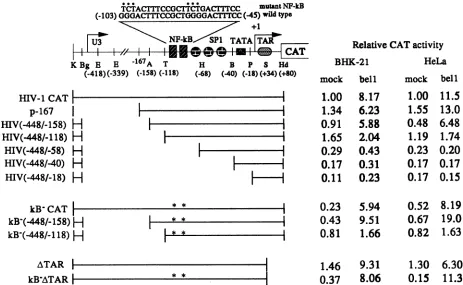
To determine which LTR sequences are critical to trans-activation by bell, we generated a series of deletions in the LTR and tested their ability to direct bell-responsive tran-scription (Fig. 2). These deletion mutants were transfected into BHK-21 or HeLa cells in the presence or absence of a bell expression vector, and transient expression of the CAT enzyme was measured. The ability of the LTR to respond to bell was not affected significantly until the deletion reached
158 bp upstream from the RNA start site. Deletion of an
additional 40 bp (to -118) did not lower basal CAT activity, but the LTR was not activated by bell. Further deletions
extending downstream from -118 resulted in considerably
lower basal CAT activity relative to the wild-type plasmid
and resulted in no response to bell. Examination of the
coordinates of these deletions indicates that an essential part of BRE is located between -158 and -118, the region just upstream from the nucleotide sequence interacting with the
cellular transcription factor NF-KB(KBsites). To our
knowl-edge, there are no known consensus regulatory sequences identified in this region.
We also tested whether NF-KB is needed for
transactiva-tion of the HIV-1 LTR by bell (Fig. 2). For this experiment,
BHK-21 and HeLa cells were transfected with HIV-1 LTR/
CAT fusion constructs containing wild-type or mutated
KB
sites. It was previously shown that the mutations used in
these constructs abolish NF-KB binding (21). Mutations in these sites lowered basal LTR activity two- to fourfold, but when a bell expression vector was cotransfected, levels of CAT activity from these mutant LTR constructs were com-parable to that from the wild-type LTR. Therefore, bell
apparentlyactivates the HIV-1 LTR containing defectiveKB sites more efficiently than the wild-type LTR, in terms of magnitude of transactivation. When mutated KB sites were
combined with the deletion mutations constructed as
de-scribed above, the same region of the LTR (-158 to -118)
was found to harbor the element interacting with the bell
protein(Fig. 2).
To test whether the TAR region of the HIV-1 LTR
interactingwith tat is necessary for transactivation by bell,
BHK-21 and HeLa cells were transfected with
LTR/CAT
constructscontaining the deletion in the TAR region (ATAR;
+34 to +80) (Fig. 2). The same deletion was previously
shown to abolish transactivation of the LTR by tat. In both
cell lines, the ATAR LTR construct was transactivated by
bell as efficiently as was the wild type. The same results
were obtainedwhen defective KB sites were combined with
the ATAR LTR. These data indicate that TAR is not
required for transactivation of the LTR by bell. We were
alsointerested in how bell and tat interact with each other.
In HeLa cells, bell and tat transactivated LTR-directed
expression 11- and 35-fold, respectively (Table 1). When
bothplasmids were transfected,CAT activity was increased
more than 170-fold. Similar observations were made for
BHK-21 cells. These results suggest that bell and tat
pro-A)
B)
VOL. 66,1992
on November 9, 2019 by guest
http://jvi.asm.org/
[image:2.612.55.300.81.495.2]3238 NOTES
TCTACTIECCGCTTCTGACTTrCC mutat F.kB
(-103)GGGACTTECCGCTGGGGACTrTCC(45) wild type
+1
U3
\F[NF-kB1
TATACAT
KBgE E 167A T H B P S Hd
(-418)(-339) (-158) (-118) (-68) (40) (-18)(+34)(+80)
TWV-1 CAT I
p-167 I
HIV(-448/-158) H HIV(-448/-118) H
HIV(-448/-58)
H
HIV(-448/-40) H
HIV(-448/-18)
H
kB- CAT F
kB-(-448/-158)
H
kB(.448/-1 18) H
r-IF
* *
I **
I I * *
Relative
CAT
activity
BHK-21
mock
bell
HeLa
mock
bell
4
1.00
8.17
1.00
11.5I
1.34
6.23
1.5513.0
i
0.91
5.88
0.48
6.48
I
1.65
2.04
1.19
1.74
0.29
0.43
0.23
0.20
0.17
0.31
0.17
0.17
d
0.11
0.23
0.17
0.15
0.23
0.43
0.81
5.94
9.51
1.66
0.52
8.19
0.67
19.0
0.82
1.63
1.46
9.31
0.37
8.06
1.30
6.30
0.15
11.3
FIG. 2. Schematicdiagram of wild-type andmutantHIV-1LTRs and theirresponsestobell. HIV-1 CATwasconstructed by subcloning
theKpnl-HindIII fragment comprising the HIV-1 3' LTRupstreamof the CATgeneand SV40 poly(A) signal. KB- CATwasprepared by
changingthe twoNF-KBbindingsites (GGG-- TCT) bysite-directedmutagenesis (21),as shownatthe top.The basesubstitution(*)was
confirmedby the dideoxy sequencing method (29) with the CATgeneantisenseprimer(5'-GGCCGTAATATCCAGC-3'). All deletionmutants
exceptp-167wereconstructedby deleting thesequencesbetweenthetworestrictionenzymesitesasshown above.p-167wasprepared by
Bal31deletion ofpU3RIII CAT (28). Restrictionenzymesites: K,
KpnI;
Bg,BglII; E, EcoRV; A, AvaI; T, TaqI; H, HaeIII; B, BanII;P,PvuII;S, SacI; Hd, HindlIl. Transfection and CATassays wereperformedasdescribedinthelegendtoFig. 1. The relative CAT activities (percentconversion ofchloramphenicol into itsacetylated form)wereobtainedsothat thevalues fell within the linearrangeof theassayand
werenormalizedtotheactivity obtained withplasmid HIV-1 CAT in thepresenceofcontrolDNA(pS-bell-A)foreach cell line.Mockand bell refertopS-bell-A and pS-bell-S, respectively.
teins have an additive or
cooperative
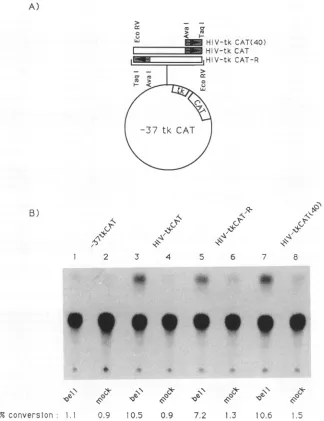
effect in transactiva-tion.Theforegoing studies identified the -158to -118 region of the HIV-1 LTR as containing the nucleotide sequence interacting with bell. To be certain that this region is indeed BRE,wefused the -158to -118 region of theHIV-1 LTR
upstreamfrom theTATAboxof theherpes
simplex
virus tk gene(Fig.
3A). In addition, we placed the -339 to -118 region of the HIV-1 LTRin the sense orantisense orienta-tion. This truncated tk promoter contains only 37 bpup-TABLE 1. Additive orcooperative activation of the HIV-1 LTRbybell and tata
Relative CATactivityb
Infection
BHK-21 HeLa
Mock 1.00 1.00
bell 8.17 11.5
tat 5.31 35.7
bell + tat 30.6 172
aBHK-21 and HeLa cells were cotransfected with HIV-1 CAT and the
indicated plasmids. Mock, bell, and tat represent cotransfection with
pS-bell-A,pS-bell-S,andcytomegalovirustat,respectively. bValues were obtained as described in thelegendtoFig.2.
stream from the transcription start site, with only one
transcription element, a TATA box (2). As a negative
control,theidentical plasmid lackingtheputative BREwas
used. Theplasmidsweretransfected into BHK-21cells with
or without a bell expression plasmid, and transient
ex-pressionof the CATenzymewasmeasured totestwhether this DNA fragment indeed harbors BRE (Fig. 3). In the
absence of the bell expressionvector,all fourplasmidsgave
a background conversion of chloramphenicol to its
acety-lated forms of around 1.0% (Fig. 3B, lanes2, 4, 6, and8).
When cells werecotransfected with abell expression
vec-tor, CAT activitywas increased 5- to 10-fold with the test plasmids containing the putative BRE in either orientation
(Fig. 3B, lanes 3, 5, and 7). Only a background level was
detected in theabsence of this nucleotide sequence. These
datasuggestthatthe -158to -118regionof the HIV-1 LTR
issufficient for transactivation bybell and that BRE
func-tions independently of its orientation. Interestingly, when
nucleotidesequencesof the LTR from HIV-1 and HFVwere
aligned, the -124 to -116 region of the HIV-1 LTR (TGA CATCGA)wasverysimilar to the -134to -126region of
the HFV LTR(TGAGATCGA). Therefore, the HIV-1 LTR
region thatwe identified as BRE contains this homologous
sequence. Noother distinct homology was found between
theLTRsequencesof HIVand HFV(ourunpublished data).
ATAR
F
kBWATAR
F
* *J. VIROL.
l
I
l
I
i
II
on November 9, 2019 by guest
http://jvi.asm.org/
[image:3.612.80.543.77.362.2] [image:3.612.62.303.619.688.2]A)
c <
F-U. HlV-tk CAT(40)
1 _HHIV-tk CAT
_~E
1HIV-tk CAT-Rcr X C
X > 0
U~
-37 tk CAT
,
z-~
~~4>
2 3 4 5 6 7 5
999S99-1
I I IPcvs' Ct.
conversion 1.i 0.9
0t&so %'tv 49°tC0'C>tv
'9 '9 '9~~~~~~~~~~~~~~~~~~~ 10.5 0.9 7.2 1.3 10.6 1.5
FIG. 3. Transactivation by bell of the truncated herpes simplex virus tk promoter containing the putative BRE. (A) The EcoRV (-339)-TaqI(-118) fragmentof the HIV-1 LTRwasfilled withKlenowenzymeand inserted into theSall site of -37tkCAT (2)inthesense or antisense orientation. HIV-tkCAT(40)was constructed by deleting theEcoRV-AvaI fragment fromHIV-tkCAT. The inserted DNA sequencewasconfirmedbythedideoxyDNAsequencingmethod(29). Thearrowindicates the orientationof the insert with respecttothe CATgene.(B)The indicated reporterplasmids (1 p.g)weretransfected into BHK-21 cells with 3,ugofpS-bell-A (mock infection; lanes2, 4, 6,and8)orbellexpression plasmidpS-bell-S(lanes 1, 3, 5, and 7).TheCATassay wasperformed subsequentlyasdescribed in thelegend
toFig. 1.
We are currently investigating whether this nanomer
se-quence is indeed a key element interacting with the bell
protein.
It has previously been shown that the HIV-1 LTR is
transactivated bymanyregulatory proteinsofother viruses
(1, 11, 13, 20, 32, 35, 38). However, the action of bell appears tobe distinct from those of other viral proteins in
that the targetelement is aspecific DNAsequence located
upstream from the KB sites. For example, the early gene
products of herpes simplex virus, cytomegalovirus, and
hepatitis B virus transactivate the HIV-1 LTR, but their
responsive sequenceshavenotbeen identifiedorhave been
mappedaround the TATA box. We donotyetknowwhether
the bellproteininteracts with theDNAsequencedirectlyor
indirectlyvia other cellular proteins. Whatever the
mecha-nism, it is clear that bell transactivates the HIV-1 LTR as
efficiently as does tat in some cell types. Given the broad range of cells for HIV-1, including epithelial cells and
fibroblasts, that are also susceptible to HFV, it would be importanttodetermine theprevalenceofHFVamong
HIV-1-infected individuals.
We thank V.terMeulen for his kindgiftofplasmids pHSRVand
pS-bell-S/Aand A. Rethwilm forhelpfuladvice.
Thisworkwassupported by Korea Research Foundationgrant
RPT-10:334 (Y. Sung), Research Institute of Science and
Technol-ogy grant R91057 (Y. Sung), and Public Health Service grant
AI30897(S. Kim). B)
on November 9, 2019 by guest
http://jvi.asm.org/
[image:4.612.145.469.76.497.2]3240 NOTES
REFERENCES
1. Bohnlein, E.,M.Siekevitz,D.W.Ballard, J.W.Lowenthal,L.
Rimsky, H. Bogerd, J. Hoffman,Y.Wano, B. R. Franza,and
W. C. Greene. 1989. Stimulation of the human
immunodefi-ciencyvirustype 1enhancerbythe humanT-cell leukemia virus
type 1taxgeneproductinvolves theactionofinduciblecellular
proteins.J. Virol. 63:1578-1586.
2. Courey, A. J., and R. Tjian. 1988. Analysis of Spl in vivo
reveals multiple transcriptional domains, including a novel
glutamine-richactivation motif. Cell 55:887-898.
3. Cullen, B.R., and W. C. Greene. 1989. Regulatory pathways governingHIV-1replication. Cell 58:423-426.
4. Dingwall,C.,I.Ernberg,M.J.Gait,S. M.Green,S.Heaphy, J.
Karn,A. D.Lowe,M.Singh,and M. A. Skinner.1990. HIV-1tat
proteinstimulates transcription by bindingto aU-richbulgein
thestemof the TAR RNAstructure. EMBO J. 9:4145-4153.
5. Dingwall, C.,I.Ernberg,M.J. Gait,S. M.Green,S.Heaphy, J.
Karn,A. D. Lowe, M. Singh, M. A. Skinner, and R. Valerio.
1989. Human immunodeficiencyvirus type 1 tat proteinbinds trans-activation-responsive region (TAR) RNA in vitro. Proc.
Nati.Acad. Sci. USA 86:6925-6929.
6. Felber,B.K.,H.Paskalis,C.Kleinman-Ewing,F.Wong-Staal,
and G. N. Pavlakis. 1985. The pX protein of HTLV-I is a
transcriptional activator of its long terminal repeats. Science
229:675-679.
7. Feng, S., and E. C. Holand. 1988. HIV-1 tat transactivation
requirestheloopsequence withintar. Nature(London)
334:165-167.
8. Flugel, R. M., A. Rethwilm, B. Maurer, and G. Darai. 1987.
Nucleotide sequence analysisof theenvgene and itsflanking
regionsof the humanspumaretrovirusrevealstwonovelgenes. EMBO J. 6:2077-2084.
9. Fraenkel-Conrat, H.,P.C.Kimball,andJ.A.Levy.1988.
Virol-ogy, p. 180-125.Prentice-Hall,Inc.,Englewood Cliffs,N.J.
10. Fujisawa, J., M. Seiki, M. Sato, and M. Yoshida. 1986. A
transcriptionalenhancer sequence of HTLV-1 isresponsiblefor
trans-activation mediatedby
p40"
ofHTLV-1.EMBOJ. 5:713-718.11. Gendelman,H.E.,W.Phelps,L.Feigenbaum, J.M.Ostrove,A.
Adachi,P. M. Howley,G.Khoury,H. S.Ginsberg, and M. A.
Martin. 1986. Transactivationof the humanimmunodeficiency
virus long terminal repeat sequence by DNA viruses. Proc. Natl. Acad. Sci. USA 83:9759-9763.
12. Gorman, C. M., L. F. Moffat, and B. H. Howard. 1982.
Recombinant genomes which express chloramphenicol
acetyl-transferase in mammalian cells. Mol.Cell. Biol.2:1044-1051.
13. Horvat,R.T.,C.Wood,andN.Balachandran. 1989.
Transac-tivation of human immunodeficiencyvirus promoterbyhuman
herpesvirus 6. J.Virol. 63:970-973.
14. Jeang, K.-T., I. Boros, J. Brady, M. Radonovich, and G.
Khoury. 1988.Characterizationof cellularfactors that interact
with the human T-cell leukemia virus type I
p40"-responsive
21-base-pairsequence. J. Virol. 62:4499-4509.
15. Jones, K. A. 1990. HIV transactivation and transcriptional
mechanisms. New Virol. 1:127-135.
16. Keller, A.,K. M.Partin, M.Lochelt,H.Bannert,R.M.Flugel,
and B. Cullen. 1991. Characterization of the transcriptional
transactivator of human foamy retrovirus. J. Virol. 65:2589-2594.
17. Kunkel,T. A.1985.Rapidandefficientsite-specific mutagenesis
without phenotypic selection. Proc. Natl. Acad. Sci. USA
82:488-492.
18. Luthman,H.,andG.Magnusson. 1983.High efficiencypolyoma
DNA transfection ofchloroquine treated cells. Nucleic Acids Res. 11:1295.
19. Maurer, B., H. Bannert, G. Darai, and R. M. Flugel. 1988.
Analysisoftheprimarystructureof thelongterminalrepeat and thegagandpolgenes of the humanspumaretrovirus. J. Virol. 62:1590-1597.
20. Mosca, J.D.,D. P.Bednarik,N. B. K.Raj,C. A.Rosen, J.G. Sodroski, W. A. Haseltine, and P. M. Pitha. 1987. Herpes simplex virus type-i can reactivate transcription of latent
hu-manimmunodeficiencyvirus. Nature(London)325:67-70.
21. Nabel, G. J., and D. Baltimore. 1987. An inducible transcrip-tional factor activatesexpression of human immunodeficiency virus in T cells. Nature(London) 326:711-718.
22. Pavlakis, G. N., and B. K. Felber. 1991. Regulationof
expres-sionof humanimmunodeficiencyvirus. New Virol. 2:20-31.
23. Queen,C.,andD. Baltimore. 1983. Immunoglobulingene
tran-scriptionis activatedbydownstream sequence elements. Cell
33:741-748.
24. Rethwilm, A., G. Baunach, K.-O. Netzer, B.Maurer,B.Borisch,
and V.terMeulen. 1990. Infectious DNA of the human spum-aretrovirus. Nucleic Acids Res. 18:733-738.
25. Rethwilm, A., G. Darai, A. Rosen, B. Maurer, and R. M.Flugel.
1987. Molecularcloningof thegenome of the human spumaret-rovirus. Gene 59:19-28.
26. Rethwilm, A.,0. Erlwein, G.Baunach, B.Maurer, andV.ter
Meulen. 1991. The transcriptional transactivator of human
foamyvirus mapstothe bellgenomic region.Proc. Natl. Acad.
Sci. USA 88:941-945.
27. Rethwilm, A., K. Mori, B. Maurer, and V. ter Meulen. 1990.
Transacting transcriptional activation of human
spumaretrovi-rusLTR in infected cells.Virology175:568-571.
28. Rosen,C., J.G.Sodroski,andW. A. Haseltine.1985. Location
ofcis-acting regulatorysequencesin the human T-cell
lympho-tropicvirus type III(HTLV-III/LAV) longterminalrepeat. Cell
41:813-823.
29. Sanger, F.,S.Nicklen,and A. R.Coulson.1977. DNA
sequenc-ing with chain-terminating inhibitors. Proc. Natl. Acad. Sci.
USA 74:5463-5467.
30. Schupbach, J. 1989. Human retrovirology, p. 1-11.
Springer-Verlag,Berlin.
31. Seiki, M., J. Inoue, T. Takeda,andM. Yoshida. 1986. Direct
evidence that p40"ofhuman T-cellleukemiavirus type 1 isa
trans-acting transcriptionalactivator. EMBO J. 5:561-565.
32. Seto, E., T. S. B. Yen, B. M. Peterlin, andJ. H. Ou. 1988.
Transactivation of the human immunodeficiency virus long
terminalrepeatbythehepatitisBvirusXprotein. Proc.Natl.
Acad.Sci.USA 85:8286-8290.
33. Sharp, P.A., and R. A.Marciniak 1989. HIV TAR: an RNA
enhancer? Cell 59:229-230.
34. Shimothono, K.,M.Dakano,T.Teruuchi,and M. Miwa.1986.
Requirementofmultiple copiesofa 21-nucleotide sequence in
the U3regionsof human T-cell leukemia virus type I and type II
longterminal repeats fortrans-actingactivation oftranscription. Proc. Natl. Acad. Sci. USA 83:8112-8116.
35. Siekevitz, M.,S. F.Josephs,M.Dukovich,N.Peffer,F.
Wong-Staal,andW.C. Greene. 1987.Activation ofthe HIV-1 LTRby
T cell mitogens and the transactivator protein of HTLV-1.
Science238:1575-1578.
36. Southgate, C.,M. L.Zapp,and M. R. Green.1990.Activation of
transcription by HIV-1 tat protein tethered to nascent RNA
throughanotherprotein.Nature(London)345:640-642.
37. Tong-Starksen, S. E., P. A. Luciw,and B. M. Peterlin. 1987.
Human immunodeficiencyviruslongterminal repeatresponds
to T-cell activation signals. Proc. Natl. Acad. Sci. USA 84: 6845-6849.
38. Twu, J.S.,C. A.Rosen,W.A.Haseltine,and W.S. Robinson.
1989. Identification ofa regionwithin the human
immunodefi-ciencyvirus type 1 long terminal repeat that is essential for
transactivation by the hepatitis B virus gene X. J. Virol. 63:2857-2860.
39. Valerie, K.,A.Delers, C.Bruck,C.Thirart,H.Rosenberg,C.
Debouck,and M. Rosenberg.1988. Activation of human
immu-nodeficiency virus type 1 by DNA damage in human cells.
Science 333:78-81.
J. VIROL.