Rochester Institute of Technology
RIT Scholar Works
Theses Thesis/Dissertation Collections
11-1-2010
Autonomous robot patrolling of a sparsely
populated unknown environment
Patrick LaRocque
Follow this and additional works at:http://scholarworks.rit.edu/theses
This Thesis is brought to you for free and open access by the Thesis/Dissertation Collections at RIT Scholar Works. It has been accepted for inclusion in Theses by an authorized administrator of RIT Scholar Works. For more information, please [email protected].
Recommended Citation
Autonomous Robot Patrolling of a Sparsely Populated
Unknown Environment
by
Patrick J. LaRocque
A Thesis Submitted in Partial Fulfillment of the Requirements for the Degree of Master of Science in Computer Engineering
Supervised by
Associate Professor, Department of Computer Engineering Dr. Shanchieh Jay Yang Department of Computer Engineering
Kate Gleason College of Engineering Rochester Institute of Technology
Rochester, New York November 2010
Approved By:
Dr. Shanchieh Jay Yang
Associate Professor, Department of Computer Engineering Primary Adviser
Dr. Andres Kwasinski
Assistant Professor, Department of Computer Engineering
Dr. Sonia Lopez Alarcon
Thesis Release Permission Form
Rochester Institute of Technology
Kate Gleason College of Engineering
Title: Autonomous Robot Patrolling of a Sparsely Populated Unknown
Environment
I, Patrick J. LaRocque, hereby grant permission to the Wallace Memorial Library
re-porduce my thesis in whole or part.
Patrick J. LaRocque
Dedication
To my wife Jessica without whom none of this would have been possible. To my family,
Acknowledgments
I am grateful for all of the guidance and dedication that Dr. Yang has provided to help me
through this thesis process. I would also like to thank Dr. Kwasinski and Dr. Lopez
Abstract
The increasing availability and affordability of autonomous robots has expanded their uses
for many new applications, such as exploration, surveillance and threat containment. Most
research considers a team of a large number of robots that contain global information. This
work explores distributed and low overhead algorithms for patrolling and threat
contain-ment within a region sparsely populated with few robots. The robots patrol the area without
the global knowledge of the region, but each is equipped with an omni-directional range
finder and a positioning system for keeping track of its location and metering distance
and directions of events. This study presents the extent of effectiveness and limitations of
utilizing a limited number of robots patrolling an unknown wide-spread region.
A set of three algorithms was developed. All algorithms assume the use of artificial
potential fields (APFs) for collision avoidance with other robots and the walls as well as
to approach the threat. The algorithms differ in two ways; whether or not the robots have
a limited memory of past events and the way the robots maneuver from one patrol target
location to another. The next patrol target location can be derived randomly or based on
past events. The past events include previously sensed robot locations, target locations, and
walls. The algorithms are analyzed in terms of the time it takes for the robots to detect and
neutralize threats within the surveillance region. Simulations via MATLAB are conducted
to investigate the tradeoffs due to factors such as the number of robots, the size of the
region, and the frequency of threats. The results show that the three algorithms perform
comparably on average, achieving reasonable effectiveness given the inherent limitations
Contents
Dedication. . . iii
Acknowledgments . . . iv
Abstract . . . v
1 Introduction. . . 1
1.1 Motivation and Background . . . 1
1.2 Problem Statement . . . 2
1.2.1 Scenario . . . 2
1.3 Technical Issues . . . 3
1.3.1 Robot Limitations . . . 4
1.3.2 Environment and Threat Arrival . . . 4
1.4 Contribution . . . 5
2 Related Work . . . 6
2.1 Robotic Platforms . . . 6
2.2 Path Planning . . . 7
2.2.1 Artificial Potential Fields . . . 7
2.2.2 Preplanned Routes . . . 8
2.2.3 Dynamic Routes . . . 12
3 Methodology . . . 15
3.1 History Influenced Patrolling . . . 15
3.2 Surveillance Algorithms . . . 16
3.2.1 Movement - Sensing Mode . . . 16
3.2.2 Movement - Calculation Mode . . . 18
3.2.3 Movement - Moving Mode . . . 28
3.2.4 Patrol Target Creation . . . 28
4 Simulation Architecture . . . 39
4.1 Event Queue . . . 39
4.2 Threat Arrival . . . 40
4.3 Parameters . . . 40
4.4 Simulation Visualization . . . 42
5 Simulation Results and Discussion . . . 45
5.1 Metrics . . . 45
5.2 Constant Parameters . . . 46
5.2.1 Robot and Wall Fading Methods . . . 46
5.2.2 PTL Storage Method . . . 48
5.3 Experiments . . . 50
5.3.1 Varying Region Size . . . 56
5.3.2 Varying Number of Robots . . . 58
5.3.3 Varying Threat Arrivals . . . 58
5.3.4 Varying Region Shape . . . 63
5.3.5 Varying Number of Stored Patrol Target Locations . . . 64
5.3.6 Comparison Against Systematic Patrolling . . . 69
6 Conclusion and Future Work . . . 72
6.1 Future Work . . . 73
List of Figures
2.1 Ladybug Force Geometry[18] . . . 9
2.2 Initial Robot Configuration, Trajectories, and Final Configuration[18] . . . 10
2.3 Autonomous Robot Cleaning Path Planning Techniques[10] . . . 12
2.4 Combined Covering Path Planning[10] . . . 13
3.1 Robot Operational Flow Chart . . . 17
3.2 Effect of Forces on Robot Movement . . . 19
3.3 Artificial Potential Field Forces . . . 21
3.4 Robot Spiraling Towards Patrol Target Location . . . 24
3.5 Threat Hand Off . . . 27
3.6 Patrol Target Creation Step 1 . . . 31
3.7 Patrol Target Creation Step 2 . . . 32
3.8 Patrol Target Creation Step 3 . . . 33
3.9 Patrol Target Creation Step 4 . . . 34
3.10 Fading Effect of Historical Point . . . 36
4.1 Robot Movement Simulation . . . 43
5.1 Normalized Time to Target vs. Wall Fading Method for all three Robot Fading Methods using the History Algorithm with 45◦ Spiral Towards PTL 47 5.2 Normalized Time to Target vs. PTL Storage Method . . . 49
5.3 Histogram of Normalized Time to Target Values . . . 53
5.4 Histogram of Normalized Time to Target Values with Log Scale . . . 54
5.5 Histogram of 95% of Normalized Time to Target Values with Log Scale . . 55
5.6 Normalized Time to Target vs. Region Size with 95% of Values . . . 57
5.7 Normalized Time to Target vs. Number of Robots with 95% of Values . . . 59
5.8 Normalized Time to Target vs. Number of Threats with 2s Threat Elimina-tion Time with 95% of Values . . . 61
5.10 Square Surveillance Region . . . 64 5.11 Slightly Irregular Surveillance Region . . . 64 5.12 Complex Convex Surveillance Region . . . 65 5.13 Normalized Time to Target vs. Surveillance Region Shape with 95% of
Values . . . 66
5.14 Normalized Time to Target vs. Number of Stored PTLs with 95% of Values 68
List of Tables
3.1 Threat to Robot Force . . . 22
3.2 Robot to Robot Force . . . 22
3.3 Wall to Robot Force . . . 23
3.4 Exploratory Force . . . 23
3.5 Step Threshold . . . 25
3.6 Historical Point Types and Number Stored . . . 28
3.7 Patrol Target Distance . . . 30
3.8 Fading Patrol Target Distance . . . 35
3.9 Memory Usage . . . 38
4.1 Experiment Parameters . . . 41
5.1 Normalized Time To Target . . . 46
5.2 Common Experiment Parameters . . . 51
5.3 Simple 1000 Run Experiment Parameters . . . 51
5.4 Simple 1000 Run Experiment Results . . . 52
5.5 regionSizeto Region Area Mapping for Moderately Difficult Shape . . . . 56
5.6 Region Size Experiment Parameters . . . 57
5.7 Number of Robots Experiment Parameters . . . 58
5.8 Threat Arrivals Experiment Parameters . . . 60
5.9 Surveillance Region Shape Experiment Parameters . . . 65
5.10 Number of Stored PTLs Experiment Parameters . . . 67
Chapter 1
Introduction
1.1
Motivation and Background
Robotic platforms have become cheaper and more available over the last several years. The
increased availability has not only given rise to manufacturing and military robots, but also
for robots to handle common household chores[10]. Given the common usage of robots
for various tasks, many researchers have investigated how to allow robots to make better
decisions with less external control. Many of these scenarios use robots controlled remotely
like UAVs, while others are completely autonomous.
Autonomous robots are a particularly interesting area of research due to their
resem-blance to animals. The realization of the biological link gave rise to the study of robot
motion by imitating real animal behavior. Two such examples are flocking and swarms.
Flocks of birds move together like a super-organism. The benefits to birds include
protec-tion in numbers, allowing them to individually avoid detecprotec-tion by predators, as well as to
improve energy efficiency while traveling. These same benefits can be extended to robots
that mimic this behavior.
Threat containment and surveillance are active areas of research with military
applica-tions as well as security implicaapplica-tions. Many algorithms exist utilizing autonomous robots
to achieve these goals. Many of these are handled with teams of robots where movement
is dictated in one of two fundamentally different ways. Team management can be
robots are all controlled by a central overseer, often someone with a global view of the field
and knowledge of every task needed to be completed. Decentralized strategies are harder
to implement but have the benefit of randomly deployable robots that can remain dormant
and complete tasks when triggered by external stimuli. In these scenarios the robots act
completely autonomously, making decisions and forming behaviors based upon their own
sensor readings or global knowledge of the environment. They decide independently how
to move or what action to take. Autonomous robot research is further divided into
algo-rithms that require global knowledge and those that only rely on the sensor readings of the
robot. Some algorithms actually bridge this gap by allowing the robots to communicate
with each other wirelessly and share sensor knowledge.
1.2
Problem Statement
The fundamental task of a majority of the areas of autonomous robotic research has to do
with the robot mobility. Path planning is non-trivial with research on the subject spanning
decades. Given a large surveillance region with only a few low cost robots to cover the
area, what is the best path planning algorithm? Is it completely random, or should the
robot intelligently make decisions on how to proceed? With global knowledge of a fixed
environment at the start of a scenario, the obvious solution is to statically map out the
best route to a Patrol Target Location (PTL). What will happen, however, if the robots are
dropped in a region they are completely unfamiliar with? Will the random direction model
of movement yield the best results? Or can a more intelligent algorithm based on past
sensing history improve coverage? This research will attempt to answer these questions.
1.2.1
Scenario
Imagine the scenario where robot agents are dispersed in an area with no knowledge of their
environment and only limited sensing capabilities. Furthermore, the robots are only able
only advanced feature is a positioning system so that each robot will be able to remember
where it has been.
These robots are given the task of surveillance of this unknown area that is much larger
than their sensing range. The robots will continually explore the region and must not settle
out and become stationary, but instead keep looking for threats. The threats are toxins that
can appear in one concentrated area. These toxins could have fallen from the sky or could
be moving with the wind across the surveillance region. The robots’ job is to seek out the
threats and neutralize them without directions sent from a central controlling agent. While
being entirely autonomous, the robots will also operate without any global knowledge of
the environment. All calculations performed are based on events sensed only by the local
hardware to the robot. It is important that the robots plan their paths effectively through
the environment to explore new areas and avoid obstacles. Not only must this algorithm
be simple and efficient, but it must be able to run with the limitations of simple low cost
hardware available today.
1.3
Technical Issues
There are several issues that need to be overcome in order to achieve a comprehensive
al-gorithm that will be able to succeed in all of the goals in the described scenario. The factors
that will affect the robot movement and their interactions need to be decided. Obviously,
a minimum amount of stimuli and memory requirements are best in order to keep the
per-spective robot platforms at a minimal cost. Algorithms for the path planning and object
detection must be simple in order to keep the cost of processing low and limit the power
requirements needed. Memory constraints also effect the algorithms; a minimum amount
of data should be stored at any given time. This keeps the cost of the memory components
low as well as processing requirements low, allowing each robot to iterate over smaller data
1.3.1
Robot Limitations
Sensing the environment is not a simple task. Omni-directional sensors are commonly used
in autonomous robots to negate the need to rotate in place to sense the environment in every
direction. It is not necessary to artificially limit the sensing capabilities of a robotic system
to those of a human. The robot need not look around but instead be able to simultaneously
”see” in every direction. Expensive sensors like lidar can give a rapid and very adequate
mapping but are not feasible for a multi-robot deployment. Infrared (IR) sensors positioned
all around the robot can achieve the same effect with perhaps less resolution but at a much
lower cost. Using IR sensors will only give the distance and direction in which objects are
detected.
The robot in this study will have the ability to determine its position based on the
readings from the positioning system but will not know where the location is in reference
to anything else. This will be overcome when the robot has explored the surveillance region
and detects several objects. The positions of the last several locations that the robot had
sensed in the environment will be stored in local memory on the robot. The simple robots
that will be simulated in this work have very limited memories, therefore they will not be
able to store the locations for everything over time. Much of the memory will be consumed
in the calculation of the forces and their effects on the robot.
The drive system on the robot is not considered to be omni-directional, similar to the
limitations of the sensing capabilities. The robot must turn in place in order to move in the
new desired direction based on its sensory information. Due to the robot’s ability to sense
in every direction simultaneously, a robot can travel forward or reverse equally effectively.
Therefore, the most a robot will need to rotate is 90 degrees.
1.3.2
Environment and Threat Arrival
The problem this research attempts to solve involves a large sensing region within which
region so that their sensing ranges overlap and so no gaps are allowed where threats could
appear. This approach would be completely infeasible due to the high cost of the many
robots. The field would become so saturated with robots that any other use of the region
would become hindered. Since the threats rarely occur and can appear at any time in any
random location, it is not necessary to have many robots patrolling the region. Only one is
necessary to neutralize a threat at a time, so from a practical point of view it is unnecessary
to have more robots than there could possibly be threats at any given time. The robots will
eventually get to the threats and neutralize them.
1.4
Contribution
This research provides an important analysis of three different algorithms for movement
and path planning in a large region with few robots. Their performance is analyzed with
Chapter 2
Related Work
This thesis work was completed after an extensive search into the state of the art in
au-tonomous research. Several areas of related research are highlighted in the following
sec-tions as well as motivation for completing this work.
2.1
Robotic Platforms
There are many different robotic platforms capable of achieving the task described here.
Many of these platforms, however, have been mostly utilized to achieve group tasks in a
centralized manner. The Robotics Research Group of the DAEIMI University of Camino
used an experimental setup comprised of several Khapera II robots manufactured by
K-Team[16]. These commercially available robots have omni-directional sensing capabilities,
provided by 8 infrared range sensors, but these robots have limited processing power due to
the meager 25MHz processor[4]. The experimental setup featured cameras mounted above
the field and a central controlling computer directing the actions of the robots wirelessly.
It was used for experimentation with robot entrapment and escorting[1] and with robot
flocking[2]. Simple algorithms were developed for the the tasks but were not optimized to
be truly autonomous and decentralized. This setup could be used for the scenario proposed
by this work but fails to meet the requirement of a decentralized control system.
Similarly, the UPENN GRASP Lab has their own robotics setup for testing autonomous
the previous group’s work, there is an overhead camera that tracks the movements of the
robots. In the UPENN setup, however, the processing of each move is kept separate and the
robots have no global knowledge of the environment[13]. This simulates fully autonomous
robots but still does not achieve a truly autonomous setup because there is still a reliance on
a partially simulated environment. The SCARAB and Kepri Robots are much more capable
than the previous group’s with a standard PC Processor at 1GHz clock speed with 1GB of
RAM. The robots also equipped with advanced features such as lidar and a camera. The
extra expense of these robots makes them impractical for use with our algorithm. However,
the extra power allows for experimentation into areas that are impossible with simpler
hardware. The UPENN research group has used their experimental setup for surrounding
of robot threats[5] similar to the Research Group of DAEIMI University of Camino. They
also have experimented with swarms[11] and many other algorithms.
Robotic platforms are an interesting field of research for the reason that simulation can
really only go so far with evaluating the validity of newly created algorithms. This research
does not go the final step and implement the surveillance algorithms in hardware but it does
create a very close approximation with the design of the simulated environment.
2.2
Path Planning
The surveillance problem is essentially one of path planning. How can a robot move
through the surveillance region covering the most area possible while searching for threats?
This has been achieved in previous research by using varying methods of path planning,
including pre-planning methods with a known region, as well as creating path plans on the
fly with only the information the robots can immediately sense themselves.
2.2.1
Artificial Potential Fields
Many other simulated works do not take into account the same environmental factors and
simulation for robot formation experiments using Artificial Potential Field (APF)[12]. This
research used the artificial potential fields to surround and neutralize threats similarly to
this work. This was further expanded upon with work that adds wireless capabilities[15].
With the ability to directly communicate, the robots are able to call for help and therefore
improve upon the time to surround a target and can sense further by borrowing the readings
of neighboring robots. The surveillance region in these cases was of varied sizes but there
were many robots in the region to help contain the threat, necessary because many robots
would be needed to surround and neutralize threats.
Another work looked into the issue of surveillance similar to the problem discussed in
this work. The research used simulation to evaluate the use of Artificial Potential Fields
(APFs) for helping to form Voronoi cells and to pull the robots towards moving targets [8].
This work, however, assumed that there were enough robots to cover the entire surveillance
region and kept the robots within their Voronoi regions (zones). The robots were able to
reach a steady state when there were no targets to track. When the threats moved though the
region however, the robots would hand off the tracking of the threats in order to maintain
coverage. This algorithm will not comprehend the scenario of a sparsely covered region.
There needs to be another force pushing the robots into exploring more of the region in
order to achieve the surveillance of environments with large field to robot ratios such as
those in this thesis work.
2.2.2
Preplanned Routes
Ladybug Movement
Several strategies to achieve exploration for threats and coverage for surveillance have
been studied over the years. One such strategy was proposed by Schwager et al.and was
influenced by the real-world hunting strategies of the ladybug[18]. It was discovered that
when ladybugs hunt for aphids, they disperse themselves and spiral around towards the
figure (2.1) is a geometric representation the ladybug controller. The robot at point pi
is affected by the force e towards the centroid (Cvi) of the region and the perpendicular
force fieperpi . The combination of the force towards the centroid and the perpendicular
[image:20.612.227.394.188.315.2]force causes the robot to spiral towards the target. The centroid is the calculated center
Figure 2.1: Ladybug Force Geometry[18]
of the surveillance area that the robot is responsible for. This centroid will change with
every move that the robots make until they reach a steady state. The steady state is only
achieved when the threats are not moving. The following figure (2.2) shows the difference
between the movement of the robots with and without the perpendicular force. Without the
perpendicular exploratory force, the robots move directly towards the targets (d), and as a
result much less of the total surveillance region is explored.
The ladybug exploration strategy is effective for searching through an area and setting
up surveillance areas. It was proven successful in exploring the region more thoroughly
with the ladybug exporatory force, and in creating Voronoi cells with a more uniform size
as compared to the basic algorithm. This algorithm falls short, however, with our scenario
with the sparsely covered region due to several factors. These factors include global
knowl-edge of the environment in the ladybug experiments as well as the Voronoi cells that are
created. Voronoi cells are much more useful when trying to create an algorithm with a
steady-state rest position. In order to constantly look for new threats, the robots must keep
Other Preplanned Routes
Other approaches to static path planning include a genetic algorithm for autonomous
mo-bile robots [19]. In this approach, a genetic algorithm searches for the optimal path through
a two dimensional grid adjusting itself iteratively until the shortest path is found. This
approach is fast but requires global knowledge of the surveillance region including the
locations of all obstacles. The algorithm simplified the region into basic squares and
ex-perimentation to test this was limited to a small region.
Hassanzedehet al.devised another genetic algorithm based on the shuffled frog
leap-ing optimization [6] that combines the genetic-based algorithms and social behavior. The
pre-planned strategy is based upon the best plan found from the shuffled frog leaping. A
final static analysis path planner devised a path for a robot to travel amongst a statically
deployed sensor network to act as a moving beacon[7]. This approach aided in sensor
network communication but is not as useful for threat containment or neutralization.
A dynamic subgoal path planner was devised by Liuet al.. This planner also required
the use of global knowledge of the environment for a pre-planning phase [9]. After the
initial planning phase, a secondary subgoal approach was used to dynamically update paths
to handle scenarios and obstacles as they appeared. This component was the re-planner.
This hybrid approach of static and dynamic path formation shows an interesting approach
to path planning that may be optimal in most solutions.
All of these designs including the hybrid approach[9] featured components that required
global knowledge and pre-processing of the path before the robots would move within the
surveillance region. This falls short of one of the primary goals in this thesis research of
not having a reliance on a priori global knowledge of the environment. The approach in
(a) Random (b) Local complete coverage (c) Combined
Figure 2.3: Autonomous Robot Cleaning Path Planning Techniques[10]
2.2.3
Dynamic Routes
Several researchers have looked into solving the path planning problem using approaches
without a preprogrammed path. Vadakkepat et al.devised one such approach using
evo-lutionary artificial potential fields (EAPFs)[20]. EAPFs use a combination of genetic
al-gorithms to form the optimal potential field functions. This approach however still knows
where the goal is ahead of time. Another approach modifies artificial potential fields by
including a multi-rate Kalman Filter (MKF)[14]. The filter provides estimations of current
and future goals. It takes an approach opposite of this thesis research, using the predicted
locations instead of a decaying history of locations.
Autonomous Cleaning Robots
A dynamic routing path planning algorithm was created for use in autonomous cleaning
robots (in [10]). A combined coverage path planning algorithm was presented to solve the
problem of path planning in an unstructured environment[10] similar to the one defined
in this research. Figure 2.3 shows the three different algorithms devised by the research.
The most simple of these is a random direction approach they called random path planning
(Figure 2.3(a)). This algorithm involved the robot traveling in a straight line, cleaning as
it travels until it reaches a wall. It slowly approaches the wall and turns away from it at a
random angle. This was proven to give good in a complex environment but was not shown
In their second approach (Figure 2.3(b)), the complete coverage path moved the robot
along a comb-like path[10] traveling back and forth to cover the entire region
systemat-ically. This had the benefit of reaching every location in the environment but not very
efficiently. A third approach that was proven to improve efficiency was to combine the two
approaches (Figure 2.3(c)). The robot would move using the complete coverage method
and periodically a random path was inserted. Figure 2.4 shows an example path the robots
would travel through a real-world environment using the combined approach.
Figure 2.4: Combined Covering Path Planning[10]
The performance of the combined algorithm was tested by looking at the cleaning
cov-erage rate (η). The complete coverage rate is the rate between the floor area that the robot has cleaned and the whole floor area[10] as shown in the following equation.
η=scovered/stotal
The combined algorithm was shown to work well with a covering rateηof over 90%. This robot cleaning research achieves many of the desired goals of this thesis research
but fails in a couple of key areas. Testing was not conducted with multiple robots or with a
region in which threats appeared and could cause the robot to stay in a stationary location
be plotted out and can be traveled easily with a systematic approach. The cleaning scenario
also dictates that the robot covers the entire area once and then the robot recharges. The
scenario in this thesis research cannot allow time for batteries to charge, the robot must
Chapter 3
Methodology
3.1
History Influenced Patrolling
Several exploration and patrolling algorithms were developed. The algorithms included
different approaches for the robot scope of awareness, from global knowledge to limiting
to only local knowledge. The task to solve the surveillance problem with a simple low cost
robot platform is non-trivial. Simple robots necessitate a simple method of movement to
ensure that the required processing complexity does not get too large. Early in the research,
it was apparent that while the robots are moving through the region, they should move away
from areas that they have already explored. This method helps the robots to travel to areas
within which they may not have searched for threats for a long period of time.
In order to move to areas where the robot has not been, the robot needs to remember
where it has already searched. Therefore, several history locations will be stored to keep the
robot from moving immediately back to an area it has searched. These historical points will
be limited in number to allow the robot to eventually travel back to where it has patrolled
before and discover any threats that may have appeared during the robot’s absence. The
details of the history aspect of the algorithms that were developed are described in more
3.2
Surveillance Algorithms
The surveillance algorithms created for this thesis work consist of two configurable
com-ponents. The first component is the history of previous events or locations the robot has
stored. The second is the way the robots maneuver towards the patrol target locations. The
three combinations of these tested in this work are as follows:
1. History with 45◦maneuvering towards target.
2. History with straight movement towards target.
3. Random Path Patrolling.
Furthermore, there are two important sub-themes of computation for the robots to
un-dergo when simulating the more difficult of these configurations. These will be discussed
here. The first of these achieves robot movement using Artificial Potential Fields (APFs)
in three modes of operation. The second creates patrol target locations (PTLs) used in the
movement portion of the algorithm. The robot moves through the surveillance region by
making a series of moves or steps while moving towards a PTL. When this patrol target
location has been reached, or it is determined that the robot will not be able to reach the
target, a new target is created. This occurs until the robot is finally able to detect a threat at
which time it will immediately neutralize it.
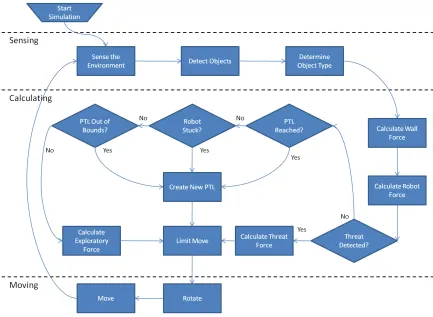
The robot achieves motion with three basic modes of operation. These include sensing
the environment, calculation of next step, and moving towards the next location (executing
the step) as seen in Figure 3.1.
3.2.1
Movement - Sensing Mode
In the sensing mode, the robot will use the omni-directional range finders to detect the
distance to any surrounding objects. Identifying if an object is a friend-or-foe (IFF) is not a
trivial task. There has been ongoing long-term research into this area [3] and in accounting
robot will know the type of object when it has sensed it. In actuality, the IFF could be
achieved in low cost robots with cameras by sensing the color or the shape of the object.
Other more extensive solutions may involve attempting to communicate with the object
using RF (Radio Frequency) communication. After the robot determines where the objects
are and what type they are, the next step is to use this information to determine the robot’s
movement, described in Section 3.2.2.
3.2.2
Movement - Calculation Mode
The most complicated and important mode of the robot operation is the second mode, the
calculation mode. The robot uses the distance from each of the objects to determine the
forces exerted on the robot. The calculation mode fuses several approaches to determine
forces needed to establish the next move, including Artificial Potential Fields, protecting
against the Local Minima Problem, collision avoidance, and threat handoff.
Artificial Potential Fields
Artificial Potential Fields (APFs) are a simple and low overhead method commonly used for
path planning. The APFs are also used for other robot formation[12, 15] and surveillance[8]
as described earlier.
The basic principle of the Artificial Potential Field is a system of forces all acting
to-gether on object moving through an environment. Several forces can be potentially
com-bined in a unique way to help solve this scenario. This APF will achieve the objectives
of the algorithm with simple calculations that are trivial for the robot to calculate with its
limited hardware. Along with the forces, the robot will makes decisions as to which forces
to ignore to better help to achieve the goal and protect the area.
The forces include the following (Figure 3.2):
1. Threat to Robot Force
3. Wall to Robot Force
4. Exploratory Force
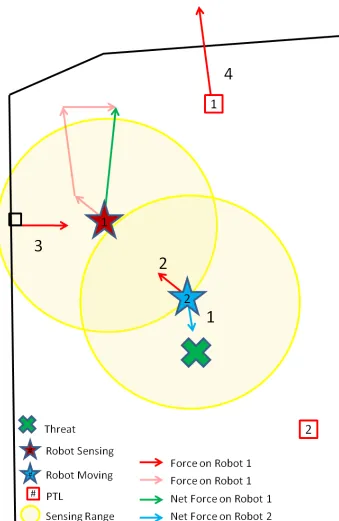
Figure 3.2 shows the interaction of all the forces that effect the robot’s movement. In
the diagram the red star is robot 1. The diagram shows robot 1 in the process of sensing
it’s environment and may be in either the sensing or moving mode of operation. The blue
star is robot 2 which is actively moving in the step that it has previously calculated. The
yellow circles around the stars show the effective sensing ranges of the robots. The green
X is a threat that robot 2 was affected by when it calculated its next move. The net forces
on robot 2 are shown with the blue line. The black line is a wall or boundary of the
surveillance region, and the red squares are the patrol target locations for robots 1 and 2
(labeled). Finally, the red lines are forces acting on robot 1. The faded red lines are the
projected forces on robot 1, and when placed end to end forms the green line for the net
force on robot 1. Robot 1 has the robot, wall, and exploratory forces acting upon it to make
this net force. The direction of the robot’s move will be in this direction. The robot’s step
will be calculated based on the combination of these forces, and later limited by several
factors.
The artificial potential field is essentially an area with differences in potential that form
hills and valleys. The valleys of the region apply forces on the robots similarly to a ball
rolling down a hill. The robot will move towards the areas with lowest potential. The patrol
target locations (PTLs) are the locations of lowest potential, and a wall or other robot is at
a point with the highest potential[20]. The quadratic APFs used in this research build upon
those used in [8]. All four of the forces are implementations of these quadratic APFs.
Below is the simple equation for the force with respect to the potential. The details of
calculating an actual move based on the force will be discussed at the end of this section.
− →
F =−O−→P
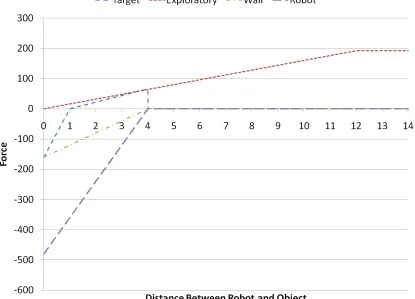
The Threat to Robot force is a two part attractive and repelling force. When the threat
threats are within the robot’s sensing range, the closest threat will be eliminated first. The
force toward the threat on the robot is larger the farther the robot is from the threat. This
force pulls on the robot until it is within the ideal distance from the threat. When this occurs,
the force will reverse direction and push the robot away from the threat. The ideal distance
used for simulation will be 1 meter. This essentially pushes and pulls the robot from the
threat until it settles at the ideal distance from the threat. After a predetermined amount of
time after the robot has detected the threat, this threat will be considered neutralized and
the robot will continue to seek other threats. During this time all, other forces are ignored.
[image:32.612.105.520.304.603.2]This force can be seen in Figure 3.3.
Figure 3.3: Artificial Potential Field Forces
The Robot to Robot force is a repelling force that only acts upon the robots when they
krta = 11 Attracting Constant toward the
Threat.
krtr =−80 Repelling Constant away from the
Threat.
drt= 1 Optimal distance (threshold at
which the force flips).
Frt=
2krta|(x−drt)|, x > drt
2krtr|(x−drt)|, x <=drt
Table 3.1: Threat to Robot Force
robots come to each other. This effectively achieves a simple collision avoidance
mecha-nism. If the threat is also within the sensing range of the robots, the robot that is farther
away from the threat will ignore the Threat to Robot force and continue exploring the
surveillance region looking for other threats. This force can be seen in Figure 3.3.
srad = 4 The sensing radius of the robot
(limited by sensors).
krtr = 60 Repelling Constant away from the
Robot.
Frt= 2krtr(|x| − |srad|)
Table 3.2: Robot to Robot Force
The Wall to Robot force is a slightly more complicated repelling force. The robot will
be affected by the obstacle as soon as it is detected within its sensing range, similar to the
behavior of the other forces. However, it will not be a force acting in the direct angle to
the robot. Instead, the angle of the force will be α−90, whereαis the angle of incidence between robot and the obstacle. This ensures that the robot will travel in a more variable
direction to help keep the robot from traveling the exact same path continually. This force
can be seen in Figure 3.3.
The final and most complex force is the Exploratory force. This force keeps the robot
moving to new areas to explore instead of settling to a particular region. Several
com-ponents make up this force. A new point of interest is calculated based on the last several
positions that were used as points of interest. The points of interest are the locations that the
srad = 4 The sensing radius of the robot
(limited by sensors).
krtr = 8 Repelling Constant away from the
Wall.
Frt= 2krtr(|x| − |srad|)
Table 3.3: Wall to Robot Force
force from the last n points of interest (n is a variable calculated through experimentation)
with a time step assuming a constant speed (also a variable modified through
experimenta-tion). The robot does not move directly towards the point of interest. Instead, its move is
directed by a combination of the force towards the point of interest and one perpendicular
to it (Figure 3.4). The net force on the robot will cause it to spiral inwards toward the point
of interest thus covering more of the area while searching for threats. This spiraling force
is based upon the ladybug exploration force [18]. It is the secondary component of the set
of three algorithms. When the spiral angle is set to 0, the robot will move directly towards
the patrol target.
srad = 4 The sensing radius of the robot
(limited by sensors).
krta = 20 Attracting Constant effecting
movement toward the PTL.
Frt= 2krta(|x|)
Table 3.4: Exploratory Force
The force is not enough to determine how the robot actually moves. This must be
translated into an actual move. Using the force, the move can be calculated by finding the
velocity of the move over a time step. SinceF =m∗awhereais the acceleration, and we are assuming for simplicity that the mass (m) of the robot is 1, thenF = a. The velocity
v can be related to the acceleration via the equationv =a∗δtsubstituting in the force for acceleration to getv =F ∗δt. The final step to get the displacement or the move based on the force. Since disp=v ∗δt, thendisp =F ∗(δt)2. For simulation purposes a constant
δt= 0.15is used for a final formula ofdisp=F ∗0.0225.
closest robot and wall. These displacements will be added to the current location of the
robot. If there is a threat within the robot’s sensing range, the robot will calculate the
displacement based on the threat force, otherwise the exploratory force will be added
in-stead. The algorithm for the exploratory force involves a few more steps than the other
forces. These steps help to avoid a common problem with APFs called the Local Minimum
Problem.
Local Minimum Problem
Local minima can occur when the attractive and repulsive forces cancel out and effectively
trick the robot into thinking that it is at the PTL without being attracted in any direction.
The robot will stop moving and be locked or ”stuck” in a single location with little or no
movement. This can commonly occur when the robot is close to walls (especially corners)
or when the robot is close to other robots. Several approaches exist to overcome this
phe-nomenon. Yagnik et al.overcame the local minima problem in their research work with
a hybrid APF approach with simulated annealing[21]. Simulated annealing replaces each
step of the current solution with a random ”nearby” solution. This approach yields a good
solution even in the presence of noisy data, but may not be the most optimal due to
neigh-bors being chosen randomly. A more exhaustive search may yield better results, but could
take more processing time.
The local minima problem has been overcome in the surveillance algorithm in this
research by keeping track of the number of moves or steps that the robot makes since the
last PTL had been created. If number of steps is larger than a simple threshold, then the
robot must be in a local minimum. The threshold used for simulation is based on the PTL
distance and a constant.
Msm = 1.1 Max Step Multiplier.
Gdist PTL Distance.
Sthresh=d(Gdist∗Msm)e Step Threshold
When this scenario is detected of being ”stuck” in a local minimum, the robot
imme-diately calculates a new patrol target location. The final determination the robot makes
after trying to reach the PTL is whether the robot cannot reach the PTL because it is out
of bounds. When the robot senses the wall, it sees a line. The robot can easily establish
the orientation of this line based on the angles of the end points of the wall to the angle
the PTL is from the robot’s current position. If the PTL is determined to be out of bounds
the robot creates a new PTL in this scenario as well. The exploratory force displacement
is now calculated if no PTL was created. This displacement is added to the robot’s current
position. The next step for the robot is to now determine whether it is safe to make the
move that it has just calculated.
Collision Avoidance
The artificial potential fields create the individual move that the robot creates and moves
along when in the movement mode. The sum of all forces creates the raw move. Since the
robot does not actively sense the environment while moving, only sensing and detecting
when in the sensing mode, the robot must have some way to keep from colliding with other
objects. The collision avoidance method is a simple limitation of the calculated raw move.
All objects need to be avoided, including walls, threats, and other robots. Limitations
are put on the distance of the move in order to keep from colliding with each. When a
threat is detected, the robot limits itself to a move no larger than the distance to the threat.
Since the magnitude of the threat force will overwhelm any other forces and the exploratory
force will not be in effect, the robot will not collide with the threat. In order to keep from
colliding with other robots, the robot limits the move to1/2the sensing range of the robot. This is further limited to 1/2the distance to the closest robot if a robot is within sensing range.
The robot will also limit the move for the step to1/2the distance to the closest wall within sensing range. The limit is less than the distance to that closest wall to keep the
a small move, it becomes difficult for the robot to move away from the wall. Extra moves
are necessary for the robot to break free.
Threat Hand Off
There is no explicit hand off of threats between robots since the threats do not move. The
scenario does occur, however, where the threat may be identified by two separate robots.
One robot is assumed to be enough to eliminate a threat so the second robot would be
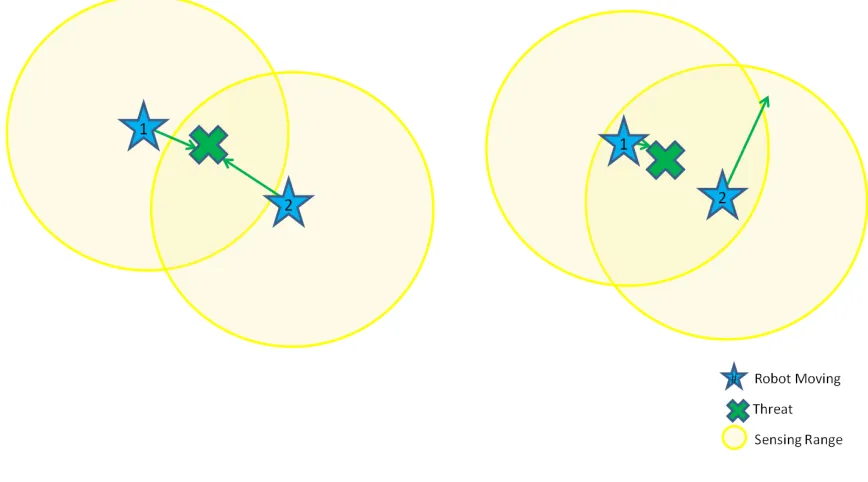
available to look for other threats. The hand off occurs with the following steps as shown
in Figure 3.5. When robot 2 detects the threat within it’s sensing range, it will move towards
the threat. When robot 2 senses robot 1 within its sensing range, it determines which robot
is closer to the threat. Robot 1 will do the same thing. The robot that decides it is further
away from the threat will ignore the threat and continue on with its move. Robot 1 was the
first to detect the threat and moved in closer to the threat before robot 2 had a chance to.
[image:38.612.91.525.406.647.2]Therefore, robot 1 will be the closer robot to the threat and will neutralize it.
3.2.3
Movement - Moving Mode
The third mode of operation is movement. The robot turns in the direction of the calculated
movement and continues in that direction until it reaches the distance calculated for the
move. Individual moves will be created and traveled until the PTL is reached. If the PTL
cannot be reached due to the prior criteria (section 3.2.2), a new PTL will be created for
the robot to move towards. By this method, the robot is constantly moving, increasing the
area that is covered by the limited number of robots in the surveillance region.
3.2.4
Patrol Target Creation
The most novel feature of the three patrolling algorithms is the patrol target creation by
using robot sensing history. There are three different types of historic events that the robots
store in memory. While the robot is actively moving around the surveillance region, it
stores these points of interest as it comes across them. The historical points of interested
are listed in Table 3.6;
Historical Point Type Number Stored
Walls 2
Robots 1
Patrol Targets 1
Table 3.6: Historical Point Types and Number Stored
The robot keeps track of the last two walls that have been detected. When the robot
senses a wall, it first determines if a point close to the new wall point has already been
stored. It is not as useful to have two reference points for the same wall that are right
next to each other. It iterates through the array of wall locations stored finding any that
are within a threshold in distance from the current point that the robot is trying to store.
The threshold used for simulation is the sensing radius of the robot. This ensures that two
points near each other on the same wall will not both be stored for target generation. When
middle of the detected line segment representing the wall is stored. This makes for simpler
calculations and comparison of the walls.
For robot location history, only the last robot detected will be stored. If other robots
throughout the surveillance region were stored as well, there may be more cases where
local minima could occur. As the robot senses its environment and detects a new robot, the
previously stored robot is replaced by this newly detected robot. This may in fact be the
same robot, just at a different position than it was previously known to be located at.
Similar to the method of recording the robot historical point, only the last patrol target
location is stored and will be used. However, the storage of the patrol targets does differ
in two respects. First, when a new patrol target is created, it is not immediately stored in
the robot memory in the historical points. Instead, the point is stored in a general
infor-mation area for the robot that will guide each step as it moves towards the patrol target.
When the patrol target is reached, it is stored in a temporary location while a new patrol
target is generated. This previous target that was stored temporarily is now prepared to be
placed into the historical points memory and will be used on the next calculation to create
a patrol target. The preparation of the point involves storing a point half way between the
target and where the robot actually reached, instead of actually storing this exact target into
the memory. Due to local minima problems and the target actually being out side of the
surveillance region in many cases, it is not accurate to store the target directly. Through
experimentation it was also determined that it was best to store the PTL at this location
(subsection 5.2.2).
Testing was completed to compare the performance between three different methods of
storing the target (storing the target point where it was, where the robot was able to reach
before getting ”stuck” or determining the PTL was out of bounds, or halfway between the
points. It was determined that the point half way between the target and the robot’s end
point yielded the best performance in normalized time to detect targets (see Section 5.1 for
details on the performance metric). The next sections describe the process of establishing
flavors.
Initial Patrol Target
At the initiation of a simulation, there are no historical locations stored of any type.
There-fore, the robot must create a new patrol target with no history. A random angle from the
random robot start location is generated. The first patrol target is created at a distance ofdpt
from the robot start location at this initial random angle. The patrol target location distance
(dpt) is defined by table 3.7.
srad = 4 Sensing radius of the robot (limited
by sensors).
dpt=srad∗3 Patrol target location distance.
dpt= 4∗3 = 12 Final value of the constant patrol
target location distance.
Table 3.7: Patrol Target Distance
The patrol target distance is defined by the sensing range of the robot (4 meters)
multi-plied by a constant. During initial experimentation and algorithm creation, the best constant
was determined to be 3. This gives the robot a large swinging radius while spiraling towards
the PTL in the average target region of 60 meters by 60 meters square. A larger constant
will cause fewer patrol target locations while the robot is traveling across the surveillance
region which will ultimately cause a smaller region to be explored during a single pass
across the surveillance region. The possibility of basing the patrol target distance off of
the region size was explored initially. This was however, ultimately abandoned due to the
knowledge of the region that is necessary yet unknown to the robots.
Patrol Target Creation Scenario
The following scenario is an example of the calculation of a new patrol target based on
two wall history points and one PTL history point. For this simulation, no robot has yet
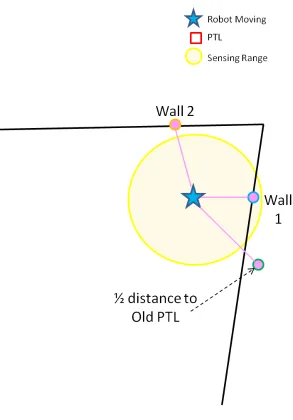
the initial configuration of the robot. The blue star is the robot and the yellow circle is the
sensing radius of the robot. The pink points are the historical points of interest, and the red
square is established as the new patrol target location. The pink lines connecting the robot
to the historical locations are merely for reference of the angle between the robot and these
[image:42.612.223.516.200.620.2]locations.
Figure 3.6: Patrol Target Creation Step 1
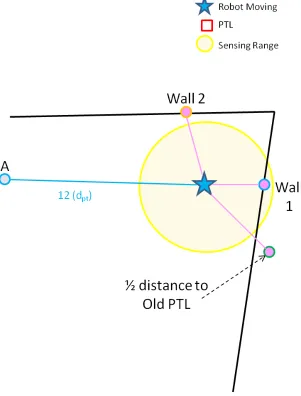
The robot first finds the angle to the first wall point (Wall 1 in Figure 3.7). It then
this wall point and adding 180◦. This now gives the direction of the new point. The distance
of the point is calculated to be at a constant distance from the robot’s current location (dpt,
Table 3.7). This new point is illustrated in 3.7 with a connecting blue line.
Figure 3.7: Patrol Target Creation Step 2
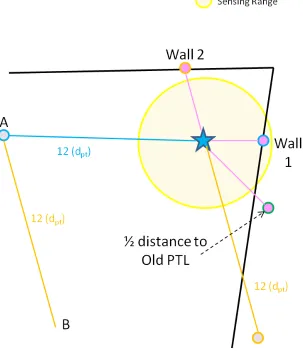
Next, the robot uses the second wall point in its patrol target location creation. It creates
a similar temporary point for reference from the robot at the opposite angle (180◦) from this
second wall point to the robot. This corresponding point and line are shown in Figure 3.8 in
[image:43.612.212.513.172.568.2]the first temporary point A at that same opposing angle determined from the wall point 2
to the robot’s current location. A line representing the connection of temporary point A to
[image:44.612.213.516.216.567.2]point B is shown in Figure 3.8.
Figure 3.8: Patrol Target Creation Step 3
The new PTL can now be generated based on the final history point. The1/2distance to old patrol target has a similar temporary point to the wall points created at an opposing
angle from the robot again atdptfrom the robot’s current location. This same distance and
in the Figure 3.9 as a red box. A reference line in green has been drawn on the figure for
[image:45.612.105.516.142.554.2]easy visualization.
Figure 3.9: Patrol Target Creation Step 4
Fading Effect
In an attempt to optimize the history algorithm a feature was added to fade the effect of the
robot and wall historical points over time. Three functions were tested on thedpt with the
dpt= 12 Patrol target location distance.
tcur Current simulated time (sec).
thp Time history point was first detected
(sec).
th =tcur−thp Time since the history location was first
identified (sec).
tf = 600 Time over which the history location will
fade away (sec).
cf = ((dpt/0.01)(1/tf))−1 History point fade constant.
dptlin =dpt−(dpt∗(th/tf)) Patrol target distance after linearly
de-creasing effect.
dptsf =dpt−(0.01∗((1 +cf)th)) Patrol target distance after slower fading
effect.
Table 3.8: Fading Patrol Target Distance
The linear function is a standard functions for linear decay. The slowly fading function
was derived to obtain the desired fading effect. Figure 3.10 shows the effect on thedptwith
these two functions and with no fading. The historical point fade time (tf) is a constant
used for every simulation. In the case of the two fading algorithms, the historical point will
have no effect on the patrol target generation at a simulated timetf after the time that the
point was first stored in the robot’s memory (thp). The effect of the fading historical points
is to further reduce the occurrences of local minima when the robot is moving through the
surveillance region.
Through experimentation it was determined that the optimal fading method for the
his-torical location of the previously seen robots was to have them fade linearly (subsection
5.2.1). There was an improvement on average but was not large enough comparatively
with the slowly fading method to warrant the more complex calculations that would tax
the processing capabilities of such a low cost platform. However, for the wall locations in
the history, it was also determined through experimentation that having the location of the
walls fade over time had a detrimental effect on the abilities of the algorithms. Since there
was no improvement, no fading was applied to the wall history locations for simulations
PTL history has no fading applied since the locations are replaced frequently (on every
[image:47.612.105.515.149.459.2]calculation of the patrol target location).
Figure 3.10: Fading Effect of Historical Point
Random Path Patrolling
Using the robot’s sensing history is the primary component of two of the three algorithms
that were tested in this thesis. The first is the history with 45◦ maneuvering towards target,
and the second is the history with straight movement towards target, as enumerated in
section 3.2. One of the three algorithms tested, the Random Path Patrolling , however, does
not use this. It uses a much simpler method of patrol target generation called random path
Random path patrolling is an example of a random direction algorithm. For this
algo-rithm, the initial direction is created in the same method as the history algorithm. The robot
will travel in a straight line at this angle until it reaches a wall. When the wall is reached, a
new random angle is once again created. The angle is generated to be anywhere between 0◦
and 360◦from the robot’s current location (any direction in a circle). Because of this wide
window, it is possible and highly likely that the new angle will bring the robot towards the
wall again. The will cause a minimal amount of flutter as the robot is pushed in and out
from the wall (wall force and exploratory force opposing each other) until a new angle is
generated that points away from the wall. This is possibly not a very optimal method of
generating the random angle, and would be a good place for future improvement.
3.3
Memory Usage Analysis
One of the primary goals of this thesis research is to create an algorithm that simple low
cost robots are capable of supporting. The memory usage is a critical issue when the goal
is to run on a robot driven by a simple microcontroller with very little memory. Table
3.9 provides a high-level classification of the memory that will be needed by the robot to
complete any calculations for the history algorithms described in section 3.2.
Memory is needed for keeping the historical points as well as calculating new PTLs.
It is also used for various miscellaneous locations and timestamps. In addition, a section
of memory (48 32-bit floating point integers) is allocated for various calculations in the
algorithms. The calculated total memory needed is only 300 bytes. This is easily achieved
with the basic memory limitations of cheap microcontrollers found in many low cost robot
Number of Values
(32-bit floating point integers) Locations
2 History: PTL
4 History: Walls
2 History: Robot
2 PTL Creation: PTL
4 PTL Creation: Walls
2 PTL Creation: Robot
2 Misc: Current Robot Location
2 Misc: PTL Robot is Moving Towards
2 Misc: Temporary PTL Location
2 Misc: Sensed Threat
Number of Values
(32-bit floating point integers) Timestamps
1 Current Time
1 Time Robot Sensed (Fading)
1 Time Threat Sensed
Number of Values
(32-bit floating point integers) Miscellaneous
48 Enough for temporary values while
per-forming various calculations.
Total
[image:49.612.126.500.187.588.2]24 + 3 + 48 = 75 75∗32bits= 2400bits= 300bytes
Chapter 4
Simulation Architecture
Simulation of the surveillance region has been completed using MATLAB for the
simula-tion environment.
4.1
Event Queue
An event queue model of simulation was chosen for implementation in the simulator for
the three surveillance algorithms. The event queue has the benefit of not requiring constant
time simulation and not requiring multi-threaded simulation where a thread of operation
is tied to each of the elements being simulated (the robots and threats in this case). The
simulator using an event queue was able to place the simulation events into a simple queue
that are operated on in order of time to be executed. All of the events in this simulation
occur when the robots were in their sensing and calculating modes. The first robot is
popped off the head of the queue and the algorithm of choice from the three described in
section 3.2 is run on it to determine the robot’s next move and if a new patrol target needs
to be created. When all calculations are complete, the robot is added back into the queue
sorted by time at which the robot should next enter its sensing and calculating modes.
This simple operation repeats until the simulation is completed. This simulation method
allowed for easy integration with the surveillance algorithms due to the robots only sensing
the environment while in the appropriate sensing mode and not while moving.
where the robots move separately and independently from each other. This is necessary
for the needs of this work because the robots must be completely autonomous. A discrete
simulation mode was briefly considered due to its simplicity, but requiring all of the robots
to be in the same mode of operation at the same time fell outside the parameters for desired
simulation. Each move would have had to have been exactly the same length and therefore
would have taken the same amount of time for travel, or enough simulated time would
have been given before the next sensing event for each robot to get to their destination.
This would be extremely inefficient in real-time with robots pending action and waiting for
others to finish.
4.2
Threat Arrival
The number of threats that will arrive in a given simulation run is provided as a parameter to
the simulator. The time at which they will start to arrive is a constant defined in the code as
600 seconds. The robots will arrive any time after the 600 simulated seconds (10 minutes)
have passed, but before 1400 seconds (23 minutes 20 seconds) have passed. When the
simulation starts the threats are placed in an array with a randomly generated start location
and a randomly generated arrival time between 600 and 1400 seconds of the simulation.
During the simulation run, the robots are not able to detect the threats unless the simulated
running clock is after the time at which the robot is slotted to appear.
4.3
Parameters
The simulator takes several parameters to define how the experimentation will run. This
section gives a brief overview of all of the important parameters to the simulator. Table 4.1
gives and example of each of these.
Parameter Value Explanation
simulationM ethod 0 Use robot history.
regionSize 60 Surveillance region is 60m square.
regionShape 1 Slightly irregular shape surveillance region.
numLoops 100 The simulator will run 100 simulations.
numRobots 2 Two robots actively patrolling the region.
numT argets 2 Two randomly appearing threats.
rotateAngle 45 45◦spiral towards patrol target.
numLocsGoal 1 Simulate storing one PTL location used for PTL creation.
rF adeT ime 600 Robots fade over 600 seconds.
rF adeM ode 1 Robots will fade from history linearly.
wF adeT ime 600 Walls fade over 600 seconds.
wF adeM ode 0 Walls will not fade from history.
[image:52.612.114.506.88.311.2]storeP T LM ethod 3 Patrol target is stored1/2distance from robot. Table 4.1: Experiment Parameters
patrol target creation. For later experimentation, a value of 2 for the simulationM ethod
will run the simulations with a systematic walk method for a baseline comparison
(subsec-tion 5.3.6). TheregionSize parameter defines the general dimensions of the surveillance region over which the surveillance region shape will be overlaid. It is a single number
in meters that will be used to create a square region with each side being the value
pro-vided. The regionShapewill be one of the following shapes: 1 is for slightly irregular shaped region, 2 is for simple square shape, and 3 is for the highly irregular difficult shape.
The shapes will be discussed in more detail with the test of the algorithm for the
differ-ent shapes. It is easy to set the number test runs the simulator will run over the given
parameters, thenumLoopsparameter defines this.
ThenumRobots defines how many robots will be available to patrol the region. The
numT argets defines the number of targets that will appear over the lifetime of a single simulation run. TherotateAngleis the second critical piece of the algorithm configuration. If the simulationM ethodvariable is set to 0 the robot will use sensing history and the
rotateAngle will effect how the robot moves towards the patrol target. Both 45◦ and 0◦
PTLs that will be stored and later used for calculating new Patrol Target Locations. For
most experimentation only one PTL is stored (subsection 5.3.5).
The fade time parameters includingrF adeT ime andwF adeT imecorrespond to the
time over which the robots and walls will fade into having a smaller effect on patrol target
creation respectively. The parameters paired with theserF adeM odeandwF adeM odefor the robots and walls respectively correspond to the method by which the historic events
will fade into oblivion. Mode 0 means that the location will not fade, mode 1 means that
the location will fade linearly, and mode 2 means that the location will fade exponentially.
The final parameter storeP T LM ethod was varied during initial experimentation to find the optimal method of PTL storage for patrol target creation. A value of 1 corresponds to
storing the current location of the robot, 2 corresponds to storing the patrol target location,
and a value of 3 will cause the simulator to store the point half way between the robot’s
current location and the patrol target.
4.4
Simulation Visualization
As shown in the plot (4.1), the robots are represented by the different colored *’s and the
threats are represented by green X’s. When a threat is neutralized by a robot it turns into
a black X. Each robot has a number near it that represents the robot number assigned to
the robot for simulation and tracking. This number will not change during the simulation.
The yellow circle shows the omni-directional sensing range of each of the robots, and the
green line represents the path that the robot is following with this calculated move. A
red * (robot) is the current sensing robot. When it has completes sensing the region and
calculates its next move, it will become yellow. A yellow * (robot) represents one that is
turning towards the direction that it will be traveling in. Finally, a blue * (robot) shows that
the robot is moving along its calculated path. It will not sense the environment again until
A red square with a number inside is the current patrol target for the robot whose
num-ber matches that within the square. The historical point locations are represented by pink.
A pink #W# is for a wall history point for a robot represented by the #. A pink #R# is for
a robot history point for the robot represented by the #. And finally, a pink #G# is for a
previous patrol target (goal) for numbered robot.
As shown with the different colored robot symbols in the plot, there are several
real-world factors taken into account. First, the time for the robot to turn is factored into the
time for the robot to take its move and plot its turn. Second, a surveillance region that is
not a normal square shape is also used to test the ability of the algorithm to function in a
Chapter 5
Simulation Results and Discussion
5.1
Metrics
The primary goal of the algorithms developed is to eliminate threats when they appear in
the surveillance region as quickly as possible. One critical assumption is that only one
robot is needed to eliminate a threat. Therefore, the natural metric of choice for this type
of algorithm is the time it takes for the threat to be first detected after it appears. It is
not necessary to take into account the amount of time the robot will take to neutralize the
threat since this is a constant that will not change. In fact, the robots will stay locked into
the threat so it will take exactly the same amount of time to eliminate a threat every time.
The simulation keeps track of the arrival and first detection time of every threat within the
surveillance region, so that the time to eliminate the threat can be calculated.
The time that it takes to reach a threat is highly variable by nature. It is based on
where the robots are located at the time of the first appearance of the threats in the region.
Therefore, i
![Figure 2.1: Ladybug Force Geometry[18]](https://thumb-us.123doks.com/thumbv2/123dok_us/54418.4994/20.612.227.394.188.315/figure-ladybug-force-geometry.webp)
![Figure 2.2: Initial Robot Configuration, Trajectories, and Final Configuration[18]](https://thumb-us.123doks.com/thumbv2/123dok_us/54418.4994/21.612.213.409.215.548/figure-initial-robot-conguration-trajectories-final-conguration.webp)