
Copper complexes as a source of redox active MRI contrast
agents.
Lynsey Dunbar,
aRebecca J. Sowden,
bKatherine D. Trotter,
aMichelle K.
Taylor,
a,dDavid Smith,
aAlan R. Kennedy,
aJohn Reglinski*
aand Corinne M.
Spickett
*b,ca
Department of Pure & Applied Chemistry 295 Cathedral St.,
Strathclyde University Glasgow G1, 1XL
b
Strathclyde Institute of Pharmacy and Biomedical Sciences, 27 Taylor Street,
Strathclyde University, Glasgow G4 0NR.
c
Current Address:
School of Life and Health Sciences, Aston University,
Aston Triangle,
Birmingham, B4 7ET, UK
d
Current Address
School of Science and Technology University of New England
Armidale NSW 2351 Australia
Corresponding author:
Dr John Reglinski Fax: 141 548 4822; Tel: 141 548 2349; E-mail: [email protected]
Key Words: Copper macrocycles, oxidation-reduction, redox sensitive contrast agent,
Abstract
The study reports an advance in designing copper-based redox sensing MRI contrast
agents. Although the data demonstrate that copper(II) complexes are not able to compete with
lanthanoids species in terms of contrast, the redox-dependent switch between diamagnetic
copper(I) and paramagnetic copper(II) yields a novel redox-sensitive contrast moiety with
potential for reversibility.
Introduction
MRI contrast agents capable of detecting redox status in biological tissues would be
valuable in the diagnosis of inflammatory diseases that involve an oxidative pathology, such
as atherosclerosis or rheumatoid arthritis (Filippin et al. 2008; Profumo et al. 2011).
Historically, contrast agents have depended on lanthanide chemistry (De Leon-Rodriguez et
al. 2009; Aime et al. 2009) and the development of agents for MRI continues to focus largely
on gadolinium owing to its key qualities; i.e. it is a quadrupolar nucleus, it has a large number
of unpaired electrons and when coordinatively unsaturated it displays rapid exchange kinetics
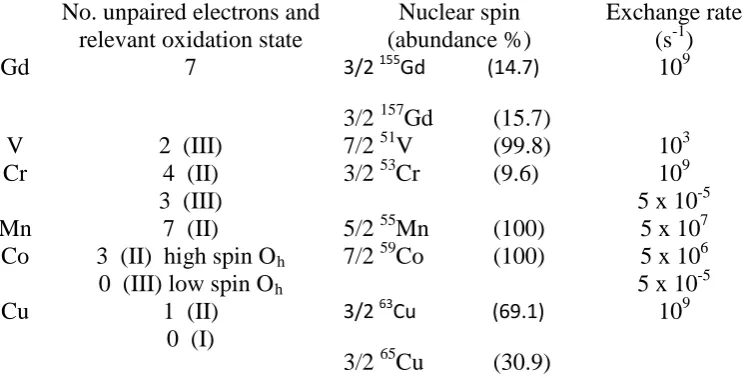
in aqueous solution (Table 1). However, the synthesis of new, smart imaging agents for
measuring biochemical processes (e.g. pH and pO2) requires that the contrast agent has added
capability (Angelovski et al. 2008; Iwaki et al. 2012; Viger et al. 2013; Vologdin et al. 2013)
A method of introducing added capability is to modify the ligand that chelates the lanthanoid
centre (Angelovski et al. 2008; Iwaki et al. 2012; Vologdin et al. 2013). Alternatively, it is
possible to encapsulate a gadolinium species into a polymer matrix which degrades in
response to the biological environment (Viger et al. 2013).
Recent concerns about the nephrotoxicity of gadolinium suggest that there would be
advantages in broadening the range of metals used as contrast agents (Badero et al. 2008;
Ledneva et al. 2009). The clinical use of transition metals in MRI has been mostly restricted
to nanoparticles which, as large multimetallic assemblies, are able to compensate for the weak
relaxivity of the parent elements (e.g. iron, copper) (Di Marco et al. 2007; Longmire et al.
2008; Kueny-Stotz et al. 2012; Min et al.2012). One strategy is to design modified low T2
nano-particles which assemble in the presence of key biomarkers (e.g. streptavidin-biotin) to
form assemblies with a high T2 (Min et al.2012).
Certain transition metals (Table 1) have physical properties compatible with their
development as contrast agents (Tobe 1972; Weast 1980; Grant et al. 1997; Lejeune 1999;
Yam & Lo 1999; Dorazio & Morrow 2012; Drahos et al. 2012; Thunus & Yu 2012; Loving et
al. 2013; Gale et al. 2014; Tsitovich et al. 2014). Since transition metals display different
coordination chemistry to gadolinium (lower coordination numbers, simpler topologies) and
can combine with a wider range of ligand types (e.g. phosphines, thiolates), it should be easier
to target them to physiological parameters such as pH and redox status.
Due to its large number of unpaired electrons, manganese(II) has attracted the most
attention as an alternative to gadolinium (Grant et al. 1997; Thunus & Lejeune 1999; Yam &
Lo 1999; Yu et al. 2012; Loving et al. 2013; Gale et al. 2014). Indeed, there has been some
success with manganese in the design of redox sensing contrast agents (Loving et al. 2013;
Gale et al. 2014; Tsitovich et al. 2014). Copper(II) also has some attractive properties (Table
1) (Tobe 1972; Weast 1980). Although it only has one unpaired electron, its ligand exchange
rate is higher by two orders of magnitude than manganese and commensurate with that of
gadolinium (table 1). Furthermore, its chemistry suggests that it should be easier to create an
available coordination site for water without the risk of forming insoluble oxides (c.f. MnO2,
form, d10 Cu(I), which can be sustained under biological conditions. The availability of
diamagnetic (Cu(I)) and paramagnetic (Cu(II)) forms allows the design of agents that have
redox switch capability. Lauffer briefly discussed the properties of copper as a platform for
the design of imaging agents 25 years ago, deeming it unsuitable for use due to its poor
relaxivity (Lauffer 1987). However, the advent of better imaging software, access to higher
field strengths, more sophisticated pulse sequences and the emergence of chemical exchange
saturation transfer (CEST) as a relaxation mechanism, the need for metals with such high
relaxivity may be coming to an end (De Leon-Rodriguez et al. 2009; Aime et al. 2009; Hancu
et al 2010; Sherry & Wu 2013). The design of MRI contrast agents has developed
significantly over the past 25 years and it is not uncommon for discrete sensing moieties to be
attached directly to a MRI reporting gadolinium species. Thus, should copper remain an
unsuitable metal in its own right, there are opportunities to bolster its poor relaxivity by
combining a reporting copper complex with a more responsive gadolinium species. Although
the relaxivity of copper will never supersede that of manganese or gadolinium, its potential as
a switchable redox sensing contrast moiety makes it an interesting target and, considering all
the advances in the field of MRI over the past 25 years, a topic worth re-visiting.
Experimental
Unless otherwise stated, all chemicals were commercially obtained and used
without further purification. Gd(DTPA) and Cu(BF4)2 were purchased from the
Sigma-Aldrich company UK. SprNen and the unmodified copper macrocycles ([Cu(II)SenNen]2+,
[Cu(II)SenNpr]2+, [Cu(II)SprNen]2+ and [Cu(II)SprNpr]2+) were prepared as previously
reported (Taylor et al. 2008; Trotter et al. 2009; Trotter et al. 2010; Sowden et al. 2013).
Solid reflectance spectra (400 – 900 nm) were recorded on a Photonics CCD array
Finnigan LCQDuo instrument equipped with anion trap as described previously (Taylor
et al. 2008; Trotter et al. 2009; Trotter et al. 2010; Sowden et al 2013). The
spectrophotometric titrations were carried out on a Unicam UV 300 spectrometer.
X-Ray crystallography: Crystals were coated in mineral oil and mounted on glass
fibres. Data were collected at 123 K on a Nonius Kappa CCD diffractometer using
graphite monochromated Mo-Kα radiation. The heavy atom positions were determined
by Patterson methods and the remaining atoms located in the difference electron density
maps. Full matrix least squares refinement was based on F2 with all non-hydrogen atoms
anisotropic. While the hydrogen atoms were mostly observed in the difference maps,
they were placed in calculated positions riding on the parent atoms. The structure
solution and refinement used the programs SHELX-97 and the graphical interface
WinGX (Sheldrick 1998; Farrugia 1999)
Preparation of N-substituted macrocycles: SprNen (1.04 g, 0.003 mol) was dissolved
in acetonitrile (100 mL) to which sodium bicarbonate (5.07g, 0.06 mol) was added.
The mixture was stirred and heated to reflux. Halo-alkane (2-bromo-ethanol,
3-bromo-propan-1-ol or bromoacetic acid, 2 mol equiv.) in acetonitrile (50 mL) was added
drop-wise to the refluxing mixture over a 6 hr period. The mixture was then refluxed
overnight. The solution was left to cool, before being filtered. The solvent was
removed in vacuo, resulting in a yellow waxy solid. The products were used as received. Yields were typically in the order of 70%.
cis-SprNen(-CH2COOH)2: Mass Spec. (ESI) m/z 461.13 [M+H]+.
Preparation of N-substituted copper(II) macrocycles: The required N-substituted
macrocycle (1.04 g) was dissolved in methanol (150 mL) and treated with an
equimolar amount of Cu(BF4)2.6H2O (0.96 g) dissolved in methanol (10 mL). An
immediate colour change from pale yellow to dark green was observed. The resulting
solution was refluxed gently overnight. The solution was cooled and filtered and the
solvent removed in vacuo to yield a dark green solid. The crude product was re-dissolved in the minimum amount of methanol, filtered through celite and
recrystallised by vapour diffusion using diethyl ether to give a dark green powder.
cis-[Cu(II)SprNen(-(CH2)2OH)2] 2BF4: Anal. Calcd. for C23H32 N2S2O2CuB2F8: C, 39.30; H, 4.41; N, 4.36 % Found: C, 39.98; H, 4.72; N, 4.57 %. Mass Spec (ESI) m/z
495.08 [M]+, 451.13 [M-CH2CH2O]+. λmax (solid reflectance) 435 nm, 640 nm.
cis-[Cu(II)SprNen(-(CH2)3OH)2] 2BF4: Anal. Calcd. for C25H36 N2S2O2CuB2F8: C, 43.04; H, 5.16; N, 4.02 % Found: C, 43.83; H, 5.46; N, 3.98 %. Mass Spec (ESI) m/z
523.20 [M]+, λmax (solid reflectance) 435 nm, 600 nm. XRD data: Monoclinic C2/c, a
= 35.7398(14) Å, b = 9.1810(3) Å, c = 21.0854(7) Å, β = 92.385(3)o, V (Å3)
6912.7(4), Z = 8, robs = 0.0438, wR2 = 0.1104.
cis-[Cu(II)SprNen(-CH2COOH)2] 2BF4: Anal. Calcd. for C23H28 N2S2O4CuB2F8: C,
41.94; H, 4.44; N, 3.86 % Found: C, 42.13; H, 4.42; N, 4.02 %. Mass Spec (ESI) m/z
523.27 [M]+. λmax (solid reflectance) 415 nm, 600 nm.
cis-[Cu(II)SprNen(-(CH2)2SPh)2] 2BF4: Anal. Calcd. for C35H40 N2S4CuB2F8: C,
49.22; H, 4.68; N, 3.28 % Found: C, 49.67; H, 4.79; N, 3.11 %. Mass Spec (ESI) m/z
Preparation of [Cu(II)SprNphenR]2+ 2BF4-: 5-nitro-2-chloro-benzaldehyde (1.86 g,
0.01 mol) was dissolved in iso-propylalcohol to which o-phenylenediamine (0.6 g,
0.005 mol) was added. The solution was stirred at room temperature for an hour and a
yellow precipitate formed. The solution was then filtered and the Schiff base, as a
yellow solid, collected and dried.
1H NMR (400 MHz, DMSO; δH) 8.99 (s, 2H, -CH=N-), 8.92 (d, 2H, arom), 8.29 (dd,
4H, arom), 7.87 (d, 2H, arom), 7.17 (d, 2H, arom), Anal. Calcd. for C20H12Cl2N4O4:
C, 54.20; H, 2.73; N, 12.64 % Found: C, 54.34; H, 2.60; N, 12.83 % Mass Spec. (ESI)
m/z 443 [M+H]+
The Schiff base (10 mmol) was dissolved in dichloromethane to which
Cu(BF4)2 (0.34 g, 10 mmol) was added. The compound was heated to reflux and then
propanedithiol (0.09g, 5 mmol) added drop-wise. The solution was subsequently
refluxed for 48 hours. The solution was then filtered and the solvent removed in vacuo to yield a green-black oil. The crude product was dissolved in distilled water and
extracted with dichloromethane and dried over anhydrous sodium sulphate. The
solvent was removed to yield the copper Schiff base macrocycle as a green-black oil.
Anal. Calcd. for C23H18N4O4S2CuB2F8: C, 38.60; H, 2.53; N, 7.83 % Found: C,
40.98; H, 2.60; N, 6.59 % Mass Spec. (ESI) m/z 541 [M]+
The Schiff base macrocyclic complex (10 mmol) was dissolved in ethanol (100
overnight. The excess NaBH4 was quenched with ammonium acetate. The solvent was
then removed in vacuo to yield a green oil. This was dissolved in distilled water and extracted with dichloromethane and dried over anhydrous sodium sulphate. The
solvent was removed in vacuo to yield [Cu(II)SprNphenR]2+ 2BF4- as a green solid.
Anal. Calcd. for C23H20N4O4S2CuB2F8: C, 38.37; H, 4.42; N, 7.67 % Found: C,
39.03; H, 4.26; N, 7.59 %. Mass Spec. (ESI) m/z 543 [M]+. λmax (solid reflectance)
425 nm, 610 nm.
Relaxation measurements: Relaxation measurements were carried out in triplicate on
a Bruker Avance I NMR spectrometer equipped with an 11.7 T magnet. The
measurements were carried out using an inversion recovery pulse sequence under full
automation control with a 90º pulse width of 11.5 µs. All spectra were referenced
internally to the residual proton resonance of the relevant deuterated solvent. The
relaxation delay was varied from 1-100 s, depending on the relaxation characteristics
of the sample. Data were transferred for remote data processing using Topspin
(version 2.1, Bruker Biospin, Karlsruhe) on a desktop PC running under Windows XP.
Following Fourier transformation, all data were baseline corrected. The T1/T2
sub-routine within Topspin was used to evaluate the relevant T1 values from the data.
Samples of the copper macrocycles, GdDTPA and Cu(BF4)2 were prepared in
0.1 M NaCl, 100% D2O in a 10 mL volumetric flask at concentrations of 10 mM, 2.5
mM, 1 mM, 0.1 mM and 0.01 mM. A control sample of 0.1 mM NaCl in 100% D2O
Electrochemistry: Cyclic voltammetry in aqueous solution was carried out on a CH
Instruments 660A Electrochemical Workstation with iR compensation, using ultra high
purity water (Elga: 0.22µm filtered, 17 MΩ/cm) and acetonitrile (redistilled from
calcium hydride). The electrodes were glassy carbon, platinum wire and silver wire as
the working, counter and reference electrodes, respectively. All solutions were
degassed with argon and contained sample concentrations 2 x 10⁻³ M for acetonitrile,
together with the supporting electrolyte; tBu4NBF4 (0.1 M) respectively.
Measurements are referenced against the redox couple (E½) of ferrocene / ferrocenium.
Chemical redox cycling: Reduction: A solution of the copper macrocyclic (0.3 mM)
complex and reducing agent (10 mM ascorbic acid) was prepared in Tris-buffer (5 mM
pH 7.4). A 1.0 ml volume of the solution of the complexes was placed in a 1.5 ml
quartz cuvette (1 cm pathlength) and the spectrum was recorded (250-800 nm). The
solution was titrated with reducing agent in 5 µl aliquots. The cuvette was allowed to
stand for 5 minutes at room temperature to allow the solution to come to equilibrium
before the spectrum was recorded. The titrations continued until no further change was
observed. Each experiment was carried out in triplicate.
Re-oxidation: A solution of the copper macrocyclic complex (0.3 mM) was
prepared in Tris-buffer (5 mM, pH 7.4) and reduced using ascorbic acid from the data
above to generate the copper (I) complex in-situ. A 1.0 ml volume of the solution of the required copper complexes was placed in a 1.5 ml quartz cuvette (1 cm pathlength)
and the spectrum was recorded (250 - 800 nm) against a Tris-buffer reference placed in
a matched cuvette. A 100 mM solution of sodium hypochlorite was titrated in 5 µl
aliquots into the solution. The cuvette was allowed to stand for 5 minutes at room
recorded. The titrations continued until no further change was observed in the spectra.
Each experiment was carried out in triplicate.
Results and Discussion
As a potential platform for the design of copper-based MRI moieties, we have
synthesized and studied three related series of copper complexes (Taylor et al. 2008;
Trotter et al. 2009; Trotter et al. 2010; Sowden et al 2013). The first series (Figure. 1)
comprise four thioether-secondary amine macrocycles where the alkyl chains linking
the donor atoms are modified so as to allow the formation of 14, 15 or 16 membered
rings. In all of these complexes the macrocycle lies in the meridial plane of the metal.
A number of these complexes crystallise with a solvent molecule (MeCN, H2O)
coordinated to the copper atom in an axial position (Taylor et al. 2008; Trotter et al.
2009. This structural feature indicates that a relaxation mechanism similar to that found
in Gd(DTPA) should be available with these copper macrocycles. A second series of
macrocycles contain tertiary amines have been prepared. Here the pendant arms (X in
Figure 1) include a terminal donor atom, which is introduced to increased the denticity
of the ligand and the stability of the resulting copper complex. A third system has
been synthesised that includes electron withdrawing groups (Figure 1, aryl and -NO2)
in an attempt to support the copper(I) form better.
-Figure 1 in here-
The secondary amine copper macrocycles (figure 1 left) were prepared as
previously described (Sowden et al 2013) and their relaxation properties assessed in
measured against Gd(DTPA) and Cu(BF4)2. Gd(DTPA) was included as a reference
material to demonstrate the relative ability of these copper macrocycles to act as
contrast agents. A simple hydrated copper salt (Cu(BF4)2) was also included in the
study to gauge the maximum effect one might expect from copper agents and in turn
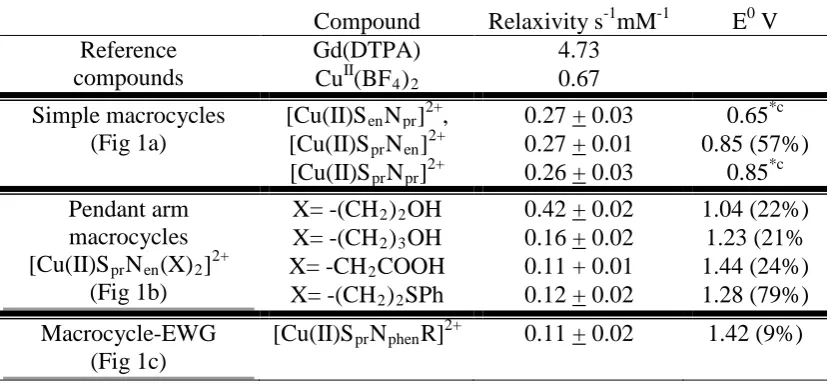
the influence of the macrocyclic ligand. As expected, the relaxation measurements
(Table 2) show that hydrated copper(II) ions have poor relaxivity compared to
gadolinium (Lauffer 1987). The hydrated copper(II) cation has a primary coordination
sphere of six waters and a weakly bound secondary coordination sphere of up to eight
water molecules (Persson 2010). Consequently, it is unsurprising that once the copper
is placed within the macrocycles four of the exchange sites are occupied and the
relaxivity falls.
- Table 2 in here-
It has been shown previously that bovine serum albumin (BSA) can efficiently
remove the copper from these secondary amine macrocycles (Figure 1, top left) in
competitive binding studies (Sowden et al 2013). Thus, although the copper macrocycles
have the potential to act as contrast agents, in order to have any real utility the stability of
these complexes needs to be increased. Earlier studies have shown that the
[Cu(II)SprNen]2+ motif was marginally more resistant to de-metalation by BSA and this
framework was adopted for modification (Sowden et al 2013). Preliminary studies using
a tertiary amine complex that incorporates ethanol pendant arms (Figure 1 top right, X =
-(CH2)2OH) indicated that this modification prevented BSA from removing the metal
from the complex (Sowden et al 2013). Mattes et al. have previously synthesised a range
ethanol, acetate and pyridyl groups attached to the secondary amines (Funkemeier &
Mattes 1993; Bentfeld et al. 1995; Mattes et al. 2004). In the solid state, these complexes
are observed to be cationic, five coordinate species in which the pendant donor oxygen
atoms are in the coordination sphere of the copper, lie cis- to one another and are found in their protonated form. The two donor oxygen atoms are included in the coordination
geometry at the expense of one of the ring sufur atoms. The [Cu(II)SprNen]2+ platform has
good potential and we have therefore adapted the work of Mattes et al. to introduce
ethanol, propanol, acetate and arylthioether pendant arms into this motif (Figure. 1).
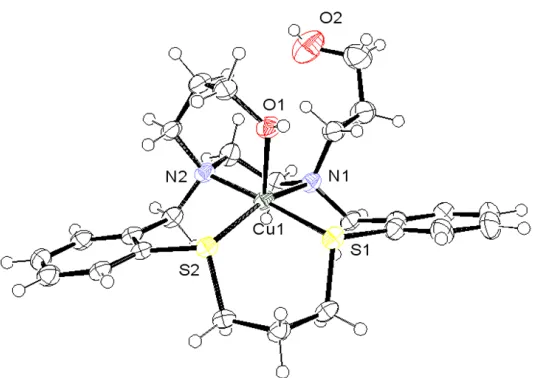
Although all four complexes were isolated and characterised, only [Cu(II)SprNen
(-(CH2)3OH)2]2+ provided X-ray quality crystals. In contrast to the structures reported
previously, this complex was found to adopt a five coordinate square based pyramidal
structure (Figure 2). Although both alcohol groups are found above the plane of the
ligand and are protonated, only one of the hydroxyl groups coordinates. The structures of
the corresponding ethanol, acetate thioether adducts remain unclear at this time but we
would predict that they are also five coordinate in the solid state (Funkemeier & Mattes
1993; Bentfeld et al. 1995; Mattes et al. 2004).
-Figure 2 in here-
The fifth donor atom was introduced into the ligand to increases the stability of
the complexes. Typically the stability of a complex is framed using its formation
constants, which are then used to hypothesise about the potential biochemistry. We
have developed a more direct method of analysis whereby the copper complex is
titrated with BSA (Sowden et al 2013). Using this approach, we circumvented the
protein can sequester the metal (copper). Using this approach we can show that copper
in the five coordinate species are stable to metal sequestration by BSA.† Although the
introduction of a fifth donor into the motif has generated a suite of complexes that are
suitably bio-tolerant, the increase in stability requires that a fifth water exchange site
(c.f. Cu(BF4)2) is occupied and consequently the relaxivity of the complexes falls
(Table 2).
The ability of the compounds to act as redox sensing contrast agents requires
that they have redox reversibility between the copper(II) and copper(I) forms. The
issue of redox reversibility has been interrogated in two ways: electrochemically and
chemically. Electrochemical analysis of the compounds (Table 1) shows that the
addition of the pendant arms has raised the E0 of the complexes significantly.
Surprisingly, the addition of electron withdrawing groups (i.e. [Cu(II)SprNphenR]2+) and
soft donor moieties ([Cu(II)SprNen((-CH2)2SPh)2]2+) into the motif has little impact on
redox potential of the copper centre and the values obtained for these species (1.2-1.5
V) consistently come to the higher end of the desired range (table 2). The
voltammograms of compounds indicate that the addition of pendant arm donor
moieties renders the complexes irreversible except in one case i.e.
([Cu(II)SprNen((-CH2)2SPh)2]2+). This compound shows good reversibility at a range of scan rates
(Figure 3.). This indicates that an increase in the sulphur density around the copper
centre is having a beneficial effect and that the additional soft donors is able to support
the formation of the copper(I) species during redox cycling better.
- Figure 3 in here-
In our previous studies we investigated the redox chemistry of our compounds
by subjecting them to chemical redox cycling using ascorbic acid reduction followed
by hypochlorite oxidation (Taylor et al. 2008; Trotter et al. 2009; Trotter et al. 2010;
Sowden et al 2013). Repeating this approach here, we found behaviour which
paralleled the electrochemical study above. While all the compounds could be
stoichiometrically reduced, only [Cu(II)SprNen((CH2)2SPh)2]2+ could be efficiently
re-oxidised (~85%) back to the divalent state (Fig 4.). The ability to re-oxidise
[Cu(II)SprNen((CH2)2SPh)2]2+ is a significant improvement over the previous
compounds studied (table 1) (Taylor et al. 2008; Trotter et al. 2009; Trotter et al. 2010;
Sowden et al 2013). However, whereas reduction remains stoichiometric, re-oxidation
still required an excess of oxidant to effect the redox switch.
Conclusions
Here we present the first major effort to explore copper’s ability to be used as a
redox-sensitive MRI moiety. As predicted by Lauffer (1987), the relaxivity of these
copper based species is poor compared with gadolinium and considerable further
development is needed before copper will be able to perform independently as a redox
sensitive contrast agent. The study does indicate that it should be possible to generate a
compound which is stable in both the +1 and +2 oxidation states under biological
conditions with an appropriate oxidation potential. However, it is clear that for these
compounds to have any use in MRI they will have to be coupled with a higher
relaxivity metal such as gadolinium. Finally, it would be better if the sensing agent
was administered in its low valent form and the challenge now is to produce copper(I)
complexes of this type that respond to oxidants rather than copper(II) complexes which
Acknowledgements
L.D., K.D.T., M.K.T. and D.S. would like to thank Strathclyde University and
WestChem for financial assistance. J.R., C.M.S. and R.J.S. gratefully acknowledge the
support of the BBSRC (BBS/B/01553).
Electronic Supplementary Information (ESI) available:
Details of the X-ray crystal structure determination of [Cu(II)S
prNen(-(CH2)3OH)2] 2BF4 may be obtained from the CCDC; e-mail [email protected]
or www:http://ccdc. cam.ac.uk) on request quoting the depository numbers ccdc
953160. †The supporting information contains details on the competitive binding
studies of the macrocycles with BSA.
Notes and references
It should be noted that Kupka et al. (1992) made a brief comment on the
potential use of copper(II) D-penicillamine as a contrast agent in plants. To our
knowledge this work did not develop further.
References
Aime S, Castelli DD, Crich SG, Gianolio GE, Terreno E Pushing the Sensitivity Envelope of
Lanthanide-Based Magnetic Resonance Imaging (MRI) Contrast Agents for Molecular
Angelovski G, Fouskova P, Mamedov I, Canals S, Toth E, Logothetis NK Smart magnetic
resonance imaging agents that sense extracellular calcium fluctuations (2008) ChemBioChem,
9: 1729-1734.
Badero OJ, Schlanger L, Rizk D, Gadolinium nephrotoxicity: case report of a rare entity and
review of the literature (2008) Clin Nephr 70: 518-522.
Bentfeld R, Ehlers N, Mattes R, Synthesis and characterization of copper(II) complexes of a
14-membered cis-N2S2 dibenzo macrocycle and of its bis-acetato and bis(methylpyridyl)
derivatives (1995) Chem Ber 128: 1199-1205
De Leon-Rodriguez LM, Lubag AJM, Malloy CR, Martinez GV, Gillies RJ, Sherry AD
Responsive MRI Agents for Sensing Metabolism in Vivo (2009) Acc Chem Res 42: 948-957.
Di Marco M, Sadun C, Port M, Guilbert I, Couvreur P, Dubernet C Physicochemical
characterization of ultrasmall superparamagnetic iron oxide particles (USPIO) for biomedical
application as MRI contrast agents (2007) Int J Nanomed 2; 609-622.
Dorazio S, Morrow JR, The Development of Iron(II) Complexes as ParaCEST MRI Contrast
Agents (2012) Eur J Inorg Chem 2006-2014. Drahos B, Lukes I, Toth E, Manganese(II)
Complexes as Potential Contrast Agents for MRI (2012) Eur J Inorg Chem 1975-1986.
Farrugia LJ, WinGX suite for small-molecule single-crystal crystallography (1999) J. Appl.
Filippin LI, Vercelino V, Marroni NP, Xavier RM, Redox signalling and the
inflammatory response in rheumatoid arthritis (2008) Clin Exper Immunol 152: 415-422.
Funkemeier D, Mattes R, Synthesis and structural studies of copper(II), nickel(II) and
cobalt(II) complexes of a 14-membered trans-N2S2 dibenzo macrocycle with 2 pendant
pyridylmethyl groups (1993) J Chem Soc Dalton Trans 1313-1319.
Gale EM, Mukherjee S, Liu C, Loving GS, Caravan P, Structure–Redox–Relaxivity
Relationships for Redox Responsive Manganese-Based Magnetic Resonance Imaging Probes
(2014) Inorg Chem 53: 10748-10761.
Grant D, Refsum H, Rummeny E, Marchal G, Liver imaging: Clinical applications and future
perspectives (1997) Acta Radiol 38: 623-630.
Hancu I, Dixon WT, Woods M, Vinogradov E, Sherry AD, Lenkinski RE, CEST and
PARACEST MR contrast agents (2010) Acta Radiol 51: 910-923.
Iwaki S, Hanaoka K, Piao W, Komatsu T, Ueno T, Terai T, Nagano T, Development of
hypoxia-sensitive Gd3+-based MRI contrast agents (2012) Bioorg Med Chem Lett 22:
2798-2892
Kueny-Stotz M, Garofalo A, Felder-Flesch D Manganese-Enhanced MRI Contrast Agents:
Kupka T, Dziegielewski JO, Pasterna G, Malecki JG, Copper-D-penicillamine complex as
potential contrast agent for MRI (1992) Mag Reson Imag 10: 855-858
Lauffer RB, Paramagnetic metal complexes as water proton relaxation agents for NMR
imaging: theory and design (1987) Chem Rev 87: 901-927
Ledneva E, Karie S, Launay-Vacher V, Janus N, Deray G Renal Safety of Gadolinium-based
Contrast Media in Patients with Chronic Renal Insufficiency (2009) Radiology 250; 618-628.
Longmire M, Choyke PL, Kobayashi H, Clearance properties of nano-sized particles and
molecules as imaging agents: considerations and caveats (2008) Nanomed 3; 703-717;
Loving GS, Mukherjee S, Caravan P, Redox-Activated Manganese-Based MR Contrast Agent
(2013) J Amer Chem Soc 135: 4620-4623.
Mattes R, Muhlenbrock C, Leeners K, Pyttel C, Metal complexes with N2O2S2 donor set.
Synthesis and characterization of the cobalt(II), nickel(II), and copper(II) complexes of a
15-and a 16-membered bis(2-hydroxyethyl) pendant macrocyclic lig15-and. (2004) Z Anorg Allg
Chem 630: 722-729.
Min C, Shao H, Liong M, Yoon T-J, Weissleder R, Lee H Mechanism of Magnetic
Relaxation Switching Sensing (2012) ACS Nano 6; 6821-6828.
Persson I, Hydrated metal ions in aqueous solution: How regular are their structures? (2010)
Profumo E, Buttari B, Rigano R Oxidative stress in cardiovascular inflammation: its
involvement in autoimmune responses (2011) Int J Inflamm Article ID 295705.
Sheldrick GM, SHELXL-97. Programs for crystal structure analysis (release 97-2), Institut
für Anorganische Chemie der Universität Göttingen, Tammanstrasse 4, D-3400 Gottingen,
Germany (1998).
Sherry AD, Wu YK, The importance of water exchange rates in the design of responsive
agents for MRI (2013) Curr Opin Chem Biol. 17: 167-174.
Sowden RJ, Trotter KD, Dunbar L, Craig G, Erdemli O, Spickett CM, Reglinski J, Reactions
of Copper Macrocycles with Antioxidants and HOCl: Potential for Biological Redox Sensing
(2013) Biometals 26: 85-95.
Taylor MK, Trotter KD, Reglinski J, Berlouis LEA, Kennedy AR, Spickett CM, Sowden RJ,
Copper N2S2 Schiff base macrocycles: The effect of structure on redox potential (2008)
Inorg Chim Acta 361: 2851-2862.
Thunus L, Lejeune R, Overview of transition metal and lanthanide complexes as diagnostic
tools (1999) Coord Chem Revs 184: 125- 155.
Trotter KD, Reglinski J, Robertson K, Forgie JC, Parkinson JA, Kennedy AR, Armstrong DR,
Sowden RJ, Spickett CM, Structural Studies of trans-N2S2 Copper Macrocycles (2009) Inorg
Chim Acta 362: 4065-4072.
Trotter KD, Taylor MK, Forgie JC, Reglinski J, Berlouis LEA, Kennedy AR, Spickett CM,
Sowden RJ, The structural and electrochemical consequences of hydrogenating Copper N2S2
Schiff base macrocycles (2010) Inorg Chim Acta 363: 1529-1538.
Tsitovich PB, Burns PJ, Mckay AM, Morrow JR, Redox-activated MRI contrast agents based
on lanthanide and transition metal ions (2014) J Inorg Biochem 133: 143-154.
Viger ML, Sankaranarayanan J, de Gracia Lux C, Chan M, Almutairi A Collective Activation
of MRI Agents via Encapsulation and Disease-Triggered Release (2013) J Amer Chem Soc
135: 7847-7850.
Vologdin N, Rolla GA, Botta M, Tei L, Orthogonal synthesis of a heterodimeric ligand for
the development of the Gd-III-Ga-III ditopic complex as a potential pH-sensitive MRI/PET
probe (2013) Org Biomol Chem 11: 1683-1690;
Weast RC in Handbook of Chemistry & Physics, 60th Edition, CRC Press 1980
Yam VWW, Lo KKW, Recent advances in utilization of transition metal complexes and
Yu M, Beyers RJ, Gorden JD, Cross NJ, Goldsmith CR, A Magnetic Resonance Imaging
Contrast Agent Capable of Detecting Hydrogen Peroxide (2012) Inorg Chem 51: 9153-9155.
Table Captions
Table 1. The properties of gadolinium and certain first row transition metal species key to
their ability to perform as contrast agents (Tobe 1972, Handbook of Chemistry 1980). Unlike
the lanthanoids, the exchange kinetics and number of unpaired electrons vary more widely
and are governed by the prevailing oxidation state and ligand field considerations. Oh denotes
an octahedral geometry
Table 2. Relaxivity and electrochemical data: The relaxivity of GdDTPA, Cu(BF4)2,
[Cu(II)SenNen]2+; [Cu(II)SprNen]2+; [Cu(II)SenNpr]2+;[Cu(II)SprNpr]2+; [Cu(II)SprNen(X)2]2+,
where X = -(CH2)2OH, -(CH2)3OH, -CH2COOH, -(CH2)2SPh and [Cu(II)SprNphenR]2+ (n =
3) in 0.1 M NaCl in 2H2O at 9.4T. . Electrochemical data for the copper macrocycles in
acetonitrile (0.1M tBu4NBF4: The values for the complexes are expressed relative to the
normal hydrogen electrode (HNE) (Taylor et al. 2008)
Figure Captions
Figure 1 The copper macrocyclic frameworks studied (Taylor et al. 2008; Trotter et al. 2009;
Trotter et al. 2010; Sowden et al. 2013). (a) Secondary amine complexes, where the
polymethylene chains between the nitrogen and sulfur donor atoms are ethylene (en) or
propylene (pr) giving rise to four compounds: [Cu(II)SenNen]2+, [Cu(II)SenNpr]2+,
[Cu(II)SprNen]2+ and [Cu(II)SprNpr]2+. (b) Tertiary amine complexes [Cu(II)SprNen(X)2]2+,
where X = -(CH2)2OH, -(CH2)3OH, -CH2COOH or –(CH2)2SPh. (c) [Cu(II)SprNphenR]2+
Figure 2. The X-ray crystal structure of [Cu(II)SprNen(-(CH2)3OH)2]2+. The counter ions
(BF4-) are omitted for clarity. The copper sits in a distorted square based pyramidal
geometry. The hydrogens on the oxygens were found during refinement. The thermal
ellipsoids are shown at 50% probability. Selected metrical parameters (d/Å, o) Cu-S
2.3450(7), 2.3487(7); Cu-N 2.045(2), 2.052(2); Cu-O 2.1725(18); <S-Cu-N (o), 163.00(6),
93.48(6), 176.82(6), 93.49(6).
Figure 3. The cyclic voltammogramm of [Cu(II)SprNen((CH2)2SPh)2]2BF4 (2 mM) in
acetonitrile/tBuNBF4 (0.1M) at scan rates of 10, 40, 80, 120, 160 and 200 mVs-1. The E0
values (table 2) were referenced to the normal hydrogen electrode using a ferrocene standard.
Figure 4. The chemical reduction of [Cu(II)SprNen((CH2)2SPh)2]2+ by ascorbic acid (left)
followed by the chemical re-oxidation using hypochlorite (right). The figure is a composite
Table 1
Table 1. The properties of gadolinium and certain first row transition metal species key to their ability to perform as contrast agents (Tobe 1972, Handbook of Chemistry 1980). Unlike the lanthanoids, the exchange kinetics and number of unpaired
electrons vary more widely and are governed by the prevailing oxidation state and ligand field considerations. Oh denotes an octahedral geometry
No. unpaired electrons and relevant oxidation state
Nuclear spin (abundance %)
Exchange rate (s-1)
Gd 7 3/2 155Gd (14.7)
3/2 157Gd (15.7)
109
V 2 (III) 7/2 51V (99.8) 103 Cr 4 (II)
3 (III)
3/2 53Cr (9.6) 109 5 x 10⁻⁵ Mn 7 (II) 5/2 55Mn (100) 5 x 10⁷
Co 3 (II) high spin Oh 0 (III) low spin Oh
7/2 59Co (100) 5 x 10⁶ 5 x 10⁻⁵ Cu 1 (II)
0 (I)
3/2 63Cu (69.1)
3/2 65Cu (30.9)
Table 2
Relaxivity and electrochemical data: The relaxivity of GdDTPA, Cu(BF4)2, [Cu(II)SenNen]2+; [Cu(II)SprNen]2+; [Cu(II)SenNpr]2+;[Cu(II)SprNpr]2+;
[Cu(II)SprNen(X)2]2+, where X = -(CH2)2OH, -(CH2)3OH, -CH2COOH, -(CH2)2SPh and [Cu(II)SprNphenR]2+ (n = 3) in 0.1 M NaCl in 2H2O at 9.4T. . Electrochemical data for the copper macrocycles in acetonitrile (0.1M tBu4NBF4: The values for the complexes are expressed relative to the normal hydrogen electrode (HNE). * (Taylor 2008)
Compound Relaxivity s-1mM-1 E0 V Reference
compounds
Gd(DTPA) 4.73
CuII(BF4)2 0.67 Simple macrocycles
(Fig 1a)
[Cu(II)SenNpr]2+, 0.27 + 0.03 0.65*c [Cu(II)SprNen]2+ 0.27 + 0.01 0.85 (57%) [Cu(II)SprNpr]2+ 0.26 + 0.03 0.85*c Pendant arm
macrocycles [Cu(II)SprNen(X)2]2+
(Fig 1b)
X= -(CH2)2OH 0.42 + 0.02 1.04 (22%) X= -(CH2)3OH 0.16 + 0.02 1.23 (21% X= -CH2COOH 0.11 + 0.01 1.44 (24%) X= -(CH2)2SPh 0.12 + 0.02 1.28 (79%) Macrocycle-EWG
(Fig 1c)
Figure 1. The copper macrocyclic frameworks studied (Taylor et al. 2008; Trotter et al. 2009; Trotter et al. 2010; Sowden et al. 2013). (a) Secondary amine complexes, where the polymethylene chains between the nitrogen and sulfur donor atoms are ethylene (en) or propylene (pr) giving rise to four compounds: [Cu(II)SenNen]2+, [Cu(II)SenNpr]2+, [Cu(II)SprNen]2+ and [Cu(II)SprNpr]2+. (b) Tertiary amine complexes [Cu(II)SprNen(X)2]2+, where X = -(CH2)2OH, -(CH2)3OH, -CH2COOH or –(CH2)2SPh. (c) [Cu(II)SprNphenR]2+ where additional electron withdrawing groups (aryl, -NO2) are included in the motif.
[image:25.540.128.397.416.605.2]Figure 4. The chemical reduction of [Cu(II)SprNen((CH2)2SPh)2]2+ by ascorbic acid (left) followed by the chemical re-oxidation using hypochlorite (right). The figure is a composite of the data from two separate titrations.
Copper complexes as a source of redox active MRI contrast agents.
Lynsey Dunbar, Rebecca J. Sowden, Katherine D. Trotter, Michelle K.
Taylor, David Smith, Alan R. Kennedy, John Reglinski and Corinne M.
Spickett
Supporting Information
Competitive binding studies: Rather than measure the formation constants to arrive at
a value which has limited biological impact, we elected to challenge our copper complexes directly with bovine serum albumin (BSA). This simple experiment is designed to probe stability of our copper complexes directly in competition with BSA, which is a major metal scavenger present in the blood stream. This simple, direct experiment more closely models the sequestration of metals in-vivo.
Reaction of the copper(II) complexes with bovine serum albumin (BSA): 0.3 mM
solutions of each of the copper macrocycles and BSA (199 mg, 1 mL) were prepared in Tris-HCl buffer (5 mM, pH 7.4). A 1.0 mL volume of the solution of each of the required copper complexes was placed in a 1.5 mL quartz cuvette (1.0 cm path length) and the spectrum was recorded between 200 and 800 nm against a Tris-buffer reference placed in a matched cuvette. BSA solution was titrated in aliquots of 20 μL into the cuvette.
0 10 20 30 40 50 60 70 80 90 100
0 20 40 60 80 100 120 140 160 180
Concentration (uL) P er cen tag e ( % ) 0 0.2 0.4 0.6 0.8 1 1.2 1.4
[image:27.595.79.542.476.616.2]350 400 450 500 550 600 650 700 750 800
Figure ESI1: Left: The spectrophotometric titrations (412 nm) of cis-[Cu(II)SprNen]2+ (adapted from Sowden et al.) and cis-[Cu(II)SprNen(-(CH2)3OH)2]2+. Right: The
spectrophotometric titrations (350-800) of cis-[Cu(II)SprNen(-(CH2)3OH)2]2+: (0.3 mM in 5 mM Tris buffer at pH 7.4) with BSA solution (199 mg, 1 mL). A small diminution in the spectrum of cis-[Cu(II)SprNen(-(CH2)3OH)2]2+ of the absorbance occurs owing to dilution of the sample as the titrant is added. The integrity of the complex (cis-[Cu(II)SprNen
![Figure 4. The chemical reduction of [Cu(II)SprNen((CH2)2SPh)2]2+ by ascorbic acid (left) followed by the chemical re-oxidation using hypochlorite (right)](https://thumb-us.123doks.com/thumbv2/123dok_us/1585748.111229/26.540.96.457.73.299/figure-chemical-reduction-ascorbic-followed-chemical-oxidation-hypochlorite.webp)
![Figure ESI1: Left: The spectrophotometric titrations (412 nm) of cis-[Cu(II)Sprspectrophotometric titrations (350-800) of cis-[Cu(II)SNen]2+ (adapted from Sowden et al.) and cis-[Cu(II)SprNen(-(CH2)3OH)2]2+](https://thumb-us.123doks.com/thumbv2/123dok_us/1585748.111229/27.595.79.542.476.616/figure-spectrophotometric-titrations-sprspectrophotometric-titrations-adapted-sowden-sprnen.webp)