RECEIVED28 February 2015 REVISED7 May 2015 ACCEPTED5 June 2015
Delivering Digital Health and Well-Being
at Scale: Lessons Learned during the
Implementation of the
dallas
Program
in the United Kingdom
Alison M Devlin1,Marilyn McGee-Lennon2,Catherine A O’Donnell1,Matt-Mouley Bouamrane2,Ruth Agbakoba1,
Siobhan O’Connor1,3,Eleanor Grieve1,Tracy Finch4,Sally Wyke1,Nicholas Watson1,Susan Browne1,Frances S Mair1and
the “dallas” evaluation team
ABSTRACT
...
ObjectiveTo identify implementation lessons from the United Kingdom Delivering Assisted Living Lifestyles at Scale (dallas) pro-gram—a large-scale, national technology program that aims to deliver a broad range of digital services and products to the public to promote health and well-being.Materials and Methods Prospective, longitudinal qualitative research study investigating implementation processes. Qualitative
data collected includes semi-structured e-Health Implementation Toolkit–led interviews at baseline/mid-point (n¼38), quarterly
evaluation, quarterly technical and barrier and solutions reports, observational logs, quarterly evaluation alignment interviews with
project leads, observational data collected during meetings, and ethnographic data from dallas events (n>200 distinct pieces of
qualitative data). Data analysis was guided by Normalization Process Theory, a sociological theory that aids conceptualization of im-plementation issues in complex healthcare settings.
ResultsFive key challenges were identified: 1) The challenge of establishing and maintaining large heterogeneous, multi-agency partnerships to deliver new models of healthcare; 2) The need for resilience in the face of barriers and set-backs including the backdrop of continually changing external environments; 3) The inherent tension between embracing innovative co-design and
achieving deliveryat pace and at scale; 4) The effects of branding and marketing issues in consumer healthcare settings; and 5)
The challenge of interoperability and information governance, when commercial proprietary models are dominant.
ConclusionsThe magnitude and ambition of the dallas program provides a unique opportunity to investigate the macro level
imple-mentation challenges faced when designing and delivering digital health and wellness servicesat scale.Flexibility, adaptability, and
resilience are key implementation facilitators when shifting to new digitally enabled models of care.
...
Keywords: consumer health informatics, eHealth implementation, assistive living technologies, electronic health records, mHealth
BACKGROUND
Healthcare systems globally recognize the need to adapt in order to accommodate unprecedented changes in population demographics
and related increases in incidence of chronic disease.1–3Interactive,
person-centered digital tools and services offer a vehicle to promote a more citizen-led, self-care and preventative health and well-being
agenda.4–6
Previous studies in the evolving interdisciplinary field of health in-formatics have highlighted the complex nature of implementing digital
health and well-being tools in practice.7 This is due in part to the
breadth and complexity of the systems, processes,and stakeholders
involved in implementing e-health interventions.8 A recent study by
Cresswell et al.9highlighted 10key considerations for implementing e-health interventions at scale, including: clarification of the problem
being addressed, building consensus, planning, addressing
infrastructure, and evaluation. However, to date, most of the evalua-tion literature focuses on single digital tools or systems at a time, such
as the implementation of electronic health records,10–13computerized
decision support systems,14 or the implementation of telemedicine
services.7,15In contrast, the Delivering Assisted Living Lifestyles at Scale (dallas) program aims to deploy a broad portfolio of digital tools and services and represents the next stage toward deployment of such technologies for health and well-being at scale in the United Kingdom.
The dallas program is a pan-UK program that was funded by
Innovate UK (formerly the Technology Strategy Board) (https://www.
gov.uk/government/organisations/innovate-uk), the National Institute for Health Research, The Scottish Government, Scottish Enterprise, and Highlands and Islands Enterprise. The total investment of £37 mil-lion (over the period 2012–2015) reflects the current emphasis being
Correspondence to Professor Frances S. Mair, General Practice & Primary Care, Institute of Health and Wellbeing, University of Glasgow, United Kingdom;
[email protected]; Tel:þ44 (0)141 330 8317.
VC The Author 2015. Published by Oxford University Press on behalf of the American Medical Informatics Association.
This is an Open Access article distributed under the terms of the Creative Commons Attribution Non-Commercial License (http://creativecommons.org/licenses/by-nc/ 4.0/), which permits non-commercial re-use, distribution, and reproduction in any medium, provided the original work is properly cited. For commercial re-use, please contact [email protected]
For numbered affiliations see end of article.
RESEARCH
AND
placed on developing digitally enabled healthcare and wellness globally. The funding was delivered via Small Business Research Initiative to 4 lead contractors and the projects developed in conjunction with a highly innovative group of sub-contracted organizations, mostly private sector business and small companies (referred to as SMEs). The dallas pro-gram is highly ambitious and aims to deliver health and well-being ser-vices (to 169 000 individuals) using a wide range of technologies including interactive, person-centered digital portals; telecare;
elec-tronic personal health records; and Mobile applications (Apps)at scale
and across remote, rural, and urban areas of the United Kingdom. It
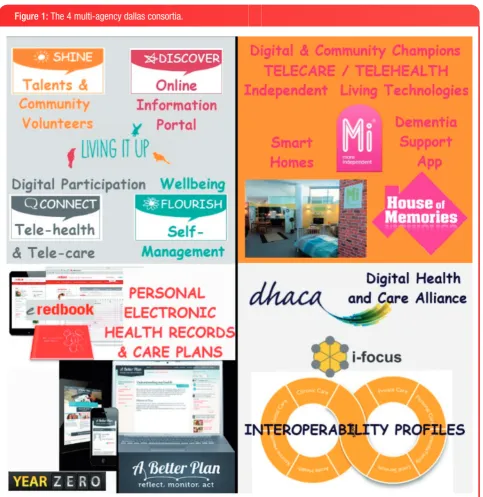
consists of 4 multi-agency consortia or “communities”: More
Independent;i-Focus;Living it Up, andYear Zeroworking in new col-laborative partnerships and distributed across the United Kingdom
(Figure 1). Each community involves health and care services, industry (including small-, medium-, and large-size companies), nongovernmen-tal, third-sector and voluntary organizations, as well as academia and government bodies (see table in online Appendix). As such, dallas aims to harness new knowledge across traditional boundaries and disparate systems to introduce interoperable, person-centered digital tools and enable more adaptive systems to provide a new “space” for interactive, person-centered, digital health and wellbeing products and services.
OBJECTIVE
[image:2.595.58.542.221.719.2]The objective of the present study was to report on the qualitative evaluation conducted, which aimed to identify the barriers and facilitators in the dallas implementation journey and to share
Figure 1:The 4 multi-agency dallas consortia.
RESEARCH
AND
implementation lessons learned within and across the unique dallas program.
MATERIALS AND METHODS
We have a multi-disciplinary team with expertise in General Practice and Primary Care, Computing Science & Human Computer Interaction (HCI), Health Informatics, Nursing, Health Economics, Statistics, and Social Sciences. The team is working closely with the dallas commu-nities to conduct an independent evaluation.
Data Collection
Our evaluation adopts a socio-technical approach,16–19using a mixed
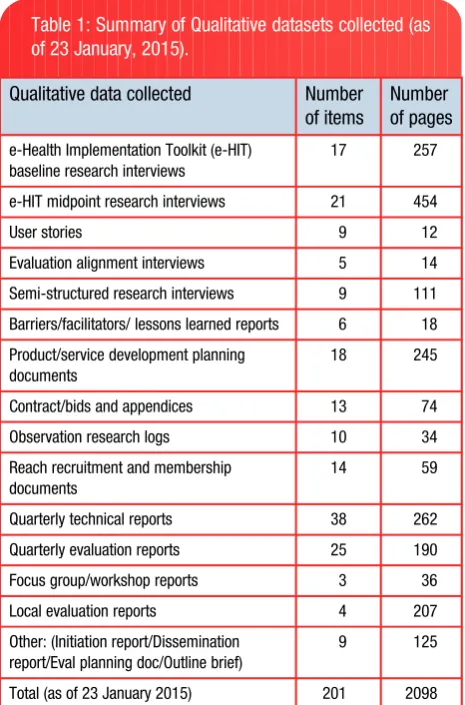
methods evaluation framework consistent with evaluations of complex interventions.20Qualitative data has been collected longitudinally from the four communities.Table 1outlines the breadth and extent of the data collected.
The present study draws on the evaluation alignment interviews, the barriers and facilitators reports, and the in-depth e-Health Implementation Toolkit (e-HIT) led semi-structured research interviews
held at baseline (n¼17) and approximately 12–14 months later
(mid-point;n¼21) of the implementation process. The e-HIT is a tool to aid
consideration of implementation issues in e-health, underpinned by
Normalization Process Theory (NPT).21,22Stakeholders sampled
repsent a cross-section of those involved in the dallas digital service re-design and delivery and include professionals from public sector health (NHS) and social care,business and industry leads, technical
ICT personnel, voluntary and third-sector organizations, academia, and other government bodies.
Research Governance and Ethics
University of Glasgow ethical approval was granted for this study. All respondents provided consent for participation. Identities are protected and are assigned a confidential generic descriptor to ensure anonymity.
Theoretical Framing of Qualitative Data Analysis
In order to conduct a meaningful evaluation of the complex socio-tech-nical processes involved in the implementation of digital tools and ser-vices within dallas, we have drawn on NPT, which has been used in
e-health implementation projects.16,21,23,24The judicious choice of a
robust underpinning theoretical framework is known to aid with con-ceptualizationof analysis in complex adaptive systems such as
health-care settings.25NPT has 4constituent constructs (Figure 2).
Qualitative Data Analysis Procedure
All baseline and midpoint research interviews were transcribed verba-tim and transcripts checked for accuracy. Transcripts were coded and
analyzed in an inductive manner.26 Codes and themes were then
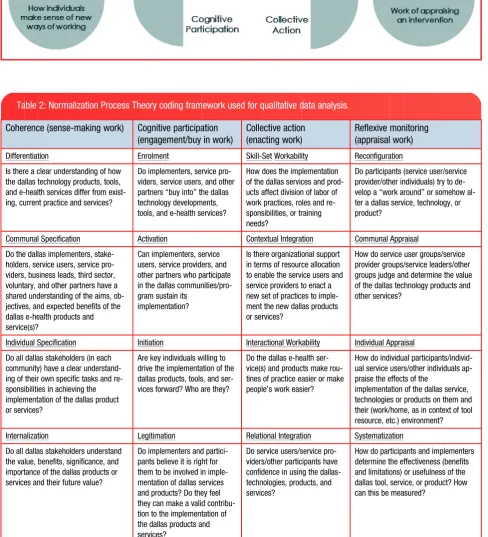
mapped to NPT, as a conceptual framework and system of organizing
the data (Table 2).
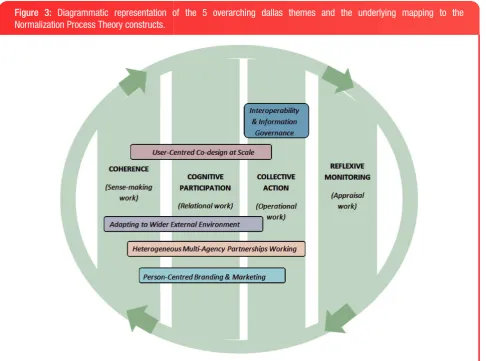
Data coding clinics were conducted at regular intervals among the team using samples of coded transcripts at baseline and mid-point to ensure accuracy and consistency of coding. We then mapped the results from each community in order to capture 5 of the significant challenges and navigation processes implemented across dallas as follows: 1. Challenges related to working as part of a large multi-agency,
heterogeneous consortium.
2. Challenges related to the wider socio-political and economic environment.
3. Challenge of co-design at scale. 4. Challenge of branding and marketing.
5. Challenges related to interoperability and information governance (IG).
Emergent findings were shared with key leads and related stake-holders who concurred with the findings. The mapping of the 5 main challenges and navigation processes to the fine-grained NPT codes is
presented inFigure 3. Results are presented and organizedaccording
to overarching themes as identified within dallas, and data presented drawing from the cross-section of stakeholders involved in order to provide depth and breadth to the findings.
RESULTS
Here we provide details of 5 key implementation themes identified from the early phases of the dallas program.
1. Challenges and Learning to Work within New, Multi-agency, Heterogeneous Partnership Models
[image:3.595.57.290.377.730.2]One of the strategic aims of the dallas program was to support new partnerships to foster innovation, drawing on a diverse range of orga-nizations including the NHS, local authorities, SMEs, voluntary and community organizations, as well as academia. However, challenges emerged related to forming and sustaining such heterogeneous part-nerships with little shared history of working together. Reservations were expressed across sector boundaries, with perceptions of inertia
Table 1: Summary of Qualitative datasets collected (as of 23 January, 2015).
Qualitative data collected Number
of items
Number of pages
e-Health Implementation Toolkit (e-HIT) baseline research interviews
17 257
e-HIT midpoint research interviews 21 454
User stories 9 12
Evaluation alignment interviews 5 14
Semi-structured research interviews 9 111
Barriers/facilitators/ lessons learned reports 6 18
Product/service development planning documents
18 245
Contract/bids and appendices 13 74
Observation research logs 10 34
Reach recruitment and membership documents
14 59
Quarterly technical reports 38 262
Quarterly evaluation reports 25 190
Focus group/workshop reports 3 36
Local evaluation reports 4 207
Other: (Initiation report/Dissemination report/Eval planning doc/Outline brief)
9 125
Total (as of 23 January 2015) 201 2098
RESEARCH
AND
Figure 2:Representation of the 4 constituent NPT constructs which attend to the 4 key aspects in e-health implementation. (From May and Finch, 2009).16
Table 2: Normalization Process Theory coding framework used for qualitative data analysis.
Coherence (sense-making work) Cognitive participation
(engagement/buy in work)
Collective action (enacting work)
Reflexive monitoring (appraisal work)
Differentiation Enrolment Skill-Set Workability Reconfiguration
Is there a clear understanding of how the dallas technology products, tools, and e-health services differ from exist-ing, current practice and services?
Do implementers, service pro-viders, service users, and other partners “buy into” the dallas technology developments, tools, and e-health services?
How does the implementation of the dallas services and prod-ucts affect division of labor of work practices, roles and re-sponsibilities, or training needs?
Do participants (service user/service provider/other individuals) try to de-velop a “work around” or somehow al-ter a dallas service, technology, or product?
Communal Specification Activation Contextual Integration Communal Appraisal
Do the dallas implementers, stake-holders, service users, service pro-viders, business leads, third sector, voluntary, and other partners have a shared understanding of the aims, ob-jectives, and expected benefits of the dallas e-health products and service(s)?
Can implementers, service users, service providers, and other partners who participate in the dallas communities/pro-gram sustain its
implementation?
Is there organizational support in terms of resource allocation to enable the service users and service providers to enact a new set of practices to imple-ment the new dallas products or services?
How do service user groups/service provider groups/service leaders/other groups judge and determine the value of the dallas technology products and other services?
Individual Specification Initiation Interactional Workability Individual Appraisal
Do all dallas stakeholders (in each community) have a clear understand-ing of their own specific tasks and re-sponsibilities in achieving the implementation of the dallas product or services?
Are key individuals willing to drive the implementation of the dallas products, tools, and ser-vices forward? Who are they?
Do the dallas e-health ser-vice(s) and products make rou-tines of practice easier or make people’s work easier?
How do individual participants/individ-ual service users/other individparticipants/individ-uals ap-praise the effects of the
implementation of the dallas service, technologies or products on them and their (work/home, as in context of tool resource, etc.) environment?
Internalization Legitimation Relational Integration Systematization
Do all dallas stakeholders understand the value, benefits, significance, and importance of the dallas products or services and their future value?
Do implementers and partici-pants believe it is right for them to be involved in imple-mentation of dallas services and products? Do they feel they can make a valid contribu-tion to the implementacontribu-tion of the dallas products and services?
Do service users/service pro-viders/other participants have confidence in using the dallas-technologies, products, and services?
How do participants and implementers determine the effectiveness (benefits and limitations) or usefulness of the dallas tool, service, or product? How can this be measured?
RESEARCH
AND
and resistance to change in the NHS compared to the speed of change
in the business world (Table 3, Q1). There were also cultural
differ-ences between NHS organizationsand the retail or technology/ busi-ness partners. Examples included the way in which each viewed dallas as a scaled-up and live project, adherence to governance, and
focus on developing finished digital products (Table 3, Q2).
Some communities struggled initially to communicate across the diverse array of partners and had to work toward understanding new processes and ways of working. For example, the voluntary sector is comfortable with “grass-roots” community engagement whilst techni-cal/digital technology partners feel more comfortable with progressing
directly to build an actual product (Table 3, Q3). Other partnerships
in-volved different NHS organizations, which varied in terms of their
digi-tal readiness (Table 3, Q4). This lack of strategic knowledge was
communicated by stakeholders as being, at least partially, due to the unusual initial contractual procedures with tension related to the speed with which the lead and sub-contractors had to sign off the contract (Table 3, Q5). Stakeholders reported it took some time for the con-tracts to be fully understood and embedded and understanding of roles and commitments to crystallize(Table 3, Q5, Q6). This experi-ence led some stakeholders to reflect on what would help across multi-agency partnerships if this type of contracting arrangement was implemented in the future including, e.g., a much clearer articulation
of roles at the beginning (Table 3, Q7).
Each community overcame barriers differently, but the issue of
“choosing the right partner” arose across all communities (Table 3,
Q8). Suitable partners should be able to implement action at the level of the operations within their own respective organizationsas well as balance the “visionaries” with the “pragmatists” to prevent aspirations
outrunning ability and capacity of the consortium as a whole (Table 3,
Q8, Q9).
In spite of initial challenges, the multi-agency partnerships made significant progress and can now share their learning on what helps to facilitate new collaborative partnerships across traditional silos be-tween different communities of practice. Most of the facilitators are typical of good project management and include keeping in constant dialogue across the partnerships, clear communication, negotiation, and active problem-solving skills. The importance of team work and understanding exactly what roles entail at an individual and collective level are of key importance as are astute, strategic leadership, and strong project management skills in ensuring that a shared vision or coherence emerges and stakeholders “buy into” the direction of travel (Table 3, Q10, Q11).
2. Need for Resilience in the Face of Challenging Socio-political and Economic Factors in the External Environment
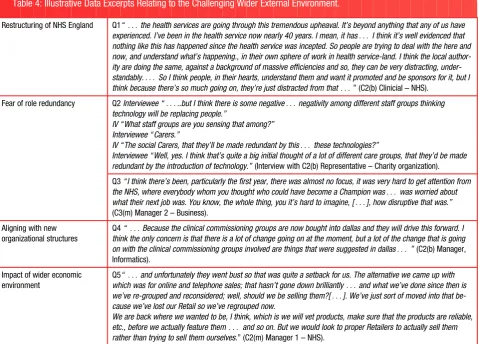
[image:5.595.58.545.67.428.2]Digital and technology based health interventions are not implemented in a vacuum, but are intrinsically related to the complex socio-techni-cal features within organizations, as well as the wider politisocio-techni-cal and economic factors in the external environment. Some dallas consortia had to work on digital innovation against the backdrop of NHS England
Figure 3: Diagrammatic representation of the 5 overarching dallas themes and the underlying mapping to the Normalization Process Theory constructs.
RESEARCH
AND
undergoing a radical restructuring process. This resulted in uncertainty
and disruption along with a fear of role redundancy (Table 4, Q1, Q2),
which affected engagement and the operationalization of services (mapping onto coherence, cognitive participation, and collective action constructs of NPT). This was particularly challenging for one of the business-led dallas consortia in the initial stages when they were try-ing to engage with several NHS partners, each of which were factry-ing
structural changes within their own localities (Table 4, Q3).
The wider political environment of austerity and economic reces-sion was thought to be an external driver with some suspicion voiced that the real motive for introducing digital tools and services was as a cost-cutting measure as opposed to improving person-centered
healthcare and well-being (Table 4, Q2). However, in at least one of
the consortia, work was invested in ensuring that the dallas program was in alignment with the ongoing strategic planning of the new NHS structures. Indeed there was recognition that many of the dallas aims and objectives were similar to those of the new organizations, with re-gards to technologies as an enabler of more integrated, personalized
health and well-being systems (Table 4, Q4).
In addition to the challenge of navigating the restructuring of NHS England, there were some key retail partners who went out of busi-ness and into receivership against the backdrop of economic austerity. A large commercial partner also withdrew from a consortium, due to wider company-related issues. This was recognized as an inherent risk from the outset, but consortia had worked with such new partners in order to try and build consumer-based business models in the
existing health economy. However, the reality faced by more than one of the multiple partnerships was the collapse of their “route to market” through well branded, trusted commercial partners going bankrupt or withdrawing. As a result, the dallas communities had to recover and actively find new solutions in order to overcome these significant
set-backs and move forward (Table 4, Q5).
3. Inherent Tension between Embracing Co-design and Achieving Delivery at Pace and Scale
One of the major strategic aims of dallas was to innovate through the co-design of more person-centered, interactive digital tools and
ser-vices and to do thisat scale.The emphasis on more personalized tools
and services was viewed as part of the solution to the challenges in
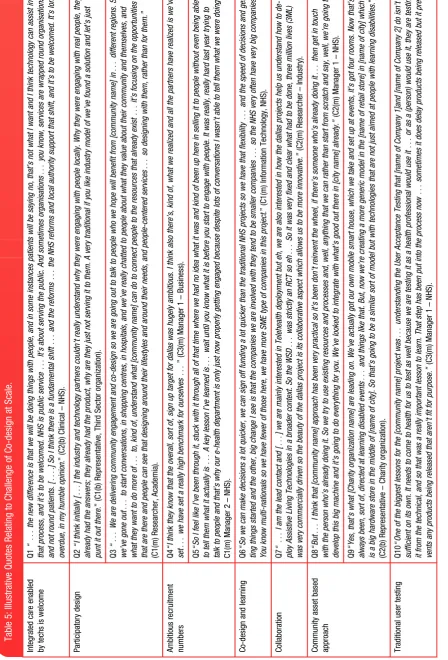
current healthcare and well-being provision (seeTable 5, Q1). The
dal-las communities used a spectrum of “co-design” methodologies rang-ing from 1) “grass-roots” community engagement using creative, participatory co-design methodologies to enable end users to directly
shape services (Table 5, Q3); 2)HCI technical co-design
methodolo-gies that are iterative and contribute to product or tool development via prototyping and refining; and 3) a wider, broad-based, community asset design methodology which involved creative modification of a range of digital tools and services and linking in with pre-existing, large networks.
[image:7.595.60.541.372.716.2]Such collaborative digital design methods were at first foreign to the technology partners who raised concerns about the time commit-ment required. In one community, extensive input from end users via
Table 4: Illustrative Data Excerpts Relating to the Challenging Wider External Environment.
Restructuring of NHS England Q1“. . .the health services are going through this tremendous upheaval. It’s beyond anything that any of us have experienced. I’ve been in the health service now nearly 40 years. I mean, it has. . . I think it’s well evidenced that nothing like this has happened since the health service was incepted. So people are trying to deal with the here and now, and understand what’s happening., in their own sphere of work in health service-land. I think the local author-ity are doing the same, against a background of massive efficiencies and so, they can be very distracting, under-standably.. . . So I think people, in their hearts, understand them and want it promoted and be sponsors for it, but I think because there’s so much going on, they’re just distracted from that. . .” (C2(b) Clinicial – NHS).
Fear of role redundancy Q2Interviewee “. . ...but I think there is some negative. . .negativity among different staff groups thinking technology will be replacing people.”
IV “What staff groups are you sensing that among?” Interviewee “Carers.”
IV “The social Carers, that they’ll be made redundant by this. . .these technologies?”
Interviewee “Well, yes. I think that’s quite a big initial thought of a lot of different care groups, that they’d be made redundant by the introduction of technology.”(Interview with C2(b) Representative – Charity organization).
Q3“I think there’s been, particularly the first year, there was almost no focus, it was very hard to get attention from
the NHS, where everybody whom you thought who could have become a Champion was. . .was worried about
what their next job was. You know, the whole thing, you it’s hard to imagine, [. . .], how disruptive that was.”
(C3(m) Manager 2 – Business).
Aligning with new organizational structures
Q4“. . .Because the clinical commissioning groups are now bought into dallas and they will drive this forward. I think the only concern is that there is a lot of change going on at the moment, but a lot of the change that is going
on with the clinical commissioning groups involved are things that were suggested in dallas. . .”(C2(b) Manager,
Informatics).
Impact of wider economic environment
Q5“. . .and unfortunately they went bust so that was quite a setback for us. The alternative we came up with
which was for online and telephone sales; that hasn’t gone down brilliantly. . .and what we’ve done since then is
we’ve re-grouped and reconsidered; well, should we be selling them?[. . .]. We’ve just sort of moved into that be-cause we’ve lost our Retail so we’ve regrouped now.
We are back where we wanted to be, I think, which is we will vet products, make sure that the products are reliable, etc., before we actually feature them. . . and so on. But we would look to proper Retailers to actually sell them rather than trying to sell them ourselves.” (C2(m) Manager 1 – NHS).
RESEARCH
AND
face-to-face workshops and “pop-up” events was undertaken to shape all aspects of the service, foster ownership, and ensure the development of a digital health and well-being product that was
“fit-for-purpose” (Table 5, Q2). However, the nature of iterative, agile,
co-design caused a challenge because contractual arrangements with the communities required them to recruit large numbers of users simulta-neously, which took time. Target recruitment numbers were perceived as overly ambitious and unrealistic to attain within a fixed 3-year
time-frame (Table 5, Q4). There were also difficulties in engaging end users
with a product undergoing iterative development. This conflicting ten-sion of innovation and recruitment was a concern of all of the commu-nities and seen as a real challenge (Table 5, Q4, Q5).
However, there were advantages and learning associated with working in new partnership models involving smaller business part-ners. These included more flexibility and the opportunity for active col-laboration as compared to working with large multi-national
companies (Table 5, Q6, Q7).
One consortium adopted a community asset based approach to co-design as their means of innovating, through drawing on
pre-existing networks and resources (Table 5, Q8, Q9). This also allowed
the consortium to build on some assisted living technologies which already existed. Some adopted a federated membership model or ap-proach in order to address target recruitment numbers by partnering with pre-existing networks with significant reach in their local community.
Yet another approach to co-design involved more traditional HCI it-erative methods with the overall aim of designing fit-for-purpose digi-tal health tools. This partnership involved workshops with end users and service providers with the learning and feedback obtained from prototypes being fed back into the design of the digital health product. This also provided an important learning opportunity about
person-centered design with the emergent learning beingwritten into form
the basis of new e-health tool and service design processes (Table 5,
Q10).
4. Branding and Marketing Challenges in Consumer Healthcare Settings
One of the strategic aims of dallas was to stimulate consumer and re-tail business models in order to drive innovation and economic growth in the United Kingdom. However, culturally, health is still not usually perceived as a commercial venture in the United Kingdom. All 4 con-sortia have carried out significant work in building person-centered brands and corporate identities, aligned to more personalized brand-ing. However, challenges emerged—for example, one community dis-covered their brand was already in use by a pre-existing organization and they had to undergo a very expensive and time-consuming re-branding exercise.
In other communities, challenges existed since the grass-roots, participatory co-design process was time and labor intensive. A signif-icant investment was made in this iterative co-design methodology which involved the end users in all aspects including choosing the colors and visual representation of the brand, resulting in a tailored,
unique digital product (Table 6(A), Q1).
Another community invested significant time and resource in work-ing toward the launch of a digital consumer version of a traditional health product only to face it not being endorsed by a key regulator (Table 6(A), Q2). Despite these challenges and set-backs the commu-nities “stayed the course,”9and through agility and adaptive learning, have made significant progress toward achieving digital health brand recognition (Table 6(A), Q3, Q4). There is now growing European inter-est and wider recognition of the innovative, digital dallas services and
products which provide exemplars of new models of collaborative, partnership working and perseverance in the face of seemingly intrac-table problems (Table 6A, Q5).
5. Facing the Challenges of Interoperability and Information Governance
The dallas program aims to facilitate person-centered, seamless digi-tal healthcare and well-being; a key feature of this is the role of infor-mation sharing between services and the user and the need to open up proprietary/statutory IT systems in order to become more interoper-able and flexible. One consortium in particular has been working on in-teroperability in order to open up the market and enable more customized technologies to be introduced that are tailored more closely to local needs. The technology companies believe that the cur-rent limited success of digital technologies may be partially related to a lack of customized products that people actually want and which take into account the organizations’ and/ or the end user’s needs,
choices, and requirements (Table 6(B), Q1).
To achieve this, there is a need to design systems and products that are interoperable, which some traditional suppliers see as a threat since increased competition may result in them losing their market
share (Table 6(B), Q2). In order to progress this interoperability agenda
new guidelines and open architectures are being developed (Table 6(B), Q3), as well as the launch of the “Digital Health and Care Alliance” in the United Kingdom. Their aim is to try and reshape the current healthcare landscape to move the field forward from locked down proprietary systems to one of open sharing with digital products working across systems.
The information governance (IG) rules and regulations surrounding patient records, which are required to ensure patient confidentiality and security, also presented challenges. New person-centered, health and well-being digital tools that enable citizens to access and own parts of their personal digital health records also require new IG approaches. Within dallas, one consortium has been working to launch a broad range of digital health and care planning and management tools but are finding a lack of IG that would accommodate such tools (Table 6(B), Q4, Q5). There exists fear and a lack of understanding and clarity about security and associated issues of trust surrounding such new interventions (Table 6(B), Q6). Thus, IG represents a significant part of the process of trusted implementation that has yet to be ad-dressed and represents a barrier toward implementation at the pre-sent time (Table 6(B), Q6). Initially, business partners did not fully understand the deeply embedded nature of IG rules in the NHS and its status on sharing information. However, the consortia have con-tributed to policy discussions and, although not a tangible operationalized product, this work is making new pathways and “in roads” as an important part of the wider dallas implementation
processes (Table 6(B)Q7).
DISCUSSION
This article communicates key challenges and lessons learned across dallas, a large-scale, national, multi-agency, and multi-site deploy-ment of a wide range of digital technologies for the promotion of health and well-being in the United Kingdom. Importantly, we report on the implementation challenges faced when rolling out a broad
port-folio of digital tools and services nationallyat scaleandat pace(see
table in Supplementary Appendix) as opposed to previous studies
which describe implementation lessons arising from individual interventions (e.g.,telecare or telehealth or electronic medical record
implementations).27We have highlighted 5 key challenges: 1)
estab-lishing and maintaining large heterogeneous, multi-agency
RESEARCH
AND
partnerships in the consortia; 2) the need for resilience in the face of barriers and set-backs including continually changing external envi-ronments; 3) the inherent tension between embracing innovative
co-design and achieving delivery at pace and scale; 4) the effects
of branding and marketing issues in healthcare settings; and 5) the challenge surrounding interoperability and IG, when commercial pro-prietary models dominate. These challenges generate a valuable evi-dence base about issues for consideration when embarking on any large scale digital health or well-being deployment. Key lessons for consideration include:
1. Successful, multi-agency partnership working requires robust management, excellent continual communication, and time to achieve coherence in order to influence health and care models. 2. The importance of resilience when embracing real risk in order to
support and enable healthcare innovation.
3. The ability to navigate complex socio-technical change against a backdrop of challenging wider uncertainty.
4. The benefits of capitalizing on the opportunity to innovate locally with communities and implement person-centered design at scale.
5. How to build consumer-facing life enhancing health technologies and enhance digital health brand recognition.
6. The benefits, but difficulties in practice, of advancing
interoperability and IG agendas.
7. The importance of brand trust and confidence as well as intervening and promoting at the right time and place—and with the right people—to increase meaningful uptake of digital healthcare services.
8. Mechanisms for innovating can be important for generating a sense of coherence across heterogeneous stakeholders, to facili-tate traction in this emergent field.
Some of the lessons learned across the dallas program align
closely with work reported by Cresswell et al.,9especially the
impor-tance of building consensus, which relates to issues raised in working in large, multi-agency partnerships; some aspects of infrastructure, particularly interoperability; the importance of maintenance, which was a constant feature across the dallas program and noteworthy in the work undertaken to maintain consortia; and finally, the importance of “staying the course” which has been a clear and successful feature of the dallas program. Furthermore, additional insights involve the need for agility in service re-design and adaptive learning to overcome seemingly intractable problems related to the wider socio-economic and political environment. The management of organizationalchange literature emphasizes the agency of people as a key factor influencing
the implementation of change.28Technologies can be enablers of
or-ganizationalchange but only if the surrounding socio-technical factors
are taken into account28and the dallas program has faced significant
challenges posed by organizationalrestructuring and economic aus-terity. Our findings also resonate with current studies which recognize that a lack of integration and interoperability across traditional services
is not conducive to flexible, joined up healthcare provision.29The
im-portance of flexibility and adaptability and an iterative, agile approach to both development of digital systemsandthe implementation strat-egy highlighted here resonates with previous reports concerning na-tional deployments of electronic medical record systems.10
Since the locus of healthcare is shifting to the home and commu-nity setting, there is an increasing need to adopt a broader approach across the traditional boundaries of health and social care in order to operationalize a more integrated and personalized healthcare service
provision. Indeed, May et al.30have called for the need to form new
partnerships across a diverse range of healthcare communities and to include nongovernmental, third sector and voluntary organizationsin order to harness multiple skillsets and localized knowledge to deliver
more appropriate digital models of healthcare and well-being.30Here
we have demonstrated the importance of building coherence and cog-nitive participation feedback loops across consortia in order to sustain engagement. Other lessons learned relate to the nuanced, yet crucial, shifts in shared understanding (coherence) between public and private sectors with one of the shared goals being the need to enhance interoperability.
One of the major challenges reported here was the need to inno-vate and recruit at the same time. Nonetheless, the number of users,
as reported by the communities (in January 2015) was 24 588. However, importantly, the dallas program has resulted in the develop-ment and deploydevelop-ment of a wide range of digital tools and services
across the United Kingdom (see table in Supplementary Appendix)
with associated wider impact. These include a national digital health and well-being portal, which represents a new suite of interactive, web-based tools that can be personalized to each individual user; an electronic personal health record which has been endorsed by a key Regulatory body in the United Kingdom; and a consortium whose re-gion is now recognized as a European Reference Site for innovation in digital healthcare.
Developing digital health and well-being products cognizant of users’ needs that also had trusted brand recognition highlighted cru-cial differences in approaches to product design between the two prin-cipal communities of healthcare and digital technology. The dallas consortia aimed to innovate in the area of consumer-facing healthcare and well-being digital tools, resources, and services, which is a lucra-tive area of market growth. However, the program has shown how risks can manifest into reality and how difficult it can be in identifying the best “routes to market.” This illustrates the perils of forging new routes to facilitate change within complex ecosystems when people
and systems are not necessarily ready to changeat equal pace.
Interoperability is needed to facilitate data and information sharing in alignment with more integrated, personalized healthcare and well-being provision but there is resistance from statutory suppliers who have dominated the market and which can be a barrier to
innova-tion.31Person-centered, digital healthcare, and wellness records
re-quires not only interoperable systems but also “real time” access to records. In the United Kingdom, the IG legislation is historical and deeply embedded in a culture of high security and confidentiality, with the concept of sharing still foreign. Experience from dallas suggests that the healthcare and well-being community would welcome better integration of health records but with some caution, perhaps due to the lack of legislation and system readiness for such change.
Strengths and Limitations
This study has a number of strengths and limitations. We have ad-dressed the implementation processes and systems within dallas by
drawing on NPT,16,19,21which served as a socio-technical analytical
lens to help us analyzethe implementation processes and emergent learning across the dallas program, and which is considered good practice by those examining implementation issues in the sphere of
digital health.32We have also used “data coding clinics” to ensure the
validity and robustness of our coding framework and we have drawn on data from multiple different sources to enhance confidence in our findings.33However, the dallas program is large and diffuse and the evaluation data presented here has focused primarily on macro and meso-level implementation issues and the perspectives of key
RESEARCH
AND
implementers, with less information gained from professionals “at the coalface.” In addition, we provide no data on the views of users of dal-las services or products. Our use of theory to inform our coding frame-work may raise concerns that we “shoehorned” data to fit the framework or were unnecessarily constrained by the theory. However, we explicitly looked for data that fell outside the framework and did not exclude such data in order to conduct a rigorous and meaningful analysis of the implementation processes. Finally, while we describe here a national deployment, the work was undertaken across only 2 countries, Scotland and England, which both operate a system of free healthcare at the point of delivery. While this may be viewed as an ad-ditional limitation, we would contend that the issues we have raised and the resultant generic learning have widespread, international applicability.
Considerations for Future Studies
The present study suggests three key areas that should be addressed for future large-scale implementation of digital healthcare tools and services: 1) For a program of this scale, there should be a longer time-line between signing the contract to program initiation and a minimum 5-year timeline (5–10 year plan ideally) for the overall program of in-novation at scale; 2) There should be significant time invested in as-sessing the digital readiness of the local health economies and a greater degree of intelligence gathering across partners before em-barking on innovation at scale, and; 3) There needs to be greater at-tention paid to the current status of IG (and lack of interoperability) which still represents a barrier to the meaningful deployment of inno-vative digital healthcare services at scale.
CONCLUSIONS
As challenges have been overcome and alternative “routes” or path-ways forged, dallas has gained momentum within each community and across the overall program, representing a significant network of expertise that is building capacity in this new interdisciplinary field. As far as we are aware, it is also one of the first programs in the world to
undertake suchlarge-scaledigital health interventions and
implemen-tation, providing new evidence about creative partnership models, in-tegrating new digital services, innovating, co-designing and delivering
at scale, and navigating socio-technical change. Therefore, in conclu-sion, the identification of the key challenges in this unique program— and the mapping of the resultant solutions—provides rich learning that will benefit both future evaluation capacity and real world imple-mentation of digital health and well-being at scale.
ACKNOWLEDGEMENTS
The authors wish to express their thanks to the funding body Innovate UK, the 4 dallas communities, and the dallas Evaluation Advisory Board which includes Anne Rogers, Alan Connell, Carl May, Christine Asbury, David Jarrold, Jeremy Linksell, Joy Todd, Hazel Harper, Nick Goodwin, Stanton Newman, Tim Ellis, and William Maton-Howarth. We would also like to acknowledge the wider dal-las evaluation team including Andrew Briggs, Sarah Barry, and Stephen Brewster.
CONTRIBUTORS
A.D., M.M.L., and M.M.B. wrote the first draft of this paper with help from F.S.M. C.O.D., M.M.L., and F.S.M. contributed to redrafting with support from M.M.B., R.A., S.O.C., E.G., T.F., N.W., S.W., and S.B. A.D. led the data analysis reported in this paper. A.D., M.M.B., M.M.L., F.M., C.O.D., E.G., S.O.C., R.A., and S.B. contributed to data collection, analysis and interpreted results. F.S.M. is Principal Investigator and the Guarantor of this paper.
FUNDING
The dallas evaluation is being funded by Innovate UK (formerly known as the UK Technology Strategy Board). The views expressed in this paper are those of the authors and not necessarily those of Innovate UK.
COMPETING INTERESTS
None.ETHICAL APPROVAL
The College of Medical, Veterinary and Life Sciences (Approval number: 200130141) and the College of Science and Engineering (Approval numbers: CSE01210 and CSE01096) at the University of Glasgow, United Kingdom ap-proved this study.
SUPPLEMENTARY MATERIAL
Supplementary material is available online athttp://jamia.oxfordjournals.org/.
REFERENCES
1. ChristensenK, Doblhammer G, Rau R,et al. Ageing populations: the
chal-lenges ahead.The Lancet.2009;374:1196–1208.
2. BloomDE, Canning D, Fink G. The greying of the global population and its
macroeconomic consequences.Twenty First Cent Soc.2010;5(3):233–242.
3. World Health Organization. Telemedicine: opportunities and developments in Member States: Report on the second global survey on eHealth 2011. Global Observatory for eHealth Series, Vol. 2. ISBN 978 92 4 156414 4.
ISSN 2220-5462.http://whqlibdoc.who.int/publications/2010/9789241564
144_eng.pdf?ua¼1. Accessed February 20, 2015.
4. Department of Health (DH).Delivering 21st Century IT Support for the NHS: National Strategic Program [report]. London, UK: The Stationery Office Ltd; 2002. 5. NHS England, Care Quality Commission, Health Education England, Monitor, Public Health England, Trust Development Authority.NHS Five Year Forward
View, 2014. London: NHS England.
www.england.nhs.uk/ourwork/futur-enhs/.Accessed February 22, 2015.
6. Scottish Government. eHealth Strategy 2011-2017. The Scottish
Government, Edinburgh 2011. ISBN: 978-1-78045-376-7.http://www.gov.
scot/Resource/Doc/357616/0120849.pdf. Accessed February 20, 2015.
7. MayC, Gask L, Atkinson T,et al. Resisting and promoting new technologies in
clinical practice: the case of Telepsychiatry.Soc Sci Med.2001;52:1889–1901.
8. AndersonR. New MRC guidelines on evaluating complex interventions.
BMJ.2008;337:a1937.
9. CresswellKM, Bates DW, Sheikh A. Ten key considerations for the success-ful implementation and adoption of large-scale health information technol-ogy.JAMIA.2013;20:e9–e13.
10. Sheikh A, Cornford T, Barber N,et al. Implementation and adoption of
na-tionwide electronic health records in secondary care in England: final quali-tative results from prospective national evaluation in two early adopter”
hospitals.BMJ.2011;343:d6054.
11. Crosson JC, Stroebel C, Scott JG,et al. Implementing an electronic medical
record in a family medicine practice: communication, decision making, and
conflict.Ann Fam Med.2005;3(4):307–311.
12. Goroll AH, Simon SR, Tripathi M,et al. Community-wide Implementation of
Health Information Technology: The Massachusetts eHealth Collaborative
Experience.JAMIA.2009;16:132–139.
13. Greenhalgh T, Stramer K, Bratan T,et al. Adoption and non-adoption of a
shared electronic summary record in England: a mixed method case study.
BMJ.2010;340:c3111.
14. Cresswell KM, Bates DW, Williams R,et al. Evaluation of a medium-term
consequences of implementing commercial computerized physician order
RESEARCH
AND
entry and clinical decision support prescribing systems in two ‘early
adopter’ hospitals.JAMIA.2014;21:194–202.
15. Finch TL, Mair FS, May CR. Teledermatology in the UK: lessons in service
in-novation.Brit J Dermatol.2007;156:(3):521–527.
16. May C, Finch T. Implementing, embedding and integrating practices: an
out-line of normalization process theory.Sociology.2009;43(3):535–554.
17. Boddy D, King G, Clark J,et al. The influence of context and process when
implementing e-health.BMC Med Inform Decis Mak.2009;9(1):9.
18. Plsek PE, Greenhalgh T. The challenge of complexity in health care.BMJ.
2001;323:625–628.
19. May CR, Mair F, Finch TL,et al. Development of a theory of implementation
and integration: normalization process theory.Implement Sci.2009;4:29.
20. McGee-Lennon M, Bouamrane M-M, Barry S,et al. Evaluating the delivery
of assisted living lifestyles at scale (dallas).Proceedings of HCI 2012; the
26th BCS Conference on Human Computer Interaction. HCI 2012 - People &
Computers XXVI. Birmingham, UK, 12–14 September 2012.http://ewic.bcs.
org/upload/pdf/ewic_hci12_diilt12_paper1.pdf. Accessed February 18, 2015. 21. Murray E, May C, Mair F. Development and formative evaluation of the
e-Health Implementation Toolkit (e-HIT). BMC Med Inform Decis Mak.
2010;10:61.
22. May C, Finch T, Ballini L,et al. Evaluating complex interventions and health
technologies using normalization process theory: development of a simplified
approach and web-enabled toolkit.BMC Health Services Res.2011;11:245.
23. Murray E, Treweek S, Pope C,et al. Normalisation process theory: a
frame-work for developing evaluating and implementing complex interventions. BMC Med.2010;8:63.
24. MacFarlane A, Clerkin P, Murray E,et al. The e-health implementation
tool-kit: qualitative evaluation across four European countries.Implement Sci.
2011;6(1):122.
25. Flatley Brennan P. Standing in the Shadows of Theory. JAMIA.
2008;15(2):263–264.
26. Ritchie J, Spencer L.Qualitative Data Analysis for Applied Policy Research.
In: Huberman AM, Miles MB, eds.The Qualitative Researcher’s Companion.
Thousand Oaks, CA: SAGE Publications Inc. 2002;12:305–329.
27. Sanders C, Rogers A, Bowen R,et al. Exploring barriers to participation
and adoption of telehealth and telecare within the Whole System
Demonstrator trial: a qualitative study.BMC Health Services Res.2012;
12:220.
28. Lorenzi NM, Riley RT. Managing Change: An Overview.JAMIA.2000;7:116–
124.
29. McGowan JJ, Cusack CM, Bloomrosen M. The future of health IT innovation
and informatics: a report from AMIA’s 2010 policy meeting. JAMIA.
2012;19:460–467.
30. May CR, Finch TL, Cornford J,et al. Integrating telecare for chronic disease
management in the community: What needs to be done?BMC Health
Services Res.2011;11:131.
31. Mandl KD, Kohane IS. Escaping the EHR Trap - The Future of Health IT.New
Engl J Med.2012;366(24):2240–2242.
32. Kaplan B. Evaluating informatics applications - some alternative approaches: theory, social interactionism, and call for methodological
plu-ralism.Int J Med Inform.2001;64:39–56.
33. Mays N, Pope C. Rigour and qualitative research.BMJ.1995;311:109–112.
AUTHOR AFFILIATIONS
...
1Institute of Health and Wellbeing, University of Glasgow, Glasgow, United
Kingdom
2Department of Computer and Information Sciences, University of Strathclyde,
Glasgow, United Kingdom
3School of Nursing, Midwifery and Social Work, University of Manchester,
United Kingdom
4Institute of Health & Society, Newcastle University, Newcastle Upon Tyne,
United Kingdom