City, University of London Institutional Repository
Citation
:
Melville, Robert (2002). Re-engineering internal audit: strategy and control, control models and control self assessment. (Unpublished Doctoral thesis, City University)This is the accepted version of the paper.
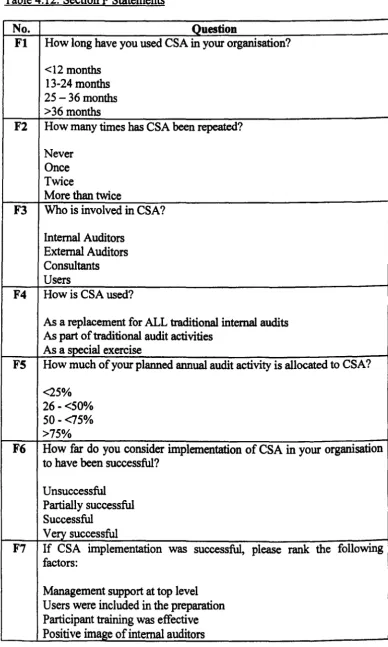
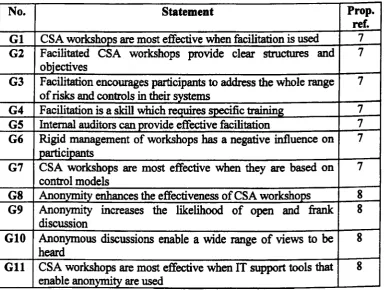
This version of the publication may differ from the final published
version.
Permanent repository link:
http://openaccess.city.ac.uk/19755/Link to published version
:
Copyright and reuse:
City Research Online aims to make research
outputs of City, University of London available to a wider audience.
Copyright and Moral Rights remain with the author(s) and/or copyright
holders. URLs from City Research Online may be freely distributed and
linked to.
Re-engineering Internal Audit: Strategy and Control, Control
Models and Control Self Assessment
Robert Melville
City University Business School
Part 1
Chapter Section 1 2 1.1 1.2 1.3 1.4 1.5 1.6 1.7 1.8
2.1
2.2 2.3 2.4 2.5 2.6 2.7 2.8 Part 1 Acknowledgements AbstractIntroduction, Need and Nature of Research ... .
Introduction ... . Nature of research ... . 1.2.1 Background ... . 1.2.2 Audit Environment and Control ... . Objectives of research ... ... Need for Research ... . 1.4.1 Overview ... . 1.4.2 Audit and strategy ... .. 1.4.3 The Balanced Scorecard ... .. 1.4.4 Benchmarking and standards ... .. 1.4.5 Other control frameworks ... . 1.4.6 Control Self Assessment ... . 1.4.7 Facilitation and consultancy skills ... .. 1.4.8 Group Decision Support Systems ... . Significance of the study ... .. Limitations of the study ... .. Structure of the thesis ... . References ... .
Literature Review ... ..
Overview ... , ... . Current Auditing Paradigm ... .. 2.2.1 External auditing ... .. 2.2.2 Internal auditing ... .. Strategic Level ... . 2.3.1 Strategy and control ... . 2.3.2 Business Process Reengineering ... .. 2.3.3 The Balanced Scorecard ... .. Tactical Level ... . 2.4.1 Benchmarking and Standards ... . 2.4.2 Control Models ... .. Operational Level ... . 2.5.1 Control Self Assessment ... . 2.5.2 Group Decision Support Systems ... . The New Internal Audit Paradigm ... .. Summary and Conclusions ... .. References ... .
Chapter 3 4 Section 3.1 3.2 3.3 3.4 3.5 4.1 4.2 4.3 4.4 4.5 4.6 4.7 4.8
Research Propositions ... .
Introduction ... . Overview ... . Strategic Level ... . 3.3.1 Proposition 1 ... . 3.3.2 Proposition 2 ... . 3.3.3 Proposition 3 ... . Tactical level ... . 3.4.1 Proposition 4 ... . 3.4.2 Proposition 5 ... . 3.4.3 Proposition 6 ... . Operational Level ... . 3.5.1 Proposition 7 ... . 3.5.2 Proposition 8 ... .
Methodology and Questionnaire Design ... ..
Introduction ... . Choice of Methodology ... . Overview of CSA Center Listing ... . Questionnaire Design ... . 4.4.1 Overview ... . 4.4.2 Section A: Background ... . 4.4.3 Section B: Audit and Strategy ... . 4.4.4 Section C: Awareness of the Balanced Scorecard 4.4.5 Section D: Control Models ... . 4.4.6 Section E: General CSA Questions ... . 4.4.7 Section F: CSA Implementation ... . 4.4.8 Section G: Questions on CSA Practice ... . 4.4.9 Section H: Further Information and Contact Details Data Collection ... . Statistics used in data analysis ... . 4.6.1 Descriptive ... . 4.6.2 Inferential ... . Conclusions ... .. References ... .
. Chapter . Section
. '5
6 7 5.1
5:2
5.35.4
5.5 -5.65.7
5.9
5.10 6.1 6.2 6.3 6.4 6.57.1
7.2
7.3
7.4
7.5
Summarised Descriptive Statistics ... .
Overview of Survey Responses ... .. Section A: Background and Personal Information ... .. Section B: Audit and Strategy ... . Section C: Awareness of the Balanced Scorecard ... . Section D: Control Models ... . Section E: General CSA Questions ... . Section F: CSA Implementation ... .. Section H: Further Information ... . Summary and conclusions ... .
Testing of Propositions ... ..
Introduction ... . Selection of the sample ... .. Structure of the chapter ... .. 6.3.1 Strategic Level ... ..
6.3.2
Tactical Level ... ..6.3.3
Operational Level ... . Detailed analysis of Propositions ... .6.4.1
Internal Auditing and Strategic Management ... .6.4.2
The BSC and Control ... .6.4.3
The BSC and Internal Auditing ... .6.4.4
Control Models ... . 6.4.5 Control Models and CSA ... .6.4.6
Control Models, CSA and Risk Assessment ... ..6.4.7
CSA and Facilitation ... .6.4.8
CSA and Anonymity ... .. Chapter Summary ... .Summary, Conclusions and Implications ... ..
Introduction ... . Summary of Research Findings ... . Conclusions ... .. Implications ... .
7.4.1
Internal Auditing and Strategy ... .7.4.2
The BSC ... .7.4.3
Qualitative issues ... .7.4.4
Control Models ... .7.4.5
CSA Implementation ... .7.4.6
Facilitation and anonymity ... .. Areas for Future Research ... .. 7.5.1 Strategy and the BSC ... .. 7.5.2 Control Models ... . 7.5.3 CSA Practice ... ..Page
125 .
126
126
129
132
139143 .
Chapter
Bibliography
Appendix A
Appendix B
Appendix C
Part 2
Questionnaire and Covering Letters ... .
Additional Comments ... .
Full Descriptive Statistics ... .
Page
210
222
228
Acknowledgements
Without the support, advice and inspiration of Professor Georges Selim this thesis would never have been attempted, let alone completed. His contribution to the international body of knowledge of internal auditors is immeasurable, and it is a privilege to work with him.
Along the way, Sally Woodward showed me the difference between reading and research, Claire Selim managed to make sense of my ideas for the survey, and Carol Vielba made sure I was prepared for the fmal stretch.
My external examiners Professor Andrew Chambers and Professor Anthony Walsh ensured that my examination not only improved the final product, but also gave me the platform to discuss my research with them. This was an unexpectedly enjoyable and positive experience. My thanks also to Dr Chris Storey for his chairing of the examination.
Finally, the co-operation and support that was given so freely by friends and colleagues from the IIA CSA Center during the fieldwork contributed massively to my research. I hope that my work will go some way to repaying their efforts.
Abstract
This thesis examines the role of internal auditors in three key areas: strategy, control models and control self assessment.
Research findings are based on the results of a survey of a specialist group of professionals with an interest in Control Self Assessment. This group comprises both internal auditors and non-internal auditors. Membership is multinational and a full range of industries is represented.
The actual and potential contribution that internal auditors can make to strategy is assessed and evaluated, with particular reference to the Balanced Scorecard. Control models were examined to identify use and effectiveness and the potential link with successful implementation of Control Self Assessment. Control Self Assessment was also examined as a specific activity. This part of the research addressed how it was perceived by the respondents and their organisations, and also to examine the importance of facilitation skills and IT support.
Section 1.1
1.2
1.3
1.41.5
1.6
1.7
1.8
Chapter 1
Introduction, Need and Nature of Research
Table of Contents
Introduction ... .
Nature of Research ... .
1.2.1 Background ... .
1.2.2 Audit Environment and Context ... .
Objectives of Research ... ..
Need for Research ... .
1.4.1 Overview ... .
1.4.2 Audit and Strategy ... ..
Page 2 4 4 5 9 10 10 12
1.4.3 The Balanced Scorecard ... 14
1.4.4 Benchmarking and Standards... 16
1.4.5 Other Control Frameworks ... ..
1.4.6 Control Self Assessment ... ..
1.4.7 Facilitation and Consultancy Skills ... ..
1.4.8 Group Decision Support Systems and Anonymity .... ..
Significance of the Study ... .
Limitations of the Study ... ..
Structure of the Thesis ... ..
References ... .
1.1 Introduction
The last two decades of the 20th century brought significant and irreversible changes to
the way organisations are managed. Innovations like Business Process Reengineering
CBPRE) and downsizing radically changed the structure and management styles of
organisations throughout the world. At the same time, progress in information
technology led to huge changes in the way information is produced, transmitted and
used. From an audit and control perspective, this meant that traditional methods of
assessing and reporting control issues were at best less effective, and at worst redundant.
This research began as an attempt to address the need for auditors to reengineer their
profession to meet the changed environment in which we work. Traditionally, internal
audit has primarily been concerned with management at operational and middle
management levels. This is unsurprising, given that much of the scope of audit work as
defined in the 1978 version of the Standards for the Professional Practice of Internal
Auditing of the Institute of Internal Auditors (llA) addresses the operation of control
systems set by senior management to ensure that targets are achieved and policies are
complied with.l Practically, this meant that internal audit had a focus not on the development and control of strategic processes but on their outcomes and
implementation. At a working level this means that internal audit work mainly impacts
management who are involved in short to medium term decision making. While this
may not have been problematic before, modern organisations may no longer have
structures that include the level of management on which internal audit has historically relied when evaluating systems of control. Anecdotally, this can be illustrated by a
statement made by a very long serving bank auditor who was making a presentation at a
· bank regarding current account operations, the presenter expressed the opinion that the
best assurance that controls were in operation was good branch management, with
experienced staff able to react to and solve day to day problems. This statement was met
with general approval from other presenters. In the past, such dependence on
management would have been justified. But in today's technology-driven organisations,
many customers have neither traditional branch managers nor branches; operation of
current accounts having moved to banking over telephone or computer networks.
Auditors who rely on traditional methods of control and evaluation in these systems will
therefore fail in their duty to assure management that their objectives are being met. The
2002 revision of the Standards has a modified definition of internal auditing that has
been developed to include a broader range of activities than hitherto, adding the
concepts of governance and risk management to its traditional domain of reviewing
management's systems of control:
Internal auditing is an independent, objective assurance and consulting activity designed to add value and improve an organization's operations. It helps an organization accomplish its objectives by bringing a systematic, disciplined approach to evaluate and improve the effectiveness of risk management, control, and governance processes. 2
The changing business environment has also increased the importance of information.
Organisations now operate
in
a context where the ownership, dissemination andproduction of information is potentially both the biggest asset and the worst threat.
Where organisations have reengineered and downsized, the need for effective, accurate
and timely management information systems is much greater. Highly automated
business systems are usually too complex for general management to fully understand,
Control and audit of these systems has also grown in complexity and difficulty.
Traditional and long established security and control measmes that rely upon stringent
input control and segregation of duties cannot be depended upon in organisations where
due to staff reduction and delayering, segregation of duty is often
seen
asan
wmecessary overhead. Furthermore, input controls are effective only if coupled with restricted accessand supervision. This is in conflict with the growing use of networked and open systems
such as electronic commerce, telephone and internet banking and automated operations.
There are three main issues underpinning this thesis. Firstly, the need to change the
internal audit paradigm from its focus on middle and operational management to a
position where greater assurance can be given to senior management on their strategic
planning and decision-making. Secondly, the potential benefits for organisations of
control models to enable internal auditors and managers to develop and implement best
practices for control and corporate governance. Finally, Control Self Assessment (CSA)
is examined as a potential solution to improve the effectiveness of audit while ensuring
that any move towards strategic management does not leave a vacuum at the operational
level.
1.2 Nature of the Research
1.2.1 Background
The starting point of this research is
that internal
audit as it is currently practisedmatters are effectively addressed. If internal audit is to continue to be a useful and
positive contribution to organisations, then its methods and approach must develop
to match the changes in the modem management environment Furthermore,
corporate governance pronouncements during the 1990s emphasised the need for
senior management to gain assurance about qualitative ('soft') controls such as
ethical behaviour and creating an effective control environment. A paradigm shift
from an operationaVtactical focus to a strategic/tactical focus must be accompanied
by management reclaiming responsibility for the review of controls in their
operations to reduce the likelihood that such assurance work would not be
undertaken, if internal auditors change the focus of their work. Control models
enable effective assessments of control systems using both quantitative and
qualitative measures. The fmal element of the research is based on CSA. Effective
use of CSA can enable management and auditors to work collaboratively in
reviewing systems of control at all levels.
1.2.2 Audit Environment and Context
Ackoff (1993) has suggested a technique of 'idealised design' where a corporate
vision is constructed of a perfect world, which may not
be
feasible at the time. Thistechnique has a firm base
in
systems theory and is therefore methodical. 3 Ackoffsuggests two types of idealised design: constrained and unconstrained. A
constrained design
assumes that the entity must be totally reconstructed, but itsenvironment remains the same.
Unconstrained design
allows the 'containingmore efficient throughput was achieved with no loss of control, envisioning
technological support which may not exist at present. An unconstrained design would enable this new model to link with other organisations to create a completely
new method of trading. Auditors have historically taken a conservative view of
reality, and prefer to work with the techniques and system components available,
although in the 1980s some practitioners made deliberate attempts to become
proactive, rather than reactive. This was largely an exercise in furthering the
participative approach championed by Mints in 1972, and although the issues were
aired in professional journals, there was no conceptual leap of the magnitude of
systems versus compliance auditing. 4
A constrained design for the audit function would need to work within current
clearly defined roles and boundaries of audit: internal auditors working within their
organisations; external auditors working from their independent finns. In some ways
this type of reorganisation has already occurred, due to changes in regulation
(compulsory market testing in government, disastrous lapses in control - such as those which initiated the Treadway report, and downsizing). In these cases it can be
seen that although internal audit has been streamlined, even automated, and made
more efficient and economic the basic premise has not altered. Internal auditors are still responsible for the review of internal control systems although external
consultancies are increasingly involved in work traditionally carried out by internal auditors. S External auditors in their tum are still responsible for reporting on
The conditions for unconstrained design and a much more radical reorganisation
have yet to occur. Arguably, it is likely to need a more comprehensive disaster even
than the Barings fiasco to stimulate this.
*
Interestingly, although both external andinternal auditors bore some criticism from inspectors from the Bank of England and
Singapore the key control issue was seen to be management's inability to understand
and control their modern business practices. 6 7 Alternatively, the auditing
professions may decide to adopt new working practices because of threats from
other sources. A research project commissioned by the ICAEW addressed the likely
impact of IT on audit in the next decade. 8 One radical view that the authors
discussed was that company accounts might be prepared by 'accounting factories'
rather than by in-house professionals. Data mining and the rapid growth of publicly
available information through the internet would mean that potentially no annual
audit would be necessary, as up to the second information could be obtained at any
time. A traditional post-event audit would not provide any significant assurance that
operations were controlled, and would therefore become irrelevant.
Negative and reactionary responses to technological and social change are not the
only alternatives. For organisations to develop and grow, there must be a
concomitant willingness to build a learning organisation, where a corporate memory
is made a clear strategic priority. As organisations reengineer and restructure, much
of the experience gained in different circumstances is lost. Periodically, fundamental
control principles are overridden or ignored and losses are incurred. In the recent
past, clear examples can be seen where basic audit concepts might have prevented
[image:16.532.82.507.154.288.2]large scale disasters. (Figure 1.1)
Figure 1.1
Event Control Weakness
Baring Brothers Segregation of duties, lack of supervision, inadequate audit testing 9
London Stock Exchange
Taurus
Inadequate audit involvement, insufficienttrading system controlofbudg~IO
Morgan Grenfell fund m~lnaoement Verification of assets, su~sion 11
SumitomolLME Segregation of duty, personnel controls, management and supervision 12
An
example of the unconstrained design approach to consider more relevant,effective auditing might address the six expectations listed by Macinnes in Auditing
in the 2
r
t Century: 131. the financial statements are right
2. the company will not fail
3. there has been no fraud
4. the company has acted within the law
5.
the company has been competentlymanaged
6. the company
has
adopted a responsible attitude to environmental and social mattersWhile senior management are responsible to their shareholders for ensuring proper
management of fInancial records, which are then audited by registered external
auditors, there is currently no legal framework for items 2, 3, and 6. Furthermore,
( '
assurance about future survival or corporate responsibility to the wider groups of
stakeholder. A reconstructed vision of the audit role could distribute audit work
among the range of agencies available: external, internal, environmental, technical
and auditors from potential investors or stakeholders.
1.3 Objectives of Research
Modem organisations in developed economies operate in an environment where their
effectiveness is measured through financial reporting. Internal and external evaluation of
performance is typically expressed in terms of profit and loss over a relatively short
period of one to five years. The focus of most audit and control activities, both internally
and externally, is on operational and tactical performance: for example, budgets versus
actual figures, return on investment, percentage of rejected throughput and market share.
Strategic issues and long term planning are not generally seen as being part of either
internal or external audit's terms of reference. Nonfinancial performance measures such
as corporate governance, social reporting and environmental issues while growing in
importance, are not yet seen as essential.
The objectives of this research are as follows:
• to examine the actual and potential contribution that internal auditors make to strategic management
• to investigate the awareness and potential benefits of control models
1.4 Need for Research
1.4.1 Overview
While outsourcing. and partnership arrangements are beginning to blur the
traditional boundaries between external and internal auditors, apart from
statutory and regulated audits control and governance issues are still largely
sidelined. Furthermore, many of the initiatives and developments which affect
the audit professions are defensive and reactive: the report of the Committee on
Corporate Governance chaired by Sir Ronnie Hampel, for example, interprets
the Greenbury and Cadbury guidelines as 'prescriptive' and (even more
disparagingly) as 'box ticking'. 14 Clearly the best intentions of these
committees to encourage honest and integrity in financial and control issues has
not convinced their potential audience. Hampel's primary method of ensuring
good practice would be the employment of good directors; furthermore, good
governance can even be a barrier to prosperity:
The importance of corporate governance lies in its contribution both to business prosperity and to accountability. In the UK the latter has preoccupied much public debate over the past few years. We would wish to see the balance corrected. 15
In Hampel's opinion, 'correction' of the imbalance implies acceptance that even
the comparatively limited response of governments and professional bodies to
the corporate failures exemplified by Barings, Maxwell and Polly Peck must
cease so that proper attention can be paid to the more pressing issue of
audit would seem bleak if this view were to become widespread. Corporate
governance and accountability are clearly perceived as barriers to prosperity,
not as safeguards of public and private investment.
The publication in January 1999 of the
Turnbull
Report and Combined Codecan be seen as having a potentially positive impact on the role of internal audit.
. Its emphasis on the importance of internal control systems and risk assessment,
and the mandatory requirement for companies to report on these issues provide
a clear justification for internal audit work. The ICAEW guidance to the
Combined Code states that 'a company's system of internal control has a key
role in the management of risks that are significant to the fulfilment of its
business objectives', and that internal control systems should 'be embedded
·thi
th
.
f th d fi f . u1 ,16 17WI n e operatIons 0 e company an orm parts 0 Its c ture.
Furthermore, they should 'be capable of responding quickly to evolving risks to
the business arising from factors within the company and to changes in the
business environment '. 18
Risk also formed the basis for Selim and McNamee in the late 1990s whose
work examined the changing perceptions of risk to internal auditors. 19 Their
results demonstrated that there is a visible change in the focus of internal audit
work from control to risk. The nature of this research project is founded in the
need for internal auditors to change their paradigm from the operationally
focused and quantitative to a participative, constructive and strategically
qualitative ('soft') controls, methods for controlling strategy, development of
control models and the successful implementation of eSA.
1.4.2 Audit and Strategy
The strategic management literature has rarely examined the links between
control and strategy; even fewer authors have examined the contribution
internal audit can make to strategic management. Johnson and Scholes define
strategy as
the
direction
andscope
of an organisation over thelong term:
which achievesadvantage
for the organisation through its configuration ofresources
within a changingenvironment,
to meet the needs ofmarkets
and to fulfilstakeholder
expectations. (emphasis in the original) 20This study will focus on the potential and actual contribution
internal
auditorsmake to the outputs of the strategic planning process rather than to the
formulation of strategy
per se.
Figure 1.2 shows the potential role of internalFigure 1.2
Strategic Activity Internal Audit Contribution
Improving efficiency Systems audit review of processes
Providing expertise Advisory role
Providing investment Provide assurance to senior management
Fostering innovation Participation in R and D
Mitigating risk Provision of assurance to management
Providing a strong external Include reputational risk in audit reviews image
Encouraging collaboration Evaluation of process effectiveness
Setting standards Involvement in governance and control
processes
(After Johnson and Scholes, 1999. 21)
A fulldamental element of this research is the evaluation of the need and
importance of qualitative controls, which include performance measurements
which are not solely based on financial and other quantitative information. As
can be seen in Figure 1.2, specific fmancial issues are only one aspect of the
strategic management process. While authors such as Kaplan and Sveiby have
suggested methods for including qualitative measures in performance
evaluation, they do not include control as an integral element. 22 23 Kaplan and
Norton proposed a method for ensuring a holistic view of performance, which
they called 'the Balanced Scorecard' (BSC). This research will examine the
potential benefits of the BSC for both senior management and internal auditors,
1.4.3 The Balanced Scorecard
A major obstruction for organisations wishing to make radical changes to their
systems of internal control is the need to report their performance against
generally agreed targets. Historically these have almost always been financial
ratios derived from analysis of the accounting records (return on investment,
payback period, and performance against budgets for example). These ratios
may not detect an underperforming strong enterprise where more aggressive
investment may have been appropriate, or misreport success of a weak
enterprise where financial records are manipulated in favour of the short term.
In particular, during the post recession period of restructuring and downsizing, management risk weakening long term control of their systems for the short term benefit of an apparently successful exercise in the reduction of overheads
and fixed costs. A more effective method of evaluatio~ and one which should
address the issues raised in the leAS report is the 'balanced scorecard', first
suggested by Kaplan and Norton in 1992.25 This method focuses on operational
as well as financial criteria, and therefore is fully in accordance with the IIA
guidance relating to the role of internal auditing.
Kaplan and Norton define four measurement criteria as a basis for evaluation: 26
• How do customers see us?
• What must we excel at?
• Can we continue to improve and create value?
These questions are placed in four measurable perspectives: Customer (are our
customers satisfied with performance, is the organisation the first choice
supplier?) Internal (how can we reduce cycle time, can we improve even on
high standards), Innovation and Leaming (are we developing new products
which will fulfil our customers' future needs), and Financial (are we gaining
sufficient return on investment, are we reducing costs, can we be more
competitive). Each stands alone, yet together they provide a complete picture of
the organisation's success. This framework fits much more comfortably with
the objectives of Total Quality Management (TQM) and the Baldrige award
than the traditional management approach, driven by the need to meet narrow
production or marketing targets. Letza emphasises the need to link the balanced
scorecard with strategy:
The scorecard puts strategy and VlSlon at the centre. Traditional measurement systems have a control bias, that is, they specify the particular actions they want employees to take and then measure to see whether or not the employees have taken these actions ... The balanced scorecard, on the other hand, assumes that people will adopt whatever
action is necessary to arrive at these goals. 27 ,
This is a philosophy which would horrify many audit practitioners, where
achieving objectives set by management is the essence of an effective control
system. There is some justification in a negative view: if employees are
empowered to do as they wish, there is a high risk of resources being directed at
satisfying the needs of the individual systems component or person rather than
those of the organisation as a whole. In other words, subsystems are optimised
recommending that all senior management are involved in an enterprise-wide
review of operations and their targets. This type of review fits readily both with
eSA and is consistent with the participative approach first suggested by Mints
in 1972. 28 While the balanced scorecard in its original design does not address
control issues, the fact that organisations that adopt the BSe by definition
include a range of measurable activities supports the argument that it has
potential benefits for both senior management and internal auditors
1.4.4 Benchmarking and Standards
TQM has been linked with internal auditing for some ten years, although quality
assurance of internal audit work has a much longer history (For example, the
ITA Standards, 1978 and 2002). 29 30 Studies by Ridley in 1996 and Gupta and
Ray in 1995 have shown that TQM and internal audit have strong links, but also significant differences in emphasis. 31 32 In principle, audit and TQM have a
great deal of potential synergy: TQM studies have highlighted the importance of
developing control systems which encourage responsibility and a target of zero
defects; the Baldrige Award and other quality frameworks emphasise clear
guidelines and a focus on measurable outputs. Despite these similarities, TQM
as a framework for audit work (rather than a target for an auditfonction) has not been wholly accepted by either branch of the audit profession.
The audit approach to TQM has taken two main paths: firstly, the external validation of internal quality through certification of the department (for
launched in 1994 where fonnal industry benchmarks are used to evaluate the
efficiency and effectiveness of internal audit departments), and secondly
through the use of TQM principles and methods in audit work. ITA Standard
1300 requires internal audit departments to establish a quality assurance and
improvement programme, and gives explicit guidance on both internal and
external reviews:
The chief audit executive should develop and maintain a quality assurance and improvement program that covers all aspects of the internal audit activity and continuously monitors its effectiveness 33
This type of TQM work is discussed by Lampe and Sutton (1994).34 A more
general approach to TQM was researched by Gupta and Ray (1995). 3S This
work investigated the ways internal auditors might consider TQM processes
during their reviews.
Not all authors have viewed TQM favourably. Ackoff finds serious weaknesses
inTQM:
TQM's development has to a large extent been based on experience; little theory has been involved. As a result, its various components do not hang together as a cohesive whole. It tends to be an aggregate (a euphemism for a hodgepodge) of procedures and practices rather than a systemic process 36
Ackoff goes on to note the fact that TQM needs a stable structure, and that
many organisations are subjected to change in less
time
than it takes to institutemeasurable standards and best practice. Quality standards define the targets and
checks which should be made. These measures can then be inspected to ensure
compliance.
In
principle, this should encourage good practice. But the realitymay be that an emphasis on strict procedures may hinder imaginative solutions
to problems; in other words, staff may be subject to prescriptive procedures and
not empowered to apply their knowledge. Conversely, without structure staff
may be able to manipulate sYstems so that controls are overridden.
TQM promised much more than it ever delivered for internal auditors. The llA
and many practitioners saw TQM as an important way of demonstrating the
-effectiveness of systems (and indeed their own audit organisations) through
compliance with an independent series of standards. Research was carried out
into TQM and internal audit, enthusiastically and widely. (Gupta and Ray,
1995; Ridley, 1996). 37 38 Unfortunately the rise of TQM ran parallel to
economic recession and a trend towards smaller management structures,
through downsizing and outsourcing.
TQM's impact on internal audit was therefore limited.
In
the UK, apart fromchampions of the ISO 9000 series of quality standards such as
Ridley,
thepotential impact of independent quality measurements was never achieved. This
is for a variety of reasons.
In
a climate of major change, concentration onprocedures and strategy takes second place to survival. With organisations
reengineering and reducing layers of management, activities with no direct
contribution to profitability are not given priority. Additionally, managers may
internal auditing too, there is an inherent mistrust of standardised solutions and
methodology. Even given that the IIA
Standards
are probably the most widelyquoted and important publication in the history of internal auditing, many
organisations develop their own methodologies and working practices which
may differ in theory and practice.
1.4.5 Other Control Frameworks
Apart from the international standards for TQM, other bodies have produced
standards frameworks which have a direct application to auditing. Most
important are the corporate governance pronouncements of the Treadway
Commission (COSO) 39 and the Canadian Institute of Chartered Accountants
Criteria of Control Report (CoCo). 40 These standards are used by the major
CSA players as a foundation for their work. In addition, the Malcolm Baldrige National Quality Award in the USA established in 1987 has encouraged world
class organisations to focus on quality management. 41 Criticism of these
standards and the Baldrige A ward has come from both supporters and detractors·
of their underlying principles: Deming (the founder of TQM) sees a misplaced
emphasis on results; others have commented on the inverse rewards for the
highly intensive process for participation in the award. 42 There is an apparent
contradiction then for management involvement in TQM schemes. The amount
of management support and effort is misdirected to a goal which has only
superficial value; meanwhile, 'real' targets are ignored in favour of a spurious
attempt to gain recognition. This argument has also been used during the growth
series) was initiated. While some large internal audit departments such as BT
and the Alliance and Leicester worked towards implementing TQM
programmes and registration others saw TQM as a distraction from 'pure' audit
work
1.4.6 Control Self Assessment (CSA)
CSA grew as a response to changes in the way organisations operate. In Gulf
Canada, the diversity of operations and speed of change meant that traditional audit approaches, even the systems audit, were not adding value to the
organisation. In order to address this problem the then Chief Internal Auditor,
Paul Makosz, in conjunction with senior managers in the internal audit
department developed a participative approach which enabled better coverage
of operations. While control remained the responsibility of management, the
means of assessing risk and evaluating control was devolved to groups of users
and auditors. This had the benefit that discussion and agreement of control
measures and risk also included the people who operate the systems. 43
From its origins in Gulf Canada, CSA has developed along two main paths. Tim Leech refined CSA into Control Risk Self Assessment, which is oriented
towards risk analysis and acceptance. In this method, workshops and discussion sessions are used as a forum for identifying, understanding and accepting the
inherent and residual risk in an organisation's systems. In contrast, the CSA
methodology developed by Paul Makosz (PDK Consultancy) focuses on
organisation. Both methodologies share similar components: workshops,
facilitated discussions, shared objectives and a willingness for staff at all levels
to make contributions and to 'buy in' to solutions.
In
the UK, CSAlCRSA has been used smce the late 1980s. Earlyimplementation of CSA occurred through the work of Tom Oxley in the early
1990s (the UK partner of Leech) and others. As early implementations were
primarily a practitioner-led development, there is little documentary evidence of
its success (or otherwise). However, postgraduate students at CUBS have
recorded and analysed their experiences and these examples are useful. 44 4S 46
Internationally, there are diverse views of the place-of CSA.
In
North America,CSA has developed rapidly and widely, to the extent that the IIA CSA
conference is among its best attended events (over 500 in 1995 and in 1996),
and a specialist group was established in 1996. The large external auditing firms
have formed partnerships with the best known practitioners (Deloitte Touche
and former members of the MAPCO audit team, KPMG and Leech's MCS for
example.) Obviously, many internal auditors see this connection as threatening.
In
this early stage of its development, CSA may become a separate disciplinefrom either type of audit practice. More positively, links between internal and
external auditors may form the basis of a new assessment profession, which has
common and equal links with both sets of players.
Control systems have traditionally been evaluated through testing and
measurement of system components against control objectives derived from
this approach through participation and team solutions, much of systems
auditing still relies on controls which originated in manual and accounting
systems. Although the underlying concepts are still correct, modem business
systems with their technologised processing and reduced supervision require a
different set of measurements. In computerised information systems for
example, the traditional binary definition of integrity (that infonnation and data
are either held in a complete and original state or they are not) has been
challenged by List and Melville. 47 The authors suggest that management need
information which is sufficiently accurate at the time it is used, not rigid faith in
incorruptible systems. Using this dictum, it is better for management to receive
information which they know to be inaccurate at the time when it is most useful
rather than rely on complete accuracy at a time when it is delivered too late for
corrective action. Obviously, management must also set their definitions of
sufficiency to acceptable levels. In order for management to measure the
effectiveness of their information systems, the paper sets out specific targets in
order for management to make decisions. Unlike traditional definitions of
information systems security where control is a function of effective
input
control and proper management of resources, List and Melville propose that
control of integrity is based on sufficient trust of
output
control. 48 49 SO Thisapproach has the potential to develop to meet the challenges of data mining and
shared resources; rigid input controls have the major disadvantage of being
directly in conflict with what future systems will offer: openness,
shared
resources, networked infonnation provision and direct control from the end
user. Further research into standards relevant to integrity showed that most
a comparison of available standards to a model of infonnation systems
components showed many gaps where technological progress had brought new
factors which have yet to be addressed. S 1
1.4.7 Facilitation and Consulting Skills
Undoubtedly internal auditing has been moving towards - a 'proactive',
consultancy style for some time, and the 2002
Standards
include consulting aspart of its definition of internal auditing. S2
Apart from Gray (1994), little fonnal research has been carned out into this
area. 53 Internal consultancy is not new, and there are strong links to positive
organisational change and development. For organisations which have
reengineered or are undergoing rapid and profound change, traditional audit
advice may not be sufficient to enable their new systems to be controlled. This
can be problematic: external, financial audits are by their nature backward
looking and systems auditing which is not based on a proper understanding of
systems may offer only partial or inadequate solutions.
A major problem for auditors is that a model consulting approach specific to
their needs has not been accepted by the professional bodies who set standards,
although individual attempts to solve this problem have been made. This is
unsurprising given the lack of an accepted methodology for systems auditing;
without this, no standardisation of work methods can occur. CSA will require a
most) auditors (external and internal) will not achieve. The skills and techniques necessary for effective facilitation, modelling, negotiation and evaluation must be delineated and researched so that auditors involved in CSA are able to satisfy
the needs of their customers.
A useful model has been described by Williams and Woodward as the '1 + 7
Model'. S4 This model identifies seven additional, supportive' elements to the
main consultancy role. As well as focusing on the clients' needs, a consultant must also be executive, researcher, tutor, educator, powerbroker, conciliator,
and synergist. Obviously, there are potential conflicts for internal auditors (who
are specifically required to maintain independence and objectivity from the systems they review) and external auditors are required to provide an opinion of
the financial statements for the benefit of shareholders. But the consultative role
which is essential for CSA is clearly set out. Internal auditors must be prepared
to define their role so that assurance is given across the whole spectrum of
performance measurements: financial, operational, social and environmental. In
particular,
in
a climate of change and growthinternal
auditors must take theinitiative for ensuring control systems either retain or improve their
effectiveness even if the client does not see this as a priority. This will require a shift in emphasis and structure of audit activity which will make the current
rigid demarcation between various types of auditor redundant. In a business
environment where only core activities are seen as necessarily carried out by
full
time, tenured staff, auditors have two options: to make themselves a core
is seen as a core activity as suggested by Yiannakis (2001), then the traditional
systems audit approach is probably outmoded, given the virtually unquantifiable
benefits it brings. 55 There is a real risk that organisations will revert to
defensive compliance reviews, where check lists of prescribed control activities
are used to demonstrate that all due professional care has been taken to prevent
disaster in the event of legal action. Systems auditing is a staff intensive and
long tenn activity which is perceived as an imposition on management. Given
the inherent flaws in this approach (the lack of fonnal methodology, the
apparent conflict between external and internal auditors, and the increasingly
complexity of systems to be reviewed) it is probably not possible to improve
current practices; the whole process must be reengineered to mee( the
requirements of modem enterprises.
If audit makes the shift to assessment suggested by MacInnes, it may be that a
range of control and consulting activities can be divided between external and
internal auditors under the supervision of an audit committee responsible for
corporate governance and control. This cannot happen without the acceptance
by senior management and stakeholders that control is essential for corporate
health.
1.4.8 Group Decision Systems Software (GDSS) and Anonymity
Although automation of current practice is not a solution for long tenn needs,
the use of technology has had a great impact on the work of auditors. For CSA,
main consultancies. It is without doubt a useful tool, and applied properly can
reduce inhibition and fear from discussions of sensitive areas.
If the future role of auditors is to enable and facilitate group work, a better
understanding of dynamics and the potential advantage of technology is
necessary. Finnegan and O'Mahony reported in 1996 that while decision
support software assisted group discussions, there was also a place for face to
face contact. S6 This may be because the technology has yet to reach a stage where its use is transparent to the user; alternatively it may be because
participants actively welcome the presence of other people.
1.5 Significance of the study
For internal auditors to meet the challenges presented by modern business systems and
in order to meet the skill and contribution of external auditors, the perception and
position of their activities must be moved from a concentration on operational and
tactical risk areas to a focus on strategic objectives and the linkage with perfonnance.
Operational and tactical control issues can be given to managers who are directly
In his best-selling book
Reengineering the Corporation
Michael Hammer describes a 'High ratio of checking and control to value adding' as an activity which fragmentsbusiness processes:
A lot of work goes on in organisations that does not add value to the company's products or service. We have a simple test for distinguishing work that adds value from work that does not. Take the customer's perspective and ask, 'Do I care?' If the answer is no, the work adds no value. Does the customer care about a company's internal controls, audits, management, and reporting? Absolutely not. That sort of checking and control work doesn't benefit the customer, only the company. 57
That such a statement could be made by one of the world's best known management
authors demonstrates the huge gap that exists between auditors and other control experts
and those whose focus is primarily on performance. (Whether this assertion would stand
up to empirical analysis is of course another matter, and is outside the scope of this
thesis.) More importantly, Hammer illuminates the central problem with traditional
means of evaluating effectiveness, that of financial performance and current market
value. If managers are effectively forced into inefficient and uneconomic practices
because of their rigid systems and objectives - as Hammer rightly suggests - moving
measurements for performance to the balance sheet through streamlining processes and
reducing blockages simply forces these inadequacies to a senior level. Instead of an
operational or tactical manager using false or misleading measurements to manage their
fragmented systems, the underlying syndrome is delegated to a higher level while
simultaneously reducing any direct control from below. Decoupling subsystems to
reduce entropy, while linking others to construct new systems is probably an effective
management method for performance improvement. Reducing or removing feedback
If internal auditors are to make a paradigm shift from a backward facing, historical view
of organisations and their systems to a continuing, real-time review, the systems audit
approach must be reengineered to enable this. This change may include a revision of the
current division between external and internal auditors.
Systems auditing has been preferred by many internal auditors as an effective replacement to compliance auditing. Much has been written on the wide range of
applications of this approach (most importantly by Chambers in the UK and Sawyer in
the USA). 58 59 60 The logic of examining and evaluating systems of control as a means
to measure their effectiveness is sound, although financial and external audits have
retained aspects of compliance and inspection. With the large volumes of transactions
produced by modem enterprises the systems approach is often the only available
technique for both internal and external auditors to evaluate controls.
Unlike systems analysis and design (a very closely related discipline) where several well
known formal methodologies have been constructed, there is no commonly
accepted
systems audit methodology. The systems auditing methodologies which are available
have mostly been designed at an organisational level for specific purposes by
government or by individual enterprises. (For example, the
Government Internal Audit
Manual
produced by HM Treasury). 61 A further anomaly is that systems auditapproaches rarely - if ever - adopt a foundation in general systems theory (GS1) or Soft
Systems Methodology (SSM). Until 1996, the ITA UK professional qualification did not
include any study of GST, although it forms a minor percentage of the CIA programme.
systems auditing is a method of evaluating systems which does not reqUIre its
practitioners to have a fonnal knowledge of how systems function. A simple example
might be where an auditor considers each element of an accounting system and confirms
that each is meeting its individual objective. Such a review concentrates only on the
subsystems, and would not identify areas where decoupling may improve efficiency,
economy and effectiveness. Conversely, an audit review may support a management
desire to outsource non-core operations through direct comparison of costs to benefits
but miss potential synergies and opportunities which may arise from redesign of control
systems. A misunderstanding of how systems work is a potentially fatal flaw, as is
illustrated by Baring Brothers Bank where a failure to see the perfonnance of a
component in the context of its environment led to a complete failure of control. (The
Bank of England and Singapore reports on the failure of Barings give excellent analyses
c. '1' ) 62 63
of these lID mgs.
Systems auditing is now reaching a stage of maturity. It is the norm for most internal
auditors and many external auditors use the systems approach in their work. Indeed, for
fonnal systems of control, designed and maintained by management in an unchanging
environment it is effective and efficient. Reviewing the organisation's internal control
systems enables an objective measurement of perfonnance against objectives. But
paradoxically, in an environment of change, structured audit plans become impractical,
business systems increase in complexity and management may have neither the
resources nor the desire to wait for scheduled reviews of their operations. A second
paradox has emerged from this situation: internal control systems are under increasing
pressure through management's attempts to reduce costs and improve their
change may be when traditional control elements are discarded or reduced, due to rapid
technological development or significant changes in staffing through downsizing or
outsourcing. So far the internal audit side of the debate has tended towards the
defensive, with increased emphasis on IT literacy, and reaction to the threat to internal
audit autonomy posed by the outsourcing consultancies. Conversely, the outsourcing
consultancies (mainly though not entirely accounting finns) are marketing their services
as 'partnership', or 'co-sourcing'. It is important to consider the potential place of audit
(internal and external) in the modern organisation and its environment of change and
competition. Handy describes the new organisation as the 'existential company', where
corporate governance is controlled through independent committees reporting to the
board.
Furthermore,
Effective and independent control systems are critical to the governance of self-governing bodies. The powers need to be even more visibly separated and separately staffed in an existential company. It may be neces~ to put the judicial or auditing power in the hands of an independent regulator.
This leads to a third paradox: competition between external and internal auditors for
traditional work means that both parties run a high risk of loss. But a completely
redefined role, where internal and external auditors act in partnership to carry out
essential control review activity may mean a rewarding and effective activity for both.
The redefinition of audit has been addressed by the ICAS in their research report
restructuring requires a strong internal audit function reporting to a special committee.
While this paper did not address the internal audit position in detail, several of the
current issues in auditing (the expectations gap, fraudulent management and the going
concern) are potentially resolved.
Corporate governance has been addressed in three important reports: the Treadway
conunittee (USA), the Cadbury committee (UK) and the Canadian ICA report on
Corporate Control (CoCo). Each report suggests a model for effective corporate control
which if followed would greatly assist a move towards good corporate control.
Unfortunately, control is more often seen as an unnecessary overhead and a restriction to
be removed. For example, in his seminal paper 'Reengineering Work' Michael Hammer
describes how the Ford Motor Company reduced headcount in Accounts Payable by
introducing a system of 'invoiceless processing', whereby goods were received and
recorded using a large database. 66 At fIrst glance, the revised system appears more
straightforward and efficient, although a more thorough analysis shows that the system
itself has not changed
its
nature. Rather, responsibility for control has been pushedupstream into the suppliers' systems. Although this does not necessarily imply that the
new system is not controlled, Hammer takes a frighteningly simplistic view of control
systems:
Our elaborate systems for imposing control and discipline on those who actually do the work stern from the post-war period .... since literate, entry-level people were abundant but well educated professionals hard to come by, the control systems funnelled infonnation up the hierarchy to the few who presumably knew
Hammer identifies two discrete populations: the 'well-educated professionals', who it is
implied force discipline and control on the other group, the 'people who actually do the
work'. This analysis of control places a clear division between management and
managed (which may be accurate) for which the solution is to reduce the nwnber of
tasks, and concentrate on processes. A reactive audit function has no response to such
damning criticism, apart from a rush to reduce headcount and middle management in its
own realm. Clearly this cannot be accepted without consideration of the risks and
benefits. Control systems must not be perceived as blocks and obstacles on otherwise
effective processes; neither must auditors look to the past for models of control.
Attempts to provide structure and methodology to audit work have developed in two
main directions: adapting and adopting a methodology from information systems or
engineering, and through guidance from manuals produced by professional bodies, large
finns of accountants and HM Treasury. These can only be partial solutions as they
address only the internal mechanisms of an audit. CSA was developed in order to ensure
that solutions to business problems were accepted by internal customers through their
active participation in the audit process.
Technological and social change over the last decade has seen a transformation of the
workplace in Western societies. Inevitably these changes have been exported to less
developed economies in the East and South. In many ways, these changes have been
positive: outmoded and repetitive tasks can now be carried out by robots, and the
increased quality of telecommunications has enabled the developing world to gain a
stake in application programming work. Yet the control implications of the changing
performance measurement (return on investment) ignores other, equally important
measurements (control, quality and social issues). Within the audit arena, external
auditors and internal auditors focus on protection of their individual interests at the
expense of the benefits of increased co-operation and synergy. In the short term, this
may produce one 'winner'; in the longer term, both sides will lose unless a more
relevant method of evaluating and assuring an enterprise's performance is designed.
eSA may be the method through which a holistic audit approach develops, with the
various parts of the balanced score card evaluated and assessed by the most appropriate
auditor.
1.6 Limitations of study
This research does not address the following areas:
• specific strategic management issues, apart from where they are linked with control and audit
• specific implementation of the BSe
• practical eSA issues, in particular with regard to implementation
1. 7 Structure of the Thesis
The remainder of the thesis is structured as follows:
Chapter 2 is a review of the literature that formed the foundation for the study. Specific
issues reviewed were:
• Strategy
• The Balanced Scorecard
• Business Process Reengineering
• Benchmarking and Standards
• Control Models
• Control Self Assessment
• Group Decision Support Systems
• Consultancy and Facilitation
Chapter 3 explains and presents the research propositions.
Chapter 4 describes the methodology and questionnaire design.
Chapter 5 presents summarised descriptive statistics, and gives an overview of the
Chapter 6 presents the testing of the research propositions, and the results of the
statistical testing.
Chapter 7 provides the conclusions and implications of the study, and suggests areas for
future research.
There are three appendices, Appendix A compnses the survey questionnaire and
covering letters; Appendix B contains the additional comments that were made by
1. 8 References
1 IIA
Standards, 1978
2 IIA
Standards,
2002 3 Ackoff, 19934 Mints, 1972 5 Yiannakis, 2000
6 Bank of England, 1995 7 Lim
et aI, 1995
8 Selim and Holtham, 1999
9 Bank of England, 1995
10 Duffy, 1993
11 Ensor and Wrighton, 1996 12 Dwyer, 1996
\3 McInnes, 1993, p6
14
Committee on Corporate Governance; Final Report,
1998Para
1.12 15Committee on Corporate Governance; Final Report,
1998Para
1.1 16ICAEW, 1999 para 1017ICAEW, 1999 para 22 18ICAEW, 1999 para 22 19 Selim and McNamee, 1998 20 Johnson and Scholes, 1999 p 10 21 Johnson and Scholes, 1999 p 424
22 Kaplan,1992
23 Sveiby, 1987; see also http://ww.sveiby.com.auJEmerginglStandard.htm 24 Kaplan, 1992
25 Kaplan and Norton, 1992 26 Kaplan and Norton, 1992 27 Letza, 1997 p58
28 Mints. 1972
29 ITA
Standards, 1978
30 ITA
Standards, 2002
31 Ridley, 1996
32 Gupta and
Ray,
199533
Standard 1300
34 Lampe and Sutton. 1994 35 Gupta and
Ray,
1995 36 Ackoff, 19945 37 Gupta andRay,
1995 38 Ridley, 199639 COSO, 1992 40 CoCo, 1993 41 Shetty, 1993 42 Deming, 1988 43 Jordan, 1995 44 Davies, 1994 45 Bassett, 1996
· 47 List and Melville, 1994 48 Clark and Wilson, 1987 49 Orange Book, 1985
50 Middleton, 1990 51 Melville, 1994
7
2 Practice Advisory 1 OOO.C 1-1 Principles Guiding the Performanceo/Consulting Activities of Internal Auditors
53 Gray, 1994'
.54 Williams and Woodward, 1994 55 Yiannakis, 2000
56 Finnegan and O'Mahony, 1996
57 Hammer, 1993
58 Chambers and Rand, 1994
59 Chambers, Selim and Vinten, 1987
60 Sawyer, 1996 61 GIAM, 1996
62 Bank of England, 1995
63 Singapore, 1995
64 Handy, 1994, p 186
65 McInnes, 1993 66 Hammer, 1990, p 107
Chapter 2
Literature Review
Table of Contents
Section Page
2.1 Overview ... 39
2.2 Current Auditing ParadigIll ... 40
2.2.1 External Auditing ... 40
2.2.2 Internal Auditing ... 45
2.3 Strategic Level ... 47
2.3.1 Strategy and Control... 47
2.3.2 Business Process Reengineering ... 54
2.3.3 Balanced Scorecard ... ... 58
2.4 Tactical Level... 63
2.5
2.6
2.7
2.8
2.4.1 Benchmarking and Standards ... 63
2.4.2 Control Models ... 67
Operational Level ... .
2.5.1 Control Self Assessment ... .
2.5.2 Group Decision Support Systems and Facilitation .. .
The New Internal Audit ParadigIll ... ..
Summary and Conclusions ... .
References ... ..
76
76
80
86
88