Forward-Chaining Partial-Order Planning
Amanda Coles
and
Andrew Coles
and
Maria Fox
and
Derek Long
Department of Computer and Information Sciences, University of Strathclyde, Glasgow, G1 1XH, UK email:[email protected]
Abstract
Over the last few years there has been a revival of interest in the idea of least-commitment planning with a number of re-searchers returning to the partial-order planning approaches ofUCPOPandVHPOP. In this paper we explore the potential of a forward-chaining state-based search strategy to support partial-order planning in the solution of temporal-numeric problems. Our planner, POPF, is built on the foundations of grounded forward search, in combination with linear pro-gramming to handle continuous linear numeric change. To achieve a partial ordering we delay commitment to ordering decisions, timestamps and the values of numeric parameters, managing sets of constraints as actions are started and ended. In the context of a partially ordered collection of actions, con-structing the linear program is complicated and we propose an efficient method for achieving this. Our late-commitment approach achieves flexibility, while benefiting from the infor-mative search control of forward planning, and allows tempo-ral and metric decisions to be made — as is most efficient — by the LP solver rather than by the discrete reasoning of the planner. We comparePOPFwith the approach of construct-ing a sequenced plan and then liftconstruct-ing a partial order from it, showing that our approach can offer improvements in terms of makespan, and time to find a solution, in several bench-mark domains.
1.
Introduction
Partial-order planning was, until the late 1990s, the most widely researched and most popular approach to planning. A central reason for this is that the least-commitment phi-losophy, in which decisions about action orderings and pa-rameter bindings is postponed until a decision is forced, is an intuitively attractive one. Nevertheless, the last decade has shown the power of early commitment under informed heuristic guidance combined with comparatively much lighter-weight search machinery able to quickly gen-erate search states and backtrack across alternatives. The general move towards state space search ignores another im-portant benefit of partial-order plans: the flexibility in exe-cution that they offer.
In this paper we explore the extent to which we can pre-serve the benefits of partial-order plan construction within the forward search framework. This is motivated by the ob-servation that the forward search approach can be seen as
Copyright c2010, Association for the Advancement of Artificial Intelligence (www.aaai.org). All rights reserved.
committing to a sequence of choices of actions, but not nec-essarily to the order of their application. By reducing the ordering constraints that are imposed during the construc-tion of the sequence of acconstruc-tion choices we retain elements of the least-commitment approach and are able to produce partially-ordered plans with the robustness and flexibility that they can offer.
In this paper we explore the following questions:
• Can forward search planning be modified to support effi-cient construction of partially-ordered plans?
• Is it more effective, in terms of time or plan quality, to construct order plans directly, or to lift partial-orders from totally ordered plans?
We explore these questions in the context of temporal ning with numbers and continuous effects. Temporal plan-ning, in particular, includes problems where partial-order planning appears to be particularly important, but the inter-actions between partial-order structures and numeric effects increases the challenges in achieving effective handling of the necessary reasoning.
In the remainder of the paper we consider the background to the problem and then present our approach to solving it. We describe our implementation of the solution and present results comparing its performance in various domains with a partial-order lifting approach applied to the plans produced by a straightforward forward state-space search approach.
2.
Background
Partial-order planning has become unfashionable, largely due to the remarkable performance gains we have witnessed in forward state-space search planners over the past decade. Despite the power of forward search, partial-order planning appears to offer a more flexible approach to temporal plan-ning, where the precise embedding of actions in time can be delayed until constraints emerge. Temporal planning has be-come a far more central concern in the planning community and this appears to offer an opportunity to exploit partial-order planning benefits. However, planning with numbers, which is also an important concern, appears to be made more difficult in the partial-order framework, where the values of metric variables can become difficult to reason with under the effects of partially-ordered actions.
planning. Zeno (Penberthy and Weld 1994) was a more am-bitious planner designed to solve problems involving con-tinuous processes as well as time, built on aUCPOP foun-dation (Penberthy and Weld 1992). The former used a grounded representation and was unable to handle numbers, but neither of the planners could be considered competitive or scalable (VHPOPis the more competitive, but remains far behind current leading technology).
In this work we usePDDL2.1 temporal models, in which durative actions can be considered as instantaneous actions linked by a duration and, possibly, invariant conditions. We consider temporal–numeric planning within a forward state-space search framework. In order to handle the combination of temporal, numeric and continuous effects we build on the COLIN(Coles et al. 2009a) planner, which is the onlyPDDL
planner generally available that can handle this combina-tion. The remainder of this paper relies on some background knowledge of the techniques employed in COLIN and its purely temporal-planning predecessor, CRIKEY3. The im-portant elements of this are included, for convenience, be-low. In the general case, states in a temporal-metric planning problem can be characterised by a tuple hF, V, Q, P, Ci, where:
• Fis the set of atomic propositions that hold in the state.
• V is the vector of values of the task numeric variables. In COLIN, where actions can have linear continuous numeric effects,V is represented byVmin andVmax, the
lower-and upper-bounds on eachV respectively, in the current state (depending on how long the state persists).
• Q, the event queue, is a list of actions whose execution has begun but not yet finished. For each(a, s) ∈ Q,a
identifies a ground action, andsthe step at which it began.
• Pis the plan to reach the current state.
• Cis a list of temporal constraints over the steps inP, each of the formlb≤(t(j)−t(i))≤ubfor a pairi, jof step indices from the plan.
Adding actions to a plan involves appending the corre-sponding start and end points of the action to the plan, not necessarily in successive steps. When an action is added to the plan, the state is updated. As in classical planning, ap-plying an action (end point)aupdatesFandV according to its effects, with the additional constraint thatacan only be applied if its effects do no conflict with the invariants of any action inQ. To respect the temporal structure of the prob-lem,Cis updated as each step is added to the plan. There are alternative approaches to this. For example, in Sapa (Do and Kambhampati 2001), each new start action is added im-mediately after the preceding action (allowing a separation ofto avoid interactions), while end actions can be added by advancing time to the next event inQand then enacting that event. Although Sapa does not use an explicit repre-sentation ofC, this is equivalent to adding constraints toC:
t(i)−t(i−1) =in the first case, whereiis the index of the newly added action andt(i)is its time of execution, and
t(i)−t(s) =dur(a)in the second case, where theith action is the end of durative actionathat started with start action
s. CRIKEY 3 (Coles et al. 2008) uses a different approach,
representing the temporal constraints explicitly. Addingato the plan at indexichangesCas follows:
• if stepiis the start or end of an action, the sequence con-straint≤t(i)−t(i−1)is added toC.
• if step i ends the action (a, s) from Q, the constraint
mindur(a) ≤t(i)−t(s) ≤mindur(a)is added toC
(wheremindurandmaxdurare the bounds on the dura-tion ofaat steps.)
The more complex constraints used in CRIKEY 3 gener-ate a Simple Temporal Problem (STP) (Dechter, Meiri, and Pearl 1991) which can be used to check the temporal sound-ness of decisions as they are made. This additional complex-ity is necessary, however, in order to allow temporal planners to reason with problems that exhibit required concurrency or other more complex temporal constraints.
To perform forward search planning in domains with lin-ear continuous numeric effects, COLINuses an LP solver to solve an augmented instance of the STP. First, additional variables are added to record the values of the task numeric variables along the trajectory of the plan. For each stepi, the variablesvi ∈V(i)record the values of each ofV prior toi. Likewise,v0i∈V0(i)record those immediately followingi. Preconditions and effects of actions can then be represented as constraints over these values:
• Numeric preconditions required at pointi(the start or end of an action) are added as constraints overV(i).
• Numeric invariants starting at stepiand finishing at stepj
are added as constraints overVi0..Vj0−1andVi+1..Vj0, i.e. on points within the open interval between the start and end of the action.
• Instantaneous numeric effects are added as a constraint relatingVitoVi0. For example,vi0 =vi+wirecords that stepiincreases the value ofvby the value ofw.
• Continuous numeric effects are added as constraints over both timestamps and state trajectory variables. For exam-ple,vi+1=vi+2(t(i+1)−t(i))records that a continuous effect is changingvat a rate of 2 between stepsiandi+1. By combining the STP with the metric constraints, the LP can be used to check both the temporal consistency of actions (as before), and also check that any interactions be-tween time and numbers can be resolved (for instance, by delaying the point at which a precondition is needed until sufficient continuous change has occurred.)
3.
Limitations of Forward State-Space
Search
additionally requires that no action appended to the plan can threaten the invariants of actions that have started but not yet finished: threatening actions cannot be added until later, and hence are necessarily ordered to occur after the actions ending the invariants.
Whilst a total-order eliminates threats, it comes at the cost of early commitment. Suppose one were to add a sequence of non-durative actions[A, B, C]to a plan, where A and B do not interfere with each other, and C depends only on B. In a forward search planner, these actions would be given sequential timestamps, say [0,1,2], even though A and B could equally well go in the opposite order (i.e. [1,0,2]). Furthermore, if we were to add another action to the plan that must follow B but has no impact on A or C, the times-tamp assigned to it would be3, even though1would be ac-ceptable. In other words, the price paid for threat-resolution using a total-order is that actions never occur in parallel and their ordering is determined early, in order to to avoid mu-tual interference — even when there is none. Fortunately, forward search is also able to support very rapid search tree generation and backtracking, allowing it to recover from poor choices of ordering.
In the temporal-case, where planning considers both the starts and ends of actions, not only does a total-order lead to poor-quality plans, it makes search far more difficult. To see why this is, consider the example of two durative ac-tions, A and B, with start pointsA` andB` and endsAa
andBa. Suppose that B is longer than A, and the actions
do not interfere with one another at the start, but due to their end conditions and effects,Bamust precedeAa. If the
plan-ner chooses to construct the plan by adding the actions:A`,
..., B`, ..., Ba, in that order, (where the ellipses indicate
other actions in the plan, none of which affect A or B) then the temporal constraints will turn out to be unsatisfiable and require the planner to backtrack through all intermediate de-cisions until it reordersB` beforeA` — even though the
ordering on the starts of the actions is logically uninterest-ing, as the two do not interact.
Some of the problems that arise because of early com-mitment in a temporal planning context can be preempted, as discussed in (Coles et al. 2009b), but there remain oth-ers that follow from the early commitment approach. One of the most serious problems for forward search temporal planning is in solving problems with deadlines, where dead-lines can arise as the consequence of timed initial literals (creating absolute deadlines) or within the interval of one or more durative actions that provide some resource through-out their execution (creating deadlines relative to their start-ing points). Deadlines cause problems for forward search because the point of failure in constructing a plan against a deadline is at the deadline itself. However, thereasonfor the failure can often be a poor choice of action ordering far earlier in the plan, where the choice was made arbitrarily as an early and unnecessary commitment. In these cases, for-ward search is typically faced with significant backtracking as the planner attempts to explore plan permutations without effective guidance. As we will go on to demonstrate, reason-ing directly with partial-orders makes our planner far more effective when planning against deadlines.
These problems motivate the exploration of an approach that exploits less commitment in the ordering of actions.
4.
Modifying Forward Search to Reduce
Commitment
We propose to reduce the commitment to ordering choices during forward search by adding constraints to the temporal orderings of actions only as they are required to ensure pre-conditions are met. The approach represents a compromise between the total-ordering commitment of standard forward search and the least commitment approach in partial-order planning, since we commit to ordering choices that ensure consistency of the plan, even though in some cases disjunc-tions of constraints would be sufficient. Whilst our approach is general and applicable to non-temporal and temporal plan-ning, we restrict our attention to the temporal case, first con-sidering a purely propositional representation, and then ex-tending our approach to include both instantaneous and (lin-ear) continuous numeric change.
4.1
Propositional Temporal Planning
In order to extend our forward search to support partial-order planning we extend the representation of the state described in Section 2.. We add further elements to the tuple as fol-lows:
• F+ (F−), where F+(p)(F−(p)) gives the index of the stepaby which factpwas most recently added (deleted), respectively.
• F P, whereF P(p)is a set of pairshi, di ∈(N0× {0, }): – hi,0i ∈ F P(p)records that stepiis at the end of an open interval during which pis required to hold. In
PDDLthese arise due to invariants on actions, in which caseiis the end step of an action of whichpis anover allcondition.
– hi, i ∈F P(p)records that stepiis the start of an inter-val (half-closed on the left for consistency withPDDL
semantics) wherepis required to hold. InPDDLthese correspond to at startor at end conditions rele-vant to the stepi.
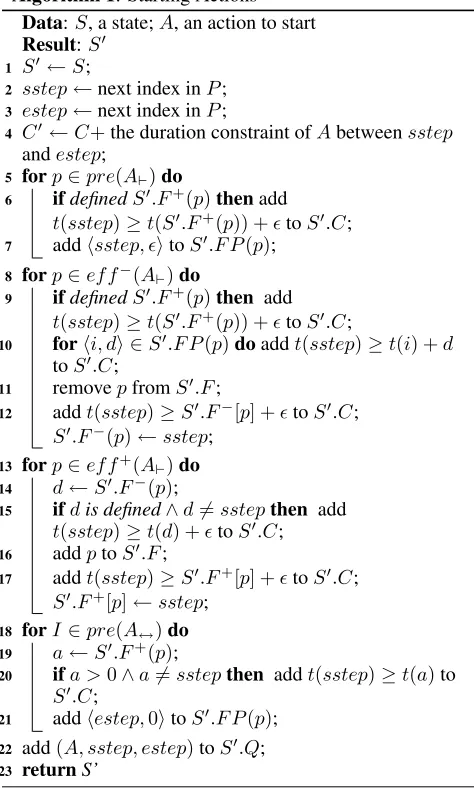
The process of updating the state on application of start or end actions is shown in Algorithms 1 and 2. On apply-ing a start action, A`, at stepi in the plan, the following
constraints are added to the partial-oder:
• for eachp ∈ pre(A`), the recorded achiever ofpis
de-moted to come before stepi(line 6). Note that this implies commitment to an achiever and ignores the possibility of exploitingwhite knights(Chapman 1987).
• for each negative effectpofA`, pis removed from the
state, and stepiis promoted to occur after any action that requiresp(line 10). This is a standard promotion declob-bering strategy. The alternative demotion choice (placing stepibefore the achiever forp) is not considered, though this does not sacrifice completeness, as search could back-track and find a plan in whichA`comes earlier.
• for each positive effectpofA`,pis added to the state, and
Algorithm 1: Starting Actions Data:S, a state;A, an action to start Result:S0
S0←S;
1
sstep←next index inP;
2
estep←next index inP;
3
C0←C+the duration constraint ofAbetweensstep 4
andestep;
forp∈pre(A`)do
5
ifdefinedS0.F+(p)thenadd
6
t(sstep)≥t(S0.F+(p)) +toS0.C;
addhsstep, itoS0.F P(p);
7
forp∈ef f−(A`)do
8
ifdefinedS0.F+(p)then add
9
t(sstep)≥t(S0.F+(p)) +toS0.C;
forhi, di ∈S0.F P(p)doaddt(sstep)≥t(i) +d 10
toS0.C;
removepfromS0.F;
11
addt(sstep)≥S0.F−[p] +toS0.C;
12
S0.F−(p)←sstep;
forp∈ef f+(A
`)do
13
d←S0.F−(p);
14
ifdis defined∧d6=sstepthen add
15
t(sstep)≥t(d) +toS0.C; addptoS0.F;
16
addt(sstep)≥S0.F+[p] +toS0.C;
17
S0.F+[p]←sstep; forI∈pre(A↔)do
18
a←S0.F+(p);
19
ifa >0∧a6=sstepthen addt(sstep)≥t(a)to
20
S0.C;
addhestep,0itoS0.F P(p);
21
add(A, sstep, estep)toS0.Q;
22
returnS’
23
order of selection of actions leads to early commitment to possible orderings: alternative achievers are displaced by the addition ofA`.
• for each invariantp∈pre(A↔), ifA`did not achievep,
the recorded achiever is demoted to come before stepi.
[image:4.612.53.290.63.458.2]Applying an end action is similar, although without the need to consider anyover allconditions.
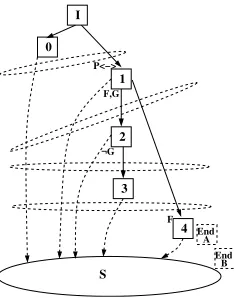
Figure 1 shows an example in which the current state,S, has evolved from the application of a series of actions, rep-resented by the numbered nodes — the numbers indicate the order in which the actions were added. The dotted boxes holding the ends of actionsAandBindicate that the state records actions that remain in progress. The dotted ellipses show the points at which states are created during the for-ward search, each following the addition of one of the ac-tions. Action 1 is recorded as the most recent achiever for
F, while action 2 is the most recent deleter forG. When step 4 is applied, the only necessary constraint is that step 1 should precede it, indicated by the connecting arrow.
Algorithm 2: Ending Actions
Data:S, a state;A, sstep, estep, an entry from Q Result:S0
S0 ←S;
1
forp∈pre(Aa)do
2
ifdefinedS0.F+(p)then add
3
t(estep)≥t(S0.F+(p)) +toS0.C;
addhestep, itoS0.F P(p);
4
forp∈ef f−(Aa)do
5
ifdefinedS0.F+(p)then add
6
t(estep)≥t(S0.F+(p)) +toS0.C;
forhi, di ∈S0.F P(p)do addt(estep)≥t(i) +d 7
toS0.C;
removepfromS0.F;
8
addt(estep)≥S0.F−[p] +toS0.C;
9
S0.F−(p)←estep;
forp∈ef f+(Aa)do
10
d←S0.F−(p);
11
ifdis defined∧d6=estepthen add
12
t(estep)≥t(d) +toS0.C;
addptoS0.F;
13
addt(estep)≥S0.F+[p] +toS0.C;
14
S0.F+[p]←sstep;
remove(A, sstep, estep)fromS0.Q;
15
returnS’
16
4.2
Numeric Temporal Planning
Planning systems have become increasingly capable over the past decade and the extension to handle explicit time and numbers are important developments that extend the appli-cability of the technology. For this reason, it is essential to consider the impact of modifications to planning algorithms on their ability to continue to handle these extensions. In the propositional case, the state tuple is extended to record achievers and deleters for propositions. To extend this idea to numbers, similar annotations are recorded for numeric state variables. For eachv∈V:
• Veff(v)records the index of the most recent step having an instantaneous effect onv.
• Vcts(v)records a set of pairs of start and end step indices, where(i, j)∈Vcts(v)indicates that the action that began
atiand will finish atj(where stepj is still in the event queue) has a continuous numeric effect uponv.
• VP(v)records a set of step indices, wherei ∈ VP(v)
when stepidepends on the value ofv. This arises in three cases:
– stepihas a precondition involvingv;
– stepihas an effect whose outcome depends on the prior value of v (e.g. it increases v by some amount, or changes another variable according to some function involvingv);
2
3
4
F End
A
B End
S I
F,G
1
P<−>
¬G
[image:5.612.115.232.52.201.2]0
Figure 1: Determination of which facts are true in a state.
• VI(v) records pairs of indices so that (i, j) ∈ VI(v)
when the action that begins at stepiand will end at stepj, wherejis currently in the event queue, has anover all
condition dependent onv.
Algorithms 1 and 2 can then be extended to handle the constraints implied by the management of numeric effects and preconditions. When adding a stepAat indexi:
1. If the effect ofAdepends on the value ofv:
• addt(i)≥t(Veff(v)) +toS0.Cto promoteAafter
the most recent action to affectv;
• ∀(s, e) ∈ S.Vcts(v), addt(s) + ≤ t(i)andt(i) + ≤t(e)toS0.C, to place the dependent effect inside
currently active process effects (see further comment below).
• additoS0.VP(v).
2. IfAhas an instantaneous numeric effect onv:
• addt(i)≥t(Veff(v)) +toS0.Cto order updates on
v;
• ∀j ∈ S.VP(v), addt(j) + ≤ t(i)toS0.C to avoid
harmful interactions between the effect ofA and ac-tions that depend on it;
• ∀(s, e)∈(S.Vcts(v)∪ S.VI(v)), addt(s) +≤t(i)
andt(i) +≤t(e)toS0.C, placing the step inside the range of active continuous effects;
• S0.Veff(v)←i.
• updateS0.Vmin(v), S0.Vmax(v)according to the ef-fect.
3. IfA starts an action (finishing atj) with an over all
condition onv:
• ∀(s, e)∈S.Vcts(v), addt(s) +≤t(i)andt(i) +≤ t(e)toS0.C, placing the step inside the range of active continuous effects;
• ifA does not have an update effect onv, addt(i) ≥
t(S.Veff(v)) +toS0.Cto promote the invariant past
the most recent effect onv;
• add(i, j)toS0.VI(v).
4. IfAstarts an action (finishing atj) with a continuous ef-fect onv:
• ifAdoes not also have an instantaneous update effect onv, addt(i) ≥t(Veff(v)) +toS0.C to sequence
updates onv;
• ∀j ∈S.VP(v), addt(j) +≤t(i)toS0.C;
• ∀(s, e) ∈ VI(v), addt(s) + ≤t(i)andt(i) + ≤
t(e)toS0.C, placing the step inside the range of active invariant conditions;
• add(i, j)toS0.Vcts.
• S0.Veff(v)←i.
5. IfA ends an action that began atk, with a continuous effect onv:
• ∀(s, e)∈VI(v), addt(s)+≤t(i)andt(i)+≤t(e)
toS0.C;
• remove(k, i)fromS0.Vcts(v);
• ∀(s, e)∈S0.Vcts(v)), addt(s) +≤t(i)andt(i) +
≤t(e)toS0.C, placing the action inside the range of active continuous effects;
• S0.Veff(v)←k.
6. IfAends an action that had anover allcondition onv:
• additoS0.VP(v);
• remove(k, i)fromS0.VI(v).
The key outcome of these ordering constraints is that we impose a total ordering on steps changing the value of a vari-able v, corresponding to the order in which the steps are added to the plan. In doing so, at any point we can de-termine the value of v by ordering steps predicated on v
but not changing it to occur after the last step changingv
and before the next. A further point to observe is that we force conditions that depend on active process effects to lie within those processes (and, similarly, within the range of active invariants). This is a further commitment, since the step might turn out to be better ordered after one or more of the end points of active processes or invariants. The or-dering choices in this case are left to backtracking search to identify. The consequence of all these constraint addi-tions, including those placing steps within the durations of relevant active processes or invariants, is that our implemen-tation commits to choices that allow us to maintain an unam-biguous value for each of the metric fluents while avoiding commitments about orderings relative to actions that have no relevant interaction with the inserted step. This is a com-promise between least commitment and total commitment.
4.3
Checking Action Choice Consistency
their location in the plan to occur after the effect prior to their addition, and before the next.
The construction of the LP in COLINrelies on three con-sequences of the total ordering of steps:
1. It can be assumed that the order of steps in the plan is the same as the order that they were added to it.
2. The values of the state variables at the start of each step can be defined in terms of the values after the previous step, according to the impact of any active continuous ef-fects: the gradient on eachv,δvis known (the combined process effects of all active continuous effects on the vari-able), and hencevi =v0i+δv(t(i+ 1)−t(i)).
3. By adding a dummy stepnow to the end of the plan, and maximizing and minimizing the values of eachvnow ∈ Vnow, one can obtain upper- and lower-bounds on each v∈V after the steps added to the plan so far.
Having abandoned the total ordering on the steps in the plan, we must consider the consequences of losing these three properties.
1) Determining Step Order. The constraints we add to the plan ensure that any ordering of the actions that is consistent with the partial-order is a valid total-order. Therefore, we can select an arbitrary topological sort of the partial-order as a step order in which to process the plan.
2) Determining the Values of the Fluent at Each Step. Whilst building the LP, we record three values for eachv ∈
V:
• vval: the LP variable containing the valuev0
iafter the last stepmto have an effect uponv;
• vt: the timestamp variable of the last stepmto have an
effect uponv;
• δv: the current total gradient of the active linear continu-ous change uponv(as in COLIN).
When visiting stepi, for each variablev∈V we can deter-minevibeforeias:
vi=vval+δv(t(i)−vt)
That is, rather than calculating the value ofvbased on the value after the previous step in the plan, it is calculated using the value after the last step to modifyv, and the time since that step.
On execution of each stepi, the values associated with each metric fluentv∈V are updated as follows:
• If stepihas an instantaneous effect onv, its effect is han-dled as in COLIN, by creating a constraint relatingv0(i)
tov(i)) and by settingvval tov0(i), andvt tot(i).
• If stepiis the start of an action with a continuous effect changingvat the rate ofcper time unit,cis added toδv
andvval ←v0(i),vt ←t(i).
• If stepiis the end of an action with a continuous effect on
v with ratec,c is subtracted fromδv andvval ← v0(i),
vt ←t(i).
3) Determining the Minimum and Maximum Values of
v ∈ V. In COLIN, before each iteration of the action se-lection process, a single dummy timestamp variabletnow is
added to the LP, along with a vector of values representing the metric fluents,Vnow. These values are used to represent
the timestamp and metric fluent values in the current state and bounds on them are determined using the LP according to constraints of the form:
vnow =vn0 +δv(tnow−t(n))
In the partial-order version of our planner, the value of a variablev is no longer necessarily linked to the last step of the plan, so instead we create one dummy timestamp vari-abletnow,vforeachv∈V. We then constrain eachvnow as
follows:
vnow =vval+δv(tnow,v−vt)
5.
Modifying the Heuristic
Section 4. describes the way in which the state representa-tion can be extended and correctly maintained in order to achieve a partial-order plan construction within a forward planning framework, working with time, numbers and con-tinuous effects. We now turn our attention to heuristic search guidance in the search space of these states.
One alternative is straightforward: we can discard the ad-ditional information recorded in the state, and evaluate states using the existing temporal relaxed planning graph (TRPG) heuristic in COLIN. Doing this discards important informa-tion, however: all facts in the current state are added to fact layert = 0 of the relaxed planning graph, irrespective of when they were achieved. There is therefore no pressure to choose actions in the relaxed plan that could go earlier rather than later in the partial-order. In the construction of the states we accumulate information about the earliest times at which each fact could be achieved and this can be used to improve the heuristic estimates if we use the relaxed plans to estimate makespan.
To begin with, when step i is added to the plan, we use the LP to calculate the earliest timestamp at which it could be executed, tmin(i). In the TRPG each layer is associated with the earliest time it can represent. We ob-serve that the earliest time a fact p is available will be
f t(p) = max{tmin(F+(p)), tmin(F−(p)) +}, because either it will be achieved by its last achiever as early as that action could be applied, or else it must be reachieved after its last deleter, again at its earliest application. Thuspis not added to the TRPG until a fact layer occurring atf t(p). Sim-ilarly, for each numeric precondition specified over variables vars, we delay the layer at which it is considered satisfied to:
f t(vars) = max
v∈vars(tmin(V
eff(v)) +)
These modifications prevent actions from being selected ear-lier that their preconditions can be achieved. Furthermore, the constraints that affect the scheduling of actions also im-ply that any action that addspwill be scheduled after exist-ing actions affectexist-ingp, so after f t(p), and any action that deletes pmust also come after actions requiring p. Thus, actions that deletepwill necessarily be delayed until:
f d(p) = max[f t(p), max
0.01 0.1 1 10 100 1000
0.01 0.1 1 10 100 1000
Partial-Order Lifting
POPF Driverlog
Depots Satellite Zeno Travel Trucks TPP Openstacks
(a) Time
0 200 400 600 800 1000 1200 1400 1600 1800 2000
0 200 400 600 800 1000 1200 1400 1600 1800 2000
Partial-Order Lifting
POPF Driverlog
Depots Satellite Zeno Travel Trucks (*0.05) TPP (*0.05) Openstacks (*0.5)
[image:7.612.90.514.61.196.2](b) Makespan
Figure 2: ComparingPOPFto Standard Total-Order Search followed by Partial-Order Lifting
By similar reasoning, a numeric effect,ne, updating vari-ablev, must be scheduled after the last actions affecting any of the variables appearing inne,vars, and also after the last point at whichvis required:
f t(ne) = max[f t(vars), max
i∈VP(v)(tmin(i) +)]
In our evaluation we compare results using both the origi-nal heuristic and the modified heuristic. A side-effect of the use of a relaxed plan heuristic is the opportunity to extract
helpful actions (Hoffmann and Nebel 2001). When using
our partial-order plan structure we define helpful actions to be all actions in the relaxed plan whose preconditions are satisfied in the current state (rather than in the first layer of the graph, since the TRPG is built outwards from time
t= 0).
6.
Evaluation
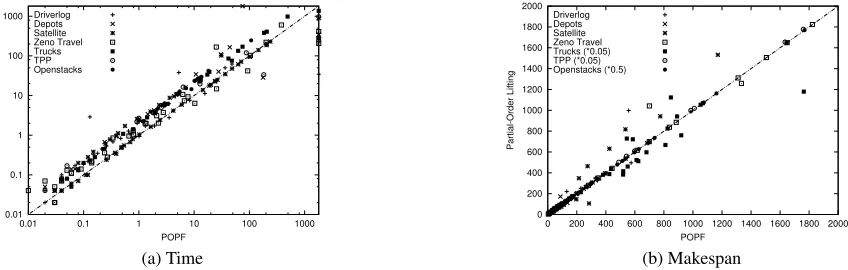
[image:7.612.332.513.62.194.2]We now present results comparing our partial-order forward planner with the alternative approach of lifting a partial-order from a totally partial-ordered plan produced by COLIN. Lift-ing an optimal partial-order is NP-hard, but findLift-ing a good partial-order is inexpensive in general using a straightfor-ward approach (Veloso, P´erez, and Carbonell 1990). All tests used a 3.4GHz Pentium IV machine, limited to 30 min-utes and 1.5GB of memory. We tested on a wide range of temporal domains from recent planning competitions, but space limitations prevent us from showing results for all do-mains. We plot a representative sample of results and com-ment on results from other domains in the text. In order to maximize the amount of data we can plot, results for IPC 3 domains include both the simple time and time variants of the respective domain (and for satellite, also complex time). In all sets of results we plot the time taken for our approach using partial orders (POPF), against the time taken using the standard total-ordered search but then lifting a partial-order (PO-LIFT). Points above the liney=xshow better perfor-mance (shorter time/shorter makespan) forPOPF.
Figure 2a, shows the performance of our approach
us-ing the original heuristic. This directly compares the costs
of reasoning with partial-orders during search with and lift-ing a partial-order from a totally ordered plan (includlift-ing the
time to construct the plan). The results show that reason-ing directly with partial-orders turns out to be consistently marginally more efficient. This result surprised us and we are still attempting to understand it better. Our current hy-pothesis is that plan permutation symmetries might be re-duced through the direct reasoning with partial-orders.
Figure 2b compares the makespans for plans produced by each approach. The partial-order planner achieves essen-tially identical performance to the lifting approach in most cases. These results serve to emphasise the importance of coupling the construction of a partial-order with a heuris-tic tuned to exploit the power this offers. With the standard heuristic the planner fails to perceive the opportunities to construct plans with shorter makespan.
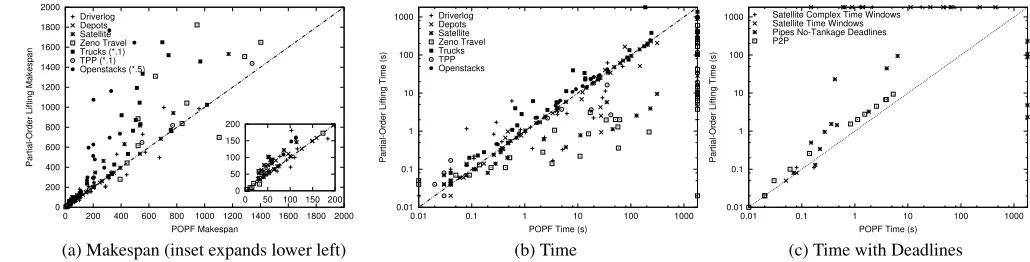
In contrast, Figure 3a shows the makespan of plans gen-erated using thePOPFapproach combined with the heuris-tic outlined in Section 5.. In this case it is clear that plans of shorter makespan are produced, often by significant mar-gins. The heuristic supports the planner in finding choices of action that make plans shorter1.
There are some interesting anomalous points on the graph where thePOPFplanner produces plans of longer makespan. There are only two domains in which this occurs: Driver-log and Zeno travel. In DriverDriver-log this happens in problems that have goals for both trucks and drivers. The shortest-makespan way to achieve a driver goal, within the relaxed planning graph, is to for a driver to drive a truck to the driver’s destination, so the heuristic will prefer this decision. However, if the truck also has a goal destination, some driver must leave his goal to drive the truck to its goal location. Then, to reach the goal state, the driver must returns again on foot. This is an example in which the short-makespan heuristic ends up producing poor decisions. A similar situa-tion arises in Zeno Travel.
Figure 3b shows that the new heuristic is more expensive to compute. The heuristic guides the search towards plans with shorter makespan rather than towards plans that con-tain fewer steps and this can lead to larger numbers of steps and slower plan construction. This increased computation
1
0 200 400 600 800 1000 1200 1400 1600 1800 2000
0 200 400 600 800 1000 1200 1400 1600 1800 2000
Partial-Order Lifting Makespan
POPF Makespan Driverlog
Depots Satellite Zeno Travel Trucks (*.1) TPP (*.1) Openstacks (*.5)
0 50 100 150 200
0 50 100 150 200
(a) Makespan (inset expands lower left)
0.01 0.1 1 10 100 1000
0.01 0.1 1 10 100 1000
Partial-Order Lifting Time (s)
POPF Time (s) Driverlog
Depots Satellite Zeno Travel Trucks TPP Openstacks
(b) Time
0.01 0.1 1 10 100 1000
0.01 0.1 1 10 100 1000
Partial-Order Lifting Time (s)
POPF Time (s) Satellite Complex Time Windows Satellite Time Windows Pipes No-Tankage Deadlines P2P
[image:8.612.39.554.70.201.2](c) Time with Deadlines
Figure 3: Results for the Planner making use of the new Heuristic
time also results in slightly poorer coverage. We demon-strated earlier, however, that if a fast solution is desired,
POPFsearch with the original heuristic is the most efficient. Planning with partial-orders therefore offers us a choice be-tween heuristics that favour performance or plan quality.
Our final set of results (Figure 3c) considers using our new heuristic on problems with deadlines2, and a P2P do-main (Huang, Chen, and Zhang 2009), where good solu-tions rely on downloading files within planned envelopes of availability. In all these problems, reasoning about the makespan of the plan head is critical in finding solutions to the problems. These domains, containing either timed ini-tial literals (TILs) or envelopes,POPFwith the new heuris-tic finds plans more quickly in general and provides much better coverage (in the Satellite variants, for instance, cover-age is increased five-fold). In reasoning with the makespan of the plan head,POPFis able to ensure that the maximum amount of activity can occur before the deadline, and im-prove the opportunity to solve the problem. On the other hand, standard search often commits early to sequential de-cisions that mean the deadlines cannot be met, and spends a great deal of time fruitlessly searching unforeseen dead-ends. Here, reasoning about partial orders in the plan is crit-ical to solving problems efficiently, encouraging parallel ac-tivity rather than only progress to the goal. Makespan data is not shown for this set of results, as the deadlines restrict the makespans of valid plans, so if the problems are solved, plans of similar makespan are produced (in the case of the P2P domain, makespans equal those known to be optimal.)
7.
Conclusion
Partial-order planning is an intuitively attractive strategy, but has proved difficult to achieve efficiently. We have shown that it is possible to achieve some of the advantages of partial-order planning in a forward planning framework us-ing an expressive plannus-ing language. The complexity of partial-order reasoning can be managed by finding a com-promise between least-commitment and total commitment.
2
We use all IPC domains with deadlines but omit Airport, as a bug in the ADL-to-STRIPS compilation means the TILs do not actually interact with the problem.
Doing so can yield significant advantages in plan quality, us-ing a more informed heuristic for guidus-ing the search within this partial-order structure.
There remain several opportunities to extend the ideas we have described. We are interested in recognising automati-cally the situations in which the extended heuristic will offer benefit. The integration of linear program into the combi-natorial decision-making in planning is a fruitful route to extension of capabilities of planners and there remain many further directions in which to exploit this line of research.
References
Chapman, D. 1987. Planning for conjunctive goals. Artificial Intelligence29:333–377.
Coles, A. I.; Fox, M.; Long, D.; and Smith, A. J. 2008. Planning with Problems Requiring Temporal Coordination. InProc. AAAI. Coles, A. J.; Coles, A. I.; Fox, M.; and Long, D. 2009a. Temporal Planning in Domains with Linear Processes. InProc. IJCAI. Coles, A. J.; Coles, A. I.; Fox, M.; and Long, D. 2009b. Ex-tending the Use of Inference in Temporal Planning as Forwards Search. InProc. ICAPS.
Dechter, R.; Meiri, I.; and Pearl, J. 1991. Temporal Constraint Networks.Artificial Intelligence49:61–95.
Do, M. B., and Kambhampati, S. 2001. Sapa: a Domain-Independent Heuristic Metric Temporal Planner. InProc. Euro-pean Conference on Planning (ECP), 82–91.
Hoffmann, J., and Nebel, B. 2001. The FF planning system: Fast plan generation through heuristic search.JAIR14:253–302. Huang, R.; Chen, Y.; and Zhang, W. 2009. An Optimal Tempo-rally Expressive Planner: Initial Results and Application to P2P Network Optimization. InProc. ICAPS.
Penberthy, J., and Weld, D. 1992. UCPOP: a sound, complete, partial-order planner for ADL. InProc. Int. Conf. On Principles of Knowledge Representation and Reasoning, 103–114.
Penberthy, J., and Weld, D. 1994. Temporal planning with con-tinuous change. InProc. AAAI.
Veloso, M.; P´erez, M.; and Carbonell, J. 1990. Nonlinear plan-ning with parallel resource allocation. InProc. of the DARPA Workshop on Innovative Approaches to Planning, Scheduling and Control, 207–212.