ENHANCEMENT OF THE UK STANDARD ASSESSMENT PROCEDURE (SAP)
SOLAR WATER HEATING PREDICTION ALGORITHM USING PARAMETRIC
DYNAMIC THERMAL SIMULATIONS
Murphy G B
1, Samuel A
2, and Counsell J
11
BRE Centre of Excellence, Department of Mechanical Engineering,
University of Strathclyde, Glasgow, Scotland
2
Building Research Establishment Scotland,
East Kilbride, Glasgow, Scotland
ABSTRACT
SAP is the UK Government’s method for calculation of a dwelling’s energy efficiency and carbon dioxide emissions.
This paper presents a method of informing the SAP procedure regarding evaluation of the advantage given to SAP ratings by installation of typical domestic Solar Domestic Hot Water (SDHW) systems. Comparable SDHW systems were simulated using the dynamic thermal simulation package TRNSYS and results were translated into empirical relations in a form that could be input into the SAP calculation procedure. Findings were compared against the current SAP algorithm and differences explained.
Results suggest that calculation variances can exist between the SAP methodology and detailed dynamic thermal simulation methods. This is especially true for higher performance systems that can deviate greatly from default efficiency parameters. This might be due to SAP algorithms being historically based on older systems that have lower efficiencies. An enhancement to the existing SAP algorithm is suggested.
INTRODUCTION
SAP (BRE, 2008) is used to demonstrate compliance under Section 6 (Scotland), Part L (England and Wales) and Part F (Northern Ireland) building regulations. SAP is also the UK Government’s approved National Calculation Methodology (NCM) for the assessment of dwellings under the European Directive on the Energy Performance of Buildings (EPBD) (Davidson, 2009). SAP certification has been required on all new UK dwellings since 1995 (SAVE, 2001). Whenever a UK dwelling is constructed, sold or rented, the SAP method must be employed to calculate ratings for energy efficiency
and environmental impact. Most algorithms
underlying SAP have been obtained from
experimental studies that usually consist of field trials of various components and systems specific to the UK domestic building stock. The SAP calculation procedure is not meant to be used as a design tool.
Dynamic thermal simulation is based on a first principles approach to solve the underlying thermodynamic equations defining a particular energy system or systems coupled at well defined interfaces. Various commercial and academic codes exist which have differing scope and applicability. Some have been subjected to various degrees of scrutiny and validation (Crawley et al, 2008). Simulation tools have been – and still are – tested for accuracy and many have a significant bank of validation history. Validation may be done by means of comparison against analytical solutions for simple
configurations. Detailed validation has been
performed between different modelling codes by comparing modelling predictions with experimental data and also by means of inter-model comparison (Kokogiannakis et al, 2008)
Dynamic thermal simulation is routinely used for building and energy systems design work and compared to experimental analysis it is usually cheaper and quicker to use. As with all analysis techniques simulation results need to be checked against sound engineering judgement and good sense. At best simulation provides results as good as the input data. Consequentially input data needs to be rigorously checked as well as the simulation process.
input than SAP but can provide results that are more detailed. SAP produces a rating on an arbitrary scale whereas simulation results may include detailed profiles of system state variables, operating conditions and other relevant physical parameters. The two computational tools have been developed for different purposes. SAP addresses legislative issues and is used to demonstrate compliance with building regulations whereas simulation attempts to emulate reality to such a degree of accuracy as would be suitable within a design context. Furthermore within simulation tools it is usually possible to make a simple or detailed simulation model both of which represent reality to a reasonable extent. The advance from simple to detailed modelling can be used in the design process where as the design progresses and details become available, these can be input into a simulation tool and output can progressively be made more indicative of reality. Such functionality is currently neither available nor required within SAP.
Although great effort is continually being invested in the dissemination of computational technologies to commercial practices (Scottish Energy Systems Group, 2010) dynamic simulation it is still considered mostly to be a specialists’ domain. This paper demonstrates how parametric dynamic thermal simulations can be used to inform empirical SAP relationships. This detracts from using experimental results to inform SAP which has historically been the case. In theory this approach can
be extended to other empirical calculation
methodologies.
BACKGROUND TO SAP
SAP is based on the Building Research
Establishment Domestic Energy Model-12
(Anderson et al, 2001), known as BREDEM 12. SAP calculates the energy performance of a dwelling
based upon steady state principles where
temperatures and heat flow are independent of time (Hens, 2007). The challenge represented by this method is the development of appropriate definitions of constant factors for parameters such as U values, because by definition dynamic values cannot be used. SAP is based on a 2 zone model as defined in BREDEM, with zone 1 being the living area of the home and zone 2 being the bedrooms. The heating set points for the two zones are 21°C and 18°C respectively. BREDEM defines two heating profiles, one for weekdays and one for weekends. The BREDEM / SAP methodology has been validated empirically with favourable comparison found between BREDEM / SAP and real measured data (Shorrock and Anderson, 1995).
SAP methodology used to assess the energy performance of buildings is based on simple physical equations and empirical evidence; this is also true for the assessment of building-integrated solar thermal collectors. The UK government has recognised the
requirement for SAP to accurately model low and zero carbon technologies (DCLG, 2007). To this end the SAP methodology has been compared to detailed simulation for low-energy buildings (Cooper, 2008). This study found discrepancies for low energy dwellings because benefits of some passive solar features were not included. This paper seeks to build on research (Murphy et al, 2010) which directly compared the SAP methodology for SDHW with more detailed assessment methods. The comparison of SAP methodology calculations with more detailed assessment methods will be investigated and an enhancement to the existing SAP algorithm for SDHW will be presented.
TRNSYS
The TRNSYS 16 simulation engine was selected as a detailed SDHW modelling tool for this paper. It was appropriate for this study because it was originally developed for the purpose of quantifying solar energy collection and utilisation analysis. TRNSYS has been commercially available since 1975 and is a transient systems simulation program (Duffy et al, 2009). TRNSYS has been successfully validated by users against other simulation tools and experimental data (Kummert et al, 2004). Recent work has seen links to air flow simulation program COMIS (Weber et al 2003) and Google’s SketchUp application (Murray et al, 2009).
TRNSYS is referenced in British and European Standards, such as EU ENV-12977-2, for Solar Thermal Systems, and was used as the reference tool in several projects of the International Energy Agency’s Solar Heating and Cooling Programme (Perers and Bales, 2002).
SAP APPROACH TO SOLAR DOMESTIC
HOT WATER
Within SAP (version 9.90) the amount of heat energy that will be contributed to a domestic hot water system, if there is a solar thermal hot water generator present, is given by equation 1.
)
/
(
)
/
(
1 00 eff d
ap panel
S
SZ
A
UFf
a
f
V
V
Q
[1]Where:
Qs = solar input, kWh/year
S = total solar radiation on collector,
kWh/m²/year
Zpanel = shading factor for the solar panel
Aap = aperture area of collector, m²
η0 = zero loss collector efficiency
UF = utilisation factor (from equation 2)
a1 = linear heat loss coefficient of
collector, W/m²K
= 0.87 – 0.034(a1/n0) + 0.0006(a1/n0)²
Veff = effective solar volume, litres
Vd = daily hot water demand, litres (from
SAP tabulated data)
f(Veff/Vd) = solar storage volume factor
= 1.0 + 0.2×ln(Veff/Vd) [Veff/Vd ≤ 1.0]
= 1.0 [Veff/Vd > 1.0]
Qs represents the dwelling’s energy usage saved due to the installation of a SDHW system. Within SAP calculations this energy is deducted from the annual hot water energy requirement. Additionally auxiliary energy required to operate the SDHW system is calculated taking into account hot water energy requirement and distribution and tank losses. This auxiliary energy is taken into account within the main SAP calculation process along with energy used for space heating, etc. to obtain the SAP rating.
Parameters used in the equation are derived from empirical measurements. For details that are not empirically validated trends and numerical values are traceable to various standards, for example BS 5918 (1989). SAP designers have deliberately designed the default figures for efficiency of glazed collectors to be lower than typical collector efficiencies, for example those noted from the IEA-SHC program (IEA-SHC, 2004). The reason for this is to encourage use of real data in SAP and not the supplied defaults. For this purpose SAP allows the user to enter e.g. efficiency of a specific collector based upon manufacturer supplied data.
In order to standardise results SAP inputs to a large extent are prescriptive. For example total solar radiation has already been integrated for the whole year and is available for a number of orientations and angles of tilt of the collector. The user selects the orientation and tilt which is closest to the actual SDHW collector. Similarly four values of shading factor are available for various degrees of over shading. Additionally user input values are strictly governed for traceability, for example the zero loss collector efficiency and linear heat loss co-efficient have to be provided from a certified performance test. Otherwise the SAP default value is used. The right hand side of equation 1 can be divided into three categories of parameters. The first four parameters (S×Zpanel×Aap×η0) represent the amount of solar energy absorbed by the collector and this is that energy which can theoretically be collected for a 100% efficient system. The next parameter is the utilisation factor and is discussed later. The last two parameters (f(a1/η0)×f(Veff/Vd)) represent losses from the collector and system respectively. The collector performance factor f(a1/n0) is a function of the collector heat loss and zero loss efficiency and will always be less than unity. The storage factor f(Veff/Vd) reflects the fact that water when heated by
solar radiation loses heat when stored in the hot water tank.
This study focuses on the variable called utilisation factor (UF) and aims to quantitatively inform the SAP methodology of appropriate values of the same. The utilisation factor encompasses mathematically the fact that not all solar energy that is captured by the solar energy collection system contributes to useful heating of the water used. This may be due to the way water draw is scheduled or may be due to the fact that more solar energy is available than is required to heat the water up to temperature. It is easy to see that this factor is critically dependant on time varying phenomena that are averaged within the SAP approach. It is similar in principal to various other factors that are used within steady state methods to account for dynamics of an energy system. A prime example of this is the utilisation factor used within ISO 13790 (2008). The standard describes a quasi steady state calculation procedure for heating and cooling requirements. This procedure accounts for utilisation of internal and solar gains by means of a utilisation factor that depends upon various building characteristics such as thermal mass and heat gain loss ratio.
Originally the SDHW utilisation factor was calculated from a number of empirical. The relationship used to determine UF is given in equation 2.
SLR
e
UF
1
1
[2]D
A
SZ
SLR
panel ap
0/
[3]Where:
SLR = solar to load ratio
D = total DHW energy demand
D is worked out from information about total dwelling floor area and number of occupants within the main SAP calculation process.
SIMULATION APPROACH TO
DETERMINE UTILISATION FACTOR
Utilisation factor is a ratio of the heat input to the system by means of solar energy to the actual solar heat utilised in the system due to domestic demand. This is the basis of determining the value of utilisation factor using dynamic thermal simulation.
Figure 1 shows the model of a domestic hot water tank represented as a control volume and the associated energy flows. There are four heat flows for the system:
QC = solar energy collected
QB = top up input from auxiliary boiler
QW = water draw output
Figure 1
Heat flows for hot water tank with solar collector Figure 2 shows a model similar to figure 1 but without the solar input. There are three heat flows for this system:
QB* = input from auxiliary boiler
QW* = water draw output
QL* = heat loss
Figure 2
Heat flows for hot water tank without solar collector
Utilisation factor then is the ratio of, excess heat provided by the boiler alone (figure 2) than by the boiler and solar collector (figure 1). This can be represented by equation 4 which also shows how to calculate UF.
C B B
Q
Q
Q
UF
*
[4]In this equation the numerator represents the actual savings in energy that can be expected by the use of a SDHW system and the denominator represents the total solar energy available.
For cases when there is no heat loss from the collector and when Veff/Vd > 1.0, equation 4 is directly comparable to equation 1 rearranged as equation 5 after omitting heat loss terms.
0
ap panel
S
A
Z
S
Q
UF
[5]To account for the loss function f(Veff/Vd) it was made sure that Veff/Vd > 1.0 in the TRNSYS model.
Hence this loss function was always unity. Function f(a1/n0) was accounted for by calibrating the TRNSYS model to have the same heat loss as that predicted by f(a1/n0) within the SAP method. This was done by integrating heat loss from the collector for the simulated year and then making sure this was the same as that predicted by f(a1/n0). Once QC the energy collected by the solar collector was corrected for heat loss the TRNSYS model was directly comparable to SAP.
[image:4.595.320.509.191.394.2]MODELLING DETAILS
Figure 3 shows the TRNSYS model.
Figure 3 Schematic view of TRNSYS SDHW model (auxiliary boiler not shown)
The model was built from standard TRNSYS components. Of interest is the water tank which is a stratified water tank model with several nodes defined at various heights. Solar inputs are made at node 2 which is roughly midway between the top and the bottom. This height was changed for some of the parametric runs. A simple on-off controller was used to control the pump based on temperatures of the collector and hot water tank. Therefore when the collector temperature is higher than tank temperature the pump comes on until the collector temperature drops below tank temperature. The lower section of the tank is available for top up heating from an auxiliary boiler. The height of this connection was changed for working out different Veff and top up heat was provided by a gas fired boiler of capacity 4.5kW dedicated to providing DHW heating only.
Water draw profile for the model was taken from BS EN 13203-2. The total water drawn off was 100lit/day. SAP calculates the number of occupants based on floor area of dwelling and calculates water demand based on number of occupants. The 100lit/day draw corresponds with 2.56 occupants and 83m2 total floor area. For various parametric runs the total draw off was varied from 79litres to 219litres following the same profile. Water inlet temperature was assumed constant at 100C and design outlet temperature was 600C. Many other
governing parameters were varied for the
Q
B*Q
W*Q
L*Q
BQ
WQ
Csimulations. For example the water tank volume was varied from 100litres to 300litres, Veff was varied from 30litres to 200litres, collector area was varied from 2m2 to 8m2 with the base case being 5m2. Pump flow rate was kept fixed at 30kg/hr.
The climate file used for simulation was modified to give the same monthly mean global solar irradiation as prescribed within relevant SAP tables. The monthly mean external temperature was also modified to agree with SAP.
RESULTS
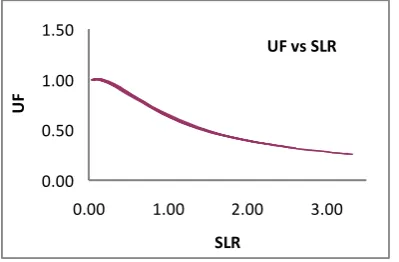
The important hypothesis underlying SAP that needed to be confirmed was that as available solar energy increases the amount of this energy utilised within the heating system decreases. This happens because demand for hot water is limited to daily use and all the solar energy stored on one day is not available the next day because it is partially or wholly lost to the environment overnight. This situation is shown in figure 4 which shows how UF varies with SLR. The figure shows SAP prediction for UF by using equation 3.
UF vs SLR
0.00 0.50 1.00 1.50
0.00 1.00 2.00 3.00
SLR
[image:5.595.310.522.98.224.2]UF
Figure 4 Utilisation factor vs. solar to load ratio (usingequation 3)
The simulation equivalent of this is looking at the boiler energy offset by utilisation of solar energy and comparing this with available solar energy. The method adopted for this comparison was by varying the collector area from 2m2 to 8m2. The remainder of the system was not modified in any way. Hence the solar energy available at the collector increased but demand did not. Simulation results have been integrated for the whole year and displayed in figure 5. The figure shows that solar energy absorbed by the collector (QC) increases with area but boiler energy displaced (QB-QB*) does not show a proportional change. Equivalent SAP prediction is also plotted, this is calculated by applying SAP predicted UF to the solar energy absorbed (QC). Figure 5 shows that as available solar energy increases, the amount of energy utilised by the heating system decreases which is similar to the SAP hypothesis. The actual rates of this decrease are different with SAP predictions showing a greater value for lower solar energy collected. This decreases to less than simulation predicted utilisation as solar energy
collected increases. Overall the SAP hypothesis is confirmed by dynamic thermal simulation.
0 500 1000 1500 2000 2500
2 4 6 8
Collector Area m2
En
e
rgy
kWh
Solar energy absorbed by collector Qc
Energy displaced by collector (TRNSYS) Qb-Qb*
[image:5.595.310.531.330.483.2]Energy displaced by collector (SAP) UF*Qc
Figure 5 Graph showing that as solar energy available at collector increases the actual energy
utilised does not increase proportionally Simulation results also show that although this is the general overall character of the system it might not be true for individual snapshots of system performance. Figure 6 shows results from four days of simulation.
Figure 6 various system and climate parameters for four days of TRNSYS simulation
It was seen that with days of high irradiance the solar collector temperature is higher than tank node 2 temperature most of the time and that the pump comes on heating up the tank. On the second day when it is not very sunny the pump does not come on for a long time. This suggests that whereas utilisation was high for day 2 it was high for day 1 as well because most of the solar heat stored overnight on day 1 would have been used on day 2. The same is not true for day 3 when the following day also has high solar gains. Therefore day 1 and day 3 have different utilisation factors even though they have similar irradiation patterns and SLR. This difference in utilisation only becomes apparent when the next day is also taken into consideration.
[image:5.595.72.272.343.474.2]than the DHW tank because the collector is exposed to external conditions whereas the tank is not. There will be some inertia built into the temperature sensors that switch the pump and there will be some finite dead band that the controls will be subject to. Due to these reasons there will be deviation from equation 3 when SLR is very low and instead of 100% utilisation there will be negligible utilisation. In principal this effect might not make a significant contribution to the overall performance of the SDHW system because this happens in cases when SLR is low. Figure 7 shows a comparison of TRNSYS and SAP predicted UF as SLR varies. The two predict similar UF for an SLR of ~0.9 but it can be seen that as SLR decreases there is divergence in the two predictions. SAP predicted UF approaches unity but TRNSYS predicted UF does not. The two UF also diverge as SLR increases. This divergence is not as
pronounced as when SLR decreases. More
importantly it suggests that as SLR increases more energy is captured in the SDHW system than is predicted by the SAP algorithm.
0.55 0.60 0.65 0.70 0.75 0.80 0.85 0.90
0.40 0.60 0.80 1.00 1.20
SLR
UF
[image:6.595.312.522.72.215.2]Utilisation Factor - TRNSYS UF Utilisation Factor - SAP UF
Figure 7
Utilisation factors predicted by SAP and TRNSYS
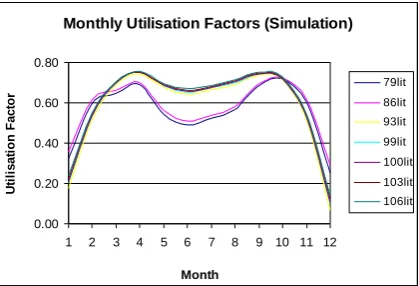
Another issue of interest was how solar energy utilisation varied by time of year. For this investigation TRNSYS was used to predict UF at monthly intervals rather than annual UF as predicted by SAP. It was seen that utilisation was low during the winter months when SLR is low but higher utilisations were observed during spring and autumn. Utilisation was low again during the summer months. This suggests that for the SDHW systems simulated there was not enough irradiation in the winter months for the system to be feasible, mid season and summer months were ideally suited for SDHW operation. Additionally there was excess solar energy available in the summer months hence utilisation was low. Figure 8 shows this characteristic where monthly UF are displayed for various total DHW draws. It was also seen that UF is higher when there is greater draw when SLR is high but lower when SLR is low. Hence UF also depends upon the DHW requirement in addition to SLR.
Monthly Utilisation Factors (Simulation)
0.00 0.20 0.40 0.60 0.80
1 2 3 4 5 6 7 8 9 10 11 12
Month
U
ti
li
s
a
ti
o
n
F
a
c
to
r
79lit
86lit
93lit
99lit
100lit
103lit
106lit
Figure 8 Profile of TRNSYS predicted monthly UF
This forms the basis of developing an empirical algorithm to determine UF based on parametric dynamic simulation runs. These recommendations will improve the accuracy of predicting of UF when
compared to equation 3. The principal
recommendations are:
1. UF should be low when SLR is low
2. UF should not be a function of SLR alone but also of DHW requirement
3. UF should be higher than SAP predictions for cases when SLR is high
In order to quantify these findings and provide an improved algorithm three tank sizes were chosen for further simulations. These were 100, 200 and 300litre capacity tanks. Multiple simulations were carried out for these tanks with various DHW requirements ranging from 79litres to 219litres. This corresponds to floor areas from 50m2 to 2000m2 according to the SAP model. Simulation predicted UF and SAP predicted UF were plotted against SLR. Figure 9 shows how the two UF compare for the 100litre case.
0.00 0.20 0.40 0.60 0.80 1.00 1.20
0.00 0.50 1.00 1.50 2.00 2.50 3.00 3.50
SLR
UF
[image:6.595.71.282.328.488.2]UF - sim UF - SAP
Figure 9 UF as predicted from simulation and SAP
[image:6.595.310.522.494.649.2])
)(
1
(
e
B
C
SLR
UF
ASLR
[6]Where the constants A, B and C would be fitted using experimental data.
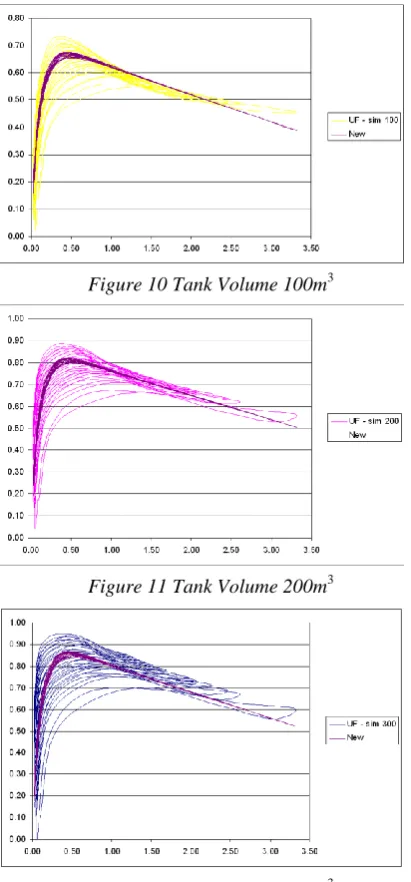
Figures 10, 11 and 12 show graphically the results of the simulations and the new empirical relationship from equation 6.
Figure 10 Tank Volume 100m3
[image:7.595.73.279.152.594.2]Figure 11 Tank Volume 200m3
[image:7.595.71.298.657.736.2]Figure 12 Tank Volume 300m3
Table 1 Experimental values for constants in equation 6
Tank volume m3 A B C
100 10 0.72 0.10
200 10 0.90 0.11
300 10 0.92 0.12
Table 1 gives the values of A, B and C used for the curve fits.
RECOMMENDATIONS FOR FUTURE
WORK
The new equation takes into consideration tank volume but still does not take into account the variation of UF with DHW requirements. This is left as a recommendation for future work. Further work may involve investigating the performance of SDHW systems in more detail and looking at the impact of other design parameters as well, for example set-point temperature and draw-off profile etc.
SAP results are based upon a single weather location, representative for the entire UK. Previous studies (Murphy et al, 2010) have highlighted the impact of differing climate locations when SAP and dynamic simulation tools are compared. A recommended area of future work would be the study of the effect of climate data to SAP Utilisation Factor for SDHW. There is provision for further work regarding reliability of the approach used. The truth model in this case was taken to be TRNSYS but the mathematical model was quasi steady state which can be made more robust by the introduction of a first principles model. This first principles model could then be run parametrically to show that empirical relations are only applicable in their range of experimental conditions. Another restriction in the approach was the use of a steady state load profile and this would not happen in reality.
CONCLUSIONS
SAP is the UK Government’s calculation procedure for energy use of dwellings. It has been developed from experimental evaluations of buildings and related energy systems. It was highlighted that SAP can be restrictive as specific values for SDHW systems cannot be measured. As SAP relies upon a series of simple equations, there is less scope for errors to occur in calculations. This contrasts with detailed analysis tools such as TRNSYS. These systems offer a greater degree of detail to be modelled, but the learning curve required to use these detailed systems is high, as is the possibility to make calculation errors. It is possible to use dynamic thermal simulation in place of experiments to perform the underlying analyses used to inform SAP. This is both cheaper than detailed experimental setups and also takes less time. The solar domestic heating algorithm present within SAP was studied and equivalent parametric simulations were carried out. These simulations explicitly take into account temporal variations in governing thermodynamic properties that are implicitly embedded within the SAP algorithm. It was found that the SAP algorithm
could be enhanced by introducing some
REFERENCES
Anderson, B. R., Chapman P. F., Cutland N. G., Dickson C. Henderson G., Henderson J. H., Iles P. J., Kosmina L., and Shorrock L. D. 2001. BREDEM-12 Model Description, BRE. Garston, UK.
BRE, 2008. SAP 2005. The Government’s Standard Assessment Procedure for Energy Rating of Dwellings. 2005 Edition, revision 2, BRE. Garston, UK.
BS 5918. 1989. Solar heating systems for domestic hot water. British Standards Institute. London, UK.
BS EN 13203-2:2006. Gas-fired domestic appliances producing hot water – Appliances not exceeding 70kW heat input and 300 l water storage capacity – Part 2: Assessment of energy
consumption. British Standards Institiute.
London, UK.
Cooper, G.A., 2008. SAP 2005 and Low Energy Dwellings. Oxford Brookes University, UK.
Crawley D B, Hand J W, Kummert M and Griffith B T (2008) 'Contrasting the capabilities of building
energy performance simulation programs',
Building and Environment, 43(4).
Davidson, 2009. EPBD Energy Calculation
Procedures – an overview. The CENSE Project - Leading the CEN Standards on Energy performance of buildings to practice.
DCLG, 2007. Building Regulations Energy
efficiency requirements for new dwellings – A forward look at what standards may be in 2010 and 2013. Department for Communities and Local Government, London, UK
Duffy, M., Hiller, M., Bradley, D, Keilholz, W., Thornton, J., 2009. TRNSYS – Features and Functionality for Building Simulation 2009 Conference. Eleventh International IBPSA Conference, Glasgow, Scotland. pp1950-1954
Hens, H. 2007. Building Physics – Heat, Air and
Moisture. Fundamentals and Engineering
Methods with Examples and Exercises. Ernest & Sohn.
IEA-SHC, 2004. Recommendation: Converting solar thermal collector area into installed capacity (m² to kWth). International Energy Agency, Solar Heating and Cooling Programme. Available from www.iea-shc.org accessed 2010-12-12
ISO 13790. 2008. Energy performance of buildings – calculation of energy use for space heating and
cooling. International Organisation for
Standardisation. Geneva, Switzerland.
Kokogiannakis G, Strachan P A and Clarke J A (2008) 'Comparison of the simplified methods of
the ISO 13790 Standard and detailed modelling programs in a regulatory context', Building Performance Simulation, V1(4), pp.209-219, ISSN 1940-1493
Kummert, M., Bradley, D., McDowell, T., 2004. TRNSYS Validation – Using validation tool sin the development of TRNSYS 16. TRNSYS Users Day – Transsolar Stutgart March 26 2004. Available from: software.cstb.fr accessed 2010-12-12
Meteotest 2010. Meteonorm - Global Meteorological
Database version 6.1, Meteotest, Bern,
Switzerland.
Murray, M., Finlayson, N., Kummert, M, Macbeth, J., 2009. Live Energy TRNSYS – TRNSYS Simulation within Google Sketchup. Eleventh International IBPSA Conference, Glasgow, Scotland. pp1389-1396
Murphy, G.B., Kummert, M., Anderson, B.R., Counsell, J., 2010. A comparison of the Uk Standard Assessnment Procedure (SAP) and detail simulation of Solar Energy Systems for Dwewllings. Journal of Buildings Performance Simulation, 1940-1507.
Perers, B., Bales, C. 2002. A Solar Collector Model for TRNSYS Simulation and System Testing. IEA – Solar Heating and Cooling Programme.
SAVE N° XVII/4.1031/Z/99-261, 2001. BELAS - Energy Labelling of Existing Buildings.
Scottish Energy Systems Group (SESG), 2010. Available from: www.sesg.strath.ac.uk accessed 2010-12-12
Shorrock L D., Anderson B. 1995. A Guide to the Development of BREDEM. BRE Information Paper IP 4/95. BRE, Garston, UK.
TRNSYS. 2010. TRNSYS 16. Thermal Energy System Specialists, LLC. Madison, Wisconsin, USA.