Bratkowska, D. and Marc, R.M. and Cormack, P.A.G. and Sherrington, D.C. and Borrull, F. and
Fontanals, N. (2010) Synthesis and application of hypercrosslinked polymers with weak cation-exchange
character for the selective extraction of basic pharmaceuticals from complex environmental water
samples. Journal of Chromatography A, 1217 (10). pp. 1575-1582. ISSN 0021-9673
http://strathprints.strath.ac.uk/
27537
/
This is an author produced version of a paper published in
Journal of Chromatography A, 1217 (10).
pp. 1575-1582. ISSN 0021-9673
. This version has been peer-reviewed but does not include the final
publisher proof corrections, published layout or pagination.
Strathprints is designed to allow users to access the research output of the University of
Strathclyde. Copyright © and Moral Rights for the papers on this site are retained by the
individual authors and/or other copyright owners. You may not engage in further
distribution of the material for any profitmaking activities or any commercial gain. You
may freely distribute both the url (
http://strathprints.strath.ac.uk
) and the content of this
paper for research or study, educational, or not-for-profit purposes without prior
permission or charge. You may freely distribute the url (
http://strathprints.strath.ac.uk
)
of the Strathprints website.
Synthesis and application of hypercrosslinked polymers with weak
cation-1
exchange character for the selective extraction of basic pharmaceuticals
2
from complex environmental water samples
3
4
D. Bratkowska,1 R.M. Marcé,1 P.A.G. Cormack,2 D.C. Sherrington,2 F.
5
Borrull1 and N. Fontanals*1
6
7
1 Departament de Química Analítica i Química Orgànica, Universitat Rovira i Virgili,
8
Campus Sescelades Marcel·lí Domingo, s/n, 43007 Tarragona, Spain 9
Phone + 34 977 55 8629 10
Fax +34 977 55 84 46 11
*e-mail: [email protected] 12
2 WestCHEM, Department of Pure and Applied Chemistry, University of Strathclyde,
13
Thomas Graham Building, 295 Cathedral Street, Glasgow, G1 1XL, Scotland 14
15 16
Keywords: Hypercrosslinked sorbents, polymer microspheres, mixed-mode 17
weak cation-exchanger, solid-phase extraction, basic compounds 18
Abstract
37
38
The synthesis of high specific surface area sorbents (HXLPP-WCX) in the form 39
of hypercrosslinked polymer microspheres with narrow particle size 40
distributions, average particle diameters around 6 µm, and weak cation 41
exchange (WCX) character, is described. The WCX character arises from 42
carboxylic acid moieties in the polymers, derived from the comonomer 43
methacrylic acid. A novel HXLPP-WCX sorbent with an attractive set of 44
chemical and physical properties was then used in an off-line solid-phase 45
extraction (SPE) protocol for the selective extraction of a group of basic 46
compounds from complex environmental samples, a priority being the clean 47
separation of the basic compounds of interest from acidic compounds and 48
interferences. The separation power of the new sorbent for basic 49
pharmaceuticals was compared to two commercially available, mixed-mode 50
sorbents, namely Oasis WCX and Strata X-CW. Under identical experimental 51
conditions, HXLPP-WCX was found to deliver both higher capacity and better 52
selectivity in SPE than either of the two commercially available materials. In an 53
optimised SPE protocol, the HXLPP-WCX sorbent gave rise to quantitative and 54
selective extractions of low µg l-1 levels of basic pharmaceuticals present in 500 55
ml of river water and 250 ml of effluent waste water. 56
57
58
59
60
62
Introduction
63
Solid-phase extraction (SPE) is a powerful analytical tool used widely for 64
pre-concentration, fractionation and purification of analytes of interest from 65
complex environmental [1-4] and biological samples (urine, blood and plasma) 66
[5,6]. In recent years, a group of analytes of increasing interest is 67
pharmaceuticals, since they are dispersed
68
a result of human use [5,7], which can give rise to problems including health 69
concerns for humans, therefore there is a demand for analytical methods which 70
enable the accurate determination of pharmaceuticals in the environment, even 71
when the pharmaceuticals are present at low levels. To satisfy this demand, 72
and meet the appropriate detection limits, there is a requirement for suitable 73
pre-concentration techniques which can both concentrate and clean-up the 74
analytes present in the complex environmental matrices. SPE is excellent 75
choice in this regard since it can provide high enrichment factors of the target 76
compounds and eliminate interferences from the sample to be analysed. 77
Polymeric materials are the most important group of sorbent used in SPE, since 78
they offer attractive advantages such as good retention of analytes and sorbent 79
stability under a much broader range of analysis conditions than for sorbents of 80
other types (i.e., silica- and carbon-based sorbents). Several polymeric sorbents 81
have been developed and applied to the extraction of pharmaceuticals [8-10]. 82
In recent years, SPE technology has expanded to offer the use of mixed-83
mode, polymeric ion-exchange media, which combines the attributes of 84
reversed-phase chemistry and ion-exchange interactions into one single 85
ionic species, but they can also retain non-charged species effectively through 87
hydrophobic or hydrophilic interactions [11,12]. Mixed-mode sorbents are 88
classified as either strong or weak ion-exchange, depending on the ionic groups 89
tethered to the sorbent. An important advantage of weak ion-exchange sorbents 90
is that the ionisation state of the resin may be tuned easily by pH, thus adding 91
more versatility and power to SPE applications [12]. Amongst the most popular, 92
commercially available mixed-mode sorbents are Oasis MCX, Oasis MAX, 93
Oasis WCX, and Oasis WAX (all from Waters), which are classified as strong 94
(MCX, MAX) or weak (WCX, WAX) cation/anion-exchange resins, respectively. 95
All four of these interesting sorbents are derived from an Oasis HLB polymeric 96
skeleton [poly(vinylpyrrolidone-co-divinylbenzene), ~800 m2 g-1] which has been 97
modified chemically with sulfonic acid and quaternary ammonium groups in the 98
case of the strong ion-exchangers, and carboxylic acid and piperazine groups in 99
the case of the weak ion-exchangers. In an analogous fashion, Strata-X (a 100
Phenomenex sorbent), which is based on a poly(styrene-co-divinylbenzene) 101
skeleton bearing polar vinylpyrrolidone residues, can be modified chemically to 102
give related sorbents bearing sulfonic acid groups (Strata-X-C), carboxylic acid 103
groups (Strata-X-CW) or ethylene diamine groups (Strata-X-AW). 104
All of these commercial sorbents have macroreticular structures which give 105
rise to weaker reversed-phase interactions with analytes than do 106
hypercrosslinked polymer resins. Hypercrosslinked polymers are a new 107
generation of permanently porous, polymeric resins with enhanced analyte 108
retention characteristics arising from their high micropore contents and 109
correspondingly high specific surface areas (>1000 m2 g-1) [13]. Recently, we 110
anion exchange (WAX) character, and the application of these novel sorbents to 112
the SPE of acidic pharmaceuticals from aqueous samples [14]. 113
The present study describes the synthesis of hypercrosslinked polymer 114
resins with weak cation-exchange (WCX) character, where the WCX properties 115
are derived from the presence of carboxylic acid moieties, and the application of 116
these sorbents to the SPE of basic pharmaceuticals from complex 117
environmental samples. The new materials have been bench-marked against 118
Strata-X-CW and Oasis WCX. Although previously porous polymer containing 119
methacrylic acid (MAA) in monolith format has been applied to in-tube-solid-120
phase microextraction (SPME)-liquid chromatography (LC) for the extraction of 121
drugs from complex sample matrices [15]; as far as we are aware, this is the 122
first time that a hypercrosslinked sorbent has been used as a weak cation-123
exchanger for the selective extraction of basic pharmaceuticals from complex 124
environmental samples, which also contain acidic and neutral compounds. 125
126
2. Experimental
127
2.1 Reagents and standards
128
The reagents used for the polymer syntheses were divinylbenzene (DVB) 129
(80% grade) supplied by Aldrich (Steinheim, Germany), methacrylic acid (MAA) 130
(98% grade) and para-vinylbenzyl chloride (VBC) (95% grade) supplied by 131
Fluka (Buchs, Switzerland). DVB and VBC were purified by passing through 132
short columns packed with neutral alumina. MAA was purified by vacuum 133
distillation. The 2,2’-azobisisobutyronitrile (AIBN) used as initiator was supplied 134
Darmstadt, Germany). Ferric chloride (FeCl3) and anhydrous 1,2-dichloroethane 136
(DCE), from Aldrich, were used in the hypercrosslinked reactions. 137
The pharmaceutical analytes selected to evaluate the performance of the 138
sorbents in SPE were: acetaminophen, caffeine, antipyrine, propranolol, 139
carbamazepine, naproxen and diclofenac (all obtained from Sigma-Aldrich). The 140
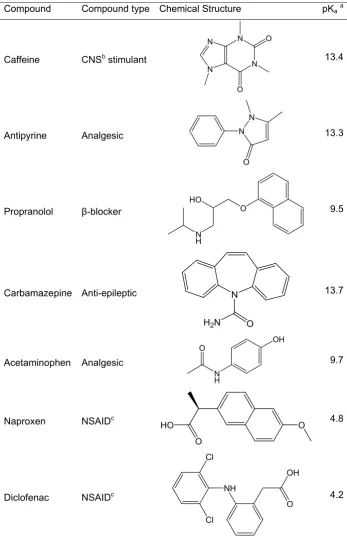
chemical structures and pKa values of the analytes are presented in Table 1. 141
Standard solutions at 1000 mg l-1 in methanol were prepared for each 142
analyte. The mixture of all the analytes was prepared by diluting the standard 143
solutions with MeOH:H2O (1:1, v/v). 144
LC-grade acetonitrile and methanol (SDS, Peypin, France) and Milli-Q 145
water (Millipore, Bedford, MA, USA) were used to prepare the mobile phases. 146
Hydrochloric acid (Probus, Barcelona, Spain) was used to adjust the pH of the 147
mobile phase and the sample before SPE. Other reagents used in SPE 148
procedures were: ammonium hydroxide (NH4OH) (Merck), formic acid 149
(HCOOH) (Probus) and trifluoroacetic acid (TFA) (Fluka). 150
2.2 Resin preparation and characterisation
151
The micron-sized spherical particles (PP-WCX) used as swellable 152
precursors in the production of the hypercrosslinked resins (HXLPP-WCX), 153
were synthesised using an optimised precipitation polymerisation (PP) protocol 154
[16]. The monomers (10% MAA, 50% VBC and 40% DVB [% w/w]) and AIBN (2 155
mol% relative to polymerisable double bonds) were dissolved in acetonitrile 156
(200 ml) in a polypropylene bottle (250 ml) at a total monomer concentration of 157
2% w/v. The monomer solution was de-oxygenated with N2 at 0 oC and the 158
bottle then placed on a low-profile roller (Stovall, Essex, UK) in a temperature-159
ramped from ambient to 60 oC over a period of ~ 2 hours and the polymerisation 161
allowed to proceed at 60 oC for a further 46 hours. The resulting particles were 162
filtered on a 0.2 µm nylon membrane filter and washed successively with 163
MeOH, toluene and acetone, before overnight drying in vacuo at 40 oC. 164
The hypercrosslinked reactions of the MAA-VBC-DVB precursors were 165
carried out as described in previous study [16], using a well-established reaction 166
for the VBC-DVB precursor. 167
The hypercrosslinked resin (HXLPP-WCX) was characterised by 168
measuring specific surface area using a BET treatment of N2 sorption isotherm 169
data generated on a Micromeritics ASAP 2000 porosimeter. The carbon (83.1% 170
w/w), hydrogen (7.2% w/w), chlorine (2.5% w/w) and oxygen (6.3% w/w, 171
calculated by difference) contents for the resin were obtained by elemental 172
microanalysis using a Carlo-Erba EA 1106 instrument. The cation-exchange 173
capacity was calculated from the microanalytical data using the theoretical 174
values. The average microsphere diameter and homogeneity in size (particle 175
size distribution) were calculated using ImageJ software from the image 176
analysis of 100 individual particles in scanning electron microscopy (SEM) 177
images, which were acquired using a JEOL 6400 Instrument. SEM image for 178
the HXLPP-WCX resin is included in Figure 1S of the Supported Information 179
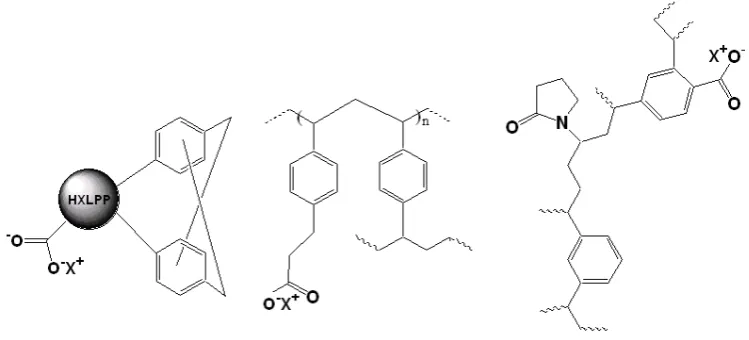
Section. A schematic representation of the structure of HXLPP-WCX is depicted 180
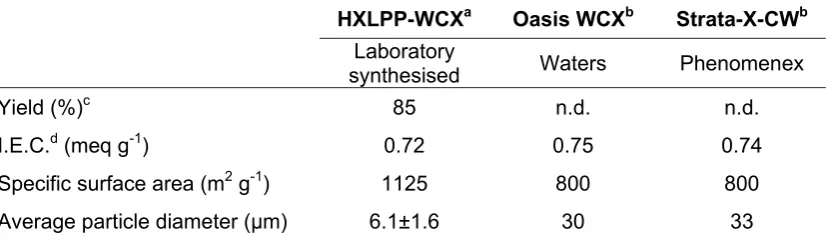
in Figure 1. The characterisation data for all the sorbents studied is detailed in 181
Table 2. 182
2.3 Chromatographic equipment and conditions
183
The chromatographic experiments were performed with an HP 1090 Liquid 184
Agilent 1200 UV spectrophotometric detector (Agilent, Waldbronn, Germany). 186
The analytical column was a 250 mm × 4.6 mm i.d. stainless-steel column 187
packed with Kromasil 100 C18, 5 μm (Teknokroma, Barcelona, Spain). 188
The mobile phases were Milli-Q water adjusted to pH 3 with HCl (solvent 189
A) and acetonitrile (solvent B). The flow rate was 1 ml min-1 and the 190
temperature of the column oven was set at 65 ºC. The gradient profile was from 191
10% to 15% ACN in 5 min, then to 100% ACN in 25 min (held for 2 min), then 192
the mobile phase was returned to the initial conditions (10% ACN) in 3 min. 193
The detection wavelength for all the compounds was 210 nm. 194
2.4 Solid-phase extraction
195
SPE cartridges (6 ml, polypropylene) were packed with 200 mg of the 196
HXLPP-WCX sorbent. The sorbent was retained by two frits: a 2 µm pore size 197
metal frit at the bottom, and a 20 µm pore size polyethylene frit at the top. The 198
retention capabilities of the novel sorbent was compared to commercial SPE 199
cartridges from Phenomenex (Strata-X-CW; 200 mg/6 ml) and Waters (Oasis 200
WCX; 200 mg/6 ml) (which was packed manually). A vacuum manifold 201
(Teknokroma) was used to manipulate the cartridges in the off-line SPE 202
process. One single sorbent cartridge of each type was used for the whole 203
study. The three sorbent structures are presented in Figure 1. 204
Prior to the SPE extractions, the pH of the sample was adjusted to 7 with 205
HCl or NaOH. The procedure used for all cartridges was identical: the cartridge 206
was activated with 5 ml of MeOH followed by 2 ml of Milli-Q water, and the 207
sample then loaded at a flow rate 10 ml min-1. After equilibration, the cartridge 208
was washed with 2 ml 5% NH4OH in MeOH. Finally, the compounds were 209
Prior to LC analyses, the SPE eluates were evaporated to dryness and 211
then reconstituted in 1 ml of MeOH:H2O (1:1, v/v). 212
To keep the samples under proper conditions, real water (Ebre river water 213
and effluent waste water from a treatment plant) were adjusted to ~ pH 3 with 214
HCl and kept at 4 ºC before analysis. They were filtered through 0.22 μm nylon 215
membranes (Supelco, Bellefonte, PA, USA) prior to the preconcentration step to 216
eliminate the particulate matter which is normally present in real samples. 217
218
3. Results and discussion
219
3.1 Preparation of the HXLPP-WCX sorbent
220
The novel WCX hypercrosslinked sorbent (HXLPP-WCX) was derived from 221
a swellable copolymer precursor (PP-WCX) prepared by precipitation 222
polymerisation (PP). PP is a simple, straightforward and reproducible method 223
for obtaining, in one single preparative step, spherical polymer particles with 224
average diameters in the low micron size regime which, as has been 225
demonstrated previously [14,17,18], perform well as novel sorbents in SPE 226
applications. The aim of the present work was to synthesise a hypercrosslinked 227
derivative of the terpolymer poly(MAA-co-VBC-co-DVB), and thereby access a 228
resin which combined both weak cation-exchange character (through the MAA 229
residues present) and high specific surface area derived from its high micropore 230
content (from hypercrosslinking reactions which consume the pendent 231
chloromethyl groups). During the production of the poly(MAA-co-VBC-co-DVB) 232
precursor polymer, various comonomer ratios were evaluted (data not shown); 233
50%VBC, 40% DVB [w/w]) was found to offer the optimal balance of properties, 235
i.e., suitable ion-exchange capacity and particle size, and high specific surface 236
area. 237
The resin characterisation data for HXLPP-WCX is detailed in Table 2. The 238
specific surface area was 1125 m2 g-1 and the cation-exchange capacity 0.72 239
meq g-1. Following on from the development of a convenient synthetic route into 240
an HXLPP-WCX resin, our aim was to evaluate the potential benefits in SPE of 241
introducing carboxylic acid moieties into hypercrosslinked polymer 242
microspheres, and to compare the performance of this new resin to the 243
commercially available sorbents (more specifically, Oasis-WCX and Strata-X-244
CW). The characterisation data for all three sorbents is detailed in Table 2. The 245
ion-exchange capacity is similar for all three sorbents (~ 0.75 meq g-1), however 246
the particle size of the HXLPP-WCX sorbent (~ 6 µm) is markedly lower than 247
either of the other two materials. The lower particle size of the sorbent might 248
provide better contact with the analytes to be extracted, and, thus, benefit in the 249
SPE process. 250
251
3.2 SPE optimisation
252
Pharmaceuticals bear a variety of functional groups and they can be 253
cationic, anionic or zwitterionic depending on the sample pH. Some 254
pharmaceuticals contain nitrogen-containing functional groups which are basic 255
and will therefore be readily protonated to give a cation under certain conditions 256
[19,20]. To evaluate the cation-exchange properties of the HXLPP-WCX 257
sorbent, and establish the scope of its sorption characteristics, we selected a 258
Besides the selection of analytes with a wide range of acidic/basic 260
properties, to test the performance of the WCX sorbents in an accurate and 261
reliable manner it was necessary to optimise the SPE conditions in such a way 262
as to maximise the retention of the analytes on the sorbents. Optimal retention 263
conditions are those for which ionic interactions between the MAA residues in 264
the sorbent and the cationic forms of the analyte are maximised. 265
3.2.1 Sample loading 266
Since HXLPP-WCX is a cation-exchange material, the analyte retention 267
mechanism is based on ionic interactions between carboxylic acid groups in the 268
polymer and the pharmaceuticals. Thus, the pH of the sample during analyte 269
extraction by the sorbent is an important parameter to be optimised. 270
To investigate the retention properties of the HXLPP-WCX sorbent, 100 ml 271
volumes of two separate samples (at pH 3 and pH 7, respectively) were 272
percolated through SPE cartridges packed with the sorbent. At pH 3 the 273
carboxylic acid groups of the acidic compounds and the sorbent are primarily in 274
their non-ionised form, whereas the basic compounds are fully ionised. In 275
contrast, at pH 7 the carboxylic acid-containing acidic compounds are 276
deprotonated and are eluted during the SPE washing step, while the carboxylic 277
acid residues in the polymer are ionised and retain the basic pharmaceuticals 278
(protonated) by ionic interactions. Thus, cation-exchange phenomena are 279
expected to be more effective at pH 7 than at pH 3. When preliminary SPE 280
experiments were performed to confirm these expectations, the recoveries of 281
the basic compounds were found to be lower at pH 3 and very high at pH 7. For 282
this reason, samples were adjusted to pH 7 in all the subsequent SPE 283
3.2.2 Washing step 285
The aim of the washing step was to eliminate interferences (including 286
acidic and neutral compounds) bound to the sorbent through reserved-phase 287
mechanisms, while retaining on the sorbent the basic compounds bound 288
through cation-exchange interactions. 1 ml volumes of various neat organic 289
solvents (such as methanol and acetonitrile) were applied in the washing step, 290
but in such cases all the analytes were eluted. Thus, we decided to use a 291
solution of NH4OH in organic solvent as the washing solution, to maintain the 292
desired ionisation state of the analytes and the sorbent. In this regard, the 293
following solutions were evaluated: 5% NH4OH in MeOH; 5% NH4OH in ACN; 294
5% NH4OH in MeOH/ACN (1/4). Of these three options, 5% NH4OH in MeOH 295
gave higher recoveries for all analytes than the other two washing solution and 296
was thus selected as the washing solvent of choice. Thereafter, the next step 297
was to evaluate the optimum volume of the washing solvent to be used in the 298
SPE protocol. For these experiments, where the sample matrix was Milli-Q 299
water, 1 ml of 5% NH4OH in MeOH was used initially. Although this volume of 300
washing solvent was found to be not enough to elute all the acidic compounds 301
quantitatively, 2 ml of 5% NH4OH in MeOH was found to be effective for this 302
purpose so was established as the optimal volume of washing solvent required 303
to elute acidic compounds and interferences, whilst still allowing total retention 304
of the analytes of interest (i.e., basic compounds). 305
3.2.3 Elution of basic compounds 306
For the elution step, in which the aim was to elute the basic compounds 307
bound to WCX sorbents through ionic interactions, various acidic solutions were 308
break the cation-exchange interactions and leads to release of the basic 310
analytes from the sorbents thanks to the elution strength of the organic solvent 311
also present in the solution). For this purpose, 5 ml aliquots of 2% HCOOH in 312
MeOH, 2% TFA in MeOH and 2% TFA in MeOH/ACN (1/4) were investigated. 313
Since 2% TFA in MeOH delivered the best results (higher recoveries than for 314
2% HCOOH in MeOH), and did not give any significant disturbance in the LC 315
separation of the analytes, it was selected for use in the elution step. 2% TFA in 316
MeOH/ACN (1/4) delivered good results also, but required longer evaporation 317
times. 5 ml of 2% TFA in MeOH was found to be sufficient to elute completely 318
all of the basic compounds, so was set as the optimal volume of elution solvent. 319
3.2.4 Volume of sample 320
Once the SPE protocol had been established, the effect of varying the 321
volume of sample in the loading step (from 100 to 1000 ml) was investigated as 322
a manner to predict the extraction capacity of the sorbent. The HXLPP-WCX 323
sorbent gave rise to good recoveries of analytes even when the sample volume 324
was 1000 ml (Table 3). Typically, the recoveries of the basic analytes were 325
close to 100% for the WCX sorbent. Only for antipyrine did the HXLPP-326
WCX resin gave rise to a small degree of fractionation; for example, when 1000 327
ml of sample spiked at 20 μg l-1 with the analyte mixture were extracted, the 328
recovery of antipyrine in the elution step was 79%, with the remainder (15%) 329
being eluted in washing step. In view of the pKa (13.3) and chemical structure of 330
antipyrine, this behaviour may be attributable to the stronger retention of 331
antipyrine through hydrophobic interactions. 332
Therefore, we have demonstrated that the HXLPP-WCX sorbent is highly 333
(1000 ml) aqueous samples, after a washing step with 2 ml of 5% NH4OH in 335
MeOH, a feature which helps greatly in the removal of interferences from the 336
sample matrix. 337
3.3 Comparison to commercial sorbents 338
The SPE performance of the HXLPP-WCX sorbent was compared to 339
Strata-X-CW and Oasis WCX. The former had a specific surface area of 1125 340
m2 g-1
(
arising from the high micropore content) whereas the commercially 341available sorbents, which are not hypercrosslinked, have lower specific surface 342
areas (800 m2 g-1). A second notable difference between the HXLPP-WCX 343
sorbent and the commercially available sorbents is the particle size; the 344
HXLPP-WCX sorbent is in the form of microspheres with average particle 345
diameter around 6 μm, whereas the average particle size of Strata X-CW and 346
Oasis WCX are both significantly larger at around 30 μm. 347
The SPE results arising from use of the three different resins are 348
presented in Table 3. It can be seen that the analyte recoveries were higher for 349
all compounds with HXLPP-WCX than either Strata-X-CW or Oasis WCX. 350
When varying sample volumes were percolated through the Strata-X-CW and 351
Oasis WCX cartridges, most of the compounds were either eluted in the 352
washing step or fractionated between the washing and the elution steps; the 353
retention of certain analytes was also low compared to HXLPP-WCX. 354
When 1000 ml of sample was percolated through Strata-X-CW, the 355
recoveries of the acidic analytes in the washing step were 9% for 356
acetaminophen, and close to 50% for naproxen and diclofenac. It was also 357
The Oasis WCX sorbent, which has properties similar to Strata-X-CW, 359
was found to be even less useful than Strata-X-CW for the capture of basic 360
pharmaceuticals; for Oasis WCX all the compounds retained very poorly and 361
were eluted primarily during the washing step. 362
Another interesting feature relates to the retention behavior of naproxen 363
and diclofenac, which have pKa values of 4.8 and 4.2, respectively. These 364
compounds were eluted nearly quantitatively (%R ∼100%) during the washing 365
step when percolated through the HXLPP-WCX sorbent, but they were not 366
recovered completely by the commercial sorbents, which can be attributed to 367
losses of these analytes during the loading step. This behaviour for this pair of 368
analytes may be due to the weaker reversed-phase retention mechanisms 369
operating for the commercially available sorbents. In any case, it is evident that, 370
the HXLPP-WCX sorbent gives higher recoveries for all of the target analytes 371
than the two commercial WCX sorbents, which, due to its not suitable results 372
were not further tested. 373
374
3.3 Application to real samples
375
Given the highly promising SPE data obtained with HXLPP-WCX when 376
the SPE protocol was applied to Milli-Q water, an analogous protocol was 377
applied to the analysis of Ebre river water and effluent waste water. As is 378
common practice, for the analysis of real water samples the sample volume 379
loaded onto the SPE cartridges is normally lower than the sample volume 380
applied when the analytes are in Milli-Q water due to the presence of 381
interferences in real samples which compete with the analytes for binding to the 382
utility of the HXLPP-WCX sorbent for the analysis of real water samples, the 384
initial SPE experiments involved the percolation of 500 ml sample of Ebre river 385
water spiked at 1 μg l-1 through cartridges packed with the sorbent (thereafter, 386
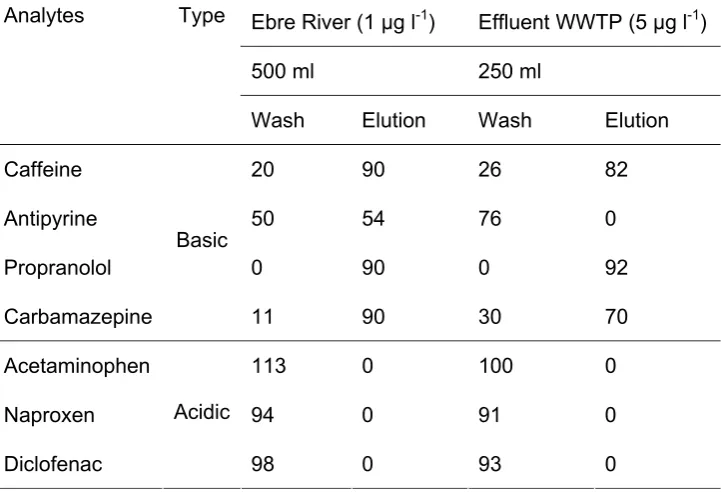
the remainder of the SPE protocol was as detailed in Section 2). Table 4 387
summarises the recovery values obtained for the various analytes on the 388
HXLPP-WCX sorbent. From these results it can be observed that when 500 ml 389
of a river water sample was loaded onto the SPE cartridge the recovery values 390
for the analytes were high and similar to those obtained for Milli-Q water, with 391
the exception of antipyrine which showed a higher level of fractionation than for 392
the Milli-Q water case. 393
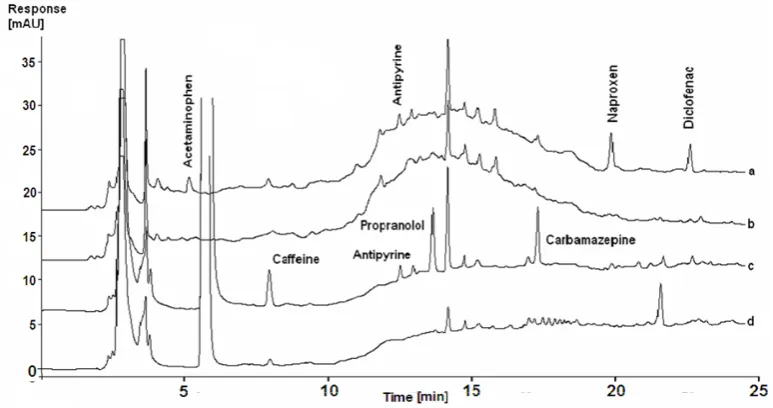
Fig. 2 shows the chromatograms obtained following preconcentration on 394
HXLPP-WCX of 500 ml of non-spiked (Fig. 2b, 2d) and spiked (at 1 µg l-1 for 395
each analyte; Fig. 2a, 2c) Ebre river water. For the river water samples, a signal 396
was detected at the retention time corresponding to caffeine (see the non-397
spiked Ebre river water chromatogram, Fig. 2d), but further analysis by a 398
confirmatory technique such as mass spectrometry (MS) may be appropriate 399
here. Typical chromatograms for the washing step, where all the interferences 400
and acidic analytes retained on the cartridges through reversed-phase 401
mechanism are eluted from the sorbents, are shown in Fig. 2a (spiked) and Fig. 402
2b (non-spiked). Typical chromatograms for the elution step, where the target 403
analytes retained through weak cation-exchange interactions (i.e., mainly the 404
basic analytes) are eluted from the sorbents, are shown in Fig. 2c (spiked) and 405
Fig. 2d (non-spiked). It is important to note the cleanliness of the 406
chromatograms, an observation which is particularly striking when one 407
analyses. Both the selectivity and sensitivity of the analyses could be improved 409
further by using more powerful detector such as mass spectrometer. 410
To demonstrate the selectivity of the HXLPP-WCX sorbent, a further set 411
of SPE experiments was performed using dirtier sample matrices, including 412
effluent water from a wastewater treatment plant (WWTP). The recovery values 413
obtained when 250 ml of effluent WWTP samples, spiked at 5 μg l-1, was 414
percolated through the HXLPP-WCX sorbent, is shown in Table 4. In general, 415
the HXLPP-WCX sorbent gave good recoveries for most of the analytes 416
studied, with the exception of antipyrine and carbamazepine. The recovery of 417
carbamazepine in the elution step was 70%, the remaining 30% being eluted in 418
washing step. As regards antipyrine, its elution profile, when loaded onto the 419
HXLPP-WCX sorbent, was the reverse of that expected, i.e., it was eluted in the 420
washing step. In fact, antipyrine had already presented retention problems 421
when present in other aqueous matrices, and these problems may be magnified 422
when antipyrine is present in more complex samples since natural organic 423
matter and other compounds present in wastewater matrices give rise to 424
increased competition for binding to the sorbent. 425
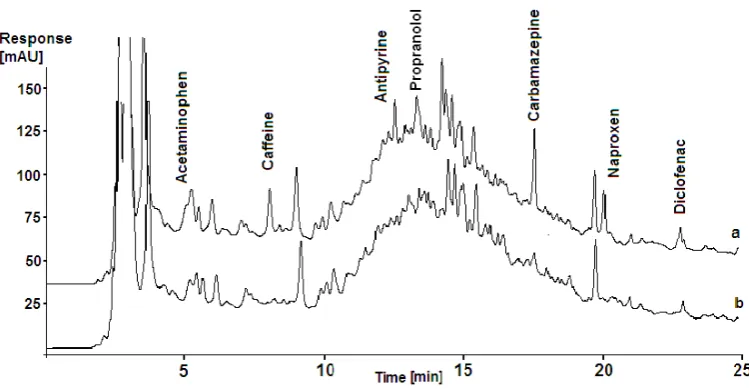
Fig. 3 shows the elution chromatograms obtained after percolation of 250 426
ml of an effluent WWTP sample through the HXLPP-WCX sorbent without (Fig. 427
3b) and with (Fig. 3a) the addition of the mixture of analytes at the 5 µg l-1 level. 428
To emphasise the importance and effectiveness of the washing step for this 429
complex sample matrix, we performed this particular analysis without a washing 430
step; after the loading of 250 ml of effluent wastewater spiked at the 5 µg l-1 431
level with the mixture of analytes, all the analytes were eluted directly with 5 ml 432
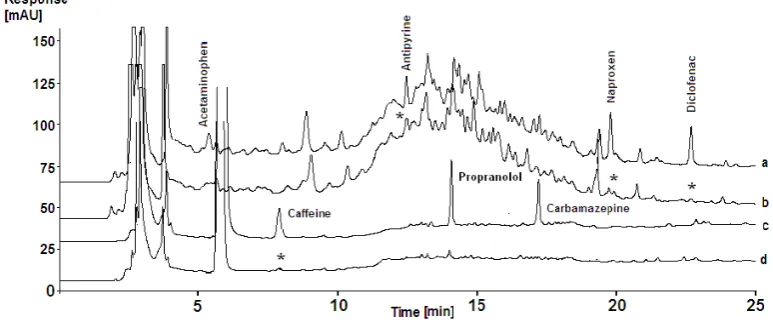
re-introducing the methanol-based washing step was then examined in an effort 434
to remove interferences. Fig. 4 shows the washing (Fig.4a, 4b) and elution 435
(Fig.4c, 4d) chromatograms obtained after the percolation of a 250 ml effluent 436
WWTP sample through the HXLPP-WCX sorbent without (Fig. 4b, 4d) and with 437
(Fig. 4a, 4c) the addition of the mixture of analytes at the 5 µg l-1 level. For the 438
effluent WWTP sample, peaks were observed at the retention times 439
corresponding to antipyrine, naproxen and diclofenac (Fig. 4b) and caffeine 440
(Fig. 4d), but these results should be affirmed by a more powerful detector. 441
In addition to the marked improvements in the quality of the 442
chromatograms, the new sorbent allows a more accurate quantification of 443
analytes at lower concentration levels in complex matrices without the analytes 444
being masked by interferences. The main point of all is the fact that the 445
recovery of all the basic analytes of interest is complete in these complex 446
environmental samples, on account of the WCX interactions which lead to high 447
analyte recoveries (and clean chromatograms). In addition, the cleanliness of 448
the extracts obtained after SPE with the HXLPP-WCX sorbent is an added 449
advantage in respect of the potential to reduce or avoid ion-suppression effects 450
in the case of determination by LC-MS with electrospray ionisation. 451
In validation studies using 500 ml of river water and 250 ml of effluent 452
WWTP, all the basic analytes exhibited good linearity. In river water all the 453
analytes exhibited a linear range from 0.5-50 μg l-1, with determination 454
coefficients (r2) greater than 0.992. The limits of detection (LODs), calculated on 455
the basis of a signal to noise ratio ≥ 3, were 0.1 μg l-1 for all the basic analytes. 456
The repeatability and reproducibility of the method, expressed as the relative 457
at 1 μg l-1, were less than 14% for all the basic analytes. For effluent waste 459
water, all the analytes exhibited a good linear range (1-50 μg l-1) with r2 greater 460
than 0.984. The LODs were 0.5 μg l-1 for most of compounds, with the 461
exception of caffeine where the LOD was 1 μg l-1. Although the LODs are not as 462
low as those reported for some environmental water samples [21,22], they 463
could be decreased markedly by the introduction of a more sensitive detection 464
system, such as tandem mass spectrometry. Moreover, the cleanliness of the 465
chromatograms will tend to reduce or prevent ion-enhancement/suppression 466
effects when LC-MS is used. 467
468
4. Conclusions
469
In this study the synthesis of hypercrosslinked polymer resin with weak cation-470
exchange is described, and a detailed investigation carried out with respect to 471
the application of this sorbent to the SPE of basic pharmaceuticals from 472
complex environmental samples. The resin was produced via the 473
hypercrosslinking of swellable polymers precursors which were synthesised via 474
precipitation polymerisation. The WCX properties are derived from the presence 475
of carboxylic acid moieties in the polymer. 476
This is the first time that a hypercrosslinked polymer resin has been exploited 477
as weak cation-exchanger for the SPE of basic pharmaceuticals. Following 478
optimisation of the SPE protocol, it was found that the novel HXLPP-WCX 479
sorbent enabled essentially quantitative recovery, and adequate selectivity, of 480
most of the analytes tested, and performed well as a weak cation-exchanger. In 481
contrast, the commercially available sorbents Strata-X-CW and Oasis WCX 482
mechanism and remove acidic analytes during the washing step. The highest 484
extraction efficiency was achieved with the HXLPP-WCX sorbent. Overall, the 485
HXLPP-WCX sorbent proved to be highly effective for the preconcentration of 486
basic analytes present in complex environmental water samples. 487
488
Acknowledgements
489
The authors thank the Ministry of Science and Innovation in Spain for the 490
financial support (Projects CTQ 2008-0825 and CTM 2008-06847-CO2-01). NF 491
also thanks the Juan de la Cierva program for personal funding. 492
References:
[1] N. Fontanals, R.M. Marcé, F. Borrull, Trends Anal. Chem. 24 (2005) 394. [2] C.F. Poole, Trends Anal. Chem. 22 (2003) 362.
[3] S.D. Richardson, T.A. Ternes, Anal. Chem. 77 (2005) 3807. [4] H. Kataoka, Trends Anal. Chem. 22 (2003) 232.
[5] H. Mai-Ling, J. Ming, W. Peng, M. Su-Rong, L. Yan-Fei, H. Xiao-Zhong, S. Yun, L. Bin, D. Kang, Anal. Bioanal. Chem. 387 (2007) 1007.
[6] P. Puig, F. Borrull, M. Calull, C. Aguilar, Anal. Chim. Acta 616 (2008) 1. [7] T. Heberer, Toxicol. Lett. 131 (2002) 5.
[8] F. Ahmadi, A.A. Shahsavari, M. Rahimi-Nasrabadi, J. Chromatogr. A 1193 (2008) 26.
[9] B. Rezaei, S. Mallakpour, N. Majidi, Talanta 78 (2009) 418.
[10] A. Beltran, E. Caro, R.M. Marcé, P.A.G. Cormack, D.C. Sherrington, F. Borrull, Anal. Chim. Acta 597 (2007) 6.
[11] M.S. Landis, J. Pharm. Biomed. Anal. 44 (2007) 1029.
[12] N. Fontanals, R.M. Marcé, F. Borrull, J. Chromatogr. A 1152 (2007) 14. [13] V. Davankov, M. Tsyurupa, M. Ilyin, L. Pavlova, J. Chromatogr. A 965 (2002) 65.
[14] N. Fontanals, P.A.G. Cormack, D.C. Sherrington, J. Chromatogr. A 1215 (2008) 21.
[15] M. Zhang, F. Wei, Y.-F. Zhang, J. Nie, Y.-Q. Feng, J. Chromatogr. A 1102 (2006) 294.
[16] N. Fontanals, P. Manesiotis, D.C. Sherrington, P.A.G. Cormack, Adv. Mater. 20 (2008) 1298.
[17] N. Fontanals, R.M. Marcé, P.A.G. Cormack, D.C. Sherrington, F. Borrull, J. Chromatogr. A 1191 (2008) 118.
[18] D. Bratkowska, N. Fontanals, F. Borrull, P.A.G. Cormack, D.C. Sherrington, R.M. Marcé, J. Chromatogr. A (2009) in press, DOI. 10.1016/j.chroma.2009.08.091.
[19] S. Mitra, Sample Preparation Techniques in Analytical Chemistry, Wiley, New York, 2003.
[20] O. Lorphensria, J. Intravijita, D. A. Sabatinib, T.C.G. Kibbeyb, K. Osathaphanc, C. Saiwand, Water Res. 40 (2006) 1481.
Table 1. Chemical structures and pKa values of the selected analytes. Compound Compound type Chemical Structure pKaa
Caffeine CNSb stimulant
O N
N N
N
O
13.4
Antipyrine Analgesic
O N
N
13.3
Propranolol β-blocker
HO
N H
O 9.5
Carbamazepine Anti-epileptic N
O
H2N
13.7
Acetaminophen Analgesic
O
N H
OH
9.7
Naproxen NSAIDc
O
HO O 4.8
Diclofenac NSAIDc
O OH
NH Cl
Cl
4.2
a pK
a values calculated using Advanced Chemistry Development (ACD/Labs) Software V8.14 for
Solaris (© 1994-2009 ACD/Labs)
b Central nervous system
Table 2.Characterisation data for the sorbents tested in SPE.
HXLPP-WCXa Oasis WCXb Strata-X-CWb Laboratory
synthesised Waters Phenomenex
Yield (%)c 85 n.d. n.d.
I.E.C.d (meq g-1) 0.72 0.75 0.74
Specific surface area (m2 g-1) 1125 800 800
Average particle diameter (μm) 6.1±1.6 30 33
n.d. no data
a Data measured experimentally
b Data provided by the supplier
c Relative to the mass of the corresponding (non-hypercrosslinked) precursor particles
Table 3. Recovery values (%) obtained when the HXLPP-WCX, Strata-X-CW and Oasis WCX sorbents were applied in SPE for the preconcentration of 1000 ml of a Milli-Q sample spiked at 20 μg l-1 with the analyte mixture.
HXLPP-WCX Strata-X-CW Oasis WCX Analytes Type
Wash Elution Wash Elution Wash Elution
Caffeine 5 93 47 17 60 5
Antipyrine 15 79 55 11 91 0
Propranolol 0 93 48 40 73 13
Carbamazepine
Basic
4 107 31 46 90 15
Acetaminophen 87 0 9 0 17 0
Naproxen 99 6 47 17 74 3
Diclofenac
Acidic
94 13 45 22 77 11
For the experimental conditions, see text.
Table 4. Recovery values (%) obtained when the HXLPP-WCX sorbent was applied in SPE for the preconcentration for different real samples spiked with the analyte mixture.
For the experimental conditions, see text.
% Relative standard deviations (RSDs) (n=3) were lower than 14% for %R >11%.
Ebre River (1 µg l-1) Effluent WWTP (5 µg l-1)
500 ml 250 ml
Analytes Type
Wash Elution Wash Elution
Caffeine 20 90 26 82
Antipyrine 50 54 76 0
Propranolol 0 90 0 92
Carbamazepine
Basic
11 90 30 70
Acetaminophen 113 0 100 0
Naproxen 94 0 91 0
Diclofenac
Acidic
Figure captions
Fig. 1 Chemical structures of the sorbents tested: HXLPP-WCX, Strata-X-CW and OasisWCX
Fig. 2 Chromatograms obtained after off-line trace enrichment with HXLPP-WCX of 500 ml of Ebre river water sample with (a,c) and without (b,d) addition of a 1 μg l-1 level of analyte mixture: washing step (a, b) and elution step (c, d).
Fig. 3 Chromatograms obtained after off-line trace enrichment with the HXLPP-WCX sorbent of 250 ml of effluent WWTP sample with (a) and without (b) the addition of a 5 μg l-1 level of an analyte mixture (without a washing step).