City, University of London Institutional Repository
Citation
:
Weerasinghe, D., Rajarajan, M., Elmufti, K. & Rakocevic, V. (2008). Patientprivacy protection using anonymous access control techniques. Methods of Information in Medicine, 47(3), pp. 235-240. doi: 10.3414/ME9116
This is the unspecified version of the paper.
This version of the publication may differ from the final published
version.
Permanent repository link:
http://openaccess.city.ac.uk/620/Link to published version
:
http://dx.doi.org/10.3414/ME9116Copyright and reuse:
City Research Online aims to make research
outputs of City, University of London available to a wider audience.
Copyright and Moral Rights remain with the author(s) and/or copyright
holders. URLs from City Research Online may be freely distributed and
linked to.
City Research Online: http://openaccess.city.ac.uk/ [email protected]
Patient Privacy Protection Using Anonymous
Access Control Techniques
D. Weerasinghe, M. Rajarajan, K. Elmufti, V. Rakocevic
School of Engineering and Mathematical Sciences, City University, London, UK
Summary
Objective:The objective of this study is to develop a solution to preserve security and privacy in a healthcare environment where health-sensitive information will be accessed by many parties and stored in various dis-tributed databases. The solution should maintain anonymous medical records and it should be able to link anonymous medical information in distributed databases into a single patient medical record with the patient identity.
Methods:In this paper we present a protocol that can be used to authenticate and authorize patients to healthcare services without providing the patient identi-fication. Healthcare service can identify the patient using separate temporary identities in each identifica-tion session and medical records are linked to these temporary identities. Temporary identities can be used to enable record linkage and reverse track real patient identity in critical medical situations.
Results:The proposed protocol provides main security and privacy services such as user anonymity, message privacy, message confidentiality, user authentication, user authorization and message replay attacks. The medical environment validates the patient at the healthcare service as a real and registered patient for the medical services. Using the proposed protocol, the patient anonymous medical records at different health-care services can be linked into one single report and it is possible to securely reverse track anonymous patient into the real identity.
Conclusion:The protocol protects the patient privacy with a secure anonymous authentication to healthcare services and medical record registries according to the European and the UK legislations, where the patient real identity is not disclosed with the distributed patient medical records.
Keywords
Anonymous medical service, record linkage, healthcare security, patient privacy
Methods Inf Med 2008; 47:■–■
doi:10.3414/ME9116
1. Introduction
Electronic or mobile healthcare networks are established by connecting information systems used by general practitioners, hospitals and national/private medical centres. This approach is an attractive sol-ution for the already overstretched and under-budgeted health sector since it re-duces the current paper-based work, de-creases waiting time, eliminates prior ap-pointment requirements, enhances health-care services with efficient, faster and more reliable methods, eliminates errors that can happen in the paper records and speeds up administrative procedures [1]. However, the development of such a working model in live medical environment will be subjected to an increase in the amount of sensitive medical information being transferred be-tween different parties, with the data trans-port taking place over the Internet or the mo-bile network. The key problem with this is the security and privacy of communication, especially preserving the patient privacy by preserving the integrity of the information about the health condition and medications. Our previous paper [2] proposed the neces-sary security framework to prevent eaves-dropping, spoofing and modifications to the healthcare information over the network. This paper proposes an approach to solve the problem of patient privacy using a novel anonymous access control technique.
Privacy as a social and legal issue has been analysed in detail in the past [3]. Pri-vacy can be understood as the right and de-sire of a person to control the disclosure of personal information [4]. This control can be passed to a third party in exchange for some services. A function of anonymity is a sub-section of the privacy protection. Anonymity protects user privacy by authen-ticating the user without identification. For example a patient who has registered with
the National Health Service (NHS) should be able to receive healthcare advices from any medical centre in the country without disclosing his identity.
The UK parliamentary POSTnote on data protection and medical research [5] proposed to encrypt personal identifiers in the electronic patient records using a code key before using those patient records for secondary use such as analysis, audit and research.These anonymous medical records consist of information about cancer regis-tration, heart disease, HIV or drug surveil-lance and there should be a methodology for patients to request a report on their data.The data linkage is a task of matching and com-bining anonymous medical records that re-lates to the same patient from one or more organizations and creating a patient medical history. There has been number of activities carried out in data linkage as a major requirement for healthcare data warehous-ing. Kerkri et al. [6] presented a medical data warehousing approach that aims to use data semantics to regroup and link patient medical data from different health infor-mation systems. Christen discussed an over-view of current privacy preserving data linkage approaches and their limitations in one of his research publications [7]. Quantin et al. studied the effect of different pa-rameters on the reliable linkage in order to reduce the homonymous and synonymous errors [8].
The demand for user anonymity has in-creased with the expansion of electronic and mobile healthcare systems. An unauthor-ized access to a person’s health-sensitive data can be subjected to different type of misdemeanours. Some of the misdemean-ours are as follows:
● The insurance companies are interested
Weerasinghe et al.
● The access to addiction or mental
sensi-tive health information of a patient will affect badly on his potential employment opportunities.
● Banks will be reluctant to approve loans
if they notice any serious health con-ditions of the account holder.
Hence patients are reluctant to use online healthcare services due to the possibility of the misuse of the health-sensitive personal data by third parties. In the past there have been incidents where the patient medical in-formation was disclosed to external parties from various institutions such as healthcare providers, blood banks, pharmacies and adoption agencies [9, 10]. Some patients are too embarrassed to meet a doctor or a gen-eral practitioner face-to-face to discuss pri-vate and sensitive healthcare issues. They prefer to use a remote access system in which their identity will not be disclosed [11]. On the other hand, one of the problems with this approach is the reluctance of the doctors or physicians to give medications without knowing that they are communicat-ing with a real patient. Eysenbach et al. [12] discussed the level of frustration of doctors or physicians responding to unidentified and unauthorized e-mails seeking medical advices. Therefore in an anonymous medi-cal situation, patients should have some validation tokens to prove their legitimacy to the healthcare service but it should not be linked with their identity.
Therefore the anonymous access to medical services is one of the key require-ments in electronic and mobile healthcare environments. This paper proposes com-munication architecture for the medical environment which enables access to medi-cal services without revealing the patient identity to the medical services or the third party service providers. However, medical environment validates the patient to the healthcare service as a real and registered patient for medical services. The patient may get medications anonymously from different medical services in the proposed environment and all the anonymous medical history can be linked as a single medical report for the patient. Doctor or physician has the capability to reverse track the patient for further communication on anonymous
medical records without compromising the real identity.
2. Related Work and
Tech-nology Requirements
The research on anonymous authentication has been carried out by a number of research groups worldwide. A group of researchers from Tokai University, Japan, have pro-posed an approach [13] to access services based on user’s authority but without iden-tifying the patient at the service provider. This approach is based on attribute cer-tificate issued by the Attribute Authority. Leszczyna has presented two un-traceabil-ity protocols for mobile agent environment as a solution for anonymous access of IT services and its applications to an e-health counselling scenario [14]. Un-traceability is a subset of anonymity since the identity cannot be inferred by tracing the message. Gritzalis et al. [3] discussed about the im-portance of privacy and confidentiality in electronic healthcare to the human psyche. They used a real scenario implemented through a well-established distributed elec-tronic environment in Greece that has been used for treating one beta-thalassemia pa-tient for more than five years.
Splitting the personal identification from the medical details and encrypting each part separately is a methodology proposed to protect privacy and confidentiality in dis-ease registers. Kelman et al. [15] proposed a secure protocol to link health data from un-paralleled resources for the monitoring and evaluation. There is a proposed anonymous record linkage procedure using a one-way hash coding based on a standard hash algo-rithm [16].As an extension to this procedure the same authors have introduced two large random files of keys, called pads, to avoid dictionary attacks on identification data [17]. A number of methods for record link-age have been presented and evaluated [7, 18-20]. Quantin et al. have done a compari-son on statistical methods to provide data anonymity against preserving data con-fidentiality using encryption methods in epidemiological environment [21]. A group of researchers from Aalborg University,
Denmark, have proposed a solution to pro-tect user-sensitive data with context-aware privacy protection mechanism by filtering the data before any disclosure in a medical environment [22].
One of our previous papers [23] ad-dresses authentication and privacy concern in electronic healthcare environment and ways to prevent it using the technologies such as Web services, Generic Authenti-cation Architecture from 3GPP and Uni-versal Mobile Telecommunications System (UMTS).The system proposed in this paper is based on the Single-Sign-On (SSO) and XML security technologies. The SSO tech-nology lets user authenticate to a single authentication authority once and allows ac-cessing all the authentication-protected re-sources and services without re-authenti-cation [24]. The protocol developed in this study follows the SSO model based on Lib-ertyAlliance standards and guidelines [25].
3. Proposed Architecture
However patient identification is not dis-closed to the healthcare service providers. The HSU acts as an anonymous identity provider, user authenticator and service access storage.
4. Protocol
The protocol presented in this paper pro-vides an anonymous authentication for pa-tients to access healthcare service providers. Patients receive medications over the Inter-net or mobile Inter-network without revealing their true identity. The following conditions must be satisfied prior to the use of the protocol.
● Many healthcare service providers are
registered with the HSU.
● The HSU and healthcare service
pro-viders maintain an asymmetric key se-cure communication channel between them.
● Each HSP has more than one registered
patient through HSU for anonymous access.
4.1 Patient Registration
with the HSP
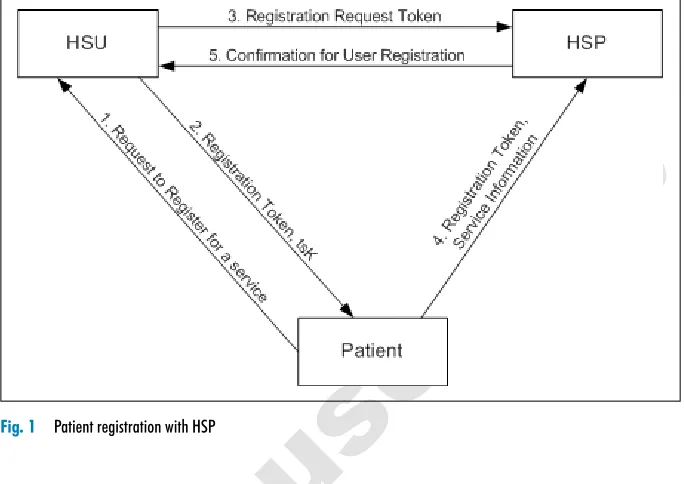
The patient registers with the HSP using the authentication at HSU.The sequences of ex-changed messages (Fig. 1) are as follows:
● Patient to HSU;the patient makes a
re-quest to register for an anonymous ser-vice access with healthcare serser-vice pro-vider.
● HSU to patient; HSU generates and
sends the registration token and a tem-porary session key (tsK). The temtem-porary session key is used for the secure com-munication between the patient and the healthcare service provider.
● HSU to HSP;the HSU sends the
regis-tration request token to HSP.
● Patient to HSP; the patient sends the
registration token with HSP offline/-online service access information to HSP. The service access information is an option field in the message and it is encrypted using the tsK.
● HSP to HSU;HSP sends the registration
confirmation message to the HSU if the
registration request token is validated successfully with the patient registration token. With the successful confirmation HSU records the identity of the patient with the healthcare service provider’s identification.
4.2 Patient Authorization and
Anonymous Service Access
The patient authorises to access services from HSP using the authorization provided
by HSU. The sequences of exchanged messages (Fig. 2) are as follows:
● Patient to HSU;the patient requests to
access a healthcare service provider anonymously by sending the healthcare service provider’s identity.
● HSU to patient; the HSU generates a
temporary user identity for the patient and it is a random number for each ser-vice request. The temporary session key (tsK) is generated by the HSU to estab-lish a secure communication channel be-tween the patient and the healthcare
ser-Fig. 1 Patient registration with HSP
[image:4.595.211.553.104.346.2] [image:4.595.211.552.531.730.2]vice provider. The HSU sends the tsK, key life time and user token to the pa-tient. HSU records the user identity, tem-porary user identity, service provider identity and timestamp in its database.
● Patient to HSP; the patient sends the
user token as the login request to health-care service provider. The patient will be an anonymous user to the HSP since the user token doesn’t have any parameters to identify the true identity of the patient but it confirms that patient is a registered user at the HSP and he/she is authorized to access services.
● HSP to patient;the healthcare service
provider validates user token and sends the confirm authentication message to the patient.
● Patient to HSP;patient sends the
vice request message to healthcare ser-vice provider and it is secured using the tsK.
● HSP to patient;the healthcare service
provider responses to the message with encrypting the response using the tsK.
The patient can send many service requests to the same healthcare service providers until the temporary session key is expired. If it is expired or the patient wants to change the healthcare service provider then patient has to do a new service access request to the HSU. Then the HSU will generate a new temporary session key and temporary identification for the patient.
5. Security Tokens
The following are tokens deployed in the proposed schema and authors have reduced sizes and complexity of tokens as much as possible due to the processing power con-strains of the mobile device and bandwidth constrains in the mobile networks.
● RegistrationToken
(RT = eHSP (sHSU [UID|TS])); used by the healthcare service provider to iden-tify and authenticate legitimate patient registration requests that are validated from the HSU. It consists with the user identification created by the HSU and the timestamp. The registration token is signed by the secret key of HSU and it is
encrypted using the service provider’s public key.
● RegistrationRequestToken
(RRT = eHSP (sHSU [UID|TS|tsK| KeyLifeTime])); used by the healthcare service provider to identify legitimate patient registration requests from HSU. It consists with the user identification of patient, temporary session key, key life time and the timestamp. The Registra-tionRequestToken is signed by the HSU secret key and encrypted using the ser-vice provider’s public key.
● UserToken
(UT = eHSP (sHSU [TUID|TS|tsK| KeyLifeTime])); used by the healthcare service provider to authorize anonymous service access requests from patients. It consists with temporary user identity, timestamp and temporary session key and key life time. The UserToken token is signed by the HSU secrete key and encrypted using the service provider’s public key.
Following are the implementation of tokens as XML objects. However these snapshots are taken before the XML encryption and XML signature are applied.
● RegistrationToken
<RegistrationToken> <UID>String</UID> <TimeStamp>Time
stamp</Time Stamp> </RegistrationToken>
● RegistrationRequestToken
<RegistrationRequestToken> <UID>String</UID>
<TimeStamp>Timestamp</ TimeStamp>
<TempSessionKey>Key</ TempSessionKey>
</RegistrationRequestToken>
● UserToken
<UserToken>
<TempUID>String</TempUID> <TimeStamp>Timestamp</
TimeStamp>
<TempSessionKey>Key</ TempSessionKey> <KeyLifeTime>Time</
KeyLifeTime> </UserToken>
6. Risk Analysis
The above healthcare environment is pro-posed as a solution to the privacy and secur-ity threats in the electronic and mobile healthcare environments. This section will discuss the possible threats that exist in the distributed healthcare environment and show how the proposed protocol can protect some of the possible security and privacy issues.
6.1 User Anonymity
The patient identity is only known by the healthcare service unit which is a trusted organisation by all the users and healthcare service providers. The healthcare service unit authenticates and authorizes patients at the healthcare service provider with a tem-porary identification. The patient obtains distinct temporary identification for each service access request to the same health-care service provider.The temporary identi-fication is a random number and it doesn’t have any relationship with the true identifi-cation of the patient. There are no relation-ships between temporary identifications that belong to the same patient or those gen-erated for the same healthcare service pro-vider access. Therefore healthcare service providers are unable to trace back the tem-porary identity to the real identification of the patient. So the patient identification is not disclosed to healthcare service providers and third parties who are interested to gather health-sensitive information.
6.2 Message Privacy
The patient health-sensitive information and the patient identification are not linked to any parties in the proposed environment. For example the patient identity is disclosed to the healthcare service unit but it doesn’t receive any patient health-sensitive infor-mation. Meanwhile the healthcare service providers have access to patient health-sen-sitive information but they are unable to trace the patient identity. Therefore the pa-tient privacy is protected in the proposed healthcare environment.
6.3 Message Confidentiality
A secured confidential communication channel is established between the health-care service unit and the patient web browser/mobile device based on the asym-metric/symmetric encryption and the pa-tient uses the secure channel for the au-thentication with the healthcare service unit.Therefore the patient authentication re-quests and tokens are protected from eaves-droppers. The communication between the patient and healthcare service providers is protected using the symmetric key encryp-tion technology. Therefore the patient-sen-sitive health records are protected from eavesdroppers and the patient privacy is protected.
6.4 User Authentication and
Authorization
Patient authenticates to the healthcare ser-vice unit by providing his/her identification details and password or relevant credentials. Once the authentication process is suc-cessful patient can request authorization to healthcare service providers from the healthcare service unit. The user token is generated by healthcare service unit and with the validity of the user token the health-care service provider authorizes the patient for healthcare services.
6.5 Replay Attacks
Tokens generated during the authentication and authorization process consist of time-stamps to prevent replay attacks. An eaves-dropper could capture login request mes-sage of a previous protocol between a pa-tient and a healthcare service provider. The attacker might later replay that message try-ing to impersonate the patient to the health-care service provider. This attack will not succeed if the healthcare service provider validates the timestamp of the requested message. These tokens are integrity-pro-tected and attackers are unable to alter the timestamps before the attack.
6.6 Reverse Identity Track and
Record Linkage
The proposed system provides medication without identifying the user due to the anonymous identification by the healthcare service unit. However healthcare service provider maintains a temporary identity for each patient request. This identification can be used to uniquely identify the patient be-tween the service provider and healthcare service unit. The healthcare service unit maintains mapping between the patient true identity and the temporary identity but this information is not revealed to external bodies. The healthcare service providers may want to contact patients after the medi-cation due to some critical medical situ-ations such as wrong diagnosis or un-covered health risk by research. In these circumstances the proposed system has the capability of tracking the true identification of the patient through healthcare service unit. However healthcare service unit has the complete privilege to make the reverse track identification. If needed in the future, they can request patient to re-access the healthcare service provider with the same temporary identity rather than disclosing the patient identity to the healthcare service provider. The same identity mapping func-tionality at the healthcare service unit will be used to link all anonymous medical his-tories of a patient to a single medical report for future medications.
7. Conclusion
This paper described a medical environment that a patient can access without disclosing his identity. There are several situations in which the patient is very reluctant to ap-proach the doctor or a medical expert for ad-vice due to the sensitivity of the medical condition. Also medical records consist of highly sensitive data and it is vital to protect the patient privacy against misdemeanours activities. The anonymous access control protocol defined in this paper will provide the way forward for secure future online/ mobile healthcare systems including the
functionalities such as reliable record link-ing and securely reverse tracklink-ing anony-mous patients to the real identity.
References
1. Wang J, Du H. Setting up a wireless local area net-work (WLAN) for a healthcare system. Inter-national Journal of Electronic Healthcare 2005; 1 (3); 335-348.
2. Weerasinghe D, Elmufti K, Rajarajan M, Rako-cevic V. Xml security based access control for healthcare information in mobile environment. Proceedings of the Pervasive Health Conference and Workshops, 2006; 2006 Nov 29; Innsbruck, Austria. IEEE Explore; 2006. pp 1-6.
3. Gritzalis S, Lambrinoudakis C, Lekkas D, Defte-reos S.Technical guidelines for enhancing privacy and data protection in modern electronic medical environments. IEEE Transactions on Information Technology in Biomedicine 2005; 9 (3): 413-423. 4. Rindfleisch TC. Privacy, information technology,
and healthcare. Commun. ACM 1997; 40 (8); 92-100.
5. Data Protection & Medical Research, Parliamen-tary POSTnote, ParliamenParliamen-tary Office of Science and technology, January 2005 (cited 2007 Nov 10); 235. Available from: www.parliament.uk/ documents/upload/POSTpn235.pdf.
6. Kerkri EM, Quantin C, Allaert FA, CottinY, et al. An approach for integrating heterogeneous infor-mation sources in a medical data warehouse. Jour-nal of Medical Systems 2001; 25 (3): 167-176. 7. Christen P. Privacy-preserving data linkage and
geocoding: Current approaches and research di-rections. Proceedings of the Sixth IEEE Inter-national Conference on Data Mining. Hong Kong, 2006.
8. Quantin C, Binquet C,Allaert FA, Gouyon B, Pat-tisina R, Le Teuff G, Ferdynus C, Gouyon JB. Decision analysis for the assessment of a record linkage procedure. Methods Inf Med 2005; 44; 72-79.
9. Geller LN, Alper JS, Billings PR, Barash CI, Beckwith J, Natowicz MR. Individual, family, and societal dimensions of genetic discrimination: A case study analysis. Science and Engineering Ethics 1996; 2 (1); 71-88.
10. Alan WM. Buying prescription drugs on the inter-net: Promises and pitfalls. Clevel Clin j med 2006; 73 (3); 282-288.
11. Eysenbach G, Diepgen TL. Patients looking for information on the Internet and seeking tele-advice: motivation, expectations, and misconcep-tions as expressed in e-mails sent to physicians. Arch Dermatol 1999; 135: 151-156.
12. Eysenbach G, Diepgen T. Responses to unsol-icited patient email requests for medical advice on the World Wide Web. JAMA 1998; 280 (15); 1333-1335.
Correspondence to:
M. Rajarajan
School of Engineering and Mathematical Sciences City University
Northampton Square London, EC1V 0HB UK
E-mail: [email protected]
14. Leszczyna R. The solution for anonymous access of IT services and its application to e-health coun-selling. Proceedings of the 1st IEEE International Conference onTechnologies for Homeland Secur-ity and Safety (TEHOSS ’05), September 2005. 15. Kelman CW, Bass AJ, Holman CD. Research use
of linked health data – a best practice protocol. Aust N Z J Public Health 2002; 26: 251-255. 16. Quantin C, Bouzelat H, Allaert FA, Benhamiche
AM, Faivre J, Dusserre L: How to ensure data se-curity of an epidemiological followup: quality as-sessment of an anonymous record linkage pro-cedure. Int J Med Inf 1998; 49(1); 117-122. 17. Quantin C, Bouzelat H, Allaert FA, Benhamiche
AM, Faivre J, Dusserre L. Automatic record hash coding and linkage for epidemiological follow-up data confidentiality. Methods Inf Med 1998; 37: 271-277.
18. Oberaigner W. Errors in Survival Rates Caused by Routinely Used Deterministic Record Linkage Methods. Methods Inf Med 2007; 46 (4): 420-424.
19. Churches T. A proposed architecture and method of operation for improving the protection of pri-vacy and confidentiality in disease registers. BMC Medical Research Methodology 2003; 3 (1): 1-13.
20. Galanti MR, Siliquini R, Cuomo L, Melero JC, Panella M, Faggiano F. Testing anonymous link procedures for follow-up of adolescents in a school-based trial: The EU-DAP pilot study. Prev Med 2007; 44 (2): 174-177.
21. Quantin C, Allaert FA, Dussere L. Anonymous statistical methods versus cryptographic methods in epidemiology. Int J Med Inf 2000; 60: 177-183. 22. Mitseva A, Imine M, Prasad NR. Contextaware
privacy protection with profile management. Pro-ceedings of the 4th international workshop on Wireless mobile applications and services on WLAN hotspots, New York, NY, USA. ACM Press; 2006. pp 53-62.
23. Elmufti K, Weerasinghe D, Rajarajan M, Rako-cevic V, Khan S. Privacy in mobile web services
ehealth. Proceedings of the Pervasive Health Con-ference and Workshops, 2006; 2006 Nov 29; Inns-bruck, Austria. IEEE Explore; 2006. pp 1-6. 24. Hillenbrand M, Gotze J, Muller J, Mullar P. A
Single Sign-On Framework for Web-Services-based Distributed Applications. Proceedings of the 8th International Conference on Telecom-munications ConTEL; 2005 June 15-17; Zagreb, Croatia. IEEE Explore; 2005. pp 273-279. 25. Liberty id-ff architecture overview. Technical