City, University of London Institutional Repository
Citation
:
Hauge, P. (1997). English music theory c.1590-c.1690 : the modal systems, changing concepts, and the development of new classification systems. (Unpublished Doctoral thesis, City University London)This is the accepted version of the paper.
This version of the publication may differ from the final published
version.
Permanent repository link:
http://openaccess.city.ac.uk/8383/Link to published version
:
Copyright and reuse:
City Research Online aims to make research
outputs of City, University of London available to a wider audience.
Copyright and Moral Rights remain with the author(s) and/or copyright
holders. URLs from City Research Online may be freely distributed and
linked to.
English Music Theory c.1590-c.1690:
The Modal Systems, Changing Concepts,
and the Development of New Classification Systems
Peter Hauge
Ph.D.
City University
Department of Music
CONTENTS
PART 1
SOURCES AND BACKGROUND
Section i Introduction 1
ii English Treatises and Foreign Sources 13
iii The Ladder of Music:The Gamut, Hexachords, and Solmisation Theory 31
PART 2
METHODS FOR THE CLASSIFICATION OF MODES
Section i Species and Ambitus 41
ii Tenor and Modes in Polyphony 53
iii Clef Combinations 60
iv Cadences and the Cadential Hierarchy of Scale Degrees 71
V Melodic Patterns 100
SUMMARY 107
PART 3
DEVELOPMENTS AND NEW SYSTEMS
Section i Gamut, Hexachords, Solmisation, and a New Conception of the Octave 111
ii The Bass and New Counterpoint Tables 139
iii Inversions of Intervals 154
iv Inversion of Triads 168
V Cadences and Cadential Degrees 177
Vi Transposition 187
Vii New 8-Mode Systems 196
Viii From Major/Minor Modes and the Senario to Major/Minor Keys 205 ix Major/Minor Keys and Practical Classification Systems:
Third above the Final 215
CONCLUSION 227
AfMw Archiv fiir Musikwissenschaft
Am Acta musicologica
AS Annals of Science: A Quarterly Review of the History of Science Since the Renaissance
RAM Basler Jahrbuch fiir historische Musikpraxis
EM Early Music
JAMS Journal of the American Musicological Society JRMA Journal of the Royal Musical Association
Md Musica disciplina
Mf Die Musikforschung
ML Music & Letters
MQ Musical Quarterly
MR Music Review
MSD Musicological Studies and Documents, ed. Armen
Carapetyan
Mth Musiktheorie
Copyright Declaration
Acknowledgements
At various stages of my work I have received advice from several scholars and friends.
Richard Langham Smith gave during many intriguing discussions inspiration and new
ideas on how to tackle various problems. I also wish to thank the Director of Le Centre
de Musique Ancienne, Geneva, Jean-Yves Haymoz, who generously helped me
under-standing many of the complex areas of early music theory. His advice in particular with
the aspects of modal theory was inspiring. Ole Kongsted, senior research fellow, showed
a great interest in my work and often provided me with a new approach to various topics
concerning Renaissance music practice. In addition, thanks are due to Raimondo Gesso,
The Royal Library, Copenhagen, who checked my Italian translations and to Charles
Burnett, the Warburg Institute, who helped me with some of the more difficult Latin
translations. Finally, I wish to thank Erika Ebbe and Birgit Berg who spotted many
in-consistencies in the drafts and for the many delightful discussions we had.
Thanks are due to the British Academy for providing me with a three-year
studentship which made the present study possible and to the Musica Britannica Trust
for awarding me the Louis Dyer Award towards research expenditure. In addition, I
should like to thank the Royal Library, Copenhagen, and its director Erland Kolding
Nielsen for providing me with a one-month's leave in order to finish my thesis.
I am, in particular, indebted to my parents for their unfailing support and
understanding throughout the whole period—without their interest the thesis would
never have been realised. Above all, I wish to thank Patricio for providing me not only
with a home where I could study and write in peace, but who also showed a great
interest in the subject—especially in the circularity of the octave.
The thesis examines the modal classification systems and the changes which lead to the development of new systems during the period c.1590 to c.1690 with particular refe-rence to English music theory. It consists of three parts the first of which considers the English writings on music, their readership, their sources, and the basic ideas for the understanding of the traditional Gamut, solmisation system and hexachordal theory.
PART 2 examines the methods employed by theorists wishing to categorise
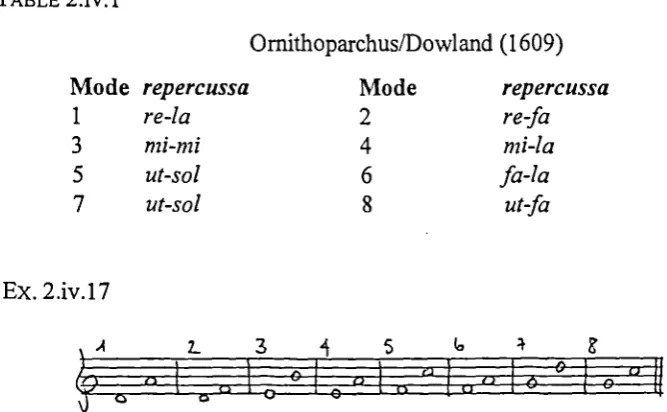
music either according to the 8-mode system or the 12-mode system. By studying Italian and German sources referred to in English writings on music, it is seen that the English theorists deal with the modal classification systems in a similar way. Furthermore, the differences between Morley's popular tract (1597), adhering to the 12-mode system, and Dowland's translation (1609) of the small tract by Ornithoparchus, promoting the 8-mode system, are also discussed.
PART 3 begins by tracing the development of a new interpretation and definition of the octave as a circular principle. This leads to the theoretical recognition of the inver-tibility of intervals. In England, in particular the growing circle of natural philosophers and the Royal Society of London seem to play an important role by asking inquisitive questions. Seeing the octave as a circle (and hence also the Gamut), together with a stronger emphasis on the bass as the fundamental part of a composition, encouraged a new interpretation of triads and inversions. The increasing use of fixed pitches versus relative pitches also influenced the interpretation of transposition. The distinctions essential for a modal classification disappeared because of many of these new concepts.
PART 1
The aim of the present thesis is:
To study English music-theoretical writings from c.1590 to c.1690 with parti-cular reference to the classification systems of modes and the evolution of new, simpler methods of classification.
In order to fulfil this objective, an essential part of the study examines specific concepts so as to expose the subtle changes, fundamental for the understanding of the evolution of new classification systems.
To limit the scope of the thesis, music practice has in general not been included, unless
directly relevant to the discussions. Thus subjects such as improvisation, compositional
practice, or the development of basso continuo are not examined in detail, though a
closer study of them would perhaps reveal some interesting aspects in terms of intervals
and chords. On the other hand, solmisation and briefly hexachordal theory have been
included as these areas are essential for the understanding of scale types, transposition,
the notion of fixed pitches, and most importantly a redefinition of the octave in theory.
Although the period is limited to c.1590-c.1690, it has been necessary to include
dis-cussions of earlier theorists in order to show a clearer line of development, which took
place over a longer period of time, and also to indicate how new incipient signs of
change can be traced even back to 1450s, for instance. The overall design of the thesis
is chronological, that is, it deals first with the modal systems before proceeding to the
changes and the evolution of new systems. However, a chronological approach between
the various sections is not desirable or even practical as new incipient signs of
develop-ment do not necessarily occur in a chronological order. Each section (subject) is, where
possible, structured according to chronology.
PART 1 ("Sources and Background") categorises the English treatises on music
Section i: Introduction
science. This division is important because in many instances it explains why some
areas are discussed and others are completely ignored. Thus music-theoretical concepts
will be discussed in different ways according to whether the author is addressing the
natural philosopher, the serious student, or the able amateur wishing to play an
instru-ment. Furthermore, the purpose, the complexity, and even the language of a tract
depends to a very great extent on for whom it is written. Sources mentioned by English
theorists are also listed, and they may provide an indication of the foreign treatises
which were available and used in England. The many references, mostly to German and
Italian sources, also suggests that the English theorists were not as isolated or
dis-interested in modal theory and classification systems as one might believe. The quoted
tracts can therefore later be drawn into the discussion to illustrate the differences or
similarities between English and foreign music theorists and thus also explain unclear
viewpoints.
A brief overview is given in the section "The Ladder of Music...", on the
tradi-tional Gamut, the hexachord and solmisation theories. These topics are of paramount
importance in understanding the inconsistencies in the traditional Gamut and the subtle
changes proposed, creating a fertile ground for redefining the Gamut.
The objective of PART 2 is three-fold:
1. To deal with the methods which theorists of the time argue should be em-ployed when classifying music either according to the 8-mode system or the 12-mode system.
2. To create a fundament for the understanding of the evolution of new concepts and the redefinition of other concepts and development of new, simpler classi-fication systems.
3. Furthermore, the purpose is to analyse English music theory in terms of the modal classification systems and place it into a broader European context, there-by explaining both similarities and differences.
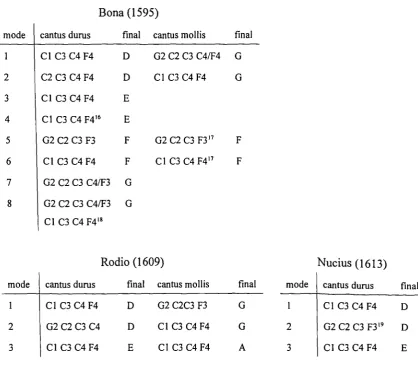
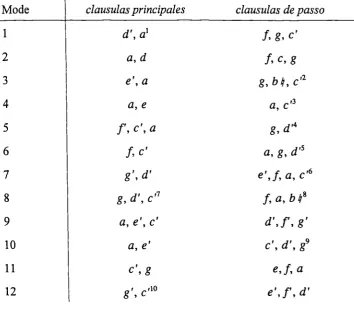
system or the 12-mode system are:' ambitus; clef combinations (together with
trans-positional system and final); cadences and cadential hierarchy; and melodic patterns.2
The remaining areas dealt with are the species of fourth, fifth, and octave. These are
important for understanding the different backgrounds of the two modal systems, and,
furthermore, are used as part of the melodic patterns. The purpose of PART 2 ("Methods
for the Classification of Modes") has not been to explain in detail the sometimes
complex differences between the 8-mode system and the 12-mode system, or the many
irregularities. To do this a thorough examination of the history of both systems and the
probable influence on compositional theory and practices would be needed.' Besides
a brief examination of the function of the tenor in terms of a modal classification, the
modal pairing in a polyphonic composition is examined showing the diverse
contentions on which part delineates the mode of a composition.
PART 2 can be seen as an abstract which mainly reinforces the findings already
made by Powers and Meier;4 however, no one has so far juxtaposed these findings with
the statements made by English theorists of the time. Using the European background
and their extensive discussions on the subject, it becomes easier to understand the
English theorists and provide solutions to many of their, for us today, ambiguous
I Only subjects relevant to the understanding of the methods of classification are examined. Areas such as mixtio, commixtio, musica ficta, imitation, fugue, counterpoint, or harmony are outside the scope and purpose of the thesis.
2 See Pedro Cerone, El melopeo y maestro. Tractado de musica theorica y pratica (Naples 1613), p. 912; and Johannes Michael Ravn, Heptachordum danicum seu nova solsisatio (Copenhagen 1646), p. 73, who asserts:
Dignoscuntur a. Modi. 1. Ex Ambitu. 2. Repercussione. 3. Cadentiis seu clausulis formalibus. 4. Et Imprimis e fine clavium & vocum Musicalium.
[The modes are determined by: 1. the ambitus; 2. the repercussa; 3. cadences or
clau-sulae formalis; 4. and especially by the final note and solmisation syllable.]
On pp. 73-80 Ravn gives a thorough explanation on how to employ the different methods. For theorists promoting the clef combinations as a way, see PT. 2.iii; for Cerone, see PT. 2 CONCLUSION.
For a more thorough discussion of the 8-mode system and the 12-mode system, see especially Harold S. Powers,"Tonal Types and Modal Categories in Renaissance Polyphony", JAMS 34 (1981), pp. 428-70; Powers, "Is Mode Real? Pietro Aron, the Octonary System, and Polyphony", BJhM 16 (1992), pp. 9-52; and Bernhard Meier, Alte Tonarten. Dargestellt an der Instrumentalmusik des 16. und 17. Jahrhunderts (Kassel 1992); cf. PT. 3 CONCLUSION.
For Powers, see note above and Powers, "Mode", The New Grove Dictionary of Music, ed. Stanley Sadie (London 1980), vol. 12, pp. 376-418; Meier, op. cit.; Meier, The Modes of Classical Vocal
Section i: Introduction
explanations. Though some of the subjects are not directly touched on in English tracts,
it is demonstrated that they are nevertheless implied.
PART 3 can be divided into two distinct sub-parts:
1. The new definition of the octave as a circular principle (SECTION i) meant that
new concepts evolved and old ones were redefined (SECTIONS ii-vi).
2. The remaining SECTIONS vii-ix deal with the new classification systems
which are a consequence of the concepts discussed in the first sections.
Thus the basis and the main criterion for which subjects have been selected is PT. 3.i,
dealing with the problems concerning the Gamut, hexachords, and solmisation. Though
many of the problems were already mentioned by earlier theorists, they had not been
solved satisfactorily (PT. 1.iii). In England during the 1660s, the Royal Society of
London played an important role in promoting new ways of understanding acoustics
and temperament.' However, basic concepts, such as the paradox between using the
hexachord with only six notes and the octave as containing seven different notes, were
also dealt with and led to the definition of the octave as a circular principle. These areas
have not earlier been studied in detail.'
While the tenor was the mode-defining part, the bass, as the lowest part of a
polyphonic composition, was considered the foundation. The definition of the bass as
These areas have to a large extent been dealt with by historians of science: Penelope M. Gouk, "The Role of Acoustics and Music Theory in the Scientific Work of Robert Hooke", AS37 (1980), pp. 573-605; Penelope M. Gouk, "Acoustics in the Early Royal Society 1660-1680", Notes and Records of the
Royal Society 36 (1982), pp. 155-75; Penelope M. Gouk, Music in the Natural Philosophy of the Early Royal Society (unpubl. Ph.D diss., University of London 1982); Mordechai Feingold and Penelope M.
Gouk, "An Early Critique of Bacon's Sylva sylvarum: Edmund Chilmead's Treatise on Sound", AS 40 (1983), pp. 139-157; Jamie C. Kassler and D. R. Oldroyd, "Robert Hooke's Trinity College Musick
Scripts, his Music Theory and the Role of Music in his Cosmology", AS 40 (1983), pp. 559-95. For an
abstract, see Leta Miller and Albert Cohen, Music in the Royal Society of London, 1660-1806 (Detroit 1987), pp. 5-18.
However, Benito V. Rivera, German Music Theory in the Early Seventeenth Century: The Treatises of
Johannes Lippius (Ann Arbor 1980), pp. 86-103, mentions briefly some aspects but does not relate the
the lowest sounding note makes it difficult to recognise inversions of chords.' By using
the new definition of the octave, it is possible to reconsider the function of the bass, and
see it as the 'real bass-line1.8 Theorists also begin to emphasise the importance of the
bass as the first part to be composed and that the upper parts are ruled by it.
Though the invertibility of intervals was recognised and used as part of the art
of descant and counterpoint, the new principle, seeing the octave as a circle, also meant
that the definition of the sixth as a composite interval (i.e. a third and the perfect fourth)
was challenged. The reason Zarlino (1558) included the minor sixth in his senario was
precisely because this interval was made up of the minor third and the perfect fourth.'
Also the complementarity of the fourth and fifth was acknowledged. Thus the
distinction between a cadence involving a move from a fifth above a note and a fourth
below it had become outmoded. The distinction was indeed a very significant concept
according to the modal systems, as it characterised the subtle difference between plagal
and authentic modes. The subject of invertibility has caused confusion among
present-day scholars, because the conception of the senario at first sight seems to oppose the
invertibility of intervals. Therefore, in this thesis the discussion of the circularity of the
octave and inversions (PT. 3.iii) is treated separately from the discussion of inversions in relation to the senario (this is dealt with in PT. 3.viii). Using the real bass-line
together with the new definition of the invertibility of intervals, it now becomes
possible to acknowledge the inversions of triads. However, before a full acceptance is
feasible, the senario must be disregarded and the triad must be seen as an entity in itself.
Though German theorists around 1608 already began to mention that a chord in root
position is the same as the sixth-chord, it took a long time for English theorists to
follow.
According to Renaissance theorists, the cadence was defined as two parts
mov-' See PT. 3.iv.
The real bass-line indicates that the lowest note in the bass is not necessarily the harmonic basis (i.e. Rameau's fundamental bass).
Section i: Introduction
ing from an imperfect to a perfect consonance. But as the bass was now the first part to
be composed, this consequently led to the definition of the cadence as the fourth or fifth
leap in the bass part. Furthermore, on the penultimate note of the cadence, one of the
upper parts should be placed a major third or a major tenth above.
In the traditional 8-mode system, the hierarchy of cadential degrees was
some-what complex. Zarlino tried to simplify the hierarchy by using only the final, the fifth,
and the third above the final. This very rigorous position proved to be untenable, as
some modes (3, 4, 7, and 8), in both the traditional 8-mode system and Glarean's
12-mode system, would employ the second or fourth degrees instead of the fifth or third.
In the beginning of the seventeenth century the cadential hierarchy was still the same.
However, the exceptions were explained differently: keys or modes with a major third
above the final did not use the third as a cadential degree, instead the second or fourth
was employed.
An area which is not immediately linked with the new interpretation of the
octave, is the concept of transposition. Because of the growing significance of using
fixed pitches, and presumably also because of the increasing popularity of equal
temperament, the otherwise clear distinction between transposition as a practical device
and the terms cantus durus and cantus mollis becomes of minor importance. Ultimately
the re-evaluation of transposition and the use of fixed pitches became important in the
distinction of modes/keys and led to new classification systems. A redefinition of all
these concepts meant that new systems could be proposed (such as the new 8-mode
systems), either related to the traditional systems, or simply employing new, easier
methods for classifying music.
At the same time, new theoretical concepts were discussed—in England,
especially among the members of the Royal Society of London. SECTION viii examines
the concept of the senario, beginning with Zarlino's explanation concerning the
separa-tion of the modes into two types depending on whether the third and sixth degrees are
major or minor. In England the subject was discussed and developed further and
united when Henry Purcell, in his revisions of Campion's tract (1694), explains to the
student that all scales originate from C major or A minor.
However, in many contemporary English music manuscripts indices are found
employing simple classification systems. One system makes use of the traditional
definition of the terms cantus durus and cantus mollis together with the name of the
final note. Another system only refers to the final note and the indication of whether the
third above is major or minor. In this system the durus and monis have been redefined
indicating the 'sharp' or 'flat' third rather than a transpositional system.
The subjects examined in PART 3 have not earlier been thoroughly studied in modem writings in connection with English music theory. One of the problems could
be that musicologists often have not been aware of the important discussions among the
growing number of natural philosophers. On the other hand, historians of science have
drawn attention to the natural philosophers, but most often in connection with the
history of acoustics and temperament, for example. Because of the complexities of the
music theoretical discussions c.1590-c.1690 including the modal classification systems,
it is also difficult to draw a clear line between the traditional and the new evolving
con-cepts. One way of solving these problems is to divide the examination of the concepts
and classification systems into separate sections.
MODERN DISCUSSIONS
Not many have studied the English theorists thoroughly in an effort to understand their
arguments and examine their definitions of the music-theoretical concepts discussed (or
not discussed!). Neither are there any extensive discussions on the 8-mode system and
the 12-mode system and the new systems that evolved. Robert Wienpahl (1955), for
example, defines modal theory as tenor-derived composition and tonal theory as
bass-derived composition, and consequently fails to address many important aspects of
English music theory. 1 ° Using modem concepts as a point of departure leads Wienpahl
Section i: Introduction
to the conclusion that "the most significant advances in tonal theory came from two of
the most important exponents...Thomas Morley and Thomas Campion", and that "the
English musicians... were in the absolute forefront of the turn to tonality"."
Lillian Ruff (1961) has dealt with English treatises published between 1574 and
1730; she has, however, completely avoided treatises dealing with the scientific aspects
of music. Hence the author also refrains from discussing Robert Fludd's interesting
treatise on the subject, "De templo musica" (1617-18), with the following arguments:
Whilst some of the theorists named in this thesis might be considered old-fashioned in their ideas, none can compare with Robert Fludd, who, in spite of the movement towards rationality, preferred to adhere to unproved theories rather than accept the evidence of his senses... like many other versatile gentlemen of the seventeenth century, he devoted some of his writings to music and musical instruments, only differing widely from his contemporaries by his fantastic metaphysical notions... Since it is unlikely that his writings, which were in Latin and obscure and mysterious, were ever studied by students of music, he is left out of account...'
It is clear that the first four parts of Fludd's "De templo musicae" are written in the
medieval-Boethian tradition. This was the usual approach towards theory and history
of music, even in the late Renaissance. In this sense Fludd cannot be considered either
original or conservative. His discussion of ligatures was de rigueur and the rather
long-winded explanation of the proportional time system and time signatures was popular,
though declining after the turn of the century. These subjects did, nevertheless, have
some practical value for the performer as can be seen in the compositions of the
Baldwine manuscript written between 1581 and 1606.' 3 Another theorist and composer
discussing the rather complex proportional time system is Thomas Ravenscroft, A
Briefe Discourse (1614). Fludd's and Ravenscroft's discussions are at times very similar,
" Ibid., p. 377.
'Ruff, The Seventeenth-Century English Musical Theorists (unpubl. Ph.D diss., University of Notting-ham 1961-2), pp. 16-7.
but it does not seem that either of them copied from the other; rather, they probably
knew and copied the same sources.'
That Fludd chose to write in Latin may for a modern reader seem to exclude
musicians, composers and music theorists. But many of the Renaissance musicians,
theorists, and composers belonged to the intellectual elite of the day and could both read
and write Latin. We have Dowland's translation of Ornithoparchus' treatise which shows
Dowland's unsurpassed skills as a translator; we have Thomas Campion's Latin poems
which show his ability in writing and reading Latin." Besides Italian, Thomas Morley
was certainly also able to read Latin, as he quotes from the anonymous medieval
manuscript Quatuor princtpalia musicae; and Glarean's Dodecachordon (1547) and
Calvisius' Melopoiia (1592), to which he also refers, are written in Latin. Ravenscroft
understood Latin as he, too, used Quatuor principalia musicae as well as other treatises
in Latin.'
Though Latin became less used during the Renaissance," it was still regarded
as a most important language, and those interested in reading books on music theory
were in any case intellectuals, which the Elizabethan population at large were not.
Indeed, the circle of English readers would have been much wider had Fludd published
his writings in English. But one of the reasons Fludd wrote his work in Latin was not
so much to exclude 'students of music' but to make it available to a wider 'European'
audience. Latin was considered the universal language—a language understood by the
intellectuals of the world—and therefore it seems particularly appropriate in Fludd's
conception of the Universe to write in Latin. Fludd's work must be considered important
as it shows intriguing signs of change in traditional music theory and practice.'
" See PT. 1.ii.
15 Campion, A New Way of Making Fowre Parts in Counter-point (London s.d.), sig. D8", also explains that he used Calvisius' Melopoiia which is written in Latin.
16 Thomas Ravenscroft refers to numerous treatises on music written in Latin, among others: Sebald Heyden, De arte canendi (Nuremberg 1540); Nicolaus Listenius, Musica (Wittenberg 1537); Heinrich Glarean, Dodecachordon (Basel 1547); Senior [Lucas] Lossi, Erotemata musicae practicae (Nuremberg 1563); Johannes Magirus, Artis musicae (Frankfurt 1596); see TABLE 1.ii.2., item 10.
" Campion, op. cit., sig. D8", indicates that less people could read Latin and therefore he finds it appropriate to translate Calvisius.
Section i: Introduction
In general, Lillian Ruff considers most English theorists conservative, and notes
that they mainly plagiarised from continental sources. Very often Ruff misses the
important points made in the tracts by neither being aware of whom the theorists
address nor of the purpose of the treatise, that is, whether practical or theoretical.
Instead, the author applies a modern way of thinking and thus assumes interpretations
which, when studied from another angle, yield a very different meaning. A similar
interpretation is also found in W. R. Davies' short introduction (1967) to the modern
edition of Campion's treatise from c.1613. Davies argues that
Campion's (with the possible exception of Coperario's) is the only Renaissance English treatise of interest to the historian of music theory, all the others being either mediaeval survivals.., or interesting for their lively testimony about contemporary practice rather than for their theoretical innovations.'
Gertrude Brown Miller (1960) tries to trace incipient signs of tonality, but like
Wienpahl she also simplifies modal and tonal concepts basically to tenor- or
bass-derived composition.2° Furthermore, she concentrates her discussion on the changes that
occur in counterpoint. Both Ruffs and Miller's dissertations are descriptive and do not
try to interpret the various topics dealt with in the treatises. Thus they avoid explaining
the differentiations between a modern way of thinking and a Renaissance conception.
A short, but practical description and bibliography of English music theory in
the seventeenth century has been written by Walter Atcherson (1972). He observes that
English music theory exhibits two orientations, the one practical and pervading the entire century, the other more purely theoretical and becoming prominent only in the second half of the century.21
19 W. R. Davies (ed.), The Works of Thomas Campion (New York 1967), P. 322.
20 Gertrude B. Miller, Tonal Materials in Seventeenth-Century English Treatises (Ph.D diss., University of Rochester 1960).
The author concludes that the progressive nature of the ideas found in English tracts
were due to the fact that the theorists "were poorly schooled in the
medieval/Renais-sance tradition".22 Joel Lester (1989), who deals mainly with German theory of music,
includes a very brief, but sensitive and sympathetic discussion on French and English
theorists." The author mentions that the English music theorists were not interested in
the problems of the modes, and that a study of modal theory was not encouraged by the
fact that modes were usually associated with Catholic music, which at the time would
have been considered "popish"."
Barry Cooper (1986), drawing his information primarily from Lillian Ruff, also
deals with English music theory and practice." First he provides a very brief discussion
of each of the treatises he considers most important. Like Ruff, he ignores the
discus-sions dealt with by the natural philosophers and therefore is not able to trace many of
the incipient signs which lead to new musical classification systems. Although Cooper
includes some brief sections on various topics on practice and theory, his discussion is
descriptive. Hence numerous problems are left unsolved, such as a new conception of
the Gamut and the octave, inversions of intervals, and the invertibility of chords.
Though some scholars have dealt with English music theory they have not tried
to understand the nature and the axioms of the tracts in their own terms, or to relate
them to contemporary continental discussions. Nor have they been able to make a clear
distinction between tracts written for the musical amateur or the serious student, or even
for the natural philosopher. In order to achieve a much more profound understanding
of the developments of English music theory, and especially the classification systems,
it is important to be aware of the subtle distinctions involved, in particular between
theory and science, before creating a synthesis.
" Ibid., p. 12.
" Joel Lester, Between Modes and Keys: German Theory 1592-1802 (New York 1989), pp. 101-4. 24 Ibid., p. 101.
English Treatises and Foreign Sources
It is curious that compared with the amount of continental treatises on music theory
published during the late Renaissance and early Baroque, there are not many English
books on the subject) The amount of information which poured out in particular from
the Italian and the German presses is tremendous and presents many different views.
But it is also clear that many of the German books on music were written for the
Lateinschule, where music was a very important part of the curriculum, rather than for
the professional elite.' Many of these books are therefore easier to understand, but they
are also somewhat conservative and maybe do not reflect the theory of the time but rely
more on previous practices. French treatises, on the other hand, are few, the most
influential being Mann Mersenne (1636-37).3
In England, the most significant book on music theory and composition was
certainly Thomas Morley's A Plaine and Easie Introduction to Practical! Musicke
(London 1597). Another important treatise, which has been rather overlooked, is
Charles Butler's Principles of Musick, in Singing and Setting (London 1636). Though
not well-known today, it presents many interesting details on music theory,
composi-tion, and practice of that time.' Only these two English tracts reach the high standard
set by continental theorists such as Zarlino (1558).
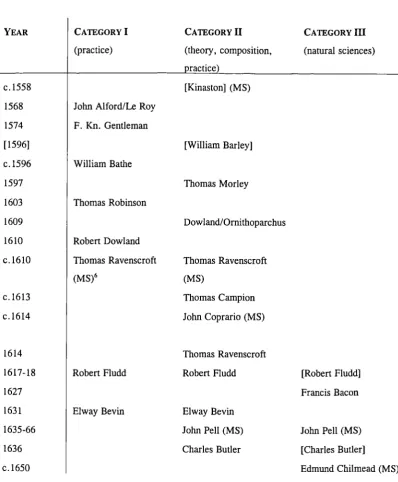
It is possible to classify the English music-theoretical sources into three
different categories:
' Albert Cohen (ed.), "National Predilections in Seventeenth-Century Music Theory: A Symposium",
JMT 16 (1972), pp. 6-71. Concerning English theory, see Walter T. Atcherson, "Symposium on
Seven-teenth-Century Music Theory: England", JMT 16 (1972), pp. 6-15.
2 The main purpose of teaching boys music and Latin in the German schools of the Reformation was to enable them to participate in the services of the church; Frederick W. Sternfeld, "Music in the Schools of the Reformation", Md 2 (1948), p. 104; Carl Parrish, "A Renaissance Music Manual for Choirboys",
Aspects of Medieval and Renaissance Music, ed. Jan LaRue (New York 1966), p. 649.
3 Cohen, op. cit., "Symposium on Seventeenth-Century Music: France", p. 20.
'The book was indeed very popular even as late as the end of the seventeenth century when Roger North borrowed it from his teacher John Jenkins; Lillian M. Ruff, The Seventeenth-Century English Musical
CATEGORY I: music practice, that is, the art of playing or singing.
CATEGORY II: music theory (usually also briefly history),
composi-tion, and practice (solmisation and hexachordal theory).
CATEGORY III: music as a natural science, generally dealing with
sound (physics) and temperament (mathematics (logarithms)).
It is important to be continuously aware of these three distinct categories, since they
clearly address different aspects of music and therefore deal with music in various ways
and from very different points of view. One cannot expect to find extensive discussions
on complex theories of modes in books written for the amateur lute player (CATEGORY
I) or in books only dealing with the calculation of temperaments using logarithms
(CATEGORY III).(see TABLE 1.ii.1).
Treatises dealing with music as a science begin to appear around 1650-60
when the Royal Society of London was formed.' In the early years of the Society,
various aspects of music science, such as acoustics, temperament, and the calculations
of musical proportions were discussed. Also music therapy and hearing were examined.
In spite of the preference for these topics, members and consultants also reviewed
music theory and sometimes even music practice. Thus John Pell (c.1635-1666), Robert
Hooke (1671-76), Francis North (1677), and William Holder (1694), who all had a
great interest in music, were active members of the Royal Society, and John Wallis
(c.1664), John Birchensha (c.1664), and Thomas Salmon (1672, 1688) were closely
associated with the Society. Through their inquisitiveness, the musical scientists created
a fertile ground upon which new musical concepts could grow. It is some of these most
important ideas which will be dealt with in PART 3.
5 For a brief and concise history of the Royal Society of London, see Leta Miller and Albert Cohen,
Section ii: English Treatises and Foreign Sources
TABLE 1.ii.1
English Musical Tracts According to Subject
YEAR CATEGORY I CATEGORY II CATEGORY III
(practice) (theory, composition, (natural sciences)
ractice
c.1558 [Kinaston] (MS)
1568 John Alford/Le Roy
1574 F. Kn. Gentleman
[1596] [William Barley]
c.1596 William Bathe
1597 Thomas Morley
1603 Thomas Robinson
1609 Dowland/Ornithoparchus
1610 Robert Dowland
c.1610 Thomas Ravenscroft Thomas Ravenscroft
(MS)6 (MS)
c.1613 Thomas Campion
c.1614 John Coprario (MS)
1614 Thomas Ravenscroft
1617-18 Robert Fludd Robert Fludd [Robert Fludd]
1627 Francis Bacon
1631 Elway Bevin Elway Bevin
1635-66 John Pell (MS) John Pell (MS)
1636 Charles Butler [Charles Butler]
c.1650 Edmund Chilmead (MS)7
Ravenscroft deals with three definitions of music: first, as an art; second, as speculative; and third, as practical.
YEAR CATEGORY I CATEGORY II CATEGORY III
(practice) (theory, composition, (natural sciences)
ractice
1653 Brouncker/Descartes
1659 Christopher Simpson Christopher Simpson
1664 Birchensha/Alsted
c.1664 John Birchensha (MS) John Birchensha (MS)
1664 John Wallis (MS)8
c.1664 Silas Domvill (MS) Silas Domvill (MS)
1667 Christopher Simpson
1671-76 Robert Hooke (MS)9
1672 [Thomas Salmon] Thomas Salmon
1672 Matthew Locke
1672 [Thomas Salmon] Thomas Salmon
1676 Thomas Mace Thomas Mace
1677 Francis North Francis North
1694 William Holder
1694 Campion/Henry Purcell
is related to Bacon whose ideas were fundamental to the Society.
In connection with John Birchensha's musical proposals (read at the Royal Society, 27th April 1664), John Wallis made an examination of the mathematical part (proportions and temperament); Letter to the
Secretary of the Royal Society, Henry Oldenburg, 14th May 1664, GB-The Royal Society of London, MS
Boyle Papers BP.41.2, fols. 23 r-31`. See also Thomas Birch, The History of the Royal Society of London (London 1756), vol. 1, p.418, 425. Wallis' discussion has not been relevant for the present thesis and has therefore not been included.
Section ii: English Treatises and Foreign Sources
Other theorists fall in between these mentioned groupings. Thus, Robert Fludd,
who deals with nearly all aspects of music, is difficult to place as he wrote about 40
years before there was any real interest in the physical science of music. Though
Fludd's large volumes, Utriusque cosmi... historia, amounting to over 1,000 pages, were
published in 1617-18, he claims that parts of it (including the section on music) were
already written when he was studying at Oxford, which means at the earliest 1596.10
The whole Utriusque cosmi... historia was completed about 1610." Fludd, together
with Francis Bacon (1627) and Mann Mersenne (1636-37), must be placed among
those who encouraged a scientific approach to music (i.e. the study of sound and
acoustics, for instance). Furthermore, presumably by the instigation of Fludd and Bacon
in particular, philosophy of music slowly changed direction and became part of the
I° Robert Fludd, Utriusque cosmi majoris scilicet et minoris metaphysica, physica, atque technica
historia ["Metaphysical, Physical, and Technical History of both the Major and Minor Worlds"]
(Oppen-heim 1617-18), vol. 1, "De naturae simia", lib. 6: "De fure & furto indicando". Cap. i: "De veritate hujus partis Astrologiae", pp. 701-2:
...Posteaquam enim Oxonii Bacculaureatus gradum assumpseram, quo tempore in ipsa medulla studii Mathematici haerebam inter caeteras artes hujus quoque scientiae Astrologiae profunditatem scrutari omnibus viribus annitebar, operamque haud exiguam in Geneseos & furti investigatione ponebam... Accidebat etiam non mult6 post, dum in studiis meis circa tractatum de Musica ita anxie occupabar, ut vix per integram septimanam è cubiculo meo egrederer, ut die quodam Jovis accederet ad me visendi causa juvenis, quidam satis nobilis, qui scientiis etiam humanioribus operam dabat in collegio Magdalense, quod a nostro collegio S
Johannis nomine insignito direct6 versus Orientem positum erat:...
[For after that I had received the BA degree at Oxford, I adhered in the depth of my heart to the mathematical science [and] amongst its other arts I also strived to examine profoundly the science of astrology with all strength, and I put no small amount of work on horoscopes and on the investigation of theft... And not long time after, it happened, while I was anxiously occupied with my studies on the treatise of Music and I hardly left my study for a whole week, that one Thursday a quite noble, young man came to visit me by chance. He attended classes in humanities at Magdalen College which lay east of our renowned S. John's College...]
Fludd received his BA in 1596.
"Robert Fludd, A Philosophical! Key, c.1619, GB-Ctc Western MS 1150 (0.2.46), fol. 15Y: My Microcosmical history as well natural as artificiall was composd by me some fower or five yeares before the renowne and fame of the Fraternity of the Rose Cross had perced my ears, as by the testimonys of my worthy friends Mr. Dr. Andrews, and that most learned Gentleman of the Inner Temple Mr. Seldein...
The first Rosicrucian manifesto, Famafraternitatis, was published by Wilhelm Wessell (Kassel) in 1614. Thus Fludd must have completed his work c.1610; William H. Huffman, Robert Fludd: Essential
natural science of music: the investigation of sound.'
Although only Morley and Butler have written thoroughly on most aspects of
music theory, it does not automatically imply that English music theory was lagging
behind the rest of Europe. When creating a synthesis of the available material, that is,
including the practical treatises as well as those on music as a natural science, it
be-comes obvious that the level of knowledge of music was just as high as in Italy and
Germany. On the other hand, comparing the English tracts with the continental in the
context of music theory and in particular with the aspects of modes, it is very noticeable
that the English avoid the subject. Thus Robert Stevenson (1952), regarding Thomas
Morley's approach to modal theory and concepts, concludes:
—however much he may have known, or forgotten, concerning modes, he at the time of writing his treatise considered the subject of small moment;... Since manifestly he was a well educated musician as English education went, we must conclude that neither at Oxford [where Morley had studied] in his day, nor in the private tutelage he may have received from Byrd was modal science stressed.I3
Or is the problem that we, today, understand and read the treatises, especially the
English sources, in a different way, superimposing a conception and meaning of words
which for the Renaissance musician, composer, theorist or amateur would be
nonsensical? The difficulty lies in the fact that the various musical treatises address
12 Though both philosophers seem to play a role in the 'Scientific Revolution', their views were indeed very different, even incompatible. Fludd believed, from a Neoplatonic point of view, that man was a microcosm of the Universe (macrocosm), and based his theories on ancient writings. Bacon, on the other hand, briefly states in The Advancement of Learning (London 1605/ Oxford 1640), book 4, 2.1, p. 186, that
Neither yet are we so senselesse, as to imagine with Paracelsus, & the Alchymists;
That there are to be found in mans Body certaine Correspondences, and Parallels to all the variety of specifique Natures in the world (as Starres, Minerals, and the
rest) as they foolishly fancy and Mythologize, straining, but very impertinently, that embleme of the Ancients, That man was Microsmus, an abstract, or modell
of the whole world..
" Robert Stevenson, "Thomas Morley's Plaine and Easie Introduction to the Modes", Md 6 (1952), pp.
Section ii: English Treatises and Foreign Sources
different media and thus choose the subjects accordingly: whether it is the serious
student of music, the amateur or music lover, or in the middle of the seventeenth
century, the scientist. Nearly all the tracts belonging to the first two categories (TABLE
1.iii.1) are clearly written for the music lover or amateur, and therefore avoid the more
complex and difficult issues.'
Since there are numerous references to foreign treatises in English books on
music, they have also been consulted. Furthermore, when collating the material and
details of English treatises with continental ones, it becomes obvious that the English
relied heavily on their foreign colleagues. Especially Glarean (Dodecachordon, Basel
1547), Zarlino (Le istitutioni harmoniche, Venice 1558/1573) and Calvisius (Melopoiia
seu melodiae condendae ratio, Erfurt 1592) were read and translated into English.
Thomas Morley has a long list of "Authors whose authorities be either cited or used in
this booke", and, indeed, when comparing many of Morley's subjects with Zarlino, it
is evident that very often he has literally translated from Le istitutioni harmoniche. In
spite of his long list, Morley also utilised sources without mentioning them at all.'
Many of the composers, to whom he refers to in the same list, are merely taken from
Glarean. I6 Morley must have had access to Glarean's, Zarlino's, and Calvisius' books
as well as to the manuscripts from which he quotes.
Thomas Ravenscroft (1614) published a short treatise dealing with the
prola-tional system which at this time was becoming obsolete. Ravenscroft supplies a
cornucopia of references to sources, so much so that it can be more confusing than
enlightening for the reader. This leads one to suspect that the author referred to the old
14 One very special tract, which only deals with musical notation, has not been included in the above table: in 1638 William Braythwaite published his Siren Coelestis in which he tries to argue in favour of a new system using 231 symbols; for a more detailed discussion of this tract, see D. W. Krummel,
English Music Printing, 1553-1770 (London 1975), pp. 98-102. Neither have the writings of John Case
been included, as he only considers the philosophical and mythological aspects of music (i.e. from a Aristotelian point of view); J. W. Binns, "John Case and the Praise of Musicice", ML 55 (1974), pp. 444-53.
IS Orazio Tigrini, 11 compendio della musica (Venice 1588); for a more detailed discussion, see Morley's
A Plain and Easy Introduction to Practical Music, ed. Alec R. Harman (London 1952), pp. 241-2.
sources as a 'show off or to give weight to his words, as it were. As in the case of
Morley, one must conclude that, though Ravenscroft lists numerous works, it does not
immediately follow that he had read them all but might have found some of the
quotations in other musical tracts. Comparing Ravenscroft with the works to which he
referred, one will notice that he is very precise though he did not copy them verbatim,
but rather formulates their arguments using his own words. Consequently, it is also
difficult to determine exactly to which editions he had access; for example, whether he
read Dowland's translation of Ornithoparchus' treatise printed in 1609, or one of the
original Latin editions from 1517 or thereafter.
Another English music theorist who made extensive use of foreign sources was
Charles Butler. Again Glarean is quoted concerning the numbers of modes, but it is
done in a somewhat vague manner and one could therefore argue that Butler had read
a secondary source. It is evident that Glarean does not play the same important role as
previously seen in Morley's treatise. Butler makes extensive use of the small but very
popular book by Seth Calvisius, and has translated large sections of this treatise.
Never-theless, Butler nearly always gives his sources in the footnotes. The author uses the new
numbering of the modes beginning with mode 1 on the note C rather than D which
Zarlino proposed in the new edition of Le istitutioni harmoniche from 1573 and to
which Calvisius also adheres.
The following TABLE 1.ii.2 covers the English treatises, both those in
manuscript and those published, together with the sources they indicate they knew or
consulted. It has not been the purpose of TABLE 1.ii.2 to provide extensive details of
sources quoted or referred to in English books on music, but rather to see which foreign
Section ii: English Treatises and Foreign Sources
TABLE 1 .ii.2
Mentioned Foreign Sources in English Treatises
[Anonymous:]
1. The Art of Music Collecit of all Ancient Doctouris of Music, Scottish, after
1558, GB-Lbl MS Add. 4911."
Volicus Baroducensis [Wollick,
Enquiridion de musica (Paris 1512)]
Nicholas Barroducensis [the same as Volicus?]
Boethius [De musical
Faber Stap. [Stapulensis, Musica
libris quattuor demonstrata (Paris
1551)]
Franchinus [Gaffurio]
Franchinus Laudensis [Gaffurio] Gaffurio [Practica musicae (Milan
1496) or Theorica musicae (Milan 1492)]
Erasmus Lapicida [quot. from Ornithoparchus?]
Johannes de Muris [Libellus cant us
mensurabilis]
Ornithoparchus [Micrologus (s.l. 1517)]
F. Kn. "Gentleman":
2. A Briefe and Plaine Instruction to Set All Musicke of Eight Divers Tunes
(London 1574) [tr. of Adrian Le Roy, Instruction de partir toute musique (Paris 1557)]
Glarean (on eight or twelve modes)
[Dodecachordon (Basel 1547)]
William Barley:
3. Pathway to Musicke (London 1596) [not extant, but according to Morley the
sources are: 18]
17 Transcribed by John D. Maynard, An Anonymous Scottish Treatise on Music (Ph.D diss., Indiana University 1961); many of the rules given in the MS are very similar to Gaffurio (1496).
Beurhusius [Musicae rudimenta e
pleniore (Dortmund 1581)]
Lossius [Erotematum musicae
practicae (Nuremberg 1563)]
Thomas Morley:
4. A Plaine and Easie Introduction to Practical! Musicke (London 1597)19
Peter Aron [Thoscanello in musica (Venice 1523)]
Menfredus Barbarinus Coregiensis Pi
Fredericus Beurhusius
Sethus Calvisius [Melopoiia seu
melodiae condendae ratio (Erfurt
1592)]
Nicolaus Faber [Musicae rudimenta (Augsburg 1516)]
Jacobus Faber Stapulensis [1551, with Jordanus]
Francho [MS, mentioned in connection with Haulo] Joannes Thomas Freigius [presumably from Beurhusius (1581)]
Franchinus Gafurius [1492, 1496] Henric. Loritus Glarean [1547] Robertus de Haulo [MS] Incertus Impressus Basilae [?] Joannes Listenius [Nicolaus?; Musica (Wittenberg 1537)]
Lucas Lossius [1563]
Joannes Magirus [Artis musicae
methodice legibus logicis (Frankfurt
1596)120
Andreas Ornithoparcus [1517] Author Quatuor Principa1 2 ' [MS] Andreas Raselius [Hexachordum seu
quaestiones musicae practicae
(Nuremberg 1589)]
John Spataro [quot. from Gaffurio?]
'Morley must at least have read Zarlino, Listenius, Glarean, Tigrini, and Zacconi; cf. critical notes to the 1952 edn. by Alec R. Harman.
' The treatise by Magirus, only published the year before, would seem somewhat late for Morley to include. It was normal that a book—depending on the size, of course—could take up to two years to print; thus Morley's book must have been completed at the latest around 1595 or early 1596; Philip Gaskell, A New Introduction to Bibliography (Oxford 1985), p. 161.
'Regarding this MS, "Francho", "Robertus Haulo", and Morley, see Robert us de Handlo Regule: The
Section ii: English Treatises and Foreign Sources
Ludovicus Zaccone [Prattica di
musica (Venice 1592)]
Josepho Zarlino [Le istitutioni
harmoniche (Venice 1558)]
John Dowland:
5. Andreas Ornithoparcus his Micrologus, or Introduction (London 1609)22
St Augustine
St Bernard (Tonale Sancti Bernardi) Berno
Boethius
Faber Stapulensis [1551]
Gaffurio (Practica musicae (Milan 1496, Theorica musicae (Milan 1492))
St Gregorie
Guido (of Arezzo) [Micrologus] J. de Muris
Placentinus Plutarch
Joannes Pontifex [Afflighemensis] Tinctoris
Valle [Giorgio Valla de Piacenza]
Robert Dowland:
6. A Varietie of Lute-Lessons: Necessarie Observations (London 1610)
Emmanuel Adrianus [Emanuel Adriansen, presumably Novum
Pratum Musicum (Antwerp 1592),
containing intabulations of madrigals]
Calvisius ("de initio & progressu musicis", on music history)
[Exercitationes musicae duae
(Leipzig 1600)]
Glareanus (Book i) [1547] Nerni [?]
Ornithoparcus [1517/1609]
22 That Ornithoparchus refers to these sources does not mean that Dowland read them; when Dowland refers to them in the book by his son Robert (1610), he could, of course, have taken them from Ornitho-parchus. For a thorough discussion on the sources of Ornithoparchus, see A Compendium of Musical
Thomas Ravenscroft:
7. Treatise of Musicke, c.1610, GB-Lbl MS Add. 19.758
Calvisius [16001'
John Coprario:
8. Rules How to Compose, 1610-14, US-HUMS EL. 6863'
[Calvisius (1592)]
[Campion, A New Way of Making
Fowre Parts in Counter-point
(London c.1613)]
Thomas Campion:
9. A New Way of Making Fowre Parts in Counter-point (London s.d [c.1613])
Calvisius [1592] [Coprario?25]
Thomas Ravenscroft:
10. A Briefe Discourse, London 1614
Beurhusius [1581?]
John Case, Praise of Musicke [Oxford 1586]
John Dunstable [Mensurabilis
musicae, presumably Muris, Libellus?21
Franchinus [Gaffurio, quot. from an-other source?]
Glareanus, Dodecachordon [1547] Heyden [De arte canendi
(Nuremberg 1540)] Listenius [1537]
Senior Lossi [presumably Lucas
23 The reference is presumably wrong and should perhaps have been David Mostart, Korte
onder-wysinghe van de musylckonste (Amsterdam 1598); but since Ravenscroft names Seth Calvisius and refers
to solmisation, he must have read Calvisius, Exercitationes musicae duae (Leipzig 1600).
For a discussion of the sources which Coprario might have used, see introduction to the facs. edn. by Manfred Bukofzer (Los Angeles 1952).
25 See note above.
26 According to Ruff, op. cit., p. 15, the reference to Dunstable implies that Ravenscroft had access to
GB-Lbl MS Add. 10.336 where the name occurs on fol. 18'; nevertheless, none of the references given
by Ravenscroft correspond with Add. 10.336 which would seem to indicate that this cannot be the MS Ravenscroft used, as he is otherwise very accurate in his references. The passage and the example in which Dunstable's name occurs is presumably an abbreviated version of Johannes de Muris, Libellus
cantus mensurabilis; Scriptorum de musica medii aevi, ed. Charles Edmond Henri de Coussemaker
(Paris 1864-76), vol. 3, pp. 46-58; cf. Margaret Bent, "Dunstable, John", The New Grove Dictionary of
Section ii: English Treatises and Foreign Sources
Loss ius (1563)] Magirus [15961 Morley [1597]
Nucius, Musices poeticae [Neisse 1613]
Ornithoparchus [1517, 1609?]
Robert fludd:
11. "De templo musicae", Utriusque cosmi... historia (Oppenheim 1617-18), pp. 159-259'
[Calvisius (1592)]
Cardanus [De musica (Basel 1570)?]
[Quatuor principalia musicae]
John Pell:
12. Portions of Treatises etc. Relating to Music, c.1635-66, GB-Lbl MS Add.
43883°
Birchensha [1664] Dr. Samuel Brunsell [?]
Butler [The Principles of Musick (London 1636)]
Calvisius [1600?] Campion [c.1613]
Kepler [Harmonices mundi (Linz 1619)]
[Lippius, Synopsis musicae novae (Strassburg 1612)]
Mersenne [Harmonie Universelle (Paris 1636-37)]
Morley [1597]
Charles Butler:
13. The Principles of Musick, in Singing and Setting (London 1636)
Bacon (Lord Verulam) [Sylva
sylvarum (London 1627)]
27 Ravenscroft refers to Magirus on p. 12 "Of Great Diminution", compare with Magirus, op. cit., "De diminutione sub signo externo", p. 13.
28 Some phrases which Fludd uses are very similar to Ravenscroft implying that they may have copied from the same sources (Quatuor principalia musicae); cf. Ravenscroft, op. cit., pp. 1-2, with Fludd, op. cit., pp. 190-1; also some of the rules which Fludd provides are paraphrases of Calvisius' Melopoiia (Erfurt 1592). It must be remembered that Fludd completed the section on music between 1596 and c.1610.
Fludd mentions Robert Brunham (op. cit., p. 191 [recte 192], 201), which implies that the copy of
Quatuor principalia musicae to which Fludd had access must have been GB-Ctc MS 1441 (0.9.29).
Calvisius [1592]
Franchinus [Gaffurio (1496)] Glareanus [1547]
Kepler [1619]
Lystenius [Listenius (1537)] Mersenne (in sua Musathena)3' Morley [1597]
Ornithoparchus [Latin edn.]
Padouanius [Institutiones ad diversas
ex plurimum vocum harm onia cantilenas (Verona 1578)]
Caelius Rhodoginus, Variarum [quot. from another source?]
Edmund Chilmead:
14. An Examination of Certaine Experiments in the Second & Third Centuries of
the "Naturall History..." Francis LL Verulam... Touching the Nature of Sounds,
c.1650, GB-06 MS Tauner 20432 [Bacon (1627)]
[Mersenne, Harmonicorum libri (Paris 1635)]
William Brouncker:
15. Renatus Des-cartes Excellent Compendium of Musick: With Necessary and
Judicious Animadversions Thereupon (London 1653) [tr. of Descartes, Compendium musicae (Leyden 1650)]
Kircher (Artis magn.)[Musurgia
universalis (Rome 1650); referred to
in Brouncker's annotations] Mersenne [1636-37]
Morley [(1597) referred to in Brouncker's annotations] Zarlinus [1558]
Silas Domvill als Taylor:
16. Miscellaneous Works Relating to Music, c.1650-1700, GB-Lbl MS Add. 4910,
fols. 39-72
Birchensha [Templum Musicum (London 1664)]
Brouncker [1653]
The author of Musathena is Ericus Puteanus (Hanau 1602); see Birchensha (item 19).
32 For a detailed description and discussion of this MS, see Mordechai Feingold and Penelope M. Gouk, "An Early Critique of Bacon's Sylva sylvarum: Edmund Chilmead's Treatise on Sound", AS 40 (1983),
Section ii: English Treatises and Foreign Sources
Campion [c.1613]
Simpson [A Compendium of
Practical Musick (London 1667)]
Christopher Simpson:
17. The Division-Viol, or the Art of Playing ex tempore upon a Ground (London
1659/1665)
Descartes [from Brouncker (1653)?] Morley [1597]
18. A Compendium of Practical Musick (London 1667)
Morley [1597]
John Birchensha:
19. Templum Musicum: Or the Musical Synopsis of.. Alstedius... (London 1664) [tr.
of Johann H. Alsted, Encyclopaedia (Herborn 1630), lib. 20, pp. 1195-1211] Cardanus [1570?]
Lippius [1612]
David Mostart [Korte onderwysinghe
van de musykkonste (Amsterdam
1598)]
Puteanus, Musathena [Hanau 1602]
Thomas Salmon:
20. An Essay to the Advancement of Musick (London 1672)
Kircher [1650]
Sympson [Christopher Simpson, A
Compendium (1667)]
Matthew Locke:
21. Observations upon a Late Booke... (London 1672)
Birchensha [1664] Simpson [1667]
Thomas Salmon:
22. A Vindication of an Essay to the Advancement of Musick (London 1672)
Descartes [1653]
Gassendus, Introduction to the
Theory of Musick [Manuductio ad theoriam musices (Lyon 1658)]
Morley [1597]
Robert Hooke:
23. Musick Scripts, 1671-76, GB-Ctc MS 0.11a.134
[Bacon (1605, 1627)] [Brouncker (1653)] [Butler (1636)] [Morley (1597)] [Simpson (1667)]
Francis North:
24. A Philosophical Essay of Musick (London 1677)
[Lippius (1612)]
William Holder:
25. A Treatise of the Natural Grounds and Principles of Harmony (London 1694)
[Brouncker (1653)?] [Hooke]36
A number of practical tracts exist which have not been relevant to the present thesis:
John Alford's A Briefe and Easye Instruction to Learne the Tableture (London 1568).
This short treatise is a translation of Adrian Le Roy, Instruction de partir... (Paris 1557),
the second book, and contains only instructions on how to play the lute and some short
compositions. In 1596, William Barley published A New Booke of Tabliture, containing
sundrie easie and familiar instructions.., whereunto is added an introduction to Pricksong, and certaine familliar rules of descant, with other necessarie tables plainly shewing the true use of the scale or Gamut, and also how to set any lesson higher or
lower at your pleasure. However, though the title indicates that the author also deals
34 For a detailed description and discussion of the MS, see Jamie C. Kassler and D. R. Oldroyd, "Robert Hooke's Trinity College Musick Scripts, his Music Theory and the Role of Music in his Cosmology",
AS 40 (1983), pp. 559-95.
Many concepts which North deals with stem from Johannes Lippius, Synopsis musicae novae (Strass-burg 1612).
Section ii: English Treatises and Foreign Sources
with music theory and composition, these subjects are not mentioned at all. The treatise
contains music by various English composers such as Francis Cutting and John
Dowland. William Barley's treatise is a vague paraphrase of Le Roy's tract. No mention
is made of either theorists or music history and philosophy; no theoretical discussion
or indeed practical advice, unless related to the playing of the lute, is considered. Thus
it was possible for the musical amateur to play on an instrument (i.e. the lute) without
any knowledge of musical notation, hexachords, solmisation, or even the Gamut. This
is an important aspect as it indicates that amateurs not necessarily knew anything about
music theory or composition. Because of this it was possible for them (as for example
the members of the Royal Society) to question the relevance and purpose of some of
the aspects of traditional music theory and practice.
William Bathe (c.1596) neither mentions nor uses foreign sources in his
treatise. It is very practical in approach as will be discussed below, and in that context
it reveals many ideas which later began to play a prominent role.' The lute treatise by
Thomas Robinson (1603), the manuscript tract by Birchensha (c.1664), 38 and the lute
treatise by Thomas Mace (1676) are also interesting in the context of the developments
of music theory, but none of them quotes or seems to have used foreign music
theoretical sources. The impressive treatise by Elway Bevin (1631), which exclusively
deals with the art of composing canons, does not name any foreign sources; nor does
the author give any specific rules concerning counterpoint, music theory, or practice.
The student must learn by studying the numerous examples contained in the treatise.
Looking closer at TABLE 1.ii.2 one will discover that some foreign tracts were
certainly more popular than others. Besides Glarean, Zarlino, and Calvisius, also
Listenius, Gaffurio, Magirus, and Ornithoparchus are mentioned several times. Later,
also Morley is referred to quite often, and Campion has been copied and used
frequent-" Cf. PT. 3.i.
ly. In the more scientific treatises Descartes and in particular Lippius were often quoted
and used. Through translations of foreign treatises (Descartes and Alsted, e.g.), Lippius
seems to have had a major influence on English music philosophical thought. In
addition, Mann Mersenne (1636-37) and, to a lesser extent, Athanasius Kircher (1650)
and Johannes Kepler (1619) are also mentioned.' These three famous natural
philosophers were the prime sources for many of the discussions at the Royal Society.
However, it is only when dealing with sound, acoustics, temperament, and intervallic
proportions that these theorists are mentioned, and not when the Society discusses
music theory. They have therefore not been included in great detail in the present study.
In order to understand both the foreign and English tracts more fully, some
sources which are not mentioned or do not seem to have been utilised have also been
included. They have been chosen very carefully, using mainly three criteria: 1. because
of their popularity (Rodio (1600) and Banchieri (1605, 1609, 1614), for examplevo 2.
because they explain some aspects which were accepted in general (Dressler (1563),
Nucius (1613), Cerone (1613)).,`" 3. in order to illustrate other viewpoints, that is, areas
of dispute (Vicentino (1555), e.g.).
39 Mersenne, Harmonie universelle (Paris 1636-37); Kircher, Musurgia universalis (Rome 1650); and Kepler, Harmonices mundi (Linz 1619). Kircher's theories are extensively dealt with by Ulf Scharlau,
Athanasius Kircher (1601-1680) als Musikschriftsteller: Ein Beitrag zur Musikanschauung des Barock
(Marburg 1969); for a short abstract, see Ulf Scharlau, "Athanasius Kircher (1601-1680), or Some Aspects of Acoustical Developments in the Seventeenth Century", Fontes artis musicae 25 (1975), pp. 86-9. For Kepler's theories, see Michael Dickreiter, "Der Musiktheoretiker Johannes Kepler", Neue
Heidelberger Studien zur Musilcwissenschaft (Bern 1973), vol. 5; and H. F. Cohen, Quantibiing Music: The Science of Music at the First Stage of the Scientific Revolution, 1580-1650 (Dordrecht 1984). On
Mersenne, see especially Albion Gruber, "Mersenne and Evolving Tonal Theory", JMT 24 (1970), pp. 36-67.
4° Rocco Rodio's small tract, Regole di musica was reprinted twice (Naples 1603, 1609) and circulated widely outside Italy; also the many books on music by Adriano Banchieri were reprinted several times:
Cartella musicale nel canto figurato, fermo, et contrapunto, numerous revisions between 1614 and 1623; L'organo suonarino (Venice 1605), revised in 1611, 1622; Conclusioni nel suono dell'organo (Bologna
1609), revised in 1626. For other works by Banchieri, see "Banchieri, Adriano", The New Grove
Dictionary of Music, ed. Stanley Sadie (London 1980), vol. 2, p. 106.
The Ladder of Music:
The Gamut, Hexachords and Solmisation Theory
In order to understand the subtle changes in music theory that occurred around the
beginning of the seventeenth century, it is imperative to know the basis from which
these changes grew. At first sight, it does not seem that the Gamut, hexachords, and
solmisation could have any great influence on the classification of music according to
modes. However, as will be shown in a later section (PT. 3.i), the complex method of
solmisation led to many proposals suggesting simplifications which ultimately would
influence the theory of modes as well as new classification systems.' The section only
deals with the most fundamental aspects of solmisation and the hexachordal theory
which are relevant for the other sections of this thesis.
The hexachordal and solmisation systems were crucial for the understanding
and teaching of music theory and practice during the medieval period, and an interest
in them did not diminish until well into the seventeenth century.' Thus Francesco
Gaffurio (1496) mentions that solmisation "is indeed almost mandatory for the
instruction of youth".3 In 1636, Charles Butler claims that singers
It has not been the purpose of the present thesis to discuss the connection between modes, hexachords, and solmisation. For a more thorough explanation of this subject, see Walter Werbeck, Studien zur
deutschen Tonartenlehre in der ersten Heilfie des 16. Jahrhunderts (Kassel 1989); Cristle Collins Judd,
"Modal Types and Ut, Re, Mi, Tonalities: Tonal Coherence in Sacred Vocal Polyphony from about 1500",
JAMS 45 (1992), pp. 428-67; Christian Berger, "Hexachord und Modus: Drei Rondeaux von Gilles
Binchois", BJhM 16 (1992), pp. 71-87.
2 For a thorough explanation of hexachordal and solmisation theories before 1600, see in particular Francesco Gaffurio, Practica musicae (Milan 1496), tr. Clement A. Miller (s.l. 1968), MSD vol. 20, pp. 25-42. For modern discussions, see Gaston G. Allaire, The Theory of Hexachords, Solmization and the
Modal System (s.l. 1972), MSD vol. 24; Jehoash Hirshberg, "Hexachordal and Modal Structure in
Machaut's Polyphonic Chansons", Studies in Musicology in Honor of Otto E. Albrecht, ed. John Walter Hill (Kassel 1980), pp. 19-42.
Gaffurio, op. cit., p. 30. On the importance of these subjects in education, see Frederick W. Sternfeld, "Music in the Schools of the Reformation", Md 2 (1948), pp. 99-122; and Carl Parrish, "A Renaissance Music Manual for Choirboys", Aspects of Medieval and Renaissance Music, ed. Jan LaRue (New York