City, University of London Institutional Repository
Citation
:
Zhang, J., Baden-Fuller, C. and Mangematin, V. (2007). Technological knowledge base, R&D organization structure and alliance formation: Evidence from the biopharmaceutical industry. Research Policy, 36(4), pp. 515-528. doi:10.1016/j.respol.2007.02.015
This is the accepted version of the paper.
This version of the publication may differ from the final published
version.
Permanent repository link:
http://openaccess.city.ac.uk/14000/Link to published version
:
http://dx.doi.org/10.1016/j.respol.2007.02.015Copyright and reuse:
City Research Online aims to make research
outputs of City, University of London available to a wider audience.
Copyright and Moral Rights remain with the author(s) and/or copyright
holders. URLs from City Research Online may be freely distributed and
linked to.
City Research Online: http://openaccess.city.ac.uk/ [email protected]
Final submission to Research Policy: Bio019 (23 January 2007)
Technological Knowledge Base, R&D Organization Structure and Alliance
Formation: Evidence from the Biopharmaceutical Industry
Jing Zhang*
Institute for Entrepreneurship and Enterprise Development Lancaster University Management School, Lancaster, LA1 4YX, UK
Tel: +44 794 0071158 Email: [email protected]
Charles Baden-Fuller
Cass Business School, 106 Bunhill Row, London, EC1Y 8TZ, UK Tel.: +44 20 7040 8652
E-mail: [email protected]
Vincent Mangematin
Grenoble Ecole Management (GEM), Grenoble, France and GAEL, INRA Université Pierre Mendès-France, BP 47, 38040 Grenoble Cedex 9, France
Email: [email protected]
Abstract
We explore how an incumbent firm’s internal knowledge and organization structure influences its strategic alliance formation. We propose that the firm’s knowledge breadth and the centrality of its R&D organization structure positively influence its absorptive capacity, and consequently, its propensity to form strategic alliances. We also argue that the centrality of the R&D
organization structure may be a substitute for the breadth of the knowledge base. We validate our ideas using data on 2 647 strategic alliances formed over the period of 1993 to 2002 by 43 major biopharmaceutical firms in the U.S. and Europe. Discussion focuses on the application of the knowledge-based view of the firm to strategic alliance research. The implications for public policy in the biopharmaceutical industry are also emphasized.
Keywords:Strategic alliance; Knowledge breadth; Organization centrality; Strategy to ally
JEL: O31 (Innovation and invention: processes and incentives), L2 (firm objectives,
organization and Behavior), M1 (business administration)
Acknowledgements:
We gratefully acknowledge the support of the UK's ESRC under the Evolution of Business Knowledge (EBK) programme, award no: RES 334-25-0016. We acknowledge the helpful comments of the Guest Editor Mark Ebers, two anonymous reviewers, and colleagues from the Cass Workshops and elsewhere that commented on earlier drafts. We are also very grateful to Lionel Nesta for sharing the patent data with us. Usual caveats apply.
1. Introduction
In technology-based industries, incumbent firms frequently form strategic alliances –
collaborative agreements involving exchange, sharing, or co-development of products,
technologies or services – with smaller firms and new entrants (Gulati, 1998; Hagedoorn, 1993).
The main motivation for the allying firms is either to learn, i.e., transfer and absorb the
knowledge of the partners in order to explore new knowledge (Dyer and Nobeoka, 2000; Kale et
al., 2000; Khanna et al., 1998; Hamel et al., 1989), or to access the partner’s knowledge assets in
order to exploit complementarities (Grant and Baden-Fuller, 2004). Because “absorptive
capacity” (the capacity of firms to learn and absorb the new knowledge) is seen as central to the
effectiveness of technology-based alliances (Cohen and Levinthal, 1990), debates about the
determinants of alliance formation typically revolve around the question of what are the
dimensions of absorptive capacity and how it is measured.
It is commonly thought that absorptive capacity is the result of cumulative
path-dependent R&D efforts by the firm (Baum et al., 2000; Hennart, 1988; Powell et al., 1996). And
until now, many measure the firm’s absorptive capacity by calculating the size of past R&D
spending and relate this to the firm’s proclivity to form alliances (e.g., Arora and Gambardella,
1994; Harrigan, 1985; Kleinknecht and Reijnen, 1992; Mol, 2005). However, these studies did
not find conclusive results on the relationship between firm alliance behavior and these measures
of absorptive capacity.
We argue that there are two major theoretical causes to the mixed findings. First, these
studies failed to capture the extent to which firms vary substantially in their ability to transform
R&D inputs into absorptive capacity. In particular, the same amount of input may be used to
Tunzelmann, 2000). Knowledge breadth is more closely linked to absorptive capacity, because it
affects a firm’s capability to link internal existing knowledge to the external new knowledge, and
eventually its propensity to enter alliances. Second, the prior studies omitted the important
influence of management generally and R&D organization structure in particular on the
connection between R&D inputs and absorptive capacity. Particularly, a centralized R&D
structure may facilitate dense internal communication flows and increase firm absorptive
capacity (Jansen et al., 2005; Taggart, 1993), and this in turn may influence the willingness of
firms to enter into strategic alliances.
In this research we rectify these deficiencies and thereby aim to offer a new
understanding of firm alliance formation from the perspectives of firm internal knowledge base
and organization structure. We explore the influence of the two constructs – the breadth of
knowledge base and the centrality of R&D organization structure – on the propensity of large
incumbent firms to form alliances with small firms. Our research site is the biopharmaceutical
industry, which is characterized by radical innovation, adaptation pressures, and frequent
alliances between large pharmaceutical firms with new biotechnology firms (NBFs) (Powell et
al., 1996). We test our ideas using a panel database of 2 647 strategic alliances formed over the
period of 1993 to 2002 by 43 major biopharmaceutical firms in the U.S. and Europe. Not only do
we find that each of the constructs is important as predicted, but we also find that there is a
strong substitution effect between knowledge breadth and organization structure.
Theoretically, this study helps deepen our understanding of both absorptive capacity
constructs and the modeling of a firm’s alliance behavior. First of all, it reminds us that R&D
expenditures are not a direct determinant of “absorptive capacity”; management has a role to
these ideas forward it is therefore possible to show theoretically and empirically that the
propensity of firms to form alliances is strongly influenced by the structure as well as the
quantity of its knowledge base.
This study has important practice implications too. First, the finding that the organization
of internal R&D (centrality) influences a big pharmaceutical firm’s propensity to ally is valuable
for policy makers in those countries that wish to develop new research parks and incubators
(Roijakkers et al., 2005). Second, the finding that a firm’s R&D centralization is substitute for its
knowledge breadth in influencing alliance behavior suggests that management can decrease or
increase the firm’s absorptive capacity even after expenditures have been made. This finding
suggests that major pharmaceutical firms may be unwise to split research capacities among
divisions as this weakens the path-dependent feature of technological knowledge development
(Nelson and Winter, 1982).
2. Theoretical background and hypotheses
Research on strategic alliances has blossomed since the 1980s (Glasmeier, 1991;
Hagedoorn, 1993), with one major strand attempting to understand the motivations and abilities
of a firm to ally (c.f. Gulati, 1998; Ireland et al., 2002). In many high-tech industries, the
incumbents do not face the problem of insufficient alliance opportunities offered in the market
(Roijakkers et al., 2005); rather their propensity to form alliances with new entrants is largely
determined by their abilities to benefit from alliances (Ahuja, 2000; Eisenhardt and Schoohoven,
1996). As noted in the introduction, this ability to benefit from external knowledge when
undertaking fundamental technological work has been linked to the concept of “absorptive
ability to recognize the value of new information and to assimilate and apply it to commercial
uses. The general view is that the development of absorptive capacity is cumulative and
path-dependent (Nelson and Winter, 1982) and involves intensive internal R&D investment (Ahuja,
2000; Hagedoorn, 1993). Hence, as said earlier, most past work on the propensity to form
technological-alliances has taken a rather crude approach to measuring absorptive capacity, and
reported mixed evidence. While some found that the firms investing actively in internal
technological knowledge development are more likely to enter alliances (Arora and Gambardella,
1994; Dyer and Singh, 1998; Kinder, 2003; Quinn, 2000), some found a negative relationship
(Harrigan, 1985; Pisano, 1990), and the others did not find constant relationship at all
(Kleinknecht and Reijnen, 1992; Mol, 2005).
It is worth unpicking in more detail the two major theoretical reasons for the inconclusive
findings. First, and perhaps the most important reason, is that the same quantity of R&D input
may affect different firms differentially, in that R&D input can be used to either deepen or
broaden the existing knowledge base. Take the example of an established pharmaceutical firm,
which is used to hiring chemists for its R&D lab. If it starts to recruit biotechnologists and
purchase relevant equipment (e.g. gene splicers), its technological knowledge base becomes
broader and its absorptive capacity is consequently increased. However, if it merely recruits
more chemists who undertake similar tasks to what the firm did before, its knowledge base will
become deeper. The firm may improve its ability to do the particular work; but its absorptive
capacity will not be substantially changed, at least in the short run (Cohen and Levinthal, 1990).
The second reason for these inconclusive findings is the failure to include the R&D
organization structure, an important aspect of knowledge management, in their models of
Clark (1990) argued that centralizing research may increase the firm’s architectural knowledge
about how components of the systems interact, but few have explored this issue in the context of
absorptive capacity. One study that fills the gap is Jansen et al (2005), who showed that
improved co-ordination within a unit increased absorptive capacity. Although some studies have
addressed the impact of organization structures on innovative performance (Chacar and
Lieberman, 2003; Dunning, 1994; Pearce and Singh, 1992; Taggart, 1993), no studies have
examined the influence of R&D organization on alliance behavior.
The research purpose of this study is to offer an improved modeling of firm alliance
behavior primarily based on an improved understanding of how to measure absorptive capacity.
Considering the theoretical problems in the prior studies, in this study we will measure
absorptive capacity directly from knowledge base (output). Moreover, we will examine how the
way the firm organizes its R&D can influence its absorptive capacity and consequently alliance
formation. Finally, we are going to explore more complex model of firm alliance behavior by
checking the interaction effects of knowledge base and R&D organization structure.
2.1. Breadth of knowledge base and alliance formation
Drawing on Wang and von Tunzelmann (2000) we define the breadth of knowledge base
as the range of knowledge areas that a firm possesses. A firm with a broad knowledge base is
therefore familiar with many territories on the knowledge landscape, and thus is capable of
trying more paths in order to explore new regions (Kauffman et al., 2000). If we take the biotech
industry since the 1970s, the drug development process requires a successful biopharmaceutical
firm to master a very wide range of technological disciplines, including molecular biology,
so on. As Peteraf (1993) points out, the employment of a Nobel prize-winning chemist is
unlikely, in itself, to be a significant source of competitive advantage, and incumbents still need
to learn or access a large range of complementary knowledge from new and smaller firms to
maintain a high performance in drug development and commercialization (Arora and
Gambardella, 1990; Rothaermel, 2001).
We predict that a broad knowledge base in a technology-based industry assists an
incumbent in learning from alliances. In general, knowledge diversity increases absorptive
capacity, which facilitates the innovation process by enabling the firm to make novel
associations and linkage (Cohen and Levinthal, 1990). A diverse knowledge base in related
territories may ease the process of absorbing the partners’ knowledge, especially tacit knowledge,
by associative learning (categorizing new knowledge into which prior knowledge is organized),
and then by establishing linkages with pre-existing concepts (Bower and Hilgard, 1981; Lindsay
and Norman, 1977; Polanyi, 1958). A diverse knowledge base also allows the firm to build up
“architectural competence” by integrating dispersed knowledge from the partners together into a
coherent whole (Henderson and Cockburn, 1994).
A broad knowledge base also provides a firm with a stronger ability to recognize and
mobilize the real option values embedded in new knowledge purchased from the partners
(McGrath, 1999). First, an incumbent with a diverse knowledge base is more able to recognize
the potential value that may unfold as technology develops, and so identify which new
technological projects offered by prospective partners offer best value (Arora and Gambardella,
1990). Second, based on a better understanding of the new technology, it can also craft better
contracts to regulate alliance activities and make more secure future benefits (Baden-Fuller et al.,
development and commercialization contracts. Pharmaceutical firms usually specify their
instalment investment as contingent on the performance of partners in meeting milestone targets
(Reuer and Tong, 2005).
The strategic alliance literature has provided empirical evidence of the value of a broad
knowledge base in alliance formation. Henderson (1994) with cardiovascular drug discovery
sector data, Orsenigo et al. (2001) with biotech industry data, Brusoni et al. (2001) with aircraft
engine control systems data and Mowery et al. (1996) with cross-sectional data have found that
established multi-technology R&D-intense firms are very capable of absorbing new knowledge
generated outside firm boundaries. This is in spite of major technological discontinuities and
breakthroughs initially resulting in the growth of specialized technology producers. Drawing
upon the argument and empirical evidence, we predict a positive impact of a broad knowledge
base on the formation of strategic alliances.
H1. The broader the firm’s technological knowledge, the more likely the firm will form new
strategic alliances.
2.2. Centrality of R&D organization structure and alliance formation
The centrality of R&D organization structure helps determine the extent to which the
technological knowledge base is concentrated at the corporate level or dispersed at the divisional
level (Argyres, 1996; Argyres and Silverman, 2004; Chacar and Lieberman, 2003). When the
knowledge is centrally located, there is strong central planning and control by the corporate-level
executives, while a decentralized knowledge base is developed extensively within divisions or
A centralized R&D organization structure may increase the possibilities that the
incumbent will benefit from alliances. The major reason for this is that centralization helps to
facilitate dense internal communication flows and increase firm absorptive capacity (Jansen et al.,
2005; Taggart, 1993). According to Henderson and Cockburn (1994), the managers or
researchers in divisions are repositories of “component knowledge” (in the biopharmaceutical
industry, the knowledge about a few particular technological disciplines or disease areas); but the
“architectural knowledge” (the knowledge of how to incorporate the multi-disciplines in order to
deal with one particular disease) tends to reside in informal communication channels between the
divisions, and such communication forms “information filters” shared by the divisions. The
channels (and associated filters) become deeper as existing drugs develop, screening out new
drug or technology alternatives beyond the previous domains of inter-division communication.
Such a screening-out problem is more serious when the new knowledge comes from the other
organizations. Because understanding, evaluating and exploring the new knowledge require more
new interactions between components, informal communication becomes more difficult between
the divisions and across organizational borders. Hence learning or accessing knowledge through
alliances is likely to be screened out in divisions.
In comparison, centralized knowledge holders may be better able to appreciate and
explore innovation and facilitate knowledge exchange with alliance partners. This is because
communication inside the corporate lab is better controlled by the top management, and the
researchers in centralized R&D labs are less deeply engaged in local communication channels,
and in turn, are less subject to the associated information filters (Argote and Ingram, 2000; De
Meyer, 1993). Thus the incumbent is better able to evaluate, assimilate and apply the new
There are several other reasons that explain why incumbents with a centralized R&D
organization structure form more alliances. Centralized R&D management helps prevent
potential leakages of important knowledge to competitors during the alliance process (Dunning,
1994). Moreover, a firm with a centralized R&D structure may achieve economies of scale and
scope in R&D operations through a portfolio of alliances (Pearce and Singh, 1992). Such a firm
is more likely to be adept in evaluating new technologies, designing alliance contracts, and
raising the value of the project (Baden-Fuller et al., 2006; McGrath, 1999; Reuer and Tong,
2005). Hence, the incumbents with centralized R&D benefit more from alliances, and thus are
more likely to form alliances.
H2. The more centralized the firm’s R&D organization structure, the more likely the firm will
form new strategic alliances.
2.3. Interaction effects of knowledge breadth and centrality
The argument above suggested the importance of two constructs of an incumbent
knowledge – its breadth and its R&D organization structure – on the decision to form strategic
alliances. The same group of researchers when managed under different organizational structures
will generate different patterns of communication within the group and between the group and
external knowledge providers. Hence, their ability to evaluate, assimilate and apply new
knowledge from alliance partners will vary. So, how do the two constructs interact when they are
investigated together?
One strand of strategic alliance literature suggests that when a firm has relatively
partners (Ahuja, 2000; Eisenhardt and Schoonhoven, 1996). The basis of this theory is the
trade-off between the benefits and pitfalls of knowledge exchange through alliances. Although a firm
can learn or access new knowledge from its partners, it also has to share its knowledge with the
partners, which may harm its competitive advantage (Mitchell and Singh, 1992). Further, such
well-endowed firms may stand to benefit much less from their partners than their partners can
benefit from them (Hamel et al., 1989; Kale et al., 2000; Khanna, et al., 1998). Therefore, it is
likely that a firm possessing rich knowledge for in-house development may have a low
inducement to enter into alliances. In this study, since the two constructs – broad knowledge base
and centralized R&D structure – are associated with stronger absorptive capacity, which
improves in-house development capabilities, the firm that happens to possess both features will
be less likely to enter alliances. In other words, the impacts of both constructs on alliance
formation may be substituted for each other. Hence, we predict that:
H3. When the firm’s R&D organization structure is more centralized, the positive relationship
between knowledge breadth and the likelihood of new alliance formation becomes weaker.
3. Methods
3.1. Research setting
The research context is that of large pharmaceutical firms active in the biotech sector in
the U.S. and Europe. Two considerations motivated the choice of the biopharmaceutical industry
as the setting of the study. First, this industry has been identified as being under radical
innovation (Hagedoorn, 1993), making it an ideal context to analyze the technological innovation
innovation knowledge is dispersed among big pharmaceutical firms, new biotechnology firms
(NBFs) and academic organizations, and consequently it is characterized by very high alliance
activities (Powell et al., 1996). Although many studies have observed the impact of alliance on
innovation performance in this industry (e.g., Rothaermel, 2001; Rotheaermel and Deeds, 2004),
few have examined how the alliances are formed.
3.2. Sample
Our data set analyzes the alliance activity of 43 firms over the period 1993 to 2002. The
43 sample firms are chosen because they are the most active companies in U.S. biotechnology
patent application as retrieved from the Derwent Biotechnology Abstract (DBA) database. DBA
covers all biotechnology patent applications since 1981 and provides 12 technology classes and
30 sub-classes in biotechnology, as seen in Appendix I. Each patent may cover one or more
technological areas. As biotechnology appears to be a vital competence for innovation in drug
development, patents play a central role in the firm’s strategies. Since a patent by definition
includes a description of a technical problem and a solution to that problem (Walker, 1995),
patent data provide a consistent chronology of firms’ knowledge accumulation (Shan et al.,
1994). The 43 sample firms can therefore be considered knowledge leaders in the
biopharmaceutical industry.
The 43 sample firms are good representatives of established pharmaceuticals with large
R&D investment. Their average annual sales during the period 1993-2002 were about US$7.9
billion, operating profit (EBIT) about US$1.0 billion, 27 173 employees, and R&D intensity
3.3. Dependent variable: new alliances
The dependent variable is the number of new strategic alliances formed by a firm in one
particular year. We employed BioCentury, an online industry database that reports and classifies
press releases by biotechnology firms, to retrieve firm alliance data from 1993 to 2002.
BioCentury has comprehensive coverage of U.S. and foreign companies actively involved in
biotech R&D. This database is highly reputed and considered to be reliable among industrial
practitioners, although it is not much used by academic researchers because of its high fees.
Considering the nature of the large firms, we included the alliances of all the divisions and
subsidiaries of a sample firm with reference to Who Owns Whom (U.S., U.K. and Ireland, and
Continental Europe editions) and the Directory of Corporate Affiliations. The alliances of
divisions and subsidiaries were counted in as if they were made by the parent firms. The sample
firms were not very active in mergers/acquisitions during 1993-2002, except for one merger
between Glaxo (sample firm) and SmithKline Beecham, two acquisitions by Johnson and
Johnson, and one acquisition by Novartis, in which cases the alliances and patents of the
merged/acquired firms are counted in under the name of the sample companies. The reason for
choosing 1993 as the starting year is because the biotech industry has mushroomed since 1993,
with U.S. revenues increasing from $8 billion in 1992 to $39.2 billion in 2003 (BIO, 2004).
We identified 2 876 alliances and for each one identified the partner. In total 988 partners
were involved in these alliances. Among them, only two organizations joined in more than 20
alliances (27 and 24 respectively), 23 organizations joined in 10-20 alliances, 392 organizations
joined in 2-9 alliances, and 571 organizations appeared only once. We cleaned the database by
deleting the alliances in which the partners were one of the focal firms or academic organizations.
focal firms to enter alliances were comparable. In total we excluded 21 alliances in which 14
academic organizations were involved and 208 alliances in which 22 focal firms were involved.
After these exclusions, 2 647 alliances remained.
3.4. Independent variable: breadth of knowledge base
It is well known that it is difficult to measure organizational knowledge, and thus
technological knowledge profile, accurately (King and Zeithaml, 2003). Patents represent a
well-recognized solution to the problem, but in turn suffer from problems. One major concern is that
the propensity for patenting varies considerably across industries (Cockburn and Griliches, 1987),
a problem we avoided by considering only one industry and being sensitive to the nature of
patents (Pavitt, 1988). For our purpose, patents are useful because we can classify the knowledge
embodied in a patent to knowledge classes and so use them to measure the breadth of a firm’s
knowledge base.1
We measured the breadth of knowledge baseby counting the number of technological
sub-classes in DBA classification (see Appendix I) in which the firm has been granted patents in
the 5-year window (Birkinshaw et al., 2002; Granstrand and Sjolander, 1990). We took a 5-year
window of prior patents for each firm and each year to assess the breadth of a firm’s stock of
knowledge. For example, any of the knowledge measures for year 2000 for any firm is the sum
of the patents granted to the firm in 2000, 1999, 1998, 1997 and 1996 (Henderson and Cockburn,
1994). The 5-year window for patenting attenuates annual fluctuations and thus may capture a
firm’s patenting propensity more accurately. In addition, it is reasonable to believe that a firm’s
decision to enter alliances is based on the stock of its knowledge base. Using a 5-year time
window is also consistent with prior research (e.g., Ahuja, 2000; Rothaermel and Deeds, 2004).
For all variables we composed data for 1992 through 2001, one year lag before the dependent
variable. We also considered the nature of the large and multinational firms. The patents of
divisions and subsidiaries were counted in under the name of their parent firms.
3.5. Independent variable: centrality of R&D organization structure
We followed the work of Argyres and his colleagues in measuring centrality of R&D
organization structure(Argyres, 1996; Argyres and Silverman, 2004). The data were collected
from various sources. The Directory of American Research and Technology (1991-1998) was the
primary source of information on U.S. firms. This contains information on the number of
researchers in R&D laboratories in each division/subsidiary for some of our sample firms. The
lack of researcher-counts for all firms precludes our creating a continuous measure of R&D
centrality. For the eight firms that did not release such information, we estimated the size of each
lab based on the number of fields of R&D listed for the lab, which is highly correlated with the
number of researchers. We categorized a firm’s R&D structure as “centralized”, if no lab was
under any business divisions; and “decentralized”, if the firm had no central lab under corporate
headquarter. Following Argyres and Silverman (2004), we refined “hybrid” structure into three
categories. Hybrids with a ratio of central to divisional researchers greater than 1.3 were
categorized as “centralized hybrids”; those whose ratio was below 0.7 were categorized as
“decentralized hybrids”; those in the middle were “balanced hybrids”. In nature, the “centralized
hybrids” typically possess a relatively large corporate lab located at corporate headquarters, and
relatively small divisional labs elsewhere. The “decentralized hybrids”, in contrast, have large
central lab. Essentially, the R&D structure of all firms remained stable over the years 1991-1998,
which is the coverage of the directory. We checked company annual reports and 10K statements
and company histories when available, and we found a similar result for the years 1999-20012.
This reinforced the study of Henderson and Cockburn (1994), which reported the stability of a
firm’s R&D structure in the pharmaceutical industry. Hence, the centralityof R&D organization
structure was constant over the research years 1992-2001 for each firm. To check the validity of
the data, we compared ours with those of Argyres and Silverman (2004), and found that the
proportion of each category is similar between the two samples, thus verifying our measurement.
To collect information on the European firms, we used the Directory of European Research and
Development in various years. The data were verified using company annual reports and 10K
statements, company histories when available, and newspapers and magazine articles.
We then created five categorical variables that capture each of the R&D structure types,
where “decentralized” structure was the reference group. In addition, we also created a centrality
scale which increases with overall R&D centralization, from 1= “decentralized” to 5=
“centralized”. Although this scale has an unsatisfactory assumption – the distance between each
adjacent category is the same – it has the advantage of ease of interpretation in some of the
models shown later.
3.6. Control variables
We introduced a number of control variables, which might influence firm alliance
behavior according to previous research. The first was the concentration of knowledge base. A
firm that has a profile of 10%-10%-80% patent granted in 3 DBA sub-classes, for instance,
would have a different knowledge base from a firm with the same knowledge breadth but which
has a profile of 33%-33%-33%. Concentration is computed in two steps (Soete, 1987). In the
first step, the Revealed Technological Advantage (RTA) is computed as follows:
it it i it t it it it P P P P RTA (1)
where P is the number of patents held by firm i in technology class t. Eq.(1) is the ratio of the
share of firm i patents falling in technology class t, over the share of all patents falling in that
technology class. In the second step, we compute the coefficient of variation of all the firm’s
RTA measures:
RTA RTA ion Concentrat (2)
Eq.(2) says that the concentration of the firm’s knowledge base is high when the firm has
developed a high relative technological advantage in one or a few technology classes.
Second, we controlled for the stages of alliances. Following Rothaermel (2001) and
Rothaermel and Deeds (2004), we classified each alliance as either early stage (i.e., exploration
alliance) or later stage (i.e., exploitation alliance) according to the initiative stage of the alliance
contract. The alliances relevant to basic research and drug discovery (preclinical trials) were
coded as early stage alliances, and those targeting commercialization (drug development in
clinical trials, manufacturing, FDA approval and marketing/sales) were coded as later stage
alliances. To check our coding, we used second researchers to examine about 50 percent of the
point of 0.70 (Cohen and Cohen, 1983). The 2 647 alliances included 1 063 early stage alliances
and 1 584 later stage alliances.
Third, we controlled for R&D intensity, measured by the ratio of R&D expenditure to the
number of employees. Fourth, we controlled for firm size using the log value of the number of
employees. Fifth, we controlled for operating profit (EBIT), since slack financial resources may
provide a firm with a strong ability to form alliances (Eisenhardt and Schoonhoven, 1996). Sixth,
we controlled for national effects by adding one dummy Europe, while keeping U.S. companies
as the reference group. Finally, we controlled for firm heterogeneity (e.g., alliance strategy) by
including a one-period-lagged dependent variable Yt-1 (Heckman and Borjas, 1980)3.
4. Findings
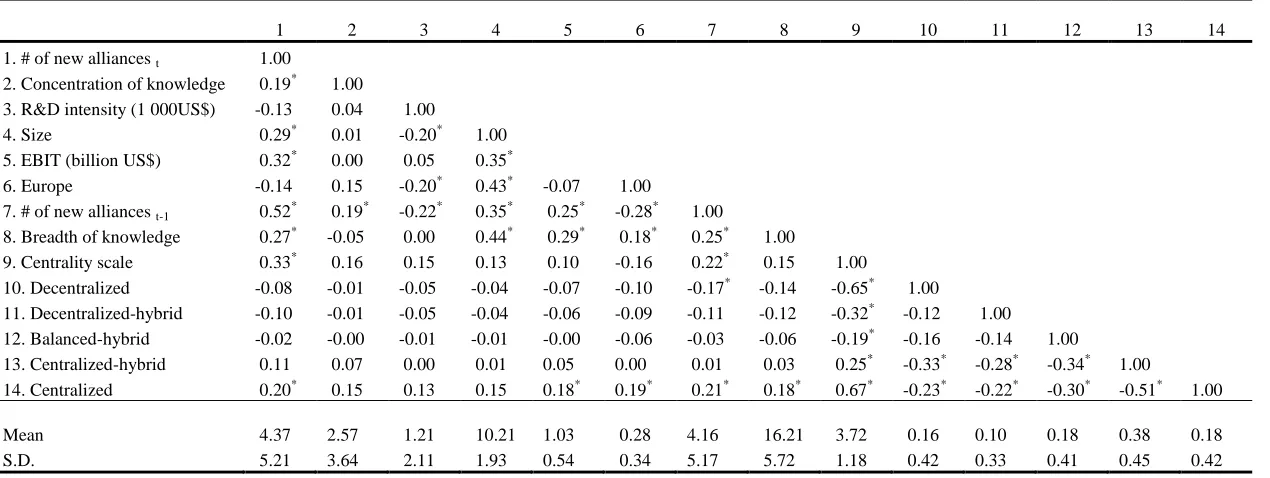
Table 1 shows the descriptive statistics and correlations for all variables. It indicates that
on average a firm formed 4.3 alliances (1.6 in early stage and 2.7 in later stage) each year. The
absence of high correlations between knowledge breadth and R&D centrality, and between these
and the controls suggests that multicollinearity is unlikely to be problematic in this analysis.
Moreover, prior to the creation of interaction items, knowledge breadth and R&D centrality scale
were mean-centered to reduce the potential multicollinearity (Aiken and West, 1991).
--- Insert Table 1 about here ---
We applied negative-binomial models to test the hypotheses. Like Poisson regression, the
negative-binominal model treats the dependent variable as a count variable but allows for a direct
measure of heterogeneity (Cameron and Trivedi, 1986). Estimating heterogeneity not only
relaxes the stringent Poisson assumption of equal mean and variance in the error term but also
accounts for omitted variable bias (Walker et al., 1997). We also applied Poisson regressions,
and found no substantial differences.
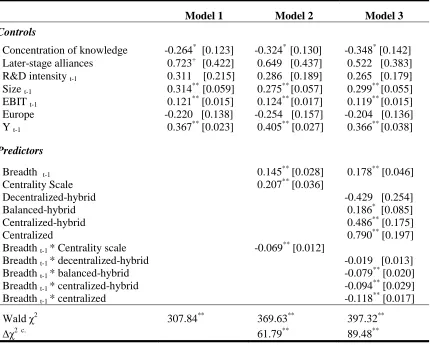
Table 2 depicts our statistical analysis results. Model 1 is the base model that includes
only control variables. We introduced variables in differing combinations to test for robustness,
and we found stability in our results. For the sake of brevity we only show two models (2 and 3)
that include both direct and interactive effects of knowledge breadth and centrality of R&D
organization. In model 2 we measure centrality using the centrality scale, and in model 3 we
replace the centrality scale with a vector of categorical measures with decentralization as the
reference group, which allows us to test for non-linearity.
--- Insert Table 2 about here ---
Hypothesis 1 predicts a positive relationship between knowledge breadth and alliance
formation. In models 2 and 3, the coefficients on breadth are positive and significant (B=0.145,
p<0.01; B=0.178, p<0.01 respectively). So H1 is supported.
Hypothesis 2 predicts a positive relationship between R&D centrality and alliance
formation. It is supported by the result in model 2 with the measure of centrality scale, which has
assumed that decentralization-centralization effects are linear, since its coefficient is positive and
significant (B=0.207, p<0.01). Model 3 with categorical variables of centrality further explores
this effect. By and large, the linearity assumption stands, since except for decentralized-hybrid
the effects of the other dummy variables of organizational structure on alliance formation are
Hypothesis 3 states negative interaction effects of breadth and R&D centrality. Model 2
supports it with the measure of centrality scale, since the product term breadth*centrality scale
is negative and significant (B=-0.069, p<0.01). Model 3 also supports H3 with the categorical
variables of centrality, except that the effect of decentralized-hybrid is insignificant relative to
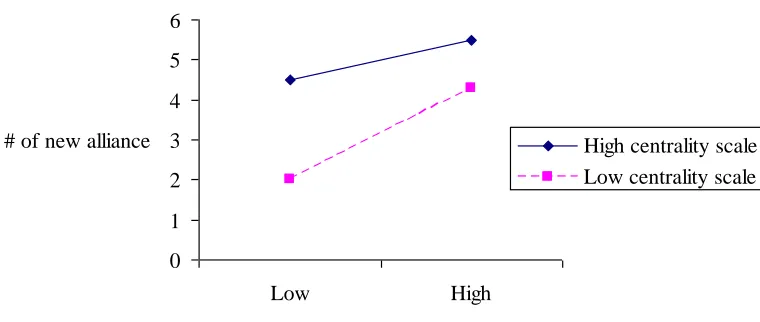
the omitted decentralized category. Figure 1 graphically plots the interactions. We used one
standard deviation between and above the mean as the range for centrality scale, and the other
variables were constrained to their mean values (Aiken and West, 1991). The two lines in Figure
1 indicate that overall the breadth of knowledge base has positive impact on resource acquisition;
and its impact is strengthened when centrality scale is low rather than high.
--- Insert Figure 1 about here ---
The results of the control variables have some interesting insights. Knowledge
concentration showed somewhat negative effects. It suggests that a firm with evenly dispersed
R&D capabilities has a slightly higher likelihood of using alliances. The dummy variable
later-stage alliances did not show significant results. It implies that after checking for the influences
of the other factors, the firms have a similar propensity to enter early and later stage alliances.
Similarly, R&D intensity did not show significant influence on alliance formation, which
suggests that its impact was perhaps mediated by the other knowledge and organizational
variables included in our model. Firm size and EBIT (profit) showed significantly positive effects,
which suggests that the firm with munificent (slack) resources is more able to explore new
technological development, as well as exploit market opportunities with alliance partners. It also
implies that entering alliances is a way of improving the efficiency of firm knowledge-utilization
coefficient of Europe did not appear to be significant, suggesting that the European context did
not skew results. Finally, the consistent and positive effects of Yt-1 suggest the path-dependence
feature of a firm’s alliance activities (Nelson and Winter, 1982).
We conducted extra tests to further explore firm alliance behavior at the different stages
of alliances. The literature seems to suggest that compared with later stage alliances the early
stage alliance activity would rely more on a broad R&D knowledge base as those partnerships
are exploratory, fundamental and generic in nature (Argyres and Silverman, 2004). We tested
this hypothesis by including the product term later-stage alliances*breadth in the model. But no
significant results were found. We also split the samples into two groups with early-stage
alliances as one group and the rest in the other group, and tested H1 to H3. All hypotheses were
supported by both sub-samples. The result implies that the impacts of knowledge breadth and
organizational structure on firm alliance decision are consistent over the different stages of
alliances.
We undertook some further robustness tests. We first added centrality scale2to check the
non-linearity of the effect of centrality scale, but did not find significant results. Then, we
changed the measures of the control variables. For instance, we changed the measure of firm size
by the value of fixed assets, the measure of R&D intensity by calculating log (R&D investment)
or the ratio of R&D investment over the value of fixed assets. The results remained the same for
the variables of interests. In addition, we modified the models by excluding Yt-1, since this
variable might absorb too much effect stemming from firm features and thus lead to the
non-significant results of the other variables. We did not find non-significant change either. In sum, our
In sum, all of our hypotheses are supported. The broader the technological knowledge
base of the firm, the more likely it is to form technological alliances. Likewise, a more
centralized R&D organization structure has the same effect. And, significantly, there is a
substitution effect between these two constructs. Finally, the importance of knowledge breadth
and organization structure on firm alliance decision is stable as between early and later stage of
alliances.
5. Discussion
Because absorptive capacity is seen as central to a firm’s motivation to benefit from
alliances, a central theme of this paper was to deepen our understanding of how to understand
and measure this important concept. Absorptive capacity as a concept is a measure of a firm’s
ability to accumulate and mobilize knowledge (Cohen and Levinthal, 1990). Hitherto, many
researchers appear to have assumed that expenditures on R&D automatically translate into
absorptive capacity. But our research confirms what several researchers have argued: the process
of creating and mobilizing knowledge is quite complex. Unlike Jansen et al. (2005) we did not
explore the micro-process by which individual managers influence the conversion process.
However, we did investigate how managerial choices such as the organization of the firm
interact with knowledge stocks to alter absorptive capacity. This approach, as noted earlier, is
consistent with taking an architectural view of knowledge (Henderson and Clark, 1990). It is also
consistent with the view that a firm’s ability to mobilize its knowledge is more than just
identifying what individual units know (Grant, 1996). We know that mobilizing embedded
knowledge is a form of dynamic capability and firms differ greatly in this respect (Teece et al.,
capability, by suggesting that centralization of research activities may enhance firms’ capacity to
renew and change. This view is congruent with themes in the literature on strategic renewal that
argue for centralization to generate new ideas in the renewal process (Stopford and Baden-Fuller,
1994).
Our work has a more general message for the knowledge-based view of the firm, which
sees the role of the firm as the integrator of knowledge (Kogut and Zender, 1992; Spender, 1996).
There is a strong view in the resource-based view of the firm that what happens inside the firm is
critical to its development path (Barney, 1991). Yet the knowledge-based view takes a broader
perspective. We know that inter-firm collaboration is profoundly important in a firm’s
development in certain industries, especially those involving high-technology. For example, the
frequency of alliances in biopharmaceutical industry in this study was on average greater than 4
a year and they were wide in their scope. This reinforces the suggestion of many prior studies
that the firm should be seen as an institution that integrates knowledge both within and across the
boundaries (e.g., Grant and Baden-Fuller, 1995, 2004).
Obviously our work has an important bearing on our understanding of how to model
alliance behavior, something called for by Dyer et al. (2001). The paper shows that the
incumbent’s alliance motivations are strongly influenced by the breadth of the knowledge base
and the way the internal R&D knowledge is organized (centrality). We also found that the
centrality of the R&D organization can substitute for the power of the knowledge base.
As underlined by Arora and Gambardella (1994), the benefits of R&D centralization –
rapidity of decision making, strong capacity to renew knowledge and achievement of the
economies of scale or scope of knowledge – reinforce the advantage of large incumbents in
assets as well as strong knowledge integration capabilities (Kogut and Zender, 1992; Teece,
1986). Our finding appears to support this point. It also casts doubt on the claims that R&D
centralization is unwise because it reduces the flow of external know-how into the firm (Chacar
and Lieberman, 2003), creating bureaucratic diseconomies (Williamson, 1991), higher
monitoring cost (Ouchi, 1978), and less internal competition (Porter, 1990). However, it merits
noting that in this paper we did not examine the performance of the alliances directly (e.g., new
drugs are developed successfully). Our study only shows that R&D centralization may provide
the conditions for the incumbents to benefit from alliances, which could improve subsequent
alliance performance if incorporated with their strong alliance management skills. We will
discuss this further in the “limitations and future research” section below.
The findings of the substitution effect between knowledge breadth and R&D structure
centrality and the negative effect of knowledge concentration on alliance formation make sense
of Rothaermel and Deeds (2004)’s assertion in their research on the biotech industry that under
some circumstances “internal resources are substitute for external alliances” (p. 206). This study
suggests two such circumstances: (1) the firm possesses both broad and centralized knowledge
bases, and (2) it has concentrated technological strength in a few areas. Both mean the firm has
the strong capability to conduct in-house development. This reinforces the view that there is a
trade-off between the benefits and pitfalls of knowledge exchange through alliances (Ahuja,
2000; Eisenhardt and Schoonhoven, 1996).
6. Policy and managerial implications
This study has important implications for public policies towards the biopharmaceutical
alliances at the stages of early drug discovery between big pharmaceutical firms, NBFs and
academic organizations. Our study shows that large incumbents not only ally to explore new
knowledge with NBFs but also to access complementary assets as illustrated by the number of
later stage alliances compared with early stage ones. According to Callon (1994), the rationale
for public intervention in science policy is to maintain a high level of diversity in order to avoid
early lock-in on specific technological solutions. In the biotech model, public investment in
academic research and in stimulating start-up creation is indeed useful in generating a diversity
of technological development opportunities, and thus remedying market failure. However, such
investment efforts may turn out to be less effective as alliances and internal architectural
competencies can be substituted. Our research shows that those having the highest capability to
benefit from the exploration of technological knowledge are the large centralized pharmaceutical
firms: arguably assisting these firms is neither necessary nor encourages diversity. In contrast,
public policies may encourage more alliances at the commercialization stages, when the big
pharmaceutical firms have complementary assets and rich marketing experiences that NBFs and
academic organizations lack.
This study has clear managerial implications. For managers in big incumbents our
findings justify the long-term strategic investment in new technology territories. It shows that a
broad knowledge base may create more chances to enter into and gain benefits from alliances.
An alternative way to achieve the same target, according to this study, is that managers organize
R&D activities under more centralized planning and control. In addition, the substitution effect
between knowledge breadth and R&D centrality, and the negative impact of knowledge
concentration on alliance formation indicate some of the potential dangers of using alliances. As
single product coming speedily to market may not be worth the trouble if there is a serious
danger that the long-term knowledge position will be undermined. In situation where such
dangers are serious, an alternative method is to concentrate resources on one or a few
technological knowledge areas and strengthen firm in-house development capabilities. Finally,
managers can consider using alliances as real options, but they need sufficient architectural
knowledge to improve the competence in monitoring market change, crafting option contracts
and exercising option opportunities.
7. Limitations and future directions
Our work is inevitably limited by several considerations. First of all, this research
focused on alliance formation and did not take a nuanced look at the performance of each
firm/alliance in terms of drug development outcomes and the like. So we need to be cautious in
drawing on the implications of our findings in predicting firm/alliance performance or success.
Second, and importantly we took a technologically biased view of knowledge, which we
measured using patent classes. Obviously, this approach has the advantage of objectivity and
robustness. But it does not capture many important and more tacit dimensions of knowledge
capability. Whilst one could argue that the tacit dimension is probably correlated with the
patenting, one cannot be sure of this. Third, our modeling did not look at network effects in the
biotech industry, where knowledge is transmitted not only via alliances directly, but also by
making alliances with firms that have alliances with other partners.
There are many researchers working in this field and we anticipate future work following
several tracks. One is to investigate in more depth the influence of knowledge base features and
by Rothaermel and Deeds, 2004). This would allow us to see if there is symmetry between
external absorptive capacity and internal capability. Another theme is to examine the impact of
alliance projects on research outcomes. It would be useful to see how many of the alliances
achieve their objectives (see for instance the work of Hoang and Rothaermel, 2005). Such
research would also test the ideas of relative absorptive capacity of alliance partners as laid out
by Lane and Lubatkin (1998).
Another direction for future work would be to expand our measures of knowledge
breadth beyond those provided by patents, by looking at other dimensions of capability. In this
vein of reasoning, we recognize that knowledge lies beyond any dyadic alliance. There is
potential to utilize network analysis to capture the position of the large firms in the
alliance-making field and shed further insight into the path-dependent feature of alliance formation (see
for instance Hagedoorn’s work). Finally, future research can apply our framework to, and test it
on, other industries, such as telecoms and semiconductors, to see how rapid innovation in the
industrial environment influences the incumbents’ collaboration activities.
In sum, this study explores how the firm’s knowledge base and knowledge management
in terms of R&D organization structure influence its propensity to use alliances in exploring
technological development or in exploiting business opportunities. By doing this it sheds light on
our understanding of absorptive capacity and the related concept of dynamic capabilities. In this
new century, the development of knowledge economies requires firms to have superior
innovation capabilities. Because “the ability to exploit external knowledge will be the critical
component of innovative capabilities” (Cohen and Levinthal, 1990, p. 128), we hope that this
study will help to reinvigorate the exploration of how to build up innovation capabilities across
References
Ahuja, G., 2000. The duality of collaboration: Inducements and opportunities in the formation of interfirm linkages. Strategic Management Journal 21, 317-343.
Aiken, L.S., West, S.G., 1991. Multiple Regression: Testing and Interpreting Interactions, Thousand Oaks, SAGE.
Argote, L., Ingram, P., 2000. Knowledge transfer: A basis for competitive advantage in firms. Organizational Behavior and Human Decision Processes 82, 150-169.
Argyres, N.S., 1996. Capabilities, technological diversification and divisionalization. Strategic Management Journal 17, 395–410.
Argyres, N.S., Silverman, B.S., 2004. R&D, organization structure, and the development of corporate technological knowledge. Strategic Management Journal 25, 929-958.
Arora, A., Gambardella, A., 1990. Complementarities and external linkages: The strategies of the large firms in biotechnology. The Journal of Industrial Economics 37, 361-379.
Arora, A., Gambardella, A., 1994. Evaluating technological information and utilizing it: Scientific knowledge, technological capability, and external linkages in biotechnology. Journal of Economic Behavior and Organization 24, 91-114.
Baden-Fuller, C., Dean, A., McNamara, P., Hilliard, B., 2006. Raising the returns to venture finance. Journal of Business Venturing 21, 265-285.
Barney, J.B., 1991. Firm resources and sustained competitive advantage. Journal of Management 17, 99-120.
Baum, J.A., Calabrese, T., Silverman, B., 2000. Don’t go it alone: Alliance network composition and startups’ performance in Canadian biotechnology. Strategic Management Journal 21, 267-294.
BIO, 2004. BIO’s Editors’ and Reporters’ Guide to Biotechnology. Biotechnology Industry Organization. www.bio.org.
Bower, G.H., Hilgard, E.R., 1981. Theories of Learning, Englewood Cliff, NJ, Prentice Hall.
Birkinshaw, J., Nobel, R., Ridderstrale, J., 2002. Knowledge as a contingency variable: Do the characteristics of knowledge predict organization structure. Organization Science 13, 274-289.
Callon, M., 1994. Is science a public good? Science Technology and Human Values 19, 395-425.
Cameron, A.C., Trivedi, P.K., 1986. Econometric models based on count data: Comparisons and application of some estimators and tests. Journal of Applied Econometrics 1, 29-53.
Chacar, A.S., Lieberman, M.B., 2003. Organizing for technological innovation in the U.S. pharmaceutical industry. Advances in Strategic Management 20, 299-322.
Cockburn, L., Griliches, Z., 1987. Industry effects and appropriability measures in the stock market’s valuation of R&D and patents. Working paper no. 2465, NBER, Cambridge, MA.
Cohen, J., Cohen, P., 1983. Applied Multiple Regression/Correlation Analysis for The Behavioral Sciences. Hillsdale, NJ, Lawrence Erlbaum Associates, Inc.
Cohen, W.M., Levinthal, D.A., 1990. Absorptive capability: A new perspective on learning innovation. Administrative Science Quarterly 35, 128-152.
De Meyer, A., 1993. Management of an international network of industrial R&D laboratories. R&D Management 23, 109–120.
Dunning, J. H. 1994. Multinational enterprises and the globalization of innovatory capacity. Research Policy 23, 67-88.
Dyer, J.H., Kale, P., Singh, H., 2001. How to make strategic alliances work. Sloan Management Review 42(4),37–43.
Dyer, J.H., Nobeoka, K., 2000. Creating and managing a high performance knowledge-sharing network: The Toyota case. Strategic Management Journal 21(3), 345–368.
Dyer, J.H., Singh, H., 1998. The relational view: Cooperative strategy and sources of interorganizational competitive advantage. Academy of Management Review 23, 660–679.
Eisenhardt, K., Schoonhoven, C.B., 1996. Resource-based view of strategic alliance formation: Strategic and social effects in entrepreneurial firms. Organization Science 7, 136-150.
Granstrand, O., Sjolander, S., 1990. Managing innovation in Multi-technology corporations. Research Policy 19, 35-60.
Glasmeier, A., 1991. Technological discontinuities and flexible production networks: The case of Switzerland and the world watch industry. Research Policy 20, 469-485.
Grant, R., Baden-Fuller, C., 1995. A knowledge-based theory of inter-firm collaboration. Academy of Management Best Paper Proceedings, pp. 17-21.
Grant, R., Baden-Fuller, C., 2004. A knowledge access theory of strategic alliances. Journal of Management Studies 41, 61-84.
Gulati, R., 1998. Alliances and networks. Strategic Management Journal 19, 293-317.
Hagedoorn, J., 1993. Understanding the rationale for strategic technology partnering: Interorganizational models of co-operation and sectoral differences. Strategic management Journal 14, 371-386.
Hamel, G.P., Doz, Y., Prahalad, C.K., 1989. Collaborate with your competitors and win. Harvard Business Review 67: 133–139.
Harrigan, K.R., 1985. Strategies for Joint Ventures. Lexington, MA, Lexington Books.
Heckman, J.J., Borjas, G., 1980. Does unemployment cause future unemployment? Definitions, questions and answers from a continuous time model of heterogeneity and state dependence. Economica 47, 247-283.
Henderson, R., 1994. The evolution of integrative capabilities: Innovation in cardiovascular drug discovery. Industrial and Corporate Change 33, 607–630.
Henderson, R.M., Clark, K.B., 1990. Architectural innovation: The reconfiguration of existing product technologies and the failure of established firms. Administrative Science Quarterly 35, 9–30.
Henderson R, Cockburn, I., 1994. Measuring competence? Exploring firm effects in pharmaceutical research. Strategic Management Journal 15(Winter Special Issue), 63–84.
Hennart, J.F., 1988. A transaction costs theory of equity joint ventures. Strategic Management Journal 9, 361-374.
Hoang, H., Rothaermel, F.T., 2005. The effect of general and partner-specific alliance experience on joint R&D project performance. Academy of Management Journal 48, 332-345.
Ireland, R.D., Hitt, M.A., Vaidyanath, D., 2002. Alliance Management as a source of competitive advantage. Journal of Management 28, 413-446.
Kale, P., Singh, H., Perlmutter, H., 2000. Learning and protection of proprietary assets in strategic alliances: Building relational capital. Strategic Management Journal 21 (Special Issue), 217–237.
Katila, R., Ahuja, G., 2002. Something old, something new: A longitudinal study of search behavior and new product introduction. Academy of Management Journal 45, 1183-1194.
Kauffman, S., Lobo, J., Macready, W.G., 2000. Optimal search on a technology landscape. Journal of Economic Behavior & Organization 43, 141-166.
Khanna, T., Gulati, R., Nohria, N., 1998. The dynamics of learning alliances: Competition, cooperation, and relative scope. Strategic Management Journal 19: 193–210.
Kinder, T., 2003. Go with the flow-a conceptual framework for supply relations in the era of the extended enterprise. Research Policy 32, 503-523.
King, A., Zeithaml, C., 2003. Measuring organizational knowledge: A conceptual and methodological framework. Strategic Management Journal 24, 763-772.
Kleinknecht, A., Reijnen, J.O.N., 1992. Why do firms cooperate on R&D? An empirical study. Research Policy 21, 347–360.
Kogut, B., Zender, U., 1992. Knowledge of the firm, combinative capabilities, and the replication of technology. Organization Science 3, 383-397.
Lane, P.J., Lubatkin, M., 1998. Relative absorptive capacity and interorganizational learning. Strategic Management Journal 19, 461-477.
Lindsay, P.H., Norman, D.A., 1977. Human Information Processing. Orlando, FL, Academic Press.
McGrath, R.G., 1999. Falling forward: Real options reasoning and entrepreneurial failure. Academy of Management Review 24, 13– 30.
Mitchell, W., Singh, K., 1992. “Incumbents” use of pre-entry alliances before expansion into new technical subfields of an industry. Journal of Economic Behavior and Organization 18, 347-372.
Mol, M.J., 2005. Does being R&D intensive still discourage outsourcing? Evidence from Dutch manufacturing. Research Policy 34, 571-582.
Mowery, D., Oxley, J., Silverman, B., 1996. Strategic alliances and interfirm knowledge transfer. Strategic Management Journal 17, 77-91.
Orsenigo, L., Pammolli, F., Riccaboni, M., 2001. Technological change and network dynamics: Lessons from the pharmaceutical industry. Research Policy 30, 485–508.
Ouchi, W.G., 1978. The transmission of control through organizational hierarchy. Academy of Management Journal 21, 173-191.
Pavitt, K.L.R., 1988. Uses and abuses of patent statistics, in: van Raan A.F.J. (Eds.), Handbook of Quantitative Studies of Science and Technology. Elsevier Science Publishers.
Pearce, R.D., Singh, S., 1992. Globalizing Research and Development. London, MacMillan.
Peteraf, M., 1993. The cornerstones of competitive advantage: A resource-based view. Strategic Management Journal 14, 179-191.
Pisano, G.P., 1990. The R&D boundaries of the firm: An empirical analysis. Administrative Science Quarterly 35, 153-176.
Polanyi, M., 1958. Personal Knowledge: Towards a Post- Critical Philosophy. Chicago, University of Chicago Press.
Porter, M., 1990. The Competitive Advantage of Nations. New York, The Free Press.
Powell, W.W., Koput, K.W., Smith-Doerr, L., 1996. Interorganizational collaboration and the locus of innovation: Networks of learning in biotechnology. Administrative Science Quarterly 41, 116-145.
Quinn, J.B., 2000. Outsourcing innovation: The new engine of growth. Sloan Management Review 41(4): 13-28.
Reuer, J.J., Tong, T.W., 2005. Real options in international joint ventures. Journal of Management 31, 403-423.
Roijakkers, N., Hagedoorn, J., van Kranenburg, H., 2005. Dual market structures and the likelihood of repeated ties – evidence from pharmaceutical biotechnology. Research Policy 34, 235-245.
Rothaermel, F., 2001. Incumbent’s advantage through exploring complementary assets via interfirm cooperation. Strategic Management Journal 22, 687-699.
Rothaermel, F., Deeds, D., 2004. Exploration and exploitation alliances in biotechnology: A system of new product development. Strategic Management Journal 25, 201-221.
Simonin, B.L., 1997. The importance of developing collaborative know-how: An empirical test of the learning organization. Academy of Management Journal 40, 1150-1174.
Soete, L., 1987. The impact of technological innovation on international trade patterns: the evidence reconsidered. Research Policy 16, 101-130.
Spender, J.C., 1996. Making knowledge the basis of a dynamic theory of the firm. Strategic Management Journal 17 (Winter Special Issue), 45-62.
Stopford, J., Baden-Fuller, C., 1994. Creating corporate entrepreneurship. Strategic Management Journal 15, 521-536.
Taggart, J.H., 1993. The World Pharmaceutical Industry. New York, Routledge.
Teece, D., 1986. Profiting from technological innovation: Implications for integration, collaboration, licensing and public policy. Research Policy 15, 285-305.
Teece, D., Pisano, G., Shuen, A., 1997. Dynamic capabilities and strategic management. Strategic Management Journal 18, 509-533.
Walker, R., 1995. Patents as Scientific and Technical Literature. Metuchen, NJ, Scarecrow Press.
Walker, G., Kogut, B., Shan, W., 1997. Social capital, structural holes, and formation of an industry network. Organization Science 8, 109-128.
Wang, Q., von Tunzelmann, G.N., 2000. Complexity and the functions of the firm: Breadth and depth. Research Policy 29, 805-818.
Table 1
Descriptive analysis and correlation matrix
1 2 3 4 5 6 7 8 9 10 11 12 13 14
1. # of new alliances t 1.00
2. Concentration of knowledge 0.19* 1.00
3. R&D intensity (1 000US$) -0.13 0.04 1.00
4. Size 0.29* 0.01 -0.20* 1.00
5. EBIT (billion US$) 0.32* 0.00 0.05 0.35*
6. Europe -0.14 0.15 -0.20* 0.43* -0.07 1.00
7. # of new alliances t-1 0.52* 0.19* -0.22* 0.35* 0.25* -0.28* 1.00
8. Breadth of knowledge 0.27* -0.05 0.00 0.44* 0.29* 0.18* 0.25* 1.00
9. Centrality scale 0.33* 0.16 0.15 0.13 0.10 -0.16 0.22* 0.15 1.00
10. Decentralized -0.08 -0.01 -0.05 -0.04 -0.07 -0.10 -0.17* -0.14 -0.65* 1.00
11. Decentralized-hybrid -0.10 -0.01 -0.05 -0.04 -0.06 -0.09 -0.11 -0.12 -0.32* -0.12 1.00
12. Balanced-hybrid -0.02 -0.00 -0.01 -0.01 -0.00 -0.06 -0.03 -0.06 -0.19* -0.16 -0.14 1.00
13. Centralized-hybrid 0.11 0.07 0.00 0.01 0.05 0.00 0.01 0.03 0.25* -0.33* -0.28* -0.34* 1.00
14. Centralized 0.20* 0.15 0.13 0.15 0.18* 0.19* 0.21* 0.18* 0.67* -0.23* -0.22* -0.30* -0.51* 1.00
Mean 4.37 2.57 1.21 10.21 1.03 0.28 4.16 16.21 3.72 0.16 0.10 0.18 0.38 0.18
S.D. 5.21 3.64 2.11 1.93 0.54 0.34 5.17 5.72 1.18 0.42 0.33 0.41 0.45 0.42
Table 2
Negative binomial regression on the number of new alliances with fixed-year effects a, b
Model 1 Model 2 Model 3
Controls
Concentration of knowledge -0.264* [0.123] -0.324* [0.130] -0.348* [0.142] Later-stage alliances 0.723+ [0.422] 0.649 [0.437] 0.522 [0.383] R&D intensity t-1 0.311 [0.215] 0.286 [0.189] 0.265 [0.179]
Size t-1 0.314
**
[0.059] 0.275** [0.057] 0.299** [0.055]
EBIT t-1 0.121
**
[0.015] 0.124** [0.017] 0.119** [0.015]
Europe -0.220 [0.138] -0.254 [0.157] -0.204 [0.136]
Y t-1 0.367
**
[0.023] 0.405** [0.027] 0.366** [0.038]
Predictors
Breadth t-1 0.145
**
[0.028] 0.178** [0.046]
Centrality Scale 0.207** [0.036]
Decentralized-hybrid -0.429 [0.254]
Balanced-hybrid 0.186* [0.085]
Centralized-hybrid 0.486** [0.175]
Centralized 0.790** [0.197]
Breadth t-1 * Centrality scale -0.069
**
[0.012]
Breadth t-1 * decentralized-hybrid -0.019 [0.013]
Breadth t-1 * balanced-hybrid -0.079** [0.020]
Breadth t-1 * centralized-hybrid -0.094
**
[0.029]
Breadth t-1 * centralized -0.118** [0.017]
Wald χ2
307.84** 369.63** 397.32**
∆χ2 c.
61.79** 89.48**
a.
S.E. in brackets
b.
In all models year dummies were included.
c.
Represents statistical comparison with base model 1.
+p < 0.10
*
p < 0.05
**
Figure 1
Split-plot analysis of the interactive effects of R&D organization structure and knowledge breadth on alliance formation
0 1 2 3 4 5 6
Low High
Breadth of Knowledge base
# of new alliance High centrality scale
Appendix I
Derwent Biotechnology Abstracts Technological classes and Sub-classes
DBA Technology Classes DBA Technology Sub-Classes
A-Genetic-Engineering-and-Fermentation
A1-Nucleic-Acid-Technology A2-Fermentation
B-Engineering B1-Biochemical-Engineering
C-Analysis C1-Sensors-and-Analysis
D-Pharmaceuticals D1-Antibiotics D2-Hormones D3-Peptides-and-Proteins D4-Vaccines D5-Other-Pharmaceuticals D6-Antibodies D7-Clinical-Genetic-Techniques E-Agriculture E1-Biological-Control-Agents E2-Plant-Genetic-Engineering E3-Pesticides E4-In-Vitro-Propagation E5-Agricultural,-Other
F-Food F1-Food-and-Food-Additives
G-Fuels,-Mining-and-Metal-Recovery G1-Biofuels-and-Solvents G2-Mining-and-Metal-Recovery H-Other-Chemicals H1-Polymers H2-Chiral-Compounds H3-Miscellaneous-Compounds H4-Polyunsaturates J-Cell-Culture J1-Animal-Cell-Culture J2-Plant-Cell-Culture K-Biocatalysis K1-Isolation-and-Characterization K2-Application
L-Purification L1-Downstream-Processing
M-Waste-Disposal-and-the-Environment