IOS Press
The sinking of the Ro–Ro passenger ferry
SS Heraklion
A. Papanikolaou
a, E. Boulougouris
b,∗and A. Sklavenitis
aaShip Design Laboratory, National Technical University of Athens, Athens, Greece
E-mail: [email protected]
bDepartment of Naval Architecture and Marine Engineering, University of Strathclyde, Glasgow, UK
E-mail: [email protected]
Received 29 April 2013 Revised 14 October 2013 Accepted 2 November 2013
On December 8, 1966 the Ro–Pax ferrySS Heraklioncapsized and sank in the Aegean Sea, resulting in the death of over 200 people. The present paper tries to shed some light into the various events that led to the largest tragedy of modern Greek maritime history. It re-constructs the accidental data based on a variety of original investigation reports, ship files and legal evidence. Ship’s loading, intact and damage stability behaviour were re-investigated and the flooding/sinking of the ship was simulated by use of a time simulation method. Results of our investigation were compared with available testimonies of survivors. It was found that downflooding of large void spaces below the flooded car deck and the effect of multiple free surfaces on ship’s stability was eventually the main reason forSS Heraklion’s capsize.
Keywords:SS Heraklion, marine accident, damage stability, water on deck, extreme weather, sail-out permit, time simulation
1. Introduction
In the night of December 8, 1966 the Ro–Pax ferrySS Heraklioncapsized and sank in the Aegean Sea, resulting in the death of over 200 people.
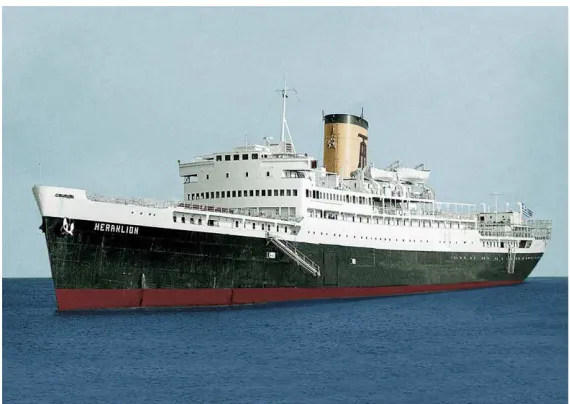
SS Heraklionwas originally built at Fairfield Shipbuilding and Engineering Com-pany in Glasgow in 1949. Her first name wasSS Leicestershireand she was owned by Bibby Line. She initially operated the UK to Burma route. She was also chartered to the British India Line for some time to supplement its London to East Africa ser-vice. Aegean Steam Navigation Co bought the ship in 1964 to operate her under their Typaldos Line. It was then renamed toSS Heraklion. In order to fit her new duties Typaldos Line converted the ship to a passenger/car ferry (see Fig. 1).
*Corresponding author: Dr.-Eng. Evangelos K. Boulougouris, Lecturer, Department of Naval
Architecture and Marine Engineering, University of Strathclyde, Henry Dyer Building, 100 Montrose Street, Glasgow G4 0LZ, Scotland, UK. Tel.: +44 141 548 3875; Fax: +44 141 552 2879; E-mail: [email protected].
Fig. 1.SS Heraklionfollowing her conversion. (Colors are visible in the online version of the article; http://dx.doi.org/10.3233/ISP-130109.)
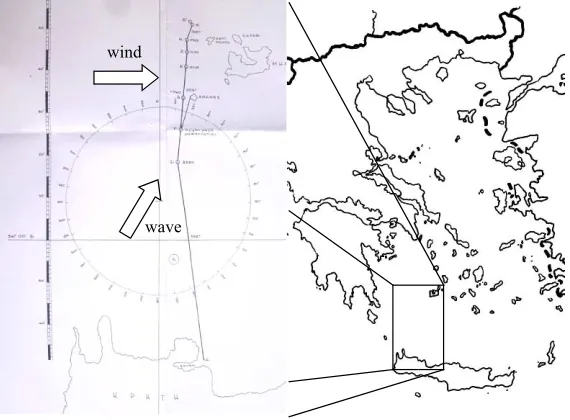
The ship sailed out from Souda Bay, Chania–Crete in the evening of December 7, 1966, under extreme weather conditions, for the port of Piraeus. While sailing south of the rocky island ofFalkoneraa non-secured refrigerator truck moved transversely and hit the side loading door violently. The door opened and the truck plummeted into the sea. As result of that the car deck was flooded through the side door opening and this caused the capsize/sinking of the ship sometime after 2:00 AM on Decem-ber 8, 1966.
Considering the significance of this accident for the modern Greek maritime his-tory (e.g. modernization of Greek Maritime Authorities, introduction of ‘suspension of sail-out of passenger ships in bad weather’ decree etc.), the authors using state of the art methods and tools are revisiting this accident in order to assess the main reasons for this maritime tragedy, causing the lives to more than 200 people. TheSS Heraklionaccident is believed to be one of the first ships worldwide, in which the effect of flooding of a passenger ferry’s car deck (Water On Deck, WOD problem) on ship’s damage stability proved fatal.1The subject of the paper is part of the diploma thesis work of the 3rd author [13].
1Remarkably, the Norwegian train ferry Skagerrak (built in 1965) sank three months earlier, on
2. Historical background
The owner and operator of the tragic ship was theAegean Steam Navigation Co
of Typaldos brothers. The company was founded after WWII and started offering passenger transport and cruising services in the Greek coastal market. The company was quite successful and kept steadily growing, operating with more and more ships in the sixties. In 1964,SS Heraklionwas acquired by Typaldos brothers to provide passenger liner services between Piraeus and Chania–Crete. Once the ship arrived in Greece, the formerSS Leicestershireoriginally built by Fairfield Shipbuilding and Eng. Co. in Glasgow in 1949 for the UK Bibby line, was refitted as a passenger/car ferry. The ship had an overall length of 498 ft (152 m), a beam of 60 ft (18 m), gross tonnage of 8,922 tonnes. She was equipped with a 4-cylinder steam turbine placed in an engine room amidships, like in most ships of that period. Powered by 7,000 HP and fitted with a single propeller she was capable of reaching a speed of about 18 knots.
At that time, the Greek shipping industry was on the way to recover from the dam-ages of WWII. Most ship-owners were looking for second hand and often unsuitable vessels that were converted to passenger ferries and completely refitted. Conversions took place at small Greek yards without experience in this type of work. Naval ar-chitects, in charge of the conversions, did also have little experience in the assigned work.
Next to them, the coast-guard authorities had also little experience in safety in-spections of passenger ferries, thus could not properly monitor the condition of the growing fleet. Without appropriate staffing, the authorities were simply unable to meet the demands of their assigned tasks.
Even more, the political situation in Greece was at the time of the accident very unstable, if not chaotic, what was reflected in the performance of Greece’s admin-istration. With the general elections pending, temporary governments were being appointed by the King of Greece, to be replaced by others within very short time. Notably, few months after the accident (April 21st, 1967) a military junta came into power in Greece.
According to a report of the chief of the coast guard’s naval architecture de-partment of December 12, 1966 (this report was released only 4 days after the accident. . .),only few passenger ships complied with the safety regulations in force. This is not surprising if we consider the following.
converted to ferry ships (“watertight” bulkheads were not truly watertight in practice, due to various non-watertight openings/ways in between subdivided spaces).
In this state of affairs of Greek coastal shipping at the time of the accident, a fatal accident as that ofSS Heraklioncould have been expected to come. Next toSS Her-aklion, several other Typaldos Line’s vessels, likeLemnos,YdraandElli, were often reported as operating without proper safety certificates, incorrect or no data at all in their files.
3. SS Heraklion– The ship after the conversion
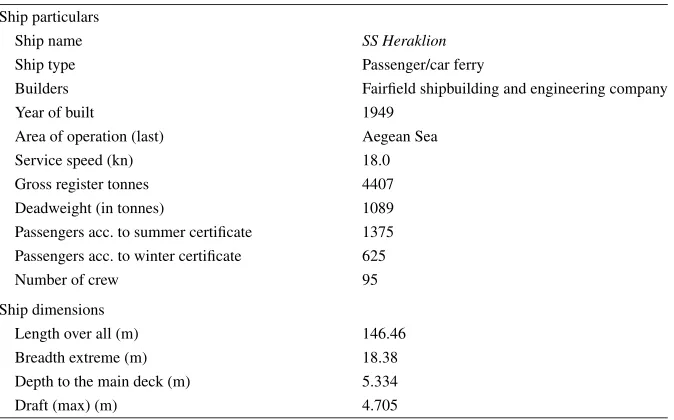
SS Heraklionfollowing her conversion had a capacity of 1,000 passengers and 400 t of trucks and cars, making her one of the largest, fastest and most competitive ships operating in the Aegean at that time (see Table 1).
The main conversion works refer to the following [1]:
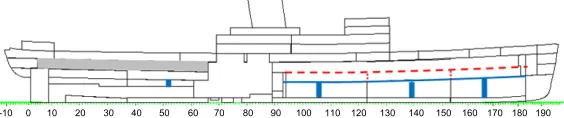
• Four (4) additional transverse bulkheads were fitted, subdividing the existing holds of the ship and generating nine (9) newvoid spacesas shown in Fig. 2 (encircled with blue colour).
[image:4.595.131.468.468.678.2]• The original hatch coamings were covered in such a way so as to generate two car decks, namely one extending from the engine room to the forepeak ballast tank and another one extending from the engine room to the afterpeak ballast tank.
Table 1
SS Heraklionmain particulars Ship particulars
Ship name SS Heraklion
Ship type Passenger/car ferry
Builders Fairfield shipbuilding and engineering company
Year of built 1949
Area of operation (last) Aegean Sea
Service speed (kn) 18.0
Gross register tonnes 4407
Deadweight (in tonnes) 1089
Passengers acc. to summer certificate 1375 Passengers acc. to winter certificate 625
Number of crew 95
Ship dimensions
Length over all (m) 146.46
Breadth extreme (m) 18.38
Depth to the main deck (m) 5.334
Fig. 2.SS Heraklion: main design alterations. (The colors are visible in the online version of the article; http://dx.doi.org/10.3233/ISP-130109.)
• The front part of the intermediate deck was totally removed (marked in red colour in Fig. 2) in order to provide space for high trucks loaded on the forward car deck.
• Several compartments were refurbished as tourist class accommodation spaces (marked in grey colour) while existing accommodation spaces on the main deck were extended/refitted.
• The original ship’s winches, cranes and other equipment concerning the load-ing/unloading procedure were totally removed from the main deck while the hatch coamings were covered in such a way to form a continuous deck. • The ship was equipped with four (4) side ramp-doors, two for the forward,
larger car deck and two for the smaller car deck on the ship’s stern.
As shown in the side profile (Fig. 2), the ship’s watertight part, extending from the baseline to the car deck, was subdivided by eleven (11) transverse bulkheads. However, the four additional bulkheads fitted during the conversion works did not go through to the base of the double bottom, but reached only the double bottom’s ceiling.
It was definitely a major conversion according to SOLAS that had a great impact on ship’s safety. It is notable that most of the conversion works were carried out at a local yard in the Piraeus–Perama shipbuilding area; local yards and naval archi-tects did not dispose at that time experience in this type of conversion work, which was completed without the supervision by the Greek flag authorities and nor by the classification society in charge. This may explain the numerous irregularities that were revealed later on, while the ship was in operation for a prolonged time without properly approved safety and class certificates.
According to the documentary files of the authorities, theSS Heraklionin par-ticular encountered several problems during the period after her conversion and the commencement of operations in summer 1965 and up to December 1966, when she sank. These included [1]:
• improper fitting of watertight transverse bulkheads, with alleged 15 holes of 15 cm diameter,
• untrained crew in the proper use of the auxiliary systems of the ship (ballast pumps, etc.),
• lack of inclining experiment and of related assessments of ship’s stability, • improper fitting of side ramp doors, with repeatedly broken mounting/hinges,
etc.,
• Lack of class and safety certificates.
Given the fact that the ship had no proper class certificate as passenger ship, it is a miracle howthe ship continued operating under temporary permit by the coast guard authorities for about1.5years after her conversion to Ro–Pax ferry!
It may be however improper to examine that time’s state of affairs of Greece’s Coast Guard strictly by today’s standards and rush to simple conclusions. Damage stability regulations for passenger ships were at the time of accident insufficient, even at international level. SOLAS 48 came into force only in September 1961 (!) and its provisions were mandatory strictly only for newbuildings. Only several years later, in October 1969, SOLAS 60 came into force. That more or less led to the foundation of the later deterministic stability criteria of SOLAS 74 and SOLAS 90, which remained in use until quite recently.
4. The accident
According to the official report [1] in the night of December 7, 1966, at about 7.30 PM local time, theSS Heraklionleft Souda Bay in North-West Crete heading for the port of Piraeus in mainland Greece. The ship was in regular service on the route Chania/Crete–Piraeus. There was a delay of about half an hour of the departure from Chania port due to the late arrival of an expected 34-ton reefer truck loaded with oranges. Upon arrival the truck entered in hurry the forward car deck of the ship from a side ramp/door. It was already late with ship’s departure and the crew was under pressure to quickly load the truck so that the ship could leave. In view of this, the truck was unconventionally loadedtransverselyand without being lashed, noting that all other trucks and cars on the same deck were loaded longitudinally according to the loading plan, but without special means of lashing as well.
At about midnight the already rough weather conditions worsened (winds of 8+ Beaufort scale and SW stern-quartering waves of 5–6 m wave height) and the ship started to roll heavily, in addition to strong heave and pitch motions. According to survivors’ testimonies, several trucks started moving and crashing against each other due to the extreme motions of the ship. At about 01:10 AM, a truck carrying soap and oil turned over. The released oily cargo made the car deck extremely slippery and dangerous to move on it.
open, with the truck plummeting into the sea (first, the trailer was disconnected from the tractor and did fall to the sea; shortly after the tractor followed).
With the ship moving heavily in strong seas, water started flooding the car deck, resulting in a heavy list. Despite the captain’s efforts to restore the ship to her vertical position, the list progressively increased and additional water entered ship’s car deck from the open side door until the point of no return. The ship finally sank near the island of Milos (Fig. 3,Falkonera’s Waters), shortly after 2:00 AM on December 8, 1966.
An SOS signal fromSS Heraklionwas received at 02:06 AM from various stations and ships around the Aegean Sea. The SOS signal was repeated twice. The Greek Ministry of Mercantile Marine was underequipped to handle the necessary commu-nications and SAR actions, while the port authorities of Piraeus, Syros and of other neighbouring islands were also unable to offer assistance due to lack of equipment. Unfortunately the ferryMinos, which was on the same route and some 15 miles away from the scene, did not receive the SOS.
At 4.30 AM the naval shipRHS Syros was ordered to get under way, while an hour later the Hellenic Air Force was alerted. A C-47 Skytrain took off from Elefsis airport followed shortly by two more. The first aircraft arrived at around 10:00 AM at the same time with the BritishHMS Ashton, which started picking up survivors aided from the three aircraft. This was about 8 h after ship’s sinking!
[image:7.595.157.442.439.649.2]Officially, out of 73 officers and crew and 191 passengers only 46 were rescued, (16 crew and 30 passengers), while 217 perished. The exact number remains however
unknown (some refer to 247 casualties), since at the time it was common to board the ship without a ticket, which would be issued upon sailing.
The Greek government’s investigation found the Typaldos Line guilty of negli-gence; the company was also charged with manslaughter and forgery of documents. The owner of the company, the general manager and two officers were sentenced to jail in 1968 (5–7 years prison). In the aftermath, it was found that twelve of the com-pany’s fifteen ships failed inspections under the international law. The comcom-pany’s remaining ships were taken over and sold either for scrap or sold off for other uses. The Typaldos line was dissolved. Following theSS Heraklion disaster, the Greek government enacted for all passenger ships leaving Greek ports the so-called ‘ sus-pension of sail-out in bad weather’ decree. Based on this, passenger ships operating in Greek waters are prohibited from sailing out with winds blowing at 8 Beaufort scale or higher, depending on their size. At the time of accident, it was up to the cap-tain to decide whether to sail out or not. The ‘suspension of sail-out in bad weather’ decree remains in force until today in Greece.
5. Ship model reconstruction
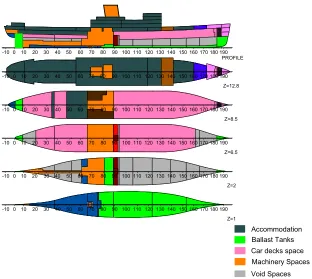
In an attempt to shed light in this tragic accident, a reconstruction of the ship’s hull was accomplished using various historical documents [1,4,5], the close cooperation with Technical University Hamburg–Harburg, which worked with the authors in a parallel study on the reasons of ship’s accident [2] and the available ship drawings. Based on the above, the geometry file of the hull was developed in NAPA [10] (see Fig. 4). The hydrostatics were verified for various loading conditions with those laid down in the investigations reports. The developed ship model coloured according to the purpose of each room is shown in Fig. 5.
[image:8.595.219.380.524.649.2]A key issue in our study, but also in all the conducted legal investigations in rela-tion to the accident, was the determinarela-tion of ship’s actual lightship weight and her
Fig. 5. NAPA model colours with room purposes. (Colors are visible in the online version of the article; http://dx.doi.org/10.3233/ISP-130109.)
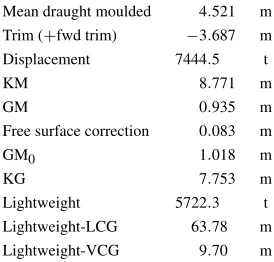
mass centre location. Regretfully, an inclining experiment was never properly con-ducted afterSS Heraklion’s conversion and prior to delivery, thus only the data of her sister vessel, namelySS Chaniacould be used for concluding on the lightweight and centroids ofSS Heraklion. Using recorded data of the sister ship, the loading case was reconstructed in NAPA and the results are shown in Table 2. Both the light-ship weight and VCG are in good agreement with the court study of Georgiadis and Antoniou [5]. The displacement at the inclining test condition was estimated to be 7,444.5 t compared to 7,447.62 t given in the comparative study report [5]. The VCG at the inclining experiment was estimated to have been 7.753 m, compared to 7.516 m in the comparative report [5]. This difference is considered satisfactory for the purpose of the present study, considering the overall uncertainty of the available comparative data and the circumstances of their generation.
Table 2
SS Chaniainclining experiment results Mean draught moulded 4.521 m Trim (+fwd trim) −3.687 m
Displacement 7444.5 t
KM 8.771 m
GM 0.935 m
Free surface correction 0.083 m
GM0 1.018 m
KG 7.753 m
Lightweight 5722.3 t
Lightweight-LCG 63.78 m
Lightweight-VCG 9.70 m
[image:10.595.229.366.191.322.2]Table 3
ExtractedSS Heraklionlightship Lightweight 5659.41 t Lightweight-LCG 64.19 m Lightweight-VCG 9.641 m
Fig. 6. Full load floating condition. (Colors are visible in the online version of the article; http://dx.doi.org/ 10.3233/ISP-130109.)
those calculated by the model. Considering the lighter superstructure ofSS Heraklion
due to the removal of the aft superstructure, her lightship was estimated as given in Table 3.
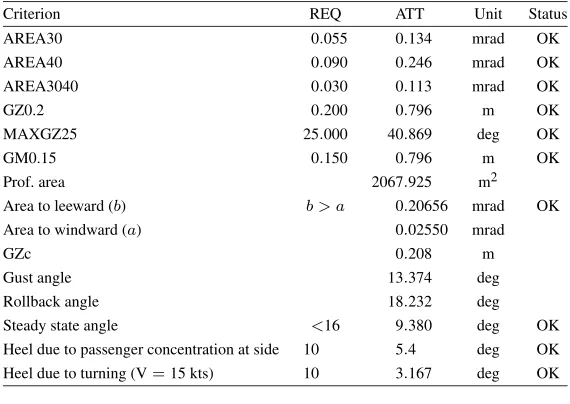
In order to check the stability of the vessel, the reconstruction of the full load condition was made using the available data from Georgiadis and Antoniou [5]. The resulting floating conditions are shown in Fig. 6 and corresponding numerical results in Table 4.
Table 4 Full load condition
Deadweight 2120.8 t
Displacement-full load 7780.2 t
Full load-LCG 69.20 m
Full load-VCG 7.69 m
GMcorr 0.82 m
Table 5
Intact stability in full load condition
Criterion REQ ATT Unit Status
AREA30 0.055 0.134 mrad OK
AREA40 0.090 0.246 mrad OK
AREA3040 0.030 0.113 mrad OK
GZ0.2 0.200 0.796 m OK
MAXGZ25 25.000 40.869 deg OK
GM0.15 0.150 0.796 m OK
Prof. area 2067.925 m2
Area to leeward (b) b > a 0.20656 mrad OK
Area to windward (a) 0.02550 mrad
GZc 0.208 m
Gust angle 13.374 deg
Rollback angle 18.232 deg
Steady state angle <16 9.380 deg OK
Heel due to passenger concentration at side 10 5.4 deg OK
Heel due to turning (V=15 kts) 10 3.167 deg OK
[image:11.595.155.440.298.500.2]Fig. 8. Ship’s stability in waves (wave crest).
Based on the data from the official investigation report [1], the loading condition at the time of the tragic accident was modelled. The vessel satisfied also in this condition the latest IMO intact stability standards.
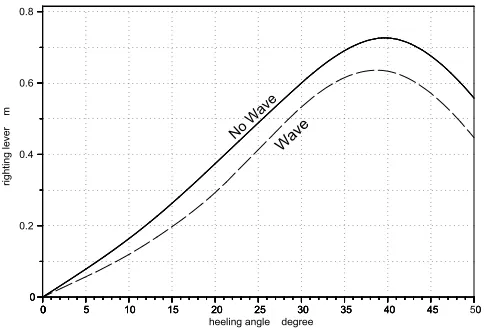
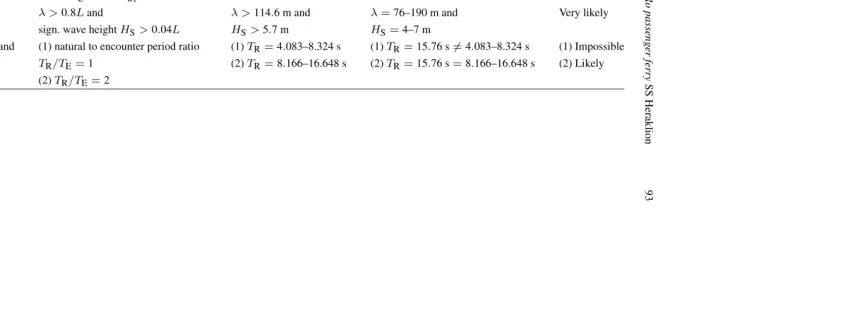
The effect of stern or stern-quartering waves on ship’s stability was also investi-gated, calculating at first the righting arm in waves. As can be seen in Fig. 8, there is a reduction of the righting arm with the ship on the wave crest (H =4 m, wave length ≈ Lwl), but this is not substantial, in view of ship’s hull form. In addition, the guidance criteria provided by IMO for avoiding dangerous situations in adverse weather and sea conditions (MSC.1/Circ.1228 [6]) were examined. It includes dy-namic stability phenomena that may occur in following and quartering seas, e.g. surf-riding and broaching-to phenomena; synchronous rolling motion; parametric rolling and combination of various dangerous phenomena. The respective phenomena, the conditions for their occurrence in general and in particular in the case ofSS Herak-lionin the night of accident were examined and the outcome is shown in Table 6. From these results it is obvious thatSS Heraklionwas in the night of the accident sailing in the dangerous zone ofvery likely occurrence of successive high-wave at-tacks and likely of parametric rolling motions.
6. Flooding investigation
P
apanik
o
laou
et
al.
/
The
sinking
of
the
R
o–Ro
passeng
er
ferry
SS
Heraklion
9
[image:13.595.165.677.228.387.2]3
Table 6
Additional dynamic intact stability criteria [6]
Phenomenon Stability criterion As applied to the case of SS Heraklion Likelihood of
SS Heraklion (condition at the time of accident) occurrence (qualitative)
Surf-riding V (kn)=1.8√L(m)/cos(180−α) V =21.5–30.5 kn V =15 kn (max 19 kn) Impossible
α: angle of wave encounter (0 degrees: head seas)
Pure loss of stability wave heightH=4 m and Reduced but adequate stability Very likely wave lengthλ≈Lwl
Successive high λ >0.8Land λ >114.6 m and λ=76–190 m and Very likely wave attack sign. wave heightHS>0.04L HS>5.7 m HS=4–7 m
Synchronous rolling and (1) natural to encounter period ratio (1)TR=4.083–8.324 s (1)TR=15.76 s=4.083–8.324 s (1) Impossible parametric rolling TR/TE=1 (2)TR=8.166–16.648 s (2)TR=15.76 s=8.166–16.648 s (2) Likely
motions the flooding of the vehicle deck was the due consequence. This resulted in additional heeling and in a reduction of ship’s GM due to the significant free surface formed in the car deck space. The floodwater amount led also to a reduction of ship’s freeboard, which also led to an increase of the water quantities entering the ship. Si-multaneously, due to down-flooding openings on the car deck, amounts of water flooded also the lower void spaces, creating additional free surfaces and reductions of ship’s GM, eventually rendering the capsizal of the vessel unavoidable.
The identified events that caused the rapid heeling of the ship at her starboard side were in particular:
• The transverse shift of the heavy reefer truck from the centre line to the edge of the opened side door.
• The flooding of the car deck (and of lower spaces). • The transverse shift of the rest of the cars.
• The presence of following/stern quartering waves. • Beam winds blowing from the port side of the vessel.
The heeling caused by the beam winds was calculated using the IMO weather cri-terion, where the wind heeling moment that is generated when a pressure of 0.1 t/m2 is applied on ship’s profile area. This pressure would cause the heeling of the ship by 12.5 degrees in still water and more than 16 degrees with the ship on a wave crest.
It should be mentioned here that due to ship’s relatively small freeboard, the lower edge of the side door is getting submerged at an angle of about 10 degrees. The location of the side door in the middle of the forward car space combined with the sheer of the car deck and the large trim of the vessel permitted the accumulation of large quantities of water in case of flooding and the developing of a large free surface on her car deck. The calculation has shown that in her intact loading condition, only 17 t of flood water would be required to reduce to zero the metacentric height of the vessel in still water condition and only 6 t when the ship is situated on a wave crest. For reference, the forward car deck space had a capacity (as floodable space, according our NAPA model) of more than 95 t for a reference height of 0.5 m at its lower aft end, assuming a trim of the ship by 3 m (aft).
With the reefer truck hanging at the end of the opened side door, a significant heeling moment is being imposed on the vessel. In still water, the ship would heel about 4 degrees due to this, reaching 15 degrees with the wind force. With the ship on the wave crest these values increase to 5 and 19 degrees respectively. Assuming a quantity of 50 t of flood water on the car deck the static heel reaches 9 degrees and the wind imposed heeling surpasses 21 degrees.
condition significant quantities of water may enter the car deck. A quantity of 100 t is sufficient to increase the static heel to 12 degrees and the wind imposed heeling to 23 degrees. Increase of the flood volume would degrade further the stability of the ship.
6.1. Flooding simulation
In order to investigate more carefully the progressive flooding sequence, a full geometric model of the flooded spaces was created in NAPA, modelling all floodable spaces above the main deck as shown in Fig. 9. A number of internal and external openings were also modelled in order to create a complete hydraulic model for the simulation of the progressive flooding of the ship [2].
6.2. The pressure-correction method
The NAPA dynamic flooding simulation tool was used for simulating the pro-gressive flooding. The principles of the method were presented in Ruponen [12]. At each time step the conservation of mass is satisfied in each flooded room, both with respect to water and air. The equation of continuity stipulates:
Ω
∂ρ
∂t dΩ=−
S
ρ UndS, (1)
[image:15.595.181.418.486.644.2]whereρ is the density of the fluid,U the velocity vector andS the surface that bounds the control volumeΩ. The minus sign on the RHS of the equation is due to the assumption that the surface’s normal vectornpoints outwards from the control
Fig. 10. Definition of points A (middle of room) and B (opening). (Colors are visible in the online version of the article; http://dx.doi.org/10.3233/ISP-130109.)
volume. The velocities at the openings are calculated using Bernoulli’s equation for a streamline from a point in the middle of a flooded room A to a point in the opening B (see Fig. 10):
B A dp ρ + 1 2
u2B−u2A
+g(hB−hA)=0, (2)
wherepis the pressure,uthe flux velocity andhthe height for a reference level. Assuming slow flooding, the velocity at the centre of the room is assumed zero. The flux is considered inviscid and irrotational. With the introduction of semi-empirical discharge coefficients for the pressure losses in flooding openings and pipes, the following equation derives [12]:
B A dp ρ + 1 2
u2B−u2A
+g(hB−hA)+ 1 2kLu
2
B=0, (3)
wherekLis a semi-empirical non-dimensional pressure loss coefficient. Solving (3)
for the square of the velocity in the opening, we obtain the following equation [12]:
u2B= 1 1+kL
2g(hB−hA)−2
B A dp ρ . (4)
The latter suggests that the flux velocity in the opening is directly proportional to a constant discharge coefficient 1/√1+kL. MSC.245(83) can be utilized to estimate
the coefficient’s value [7].
[image:16.595.231.358.167.218.2]The tool allows also the approximation of the dynamic roll motion of the ship in waves. However, in contrast to the more accurate time domain simulation tools – e.g. CAPSIM [11,14], FREDYN [3] or PROTEUS [8] – that allow the consideration of 6 degrees of freedom motions in seaways, the NAPA flooding simulation tool does account only in an approximate way for the roll motion and ship dynamics, whereas trim and draught are treated in a quasi-static way. The NAPA simulated roll motion is an approximation of the true response and is based on specified values for ship’s natural roll period and roll damping, whereas incident wave’s height and period are also restricted to moderate values [9].
The main advantage offered by the NAPA flooding simulation tool is its fast exe-cution, allowing the assessment of many damage scenarios within reasonable time. Also, the impact of the intermediate stages of flooding can be systematically ex-plored, while taking into account moderate motions of the ship in beam waves.
6.3. Simulation results
Given the uncertainties surrounding the condition of watertightness of fitted bulk-heads and of ship’s outfitting during the conversion, but also of many other ensuing accident parameters, a variety of different scenarios were examined, namely:
• Refer truck overboard, shift of remaining vehicles, no flooding.
• Refer truck overboard, shift of remaining vehicles, with flooding, dry void spaces.
• Refer truck overboard, shift of remaining vehicles, with flooding of void spaces by 6×0.1 m2openings.
• Refer truck overboard, shift of remaining vehicles, with flooding of void spaces by 6×0.2 m2openings.
In the first scenario it was considered that after the refer truck was gone over-board; the remaining vehicles were also shifted transversely due to the severe rolling motions of the ship. This scenario results to a steady list of 3.7 degrees to starboard side (in still water and without considering wind heeling moment). For the simula-tion of ship’s flooding and mosimula-tion using NAPA’s flooding module, we assumed for the natural roll period of the ship 14.9 s (corresponding to a GM = 0.902) and a critical damping ratio (typically taken from roll decay tests) of 0.05. For the incident wave spectrum, a typical JONSWAP spectrum was used with a period of 7.6 s, cor-responding to wave lengths of 90 meters, coming from the port side. The significant wave height was 2.3 m. It should be noted that the used NAPA model did not allow evaluating large incident wave heights, what would have probably accelerated the flooding of the internal spaces.
capsized. This is shown in the following figures. The rate of increase of heeling was proportional to the size of the openings connecting the forward car deck and the down-flooding rate. This is elaborated in the following.
[image:18.595.181.408.283.443.2]Initially the forward car deck was considered watertight with no downflooding points. In this case the ship would not capsize as can be seen in the Fig. 11. As shown in Fig. 12, an average quantity of about 30 t of floodwater is entering the forward car-deck space though the side door opening. Ship’s heeling increases from 3.7 degrees in still water due to the loading asymmetry to an average of about 5 degrees, rolling at times to more than 7 degrees; however, the ship is generally stable.
Fig. 11. Heeling angle vs time (s) for watertight cardeck. (Colors are visible in the online version of the article; http://dx.doi.org/10.3233/ISP-130109.)
[image:18.595.182.411.485.649.2]Assuming that there are 6 down flooding openings on the car deck (for which there is evidence that it was not watertight), with an effective area of merely 0.1 m2, each connecting the cardeck space with the void spaces below, the situation changes dramatically. Now the list of the ship increases continuously and the ship capsizes after 340 s as can be seen in Fig. 13. The floodwater is following the same trend as it is shown in Fig. 14. The position of the ship just before capsizing is shown in Fig. 15. Doubling the size of the downflooding openings results in the capsize of the ship in almost half the time, namely from 340 s to 185 s. It is interesting to note that
Fig. 13. Heeling angle vs time (s) for 0.1 m2cardeck downflooding opening area each. (Colors are visible in the online version of the article; http://dx.doi.org/10.3233/ISP-130109.)
[image:19.595.180.416.483.652.2]Fig. 15. Intermediate stage of flooding just before capsizing for 0.1 m2cardeck downflooding opening area each. (Colors are visible in the online version of the article; http://dx.doi.org/10.3233/ISP-130109.)
the floodwater quantity is about the same (around 2,500 t). The heeling angle time history for this case is illustrated in Fig. 16 while the floodwater time history is depicted in Fig. 17.
7. Conclusions
Fig. 16. Heeling angle versus time (s) for 0.2 m2cardeck downflooding opening area each. (Colors are visible in the online version of the article; http://dx.doi.org/10.3233/ISP-130109.)
Fig. 17. Floodwater (t) versus time (s) for 0.2 m2cardeck downflooding opening area each. (Colors are visible in the online version of the article; http://dx.doi.org/10.3233/ISP-130109.)
[image:21.595.187.412.369.530.2]Acknowledgements
The authors would like to thank Prof. S. Krüger and Dr. H. Dankowski of TU Hamburg–Harburg for the excellent collaboration with NTUA-SDL in the collection of data and the analysis of this tragic marine disaster. Also, they are thankful to the Division of Ship accidents of the Hellenic Coast Guard authorities for enabling the access to important historical information in relation to theSS Heraklionaccident.
References
[1] AEENA, Hellenic Maritime Accident Investigation Board, 1967, Official Report Heraklion (in Greek), 1967, Athens.
[2] H. Dankowski, A fast and explicit method for simulating flooding and sinkage scenarios of ships, PhD thesis, TUHH, Hamburg, March 2013.
[3] J.O. de Kat and A.J. Peters, Model experiments and simulations of a damaged frigate, in: Proceed-ings of the IMAM 2002 Congress, Vol. 129, Crete, May 2002.
[4] V. Fragoulis, Expertise on the sinking ofSS Heraklion(in Greek), AEENA, Official Investigation Report, Athens 1967, Addendum No. 2, 1967.
[5] S. Georgiadis and A. Antoniou, Expertise on the sinking ofSS Heraklion(in Greek), AEENA, Official Investigation Report, Athens 1967, Addendum No. 5.
[6] IMO, MSC.1/Circ.1228, Revised guidance to the master for avoiding dangerous situations in ad-verse weather and sea conditions, adopted 11th January, 2007.
[7] IMO, Resolution MSC.245(83) recommendation on a standard method for evaluating cross-flooding arrangements, adopted on 12 October, 2007.
[8] A. Jasionowski, An integrated approach to limit state performance assessment, PhD thesis, Univer-sity of Strathclyde, Glasgow, UK, 2002.
[9] A. Metsä, P. Ruponen, C. Ridgewell and P. Mustonen, Flooding simulation as a practical design tool, in:Computer and IT Applications in the Maritime Industries (COMPIT), Liege, 21–23 April, 2008, pp. 135–147.
[10] NAPA OY, Simulation tool, NAPA 2011, available at: http://www.napa.fi.
[11] A. Papanikolaou, G. Zaraphonitis, D. Spanos, E. Boulougouris and E. Eliopoulou, Investigation into the capsizing of damaged Ro–Ro passenger ships in waves, in:Proceedings of the 7th Inter. Conf. On Stability of Ships & Ocean Vehicles, STAB2000, Tasmania, Australia, 2000.
[12] P. Ruponen, Progressive flooding of a damaged passenger ship, Doctoral dissertation, Helsinki Uni-versity of Technology, TKK Dissertations 94, 2007.
[13] A. Sklavenitis, Investigation into the sinking ofSS Heraklion, Diploma thesis, Ship Design Labora-tory, National Technical University of Athens, 2012.