International Journal of Innovative Technology and Exploring Engineering (IJITEE) ISSN: 2278-3075, Volume-8 Issue-8, June, 2019
Abstract: The demand for the tutor support implementation in Russian education is determined by the tasks set in the basic general education system. The current research is based on such scientific approaches as systemic, personal-activity and environmental approaches. At the current stage of development of Russian society, the importance of a school teacher as an active participant in the teaching and educational process increases significantly, the requirements for his/her professional qualities and personal qualities, socio-ethical principles and attitude to the chosen profession become stricter. The key points on which a tutor relies in the context of his/her work activity are the principles underlying open education: transparency; flexibility; continuous nature; variability; individual approach; individualization. Pedagogical conditions for the implementation of the tutor support model for the formation of research skills of primary school students should be considered as follows: innovative educational environment; the scientific-methodological framework of tutor support of the process of forming research skills of primary school students; tutor’s professional skills.
Index Terms: innovative educational environment, professional skills, scientific approaches, tutor support.
I. INTRODUCTION
The demand for the tutor support implementation in Russian education is determined by the tasks set in the basic general education system with the aim of increasing the efficiency and improving the educational process so that students can achieve significant personal, subject and metasubject results of mastering the principal educational program of basic general education, as well as the formation of students' foundations of the culture of research and project activities and skills of development, implementation and public presentation of the study results, a subject or metasubject educational project aimed at solving a scientific, personal and (or) socially significant problem, which is fixed in the Federal State Educational Standard of Basic General
Revised Manuscript Received on June 05, 2019
Marina Georgiyevna Sergeeva, Research Institute of the Federal Penitentiary Service of Russia, Moscow, Russia.
Anna Konstantinovna Oreshkina, Institute for Strategy of Education Development of the Russian Academy of Education, Moscow, Russia.
Vladimir Mikhailovich Litvishkov, Research Institute of the Federal Penitentiary Service of Russia, Moscow, Russia.
Elena Mikhailovna Klimova, Research Institute of the Federal Penitentiary Service of Russia, Moscow, Russia.
Olga Nikolaevna Perevezentseva, Moscow Center for the Development of Staff Cooperation in Education, Moscow, Russia.
Sergey Sergeevich Perevezentsev, Institute of Educational Psychology and Pedagogy, MGPU, Moscow, Russia.
Armine Vachaganovna Dallakyan, Peoples' Friendship University of Russia, Moscow, Russia.
Education (FSES BGE). The national educational initiative “Our New School” notes that education should be an effective tool for a person to reveal his/her own abilities and prepare for life in a competitive and highly technical world. However, such social and state order is in certain contradiction with the traditional educational practice of teaching, which is still organized largely on the principle of uniformity, mostly involving minimal social and other activity of students, which virtually does not provide for free choice for schoolchildren [1]. In this regard, the problem of creating an enabling environment for students to develop research skills, which is solved by individualizing the learning process in an educational organization through tutor support, becomes significant.
II. LITERATURE REVIEW
In recent years, many scientists have attempted to create a tutor support model [2-6]. Let us list some of them. A tutor support model for an individual educational trajectory was proposed by N.V. Rybalkina. E.A. Alexandrova investigates an issue of the influence of tutor support on the development of gifted children. E.B. Kolosova in her works considers tutor support in the additional education system. E.L. Gavrilova, E.S. Komrakov, S.A. Shchennikov suggest the basis of specifics of the tutor support of remote postgraduate education. The results of studying the tutoring experience allowed identifying tutoring as a resource with great potential in influencing various aspects of students’ cognitive development, including the formation of their research skills, which is a pressing pedagogical problem.
III. PROPOSED METHODOLOGY
A. Scientific approaches
The current research is based on the following scientific approaches:
a systemic approach that considers students’ research skills as a complex multilevel system;
a personal-activity approach in education, focused on the development of the personality of a pupil-researcher, defining the conditions for his/her creative activity through inclusion in the activity;
an environmental approach, which determines the characteristics of the educational environment affecting the formation of pupils’ research skills.
Tutor Support: Models and Technologies
Marina Georgiyevna Sergeeva, Anna Konstantinovna Oreshkina, Vladimir Mikhailovich Litvishkov, Elena Mikhailovna Klimova, Olga Nikolaevna Perevezentseva, Sergey Sergeevich
B. Algorithm: giving a short description of the research algorithm
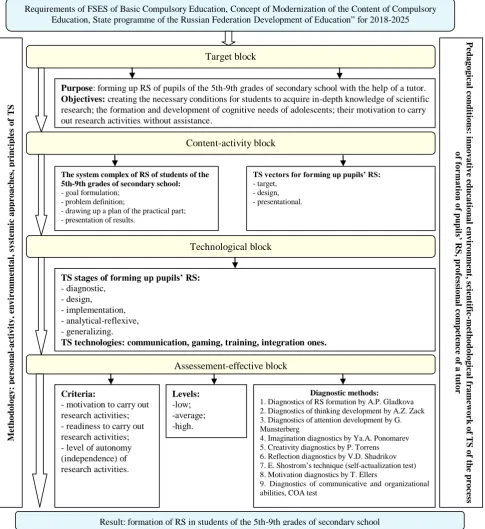
When examining the problem of tutor support (TS) for forming up research skills (RS) of students of the 5th-9th grades of secondary school, in the authors’ opinion, it is required to offer a structurally informative model
containing the following blocks: 1) a target block; 2) a content-activity block; 3) a technological block; 4) an assessment-effective block (Fig. 1).
A target block is focused on developing pupils’ RS by means of TS and involves the process of acquiring by primary school students the in-depth knowledge of conducting scientific research; improving cognitive needs; increasing the level of autonomy of their research work.
A content-activity block is represented by a structured set of RS of students of the 5th-9th grades of secondary school (goal formulation; problem definition; drawing up a plan of
the practical part; presentation of research results) and TS vectors for developing pupils’ RS (problem-oriented, design, and presentational ones).
A technological block combines the stages of TS of forming up RS in students of the 5th-9th grades (diagnostic, design, implementation, analytic-reflexive, generalizing ones) and TS technologies (communicative, integration, training, gaming ones).
An assessment-effective block fulfills an assessment-reflexive function conducive to establishing the level of RS formation in students of the 5th-9th grades (levels, criteria and methods of assessment) and implies supplying a tutor with everything necessary – questionnaires, a questionnaire for teachers of certain subjects, as well as with purposefully created methodologies that reinforce the indicators, criteria and levels of formation of students’ RS.
International Journal of Innovative Technology and Exploring Engineering (IJITEE) ISSN: 2278-3075, Volume-8 Issue-8, June, 2019
Fig. 1. Model of tutor support for forming research skills in primary school students
IV. RESULTS
At the current stage of development of the Russian society, the evolution of the educational system, due to the entry into force of new educational standards, the importance of a school teacher as an active participant in the educational process increases significantly, the requirements for his/her professional qualities and personal characteristics, social-ethical principles and attitude to the chosen profession become stricter, which is represented in a number of key texts: “National Educational Initiative “Our New School”, “Concepts of Long-Term Socio-Economic Development of the Russian Federation until 2020”, “Concept of Innovative Development of Russia – 2020” [7]. Nowadays, it is not
enough to provide the younger generation with certain useful information; they should be taught to be independent, enterprising, intellectually flexible, ready to make decisions and take responsibility for them, to take into account social changes and adapt to them. Many authors (T.M. Kovaleva, N.V. Rybalkina, P.G. Schedrovitsky, B.D. Elkonin, and others) use the term “tutoring” to designate the actions aimed at supporting a student, creating conditions conducive to his/her self-development.
Target block
Requirements of FSES of Basic Compulsory Education, Concept of Modernization of the Content of Compulsory Education, State programme of the Russian Federation Development of Education” for 2018-2025
Purpose: forming up RS of pupils of the 5th-9th grades of secondary school with the help of a tutor.
Objectives: creating the necessary conditions for students to acquire in-depth knowledge of scientific research; the formation and development of cognitive needs of adolescents; their motivation to carry out research activities without assistance.
Content-activity block
The system complex of RS of students of the 5th-9th grades of secondary school: - goal formulation;
- problem definition;
- drawing up a plan of the practical part; - presentation of results.
TS vectors for forming up pupils’ RS: - target,
- design, - presentational.
Technological block
TS stages of forming up pupils’ RS:
- diagnostic, - design, - implementation, - analytical-reflexive, - generalizing.
TS technologies: communication, gaming, training, integration ones.
Assessement-effective block
Criteria:
- motivation to carry out research activities; - readiness to carry out research activities; - level of autonomy (independence) of research activities. Levels: -low; -average; -high. Diagnostic methods:
1. Diagnostics of RS formation by A.P. Gladkova 2. Diagnostics of thinking development by A.Z. Zack 3. Diagnostics of attention development by G. Munsterberg
4. Imagination diagnostics by Ya.A. Ponomarev 5. Creativity diagnostics by P. Torrens 6. Reflection diagnostics by V.D. Shadrikov 7. E. Shostrom’s technique (self-actualization test) 8. Motivation diagnostics by T. Ellers
9. Diagnostics of communicative and organizational abilities, COA test
Result: formation of RS in students of the 5th-9th grades of secondary school
At the current stage of the development of Russian education, the word “tutor” is understood differently. Tutoring is a special kind of pedagogical support – ensuring the process of disclosing the individuality of a pupil or a student in the context of open education. Currently, there is a rapid increase in the number of tutors, new, more sophisticated management and pedagogical mechanisms are being designed, and such mechanisms are described in the works of O.I. Genisaretsky, I.D. Proskurovskaya, P.G. Schedrovitsky and other modern authors. Based on the positional self-identification and the potential of forming up tutor support for innovative activities of teachers and lecturers in the framework of continuing professional education, these mechanisms can lead to very high results.
Nowadays in Russia, tutoring is most popular in the context of distance learning. This format gives tutors the opportunity to effectively use the benefits of individual consulting, which is common at leading British universities. A teacher forms up the mastery of a training course upon an effective scenario, organizes seminars and conducts consultations, checks written assignments and expresses his/her wishes. The emergence of the tutoring profession should be viewed as a kind of reaction to the demands of modern society, which can satisfy people's desire to enrich the educational environment, understand their own potential, choose the right field of application of professional efforts and complete the process of self-realization on this way [8].
The international and Russian experience suggests that tutoring is one of the most productive ways to implement pedagogical support, while tutor support is an essential component of the individualization process in the context of open education, existing in harmonious interaction with other components related to pedagogy, philosophy, ethics, psychology, sociology. In the framework of self-education and self-improvement, the tutor support of students means a form of pedagogical support, in which a tutor helps a tutee to implement and analyze his/her behavior related to self-education [9]. Tutoring should be positioned as an educational ideology based on the ideals of humanistic philosophy, the principle of pedagogical support for students and the approach used in the pedagogy of cooperation.
The key points, on which a tutor relies in the context of his/her work activity, are the principles that underlie open education: transparency (openness); flexibility; continuous nature; variability (diversity); individual approach; individualization [10].
Tutoring should be considered as a resource of individual evolution of a person, as a form of effective use of open education opportunities for developing an individual educational program taking into account the specificity (nature, temperament, intelligence, etc.) of a particular student [11].
The main task of modern general education is not only to provide students with the relevant information but also to develop their ability and desire to independently obtain this information in a continuously transforming public context.
The development of such personal qualities as the readiness for independent implementation of cognitive activities, the
formation of research skills and abilities should be considered as one of the most important functions of the modern school.
Nowadays, the research activity of primary school students is one of the main vectors of their training for further education and the upcoming choice of profession, and the level of research competence is consistent with the results obtained during the mastery of a curriculum. Involving schoolchildren in research work creates favorable conditions for a creative understanding of the information obtained with or without assistance, contributes to the development of scientific thinking and such significant personal characteristics as intellectual independence, creativity, etc. One of the main functions of a tutor is to stimulate the development of the need for new knowledge in tutees as part of educational activities [12].
Students’ research activities can be considered as a kind of cognitive activity, involving the use of scientific tools and methods and the assimilation of information about the studied objects as a result. The components of this activity are as follows [13]:
- information component (the acquisition of information about already existing knowledge, the synthesis of these data);
- analytical-critical component (understanding and critical assessment of available knowledge, the formulation of a scientific problem based on the definition of insufficiently developed or completely unraised aspects of the study);
- research component (the analysis of theoretical material and the conduct of an experiment for the acquisition of new information, a description of the preliminary (intermediate) results of the work performed);
- presentation-prognostic component (the creation of a message and a kind of a scientific document, recording the final results of the work performed and new acquired information).
The formation of pupils’ research skills requires the competent formation of their research activities as part of the educational process. Thus, research skills of primary school students are intellectual and applied skills based on the independent choice and the use of research methods and techniques on the material understandable for teenagers and coordinated with the content of educational work at the current stage [14].
V. CONCLUSION
International Journal of Innovative Technology and Exploring Engineering (IJITEE) ISSN: 2278-3075, Volume-8 Issue-8, June, 2019
The developed structural-informative model has the following blocks: target; content-activity; technological; evaluative-effective ones.
The identified criterion indicators of the formation of research skills of primary school students were classified by their groups: cognitive, communicative, reflexive groups and a group of social relations.
Pedagogical conditions for the implementation of a tutor support model for the formation of research skills of primary school students should be considered as follows: innovative educational environment; scientific-methodological framework of tutor support of the process of developing research skills of primary school students; tutor’s professional skills contributing to the successful organization of contact with a pupil, the development and implementation of his/her individual educational trajectory, the creation and use of educational-didactic materials.
REFERENCES
1. M.A. Khmelkov, “Tyutor kak novaya pedagogicheskaya pozitsiya” [“Tutor as a New Pedagogical Position”]. Vestnik Rossiiskogo novogo universiteta. Seriya: Chelovek v sovremennom mire, vol. 2, 2018, pp. 118-122.
2. Z.K. Bagirova, and S.G. Veliyeva, “Osobennosti realizatsii funktsii tyutora v obshchem obrazovanii” [“Features of Fulfilling a Tutor’s Function in General Education”]. Mir nauki, kultury, obrazovaniya, vol. 1(62), 2017, pp. 5-6.
3. T.M. Kovaleva, E.I. Kobyshcha, S. Popova, et al., “Professiya “Tyutor”” [“Profession “Tutor””]. Moscow; Tver: SFK-Office, 2012.
4. Yu.A. Lyakh, “Tyutorskie tekhnologii v sisteme obucheniya shkolnikov” [“Tutoring Technologies in the System of Schoolchildren Training”]. Innovatsionnye proekty i programmy v obrazovanii, vol. 6, 2014, pp. 68-72.
5. O.N. Perevezentseva, “Formirovanie informatsionnoi deyatelnosti mladshikh podrostkov dlya dostizheniya metapredmetnykh rezultatov obrazovaniya” [“Formation of Information Activities of Younger Adolescents to Achieve Meta-Subject Results of Education”]. Mir nauki, kultury, obrazovaniya, vol. 4(71), 2018, pp. 84-85.
6. V.S. Frolova, “Tyutorskoe soprovozhdenie kak tekhnologiya obrazovatelnoi deyatelnosti” [“Tutor Support as a Technology of Educational Activity”]. Kontzept, vol. 39, 2017, pp. 2436-2440. 7. V.I. Glizburg, and O.N. Perevesentseva, “Tyutorskoe soprovozhdenie v
informatsionnom prostranstve shkol” [“Tutor Support in the Information Space of Schools”]. Vestnik Rossiiskogo universiteta druzhby narodov. Seriya: Informatizatsiya obrazovaniya, vol. 14(1), 2017, pp. 69-75. 8. L.V. Goryunova, N.M. Mkrtchyan, and Zh.S. Metelkina, “Tyutorskoe
soprovozhdenie obuchayushchikhsya kak pedagogicheskaya problema” [“Tutor Support of Students as a Pedagogical Problem”]. Problemy sovremennogo pedagogicheskogo obrazovaniya, vol. 55(8), 2017, pp. 153-161.
9. S.V. Dudchik, and N.Yu. Gracheva, “Formirovanie tyutorskoi kompetentnosti pedagogov kak zalog uspeshnoi realizatsii inklyuzivnogo obrazovaniya” [“Formation of Teachers’ Tutor Competence as a Guarantee of Successful Implementation of Inclusive Education”]. Vestnik Volgogradskogo instituta biznesa, vol. 4, 2015, pp. 333-337.
10. A.I. Savenkov, Zh.V. Afanasyeva, A.V. Bogdanova, V.A. Krivova, and Yu.A. Serebrennikova, “Tyutorskoe soprovozhdenie shkolnikov v issledovatelskoi deyatelnosti” [“Tutor Support for Schoolchildren in Research Activities”]. Nachalnaya shkola, vol. 9, 2016, pp. 70-75. 11. A.S. Lvova, and O.A. Lyubchenko, “Kriterii otsenki effektivnosti
pedagogicheskikh tekhnologii tyutorskoi deyatelnosti v sovremennoi obrazovatelnoi organizatsii” [“Criteria for the Assessment of Efficiency of Pedagogical Technologies of Tutorial Activity in a Modern Educational Organization”]. Vestnik Moskovskogo gorodskogo pedagogicheskogo universiteta. Seriya: Pedagogika i psikhologiya, vol. 1(35), 2016, pp. 89-96.
12. O.N. Perevezentseva, “Realizatsiya innovatsionnoi tekhnologii tyutorskogo soprovozhdeniya mladshego shkolnika v informatsionno-obrazovatelnom prostranstve shkoly” [“Implementation of Innovative Technology of Tutor Support of a Junior Schoolchild in the Information-Educational Space of Schools”]. In Sbornik materialov Nauchno-prakticheskoi konferentsii “Innovatsionnye i traditsionnye tekhnologii razvitiya doshkolnikov i mladshikh shkolnikov sredstvami
matematiki i informatiki” [Collection of Materials of the Scientific-Practical Conference “Innovative and Traditional Technologies for the Development of Preschool and Junior Schoolchildren by Means of Mathematics and Computer Science”], pp. 51-55. Moscow: State-Financed Educational Institution of Higher Professional Education “Moscow State Pedagogical University”, Institute of Pedagogy and Psychology of Education, 2016.
13. S.L. Fomenko, “K voprosu o modelyakh tyutorskogo soprovozhdeniya obuchayushchikhsya v obrazovatelnom protsesse” [“On Tutor Support Models for Students in the Educational Process”]. Pedagogicheskoe obrazovanie v Rossii, vol. 3, 2017, pp. 102-107.