Abstract: This paper focusses on scope of development of concept for the operational scheduling algorithm for Veltech small satellite. Small Satellite consists of bus sub systems, payload sub-systems and will have various operational modes. Satellite works on operational software controlling the total spacecraft. It operates and involves in monitoring different subsystems and controlling them to achieve/ decide mode of operation as per the required operational scheduling. Nominally the major scheduling of the satellite is done on the ground by a team of mission experts to analyze the data with support of the ground software modules. In the current paper it is explored to see scope of the scheduling operations onboard the spacecraft for using Heuristic approach.
Index Terms: Data Transmission Scheduling, Intelligent OBC, Heuristic Algorithm, small satellite
I. INTRODUCTION
Nowadays Earth observation satellite plays an important role in many domain like military application, disaster prediction, agriculture and other areas. Satellite mission scheduling has got high consideration in the world. In the last few decades the space technology and applications have grown tremendously providing operational services from space to the Governments and Society. These developments have brought a lot of front end technologies new innovations and also technical challenges to the research as well as the operational domains. The developments in miniaturization of electrical, electronic and electromechanical systems have made possible to realize the missions which required the big, large and medium size spacecraft to be realized in to smaller satellites. In order to generate the future scientists and engineers in the area of space technology and applications the staff and students of universities and educational institutions need to be provided an opportunity to have hands on experience in the designing, development and operation of satellites as well as to develop application modules for utilization services. Earth observer satellite used to earth observe from the orbit. It is very similar with spy satellite. This kind of satellites designed for non-military purpose. Satellites have many number of small physical devices which will control satellite throw some sequence of commands which are executed the planned actions and recover the expected errors.
Revised Manuscript Received on June 05, 2019
Rajathi K, Associate Professor, Department of Computer Science and Engineering , Vel Tech Rangarajan Dr. Sagunthala R & D Institute of Science and Technology
Alex David S, Associate Professor, Department of Computer Science and Engineering, Vel Tech Rangarajan Dr. Sagunthala R & D Institute of
Science and Technology.
.
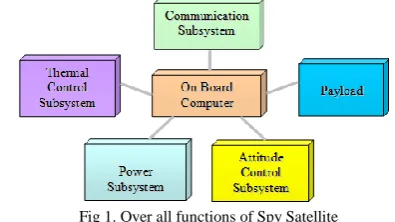
[image:1.595.322.520.251.362.2]Satellite have subsystems like thermal subsystem which monitor the device with accepted temperature, communication subsystem which transfer signal to and from earth, altitude sub system which controls and monitor the orientation of the satellite (tumbling mode or de tumbling mode), On Board Computer (OBC) which process the data and interface with all subsystem and different payloads
Fig 1. Over all functions of Spy Satellite
II. PAYLOADSANDSUBSYSTEM
a.Wireless sensor network
This payload is an experiment with Ground based sensors in remote areas for disaster detection and passing on to satellite for further processing and transmission to ground. The primary objective of WSN is to get the information for uncertainty (like detection of land slide and forest fire detection) event and the sensed data is transmit to ground station. For finding the land slide and forest fire detection, the physical parameter s like moisture, ground pressure and vibration, temperature, humidity, wind speed and direction are sensed by using the sensor. The sensed data are transmitted to the small satellite through VHF/ UHF. For uplink and downlink omni directional antennas are used for transmission. WiseMAC prototcol used for preamble sampling.
Fig 2: Simple Architecture of WSN
Rajathi K, Alex David S
Table 1: Technical Specifications of WSN
Parameter Description
Sensing Region 1000*1000m
No. of Sensor Nodes (Mica Mote Z) 25
Base Station 01
High end Processor 01
UHF/VHF Band Transmitter 01
Data Rate 256kbps
Operating frequency between nodes (Zigbee)
2.4GHz
Uplink Data Rate 1200bps
The transmitted data processed in small satellite on board. There will set some priority by using heuristic approach. High priority information will be transmitted immediately to the Ground Station and then communicated to agencies for taking measures in case of any emergencies.
b.Camera Payload
This module focus on the design and development of an imager which also can be used for optical communication. LED is rapidly used as a light source for VLC (Visible Light Communication) is a wireless communication using visible wavelength (electromagnetic waves ranging from 360 to 830nm), different from a laser communication..
From the camera payload the acquisition image data compressed and and sent to On-board computer via CAN, I2C, SPI or UART at 119520 baud rate.
Table 2: Technical Specifications of WSN
Parameter Description
Imager size 5.7 mm (H) × 4.28 mm (V), 7.13 mm (Diagonal).
Active pixels 2592 H × 1944 V
Pixel size 2.2 µm × 2.2 µm.
ADC resolution 12 bits.
c.Antenna duality
To design and develop the solar panel with patch antenna, to experiment the dual function of RF signal reception as well as solar power generation. Bow tie antenna used in small satellite. In bow tie antenna three different phases are used. First phase is lab lavel model, second phase is qualifying model and the last phase flight model.
Signals from antenna transferred to communication system. Communication system is send the received data OBC. After processing the processed data is send to ground station via same antenna.
Table 3: Antenna specifications
Parameter Description
Substrate Medium FR4/polymer based
substrate
Antenna material Graphene/GaAs/CdTe
Antenna structure Bowtie Patch
Length of the antenna 50mm
Breadth of the antenna 50mm
Feeding mechanism Co-Axial Probe Feeding
Thickness of the printed antenna
0.2-0.5mm
Airgap of the antenna 0.2-0.5mm
Welding connection type Dot Welding
Frequency type 1.2 GHz
d.Communication subsystem A primary functional requirement for mission is to exchange of information with ground based command system. A communication subsystem has three primary functions, first it receives commands from a ground station. Second to receive signals from payload through OBC. Third is to receive health parameters from OBC and transmit to ground station.
e.On Board Communication System (OBC)
OBC is the heart of the satellite system. It manage and maintain the power on initialization, telemetry command, attitude control, operation modes of satellite, power management, thermal control mechanism, emergency mode, safe mode and recovery.
OBC process the data which obtain from the pay load for image, wireless sensor network and antenna duality and etc. OBC diagnose memory, power related checks during the data process.
Various microcontrollers have been compared for the selection. Finally, it is decided to have ARM Cortex M0 for OBC for two reasons i.e. one is due to more number of in built peripheral communication devices and32 bit precision. The inbuilt communication devices are used with external peripherals like magnetometer and EEPROM according to their speed and compatibility.
Fig 3: OBC Connectivity
f. Onboard scheduling algorithm
Planning and scheduling of small satellite on board is defined as based on the abilities and requirements of the satellite. Satellite resources assigned for multiple task and determine specific activity and time requirement for fulfill the activity.
The subsystems communication system, attitude control subsystem, power subsystem and all payloads are connected with the on board control. It shown in figure2. For example attitude control subsystem monitor and send a command for every time slot, that data information like need to tilt the camera angle to 20 degree for capturing the image is send to OBC. The same data is processed and stores in RAM. Processed data is send back to attitude control sub system. Attitude control subsystem transfers processed data to Torquer. Torque align the wheels of satellite for adjusting the camera.
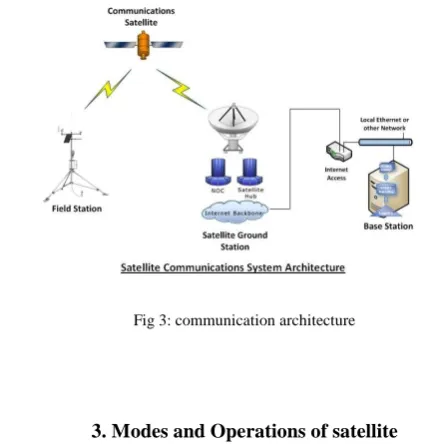
Fig 3: communication architecture
3. Modes and Operations of satellite
Space craft operation on orbit consist of satellite acquisition, stabilization, maintenance of all the systems,
mission mode operation of the experimental are operational payloads, Apart from handling the contingency and safe modes.
Satellite acquisition:
Soon after the launch the satellite get injected into the predefined orbit the respective time. The soon after injection several automatic operations will take place like solar panel deployment, initiation of the de tumbing mode, sun acquisition, etc. in these operations in case of any problem the total ground network across the world will be kept ready to handle the situation with suitable command based on the type of problem that is arisen during the automatic operation. For this operation on the ground there will be set operation procedures with command list along with timing to be executed for all possible expected problems. The problems are detected and analyzed based on the health parameters transmitted by the satellite telemetry downlink. Some problems like telemetry downlink itself being absent will be corrected with blind command to satellite to switch on transmitter 1 or 2 alternately (if redundancy exist). When once the telemetry is there the other problems get tackled by the analysis of data and its deviation from normal signature. The corrective actions many times becomes infeasible because of the non-availability of the satellite with in the radio visibility of the controlling ground station. This situation many times leads to increased number of problem.
4. Alternate for fixed programming approach
Example 1:
Telemetry data available from the international ground station has indicated the tumbing mode is completed but the sun acquisition is not taking place. Next commanding opportunity will happen only after six orbit, this approximately 600 minutes or 10 hours. As the most of the other system have become ON and solar panels are generating the power, the battery gets discharge and can lead to further problems of initiation of emergency mode and switch of most of the system. This analysis based upon the all possible deviations can also be loaded on board and initiate self-corrective action. However the most of the cases it will not be a solution in the fixed programmatic approach. It could an on board analysis.
5. Flexibility analysis of upcoming operations
Example 2:
If the fixed program approach tells to switch off all the load and wait for the radio visibility(RV) which could be two orbit away
or 6 orbit away and duration of visibility OBC
s S
1
S 2
S 3
[image:3.595.64.285.526.750.2]could be anywhere between 12 minits to 1 minites. After acquisition of signal (AOS) in RV the sufficiency of time to complete the orientation operations may be sufficient or may not be sufficient. If it is not sufficient satellite goes out of RV without completing the require operation to ensure sun pointing. In such a case satellite can go into problem again leading to mission failure. Instead if satellite could analysis the on board analysis of possibility to go ahead with sun pointing with alternate measure like redundant system selection if it is in sun lite portion the power situation will be saved and the battery gets charging. If it is in eclipse the analysis of what time it is entering sun lite (could be not more than 30 minitus ) and initiate sun pointing operation soon after entering
into sun lite.
So this saves the mission and also keeps up the schedule of the planned operation. In a similar way the other modes of operations can be managed with on board intelligence. On board intelligence operation can get enabled out of RV of it can be enabled 24 hours if all the modes and all operations are provided with enabled autonomy feature. The satellite can configured first stand-alone operations with manual back up options.
Example 3:
Antenna with duality payload is an experimental payload. This payload have the property of antenna with integrated solar panel. The antenna connection will be working as the normal procedure as an Dipole antenna for the normal frequency and for UHF Band frequency it will be acting as the Patch antenna which is a experimental payload which is having a duality property as Printed small structure antennas on solar panel based subsystem which will occupy less area and it will be effective when Duality principle is used. Antenna with duality works in three different mode. In first mode satellite orbit the earth, at the time antenna will facing the earth also in eclipse and the back side solar panels pointing the sun, Albendo radiation will coming from the earth. That time satellite change the thumbing mode. Radiation from sun and signal from earth both are collected and store in the on board computer memory for testing purpose. In second mode In this mode of operation the back side of the solar panel will be made to face the sun radiation and the front solar panel will be facing the back radiation from the earth back radiation, there will not be any change in the battery charging and
the charging will be monitored by the charge controller algorithm in the onboard computer. In third mode satellite in dark means there is sun lite there is no action. Above scenario are planned action and fixed programmatic approach. Let assume satellite in mode 1 (Solar panel cum antenna) due to some reason batteries are not charged. Whether satellite orientation need to change or not that should decide automatically.
6. Safety and survival
Safety measures of a satellite are belongs to the sequence of action, expected failure and the recovery action. All the above mentioned are expected one. To make a satellite to thing in intelligent way satellite should train in such way to handle the unplanned situation and unplanned failure. The presence satellite under certain failure can become unusable due to powerless taking beyond emergency. This satellite are declared dead and mission get closed. In such cases there will not be a possibility of revival with current day technology. The batteries could be discharged totally and can still be made functional after sometime whenever the power become available. This can be called sleep and wakeup modes. This satellite can be made to goto sleep mode and could wake up from the power generated with random sun exposure of solar panels and on board intelligence can start working to achieve a planned revival. This kind of on board intelligence is specific to each satellite. In propose system the satellite operational scheduling process is designed by using heuristic approach. Heuristic algorithm is used to find the optimal solution. This algorithm may train the system for commanding the mission. This process consist of preprocessing, acquisition, tracking and releasing. Heuristic algorithms consider the arrival time, deadline, and waiting time for scheduling. By applying support vector machine operational commands can classified with high priority, medium priority and low priority. Based on the priority task and resources are allocated in a first in first order (FIFO). The main steps of the heuristic algorithm adopted in this paper are described as follows.
a) Step 1
The three degree of priority of each task in rolling-horizon are calculated.
b) Step 2
Solar Panel
The tasks in are sorted by the priority-degrees, and the ranking results
c) Step 3
The scheduling scheme rule is generated after all tasks index have been assigned.
7. Conclusion
The overall satellite architecture and implementation of the sub- systems is accomplished by the open-source which supports various types of peripheral interfaces, telemetry storage, health information and data processing & communication. Small satellite was under developing stage with the above configuration, design and algorithm. In future the findings and result will be analyzed.
REFERENCES
1. LI Li-xin,MA Wei-zhong,LIU Xiao-li, ―Research on TSGA
Algorithm Satellite Data Transmission Scheduling,‖ 2014 International Conference on Management Science & Engineering (21th), pp. 56 –61, August 17-19, 2014.
2. Vazquez A J, Erwin R S. On the tractability of satellite range scheduling
[J]. Optimization Letters, 2014: 1-17.
3. Barbulescu L, Howe A, Whitley D. Leap befor e you look: an effective
strategy in an oversubscribed problem [C] Proceedings of
4. 19th National Conference on Artificial Intelligence ( AAAI-04) ,
California, USA, 2004.
5. Barbulescu L, Howe A, Whitley D. AFSCN scheduling: How the
problem and solution have evolved [J]. Mathematical and Computer Modeling, 2006 ,43:1023-1037.
6. S. I. Wayer and A. Reichman, ―Resource management in satellite
communication systems—Heuristic algorithms,‖ in Proceedings of the IEEE 26th Convention of Electrical and Electronics Engineers in Israel (IEEEI ‘10), pp. 342–346, November 2010.
7. Viswanathan.P.C, Sheena Jose, Usha Bhandiwad,‖ A Model based on
Priority Scheduling and State Transitions for the Automation of Integrated Spacecraft Testing‖,IEEE transaction, feb 2015.
8. Boyu Deng, Chunxiao Jiang,‖ Two-Phase Task Scheduling in Data
Relay Satellite Systems ‖,IEEE Transactions on Vehicular Technology, DOI 10.1109/TVT.2017.2763150
9. Chen Wang, Hao Chen,‖ Satellite Observing MissionScheduling
Method Based on Case-based Learning and AGenetic Algorithm―, 2016 IEEE 28th International Conference on Tools with Artificial Intelligence , DOI 10.1109/ICTAI.2016.98
10. Emir Husni1, Angga Putra2 and Nazmi Febrian3 , ―Design of IP Based
On-Board Computer for Small Satellite 2015 4th International Conference on Instrumentation, Communications, Information Technology, and Biomedical Engineering (ICICI-BME) Bandung, November 2-3, 2015
11. Adnane Addaim, Abdelhaq Kherras, and Zouhair Guennoun ,‖ Design
of WSN with Relay Nodes Connected Directly with a LEO Nanosatellite ‖ International Journal of Computer and Communication Engineering, Vol. 3, No. 5, September 2014.
12. Kamal Lamichhane, Kiran M. , Kannan T, Divyanshu Sahay, .‖
Embedded RTOS Implementation for Twin NanoSatellite STUDSAT-2 978-1-4799-7569-3/15/ 2015 IEEE .
13. Mamta Bhojne, Abhishek Chakravarti, Anshu Pallav, 2Sivakumar, V.
HIGH PERFORMANCE COMPUTING FOR SATELLITE DATA PROCESSING AND ANALYZING – A REVIEW ‖, Asian Journal of Science and Technology Vol. 4, Issue 08, pp.019-025, August, 2013.
AUTHORSPROFILE
Rajathi K, M.Tech., CSE, currently working as an Associate Professor and a Research Scholar in Vel Tech Rangarajan Dr. Sagunthala R&D Institute of Science and Technology.