International Journal of Innovative Technology and Exploring Engineering (IJITEE) ISSN: 2278-3075, Volume-8 Issue-8S2, June 2019
Abstract Background/Objectives: There has been a significant increase in the disappearance rate of children with disabilities. Hence, we propose a learning system to mitigate the issue of missing children with different levels of disabilities
Methods/Statistical analysis: We have designed a preventive learning system which prevents children from being misunderstood. When a child enters an unsafe area, his smartphone notifies the user with a warning. In order to proactively characterize the learning and to deal with communication quickly, we compared the existing Bluetooth pairing function with a Bluetooth search function.
Findings: The Bluetooth pairing function’s disadvantage is that the connection distance varies for each smartphone version and the built-in Bluetooth. To secure the notification distance and the stability of the notification distance, Bluetooth search was faster than the conventional Bluetooth pairing type. As a result, it was confirmed that the Bluetooth search function is shorter than the existing pairing function. This can enable the caregiver to respond faster by quickly recognizing that a child is missing. We applied the 35 second rule according to Kenneth Wooden's study to a child's stride, and conducted experiments to measure the distance that set off the notification using both Bluetooth pairing and search functions. Consequently, we were able to confirm that the Bluetooth search function notifies a child's departure within 35 seconds, regardless of his/her pace. As a result of the existing three field tests, it is possible to prevent children from being harmed, even when children with a handicap is present with their guardian, and it is possible to track their position regardless of their distance from the inside or the outside of a room.
Improvements/Applications: It is expected that this system, which acknowledges children’s disabilities, that is not simply dependent on location tracking, performs repetitive learning according to the characteristics of students, and which is faster and proactive, will contribute to the wellbeing of disabled children and their caregivers.
Keywords: Ubiquitous-based situation learning, Customizing, Missing children, Bluetooth Searching, Bluetooth pairing, Learning System
I.INTRODUCTION
According to statistics released by the National Statistical Office (NSO) in 2016, the number of people with intellectual disabilities reported in 2013 was 7,623; however, by 2016, the number of reported cases increased by more than 800
Revised Manuscript Received on May 22, 2019.
1Daeun Kim, Department of Elementary Special Education,Kangnam University, 40 Gangnam-ro Giheung-gu, Yongin-si, Gyeonggi-do, 16979 South Korea
2*
Youngseok Lee, KNU College of Liberal Arts and Sciences, Kangnam University, 40 Gangnam-ro Giheung-gu, Yongin-si, Gyeonggi-do, 16979 South Korea
* Corresponding author E-mail : [email protected]
every year [1]. The number of non-discoverers has also increased steadily. Although the rate of disappearance of children with disabilities is increasing every year, there is no consistent system for preventing the disappearance of children with disabilities. It is important to find children quickly; however, the most important thing is not to lose them.
As a result of a survey on special child caregivers, systematic preventive education for children with disabilities has not yet been achieved. There were positive responses to the survey based on the desire to use apps to prevent missing children [2, 3]. Because of the diverse nature of children with disabilities, there is a limit to the prevention of generalized child misbehavior in children [4]. Preventive education is expensive as well as time consuming. Development of a preventive education system for children with disabilities was delayed, based on the fact that children with disabilities visit limited places and are always accompanied by their guardians [5].
Therefore, this paper suggests a tailored preventive education system for children with disabilities using UBSL and customization. The proposed system reduces the disappearance rate of such children due to lack of an education system and suggests the need for preventive learning and for the independence of students with disabilities.
This system is targeted to children who have and can utilize a smartphone among subjects of special education laws for persons with disabilities such as borderline and mild intellectual disabilities, Down syndrome, autistic disorders and learning disorders. American child safety expert Kenneth Wooden stated in his book that it takes only 35 seconds to lose a child. The rate of disappearance of the child increases when this time is longer than the time spent searching for the child. Prevention is also important in preventing child missing; however, it is also important to take quick action in case of child missing.
The proposed system uses a GPS and Bluetooth based double tracking method to enable a more precise location tracking compared to a lost-and-found system and requires only the installation of an application on existing smartphones without purchasing a separate device.
II.MATERIALSANDMETHODS
2.1. Ubiquitous-based situation learning
Ubiquitous Based
Situated Learning (UBSL)
Design of Learning System for Missing
Prevention based on UBSL
refers to information technology such as smartphones, the Internet, location-based service systems, and various application-based situation learning [6]. UBSL is a learning model that combines ubiquitous and situation learning. Ubiquitous comes from the Latin word ‘ubique’, which means 'It exists anywhere, anytime.’ Ubiquitous implies a new concept computing environment that refers to an information and communication environment that can be freely connected to a network regardless of space or device [6].
Situation learning refers to knowledge as contextual, and the learning is created within the task, context, and culture in which it will be used, not alone, but in a situation similar to reality. Therefore, it is regarded that studying a situation that can be used in real situations is gaining true knowledge [6]. Using UBSL, which is a combination of the above two theories, a network of protectors and children is created by the apps.
The system implements UBSL as an instrument to review what children have learned when entering a pre-determined danger zone [7]. Furthermore, the children and their protectors are connected by a network called APP, hence conducting repetitive learning using UBSL within the children's living environment. A protector can be anyone who wants to run a UBSL, including a teacher or parent.
2.2. Customizing
Special Education students all have a variety of characteristics and levels. With standardized education systems applied to students in general, there is a limit to the right learning for disabled students. A survey of special education student protectors showed that the disappearance of children occurred within the radius of a child's life and not in a strange place [8, 9].
To realize the level of each learner and the varying requirements of the protector, this application completes the framework of the basic system and provides it to the protector. The app, such as blank notes, can be customized to suit the needs of each protector and tailored to a user-specific learning system [8]. Customizing refers to setting up or changing the hardware or software to match the user's usage and preferences [9]. The focus of the development of this system was on individual learners, and the ability, aptitude, and motivation of each individual were taken into account so that a child protector could distinguish between a dangerous and safe area [4, 6].
Using this system's customization, protectors are able to provide individual training to suit the characteristics of disabled children. Individualized and repeated learning within the child's life radius will greatly help in preventing the loss of children. In addition, if the nature of a child changes or if the behavioral radius changes as users modify the system, the educational environment can be altered, thereby inducing effective learning directly from the protector.
2.3. Bluetooth low energy
After the release of Bluetooth version 1.0 in 1999, Bluetooth EDR was announced in 2004 having upto three
times faster data transfer rates [10]. Bluetooth EDR has a very high transmission speed but also has high power consumption. Bluetooth Low Energy (BLE) technology was developed in order to address these shortcomings. With the release of BLE technology, Bluetooth enabled smartphones have also been changed to BLE with Bluetooth 4.0 or higher [11]. It is stated that all versions of Bluetooth presented in this thesis are BLE. Bluetooth technology is a communication technology that supports connections between 10 meters and 100 meters [10, 11].
However, Bluetooth technology in this application requires disconnection before the communication distance is 100 meters. It is this distance limitation that is used by the application to determine if a child has deviated beyond the communication range of Bluetooth from a protector. To reduce the difference in the version of Bluetooth, a solution has been proposed to measure the receiving signal from a child's smartphone while measuring whether the guardian's smartphone is reachable from the child's smartphone.
2.4. GPS
Global Positioning System (GPS) is a service that provides location related information of users using wireless communication. GPS, which provided specific map coordinates for military purposes, was eventually introduced for commercial purposes [12, 13].
The application developed in this paper utilizes GPS to identify the path of a protected person, such as a child, to check the last location information in case of a missing person, and to provide a service to check if an area is safe [12, 13]. However, when using the regional setting service, the generation of safety zones should precede, and the focus should be on measuring the child's position in real time and whether the child was out of the safe area. However, because GPS itself is prone to errors, it is possible to measure the position within the error range; however, it is difficult to measure the position fully.
2.5. Related works
A case displays a child prevention system using location-based services [14]. In the above study, the target is notified when a child is out of the path using the smartphone anti-infant application and the child is guided to a pre-set safety zone assuming that a navigation is available. This indicates that of the usage levels of the smartphone needs to be more than a certain level [14, 15]. In addition, it is not possible to personalize children because of limited options of producing a warning sound. Limitations that warning tones cannot take into account include a variety of characteristics, such as frustrated or rejected children.
The proposed prevention of the missing children application does not consider disabled children. Another case of research is the ZigBee-based prevention of missing children system at festivals [16]. This system takes into account the possibility of a missing child in a dense area such as festivals that utilizes
ZigBee. A number of fixed
International Journal of Innovative Technology and Exploring Engineering (IJITEE) ISSN: 2278-3075, Volume-8 Issue-8S2, June 2019
pre-installed [16]. Based on this, the mobile device is recognized by the fixed device and provides location information. The system for the prevention of missing children proposed in the above case will necessarily require the installation of fixed beacons in a specific area, with a device being required. In addition, there are no actions that children can take, as the child cannot be found when moving to an area without fixed beacons, with the protector receiving only the child’s location through one-way communication between the child and the target.
Additionally, the system is not a proactive preventive system for missing children, but a post-care system [17]. The analysis in the paper above shows that trends in child prevention are focused on post-care, and that existing child prevention systems do not consider the characteristics of disabled children. This system has increased efficiency by using a regular smartphone as a child prevention device without a separate device, taking advantage of the increasing penetration rate of smartphones. The prevention function of missing children was added to provide preventive training using the regional setting function for children with disabilities. In addition, it is possible to cope with a quick post-treatment by applying the double tracking method.
As seen in studies overseas as well as domestic ones, we can see that there is high interest in location tracking technology and cases of missing children abroad [2, 4, 17]. The first overseas study was done using technology. Research using GSM shows that if a child loses a panic button or loses their path, the GPS coordinate value is transmitted as a text message to the specified guardian number. GSM is mainly used in European countries and its limitations are that it cannot be used in Korea because it requires separate communication technologies in the country. However, when used in Europe, there is also a limitation of the application among general children.
When children with disabilities are running, they cannot know the location if they do not press the panic button directly. As the final position of the child is unknown, if the child is misplaced in an unavoidable situation and cannot press the panic button, no value is available. It is also difficult for a disabled child to actually become a lost child and calmly press the panic button to provide positional information to the protector using the app. This does not only make it difficult to actually introduce the above paper in Korea; however, it can also be seen as an application for children who are not disabled. A second example of an overseas study is the connection between PDR, GPS and Bluetooth [17].
In the mentioned study, Bluetooth and GPS were used for location tracking indoors and outdoors, and PDRs were used to determine more accurate details regarding the location. PDR is a navigation technology that is relative to pedestrian guesswork, which can tell the pedestrian's walking speed and direction. Using PDR technology, we can more accurately track indoor and outdoor pursuits. However, the above research has limitations, as simple navigation system’s location tracking technology, which requires the installation of a specific sensor, does not have the technology or does not provide the necessary training to prevent missing children.
III.SYSTEMDESIGN
3.1. System configuration
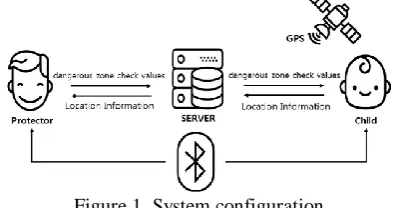
[image:3.595.332.529.314.418.2]Figure 1 shows a diagram of the composition of the child prevention learning system proposed in this paper. It periodically sends the child's positional information to the server and returns the value from the server in the protector's request for child location information. After verifying that the child's current position in the protector's application corresponds to the danger zone, the value is transferred to the SERVER to identify if it is a danger zone. The alarm is triggered in the protector’s application and the children’s application in hazardous areas. The Bluetooth connection is established through a direct connection. Event occurrence means the disconnection of the Bluetooth connection/signing when entering or exiting a hazard/safe area. At this time, the protector's smart-phone will receive a push notification. Children's smartphones will have educational vibration alerts when entering dangerous areas allowing children to learn repeatedly.
Figure 1. System configuration
[image:3.595.308.533.460.605.2]3.2. Sequence diagram
Figure 2 shows a sequence diagram that explains the flow of the proposed system.
Figure 2. Sequence diagram
The map screen initiates at the start of the guardian application and the map starts at a specified starting point. From this map, a specific area or danger zone suitable for the individualization of children can be designated. Since the protector uses the child's UUID to send and receive data through the server, the communication service is started after entering the child's UUID information value. Children periodically send location values to the server along with the child's UUID, and the protector requests location information of the child registered at any given time. The protector’s application uses the location information of the child received by the server to
server. An alarm is triggered by the caregiver’s application and children when the value of the hazardous area is true.
Additionally, a notification is issued to the protector if there are any changes after checking for new entry/exit events for children. In close range tracking using Bluetooth, the protector requests a connection to the child and, if the Bluetooth becomes available, checks for Bluetooth connectivity through periodic data exchange. If the Bluetooth connection is lost, the alarm is triggered for the protector and child, and the Bluetooth connection request is automatically repeated until the connection is reconnected. If the Bluetooth is reconnected, when entering connectable distance of the Bluetooth connection, the connection is made, and data exchange is performed.
3.3. Main function
The objective of this application is to implement GPS tracking for children's positioning and to develop a Bluetooth indoor child protection function to establish a basic child prevention system when children and protectors are present. The GPS function is used to provide safety/hazardous zone settings that are appropriate to a child's characteristics to assist protectors in the prevention of the loss of children. It is also to implement a connection status check to enable children to learn UBSL by implementing notification functions when entering a safe/hazardous area.
The main content of this application includes two educational functions and location tracking. It is a safe place for the protector to think that the safe area is set as a safe area so that the protector will be informed when the child is entering a safe area and the protector sets the danger area according to the characteristics of the child and the protector. Furthermore, the setting of dangerous areas where children are notified is a typical educational function. Children learn by classifying familiar places that they encounter within their own radius of life.
If a student enters a dangerous area, an alert will be sounded which causes UBSL to occur and help them learn one more time. Location tracking is divided into GPS and Bluetooth. GPS tracks the location of the student to check if the protector and student are not together, displays it on the protector's mobile phone, and is used to identify safe areas, dangerous areas, and departure. Bluetooth functionality was made available even when it was with a protector. If the child is far away from the protector, the Bluetooth connection will be lost, and the protector and child's smart-phones will be
notified enabling the protector to take quick action.
IV.EXPERIMENTALRESULTS
4.1. Test scenarios
The objective of this application is to implement GPS tracking for children's positioning and to develop a Bluetooth indoor child protection function to establish a basic prevention system when children and protectors are present together. The GPS function is used to provide
safety/hazardous zone setting functions that are appropriate to a child's characteristics, to assist protectors in the prevention of missing children. It is also to implement a connection status check function to enable children to learn UBSL by implementing notification functions when entering a safe/hazardous area.
Step 1: Find a child by recognizing that he/she has moved away from the child through the Bluetooth function in a complicated place taking quick action. If the system is not in use, a protector who does not know when or where he or she lost the child in a complex neighborhood will run around the Missing Children Center and find him/her
Step 2-1: In case a child enters a danger zone
The protector can immediately contact the child through real-time notification, and the child does not panic because of the alarm. Instead, the child recognizes and escapes the danger zone.
Step 2-2: When children enter a specific area
Schools and welfare centers that children often visit are set up in specific areas, and children's locations are notified in real time. When the system is not in use, there is an assistant teacher in charge of schooling; however, the protector would still worry about the location of the child. This anxiety forces the protector to always travel with the child, making it difficult for the child to become independent.
4.2. Field test
The Bluetooth pairing between the mobile phones is disconnected using the Bluetooth installed in the smartphone in each of the indoor space A (subway platform), B (underground shopping mall), and C (bookstore) in Tables<1>, <2> and <3>.
Table 1: Results of Bluetooth pairing in subway platform
Number of
experiments 1 2 3 4 5
Averag e ( A)
Distance
(metes) 46 46 47 48 47 47
Table 2: Results of Bluetooth pairing in Underground shopping arcade
Number of experiment s
1 2 3 4 5 Avera
ge (B)
Distance
(metes) 48 48 49 50 48 49
Table 3: Results of Bluetooth pairing in bookstore
Number of experiment s
1 2 3 4 5 Averag
e (C)
Distance
(metes) 47 48 48 48 48 48
The distance is measured by five experiments and the mean value is obtained. The density of each space is high in order of A, B and C. Galaxy
International Journal of Innovative Technology and Exploring Engineering (IJITEE) ISSN: 2278-3075, Volume-8 Issue-8S2, June 2019
experiments. After setting the hypothesis that the distance of the Bluetooth from the indoor is 20-30 meters, the experiment is conducted; however, it was confirmed that the cut-off distance remained approximately 47~50 meters irrespective of the density. This experiment resulted in a conclusion that it is suitable for measuring distances greater than 30 meters among indoor tracking.
[image:5.595.338.529.54.182.2]As a result of the above experiment, it is not suitable as a method to quickly recognize the moment when a child is away from the guardian with the built-in Bluetooth function, because of which another Bluetooth connection method is studied. We decide to apply Bluetooth search format instead which has been adopted as a function of the system because it is limited to a shorter distance compared to the existing Bluetooth pairing format. In order to prove this, we measured the distance between the Bluetooth pairing format and the Bluetooth search format. The experimental results are shown in Figure 3.
Figure 3. Results of an experiment in the notification time according to the distance of the Bluetooth method
Figure 3 shows that shorter distance limits are possible with the use of the Bluetooth compared to the distance from which the notification of the existing pairing format occurs. The results of this experiment confirmed that using the Bluetooth search function when a protector is with a child could help the protector resolve any anxiety from the possibility of a missing child. Using the Bluetooth search format can be a way for caregivers indoors and outdoors to cope with the disappearance of children faster than using the pairing feature.
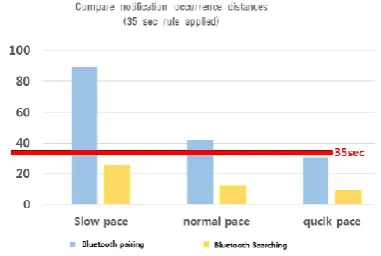
Kenneth Wooden, a child safety specialist, said that it took 35 seconds to lose a child, and the later the child's disappearance rate, the more likely it was to seek a child [18]. As such, quick follow-up measures are also important in the prevention of missing children [19]. In this study, we set up 35 seconds as the last line of disappearance of children based on his research, and then experimented with how much the children would be notified when they moved a few meters when using Bluetooth search. The distance travelled by the children was calculated by calculating the width of the beam using reference to the average age table using feet and height. Figure 4 shows the result of the assumption that the child walked at a slow speed, an average stride, and a faster one.
Figure 4. Experimental results of distance movement based on 35 seconds
Based on 35 seconds of reference, there is a significant difference between a child using a Bluetooth pairing function and a child using a Bluetooth search function. When protectors who were using Bluetooth pairing noticed that their children were missing, it took them more than 35 seconds for slow walking and average walking. However, if a child was using the Bluetooth search function, the child could be noticed missing before 35 seconds in all cases.
V.CONCLUSION
Every year, various solutions are offered to prevent missing children, and the resulting advances in technology are brilliant; however, the rate of disappearance of children is not decreasing. Prevention of missing children is important. After a child is known to be missing, the child should be found within a short time by taking immediate action.
The system discriminates against existing studies, supplementing the shortcomings of GPS, which is difficult to trace indoors, with Bluetooth, to double track the child's position. Using GPS outside, a protector can check the child's location in real time and use Bluetooth indoors to notify the child when he or she is away from the protector. This location tracking function, which encompasses indoor and outdoor activities, provides psychological stability to the protector. The application goes further than just tracking the child's location. It can be also used as a medium for children to recognize and learn danger zones themselves by adding a function of setting up a specific area or areas suitable for children.
Children have natural and repetitive individualized learning within their own behavioral radius. If the psychological security of the protector and the individualized and repetitive learning of the child work in tandem, the child will eventually be able to participate in society as a member with self-help skills and independence. It may also be used for information sharing between protectors using the apps through the establishment of hazardous and special zones.
In future studies, the proposed system is intended not to be restricted to children with disabilities but to be universally designed for everyone to use. An indoor mobility setting function that corresponds to
[image:5.595.82.273.290.400.2]search function is also being planned.
REFERENCES
1. International Centre for missing & exploring children [Internet]. Press Release. Activities in more than 29 Countries around the Globe will remember missing children on May 25; c2015-2018 [cited 2018 Jul 6].Available from: https://goo.gl/uK6BkN
2. Mankar, P., Nasare, H., Patle, P., Mahadole, M., Borkar, P., Gupta, S., & Pahune, S. Implementation of children tracking system using mobile terminals. IJARCET 4.1. 2015: 251-4.
3. Satan, A., & Toth, Z. Development of Bluetooth based indoor positioning
application. In Future IoT Technologies (Future IoT), 2018 IEEE International Conference on. IEEE. 2018, January:1-6.
4. Lee, C. H. Child Tracking System [Doctoral dissertation]. [UTAR]
:Universiti Tunku Abdul Rahman; 2016. 141 p.
5. Al-Mazloum, A., Omer, E., & Abdullah, M. F. A.GPS and SMS-based child tracking system using smart phone. International Journal of Electrical, Robotics, Electronics and Communications Engineering. 2013;7(2):171-174.
6. Lin, Y., Swan, K., & Kratcoski, A. Situated Learning in a Ubiquitous Computing Classroom. Journal of the Research Center for Educational Technology. 2009;1(2):25-38.
7. Gera, R., Muthusamy, N., Bahulekar, A., Sharma, A., Singh, P., Sekhar,
A., & Singh, V. An in-depth assessment of India’s mother and child tracking system (MCTS) in Rajasthan and Uttar Pradesh. BMC health services research. 2015;15(1):315.
8. Saranya, J., & Selvakumar, J. Implementation of children tracking system on android mobile terminals. In Communications and Signal Processing (ICCSP), 2013 International Conference on. 2013, April;961-965. 9. BRITT, Joe, et al. Internet of things (IoT) child tracking system. U.S.
Patent Application No 10/008,086. 2018.
10.Faragher, R., & Harle, R. An analysis of the accuracy of bluetooth low energy for indoor positioning applications. In Proceedings of the 27th International Technical Meeting of the Satellite Division of the Institute of Navigation (ION GNSS+’14). 2014, September:pp. 201-210.
11.Rozyyev, A., Hasbullah, H., & Subhan, F. Indoor child tracking in wireless sensor network using fuzzy logic. Research Journal of Information Technology. 2011;3(2):81-92.
12.Riggins, Scott A., and David P. Sharp. Missing child reporting, tracking
and recovery method and system. U.S. Patent No. 8,566,023. 22 Oct. 2013.
13.Cook, D. T. The missing child in consumption theory. Journal of Consumer
Culture. 2008;8(2):219-243.
14.Katz, Ilan, Xiaoyuan Shang, and Yahua Zhang. Missing elements of a child
protection system in China: The case of LX. Social Policy and Society.2011;10.1:93-102.
15.Gaikwad Priyanka Rajaram, Gotraj Sonali Machindra, Jagtap pooja
Ramdas , Pagare Prajakta Yashwant. Implementation of Child Tracking System Using Mobile Terminals. Imperial Journal of Interdisciplinary Research. 2016:828-832.
16.Huang, Li-Chien, et al. A ZigBee-based monitoring and protection system
for building electrical safety. Energy and Buildings. 2011;43.6: 1418-1426.
17.Xianghong Li, Dongyan Wei, Qifeng Lai, Ying Xu, Hong Yuan.
Smartphone-Based Integrated PDR/GPS/Bluetooth Pedestrian
Location.Advances in Space Research., 2017:877-887.
18.Kenneth Wooden, Founder & President Emeritus | Child Lures®
Prevention.Nomination for Kenneth Wooden, 2010 Pulitzer Prize Life Time Achievement Special Award/Citation; c2018[cited 2018 October 24]. Available from:https://childluresprevention.com/ken-wooden/
19.Setter, Douglas. One Less Victim: A Prevention Guide. Trafford