International Journal of Innovative Technology and Exploring Engineering (IJITEE) ISSN: 2278-3075, Volume-8 Issue-12, October 2019
Abstract: Resource allocation is the method of providing various available resources to the users in a network. Optical network is the method of the transmission of data through established equipment of optical fiber cables. Optical fibre cable used by different cable industries for communication between digital signal, telecommunication and data cable signals. Because of the low interfering, optical fibre cable has wide variety of applications over copper cable. The previously used techniques, described the distribution of the resource issue over the network for the three kinds of the stations and solution algorithms were proposed to solve the problem. First approach is representing the quantum key distribution that enables two parties to share a random key over the network .Also, different security phases have been demonstrated by updating multiple keys. Proposed algorithm decrease the rate of loss of data during the communication in optical networks. An approach is implemented namely route wavelength and time period arrangement (RWTA) algorithm to assign properties for three kinds of the stations and examine the results based on various structures. The proposed approach is based on two security mechanisms, which are in terms of the quantum key distributions and OSTBC encoding process, to improve the authentication in the network. In addition, quantum key distribution and OSTBC encoding is processed to evaluate the performance of the Quality service channel (QSC) and time division channels (TDC). Finally, it was determined that there is low probability of blocked data and less chances of the key failure in the network.
Keywords : Efficient communication, Quantum key distribution, OSTBC encoding process, Optical network, and Route wavelength and time period arrangement algorithm.
I. INTRODUCTION
O
ptical networking is the other way of communication in which the signals are associated with the light mainly to send and receive the data among several nodes in the telecommunication network. The range of communication in optical networking is better than other networks. During the presence of the intruders and attacks there may be loss of information, facility, corporate liabilities.Revised Manuscript Received on October 05, 2019.
Maninder Kaur, Persuing Master’s Degree, ECE, Punjabi University, Patiala, India.
Simranjit Singh, Assistant Professor, Department of ECE, Punjabi University, Patiala, Punjab, India.
Gurpreet Kaur, Assistant Professor, Department of ECE, CGC Landran.
In order to overcome such vulnerabilities, there must be advancement of the safety approach and techniques. Such problems can determine by resource allocation problem. Resource allocation is the method of the allocation of the source between different schemes or professional components with higher benefits. The resource is allocated in such a way that enhances the rate of transmission over the network. Optical communication is any type of communication in which light is used to carry the signal to the remote end, instead of electrical current. Optical communication relies on optical fibbers to carry signals to their destinations. A modulator/demodulator, a transmitter/receiver, a light signal and a transparent channel are the building blocks of the optical communications system. Consists of a core, cladding and a buffer through which the cladding guides the light along the core by using total internal reflection. The main benefits of optical communication include high bandwidth, exceptionally low loss, great transmission range and no electromagnetic interference. Optical networking is the communication between the nodes in which optic fibre used as transmission medium to form an optical network [1]. Generally, the conversion of the signal data in to the formation of the encoded light during the communication in the network is optical network [2] [3]. Optical network acquires high range of the frequencies in the network that enables large number of the users to connect, locating at several kilometres [4].The communication from sender to receiver by connection of the signals through different sets of the nodes in telecommunication network system is known as optical networking system. In optical network there is high range of communication includes local and wide area networks [5]. For instance, optical network dependent on the amps, LEDs and the laser lightings [6].The development of the optical communication is 50% in annual terms [7]. Subsequently, deployment of bandwidth is up to 2mbps in internet and modem equipment access in alphanumeric subscriber Optical Networks are quicker than customary systems since photons weigh not as much as electrons, and further, in contrast to electrons, photons don't influence each other when they move in a fibre (since they have no electric charge) what's more, are not influenced by stray photons outside the fibre [8] [9]. Light has higher frequencies and consequently shorter wavelengths, and in this way more "bits" of data can
An Efficient Method of Resource Allocation in
Optical Networks using Quantum Key
Distribution and OSTBC Encoding Process
OSTBC Encoding Process
be contained in a length of fibre versus a similar length of [image:2.595.73.258.227.339.2]copper wire [10]. Optical glass filaments dependent on the rule of total internal reflection, which was outstanding during the 1850s, were produced for endoscopes ahead of schedule in the 1900s [5]. The utilization of fibre glass for correspondence was first proposed by Kao and Hock ham in 1966. An assortment of optical systems appeared in the late 1980s and mid 1990s which utilized optical fibre as a swap for copper link to accomplish higher rates. PC interconnects, for example, ESCON (Enterprise Serial Connection), Fiber Channel, and Hippie (High Execution Parallel Interface), for interconnecting PCs to other PCs or fringe frameworks, utilizes low piece rate optical segments which are economical [11].
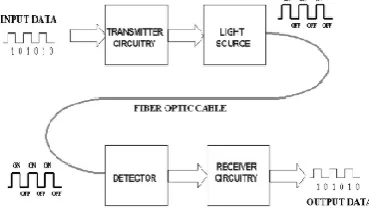
Figure 1. Optical Fiber Communication
In fig 1 data is input in the form of the electric signal and then conversion of the light signal in to light source. After that, light source is carried out to receiver through optic cable. The destination will receive the signal capable of converting the signal of desired frequency and bandwidth. In optical communication both wired and wired connections may take place [12]. Large number of users of Europe uses copper material whereas different Asian countries contains large amount of the optical access [13] [14]. The medium through which the encoding of the data to desired receiver and again the destination addresses back to sender by examining the signal is called as optical communication method [15]. In previous research, S/W defined network and quantum key distribution plane is linked to form a quantum key distribution optical network. In addition, they established various confidential phases linked to various quantities key distribution optical networks. They also proposed a new route wavelength and time period arrangement (RWTA) algorithm to assign properties for three kinds of the stations and examine the results based on various structures. In proposed research, initialise the features of network and then deployment of nodes and fibbers in the network. In next phase, modulation is performed for transmission of data over long distance. After that, hybrid quantum key distribution and OSTBC encoding channel is processed to evaluate the performance of the Quality service channel and time division channels. Finally it was determined that there is low probability of blocked data and less chances of the private key failure in network.
This research is organized as follows: Section I describes an overview of optical networks. Section II discusses the Literature review of different concept of optical network, Section III presents problem in existing research, Section IV demonstrate the proposed methodology, Section V determined result and discussion ,section VI determined the conclusion of whole research.
II. PRIORWORK
Zhao, Y., et al., (2018) [17] proposed the deep description of resource allocation in the optical networks which was
basically secured through QKD (Quantum Key
Distribution).These days, the optical network security was being a fascinating concept for the researchers and in the networking field. The loss of private data on the network was easily influenced the majority of users. Therefore, the need was to encrypt the data and it was considered the most usable method to protect the data on networks. Consequently, QKD was predicted to be more secure scenario which was responsible for generating different keys mainly for the encryption of data. In QKD, two other channels were concatenated as namely as Asch and Pitch specifically for the synchronization. At the time of network designing, there was need of securing resources also. Hence, the current research was adopting OTDM (Optical Time Division Multiplexing) which had the capability for the allotment of multiple channels in the network with similar wavelength. Next to it, RWTA (Routing, Wavelength, Time-Slot and Assignment) method was utilized for the allocation of time and wavelength mainly on three categories of channels. There were different security phases that were generally used in RWTA via updating in the secure keys. The experiment demonstrated that, the effect of the security levels were also influenced the allocation of resources in the network. Jabber, M.A., et al., (2017) [16] used different techniques for the information transmission by optical frameworks. In this specialized world, the sign correspondence was being a fascinating point for analysts and a fundamental need to satisfy the necessities of new progressions. It was happened due to huge measure of information and the information was for the most part as content, voice, pictures, recordings, sound, etc. Along these lines, to process the enormous measure of information, the need of transmission limit additionally expanded. The medium used for the transmission of information must be a copper wire yet it had diminished limit. Subsequently, the issues were raised and required to be overseen. Another strategy was viewed as which had the inclination for handling huge information, higher sign and the long correspondence. The exploration work concentrated on the structure and the demonstrating technique of directs in the optical correspondence. Fundamentally, it used the light waves as the transporter for the transmission of information. The present work was portrayed the various qualities and decided the exhibition just as plan a structure correspondence framework through utilizing diverse transmission and gathering approaches. The optical system results were considered as a novel reproduction approach for the arrangement of optical modules. It suggests on the transmitter which changed the sign into light, fibre optic channels and it returns the procedure to change the light into unique sign. Udine, M.N., et al., (2015) [18] broke down the presentation of various misfortunes in OFC (Optical Fiber Correspondence). This exploration was identified with the different misfortunes with the single mode fibre for the most part found in the optical fibre correspondence.
International Journal of Innovative Technology and Exploring Engineering (IJITEE) ISSN: 2278-3075, Volume-8 Issue-12, October 2019
weakening of sign in the optical strands. As indicated by the optical sign on the extended length in the fibre, it changed because of the assimilation, dissipating and the polluting influences. The information transmission using high transfer speed was effectively dealt with the colossal measure of information. After this, it was improved by ousting the fibre misfortunes which raised the data rate and the separation using a dynamic working wavelength. The ebb and flow investigate was about the improved advancement in the field of the correspondence organize as in particular as optical filaments. There was additionally enhancements were found in the classes of filaments and their significant qualities. The qualities of these strands were made out of lessening, loss of information, data transfer capacity. Every one of these things was quickly spoken to in the exploration. The exhibition of the ebb and flow investigate was improved like RS (Rayleigh dispersing), SBS (Animated Brillion Dissipating) with different misfortunes as the twisting in the distinctive misfortune ideas go under the fibre optic and saw in the recreation procedure. Ataman, M., et al., (2015) [19] described the blunder control in OFC (Ideal Fiber Correspondence). It was happened in light of the nearness of the electromagnetic waves. Different difficulties were identified with the clamour, weakening; the information was adjusted in the focal point of the following procedure. Consequently, the collector required to think about the viability (Precision) of the data. In this way, mistake control process did for the better correspondence channels. For the most part, it was used for the optical correspondence approach and the best vehicle for the preparing of the information transmission. The proposed strategy was gotten to for the mistake control program especially in the optical fibre framework. The primary objective of research was to instate the two kinds of blunder redress program. After this, an inside and out investigation was utilized for the mistake rectifications.
III. ISSUES
Multiplexing in optical communication is an expertise which multiplexes various optical signals on a single optical fibre using various wavelengths. This procedure deals with the bidirectional infrastructures over one component of fibre, also increase of capacity. The term wavelength division in optical communication is normally applied to the carrier signal, which is characteristically labelled by the wavelength. This is morally conservative because wavelength and occurrence connect the same amount of information. But there are some problems which really exist in optical networks and also in the reference paper is the security which leads to the loss of data and confidentiality which produce heavy impact on the users and their services provided by the optical networks. Also one more problem is addressed by the author is the allocation of the resource which is one of the important scenario in the optical networks. So in this thesis these problems will be resolved which increases the security of the optical networks in the allocation of the resources and the quality of the service increases for the network users.
IV. RESEARCHMETHODOLOGY
To study the resource allocation scenarios in the optical networks in a secure manner with the use of Quantum Key
Distribution and OSTBC encoding process. To implement the secure approach to reduce the chances of loss of data in the optical networks. Compare the proposed performance evaluations with the base approach in terms of blocking probability and Key updating failures.
We have used the proposed technique, QKD with OSTBC Encoding Process to make the channel estimations and resource allocations in an efficient manner in the optical networks. The resource must be allocated in the efficient and the secure manner to achieve high reliability and the proposed work is giving better solutions because in the proposed work two security mechanisms are used which are in terms of the quantum key distributions and OSTBC encoding process which increases the security in the resource allocations also it can be notices from the result and discussions that the proposed approach is well suited for reducing the key updating failures and also reducing the blocking probabilities. Network specifications are described first like length of network, sampling rate, bit rate etc to design a network. Nodes and Fibres are deployed on the network after that wavelength and frequencies are assigned for further processing. Quadrature Phase shift key is used to achieve the high modulation of the signal to transfer it at the long distances. After that apply the quantum key distribution and OSTBC encoding channel process to evaluate the performance of the Quality service channel and time division channels. All the simulation is done in MATLAB software. By applying the above two techniques we observed that the blocking probability and Key updations Failure is reduced as compare to the base approach. Blocking Probability is also evaluated with Time sliding Window (TSW).The simulation results shown that with the increase in value of TSW the blocking probability get reduced.
Figure 2. Proposed Approach and Methodology
Mathematical approach of OSTBC
In orthogonal space time block code, assume the wireless communication for the given time
OSTBC Encoding Process
The wireless communications are in the orthogonal form. AnSTBC is usually represented by a matrix. Each row represents a time slot and each column represents one antenna's transmissions over time. The Time slot T the received signal are,
= + ……… (I)
The network state statistics is available having the destination the superior metrics,
- ………. (ii)
The sum of the network stations have the probable state data for the approximation at the destination value is related to data signal.
. . . . . . . . . . . . ……… (iii) The value of the network station is described by the state of the data for the transmission analysis having the diverse approach. The given form described by Rayleigh space time code having maximum matrix.
The rate of the higher transmission rate with the processing signal is having the decoding optional approach with the complex structural value where the data is stored for the minimisation of the energy value p.
G (F) = ……… (iv)
The network outstations are given by the d number of the network,
=B(d,e)………(v)
The consequent analysis of the information are described by the performance of the improvement of the netwok stations under the movement conditional approach.
V. EXPERIMENTRESULT
[image:4.595.349.504.203.310.2]This section described about the results that are observed for TDCH and QSCH have 32 and 2 Wavelength, 28 and 4 Wavelength, 24 and 6 Wavelength.
Figure 3. Blocking Probability in Proposed Work
The above figure shows the blocking probability in which the proposed approach using quantum key distribution and OSTBC encoding is used and the blocking probability is evaluated with respect to the traffic load. As it can be noticed that blocking probability is coming low which shows that the proposed approach is able to achieve high security in the allocating the resource allocations for the efficient evaluation of the packet transmissions through optical channels. The blocking probability is one of the important parameter in terms of the performance evaluations which shows the high blockage during rush hours when the services are required by the users. So it can be noticed that the proposed approach is
able to achieve low blocking even if the traffic load increases which is one of the crucial part in the loss of the bits.
[image:4.595.321.531.412.680.2]The below figure 4 shows the key updating failure using proposed approach and shows the yellow indication using probability of failure of total key updating. It can be noticed that the proposed approach is having low key failures with respect to base approach in terms of the increase of the traffic load. It can be notices from the above graph the key updations are coming low which is 0.012 approximately which is having low indications of the key failures while updating the key in certain number of rounds for secure transmissions through quality and time division channels.
Figure 4. Key Updations Failure (Proposed)
As it can be noticed that the updations of the keys are in the frequent manner as the load increases and its having the huge impact in the failure of the security keys while allocation of the resources but it can be noticed from the above graph that the proposed approach is able to achieve high secure communications with less key failures which is one of the important scenario for the updations of the keys.
(i)
(ii)
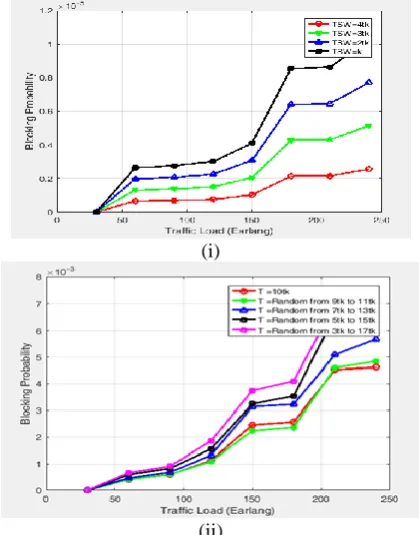
Figure 5. (i) and (ii) Impact of Different TSW’s on Blocking Probability
TSW is a parameter defines as Time Sliding window which is introduced here in RWTA
[image:4.595.62.273.485.624.2]International Journal of Innovative Technology and Exploring Engineering (IJITEE) ISSN: 2278-3075, Volume-8 Issue-12, October 2019
for the resource allocation of different types of channels. Different levels can be considered in the RWTA algorithm by tuning the time period T of key updation for each connection request.
It can be noticed from the above result graphs that different values of TSW’s are adopted. Blocking probability is reduced by increasing the value of TSW.
VI. CONCLUSIONANDFUTURESCOPE
The research had concluded that the authentication and confidentiality of data in optical network is enhanced by decreasing the rate of probable blockage. In this research, network is initialised with deployed nodes and fibre in the network. After that, we have applied the quantum key distribution and OSTBC encoding channel process to evaluate the performance of the Quality service channel and time division channels. In order to increase the security of the network a method was proposed. The proposed approach based on two security mechanisms are used which are in terms of the quantum key distributions and OSTBC encoding process to improve the authentication in the network. It can be noticed from the evaluated result that is well suited for the reducing the key updation failures and also reducing the blocking probabilities.
In Future, Optical packet routers can act as the optical element helps in the integration of data. The probability of the blockage over the network may be permanently diminished by implementing an authentication algorithm.
REFERENCES
1. Lam, C. F, “Optical network technologies for data enter networks”, Conference on optical fibre communication (OFC/NFOEC), collocated national fibre optic engineers conference, pp.1-3, IEEE, 2010.
2. Chi, N., Haas, H., Kavehrad, M., Little, T. D., & Huang, X. L, “Visible light communications: demand factors, benefits and opportunities [Guest Editorial].” IEEE Wireless Communications, pp.5-7, 2015 3. Figueira, S., Kaushik, N., Naiksatam, S., Chiappari, S. A., &
Bhatnagar, “Advance reservation of light paths in optical-network based grids.” Proc. ICST/IEEE Grid nets, 2004.
4. Refi, J. J, “Optical fibres for optical networking.” Bell Labs Technical
Journal, pp.246-261, 1999.
5. Hande, Y. S., & Akkalakshmi, A Study on Software Defined Networking, 2015.
6. Xiong, Y., Vandenhoute, M., & Cankaya, H. C, “Control architecture in optical burst-switched WDM networks” IEEE journal on selected
areas in communications, pp.1838-1851, 2000.
7. Baldine, I., Rouskas, G. N., Perros, H. G., & Stevenson, “JumpStart: A just-in-time signalling architecture for WDM burst-switched networks.” IEEE communications magazine,pp.82-89, 2002. 8. Barry, Richard A., and Pierre A. Humblet,"Models of blocking
probability in all-optical networks with and without wavelength changers." In Proceedings of INFOCOM'95,pp. 402-412 .IEEE, 1995. 9. Farrington, N., Porter, G., Radhakrishnan, S., Bazzaz, H. H., Subramanya, V., Fainman, Y., & Vahdat, “Helios: a hybrid electrical/optical switch architecture for modular data centres.” ACM
SIGCOMM Computer Communication Review, pp.339-350,2011.
10. Essiambre, R. J., Kramer, G., Winzer, P. J., Foschini, G. J., & Goebel, “Capacity limits of optical fibre networks.” Journal of Lightwave
Technology, pp.662-701,2010.
11. Aggarwal, A., Bar-Noy, A., Coppersmith, D., Ramaswami, R., Schieber, B., & Sudan, “E cient routing and scheduling algorithms for optical networks.” In Proc. of SODA ,1994.
12. Alexander, S. B “ Optical communication receiver design.” London:
SPIE Optical engineering press, pp.68,1997.
13. Mukherjee, “WDM optical communication networks: progress and challenges.” IEEE Journal on Selected Areas in communications, pp.1810-1824, 2000.
14. Hanson, F., & Radic, “High bandwidth underwater optical communication.” Applied optics, pp.277-283, 2008.
15. Tanobe, Hiromasa, Akira Okada, Kazuto Noguchi, Morito Matsuoka, Takashi Sakamoto, and Osamu Moriwaki. "Optical communication network system." U.S. Patent 7,298,974, 2007.
16. Jabbar, M. A., Albaker, B. M., and Iqbal, S.Z, “ Using Different Techniques in Data Transferring by Optisystem Program”. American Journal of Optics and Photonics, 2017.
17. Khadir, A. A., Dhahir, B. F., and Fu,“Achieving Optical Fiber Communication Experiments by OptiSystem.” International Journal of Computer Science and Mobile Computing, pp. 42-53,2014. 18. Uddin, M. N.,Rahman, D. M. M., and Ali, M. S. “Performance analysis
of different loss mechanisms in optical fiber communication.” Computer Applications: An International Journal (CAIJ), pp. 1-13, 2015.
19. Hatamian, M., Barati, H., Berenjian, S., Naghizadeh, A., and Razeghi, “Error control coding in optical fibre communication systems: an overview.” Advances in Computer Science: An International Journal, pp.70-80, 2015.
AUTHORSPROFILE
Maninder Kaur, obtained her bachelor’s degree in
Electronics and Communication Engineering (ECE) from CGC Gharuan,Mohali, India, and persuing Master’s degree in ECE from Punjabi University, Patiala, India. She has published 1 review paper in journal in International Journal of Research in Electronics and Computer Engineering (IJRECE). Vol. 7. Issue 3 July-September, 2019.
Simranjit Singh, obtained her bachelor’s degree in
Electronics and Communication Engineering (ECE) from Guru Nanak Dev Engineering College, Ludhiana, Punjab, India.(2004-08) India, and a Master’s degree in ECE from Thapar University, Patiala, Punjab, India.(2008-2010) , India. He has submitted her PH. D thesis in ECE department at Thapar Institute of Engineering and Technology, Patiala. His field of interest is Optical fiber communication, Information security , Optical sensors , Communication Systems, Free space optics. He is currently working as Assistant Professor in the Department of ECE ,Punjabi University, Patiala, Punjab, India. He has published 45 research papers in SCI journals. He has awarded by the Raman Post Doctorate Fellowship in USA of UGC (India). (Notification number: 5-175/2016(IC), dated: 10/02/2016). Selected as Postdoctoral Associate (Secondary Appointment) at The Institute of Optics of University of Rochester, Rochester, New York, USA (duration July 2016 to July 2017).Outstanding Reviewer Status awarded by Elsevier on 7th Oct 2016 via [email protected].