International Journal of Innovative Technology and Exploring Engineering (IJITEE) ISSN: 2278-3075, Volume-8 Issue-12, October 2019
Abstract: Considering the problems of the dissemination of innovative approaches to the use of information and communication technologies, it is hardly possible to ignore the phenomenon of the high-tech educational environment, which is formed both within the educational institution, the region, the education system of individual countries, and globally. In this regard, it is important to identify trends in the development of information and analytical systems of higher education in the context of the emergence of innovative information and communication platforms, in particular, based on cloud computing.
The purpose of the present article is to analyze the possibilities of using cloud computing for integrated information and analytical system of educational resources.
The article substantiates the relevance of the use of cloud computing in education, as well as considers the features of cloud-oriented educational environment. Based on an expert survey, the level of application of cloud technologies in the implementation of the educational process, the possible structure of a cloud-oriented integrated automated system (IAS) of the university, and the necessary electronic resources for educational purposes as part of an integrated IAS, are determined.
Index Terms: cloud computing, cloud educational services, cloud hosting, electronic educational resources, information-analytical system.
I. INTRODUCTION
The modern development stage of society is characterized by the emergence and dissemination of the digital technology market, constantly covering new industries [1]. Development trends of this market are determined mainly by the progress not only of the technology sector but also by the penetration of advanced information and communication technologies in other areas of production and social activities. In particular, the education sphere is a promising area of implementation and application of new technologies. This will stimulate productivity and efficiency of activities in this sphere, make
Revised Manuscript Received on October 05, 2019
Natalia Grigorievna Bondarenko, FGAOU VPO «North-Caucasus
Federal University», Pyatigorsk, Russia.
Elena Sergeevna Getmanova, FGAOU VPO «North-Caucasus Federal
University», Pyatigorsk, Russia.
Evgeniya Alekseevna Kurenkova, Moscow Region State University,
Mytishi, Moscow Region, Russia.
Elmira Mindyhatovna Karaseva, Kostanay branch of Chelyabinsk
State University, Kostanay, Kazakhstan.
Olga Viktorovna Domnina, The Federal State Budgetary Educational
Institution of Higher Education Saratov State Law Academy, Saratov, Russia.
Natalya Anatolyevna Grigorieva, Peoples` Friendship University of
Russia, Moscow, Russia.
graduates more competitive, promote their professional actualization, development of entrepreneurship, and economic growth. The dynamism of production processes, caused by the rapid change in technology, leads to the emergence of new areas of specialization, which might not have existed a few years ago, as well as to the creation of new jobs [2].
Promising information and communication technologies (ICT) are a tool for the implementation of the principles of human centrism, equal access to education in the pedagogical systems of higher education. It is cloud technologies that most meet the needs of solving urgent socio-economic, educational, and cultural problems of contemporary society, of which the main ones are increasing the level of availability and quality of education, the relationship between the research and staff training processes, improving the design, formation and functioning of the educational environment of higher education institutions [3].
In 2012, the US National Institute of Standards and Technology (NIST) developed recommendations [4], which define the concept of cloud computing and characterize their main features. The purpose of the document is developing the cloud computing concept in order to inform the public and to disseminate this concept for further circumstantiation and discussion.
By definition of NIST, the Cloud Computing is understood as the model for convenient network access to a shared fund of computing resources (e.g., networks, servers, data files, software, and services), which can be provisioned quickly with a minimum management effort and interaction with the provider [4].
This document proposes five essential (basic) characteristics of cloud computing that allow distinguishing these systems from other types of ICT [4]. That is, these are the basic characteristics that an ICT infrastructure must have in order to ensure that associated software applications and services could be considered as those that are delivered through a cloud model. These are the following characteristics: self-service on demand; free (ubiquitous) network access; pooling resources (regardless of the location of the resource); fast elasticity (provision and release of the resource in the required amount and at any time); measurability of the service (payment upon provision).
Cloud Computing for Integrated
Information-Analytical System of Educational
Resources
Natalia Grigorievna Bondarenko, Elena Sergeevna Getmanova, Evgeniya Alekseevna
Kurenkova, Elmira Mindyhatovna Karaseva, Olga Viktorovna Domnina, Natalya Anatolyevna
Formation and development of the educational environment of higher education institutions based on cloud computing technology is a relevant direction of pedagogical systems modernization of contemporary higher education [5]. It is associated with the dissemination of more convenient, flexible, scalable systems of access to electronic resources and services, the possibility of teamwork with software applications, the removal of spatial and time constraints, and the mobility of all subjects of learning when using cloud technologies.
Involvement of cloud technologies of open information and educational space in the university practices can also play a leading role in deepening the ties among education, science and production; expanding cooperation between educational and scientific institutions; creating a variety of corporate structures supported by cloud technologies aimed at developing closer interaction with the higher education sector; solving urgent social and economic problems; and improving the intensity of scientific research and staff training process.
II. LITERATUREREVIEW
Modernization of the educational environment of the university based on the cloud technologies and the implementation of cloud-oriented platforms for the supply of ICT services is increasingly becoming the subject of consideration and attention of scientists. Contemporary research is devoted to aspects, such as software virtualization and the formation of a unified ICT infrastructure of the educational institution [6]; the use of generally accessible and corporate cloud services; the advantages and disadvantages of various models of their delivery [7], environment design and deployment strategies [8], and others.
According to the study [9], the trends in the implementation of cloud technologies in educational institutions are becoming particularly relevant. They aim at organizing access to software, which is used for various types of teamwork in scientific and educational activities, research and development, project implementation, sharing experience and the like.
The subject of contemporary research is associated with analysis of various models of accessing to software for educational purposes, and in particular, by means of a virtual machine [10]; comparative analysis of software from the standpoint of pedagogical use, location in the cloud, determining the factors of the most appropriate organization of the educational environment of the institution [11].
Thus, the works [12], [13] are dealing with the issues of research processes productivity at universities, where it is proposed to use cloud services as a means of increasing the efficiency and enhancing research activities.
According to the results of Russian studies [14]-[17], devoted to the application of cloud computing technology in educational institutions, these problems are considered in the context of organization and maintenance of multiple-key access to software and electronic resources, organization of educational and scientific activities, participation in projects and research in the course of learning, as well as sharing experience in the learning process. All these issues are quite relevant.
Thus, the study of V.G. Shevchenko and M.V. Shevchuk is devoted to the definition of pedagogical capabilities of using cloud computing for the organization of competence-based training and monitoring learners (students) progress [18].
Zaslavskaya O.Yu., when investigating the integration of Google cloud technologies into the information and educational space, indicates the application areas of the cloud-oriented software, among which the deployment of Google Apps services is considered to be quite promising. This will result in integration with the institution's own web services and the creation of hybrid information and educational space of the university [19].
Shekerbekova Sh.T. and U. Nesipkaliev explore the use of cloud services in supporting scientific research and the deployment of a cloud-oriented environment based on open ICT platforms. The study provides a comparative analysis and summarizes the experience of implementing various models of cloud infrastructure deployment both based on the institution and the lease of the infrastructure of the service provider; the authors, in particular, highlight the aspects of the deployment cost [20].
Analysis of studies on the creation of information and analytical systems (IAS) in education has shown that, according to A.K. Nesterov, educational IAS includes two basic elements: an integrated management system and a single information environment of educational resources. According to the researcher, first of all, integrated IAS is necessary to support the activities of educational institutions in the context of management of educational processes, educational work, etc. At the operational level, the aim of the IAS is to automate the workflow and interaction of management systems of educational institutions. At the tactical level, the aim of IAS is a comprehensive control of the educational process. The strategic level of IAS is focused on the tasks of improving the effectiveness of educational processes in the long term, as well as providing guidance to data analysis tools [21].
In connection with the above, the cloud-oriented integrated IAS will be understood as systems that provide tools to support educational activities and research (computational capability, storage space or network resources to organize relationships, etc.), implemented based on cloud services.
Despite the fact that the formation of information and educational environment on the basis of cloud technologies is a promising area, which is being intensively developed in various fields of education, publications on this topic are not enough. The analysis of the literature shows that numerous methodological, scientific-methodical, organizational, psychological and pedagogical, as well as technical and technological issues dealing with the formation of integrated IAS on the basis of cloud technologies are practically not covered by universities. Thus, the identification of current trends in the design, formation, and development of integrated IAS of the university based on cloud technologies is a little developed problem.
Research hypothesis is formulated as follows: the implementation of a single technological platform for the
deployment of
International Journal of Innovative Technology and Exploring Engineering (IJITEE) ISSN: 2278-3075, Volume-8 Issue-12, October 2019
system of educational resources of higher education institution contributes to the solution of numerous problems on combining the technological infrastructure of training on a single basis, organizing wider access to the best electronic resources and services.
III. METHODS A. General description
General scientific methods have been used to solve the tasks set in the research:
(a) theoretical methods, namely, analysis of the reviewed scientific sources of the last decade devoted to the problem under study to clarify the state-of-the-art of the formation and development of cloud-oriented educational environment in higher education institutions, identify principles and approaches to the design of IAS educational resources; generalize domestic and foreign experience in the application of cloud services and technologies in higher education institutions; systematize and generalize scientific facts and laws to develop and design models of cloud-oriented IAS educational resources;
b) empirical methods, namely, expert online survey of participants of the educational and scientific environment of higher educational institutions to determine the level of
application of cloud technologies in the implementation of the educational process, as well as the possible structure of cloud-oriented IAS of the university, and the necessary electronic resources for educational purposes as part of an integrated IAS. In total, 32 experts from 12 educational institutions from four Russian cities were involved in the survey. The contingent of respondents included scientific and pedagogical staff, which somehow associated their activities with the cloud computing problems, i.e., it can be assumed that these people were well familiar with the latest trends in technological development, and worked mainly in educational institutions, were well prepared and focused on the use of modern ICT.
B. Algorithm
At the first stage of the study, the scientific literature was analyzed, and an expert survey was conducted, during which experts answered the question "For what types of activities do you use cloud technologies?" Besides, directions for designing the functions and components of a cloud-based IAS were indicated.
At the second stage of the study, a peer discussion of the component grouping model of cloud-oriented IAS was conducted.
C. Flow Chart
IV. RESULTSANALYSIS A. Obtained results
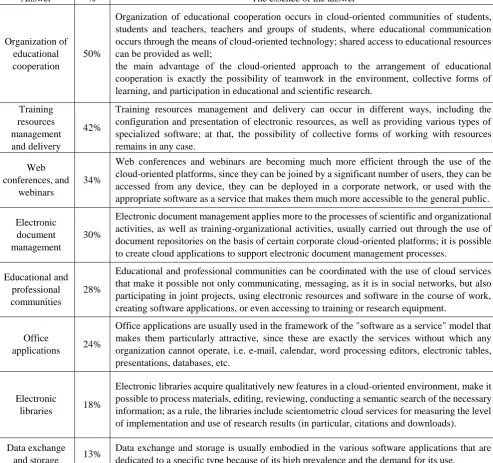
The answers to the question "For what types of activities do you use cloud technologies?" were distributed as follows (options are not mutually exclusive) (Table 1).
Expert survey Analysis of scientific literature
Cloud-oriented IAS component grouping model
Cloud-oriented IAS structure
Application of cloud technologies in the educational process
Expert discussion
Table 1.
Answer % The essence of the answer
Organization of educational cooperation
50%
Organization of educational cooperation occurs in cloud-oriented communities of students, students and teachers, teachers and groups of students, where educational communication occurs through the means of cloud-oriented technology; shared access to educational resources can be provided as well;
the main advantage of the сloud-oriented approach to the arrangement of educational cooperation is exactly the possibility of teamwork in the environment, collective forms of learning, and participation in educational and scientific research.
Training resources management and delivery
42%
Training resources management and delivery can occur in different ways, including the configuration and presentation of electronic resources, as well as providing various types of specialized software; at that, the possibility of collective forms of working with resources remains in any case.
Web conferences, and
webinars
34%
Web conferences and webinars are becoming much more efficient through the use of the сloud-oriented platforms, since they can be joined by a significant number of users, they can be accessed from any device, they can be deployed in a corporate network, or used with the appropriate software as a service that makes them much more accessible to the general public.
Electronic document management
30%
Electronic document management applies more to the processes of scientific and organizational activities, as well as training-organizational activities, usually carried out through the use of document repositories on the basis of certain corporate cloud-oriented platforms; it is possible to create cloud applications to support electronic document management processes.
Educational and professional communities
28%
Educational and professional communities can be coordinated with the use of cloud services that make it possible not only communicating, messaging, as it is in social networks, but also participating in joint projects, using electronic resources and software in the course of work, creating software applications, or even accessing to training or research equipment.
Office
applications 24%
Office applications are usually used in the framework of the "software as a service" model that makes them particularly attractive, since these are exactly the services without which any organization cannot operate, i.e. e-mail, calendar, word processing editors, electronic tables, presentations, databases, etc.
Electronic
libraries 18%
Electronic libraries acquire qualitatively new features in a cloud-oriented environment, make it possible to process materials, editing, reviewing, conducting a semantic search of the necessary information; as a rule, the libraries include scientometric cloud services for measuring the level of implementation and use of research results (in particular, citations and downloads).
Data exchange
and storage 13%
Data exchange and storage is usually embodied in the various software applications that are dedicated to a specific type because of its high prevalence and the demand for its use.
As can be seen from the results of the survey, cloud services are widely used in educational institutions. At the same time, their use is not systematic, not organized into a single system, is not sufficiently purposeful and focused on particular pedagogical goals. Therefore, further measures are needed towards modernization of educational institutions hardware and software, as well as the development of scientific and methodological research in terms of identifying promising areas of use of cloud services, which is possible, according to experts, through the construction of the information and analytical system of educational resources in educational institution.
According to experts, the cloud-oriented IAS should include cloud educational services (CES) and electronic educational resources (EER), which become available to users through ICT services implemented through cloud hosting. This means that the resources are stored on virtual servers in the data center, or on virtual cloud servers, that is, a hybrid approach to using server capacities is being organized.
At that, according to respondents, the direct organization and adjustment of educational services with the use of cloud services is provided by the network administrator, who insures the availability of cloud services; tutor, who creates cloud-oriented educational services; and organizer, dealing with the interaction between different levels and components of the IAS, which is divided into subsystems within the institution.
The main components of a cloud-oriented IAS, according to the interviewed experts, are EER stored on cloud servers, and CES provided through cloud hosting. The conceptual difference of this approach is that not only resources but also services are virtual, existing in the cloud. As a result, the ways of organizing access to electronic resources are changing, their structure and functions are changing as well, the requirements for their quality
International Journal of Innovative Technology and Exploring Engineering (IJITEE) ISSN: 2278-3075, Volume-8 Issue-12, October 2019
CES are a set of various numerous software products provided by cloud platforms (various service providers), while their inclusion in the integrated automated system (IAS), as noted by the experts, depends on the needs and financial capabilities of a particular institution.
The peculiarity of the cloud computing concept for IAS of educational resources, according to experts, consists in creating conditions for wider access to various types of EER, which can be either specially installed on a cloud server, or provided as a public service (located on any other electronic data media available via the Internet). This creates the conditions to meet the needs of wider audience of users, who may have different requirements regarding the pace and level of training, individual thinking styles, and preferences, as well as methods of material processing.
According to experts, the design of EER, which are elements of the IAS content, can be considered to a certain extent regardless of the system means and resources of their presentation and supply, which are also in the cloud. Therefore, the issues of substantiation of ways to select and classify the necessary EER, as well as ensuring an appropriate level of their quality play a more important role.
As the experts participating in the survey emphasize, EER are both objects and means of the activity of the person who is studying, therefore, they perform certain functions implemented in the course of mastering the particular subject. In this regard, according to experts, it is advisable to
characterize the types of activities, which are carried out by means of ICT services in the cloud-oriented IAS, and which appear therefore as its educational services. Obviously, not all functions, which can be implemented within a particular IAS, are necessary, that is, not all of them should be converted into services. Therefore, for the CES design based on the concerned model of cloud-oriented IAS, it will be necessary to determine the components of its content, whose composition include EER.
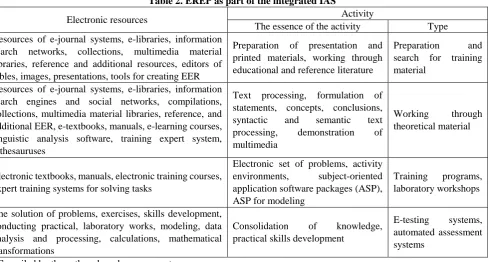
Experts identified the following basic types of EER: electronic resources for educational purposes (EREP), electronic resources to support scientific research (ERSSR), and electronic resources for managerial purposes (ERMP).
[image:5.595.60.549.402.664.2]Electronic resources to support learning activities can be classified according to the types of activities, including the development of theoretical material, and consolidation of knowledge (fulfillment of tasks, exercises, skills development, as well as knowledge assessment (Table 2).
Table 2. EREP as part of the integrated IAS
Electronic resources Activity
The essence of the activity Type
Resources of e-journal systems, e-libraries, information search networks, collections, multimedia material libraries, reference and additional resources, editors of tables, images, presentations, tools for creating EER
Preparation of presentation and printed materials, working through educational and reference literature
Preparation and
search for training material
Resources of e-journal systems, e-libraries, information search engines and social networks, compilations, collections, multimedia material libraries, reference, and additional EER, e-textbooks, manuals, e-learning courses, linguistic analysis software, training expert system, e-thesauruses
Text processing, formulation of statements, concepts, conclusions, syntactic and semantic text processing, demonstration of multimedia
Working through
theoretical material
Electronic textbooks, manuals, electronic training courses, expert training systems for solving tasks
Electronic set of problems, activity environments, subject-oriented application software packages (ASP), ASP for modeling
Training programs, laboratory workshops
The solution of problems, exercises, skills development, conducting practical, laboratory works, modeling, data analysis and processing, calculations, mathematical transformations
Consolidation of knowledge, practical skills development
E-testing systems, automated assessment systems
Compiled by the authors based on an expert survey
B. Results and discussion
According to experts, the main groups of services and other components, which are included in the cloud-oriented IAS of the university, should be reflected in the components grouping model. It distinguishes the main types of structural units, as well as the subjects of the environment, between which educational and scientific interaction can occur that corresponds to different levels of IAS deployment, namely, at
According to experts, the IAS components grouping model should also reflect the main groups of services, which can be used in the IAS. Among them, experts identified communication services, general-purpose services, and specialized services.
According to experts, the communication services include video conferencing services, which are becoming more and more qualitative and accessible, as well as e-mail and instant messaging services, which are part of many general-purpose cloud systems, in particular, Google and Microsoft Office 365, and can be used on a variety of platforms and devices.
General-purpose services, as indicated by the experts,
cover those that can be applied to various academic disciplines and are not focused on use in specific subject areas. In particular, this category includes cloud office services, document storage, which can store educational materials, files and data for individual or shared use, as well as EER design services (for example, tools for creating websites, e-learning courses, collections and repositories of EER, etc.), and cloud-oriented database management systems (DBMS).
For example, by means of services, such as Google, Zoho, Microsoft Office 365 and others, one can perform online text processing, spreadsheets, data presentation, as well as create and develop websites.
DropBox, Box, e-Disc, and others are tools for organizing access to disk space for data storage, located at the cloud service provider and accessible via the Internet.
Editors for processing various kinds of data include, for example, Pixlr, which is online photo (image) editor; Jaycut video-editor, designed for processing video fragments; Aviary online suite which represents a set of tools for creating and editing images, web-pages, etc.
The EER design services cover a variety of software tools, systems, and shells for the development of both individual EER and software systems, for example, distance learning systems (Canvas, etc.).
According to experts, specialized cloud-oriented services include those which can be used to study individual disciplines or their cycles, namely, cloud services for managing computer-oriented learning tools (COLT). In particular, these are remote training/research laboratories for the use of various types of devices and equipment; a variety of laboratory complexes, other devices controlled through the network; services of educational tasks processing (ASP for programming and design, modeling, data processing, and the like. Among them a prominent place is occupied by computer mathematics systems (CMS), for example, Sage Math Cloud; expert systems, etc.; subject-oriented EER and their sets; scientific research support services, for example, cloud-oriented services of scientific and educational information networks.
Appealing to the international experience in the use of cloud computing, experts emphasize that the use of information and analytical network tools, cloud computing tools and services in informatization of education is a priority in the development of open scientific and educational space. This is evidenced by a number of government initiatives of different countries and adopted international documents, such as the US Federal Cloud Computing Strategy (2011), the
European Cloud Initiative "Unleashing the potential of cloud computing in Europe" (2012), the European Commission's cloud strategy "Cloud as an enabler for the European Commission Digital Strategy" (2019), etc., according to which cloud computing is recognized a priority direction of technological development [22].
Speaking about the advantages of cloud computing for integrated IAS of educational resources, experts emphasize that the availability of hardware in the property requires its maintenance. In this regard, cloud computing simplifies the solution of two problems of IAS: the need to assess the characteristics of the equipment, and the lack of funds to purchase new powerful equipment. As one of the respondents noted, when using the cloud infrastructure, the necessary capacity is added in a few minutes.
Another feasibility argument for educational institutions in favor of using cloud services, according to experts, is the ability to use the resources of cloud providers cheaper, that is, there is no need to purchase and maintain software to provide services. Also, using cloud computing offers unlimited scalability, which gives educational institutions the ability to quickly increase computing power. When using the cloud, one can handle unexpected load peaks by reallocating requests to different servers.
V. CONCLUSION
The research results have confirmed the hypothesis that the implementation of a single technological platform for the deployment of cloud-oriented integrated information and analytical system of educational resources of higher education institutions contributes to the solution of numerous problems on combining the technological infrastructure of training on a single basis, and organizing wider access to the best samples of electronic resources and services.
When designing cloud-oriented integrated information and analytical system of educational resources, it is advisable to use a service model reflecting its structure, whose content should include EREP.
Systematization of EREP should be carried out according to the main types of these resources, namely, computer programs and data, of which each, in turn, can serve the basis for the creation of collections, libraries, and sets of EER of the corresponding type.
The components grouping model of the cloud-oriented integrated information and analytical system of educational resources covers various types of services, among which it is advisable to distinguish the following main groups: general-purpose services; communication services; and specialized educational and scientific services.
REFERENCES
International Journal of Innovative Technology and Exploring Engineering (IJITEE) ISSN: 2278-3075, Volume-8 Issue-12, October 2019
2. S. Greengard, “Cloud computing and developing nations”. Communications of the ACM, vol. 53, 2010, pp. 18-20.
3. V. H. Pardeshi, “Cloud computing for higher education institutes: Architecture, strategy, and recommendations for effective adaptation”. Procedia Economics and Finance, vol. 11, 2014, pp. 589-599. 4. “NIST Cloud Computing Standards Roadmap”. NIST Special
Publication 500-291, Version 2. 2013.
https://www.nist.gov/sites/default/files/documents
/itl/cloud/NIST_SP-500-291_Version-2_2013_June18_FINAL.pdf 5. L.B. Sitdikova, and S.Ju. Starodumova, “Cloud Technology Services
in the Information Security”. International Journal of Innovative Technology and Exploring Engineering, vol. 8(8), 2019, pp. 3209-3211.
6. M. Stieninger, D. Nedbal, W. Wetzlinger, G. Wagner, and M.A. Erskine, “Impacts on the organizational adoption of cloud computing: A reconceptualization of influencing factors”. Procedia Technology, vol. 16, 2014, pp. 85-93.
7. A. Jain, and U. Pandey, “Role of cloud computing in higher education”. International Journal of Advanced Research in Computer Science and Software Engineering, vol. 3(7), 2013, pp. 966-972. 8. M. Odeh, A. Garcia-Perez, and K. Warwick, “Cloud computing
adoption at higher education institutions in developing countries: A qualitative investigation of main enablers and barriers”. International Journal of Information and Education Technology, vol. 7(12), 2017, pp. 921-927.
9. L.M. Vaquero, “EduCloud: PaaS versus IaaS cloud usage for an advanced computer science course”. Transactions on Education, vol. 54(4), 2011, pp. 590-598.
10. A. Bouyer, and A. Bahman, “The necessity of using cloud computing in the educational system”. Procedia - Social and Behavioral Sciences, vol. 143, 2014, pp. 581-585.
11. A. Bouyer, M. Jalali, B. Arasteh, and M. Moloudi, “The effect of cloud computing technology in personalization and education improvements and its challenges”. Procedia - Social and Behavioral Sciences, vol. 83(0), 2013, pp. 655-658.
12. S. Sasikala, and S. Prema, “Massive centralized cloud computing (MCCC) exploration in higher education”. Advances in Computational Sciences and Technology, vol. 3(2), 2010, pp. 111–118.
13. E.Yu. Avksentieva, Yu.A. Senterev, V.A. Kostezh, and S.M. Platunova, “Application of Cloud and Fog Computing in Educational Process upon Implementation of Master's Degree Program”. International Journal of Engineering and Advanced Technology, vol. 8(3), 2019, 62-64.
14. M.G. Sergeeva, V.N. Skvortsov, Ia.I. Poliakova, O.V. Matveev, E.V. Luchina, Yu. A. Mamaeva, A.A. Suchilina, “Professional self-determination of students in the implementation of competency-based learning in vocational education”. Espacios, vol. 40(26), 2019, p. 7.
15. M.N. Rusetskaya, E.V. Rubleva, and A.S. Khekhtel, “The Use of Audiovisual Technologies in Teaching Russian as a Foreign Language (As Exemplified by Podcasts)”. Amazonia Investiga, vol. 8(20), pp. 582-595
16. A.N. Kuraev, I.V. Sokolov, T.A. Gordeeva, Zh.D. Egorova, E.A. Klimakina, “Quality Assurance in Higher Education: Russian Peculiarities and International Experience”. Amazonia Investiga, vol. 8(20), 683-692.
17. K.N. Yusupov, V.M. Timiryanova, D.V. Popov, and N.V. Trofimova, “Evaluating the impact of border in managing a municipal unit by using hierarchical analysis methods”. Espacios, vol. 40(20), 2019, p. 27.
18. V.G. Shevchenko, and M.V. Shevchuk, “Primenenie oblachnyh tekhnologij kak sredstv formirovaniya IKT-kompetentnosti budushchih uchitelej informatiki” [“Application of cloud technologies as means of ICT competence formation in future teachers of informatics”]. Bulletin of Moscow State University, vol. 3, 2016, pp. 153-167.
19. O.Yu. Zaslavskaya, “Vozmozhnosti servisov Google dlya organizacii uchebno-poznavatel'noj deyatel'nosti shkol'nikov i studentov” [“Capabilities of Google services to organize educational and cognitive activities of students”]. Computer Science and Education, vol. 1(230), 2012, pp. 45-50.
20. Sh.T. Shekerbekova, and U. Nesipkaliev, “Vozmozhnosti vnedreniya i ispol'zovaniya oblachnyh tekhnologij v obrazovanii” [“Opportunities of cloud technologies implementation and use in education”]. International Journal of Applied and Fundamental Research, vol. 6(1), 2015, pp. 51-55.
21. A.K. Nesterov, “Informacionno-analiticheskie sistemy v obrazovanii” [“Information and analytical systems in education”].
Nesterovs Encyclopedia.
http://odiplom.ru/lab/informacionno-analiticheskie-sistemy-v-obrazo vanii.html