Abstract: In this paper we present a stochastic queuing model for a restaurant which captures the stationary density flow relations. The performance of controlling the heterogeneous crowd in a restaurant under Monte Carlo simulation with various service distributions has been discussed. Using this analysis in future the waiting time of the customers can be reduced and the profit of the management can also be increased. The future behaviour of a restaurant networks both in simulation and analytical methods have been analysed. Keywords: Inter arrival pattern, Service pattern, M/M/C Queue, Monte Carlo Simulation.
I. INTRODUCTION
A queue is a line of people or things waiting in an order to get the service [1]. Queuing theory was introduced by A.K.Erlang in 1909.He published various articles in telephone traffic [2].Queueing Theory is mainly a branch of applied probability theory. It has many applications in different fields, namely, communication networks, computer systems, machine plants etc. Consider a service providing centre and a population of customers, which at some time intervals enter the service centre in order to get the service. Mostly, the service provider can only serve a limited number of customers. If a new customer arrives and the service is exhausted, he needs to stand in waiting line or queue until the service provider becomes free. So main three elements of a service providing centre are: a population of customers, the service facility and the waiting line. Also it can be considered that the several service providers are arranged in a network and a single customer can walk through this network at a specific path, visiting several service centres. With the help of Queueing Theory, many questions can be answered e.g. the mean waiting time in the queue, the mean system response time (waiting time in the queue plus service times), distribution of the number of customers in the queue, mean utilization of the service facility, distribution of the number of customers in the system etc.
II. SIMULATION
Monte Carlo simulation is a computerized mathematical technique that allows people to account for risk in quantitative analysis and decision making. Monte Carlo simulation helps the decision-maker with a range of possible
Revised Manuscript Received on August 05, 2019
Dr. Vijeta Iyer, Department of Science and Humanities (Mathematics),
outcomes and the probabilities they will occur for any choice of action.The technique was first used by scientists working on the atom bomb; it was named for Monte Carlo, the Monaco resort town renowned for its casinos. Since its introduction in World War II, Monte Carlo simulation has been used to model a variety of physical and conceptual systems. Monte Carlo simulation performs risk analysis by building models of possible results by uncertainty. It then calculates results over and over, each time using a different set of random values from the probability functions. Depending upon the number of uncertainties and the ranges specified for them, a Monte Carlo simulation could involve thousands or tens of thousands of recalculations before it is complete. Monte Carlo simulation produces distributions of possible outcome values. By using probability distributions, variables can have different probabilities of different outcomes occurring. Probability distributions are a much more realistic way of describing uncertainty in variables of a risk analysis.
III. MODEL DESCRIPTION
In this paper we discuss the application of simulation in M/M/C queueing model on the arrival and serving of customers in a restaurant. Chi-square test has been used to verify whether the arrival and service process satisfies their distributions. The simulation table helps in tracking the system over time. The main aim of this paper is to show that the service time taken by the servers to serve the customers can be reduced. Also the paper aims in finding the waiting time of the customers, idle time of the server and Queue length. Simulation and analytic solutions are also compared.
M/M/C Queue under Monte Carlo Simulation for
a Restaurant Model
International Journal of Innovative Technology and Exploring Engineering (IJITEE) ISSN: 2278-3075, Volume-8 Issue-10, August 2019
In this paper section1 gives Introduction and model description. Section 2 gives Chi-Square test. Section 3 gives calculation of simulation and analytical methods. Section 4 describes numerical study and section 5 gives the conclusion. The details of the restaurant are presented on left [3]: Total Number of customers – 50
IV. CALCULATION
At a restaurant the customer’s arrival is a random phenomenon and the time between the arrivals in Lunch hours varies from 12.00 noon to 1.00pm.and the table allotted hours, order collected hours and service time for the customers, varies from 12.00 noon to 1.00pm. For some customers the service is rendered even after 1.00pm The frequency distributions with their probabilities are given below:
Table 1: Arrival Distribution
Time (Hrs) No.of customers Arrived
P(X) No.of tables allocated
P(X) No. of orders collected
P(X) No. of services done
P(X)
Lunch Break (12.00 noon – 1.00 pm)
<12.00 noon 0 0 0 0 0 0 0 0
12.00-12.05 0 0.06 0 0.05 0 0.06 0 0.07
12.06-12.10 2 0.06 0 0.08 0 0.06 0 0.07
12.11-12.15 10 0.09 4 0.05 0 0.07 0 0.07
12.16-12.20 2 0.05 8 0.05 4 0.06 0 0.06
12.21- 12.25 4 0.12 2 0.14 10 0.13 0 0.06
12.26-12.30 9 0.15 8 0.12 6 0.13 2 0.12
12.31-12.35 7 0.14 9 0.13 6 0.12 2 0.12
12.36-12.40 4 0.09 5 0.13 4 0.12 2 0.11
12.41-12.45 4 0.07 2 0.07 8 0.06 4 0.06
12.46-12.50 0 0.06 2 0.08 0 0.07 5 0.06
12.51-12.55 0 0.06 0 0.05 0 0.06 2 0.07
12.56-1.00 4 0.02 2 0.02 4 0.02 2 0.02
>1.00pm 4 0.03 8 0.03 8 0.04 31 0.05
Total 50
Table 2: CHI-SQUARE TEST FOR ARRIVAL
We are having a set of observed frequencies and we want to test if the experimental results support the hypothesis by finding the difference between observed frequencies and
expected frequencies. This test is known as
2
test of
goodness of fit, developed by Karl Pearson.
Null Hypothesis H0:The Poisson distribution fits well into the data.
Alternative Hypothesis H1: The Poisson distribution does not fit well into the data.
Level of Significance at α = 0.01
Test statistic under H0 is
ki i
i i e
E
E
O
1
2
2
(
)
= 30.39Time (Hrs) No.of customers Arrived
No.of tables allotted
No. of orders collected
No. of services done Lunch Break (12.00 noon – 1.00 pm)
<12.00noon 0 0 0 0
12.00-12.05 0 0 0 0
12.06-12.10 2 0 0 0
12.11-12.15 10 4 0 0
12.16-12.20 2 8 4 0
12.21- 12.25 4 2 10 0
12.26-12.30 9 8 6 2
12.31-12.35 7 9 6 2
12.36-12.40 4 5 4 2
12.41-12.45 4 2 8 4
12.46-12.50 0 2 0 5
12.51-12.55 0 0 0 2
12.56-1.00 4 2 4 2
>1.00pm 4 8 8 31
x
=
16
.
21
f
fx
!
)
(
x
e
x
P
x
Degrees of freedom = (r-1)(s-1) = 12
Tabulated value for 12 degrees of freedom at 1% level of significance is (2
0
).
Hence
2 0 2
e
.
We accept H0 and conclude that the Poisson distribution is a good fit for the given data.
Time (Hrs) X P(X) Observed
Frequencies (No of customers arrived)
Expected Frequency Chi-square value
<12.00 noon 0 0 0 0 0
12.00-12.05 1 0.06 0 3 3
12.06-12.10 2 0.06 2 3 0.33
12.11-12.15 3 0.09 10 4.5 6.7
12.16-12.20 4 0.05 2 2.5 0.1
12.21- 12.25 5 0.12 4 6 0.67
12.26-12.30 6 0.15 9 7.5 0.3
12.31-12.35 7 0.14 7 7 0
12.36-12.40 8 0.09 4 4.5 0.05
12.41-12.45 9 0.07 4 3.5 0.07
12.46-12.50 10 0.06 0 3 3
12.51-12.55 11 0.06 0 3 3
12.56-1.00 12 0.02 4 1 9
>1.00pm 13 0.03 4 1.5 4.17
[image:3.595.91.501.151.429.2]Total 50
Table 3: Tag Number for Arrival Distribution
Time (Hrs) X P(X) Obs Freq
(No of customer s arrived)
Cumul ative Probabi lity
Tag No.
<12.00 noon 0 0 0 0 0
12.00-12.05 1 0.06 0 0.06 0-5
12.06-12.10 2 0.06 2 0.12 6-11
12.11-12.15 3 0.09 10 0.21 12-20
12.16-12.20 4 0.05 2 0.26 21-25
12.21- 12.25 5 0.12 4 0.38 26-37
12.26-12.30 6 0.15 9 0.53 38-52
12.31-12.35 7 0.14 7 0.67 53-66
12.36-12.40 8 0.09 4 0.76 67-75
12.41-12.45 9 0.07 4 0.83 76-82
12.46-12.50 10 0.06 0 0.89 83-88
12.51-12.55 11 0.06 0 0.95 89-94
12.56-1.00 12 0.02 4 0.97 95-96
>1.00pm 13 0.03 4 1 97-100
Total 50
Table 4: Tag Number for Table Allocation Distribution Time
(Mins )
X P(X) Observed Frequencies (No of tables allocated)
Cumulative Probability
Tag Number
0-1 16 0.32 8.33 0.32 0-31
1-2 16 0.32 8.33 0.64 32-63
2-3 2 0.04 8.33 0.68 64-67
3-4 8 0.16 8.33 0.84 68-83
4-5 4 0.08 8.33 0.92 84-91
5-6 4 0.08 8.33 1 92-100
[image:3.595.36.553.457.736.2]International Journal of Innovative Technology and Exploring Engineering (IJITEE) ISSN: 2278-3075, Volume-8 Issue-10, August 2019
[image:4.595.153.445.95.299.2]Service Distribution of Customers arrived The exponential distribution fits the service distribution using the Chi-Square test.
Table 6: Tag Number for Service Distributionx
Time (Hrs)
X P(X) Expected
Freq
Cumulativ e Prob
Tag No.
0-5 0 0 6.8 0
10-Jun 3 0.06 6.8 6 0-5
15-Nov 4 0.08 6.8 14 13-Jun
16-20 14 0.28 6.8 42 14-41
21-25 18 0.36 6.8 78 42-77
26-30 7 0.14 6.8 92 78-91
31-35 4 0.08 6.8 100 92-100
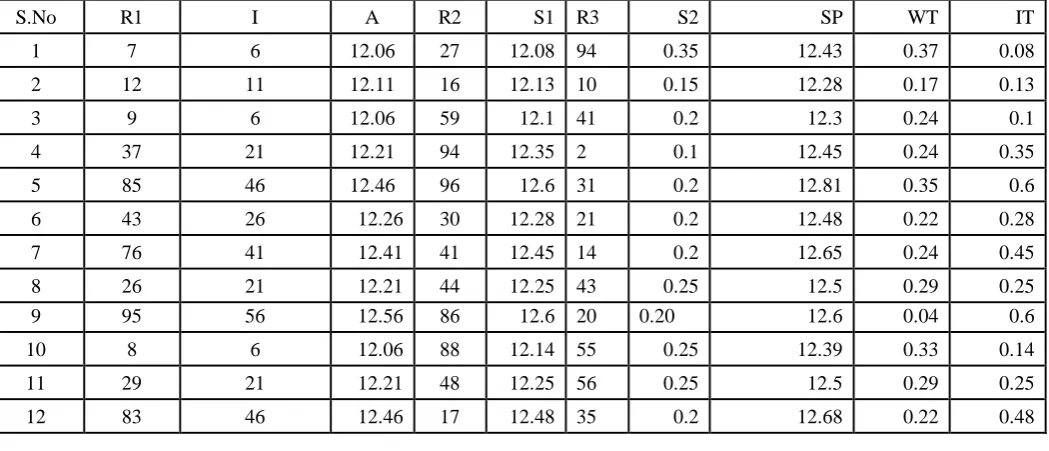
Table 7: Simulation for Multi Server Model
S.No R1 I A R2 S1 R3 S2 SP WT IT
1 7 6 12.06 27 12.08 94 0.35 12.43 0.37 0.08
2 12 11 12.11 16 12.13 10 0.15 12.28 0.17 0.13
3 9 6 12.06 59 12.1 41 0.2 12.3 0.24 0.1
4 37 21 12.21 94 12.35 2 0.1 12.45 0.24 0.35
5 85 46 12.46 96 12.6 31 0.2 12.81 0.35 0.6
6 43 26 12.26 30 12.28 21 0.2 12.48 0.22 0.28
7 76 41 12.41 41 12.45 14 0.2 12.65 0.24 0.45
8 26 21 12.21 44 12.25 43 0.25 12.5 0.29 0.25
9 95 56 12.56 86 12.6 20 0.20 12.6 0.04 0.6
10 8 6 12.06 88 12.14 55 0.25 12.39 0.33 0.14
11 29 21 12.21 48 12.25 56 0.25 12.5 0.29 0.25
[image:4.595.153.445.334.490.2]12 83 46 12.46 17 12.48 35 0.2 12.68 0.22 0.48
Table 5: Tag Number for Order Collection
Time (Hrs)
X P(X) Obs Freq
(No of orders collected)
Cumulativ e Probability
Tag Number
0-2 6 0.13 6 13 0-12
4-Feb 12 0.25 6 38 13-37
6-Apr 12 0.25 6 63 38-62
8-Jun 8 0.17 6 80 63-79
10-Aug 5 0.1 6 90 80-89
12-Oct 1 0.02 6 92 90-91
14-Dec 0 0 6 92 91-92
14-16 4 0.08 6 100 93-100
[image:4.595.39.564.517.742.2]13 41 26 12.26 82 12.34 6 0.15 12.49 0.23 0.34
14 70 36 12.36 45 12.4 44 0.2 12.6 0.24 0.4
15 66 31 12.31 67 12.37 10 0.15 12.52 0.21 0.37
16 86 46 12.46 35 12.48 7 0.15 12.63 0.17 0.48
17 78 41 12.41 69 12.47 95 0.35 12.82 0.41 0.47
18 47 26 12.26 34 12.28 44 0.25 12.53 0.27 0.28
19 91 51 12.51 89 12.59 66 0.2 12.79 0.28 0.59
20 82 41 12.41 1 12.41 69 0.25 12.66 0.25 0.41
21 64 31 12.31 19 12.33 71 0.25 12.58 0.27 0.33
22 58 31 12.31 43 12.35 13 0.15 12.5 0.19 0.35
23 34 21 12.21 16 12.23 24 0.2 12.43 0.22 0.23
24 64 31 12.31 18 12.33 22 0.2 12.53 0.22 0.33
25 26 21 12.21 54 12.25 25 0.2 12.45 0.24 0.25
26 88 46 12.46 58 12.5 8 0.15 12.65 0.19 0.5
27 53 31 12.31 89 12.41 23 0.2 12.61 0.3 0.41
28 38 26 12.26 15 12.28 60 0.25 12.53 0.27 0.28
29 14 11 12.11 28 12.13 8 0.15 12.28 0.17 0.13
30 100 1 12.01 83 12.09 47 0.25 12.34 0.33 0.09
31 44 26 12.26 75 12.32 67 0.25 12.57 0.31 0.32
32 49 26 12.26 11 12.26 30 0.2 12.46 0.2 0.26
33 20 11 12.11 89 12.19 12 0.15 12.34 0.23 0.19
34 35 21 12.21 43 12.25 85 0.3 12.55 0.34 0.25
35 99 1 12.01 15 12.11 23 0.2 12.31 0.3 0.11
36 10 6 12.06 90 12.16 67 0.25 12.41 0.35 0.16
37 37 21 12.21 51 12.25 46 0.25 12.5 0.29 0.25
38 19 11 12.11 52 12.15 31 0.2 12.35 0.24 0.15
39 18 11 12.11 71 12.17 28 0.2 12.37 0.26 0.17
40 65 31 12.31 58 12.35 50 0.25 12.6 0.29 0.35
41 50 26 12.26 100 12.4 29 0.2 12.6 0.34 0.4
42 78 41 12.41 3 12.41 34 0.2 12.61 0.2 0.41
43 4 0 12 59 12.04 29 0.2 12.24 0.24 0.04
44 31 21 12.21 84 12.29 48 0.25 12.54 0.33 0.29
45 53 31 12.31 26 12.33 97 0.35 12.68 0.37 0.33
46 51 26 12.26 38 12.3 48 0.25 12.55 0.29 0.3
47 49 26 12.26 41 12.3 88 0.3 12.6 0.34 0.3
48 43 26 12.26 37 12.26 97 0.35 12.61 0.35 0.26
49 44 26 12.26 64 12.32 55 0.25 12.57 0.31 0.32
50 83 46 12.46 55 12.5 51 0.25 12.75 0.29 0.5
R1, R2,R3 - Random Numbers IT– Idle time of the server (mins)
I-Inter arrival time (mins) SP- Actual Service
A – Actual Arrival time (mins) WT- Waiting time of the Customers
International Journal of Innovative Technology and Exploring Engineering (IJITEE) ISSN: 2278-3075, Volume-8 Issue-10, August 2019
Idle time of the server = 10mins
Analytical calculation
Average Arrival Time = 12.30 Average Service Time = 20mins Waiting time of the customers = 25mins Idle time of the server = 8mins
V. NUMERICAL STUDY
VI. CONCLUSION
In this paper work, a simulation table for queuing system with a multiple service station has been presented. Here we have developed a model for serving the food to the customers in a restaurant and decided to reduce the waiting time of the customers to get the service done. Numerical examples are given to show the similarity between numerical and analytical calculation. Hence in future this reduction in waiting time can be used to attract more customers and hence to increase the profit of the management.
REFERENCES
1. S. Arunadevi and Vijeta Iyer (2017). “A Study On M/M/C Queue Model Under Monte Carlo Simulation In Traffic”, IJPAM, Vol. 116, No. 12 (2017)
2. Syed Shujauddin Sameer (2014). “Simulation Analysis of Single server Queuing Model”, International Journal of Information Theory, Vol. 3, No.3, doi:10.5121/ijit. 2014.330547
3. Erlang.A.K (1909),”The theory of probabilities of Telephone Conversations” Nyt.Jindsskriff Mathematic, B20, 33-39.
4. P.Umarani and S.Shanmugasundaram, “A study on M/M/C Queuing
Model under Monte Carlo Simulation in a Hospital”. International Journal of Pure and Applied Mathematical Sciences, Vol. 9, No. 2 (2016),PP 109-121.
5. Shanmugasundaram .S and Banumathi.P (2015). “A study on single
server queue in southern railway using Monte Carlo Simulation”, Global Journal of Pure and Applied Mathematics “, Vol 11.
6. S.Shanmugasundaram and P.Umarani (2016), “A Simulation study on M/M/1 Queueing Model in a Medical centre”, International Journal of Science and Research, PP 284 – 288, Vol. 5, Issue 3.
AUTHORSPROFILE
Vijeta Iyer is a faculty of Mathematics with teaching experience of 12 years, currently working as Assistant Professor at Kumaraguru College of Technology, Coimbatore. She has pursued her Ph.D and was accredited for the same in March 2014 from Barkatullah University, Bhopal. The title of her thesis was “Some contributions to chains, order and connectedness in Topology”. Her fundamental research interests are Queueing Theory, Topology and Fuzzy sets. She has published 11 papers at international level and 2 papers at national level. She has presented many research papers in national and international conferences also.