Abstract: With the advent of an electronic device in humanization, there has been various usage of easing human-computer interface. However, novel methods and techniques have been developed for boosting the HCI interface. In the world of technology, including gestures in the human-computer interface, become a crucial exploration field. The gesture has become a communication approach with the computer interface and users. Hand Gesture works as a natural boundary for serving as an inspiring strength for investigating gesture classifications. The hand gesture is used in a wide variety of applications like as recognition technology, controlling of system, computer system, electronic device, home appliances, flying equipment controlling, and so forth. The hand gesture is described as the production of the motion or the gestures by hands; it determines the expression through a signature pattern that leads to the interface between the system and individuals. However, hand gesture plays the main role in the establishment of the novel human and system interface. In this research, a classification technique with ABC –ANN is developed to enhance the detection rate and the SIFT algorithm has been implemented to extract features of hand images. Features are described as - i) Assignment (ii) Localization (iii) Orientation and (iv) SIFT key-points. The extraction of features is done through the key point format. Along with that, classification and selection of the specific features of gesture image acquired based on categories. Experimental analysis is done based on parameter metrics (testing rate, validation rate, recognition rate) to improve the detection rate.
Index Terms: Hand Gesture Recognition, Sign Languages, SIFT key point, and ABC-ANN classification methods.
I. INTRODUCTION
The gesture is the other form of communication between the machine system and the users. Social being gestures can be recognized through different approaches. Social being gestures contain various kinds of expressions that are in the form of the physical figure, face expression, hand movement, iris, pattern analysis. Social and mechanical interaction can be done and permits the operator for controlling the large quantity of the campaigns [1]. Hand gesture recognition includes a stable and lively gesture that determines the expressions of social beings. Hence, static gesture detection
Revised Manuscript Received on August 12, 2019.
Satinderdeep Kaur, Dept. of CSE, Sachdeva Engineering College for Girls, Gharuan, Mohali, India
Er. Nidhi Bhatla, Dept. of CSE, Sachdeva Engineering College for Girls, Gharuan, Mohali, India
is the detection of the form of the hand, understanding the appearance of the hand and vibrant hand gesture detection is the detection of the movement of the hand curvature in the required area and after that achieving the relation motion is acquired by path values like as hand sign can be used to flip upward and downward, starting and stopping and so forth [2][3]. In out-dated gesture recognition, tools permit the operators for hand gesture along with specific data gloves. The transmission of the gesture expression and positional data to the system is done through data gloves [4]. Gesture detection is a specific method for the establishment of the substitute to predominant social system communication models [5] [6]. It has been researched that gestures maybe the combination of the static and dynamic gestures which is known as the sign language [7]. Besides, the automated detection system needs the segmentation technique for natural gesture recognition [8] [9]. Sequential segmentation requires the initial and the final stage of the motion of the edges. The gesture is influenced by the background and also language pattern which is described as:-.
A. Hand and Arm Movements: - Detection of the posture of hand, sign language, and entertaining requests (Permit children to interface the surrounding environment)[10].
B. Face and Head Signal: - For instance, like floating of eyebrows, spoken words, happy, sad, hatred, etc.
C. Bodily motion signs: - The whole body movement and tracking motion of the dual individuals, detecting social postures for medical rehabilitation [11].
Hand Gesture has the capability for the representation of the thoughts and movements based on the form of the shape that is determined by gesture detection technology and the possibility of presenting the interaction with the processor system [12] [13]. There have been increasing aspects of the system strategies like as communication performed to interact and precede the movements [14]. The main goal of this research is to implement the exact techniques of hand gesture recognition. The hand, the gesture recognition model, enables the users for a high grade of autonomy and instinctive expressions.
An Efficient Gesture Recognition with
ABC-ANN Classification and Key-Point
Features Extraction for Hand Images
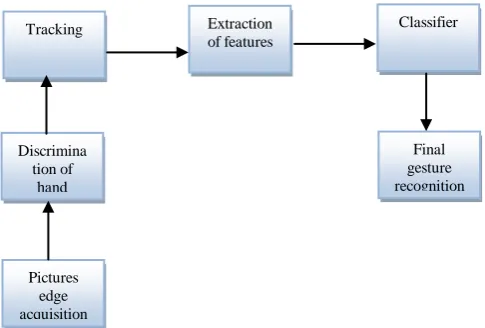
Figure 1. Block diagram of the Hand gesture recognition system.
In existing research, determine actual hand gesture recognition modal based on the American Sign Language with improved accuracy. Gesture pictures of American Sign Language are obtained through contextual through the free image Proposed approach link k arc and curved hull procedure that is used for the detection of the tip of the finger to improve accuracy rate. During the training phase, 30 characteristics, features are used for recognition of 37 signs of alphabetical language using an artificial neural network. In experimental results, gesture recognition has been improved up to 98.7% in actual conditions. In the proposed approach, we implemented scale invariant feature extraction methods to extract the unique properties in the key-points format. After that has implemented an ABC algorithm to select the valuable features with three operators are - (i) Onlooker (ii) Employee Bees (Features) and (iii) Scouts with a cost function. The proposed classification method implemented with two sections divided into two phases: - (i) Training Section and (ii) Testing Section. In the training section, create a knowledge domain and understanding with the images (Gesture Images). In the testing section, analyze the gesture images and improve the accuracy rate and reduce the error rate and noise levels. The sections are described as follows: Section 1 explained the overview of hand gesture recognition. Section 2 detailed the literature survey. Section 3 presented the proposed methodology in various steps. Section 4 provides the experimental results by comparison with the existing method. Section 5 explained the conclusion and future scope.
II. LITERATURE SURVEY
Tiantian, L et al., 2015[15] proposed research on reduction of the background edge and improvement in the feature extraction technique in hand gesture recognition using the histogram of oriented gradients that may be linked with the skin properties. The gradient of every pixel was computed by the matching of the skin. The novel gradient improves the characteristics of the hand. The classification of the hand was done by the HOG having a variance of the cell structure that
determines different native characteristics. The examination outcome determines the dimension of the cell structure that impacts the detection degree and link HOG to other given cell structure that recognizes a hand gesture system. The pictures having a variant period, brightness, and background were linked by atmospheric change and pictures in the dataset that was detected by enhanced technique. Chiang, T, et al., 2018 [16] studied the two-dimensional low complex hand posture and gesture detection technology that was used on the basis of three-dimensional deepness. The three-dimensional camera has pictured the person and then hand posture Detection was done. In the proposed plan, the framework utilizes Intel's RealSense camera, which was joined with a PC. The camera has three focal points, which incorporate the general focal point, infrared focal point. In addition, infrared discharge focal point, individually., the Intel RealSense camera gives a full 1080p shading camera at 30frames every second and furthermore offers an ideal separation somewhere in the range of 0.2m and 1.5m for the best profundity discernment. The general focal point, for example, the conventional camcorder, catches shading pictures.The infrared focal point and infrared outflow focal point are utilized for the 3D profundity estimation. At that point, the 3D profundity message is brought into the picture preparing the module for the signal acknowledgment. The RealSense camera to get the 3D profundity data, also, the profundity data is 640x480 goals. The caught remove is run from 16 cm to 50 cm. The 3D profundity hand data was moved into the 2D hand picture, furthermore, the biggest arrangement region is chosen for the conceivable palm locale. Besides, in the wake of acquiring the hand form, the framework begins to look through the highlights of the palm, and after that get the raised structure, curved point, deserts, and other hand data. Jaramillo, A. G, et al.,2017[17]implemented a method of hand gesture detection in an actual approach. They utilized area electrographic and machine learning methods. The detection of gestures using area electrographic was not suitable due to muscle infrastructure. The main objective of this research was to determine the hand gesture detection approach in real-time in a variety of applications like medical and other fields. The projected approach based on different phases which are the attainment of electro-signal, extraction of features. Mainly, the hand gesture detection method was utilizing the machine learning approach to determine the gestures of an individual. Sun J H., et al.,2018 [18] realized the distribution of the hand gestures by designing skin color textures and classification model that was done on haar on the basis of the skin texture using a hand gesture. Hand gesture was done on the basis of the segmentation of the frames of the images. The distribution of the hand of the individual was from complex contextual for the recognition of hand gestures in real-time using the Cam Sift method. After that, the surface of the hand gesture was recognized in actual time using the convolutional neural network(CNN) in order to detect a digital approach. The experimental result recognizes the improved accuracy of hand gesture recognition.
III. PROPOSED RESEARCH WORK Tracking
Discrimina tion of
hand
Final gesture recognition
Classifier Extraction
of features
Hand gestures are the ways of communication that is non-verbal and the actions of hands and arms are used to understand the sign language.
[image:3.595.58.257.118.534.2]
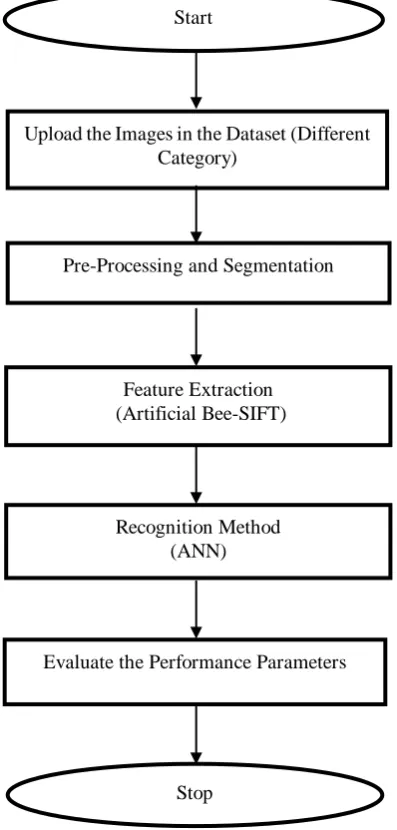
Figure 2. Research Flow Chart
The major issues in hand gesture recognition systems are: (i) Error rates are increasing continuously in the previous works in the different approaches of hand gestures. (ii) The visibility of images is also degraded and the shape altered that impact on the performance of techniques. (iii) In the base paper, different techniques are utilized for the hand recognition systems and these are the fingertip finder algorithm, the automatic process of pixel segmentation and ANN (Artificial Neural Networks) with corresponding parameters as the recognition rate in terms of average accuracy.
In this research work, Hand gesture recognition is divided into four phases: (i) A structure from the webcam is arrested. Pre-processing surprises with noise decrease using a medium strainer to remove blares. Next, the image has been collected to remove the undesirable shares of the unique images. Lastly, the consequence images are clear
with uniform size and related. , all collected hand images were resized into, smaller size than the unique size, which is essential to recover performance in terms of speed. (ii) Image segmentation is the chief step for any image gratitude process finished in which the input image is divided into different expressive objects with respect to a convincing feature. The key object of hand separation is to differentiate the user's hand from the related in the image. This can be attained by using a dissimilar image segmentation algorithm. The subdivision process should able to create a proper image to hand gesture recognition. (iii) We can use this algorithm to compute and study the key-points of the dissimilar pictures and then direct each image with its speeded up robust features. In this novel approach, the colony consists of 3 sections of Bees:-
(i) Employee Bee (ii) Onlooker Bee (iii) Scouts.
It is supposed that there are only individual artificial active extract features for each feature source. In other words, the number of active bees in the colony is equal to the number of feature sources around the hive. Active fetch features go to their feature source and come back to hive and move in this area. The active extract, whose feature source has been abandoned becomes a scout and starts to search for finding a new feature source. Onlookers watch the moves of activated features and choose the extracted feature depending on the moves.
Artificial Neural Network is a type of the Network that acts as a human brain. In this approach, the three layers have been used, i.e., Input Layer, Hidden Layer, and Output Layer. It is interconnected clusters or groups of nodes and work layer according. It considered non-linear statistical modeling tools, where the difficult relationships between inputs and outputs are modeled or design is found. Artificial Neural Network is also called as a Neural Network.
IV. RESULT ANALYSIS
Elaboration of the hand gesture recognition datasets (1,6) and Performance analysis using ABC-ANN methods and compared with the existing methods.
4.1 Dataset Description
The database consists of the movements performed by various 14 persons where each and every person is presenting 10 movements in repetitive times up to 10 times that contains 1400 gestures. The information from the kinetic and leap movement is observed as given in the figure. The standard parametric representation from kinetic is presented. Leap information contains a set of the constraints determined by leap SDK.
Upload the Images in the Dataset (Different Category)
Pre-Processing and Segmentation
Feature Extraction (Artificial Bee-SIFT)
Evaluate the Performance Parameters Recognition Method
(ANN)
Figure 3. Hand Gesture Image Dataset[19]
4.2 Uploading Hand Gesture Dataset
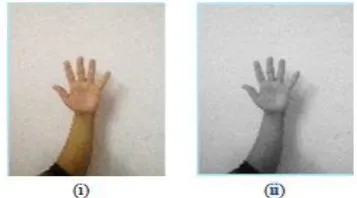
In this phase, upload the RGB hand gesture image in different-different categories.
Below Fig 4 (i) shows the upload of the test image which is a colored image (RGB). Fig 4 (ii) conversion of the colored to the black-white image. This results in the reduction of image pixels into the 2D pattern and the matrix size of the uploading hand gesture image are also reduced
Figure 4. (i) Test Image and (ii) Gray Scale Image
4.3 Data Pre-processing Phase in HGR
Figure 5. (i) Image Histogram (ii) Segmented Hand Image
The given figure determines a picture histogram that is a kind of histogram that behaves as the graph form representation of the distributing of the digital picture. The plotting of the pixel level for every set of values is done. The analyzer will be able to analyze the judgment of the unique histogram picture. The histogram data are determined on different digital cameras. The person who takes the photo helps to represent the distribution of the level nature caught and if the picture information has missing features. The invariant factor of the picture leads to the approximate value of the present image. Picture distribution is the method of the segmentation of the picture into a set of numerous partitioned data. The main objective of the distribution is the simplification and altering the demonstration of the picture that may be simple to examine. Picture Distribution is to the position group of classes and borders like linear, curvature of the picture. It is the method of allocating a mark for each pixel value in the picture like pixel having a similar mark with similar characteristics.
4.4 Feature Extraction using SIFT Algorithm
Figure 6. Feature Extraction using the SIFT algorithm
The figure demonstrates the group of classes of the picture with motivating factors that extract the features of the group of class. The extraction of the training sample picture that can be used for the identification of the group of class while trying to position the group of class in training and test sample picture consist of different substances. To execute the consistent detection, it is essential to extract the characteristic features from the training sample picture during the alteration in the scales, noise level and brightness of the picture. The maximum brightness area of the picture is used as a border of objects. Another crucial feature is the relation location between the actual image locations that may not alter from one picture to another picture. For instance, if the different characteristics of the window utilized, that may not depend on the position, detection may not be fulfilled unless the door is open or closed. Consequently, if there is an alteration in the geometrical concepts of the bot pictures that are presented. Hence, a number of the error rate may lead to alterations in the total error of each feature, whereas SIFT helps in recognition. SIFT is used for the identification of a group of classes between fractional obstruction. Due to SIFT descriptors of characteristics of SIFT that may not change to the organization, brightness alterations, mainly change to the falsification level. The section demonstrates the SIFT algorithm and challenging methods that are accessible for object detection and incomplete obstruction.
4.5 Feature Selection and ANN methods (ABC-ANN) Architecture
Fig 7(i) demonstrates the selected features have a small and differentiable grouping that is comparable to initial information, selection of differentiated features from a group of characteristics and removal of inappropriate data and also the reduction of the linear form of information that helps in searching the crucial characteristics features.
The experimental results help in the reduction of the handling time period and increment of classifier accuracy. Figure 7(ii)contains a neural network with a group of neurons and the linking of the network. Neuron presents the
[image:4.595.59.282.341.439.2] [image:4.595.307.545.403.584.2] [image:4.595.309.541.481.573.2] [image:4.595.48.290.722.752.2]outer layer is linked to form neurons.
Figure 7. (i) Selected Feature set and (ii) ABC-ANN architecture (iii) Performance Analysis and (iv) Regression
In this construction, structure determined various layers which are an inner layer, middle layer, and outer layer.
(i) The inner layer (extraction of internal features).
(ii) The middle layer ( determine the mass of neurons) and
(iii) Outer Layer (updation of data).
Fig 7(iii) Performance Investigation: The training stage to compute the better justification presentation is 33.153 based on epochs 27. Fig 7(iv) the regression presentation metrics determines the overall average.
4.6 Proposed Parameters
[image:5.595.61.267.64.368.2]This phase shows the hand gesture recognition using ABC-ANN architecture implemented and performance analysis in Testing Rate, Validation Rate, and Recognition Rate.
Table 1: Proposed Parameters Metrics
Parameter Values
Testing Rate 67.057
Validation Rate 65.057
Recognition Rate 99
Above table 1 define that the performance analysis with various parameters such as Testing Rate value is 67.0, Validation Rate value is 65.05 and Recognition Rate value is 99.
4.7 Comparative Analysis
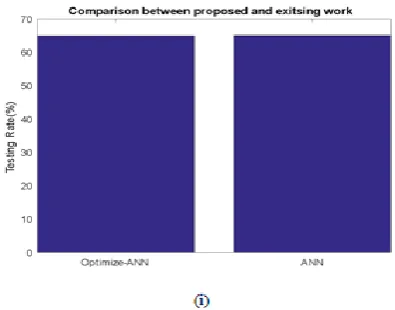
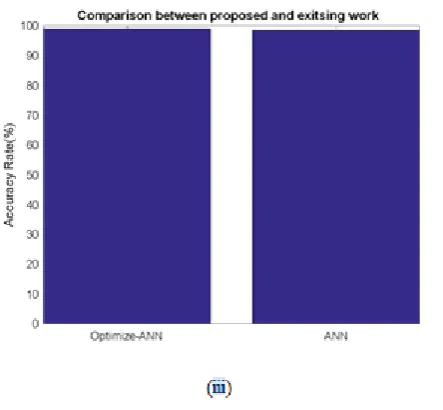
A comparison is done between proposed and existing methods using ABC+ANN and ANN. Comparative analysis with recognition rate, Validation rate, and testing rate performance parameters is shown in the following figures:
[image:5.595.317.515.205.360.2] [image:5.595.46.287.677.762.2]Figure 8. (i) Comparison – Testing Rate (ii) Validation Rate and (iii) Recognition Rate
Table 2. Comparison Between Proposed (ABC-ANN) And Existing Work (ANN)
Parameters Proposed (ABC-ANN) Algorithm
ANN Existing Algorithm
Testing Rate 67.057 65.1440
Validation Rate 65.057 63.144
Recognition Rate
99 98.4
Table 2 defined that the comparative study with ANN and ABC-ANN method. This novel approach compared with existing methods to enhance the performance parameters such as recognition rate, Validation rate, and testing rate.
V. CONCLUSION AND FUTURE SCOPE It is concluded that the detection rate of hand gesture images is improved through classification and selection of features using the ABC-ANN and SIFT technique. Gesture Recognition is the reliable method of the interaction between human-computer interfaces and helps in the recognition of the movements and gestures to the user. Gestures are the physical motion of the body like finger motion, hand, and face with the purpose of transmitting the data and interaction with the environment factor. Though, gesture recognition is used in a wide variety of applications like as monitoring of patients, long ranger communication of videos, recognition of significant level language, manipulation of the virtual environment. Various techniques for hand gestures need to be developed for better interaction between human and computer systems. Experiment results define that the ABC-ANN classification method gives more accurate hand gesture recognition. Further other methods are applied to get better accuracy in the
gesture recognition system. Image Structures took by VC (Video camera) interface are calculated or tested by the proposed trained ABC-ANN. The ABC-ANN classification method is trained with 90 train sample images of our datasets and it recognizes gestures or sign language in the alphabet or numeric format with almost 99 % accuracy achieved in real-time background. Future work will be an improvement in Fingertips and hand recognition accuracy rate and also for movement detection of HAND GESTURE for Sign Language Recognition.
REFERENCES
1. Mitra, S and Acharya, T. (2007). Gesture recognition: A survey. IEEE Transactions on Systems, Man, and Cybernetics, Part C (Applications and Reviews), vol. 37(3), pp. 311-324.
2. 2.Xu, Y. and Dai, Y. (2017). Review of hand gesture recognition study and application. Contemp Eng Sci, vol. 10(8), pp. 375-384. 3. Smith, A. V. W., Sutherland, A. I., Lemoine, A. and Mcgrath, S.
(2000). U.S. Patent No. 6,128,003. Washington, DC: U.S. Patent and Trademark Office.
4. Elmezain, M., Al-Hamadi, A., Appenrodt, J and Michaelis, B. (2008, December). A hidden Markov model-based continuous gesture recognition system for hand motion trajectory. In 2008 19th International Conference on Pattern Recognition (pp. 1-4). IEEE. 5. Freeman, W. T. and Roth, M. (1995, June). Orientation
histograms for hand gesture recognition. In International workshop on automatic face and gesture recognition (Vol. 12, pp. 296-301). 6. Liang, R. H. and Ouhyoung, M. (1998, April). A real-time continuous
gesture recognition system for sign language. In Proceedings Third IEEE international conference on automatic face and gesture recognition (pp. 558-567). IEEE.
7. Garg, P., Aggarwal, N. and Sofat, S. (2009). Vision-based hand gesture recognition. World Academy of Science, Engineering, and Technology, vol. 49(1), pp. 972-977.
8. Liu, X. and Fujimura, K. (2004, May). Hand gesture recognition using depth data. In Sixth IEEE International Conference on Automatic Face and Gesture Recognition, 2004. Proceedings. (pp. 529-534). IEEE.
9. Bretzner, L., Laptev, I. and Lindeberg, T. (2002, May). Hand gesture recognition using multi-scale color features, hierarchical models and particle filtering. In Proceedings of the fifth IEEE international conference on automatic face gesture recognition (pp. 423-428). IEEE.
10. Choudhury, A., Talukdar, A. K. and Sarma, K. K. (2014, February). A novel hand segmentation method for multiple-hand gesture recognition system under complex background. In 2014 International Conference on Signal Processing and Integrated Networks (SPIN) (pp. 136-140). IEEE.
11. Khan, R. Z., and Ibraheem, N. A. (2012). Comparative study of hand gesture recognition system. In Proc. of the International Conference of Advanced Computer Science & Information Technology in Computer Science & Information Technology (CS & IT) (vol. 2, No. 3, pp. 203-213).
12. Khan, R. Z and Ibraheem, N. A. (2012). Hand gesture recognition: a literature review. International Journal of Artificial Intelligence & Applications, vol. 3(4), pp. 161.
13. Reifinger, S., Wallhoff, F., Ablassmeier, M., Poitschke, T., and Rigoll, G. (2007, July). Static and dynamic hand-gesture recognition for augmented reality applications. In International Conference on Human-Computer Interaction (pp. 728-737). Springer, Berlin, Heidelberg.
[image:6.595.53.275.55.260.2]15. Tiantian, L., Jinyuan, S., Runjie, L., and Yingying, G. (2015, May). Hand gesture recognition based on improved histograms of oriented gradients. In The 27th Chinese Control and Decision Conference (2015 CCDC) (pp. 4211-4215). IEEE.
16. Chiang, T., and Fan, C. P. (2018, April). 3D depth information based 2D low-complexity hand posture and gesture recognition design for human-computer interaction. In 2018 3rd International Conference on Computer and Communication Systems (ICCCS) (pp. 233-238). IEEE.
17. Jaramillo, A. G., and Benalcázar, M. E. (2017, October). Real-time hand gesture recognition with EMG using machine learning. In 2017 IEEE Second Ecuador Technical Chapters Meeting (ETCM) (pp. 1-5). IEEE.
18. Sun, J. H., Ji, T. T., Zhang, S. B., Yang, J. K. and Ji, G. R. (2018, December). Research on the Hand Gesture Recognition Based on Deep Learning. In 2018 12th International Symposium on Antennas, Propagation and EM Theory (ISAPE) (pp. 1-4). IEEE.
19. 19. Hand Gesture Datasets", Lttm.dei.unipd.it, 2019. [Online]. Available: http://lttm.dei.unipd.it/downloads/gesture/. [Accessed: 05- Jun- 2019].
AUTHORS PROFILE
Satinderdeep Kaur is an M.tech student at Department of
CSE, Sachdeva Engineering College for girls , Gharuan(Mohali), Punjab, India. She has received her B.Tech degree in Computer Science and Engineering from Sachdeva Engineering College for girls, Gharuan(Mohali), Punjab, India in the year 2017. She is doing her research in the field of Digital Image Processing and Artificial Intelligence titled as “An Efficient Gesture Recognition with ABC-ANN Classification and Key-Point Features Extraction for Hand Images”. Besides this her other interests include Web Development and Web Designing,
Er. Nidhi Bhatla is HOD (CSE) at Sachdeva Engineering College for Girls, Gharuan(Mohali), Punjab, India. She has completed her B.Tech from Institute of Engineering and
Technology, Bhaddal, Ropar (IKGPTU), Punjab and