Abstract: The deep leaning has been the prominent and interesting field for researchers for last few years. There are several studies are being done on real problems in several streams of Science. In the deep leaning there are huge resources and labeled dataset are required to train the model. In convolutional neural network (CNN) training with random weights take a considerable amount of time to optimize the weights. To minimize efforts and other resources and deal with large, challenging dataset; which generally very complexed to use in the conventional training methods. New concept of deep learning has been evolved and emerge as prominent methods called transfer learning in last few years. In the transfer leaning, pre-trained model VGG16, which had been trained using 1000 different classes of Images. The VGG16 architecture having 16 CCN layers with ReLu activation function. In this study we took the Honey Bee image dataset consists of two type of the images of honey bee, some images are bearing pollen honey bees and remaining are non-bearing pollen honey bees. We got learn the model with dataset and classified problems using three optimization functions: Adaptive Moment Estimation Algorithm (ADAM), Root Mean Square Propagation (RMSprop) and Stochastic gradient descent (SGD). we compared the results, and found that Adaptive Moment Estimation (ADAM) function performed best, and got 91.94 percent Accuracy and 0.2027 losses.
Keywords: Deep Learning; Transfer learning; Honey Bee bearing pollen; Accuracy; classification.
I. INTRODUCTION
In the past few years, it has been found that Artificial Intelligence (AI) has played a very crucial role to change the world scenario. AI contributed important part to solve the real-world problems; specially in the field of Science. AI is a stream of Computer Science that simulates human intelligence by computer system. With the help of AI machine can be able to achieve accuracy, deep analysis on view data and many more [1]. Impression of artificial intelligence like learning and adaptation by the machine is called the machine learning (ML). The ML is subset of AI that enables the machine to learn and improve from experience by data input and makes decision on the basis of data input without
Revised Manuscript Received on December 05, 2019.
Pankaj Kumar Kandpal*, Department of Computer Science, D. S. B Campus, Kumaun University, Nainital, Uttarakhand, India. Email: [email protected]
Ashish Mehta, Department of Computer Science, D. S. B Campus,
Kumaun University, Nainital, Uttarakhand, India. Email:
Avinash Sharma, Deprtment of computer science and engineering, Maha Markandeshwer University, Mullana, Ambala, Haryana, India. Email: [email protected]
programmed explicitly [2]. Such type of machine learning can be classified in two categories; one is supervised and other is unsupervised. In supervised machine learning algorithm, the learning is based on input data using labeled example to predict future problems [19], Where as in unsupervised learning algorithm the machine learns from the input data that is non-classified and without labeling to train [19]. Deep learning is several levels of representation by making of hierarchy of features, in which higher and lower levels help mutually to define higher levels features [4]. The DNN is extended form of traditional ANN, in which complex and non-linear, real-world problems resolve by increasing hidden layers between input and output layer. Deep Learning is complex approximation of biological neuron model, which uses two phase approach. The first phase responsible for information flow; e.g. feed forward and second phase uses back propagation; e.g. learning phase. In the area of DNN, the novel formulations of the input and output space, neurons, type and number of synaptic connections, direction of information flow, cost function, learning methods and mechanism or various combinations of these, evolves various aspects for research. Researcher’s aim and effort is to bridge the gap between biological and mathematical model of neural network by evolving training capabilities of artificial model for regression, classification etc.
A. Related Work
Apiculture, Medical science and others similar type of science field facing the lack of automated analysis tool base on experienced data where, these types of institutions are yielding the huge data on daily basis. Seeing the potential medical field requirement, several studies are being done using deep transfer learning [3][4][14] algorithm. There the several pre-trained models existed at present like that VGG, Mobile Net, Inception and Mask R-CNN etc. [7][14]. The use of VGG16 as a pre-trained model for transferring weights for image classification done by several researchers in his resent study. The brain tumor image (MRI) classification problems done by Heba Mohsen and et.al. using VGG16, in his paper [3] and same type of problem has been considered by Dwiretno Istiyadi Swasono and et.al. in his research study [7]. Further Manali Shaha and et.al. extended the works in his study [8], another related study done in deep learning in the research paper [21].
Honey Bee Bearing Pollen and Non-Pollen
Image Classification, VGG16 Transfer Learning
Method using Different Optimizing Functions.
B. Contribution
Researches have already been done a lot of the promising work in this area for last five years. This study explores real world Science dataset classification problem using pre-trained model on transfer learning; VGG16. In our study we taken honey bee image dataset, consist of two types of honey bee images, one type of image of honey bee bearing pollen and other type bees not bearing pollen. The purpose of the classification to accumulate the process of pollination and assessment of strength and health of honey bee colony. In this study we used transfer knowledge of VGG-16, pre-trained model based on LeNet-5 architecture to classify the pollen bearing and non-pollen bearing honey bee image dataset. The transfer learning is approach in which we imitate the human vision system by making use of sufficient amounts of prior knowledge in other associated domains when executing new tasks in the given domain. Both training data and testing data contribute in two types of domain in transfer learning: First, Target domain and Second source domain [10]. The target domain consists of testing instances, which are the task of categorization system, and the source domain consists of training instances, which are under a different distribution with the target domain data. We used the dataset of honey bee image as an input, by using VGG16, convolution neural network for classification. There are several researches are available who resolved classification problems using transfer learning with VGG16 [7]. Section II of the paper, describes the models considered in the study and details with the datasets used in the study and in section III, the results of the study have been discussed. Conclusion of present study is presented in the section IV.
II. METHODSUSED
In our classification study there are three components; normalization, feature extraction and classification. In the preprocessing using different techniques transforms row data into understandable format. we normalized the honey bee image dataset described below in details, because honey bee image dataset is real world dataset that had been captured trough vediocam, may contain incomplete, inconsistent and errors in it and need to refine by suppressing unwanted or distorted features of image and enhances important features of image for further processing. In our study we first augment the image then resize the image in 64X64 frame. In the feature extraction phase, we identify the key features of normalized honey bee dataset. In the feature extraction section, we used VGG16 pre trained architecture. The new fully connected layers are added to which adjusts the nos of releases with numbers of new dataset classes. Flatten layer interface between the VGG model and fully connected layers, which are known as classifier use for classification. The work of flatten function to convert a N dimensional data into 1X1 tensor input. In the study we used three optimizer functions Adaptive Moment Estimation Algorithm (ADAM), Root Mean Square Propagation (RMSprop) and Stochastic gradient descent (SGD) to find comparative results.
A. Dataset Description
The pollination by means of honey bee contributes significant role to create offspring of flower and plants for next generation. There has already been requirement of automated
methods that can classify honey bee by its images into subcategories to know bee is bearing pollen or not bearing pollen. Honey bee image dataset is collected from the keggle.com an open source dataset library [15]. Honey bee image datasets consist of total 714 images of two categories. In the dataset there are 369 images of bees bearing pollen and 314 images of bees which are not bearing pollen. The dataset of honey bee images created from video shooted at the entrance gate of bee colony. It is prepared by Ivan Rodriguez and et.al. with the help of camera based on CNN by UPR students Stephanie Feliciano and Janpierre Aleman. It is reliable automatic technics for scientist and researchers as well as honey producers for provide lot of information about honey bee’s condition for further consultation and research work.
B. Deep Transfer Learning
In transfer learning, apart from data in the target domain, related data in a different domain can also be included to augment the availability of our prior knowledge about the target future data. Transfer learning addresses such cross- domain learning problems by extracting useful information from data in a related domain and transferring them for being used in target tasks [16]. In the resent researchers have done lot of work on computer vision and natural language processing field. In computer vision field, transfer learning tries to exhibit human vision with the help of machine by making use of prior knowledge in other related area when executing new task in same area.
a.Types of deep transfer learning
The transfer learning can broadly organized in three categories; inductive transfer leaning and transductive transfer learning, and unsupervised transfer learning. The inductive transfer learning is conventional supervised learning in which source, target domains and source, target task remains same[17]. In this technic some labeled data in the target domains are required to infer. The goal of inductive transfer is to obtain high performance in the target task by transferring knowledge from source task. Inductive transfer learning can be further divided in multitask learning and self-taught learning. Inductive transfer learning generally uses to solve classification and regression problem. The transductive deep learning is semi supervised transfer learning in which source, target domains are different but related to each-other and source, target task are same. In the transductive learning focused on classification and regression task [18]. Third category of transfer learning is unsupervised transfer learning, in which neither source and target domains are similar nor are source and target tasks same. Domains and tasks are different but related to each-other, in this case also. In unsupervised transfer learning there are no labeled data in either domains.
In our study we have used VGG16 that is inspired by LeNet-5 architecture. VGG16 had been trained using imageNet database with 1.2 million color images and 1000 classes [7][8]. It has five blocks and total 16 convolutional layers with the ReLu activation function, that are used to extract the feature and restore in it. Each block completes with a pooling layer at the end of block, as per depicted in the table.1 blow from serial no. 2-19. After then
serial no. 21, after then dropout layer to reduce the overfitting in the network by reducing active nodes in the network. And finally dense layer on serial no. 23 with 1025 parameters converting tensor in nX1 dimension.
S/ lN o
Block Name of Layer Output
(width, Height, channels)
Params
1 Input 64,64,3 0
2 Block I Conv-2D 64,64,64 1792
3 Block I Conv-2D 64,64,64 36928
4 Block I MaxPooling-2D 32,32,64 0
5 Block II Conv-2D 32,32,12
8,
73856
6 Block II Conv-2D 32,32,12
8
147584
7 Block II MaxPooling-2D 16,16,12
8
0
8 Block III Conv-2D 16,16,25
6
295168
9 Block III Conv-2D 16,16,25
6
590080
10 Block III Conv-2D 16,16,25
6
590050
11 Block III MaxPooling-2D 8,8,256 0
12 Block IV Conv-2D 8,8,512 1180160
13 Block IV Conv-2D 8,8,512 2359808
14 Block IV Conv-2D 8,8,512 2359808
15 Block IV MaxPooling-2D 4,4,512 0
16 Block V Conv-2D 4,4,512 2359808
17 Block V Conv-2D 4,4,512 2359808
18 Block V Conv-2D 4,4,512 2359808
19 Block V MaxPooling-2D 2,2,512 0
20 Flatten None,204
8
0
21 FC Dense 1 None,102
4
2098176
22 FC Dropout layer None,102
4
0
23 FC Dense 2 None,1 1025
C. Convolutional Neural Networks
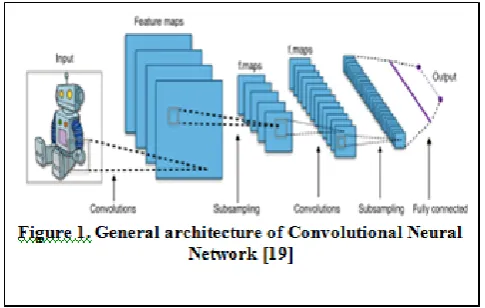
Convolutional neural network is a renowned architecture of deep learning, which is studied and used in last few years’ time frame. It has played Key role in the field of computer vision, performs complex nonlinear operation using convolution algorithm for Image classification [9]. As the traditional neural network methodology does, CNN also transit in feed forward and back propagation phases. CNN implements convolutional filters, followed by pooling to reduce complexity. After the last pooling, CNN uses fully connected layer, in which activation functions such as: tenth, max tenth and softmax uses respectively. General convolutional layers are given below in the as per the study in [11].
Input layer: In CNN input layer are associated with input data (image). Input layers generally a multi-dimensional matrix, such as the dimension of the image as per given in the fig 1. The image size in our study has been taken as 64, 64, 3.
Convolutional layer: CNN layer pick input information from the previous layer (input) and process them. This layer stores the parameters and weights of the training results. The output of convolutional layer is represented in the form of matrix which is generally smaller than the input layer with greater depth. The calculation of parameters is given in the following way [12].
Rparam = (k1*k2*Rinput * Routput + Rbias) (1)
Where k1 and k2 are the size of kernel, Rinput number of input filters, Routput numbers of output filters and Rbias is number of bias
Activation layer: this layer function is known as activation function of CNN layer. In this layer Rectified Linear Unit (Relu) function is generally uses. It is the function that is used to remove negative value from the input signal.
Pooling Layer: In the massive input image all the information is not valuable. Neither it is possible to handle the it. Pooling layer does subsample the input data matrix. The kernel size determined the size of output
Fully connected layer: Fully connected layer act as a classifier. Activation function of this layer is softmax function, which is able to highlight most dominant class. It is final layer of the model that stores weight and parameters of training results. Formula for calculating parameters is given in Eq. 2.
Rparam = Rinput * Routput + Rbias (2)
The convolutional neural networks consist of all above given layer as algorithm in the computer vision.
III. RESULTSANDDISCUSSION
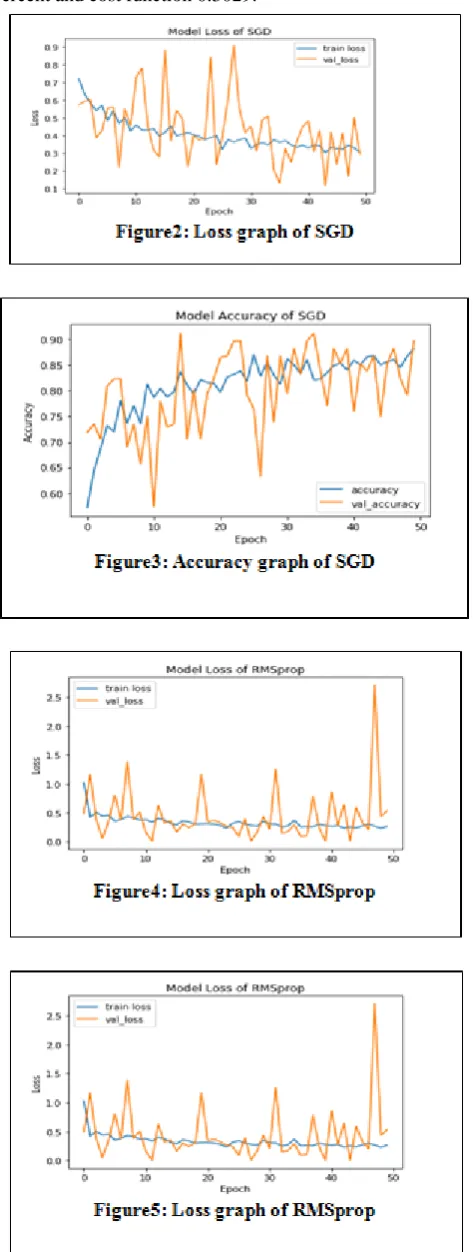
In our study we took the honey bee bearing pollen or not bearing pollen image classification problem. We used CNN for image classification using the renowned architecture VGG-16. We used this architecture (transfer learning) to improve learning and minimized the training time. To analyze the performance of transfer deep learning, using three optimizer functions: Adaptive Moment Estimation Algorithm (ADAM), Root Mean Square Propagation (RMSprop) and Stochastic gradient descent (SGD) compared the results. From the figures (2-7) and table2., we found that optimizer ADAM function performed in better way and got the accuracy 91.94 percent where the loss found 0.2027. The Table 2 and fig. (6-7) exhibit the performance results of ADAM function in the form of linear graph of accuracy and loss parameters. Optimizer ADAM took less time to train the model than others where are all other parameters was same for each model. The optimizer function
RMSprop performed in
[image:3.595.306.549.51.205.2]fig. (4-5) with the accuracy of 90.21 percent and minimized the cost function uptill 0.2249. the optimizer function SGD performed poorer in comparison to Adaptive Moment Estimation (ADAM) and RMSprop Function as depicted in the fig. (2-3). The classification rate of SGD was 84.53 percent and cost function 0.3029.
Table2. Comparative chart of results using optimizer function
S/l No.
Components ADAM RMSprop SGD
1. Accuracy % 0.9194 0.9021 0.8453
2. Loss % 0.2027 0.2249 0.3029
3. Val Accuracy % 0.1439 0.4355 0.2938
4. Val_Loss % 0.9265 0.8750 0.8971
5. Learning Rate 0.001 0.001 0.01
6. Execution Time
(Secs)
961 982 1011
From the above discussion with graphs and table it is cleared that optimizer function Adam performed better than other functions of the image classification problem of honey bee bearing pollen or not bearing pollen.
IV. CONCLUSION
[image:4.595.51.288.118.745.2]Comparable parameters like execution time, learning rate, accuracy and cost function (losses) shows that transfer learning using ADAM optimizer function is exhibit better results than other two optimizer functions.
Future works
Availability of big medical labeled database is major problem in real world automated daisies classification system. Pre trained model like Vgg16, can be very helpful in this context. With the help of pre trained models, automatic detection and classification of real-world medical and Science problem can be solved. That will resolve the scarcity of sufficient labeled database, save the time of weight optimization.
Acknowledgement
REFERENCES
1. 1.https://www.superdatascience.com/pages/deep-learning
M. Mohri, A. Rostamizadeh and A Talwarkar, “Foundation of Machine Learing” The MIT Press Cambridge, Massachusetts London, England, 2018.
2. Heba Mohsen, EI- Sayed A. El Dahshan, El Sayed M, El Horbaty, Abdel-Badeeh M. Salem, Classification using deep learning neural networks for brain tumors, 2314-7288, Elsevier, pp. 68-71,2017 3. Tharani S, Yamini C. classification using convolutional for heart and
diabetics dataset. Int J Adv Res Comp common Engg. 2016; 5(12): 417-22.Related
4. Lindsay Cain, Jeffery Clark, Eric Pauls and et.al. Convolutional Neural Networks for Radar Emitter Classification, 978-1(79-83) 5386-4649 IEEE 2018.
5. Jiaojiao Li ; Qian Du ; Bobo Xi ; Yunsong
Li,Hyperspectral Image Classification Via Sample Expansion for Con volutional Neural Network, IEEE conference,2018, Amsterdam, Netherlands 5386-4649 IEEE 2018.
6. Dwiretno Istiyadi Swasono ; Handayani Tjandrasa ; Chastine Fathicah, Classification of Tobacco Leaf Pests Using VGG16 Transfer Learning, International Conference on Information, Communication Technology and System (ICTS), Surabaya, Indonesia 5386-4649 IEEE2019
7. Manali Shaha, Meenakshi Pawar, transfer learning for image classification, Second international conference ICECA 5386-4649 IEEE 2018.
8. Yann LeCun, Leon Bottou, Yoshua Bengio and Patrick Haffner, Gradient-Based Learning Applied to Document recognition. Proceeding of the IEEE 86(11) 2278-2324 1988.
9. Ling Shao, Fan Zhu, Xuelong Li, Transfer Learning for visual categorization: A survey, 2162-237X IEEE 2014
10. A. Feffeira, G. Giraldi, Convolutional Neural Network approaches to granite tiles classification, Expert System, Appl., Vol 84, pp, 1-11, 2017
11. R. Vasudev, Understanding and calculating the number of parameters
in Convolutional Neural Network (CNNs). Internet:
https://towardsdatascience.com/
Understanding-and-calculating-the-number-of-parameters-in-Convol utional-Neural-Network-CNNs-fc88790d530d, May,8,2019. 12. Jason Riordon, Christopher McCallum, David Sinton, Deep learning
for classification of Human sperm, Elsevier, 0010-4825, 2019. 13. Lenin G. Falconí, M aría Pérez, W ilbert G. A guilar, Transfer Learning
in Breast Mammogram Abnormalities Classification with Mobilenet and Nasnet, 978-1-7281-3227-3, IEEE conference, Osijek.
14. Honey Bee Bearing Pollen image Dataset:
https://www.kaggle.com/ivanfel/honey-bee-pollen.
15. Sinno Jialin Pan and Qiang yang “A survey of transfer learning”, 1041-4347¸ vol-22, 2010¸IEEE, pp1347-1359.
16. Yuhong Zhang, Canhua Mei, Xuegang Hu, and Peipei Li, “A Weighted Algorithm of Inductive Transfer Learning Based on Maximum Entropy Model” 978-1-4244-5934-6, 2010 Seventh International Conference
17. Le Yang, Shiji Song, C. L. Philip Chen Transductive Transfer Learning Based on Broad Learning System, 2577-1655/18,2018 IEEE International Conference.
18. L. Kovacs, G. Z. Terstyanszky, Diagnosing faults by supervised and
unsupervised learning, 978-3-9524173-5-5, ECC 1999,
pp-4238-4242.
19. 20.https://en.wikipedia.org/wiki/Convolutional_neural_network#/me
dia/File:Typical_cnn.png
20. Rohini Goel,Avinash Sharma and Rajiv Kapoor, "Object Recognition using Deep Learning" JCTN, ISSN:1546-1955,Vol. 16 PP4044-4052.
AUTHORSPROFILE
Mr. Pankaj Kumar Kandpal pursued Bachelor in Computer Application from IGNOU University New Delhi, India in 2006 and Master of Computer Application from IGNOU University New Delhi, India in 2007 (integrated). He is currently pursuing Ph.D.
from Kumaun University, Nainital,
Uttarakhand, India and currently working as JAO in BSNL, an Indian Government PSU. He was a member of ―Computer Society of India‖ reputed journal in India. His main research work focuses on Artificial Intelligence and Machine Learning. He has eleven years of telecommunication industries experience.
Second Author Dr Ashish Mehta pursued Post Graduation from (M Sc) CBSH College, G B Pant University, U S Nagar, India and Ph.D. from Gurukul Kangri deemed University, Haridwar Uttarakhand, India. He is presently HoD of computer Science and Associate professor in DSB Campus Nainital, Kumaun University Uttarakhand, India. He has 19 years of teaching experience. His main research work is focused on Machine Learning and digital Image Processing.