Abstract: Automobile industries are growing exponentially in last decade in India. Growth in the vehicle numbers results in much more road accidents and traffic management problem. Not only this, long queues at toll plazas and parking lot is also a major issue of concern. Problem of traffic management and long queues can be solved by automatic licence plate recognition systems. In this paper, an automatic Licence Plate Recognition Systems based on soft computing techniques are presented. Indian vehicle with licence plates were used for testing the implemented systems. Firstly the licence plate image is extracted from the vehicle image and the characters are segmented from the extracted licence plate image and then features are extracted from the segmented characters which are used for the recognition. Soft computing techniques random forest, neural network, support vector machine, and convolutional neural network are used for the implementation pusrpose. The results obtained for the applied soft computing technique are compared to the last. The future scope is the hybrid technique solution to the problem.
Keywords : Automatic License Plate Recognition System (ALPR), Convolutional Neural Network (CNN), Neural Network (NN), Random Forest (RF), Support Vector Machine (SVM).
I. INTRODUCTION
T
raffic chaos is one of the biggest problems in a developing country. India with a huge population, limited roads, and infrastructure is facing the same problem. Traffic problem leads to the loss of time and money both. Intelligent Transportation System is the solution to the discussed problem. ITS implementation results in a solution to the Traffic Management, Parking Solutions, Automatic Toll Collection, Traffic Security, Traffic Rule Enforcement etc. [1].The process of toll collection must be fast in order to save time and fuel both. There are 462 toll plazas in India acorss the country. Long waiting at toll counters leads to loss of individual time as well as money. An ALPR system is used to do the processing fast. In ALPR system, firstly the image of the vehicle is taken and the vehicle licence plate region is separate from it. Secondly, the extracted licence plate region is processed to segment the characters of the licence plate.
Revised Manuscript Received on October 05, 2019. * Correspondence Author
Nitin Sharma*, Electronics and Communication Engineering Department, Chandigarh University, Mohali, India. Email: [email protected]
Pawan Kumar Dahiya, Electronics and Communication Engineering Department, DCRUST, Murthal, India. Email: [email protected]
Baldev Raj Marwah, Transportation Engineering Department, IIT, Kanpur, India. Email: [email protected]
Lastly, the segmented characters are recognized [2][3]. A number of soft computing techniques have been implemented for various applications and these techniques are doing well also[4]. Here soft computing techniques such as Random Forest (RF), Neural Network(NN), Support Vector Machine (SVM), and Convolutional Neural Network (CNN) are suggested for Indian licence plate recognition systems. The main contribution of the paper is as follows: The RF, NN, SVM, and CNN based ALPR systems are
implemented and tested for Indian licence plates. The different implemented techniques are compared on
the basis of performance rate.
The future trend of the techniques for ALPR systems is also discussed.
The rest of the paper is organized as follows. In the section, II ALPR system is introduced. Section III discusses the implemented techniques. Section IV discusses, the methodology used and section V discusses results, discussions and comparison of various implemented ALPR techniques. In section VI, we conclude this paper and discuss the future directions.
II. ALPRSYSTEM
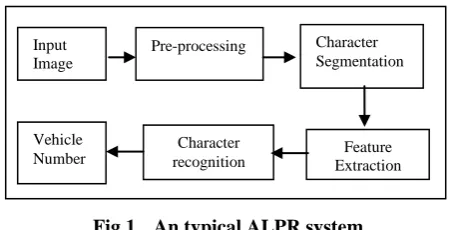
[image:1.595.311.538.556.671.2]An ALPR System, input image of the vehicle is preprocessed through a number of steps. After preprocessing the licence plate characters are segmented. The features of segmented characters are extracted and these extracted features are used for the recognition of the segmented characters [5]. The steps involved in the process are shown in fig. 1.
Fig 1 An typical ALPR system.
A country like India, there is a high accident rate which can be controlled only through law enforcement. Secondly, the long queue on toll counters results in wastage of resources and time. An ALPR system which can correctly recognize the vehicles in small time is needed to solve the said problems. A number of ALPR systems are reported in the literature but their recognition rates are
need to be improved upon.
Soft Computing Techniques Based Automatic
Licence Plate Recognition Systems for Indian
Vehicles
Nitin Sharma, Pawan Kumar Dahiya, Baldev Raj Marwah
Input Image
Pre-processing Character Segmentation
Feature Extraction Character
recognition Vehicle
III. VARIOUSIMPLEMENTEDALPR TECHNIQUES
In the implemented work, the prepossessing of the vehicle image involves steps like filtering, dilation, labeling, connected components and histogram. These steps are used to find the licence plate in the image. After that the connected components are separated. The features of the separated characters are extracted and given futher for the recognition. The following four recognition techniques are used to get the results.
A. Random Forest
RF algorithm [6]is a popular technique used to build machine learning systems. It is a supervised machine learning technique proposed by Leo Breiman [6]. RF is an ensemble algorithm. An ensemble consists of a set of individually trained algorithms, also known as base algorithms, whose predictions are combined when predicting new instances. RF uses decision tree as a base algorithm. It generates several decision trees and combines outcomes of these decision trees as the final result. RF is a supervised classification algorithm. The accuracy of classification depends on the number of trees. In this algorithm a forest is created with the number of trees [7]. It introduces randomization in two ways: firstly random sampling of data to generate bootstrap samples and secondly random selection of input features / attributes. When RF is used for classification, the outcomes of base decision trees are combined by majority voting to give outcome of the forest. Strength of individual decision trees and correlation among these trees are key issues which decide generalization error of RF classifier [6].
B. Neural Network
An ANN is inspired by the human brain. Like the human brain consists of neurons, the ANN model is an interconnection of artificial neurons called nodes. The inputs to the artificial neuron are the signals it receives from its predecessor's nodes. The input of the node is given by the mathematical equation:
(1) Where,
Pj(t) is the input to the jth node from its preceding nodes.
Oi(t) is the output of the predecessor nodes of the network.
Wij is the weight of the branch between the ith and jth node
The input calculated by above equation is given to the activation function of the jth node to obtain the final output of
the jth node. The NN work updates its interconnection weight
during learning and thus able to learn the input out relationship. Feedforward NN and Self-organizing Map network are the used for pattern classification applications and data cluster and feature mapping applications respectively.
C. Support Vector Machine
SVM is a machine learning technique in which model is trained for the classification application. It is a supervised learning model that uses the training data for the classification and regression analysis. The training dataset along with its labels are used to train the SVM model. The trained model assign each new input applied to one or the other category as a non-probabilistic binary linear classifier
[8]. An SVM model is a representation of the data sets as points in space, mapped so that the data sets of the different categories are separated by hyper plane. The gap between the dividing plane and data set is maintained as wide as possible. Now when a new input given is then mapped to the same space and predicted to belong to one of the category based on which side of the hyper plane they fall. However, A multiclass classifications problem can also be solved by a few support vectors effectively [9].
D. Convolutional Neural Network
A typical CNN is a multi-layer structure. The first layer is the input layer to which image to be classified is given. The convolutional layer is the second layer and it is called so because filtering operation is done by a feature map is a discrete convolution [10]. The input image to be classified is convole with the number of filters. After each convolution layer, conventional Rectified Linear Units Layer (ReLU) is in the architecture to have nonlinearity in the system [11]. The ReLU layer set all the negative value elements to zero [12], i.e.,
(2)
Next layer is used to do down sampling; it is achieved by pooling layer. The fifth layer used is a fully connected layer. The sixth layer of the network is a softmax layer. For a classification problem with more than two classes, the output unit activation function is the softmax function [13]:
(3)
Where and
Moreover,
is the conditional probability of the sample given class r, with P(cr) is the class prior probability. The seventh
layer is the classification layer [14] [15].
IV. METHODOLOGY
Fig. 2. Images of Licence plates with different fonts consider for the testing purpose.
Indian licence plate contains English alphabets and numbers. The two data sets 572 samples of the English alphabets and 220 samples of numbers are used for training purpose. The feature of these samples is extracted and used for the training of the recognition modules. Then these trained modules are used for the recognition of testing dataset which consists of images of Indian cars under different conditions. Here, recognition modules based on soft computing techniques that are RF, NN, SVM and CNN are implemented for the recognition of the characters and are briefed as follows.
A. Random Forest Module
The feature of (1*35) is extracted for each character. These extracted features are used to train the RF module. Using this trained RF module the results obtained are 88.5% for the alphabets and 93% is for the numerals with an overall recognition rate of 91.2%.
B. Neural Network Module
NN module consists of two feed-forward backpropagation neural networks. The feature of the segmented characters is extracted and given as the input to the feed forward neural networks. The first NN is used for the recognition of English alphabets while the other one is used for the recognition of numerals. The size of three layers neural network used for the recognition of English alphabets is 35*200*26 while the size of another three-layer neural network used for the recognition of numeral is 35*200*10. The two neural networks are trained for 1144 alphabets and 440 numerals. The trained NNs are the tested for the 50 different images of Indian licence plates and the results obtained are 90.5% for the alphabets and 93.67% is for the numerals with an overall recognition rate of 92.4%.
C. Support Vector Machine Module
The feature of (1*25) is extracted for each character. These extracted features are used to train the SVM network. Using this trained SVM model the results obtained are 92% for the alphabets and 95% is for the numerals with an overall recognition rate of 93.8%.
D. Convolutional Neural Network Module
The CNN module is a seven-layer structure. The input to the first layer of CNN is segmented characters images of size 28*28. The second layer which is a convolution layer consists of 20 filters with size 9*9. After this, the threshold function is performed by the third layer of CNN that is rectified linear unit. The fourth layer is used to find the element with the maximum value in the pool. The pool size set is 2*2. The fifth layer used is a fully connected layer. The
sixth layer of the network is a softmax layer. The seventh layer is the classification layer. the results obtained are 93.5% for the alphabets and 96.33% is for the numerals with an overall recognition rate of 95.2%.
V. RESULTSANDDISCURSSIONS
The algorithm is run over a number of input Indian licence plate images. The outputs obtained at various steps are as described below. The image of the car is given as input. Then the input image is converted into a black and white image
(a)
[image:3.595.307.548.187.339.2](b)
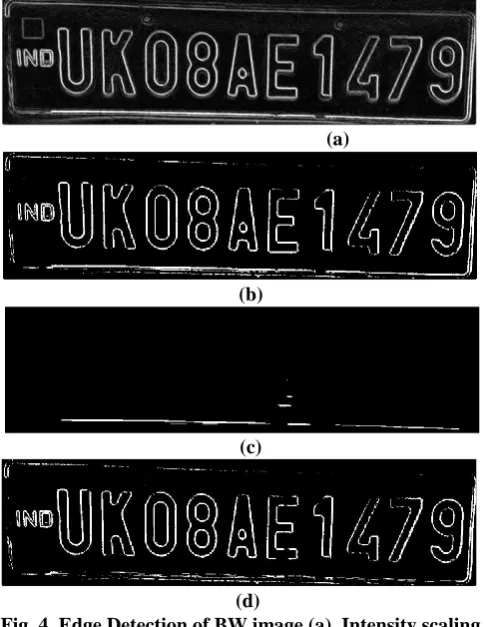
Fig. 3. Input Images (a), Black and White Image (b). Now, Sobel filter is used to find out the edges of the input image. Then the intensity scaling of the image is done. After that horizontal lines are detected in the intensity scaled image. The difference of the intensity scaled image and the horizontal lines image is used for the further processing.
(a)
(b)
(c)
(d)
[image:3.595.306.549.414.728.2]Now the holes in the input binary image are filled. Here, a hole is a set of background pixels that cannot be reached by filling in the background from the edge of the image. The next step in processing is the thinning of the connected components of the image. Now all the regions having more than 300 pixels are kept rest are discarded.
(a)
(b)
[image:4.595.309.546.51.92.2](c )
Fig. 5. Filling of the region (a), Thinning of the image for isolation (b), and Removal of the region (c).
[image:4.595.50.288.144.388.2]From the resultant image obtained from the last step, the characters are separated and segmented on the basis of the position of their starting pixel, height, and width.
Fig. 6. Segmented characters from the input image. The last step left is the recognition of the segmented characters, for which three soft computing techniques are used. Features are extracted and are given to the NN, SVM and CNN network to get the recognized characters.
Fig. 7. Recognized Number of Indian Licence Plate The techniques were implemented in MATLAB 2017. The trained network used for the recognition of 500 characters of the licence plate. The results obtained are as follows: The number of Licence plates tested is 50.
Table- I: Accuracy of Implemented Techniques Technique
Used
Accuracy
Alphabets Recognized
Numeral Recognized
Overall
Out of 200
in % Out of 300
in % Out of 500
In %
RF 177 88.5 279 93 456 91.2
NN 181 90.5 281 93.67 462 92.4
SVM 184 92 285 95 469 93.8
CNN 187 93.5 289 96.33 476 95.2
The recognition rate of alphabets in case of RF, NN, SVM, and CNN based ALPR systems are 88.5%, 90.5%, 92%, and 93.5% respectively. The recognition rate of numerals in case of RF, NN, SVM, and CNN based ALPR systems are 93%, 93.67%, 95%, and 96.33% respectively. The overall accuracy of the RF, NN, SVM and CNN based ALPR systems are 91.2%, 92.4%, 93.8% and 95.2% respectively.
VI. CONCLUSION
In this work, ALPR systems based on RF, NN, SVM, and CNN are presented. It has been observed from the results obtained that recognition rate obtained for the CNN based ALPR system is having edge over other two soft computing techniques. The recognition rate obtained for the CNN based ALPR system is better at 4%, 2.8% and 1.4% than the RF, NN and SVM based ALPR system respectively.
In India, a number of formats are used for the licence plates. Due to which the accuracy obtained here is low. However, if a standard format is used in that case the accuracy can be obtained much higher. A further hybrid technique based on soft computing can be implemented. RF hybrid with CNN, CNN hybrid with SVM can be implemented and tested for Indian licence plates in order to obtain the better results.
REFERENCES
1. S. Du M. Ib ahim M. Shehata and W. Badaway “Automati License Plate Recognition ( ALPR ): A State-of-the-Art Review ” IEEE Trans. Circuits Syst. Video Technol., vol. 23, no. 2, pp. 311–325, 2013.
2. P. Kulkarni A. Khat i B. . and K. Shah “Automati Numbe late Re ognition AN R ” 2009 19th Int. Conf. Radioelektronika, pp. 111–114, 2009.
3. S. K anthi K. anathi and A. S isaila “Automati Numbe late Re ognition ” Int. J. Adv. Technol., vol. 2, no. 3, pp. 408–422, 2011.
4. V. Kamat and S. Ganesan “An effi ient implementation of the Hough transform for detecting vehicle license plates using DS ’S ” in Real-Time Technology and Applications Symposium, 2002, pp. 58–59.
5. C. E. Anagnostopoulos “Li ense late Re ognition : A b eif tuto ial ” IEEE Trans. Intell. Transp. Syst. Mag., vol. 6, no. 1, pp. 59–67, 2014.
6. L. B eiman “Random Fo ests ” Mach. Learn., vol. 45, no. 1, pp. 5–32, 2001.
7. T. K. Ho “Random De ision Fo ests ” in Proceedings of 3rd international conference on document analysis and recognition, 1995, pp. 278–282.
8. C. Co tes and V. Vapni “Suppo t-Ve to Netwo s ” Mach. Learn., vol. 20, no. 3, pp. 273–297, 1995.
9. C. W. Hsu and C. J. Lin “A ompa ison of methods fo multi lass suppo t ve to ma hines ” IEEE Trans. Neural Networks, vol. 13, no. 2, pp. 415–425, 2002.
10. Y. Le un L. Bottou Y. Bengio and . Haffne “G adient based lea ning applied to do ument e ognition ” Proc. IEEE, vol. 86, no. 11, pp. 2278–2324, 1998.
11. Y. LeCun, Y. Bengio, and G. Hinton, “Deep lea ning ” Nature, vol. 521, no. 7553, pp. 436–444, May 2015.
[image:4.595.48.283.455.521.2]13. A. K izhevs y and G. E. Hinton “ImageNet Classifi ation with Deep Convolutional Neu al Netwo s ” Adv. Neural Inf. Process. Syst., pp. 1097–1105, 2012.
14. V. Jain and S. Biswas “Deep Automati Li en e late Re ognition system ” in Proceedings of the Tenth Indian Conference on Computer Vision, Graphics and Image Processing, 2016, p. 6.
15. K. K. Kim, K. I. Kim, J. B. Kim, and H. J. Kim, “Lea ning-based app oa h fo li ense plate e ognition ” in In Neural Networks for Signal Processing X. Proceedings of the 2000 IEEE Signal Processing Society Workshop, 2000, vol. 00, no. C, pp. 614–623.
AUTHORSPROFILE
Nitin received his B.E. (Electronics and Communication Engg.) degree (Hons.) from VCE, Rohtak, Haryana-India (affiliated to M.D. Univ., Rohtak) in 2001 and M.Tech. (Electronics and Communication Engineering) from GNDEC, Ludhiana, Punjab-India (affiliated to Punjab Technical University, Jalandhar, Punjab) in 2008. He is pursuing Ph.D. in Electronics and Communication Engineering from Deenbandhu Chhotu Ram University of Science and Technology, Murthal, Haryana-India. He is with the Electronics and Telecommunication Department at Chandigarh University, Chandigarh-India. His research interests include Intelligent Transportation System, Image Processing, etc.
Pawan Kumar Dahiya received his B.E. (Electronics and Communication Engg.) degree (Hons.) from VCE, Rohtak, Haryana-India (affiliated to M.D. Univ., Rohtak) in 1999. He has received his Ph.D. degree in Electronics and Communication Engg. from M.D. University, Rohtak (India). He served as a Development Engineer in the Research and Development Dept. of Belgian American Radio Corporation (BARCO). He has worked as a lecturer ECE. Dept. in Hindu College of Engg., Sonipat and currently working as Assistant Professor in ECE Dept. in Deenbandhu Chhotu Ram University of Science & Technology, Murthal, Sonipat, (India). He was Coordinator of TEQIP Cell of the University which has been selected for a grant of 12.5 crores from world-bank for Scaling-up Postgraduate Education & Demand-Driven Research & Development and Innovation. He is Coordinator of the Centre for Research, Innovation & Development (CRID) in the University. He is Coordinator of Research & Development Unit under CRID. He has published more than 30 research papers in journals & Proc. of National & International conferences. He is a life member of ISTE and Secy. of ISTE Chapter in the University which has won the Best Chapter Award in 2004. His interests include Evolutionary Computation applications to Digital System Design, Embedded System Design, Digital VLSI and ALPR System.