CDP0p©(3m D[]QW©8ÖCii]©CDÖ ©GJDûDs
N o 3 4 - A p r i l 1 9 8 3
iQfl(?®(ô)â0g©|}o© 0[fi)w§g!M(2)iAi§(s)aoìifó
IDaffiXûjQi]©
1οί)(?®^)(|(§(ή)ίΰ©
(a°0(iM§§ßfi©§®öi?ii©cfufi
lli©(jû©a [i(iû(?®(o)©a [óxa? g]O0 OiiiMSgofiŒiDQiAifiÔ
l(M)[f®(ô)©§© 0(ïiïM©§Qs(?QÎA)g]§lo)aiJote
ISSN 0250-3891
TG
ational Capital Marte! in 1982
The changes that occurred in the international capital market in 1982 - such as in the slope of the yield curve in virtually all sectors, in issuing techniques, in the relative importance of sectors and currencies and even in sources of funds - left it looking very different at the end of the year. Short and long-term interest rates were widely expected to continue to decline from the peaks they reached around September/ October 1981 (see graph on page 5) but it was significant that, encouraged by their respective authorities often acting in concert, interest rates in Europe led the decline while those in the U.S.A. held up until July.
A sharper fall in short-term than in long-term interest rates on most markets, including in the latter part of 1982 that of the U.S.A., helped to reintroduce a more normal relationship between them, producing once more a positively sloped yield curve. This in turn reduced the cost for market intermediaries of financ-ing their inventories of securities and so encouraged further the flow of new issues of bonds and notes that was already under way as borrowers sought to replace interim short-term finance with longer-term fixed interest funds on easier terms and investors, anticipating a continuing decline in rates, tried to lock in to higher yields while they were still available. The surge in issuing activity in 1982,
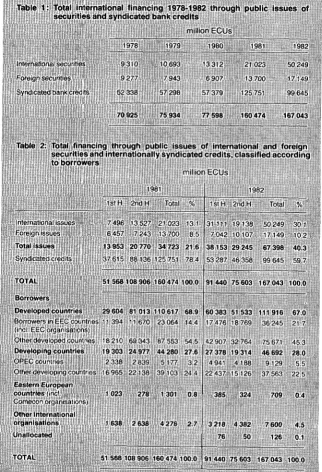
particularly on the international mar-ket (see Table 1), resulted in a 94% increase to 67.4bn ECUs in public issues of international and foreign securities compared with 1981. Bet-ween the same two years interna-tionally syndicated bank credits fell by 2 1 % in amount (to 99.6bn ECUs). This fall reflects the jolt to such financing occasioned by a number of major debtors in Latin America
In this issue
The International Capital Market in 1982
Outline of main developments The bond markets — new approaches to investors
— currencies — borrowers
— international issues by sector
p. 1
p. 1-7 Internationally syndicated
credits p. 7-8
ECU exchange rates used
for this review p.
and in Eastern Europe suspending their service payments, not to mtion the debt service problems en-countered by several developing countries in Africa. Hardly surpris-ingly the international banking syn-dicates became more selective in the matter of risk exposure and pre-ferred to lend to borrowers in de-veloped countries and, in view of the swing into deficit of the petroleum exporting countries as a group, to OPEC borrowers as well.
[image:1.592.37.200.572.787.2]The advance in 1982 of public issues on the international and foreign sec-urities markets and the contraction of internationally syndicated bank credits needs to be interpreted with caution. Not only are all currency amounts converted for the sake of comparison into ECUs, which inevit-ably introduces distortions when conversion rates are changing (see table of conversion rates in 1981 and 1982), but certain special features in both forms of borrowing need to be taken into account. Security issues on the international market in 1982 have been inflated to the extent of approximately 5.1 bn ECUs by the inclusion of the full nominal value of so-called "zero coupon" issues launched during January and
Febru-ary of that year although the amount subscribed by investors was very much less as the capital apprecia-tion of the security to final maturity compensates for the absence of in-terest income. Internationally syndi-cated bank credits in 1981, on the other hand were unusually high be-cause of the inclusion of several exceptional credits, amounting to nearly 42bn ECUs, to US oil com-panies in connection with take-over activities. If appropriate adjustments were to be made the conclusion regarding the relative changes in the two forms of borrowing would perhaps be similar but the contrast would be much less marked.
The bond markets
Development of new approaches to investors
adapt-able to other sectors in which in-deed some appeared. This streng-thening of a tendency to innovate occurred, it should be noted, when the market had already begun to show signs of expanding rapidly af-ter several years of stagnation as borrowers seerned to make special efforts to secure better terms than those prevailing at the time of issue or to prepare well in advance for future approaches to investors. On the other hand, the usefulness of one or two devices introduced in earlier periods diminished.
The zero coupon issues that were such a feature in the dollar sector of the international market during the first two months of 1982 have al-ready been mentioned above. The securities, which carried to the limit the existing practice of launching issues bearing coupons below cur-rent market levels at a deep discount so as to provide purchasers with a substantial capital appreciation of their holdings in lieu of interest in-come, appealed mainly to investors exempt from tax on capital gains, as
were residents in Japan at that time. Borrowers were accordingly able to launch their issues with lower yields to redemption than on conventional issues with similar lives. An addition-al benefit was available to borrowers under certain tax systems which per-mitted them to charge sums set aside annually for the ultimate rede-mption of zero coupon issues against their taxable income. The ban imposed by the Japanese au-thorities at the end of February on sales of such securities to their resi-dents in effect ended that practice. The Japanese regulations were eased in early 1983, but the interven-ing suspension by the U.S. au-thorities of tax advantages enjoyed by borrowers on zero coupon terms had reduced the likelihood of any large scale revival of the technique. Two other modifications to the nor-mal terms of fixed-interest issues introducing greater flexibility in the determination of the life of the sec-urities bore a certain resemblance to each other although they are in-tended to work in opposite
direc-Note
Unless otherwise stated, the statistics of bond issues in this article are of public issues on the international market or of public issues by foreign borrowers on national markets.
International issues are those which are sold through international banking syndicates, usually in more than one market Including markets outside Europe; they include all issues to which special monetary clauses are attached (ECU, EUA, SDR and other multiple-currency issues). Foreign bond issues are those which are sold on a single national market on behalf of non-resident borrowers by financial institutions of the country concerned. The distinction between international and foreign bond issues is no longer clear-cut.
Syndicated credits consist of loans granted by international banking syndicates as publicly reported; they are recorded at the time of signature and not of drawdown.
The classification of developed or "industrialised" and developing coun-tries is based on that of the World Bank, i.e., developing councoun-tries are mostly those which had an average income per head in 1980 of up to US$ 4 500. South Africa, however, has been classified as an industrialised country.
For the purpose of comparison, amounts in various currencies and currency units have been converted in the summary tables into ECUs (consisting of specific amounts of the currencies of EEC Member Countries, excluding the Greek drachma). The rates applied in this article in converting the ECU into the main currency units in use on the international market are as follows:
1981 1982
1981 1982
1 ECU 1 ECU
1 ECU 1 ECU
US$ 1.160 0.993
£
DM 2.527 2.390 Can. $
Sfrs 2.222 1.979 Fl
Yen 251.44 244.7
Ffrs 5.974 6.403
0.5555 0.5587
1.387 1.225
2.793 2.623
tions. In one of the modifications the life of the securities is usually refer-red to as "retractable" because the terms of issue permit the borrower to adjust the coupon at regular inter-vals of years but confer on the hol-der the option either of renewing his investment at the new interest rate or of requesting redemption at par and hence of shortening the life of the investment. In the other modifi-cation, however, the holder has the option of extending the original life of the securities by a stipulated number of years but, in the event of this option being exercised, the bor-rower also has the option of adjust-ing the coupon of the "extendable" issue.
A further practice to which increas-ing resort was made in 1982, entirely to suit the convenience of borrow-ers, was the swapping of proceeds of issues either to exchange a fixed-interest liability for a floating-rate liability (or vice versa) or to ex-change proceeds in one currency for the equivalent in another curren-cy, most probably bearing a different interest rate. As an example of the possible benefits for both parties of a straight interest rate swap, a bank based in Europe and able to borrow on the best fixed-interest terms in the dollar sector of the international capital market but wishing to raise floating-rate finance could find it advantageous to arrange a swap with a less highly rated U.S. corpora-tion discouraged so far from raising the fixed-rate finance it requires by cost considerations but having ac-cess to floating-rate funds in the U.S.A. on better terms than available on the international market. The cost advantage for both borrowers in the swaps that have been con-cluded, including the fees payable to intermediaries, would evidently be worthwhile. Significantly a substan-tial number of issues by banks based in Europe have been launched with the idea of raising fixed-interest fi-nance for swapping into floating-rate debt, though the partner to the transaction is not usually disclosed. Currency swaps as distinct from straight interest rate swaps have tended to be arranged in recent years between as well as within mul-tinational corporations without bor-rowing necessarily being involved but the World Bank's swapping of the proceeds of a dollar issue on the international market in August 1981 for Deutsche Marks and Swiss francs held by IBM which carried lower rates of interest set a pattern that it and others followed in 1982. While the lower interest rate on a currency obtained under the swap arrangements could be the motive for one of the partners to the deal, the main motives for the other could well be a reduction in exposure to exchange risk and/or the realisation of profits from exchange rate fluctu-ations. A fairly wide range of cir-cumstances could be envisaged as likely to produce an advantage for both sides from currency swaps but it would seem that fewer issues were made in 1982 with this purpose in view than for the simple transforma-tion of a fixed into a floating-rate interest liability.
The development of these various techniques helped to widen the
range of activity on the international market and to swell the amount of new issues but certain longer estab-lished forms of capital raising should also be mentioned as con-tributing to the growth of the mar-ket. Among these were issues of floating-rate notes which reached a peak in the second quarter of 1982 when interest rates in the dollar sector were still very high. As inter-est rates came down, however, so did issuing activity in floating-rate notes and the so-called "drop-lock" clause (under which the variable in-terest rate, if it were tp fall below a specified level, would remain fixed at that level for the remainder of the life of the securities) disappeared from prospectuses but, on the other hand, investors have been given the opportunity in some floating-rate is-sues of opting for a fixed coupon after a number of years.
[image:3.590.213.536.315.788.2]It might have been expected that issues denominated in currency un-its which offer a hedge against ex-ohange risk would continue to con-tribute to the growth of the interna-tional market during a year in which the major currencies fluctuated fair-ly widefair-ly against one another. As it happened, however, no issues de-nominated in Special Drawing Rights were made during 1982, de-spite the reduction in 1981 of the number of currencies in this basket unit from sixteen to five; it would appear that it became impractical for the SDR to compete against the strong attraction of its main compo-nent, the U.S. dollar. One public issue was, on the other hand, de-nominated in - the long-standing European Unit of Account before this too ceased to be used as its promoters turned their attention to participating in issues denominated Table 1 : Total International financing 1978-1982 through public issues of
securities and syndicated bank credits
Internalional
securllies-Foreign securilies
Syndicated bank credits
1978
931Ü
9?77
52 338
1979
10 693
7 943
57 298
million ECUs
1980
13312
C907
.•)7 379
1981
21 023
13 700
125 751
19S2
b0 249
17 149
99 6.15
70 925 75 934 77 598 160 474 167 043
Table 2: Total f i n a n c i n g t t i r o u g t i p u b l i c issues of international a n d f o r e i g n s e c u r i t i e s a n d i n t e r n a t i o n a l l y s y n d i c a t e d c r e d i t s , c l a s s i f i e d a c c o r d i n g t o b o r r o w e r s
million ECUs
1981
1st H 2>HlH Total
Intciri.lt'oml i=;suc-s
Foremn iÇ'iuPS
Total issues
Syni1iatrfic-c-dit.5
TOTAL
1182
1 St H 2nd H To'al
7490 n 5 2 7 210^3 13 1 31111 19 I'i8 50 249 'W 1 6 457 7 243 13 700 8 Ί ' 7 042 10 107 17 140 10 2
13 953 20 770 34 723 21.6
37 PI 5 88 1?6 i;'-'"i7',1 78 i
51 568 108 906 160 474 100.0
Borrowers
Developed countries 29 604 81013 110 617 68.9 Bonowersin FECcou'ilrieb 11 .39- 11670 23 OM 14 4 I IK' EEC organisat:cnSi
OlN;rdoveloi3«"1couiiliii!·, 18 210 69 343 87'153 'j4 5 Developing countries 19 303 24 977 44 280 27.6 OPECcciuntnes 2 338 2 b j q 5 17/ i i OltiTüeveiüpinacouriliuji le965 22 138 39 10.) 2.11
38153 29 245 67 398 40.3
53?87 4h'V)8 99 6.15 59 7
91440 75 603 167 043 100.0
60 383 51 533
17 176 18 7r.q
4?'i(i7 32 76.1
27 378 19 314
.1941 4 188
22437 Iv12& 111 916
36 245
r-j b71
46 692
9 124
37 5'>3 67.0
21 7
45 3
28.0
5 5
22 b
Eastern European countries (inci Comecon [ir;:^rii'.;niiorS)
Other international organisations
Unallocated
TOTAL
1 023 278
1 638 2 638
51568 108 906
1 301 0.8
4 276 2.7
160 474 100.0
. 1
385
3 218
76
91440 324
4 382
50
75 603 709
7600
126
167 043 0.4
4.5
0.1
Table 3 : International and foreign security issues classified according to currency or currency unit million ECUs
International issues Foreign securities Total
Currencies
US dollars
Swiss francs
Yen
Deutsche Mark
Pounds sterling
French francs
Canadian dollars
Guilders
SDRs
ECUs
Other currencies / currency units
Total
IStH.
5 954
139
235
268
500
36
42
176
75
71
7 496 1981
2ndH.
11 249
ISO
990
184
458
30
135
115
186
13 527 Total
17 203
319
1225
452
500
494
72
311
190
257
21023 I s t H .
27 077
290
2014
270
1023
72
197
168
31 111 1982
2ndH.
15 486
184
1939
557
269
87
525
91
19 138 Total
42 563
474
3 953
827
1 292
.159
722
259
50 249
1981 1982
I s t H . 2ndH. Total I s t H . 2nd H. Total
2 779 3 503 6 282* 1814 4 432 6 246*
1 746 1 755 3 501 2 387 2 695 5 082
915 1054 1969 1565 1144 2709
218
549 415
189
84 633
738
84 292
450
156 502
725
78 794
1 175
234
199
51 179
64 378
115 342
36 391
140 733
176
6457 7243 13700 7042 ,10107 17149
I s t H .
8733
1 746
1054
453
817
500
36
241
176
75
122
13 953
1981
2ndH.
14 752
1 755
1 234
1 405
373
84
458
209
135
115
250
20 770 Total
23 485
3 501
2 288
1 858
1 190
584
494
450
311
190
372
34 723
%
67.6
10.1
6.6
5.4
3.4
1.7
1.4
1.3
0.9
0.5
1.1
100.0 1StH.
28 891
2 387
1855
2 306
720
156
1023
414
197
204
38153
1982
2ndH.
19918
2 695
1328
2 441
1 282
78
269
478
525
231
29 245 Total
48 809
5 082
3183
4 747
2 002
234
1 292
892
722
435
67 398
%
72.4
7.5
4.7
7.0
3.0
0.4
1.9
1.3
1.1
0.7
100.0
Table 4 : International and foreign security issues classified according to borrower
International issues
Borrowers
I. Developed countries Borrowers in EEC countries (incl. EEC organisations) Other developed countries
II. Developing countries OPEC countries
Other developing countries
III. Eastern European countries (incl. Comecon organisations)
IV. Other internal, organisations (')
Total
1981 1982
I s t H . 2ndH. Total I s t H . 2nd H. Total
6117 11747 17864 27908 16831 44 739 2286 2741 5027 5939 5737 11676
3 831 9 006 12 837 21969 11094 33 063
673 1 1 1 7 . 1790 1910 959 2 869 67 67 207 75 276 673 7 056 7 729 1 709 884 2 593
706 -663 1369 1293 1348 2 641
7496 13527 21023 31111 19138 50249
million ECUs
Foreign securities
1981 1982
I s t H . 2ndH. Total I s t H . 2ndH. Total
5144 4979 10123 5330 7043 12373
7 707 7 432 2 539 7 386 2 208 3 594
4 037 3 547 7584* 3 944 4 835 8 779'
381 289 670 167 41 208 205 86 291 41 41
176 203 379 167 167
932 1 975 2 907 1 545 3 023 4 568
6 457 7 243 13 700 7 042 10107 17149
' Including private placements by Canadian borrowers.
(') Alrican Developnient Bank, Asian Development Bank, Council ol Europe. Eurofima, Inter-American Development Bank, Nordic Investment Bank, World Bank. Source; EIB
Total
1981 1982
IstH. 2ndH. Total % IstH. 2ndH. Total
11261 16 726 27 987 80.6 33 238 23 874 57 112 84.7
3393 4173 7 566 21.8 7 325 7 945 15270 22.6
7868 12 553 20 421
1 054 1 406 2 460
205 747 352
849 1259 2 108
58.8 25913 15929 41842 62.1
7.1 2 077 1000 3 077 4.6
7.0 207 776 377 0.5
6.7 7 876 884 2 760 4.1
1638 2 638 4 276 12.3 2 838 4 371 7 209 10.7
in ECUs. Thus it was that the ECU came to be the main currency unit used in 1982 in new issues on the international capital market. Public issues denominated in ECUs rose from 190m ECUs, only 0.5% of the total of international and foreign is sues in 1981, to 722m ECUs in 1982 when they formed 1.1% of a much larger total market.
The currencies
For the most part international and foreign borrowing operations con tinued to be conducted in 1982 in the same currencies as in the previ ous year if with some shifts between markets in the general expansion of activity.
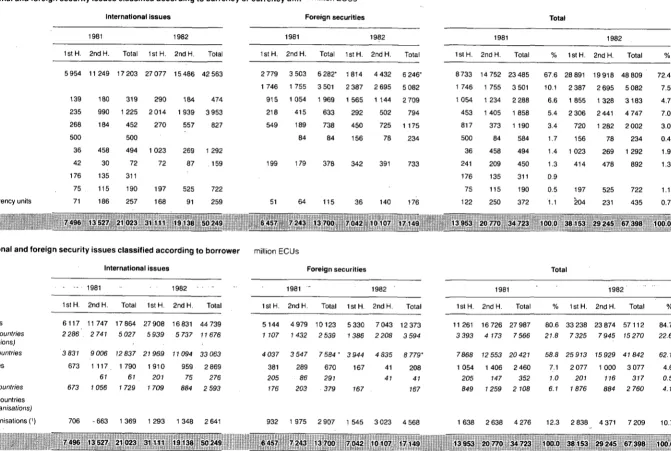
The borrowing of U.S. dollars con tinued to grow more rapidly than that of other currencies put to gether, rising from 67.6% of the total of public issues in 1981 to 72.4% in 1982 (see Table 3). All of this growth occurred in international issues which during the greater part of the year carried a lower cost for the borrower than that for a foreign issuer on the New York (Yankee bond) market. As mentioned earlier, however, the international issues in U.S. dollars during the first half of 1982, equivalent to 27bn ECUs, in clude the full nominal amount of some 7bn ECUs of zero coupon issues or about 5.1 bn ECUs more than was in fact subscribed by inves tors. A further feature contributing
to the fall of 11.6bn ECUs between the two halves of 1982 was an abrupt decline In issues of floating-rate notes from the equivalent of about 7bn ECUs in the first six months when interest rates were still very high and the outlook uncertain to approximately half this amount in the second six months when interest rates were moving steeply down wards.
In contrast foreign issues on the New York market were about 2.6bn ECUs higher in the second half of the year than the first. Until the end of July interest rates in the U.S.A. were so high that they discouraged even top rated domestic borrowers from taking on the risk of incurring long-term liabilities on fixed-interest
Average yields on new bond issues made in selected markets
%
18
17
16
15
13
12
1 1
10
—
J
/
/
/
1
4
^
y
i
1
1
/
/
,
'
^
/
/
/
'
>
•·
/
/
1
h
,
»
'
^^
/
,/
7
\''
\
\
'^
• .
\
^^
y
/1
" · i.
,
j
/
/
/
/
'
^
,
./
•
">«
•^^
y '
J
/
V
/
ψà
/
f
y
r
- __
-
·
-*^
1
/
/
^
/
/
/
n
-r
\
F "
- —
^
.
^
/>
/
- Ί
. .^
à
/
/
:
1f
Ì
/
*
S V
r ^
N
- ^
A
/
/
^
^
'•^f
J
" i
1
1
I
f
•
^.'
é
/
y
•
»
i
/
L
f*
V
/
»^
/
/
, ^
-•
•
/
/
/
,.·
•
.
y
\
\
\
S
\
\
\
• ^ ,
_
_
N\
• * · •
7?
/
—M
"•^
— H
___
• * ·
-y
N
\
^
1 —
k,
\ ,
'^^
>
N ,
s
N
S
S
\
• — • "
^
s>
1
/
•
^/
t
/
/
\
\
\
\
\
/
yt
/
•^
k^
Ys
V\
S
• " - •
\
\
Vι
\
\
(\
\\
\\
w
\
\
'
-•
. __
- |
1
·*-_ —
' " S ,
• — *
•».*^
• χ
N
J F M A M J J A S O N D J F M A M J J A S O N D J F M A M J J A S O N D
1980
International S bond market International DM bond market SWISS market m foreign issues
1981 1982
^ · ^ ^ * ^ ^ Japanese market in foreign issues
US domestic market (medium-term issues by Aa rated public utilities)
bonds With maturities between 7 and 15 years issued by tirsVclass borrowers Source EIB
Source Salomon Brothers
rate terms. From August onwards, however, interest rates declined ac-ross the board as inflationary pressures abated; though on the securities market the heavy borrow-ing programme of the U.S. Treasury tended to slow the decline in yields on issues of Government paper. The yield gap between Government and other issues accordingly narrowed, encouraging non-Government bor-rowers, including foreign entities, to approach the market on the com-paratively favourable terms which lasted until the end of November when interest rates began to edge upwards once more in the expecta-tion that the prospective economic recovery in 1983 might strain the market's resources.
Among issues denominated in other non-Community currencies, those in Canadian dollars, continuing the re-vival in activity which began in De-cember 1981, rose further in 1982 to account for 1.9% of a larger market total as against 1.4% in the previous year; in contrast to earlier years, two non-Canadian borrowers, both fi-nancial institutions, tapped this sec-tor of the market in 1982. Foreign issues denominated in Swiss francs rose in ECU terms from 3.5bn to 5 bn while the total of euroyen and fore-ign issues on the domestic (Samurai) market of Japan in-creased from 2.3bn to 3.2bn but their growth did not match that of international and foreign issues as a whole and the proportions they ac-counted for fell accordingly to 7.5% and 4.7%.
In the sectors of the market denomi-nated in the currencies of the Euro-pean Community, issues denomi-nated in Deutsche Mark continued in the lead, doubling in amount to form 7% of the total of international and foreign public issues. The cuts in administrative interest rates intro-duced by the authorities during the
first quarter of 1982 and supported by similar cuts in other European countries helped to initiate an im-provement in sentiment on the bond market which however led to such a flow of new issues that issuing activ-ity was suspended from early June until July to provide a breathing space. The broadening of the de-cline in interest rates in the second half of 1982 and a somewhat stronger performance of the ex-change rate for the Deutsche Mark particularly against the U.S. dollar contributed towards re-establishing the bond market's capacity for ab-sorbing new issues.
By generally excluding private placements on which information is incomplete, the new issues recorded in Table 3 understate the rôle played by the Netherlands guilder in inter-national financing. The private placements on the euroguilder mar-ket in 1982, all with a five year life, amounted to the equivalent of 668m ECUs, more than four times public euroguilder issues which came to 159 m ECUs. Public issues denomi-nated in guilders, taking together issues on the euroguilder market and issues by foreigners on the domestic market, doubled in amount between 1981 and 1982, thereby providing the same propor-tion (1.3%) of total public issues in the two years.
[image:6.588.46.374.614.791.2]Against a background of falling in-terest rates issues denominated in pounds sterling, whether on the eurosterling market or on the domestic (Bulldog) market, rose substantially in amount from 1.2bn ECUs in 1981 to 2bn ECUs in 1982. Issuing activity slowed however from late November onwards as the pressure brought to bear oh the exchange rate for the pound by weakening oil prices discouraged investors. In spite of the increase in their amount, issues denominated in
Table 5: Resources raised by official International institutions for financing development
\
1981
Public bond issues
million ECUs
Ottier
1982
Public bond
issues Other
World Bank
Intor-Amenran Devt-lopment Bank
Asian Development Bank
Alrican Dovelopment Bank
European Investment Bank
2 949
508
354
0
1 268
2 841
170
260
161
1042
4 893
1 289
679
42
1826
5719
100
n.a.
n.a.
1379
pounds sterling fell as a proportion of the total to 3% from 3.4% the previous year. With no issues in eurofrancs being recorded in 1982, the fall to 0.4% which issues de-nominated in French francs formed of the total was more marked. In a difficult period from the point of view of balance of payments deficits on current account and disturbed conditions in foreign exchange mar-kets, the rôle played by the Belgian franc in foreign issues of securities in 1982 was relatively minor. The borrowers
In 1982 the general category of de-veloped countries including the EEC more or less doubled its borrowing through security issues. A signific-ant part consisted of borrowing for balance of payments reasons by na-tional Governments, either directly or through subsidiary authorities and national enterprises.
Despite the adverse effect on the confidence of investors of suspen-sions of debt service by developing countries, these also increased their borrowing in 1982 but by a compara-tively modest 3 1 % in ECU terms. Within the total of 3 489m ECUs raised by the Third World, the amount going to petroleum export-ing countries of 317m ECUs was a little lower than in the previous year. Virtually all the remainder went to Latin American or South East Asian countries with nothing for the Afri-can, Caribbean or Pacific areas and only one issue for Egypt among Mediterranean countries. Certain developing countries, however, would benefit from the proceeds of capital issues made by the World Bank and regional development banks and included in the 7 209m ECUs for "Other international or-ganisations", which was nearly 3bn ECUs more (mentioned in Table 4), than in 1981.
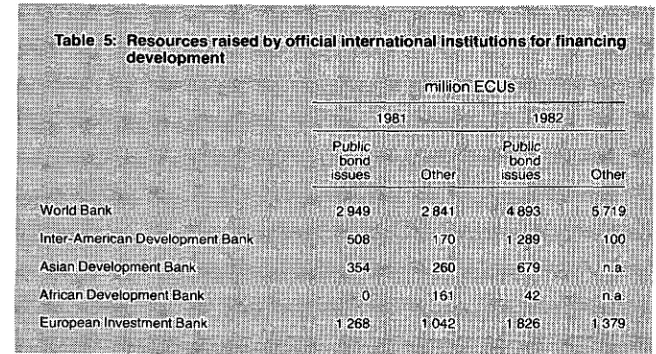
the Community and only one-tenth with those outside, the ElB's bor-rowings on capital markets are in a somewhat different category from those of the other institutions in the Table.
In 1982, as in 1981, no public issues of securities were made on the mar-kets covered in this article either by Comecon organisations or by East-ern European countries some of which have been experiencing debt servicing problems.
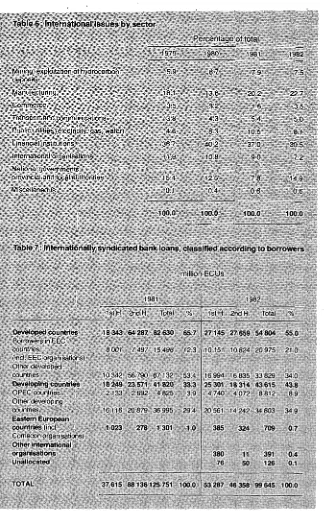
International Issues by sector The pattern of borrowing by indivi-dual sectors of activity as illustrated in Table 6 has diverged sitrprisingly little while growing rapidly in total amount. The largest changes were a fall of 6.5 percentage points in the proportion accounted for by finan-cial institutions counterbalanced by a gain of about 7 percentage points in the share of national governments and subsidiary authorities. The latter movement is partly or even largely the result of national authorities' efforts to finance balance of pay-ments deficits by recourse to exter-nal borrowing rather than by dra-wing on foreign exchange reserves. The increases in the percentages accounted for by manufacturing (+2.5%) and commerce (+1.9%) may have been more a response to more favourable terms for borro-wers on capital markets as enterpri-ses sought to fund their short-term debts than the arranging of finance for an expansion of activity, though some concerns may have been look-ing fonward to an economic upturn in 1983.
The share of the international mar-ket obtained by public utilities at 8.1% in 1982 fell back to near where it stood in 1980 but the 1982 propor-tion was of a total several times higher. The proportion secured by international organisations has been declining for a number of years but the proceeds of their public issues have risen in amount and, as may be seen in Table 5, international
deve-lopment finance institutions have derived a large part of their resour-ces from private placements.
Internationally syndicated credits
The sharp check to the expansion of lending by international banking syndicates in 1982 (see Table 7) may be said to have been partly
attribut-able to a fall in demand in that there was no repetition of the heavy bor-rowing by U.S. oil companies which occurred the previous year but the banks themselves, for a variety of reasons, were generally more cauti-ous in their lending.
[image:7.589.216.541.280.791.2]Among the reasons for a more cauti-ous and selective approach to lend-ing, were obviously the fairly wide-spread debt servicing difficulties of countries in Latin America, Eastern Europe, Africa and the Caribbean but a nuniber of banks based out-side the U.S.A. also found that the strength of the U.S. dollar against all other currencies during the first three quarters of the year posed a problem in adding substantially to the valuation of the dollar loans in
Table 6: International issues by sector
their portfolios in proportion to their other assets and to their equity. It also seems possible that, with high-er inthigh-erest rates prevailing on dollar markets than on those dealing in other major currencies, banks with-out a large deposit base in U.S. dollars experienced a drain on their resources, particularly when short-term interest rates fell faster during the second half of the year, thereby re-establishing the normal, positive, slope of the yield curve.
As a result of these factors the main lenders in the international syndi-cates were U.S. banks. Arab and Japanese banks also played a sig-nificant rôle, despite the probable effect on the first of the swing of OPEC into deficit and the request
Mlriing, exploitation of hydrocarbon deposits
Manufacturing
Commerce
Transport and communications
Public utilities (electricity, gas. water)
Financial institutions
International organisations.
National governments. provincial and local authorities
Miscellaneous
1979
5 9
1 8 1
3 5
3 8
4 6
36 7
11 9
154
0 1
Percentage
1980
6 7
136
: Ì 2
4 3
8 3
.10 2
108
125
0 4
of total 1981
7 9
20 2
1 6
5 4
10=.
37 0
9 0
7 8
0 6
1982
75
22 7
3 5
5 0
8 1
30 5
7 2
149
0 6
100.0 100.0 100.0 100.0
Table 7: Internationally syndicated bank loans, classified according to borrowers
million ECUs
Developed countries Bo-rowf-'b -n EFC
CuiirtliCS
f-ncl EEC org-inisaticr.bl Olhci i;e\,i;loprd munlriPs
Developing countries OPEC countries Olhfi duvolopinq Cfninlnes Eastern European countries find Conie.-on cruan ;,alicn=;i Other international organisations Unallocated
TOTAL
1.S1M
18 343
8 001
10 342 18249 2 133
16 116
1023
37 615
1981
2nd H
64 287
7 497
56 790 23 571 2 692
20 879
278
88136 Total
82 630
15 498
67 132 41820 4 825
36995
1301
25 751 65.7
123
53 4 33.3 3 9
294
1.0
100.0 IstH.
27145
10151
16 994 25 301 4 740
20 561
385
380 76
53 287
198?
2nd H
27 659
10 824
16 835 18 314 4 072
14 242
324
11 50
46 358 Total
54 804
20975
33 829 43615 8812
34 803
709
391 126
99 645
'i'c
55.0
21 0
340 43.8 8 9
3-19
0.7
0.4 0.1
the Japanese Ministry of Finance made of the second that, as from October, they limit their share of syndicated loans to 15% instead of 20% as previously. Although the vast mass of international credits con-tinues to be denominated in U.S. dollars, the widening range of cur-rencies used in 1982 (including the yen, Swiss franc, Canadian dollar, Kuwaiti dinar, Saudi riyal and Hong Kong dollar, as well as the Deutsche Mark, the pound sterling and the Belgian and Luxembourg francs, not to mention the ECU) indicates an active participation by banks with a deposit base in the currencies con-cerned.
The more selective evaluation by international banking syndicates in 1982 of their risk exposure was re-flected in a reduction of 2.8bn ECUs in their lending to non-OPEC de-veloping countries and to Eastern Europe which was largely counter-balanced by an increase of 5.5bn ECUs in their loans to borrowers in the EEC (see Table 7). This last amount includes the U.S.$4bn ba-lance of payments support credit obtained by France. The main con-traction in activity was, however, in lending to U.S. borrowers which are recorded under "Other developed countries", down 33bn ECUs in the Table. Lending to OPEC on the other hand rose by a little under 4bn ECUs and after a year's interval the African Development Bank, which is in-cluded under "Other international organisations", negotiated a syndi-cated credit of 0.4bn ECUs.
Both groups of developing countries in which the EIB lends, experienced a contraction in the amount of their borrowing from banking syndicates, that of signatories of the Lomé Con-vention (in Africa, the Caribbean and the Pacific) falling by about 28% and that of countries in the Mediterra-nean area by 10%. Although the contraction of 22% in lending to Latin American countries seemed to be of the same pattern, in terms of amount it was several times larger. International banking syndicates during the course of 1982 sought to harden the terms of their lending to developing countries rather more than in their loans in and to indus-trialised countries in conformity with changes in the element of risk. Broadly speaking borrowers in Western Europe were being asked earlier in the year to pay spreads of 0.375% above the London inter-bank offered rate (LIBOR) on credits
of up to five years duration or a split-spread of 0.375%/0.5% on longer-dated credits. If borrowers were more heavily indebted, these spreads would have been set 0.125% higher. Where the U.S. prime lending rate was chosen as a reference rate instead of LIBOR, the spreads would in most instances be 0.125% less. Thus when banking syridicates sought in the latter part of 1982 to widen the spreads they charged, some borrowers chose, ap-parently for the sake of maintaining a lower spread, to base the interest rate on U.S. prime rate, even though this often stood above LIBOR. The spreads attached to loans to borrowers in developing countries vary widely in accordance with the assessment made by the lenders and are naturally substantially higher than in operations in industrial countries but loans to borrowers in countries in the Mediterranean area and in Africa in which the European Investment Bank itself lends would commonly bear spreads within the range of 1.0% to 1.75% above LIBOR compared with, for example, 2.125% on Brazilian loans. From ab-out late 1981 to the end of 1982 spreads on loans to developing countries widened by about 0.25%. Nigerian borrowers were an excep-tion to the general rule in securing eight year funds on a spread of 0.875% throughout 1982, the same as they did in 1981.
The foregoing account of develop-ments in international fund raising activities in 1982 mark the year as one of significant change. The growth of public issues of fixed-interest and floating-rate securities, aided by the introduction of new techniques and fed by an increasing reflux of interest payments and red-emption proceeds from earlier bor-rowing has been impressive. Whether the growth owes anything to a possible restoration of capital flows to traditional channels as a consequence of the ending of OPEC surpluses or whether it just hap-pened to coincide remains to be seen. The momentum built up dur-ing 1982, however, together with the resourcefulness and adaptability shown by the market in profiting from changing attitudes augur well for the future of international bor-rowing.
The international banking syndi-cates, on the other hand, were
ob-liged to modify their lending pat-terns not only by changes in demand from borrowers and in their re-sources but also by a number of defaults within the year on debt ser-vice obligations, some by Eastern Europe but several of them by de-veloping countries. Solutions are currently emerging, if not without their cost for the lenders, for some at least of these debt service problems but the set-back to the economies of developing countries through the joint impact of recession and infla-tion on their export proceeds and their debt service burden remains a matter for concern. The lessons learned in 1982 could mark an im-portant step in relations between international banks and the Third World in leading, possibly, to opera-tions such as those envisaged by the World Bank in its recently an-nounced plans for participating in syndicated credits. In order to meet the financial needs of developing countries in the years to come it would seem essential to ensure that they are able to improve their access to the international capital market as well as to provide flows of official aid and support from international fi-nancial institutions.
EIB-INFORMATION Is published pe-riodically by the European Invest-ment Bank in seven different languages (Danish, Dutch, English, French, German, Greek and Italian). Material which appears in EIB-INFORMATION may be freely repro-duced; an acknowledgement would be appreciated and also a clipping of any article published.
100, bd Konrad Adenauer L-295Ç Luxembourg tei 4379-1 - telex 3530 bnkeu lu
telecopier 43 77 04 Department for Italy: Via Sardegna, 38 - 1-00187 Rome tei 49 79 41 - telex 611130 bankeu i
telecopier 474 58 77 Representative Office in Brussels:
Rue de la Loi 227 B-1040 Brussels
tei 230 98 90 - telex 21721 bankeu b telecopier: 230 58 27
Liaison Office for the United Kingdom: 23, Queen Anne's Gate, Westminster
London SW1H 9BU tei 222 29 33 telex 919159 bankeu g
Telecopier 222 29 36