RADIOACTIVE
WASTE MANAGEMENT
AND DISPOSAL
1985
Edited by R.Simon
Cambridge University Press
RADIOACTIVE
WASTE
MANAGEMENT
AND
DISPOSAL
Proceedingsof theSecondEuropeanCommunity Conference, Luxembourg,April 2226, 1985
Editedby R.SIMON Commissionof theEuropean Communities
DirectorateGeneral Science,ResearchandDevelopment,Brussels
If
1
#1»
W
Thr Vni'tniitop, allma H ú ! Iltur> Thr lmir
tthiolthr ofCambrìJ^r ntandirli nr, ./rWAj
Vanirà b\ tillin !W
nifihaiprin1rd andpublnhrJ rvntiauoiiily
smcr1ÍS4
CAMBRIDGE UNIVERSITY PRESS
for theCommissionof the EuropeanCommunitie
PA
Π1.
LT
ROP
Β
ibi
io
ih
¡\'
C.
Publication arranged by:
Commission of the European Communities
Directorate-General Information Marketand Innovation, Luxembourg
Published by the Press Syndicate of the University of Cambridge The Pitt Building, Trumpington Street, Cambridge CB2 1RP 32 East 57th Street, New York, NY 10022, USA
10 Stamford Road, Oakleigh, Melbourne 3166, Australia
© ECSC, EEC, EAEC, Brussels and Luxembourg, 1986
EUR 10163
Legal Notice
Neither the Commission of the European Communities nor any person acting on behalf of the Commission is responsible for the use which might be made of the following information.
First published 1986
Printed in Great Britain at the University Press, Cambridge
British Library cataloguing in publication data
European Community Conference (2nd: 1985: Luxembourg)
Radioactive waste management and disposal: proceedings of the Second European Community Conference, Luxembourg, April 2 2 - 2 6 , 1985. 1. Radioactive waste disposal - Management I. Title I I . Simon R. I l l , Commission of the European Communities
621.48'38 TD898
Library of Congress CIP data
ISBN 0 521 32580 3
CONTENTS
Foreword XMJ
SESSION I : OPENING SESSION
Welcoming address
J. LAHORE, State Secretary for Economic Affairs of the Grand
Duchy of Luxembourg 3
Opening address
N. MOSAR, Member of the Commission of the European
Communi-ties 5
The development of nuclear power and the research effort in the Community
D.H. DAVIES, Deputy Director-General for Research and
Devel-opment, Commission of the European Communities, Brussels 8
Waste disposal in Europe - Looking ahead
B. VERKERK, Chairman of the Advisory Committee on Programme
Management 16
The role and results of the European Community's R & D work on radioactive waste management
S. ORLOWSKI (CEC); F. GIRARDI (CEC/JRC) 22
SESSION II : TREATMENT AND CONDITIONING PROCESSES - PART 1
Chemical precipitation processes for the treatment of low and medium level liquid waste
L. CECILLE (CEC); K. GOMPPER (KfK); R. GUTMAN (AERE); S. HALASZOVICH (KFA); F. MOUSTY (CEC/JRC); J.F. PETTEAU
(SENA) 40
Electrochemical and ion-exchange processes
A.D. TURNER (UKAEA/AERE); J.F. DOZOL (CEA/CEN);
P. GERONTOPOULOS (Agip/ENEA, CEC/JRC) 53
PETRA, a hot cell facility for waste management studies
Characterization of spent fuel hulls and dissolution residues
J.P. GUE (CEA); J.R. FINDLAY (UKAEA); H. ANDRIESSEN (KfK) 85
Methods of conditioning waste fuel decladding hulls and dis solver residues
P. DE REGGE (CEN/SCK); A. LOIDA (KfK); T. SCHMIDTHANSBERG
(NUKEM); C. SOMBRET (CEA/CEN) 102
Conditioning of alpha waste
S. HALASZOVICH (KFA); P. GERONTOPOULOS (Agip); D. HENNART and N. VAN DE VOORDE (CEN/SCK); F.W. LEDEBRINK (ALKEM);
Α. LOIDA (KfK); D.C. PHILLIPS (UKAEA) 117
SESSION III : TREATMENT AND CONDITIONING PROCESSES PART 2
Plutonium recovery from oC wastes
F.W. LEDEBRINK (ALKEM); J.D. WILKING (AERE); W. WIECZOREK
(KfK); G. GASPARINI (ENEA) 134
Alpha monitoring of solid waste
R. BOSSER (CEA); L. BONDAR and J. LEY (CEC); L. BORRMAN
(KfK); G. GROSSI (ENEA); J.W. LEAKE (UKAEA); Η. WURTZ (KfK) 147
Management of nuclear airborne wastes and tritium retention W. HEBEL (CEC); A. BRUGGEMAN (CEN/SCK); A. DONATO (ENEA);
J. FURRER (KfK); I.F. WHITE (NRPB) 157
Capture and immobilization of krypton85
D.S. WHITMELL and M.J.S. SMITH (UKAEA/AERE); L. GEENS (SCK/
C E N ) ; R.D. PENZHORN (KfK) 169
PANEL SESSION : TREATMENT AND CONDITIONING OPTIONS FOR LOW AND
INTERMEDIATE LEVEL WASTE 185
SESSION IV : CHARACTERIZATION OF WASTE FORMS
Mechanisms of leaching and corrosions of vitrified radioactive waste forms
F. LANZA (CEC); R. CONRADT (FhG); A.R. HALL (UKAEA); G. MALOW
(HMI); Ρ TROCELLIER (CEA); P. VAN ISEGHEM (CEN/SCK) 196
Behaviour of vitrified radioactive waste under simulated re pository conditions
R. DE BATIST (SCK/CEN); Ν. JACQUETFRANCILLON (CEA); F. LANZA
VII
Radiation, thermal and mechanical effects in HLW glass
W. LUTZE and P. OFFERMANN (HMI Berlin); A. MANARA (CEC/JRC);
J.C.A. MARPLES (UKAEA); P. VAN ISEGHEM (SCK/CEN) 232
Behaviour of intermediatelevel waste forms in an aqueous en vironment
S. AMARANTOS (NRC); R. DE BATIST (SCK/CEN); Κ. BRODERSEN (NRL); F.P. GLASSER (Aberdeen U); P.E. POTTIER (CEN);
R. VEJMELKA (KfK); E. ZAMORANI (CEC/JRC) 252
Radiation, thermal and mechanical effects on low and medium active conditioned waste
D.C. PHILLIPS (UKAEA); R. KOESTER (KfK); G. DE ANGELIS (ENEA) 275
The challenge of quality assurance
R. SIMON and W. KRISCHER (CEC); M.S.T. PRICE (AEE) 294
SESSION V : MULTIBARRIER SYSTEMS
HLW container corrosion and design
G.P. MARSH (AERE); G. PINARDLEGRY (CEA); E. SMAILOS (KfK); F. CASTEELS (SCK/CEN); K. VU QUANG (CNRS); J. CRIPPS (Ove
Arup); Β. HAIJTINK (CEC) 314
The MIRAGE project : actinide and fission product physico chemical behaviour in geological environment
A. AVOGADRO (CEC/JRC); A. BILLON (CEA); Α. CREMERS (KUL); P. HENRION (CEN/SCK); J.I. KIM (TUM); Β. SKYTTE JENSEN (RNL),·
P. VENET (CEC); P.J. HOOKER (BGS) 331
The MIRAGE project : large scale radionuclide transport investi gations and integral migration experiments
B. COME (CEC); G. BIDOGLIO (CEC/JRC); N. CHAPMAN (BGS); J. DELMAS (CEA); F. EWART (UKAEA); M. FRISSEL and M. PRINS (Rijksinstituut voor Volksgezondheid en Milieuhygiëne
Bilthoven); M. JEBRAK (BRGM); A. FLAMBARD and G. MARX (FUB) 346
The geoforecasting approach and longterm prediction of evol utive nuclide migration
P. PEAUDECERF, M. CANCEILL, J. FOURNIQUET and P. GODEFROY
(BRGM); M. D'ALESSANDRO (CEC) 365
Technology for the improvement of shallow land burial
K. BRODERSEN (NRL); R. ANDRE JEHAN (CEA ANDRA) 380
Shallow land burial analysis
C R . HEMMING (UKDOE); V. VOLDBRO LARSEN (NRL); M. LOXHAM
SESSION V I : DISPOSAL IN SALT AND CLAY FORMATIONS
In situinvestigations in salt formations
K. KÜHN (GSF); B. VERKERK (ECN) 410
Specific investigations related to salt rock behaviour
L.H. VONS (ECN) 434
Modelling of the thermomechanical behaviour of salt rock G. ALBERS (RWTH); V. GRAEFE (GSF); E. KORTHAUS and
A. PUDEWILLS (KfK); J. PRIJ (ECN); M. WALLNER (BGR) 450
Research programmes in underground experimental facilities : Konrad Pasquasia Mol
P. MANFROY (CEN/SCK); F. BENVEGNU (ENEA); R. HEREMANS
(ONDRAF/NIRAS); W. BREWITZ (GSF) 468
Characterization and behaviour of argillaceous rocks
A. BONNE (SCK/CEN); J. BLACK (BGS); F. GERA (ISMES); P. GONZE
(FORAKY); E. TASSONI (ENEA) and J.F. THIMUS (UCL) 487
Natural evolution of clay formations
A. BRONDI and C. POLIZZANO (ENEA); A. BONNE (CEN/SCK);
M. D'ALESSANDRO (CEC/JRC) 506
SESSION VII : DISPOSAL IN GRANITE AND INTO THE SEABED
Introduction by the session chairman
P.S. FEATES (UKDOE) 522
A study of the characteristics of very deep granite: test in underground laboratories and using boreholes
A. BARBREAU (CEAIPSN/DPT); N.R. BRERETON (BGS);
P. PEAUDECERF (BRGM) 523
Associated R & D : radionuclide movement through and mechanical properties of fractured rock
P.J. BOURKE (AERE); S. DERLICH (CEA); P. GOBLET (EMP);
D. LE MASNE (BRGM) 542
Backfilling and sealing of repositories and access shafts and galleries in clay, granite and salt formations
L.M. LAKE (MHA); I.L. DAVIES ( T W O ; F. GERA (ISMES); M. JORDA (CEA); T. MCEWEN (BGS); Β. NEERDAEL (CEN/SCK); M.W. SCHMIDT
(GSF) 562
The feasibility of heat generating waste disposal into deep ocean sedimentary formations
IX
Costs and ways of financing of the geological disposal of radio active waste
P. VENET (CEC); L.H. BAETSLE (CEN/SCK); A. BARTHOUX (ANDRA);
H.J. ENGELMANN (DBE) 597
PANEL SESSION : DISPOSAL OF HLW READY FOR IMPLEMENTATION? 615
SESSION VIII : MODELLING AND PERFORMANCE ANALYSIS
PAGIS, common European methodology for repository performance analysis
N. CADELLI, F. GIRARDI and S. ORLOWSKI (CEC) 628
Longterm risk assessment of geological disposal : methodology and computer codes
G. BERTOZZI (CEC/JRC); M.D. HILL (NRPB); J. LEWI (CEA);
R. STORCK (GSF) 639
Modelling of radionuclide release and migration
G. DE MARSILY (EMP); T.W. BROYD (Atkins); B. COME (CEC); D. HODGKINSON (UKAEA); M. PUT (CEN/SCK); A. SALTELLI
(CEC/JRC) 652
Application of the PAGIS methodology to clay, salt, granite and subseabed repositories
M.J. CLARK (NRPB); A. BONNE (SCK/CEN); F. VAN KOTE (ANDRA);
Ν. STELTE (GSF) 674
CONCLUDING PANEL 689
LIST OF PARTICIPANTS 709
This conference was organized by the Commission of the European Communities, Directorate-General for Science, Research and Development,
Directorate for Nuclear Research and Development, Fuel cycle division, Brussels
Programme Committee
Chairman :
Members :
S. ORLOWSKI (CEC)
0. CAHUZAC (CEN) L. BAETSLE (CEN/SCK) K. KÜHN (GSF)
K. BRODERSEN (NRL)
H.D.K. CODEE (Ministerie van Volksgezondheid) N.B.H. HARRYMAN (UKDOE)
F. GIRARDI (CEC Ispra) A. DONATO (ENEA)
Publication arrangements:D. NICOLAY (CEC) Local organization: R. LINSTER (CEC)
Abbreviations AberdeenU Agip ALKEM ANDRA Atkins BatteileFim BGR BGS BRE BRGM CEA CEC'CCE KEG CEN/SCK CNRS ÜBE ECN EMP ENEA EP FhG FORAKY FUB
UniversityolAberdeen(UK) Agipnuclearespa Milano(I) AlkemG m b H HanauamM a i n(D) Agencenationalepourlagestiondesd é c h e t s radioactifs.Paris(F)
AtkinsResearchandDevelopment Su'reylUK) BaltelleInstituteV FrankfurtamMain(D) BundesanstatfurG e o w i s s e n s c h a f l e nundRohsto'le H a n n o v e r ( D )
BritishGeologicalSurvey Nöttnghamshire(UK) BuildingResearchEstablishment Herts(UK Bureauder e c h e r c h e sgéologiquesetminieres Orleans(F)
CommissariataIenergiea t o moue(F) C o m m i s s i o noftheEuropean Communities C o m m i s s i o ndesC o m m u n a u t é s europeennes K o m m i s s i o nderEuropaischenG e m enschaften CentredetudedeιenergienucleareS t u d i e c e n t r u m voorKernenergie Moi Β)
Centrenationalder e c h e r c h escientifique Vitrysur Seine(Ft
DeutscheGeseilschaftz u mBauundBetriebvon EndlagernfurAbtallstoffem b H Peine(D) EnergieonderzoekC e n t r u mNederland PetteniNL) EcoledesminesdeParis Fontainebleau(F) Comitatonazionaleperlaricercaeperlosvluooo dellEnergiaNucleareedelleEnergieAlternative Romafi)
GSF GesellschaftlurStrahlenundU m w e i t í o r s c h u n g m b H (D)
HMI HahnMeitnerlnstitutfurK e r n f o r s c h u n gG m b H Berlin <D>
ISMES InstitutoSperimentaleModellieStrutture,Roma(I) JRC'CCR/GFS JointResearchCentreCentrec o m m u nde
r e c n e r c h e / G e m e m s a m e F o r s c h u n g s s l e l l e KFA K e r n f o r s c h u n g s a n l a g eJulichG m b H(D) KfK K e r n f o r s c h u n g s z e n t r u m KarlsruheG m b H(D) KUL KatholiekeUniversiteitLeuven(B)
LvG LaboratoriumvoorG r o n d m e c h a n i c a Delft(NL) MHA M o t i Hay&Anderson.Croydon(UK)
NRC NuclearResearchCentre GreekAtomicEnergy C o m m i s s i o n AghiaParaskeviAttiki(GR) NRL NationalResearchLaboratory R i s ø ( D K ) NRPB NationalRadiologicalProtectionBoard,Chilton(UK) NUKEM N U K E M G m b H Hanau(D)
ONDRAFNIRAS Organismenationaldesd é c h e t sradioactifsetdes maneresfissilesNationaleInstelmgvoorhetBeheer vanradioaktiveafvalenspli|Sloffen Brussel(B) OveArup RNL RWTH THD TUM TWC UCL Ecolepolytechnique Palaiseau| F |
FraunhoferInstitutfurSilikatforschung Wurzburg(Dl UKAEA FORAKY Bruxelles B) UKDOE FreieUniversitätM ü n c h e n GarchingbeiM ü n c h e n(Dl υ Utrecht
OveArup London(UK)
RisøNationalLaboratory,Roskilde(DK) RheinischwestfälischeTechnische H o c h s c h u l e A a c h e n ( D )
FOREWORD
The European Community's research programmes on "Management and dis-posal of radioactive waste" have the prime objective of finding effec-tive means for ensuring the safety of man and his environment against the potential hazards arising from such wastes.
The EC's first R&D programme devoted specifically to radioactive waste was launched in 1973 at the Joint Research Centre, Ispra. In 1975, the Community's effort was substantially stepped up by the adoption of a five-year programme under the shared cost action scheme carried out at major laboratories in the Member States under CEC management. Since then, both research actions have been operating hand in hand.
In May 1980, the Commission of the European Communities held its first major meeting on this subject in Luxembourg. The second European con-ference, which once again follows the completion of a five-year R&D programme, presented and analysed the latest results achieved by sus-tained collaboration of leading laboratories i.n Europe, within the programme of the European Community.
The main topics addressed at the conference were:
(i) Treatment and conditioning technology : solid, liquid and
gaseous waste from reactor operation, spent fuel reprocessing and MOX fuel fabrication. Quality assurance in waste processing.
(ii) Testing and evaluation of waste forms and packages : character-ization of medium active waste forms based on cement, bitumen and polymer resins, testing of vitrified HLW, waste container corrosion studies.
(iii) Geologic disposal in salt, granite and clay formations : mechan-ical and hydrogeologic characterization by deep drilling, analy-sis of cores and in situ investigations in experimental cav-erns (Mol, Asse); studies of backfilling and sealing for reposi-tories.
(iv) Migration (near-field and far-field) : investigation of mechan-isms and modelling (MIRAGE project).
(v) Performance analysis of geological isolation systems (PAGIS project).
SESSION I
OPENING SESSION
Welcoming address
J. LAHORE, State Secretary for Economic Affairs of the Grand Duchy of Luxembourg
Opening address
N. MOSAR, Member of the Commission of the European Communities
The development of nuclear power and the research effort in the Community
D.H. DAVIES, Deputy Director-General for Research and Development, Commission of the European Communities, Brussels
Waste disposal in Europe - Looking ahead
B. VERKERK, Chairman of the Advisory Committee on Programme Management
The role and results of the European Community's R & D work on radioactive waste management
WELCOMING ADDRESS
Johny LAHURE
State Secretary for Economic Affairs of the Grand Duchy of Luxembourg
Mr Commissioner, Mr Chairman, Ladies and Gentlemen,
It gives me great pleasure to welcome you, on behalf of the Luxem-bourg Government and myself, to the Second Conference on Radioactive Waste Management and Disposal. The Conference will concentrate on five main themes and, given the importance and interdependent nature of the subjects to be covered, will last five days.
In giving the welcoming address I have the advantage of not needing to go into technical detail. I must, however, exercise a certain minimum amount of caution.
Otherwise, I might find all too quickly that I am out of my depth addressing a very technical conference attended by a good number of eminent experts actively involved in the field.
I hope nevertheless that you will allow me, as the government spokesman of the host country, to make a few brief comments before the conference proper gets underway.
From the Cortmunity viewpoint, the conference will, by considering the various questions and their ramifications, establish meaningful links between subjects which, although seemingly dry and technical, in reality have a direct bearing on various strands of Community policy, namely energy policy and its technological and economic aspects, and environmental policy, which necessarily includes ecology.
I should like to draw your attention to four points that are funda-mental to a rational and effective Community approach.
On 17 January, the European Parliament adopted a Commission pro-posal for a new, shared-cost (over the medium term) multiannual research programme in the field of radioactive waste.
Thus this conference would appear to have come at the right time. Secondly, it must be stressed that the subjects covered form part of an interrelated complex involving energy, technology, the vast re-search programme and environmental protection as a whole.
Your work - to demonstrate the interrelationships and the basic need for action work and to emphasize the community nature of the right approach - is of fundamental importance to the Cortmunity.
International cooperation is of the essence, since analysis of scientific problems of such magnitude requires the finest brains.
4 Lahure: Welcoming address
The number of Conmission documents in the field is enormous but I will only mention the document of 9 February 1982, outlining a Ccmriunity energy strategy in the nuclear field which provides an excellent de-scription of various problems, including those relating to radioactive wastes produced throughout the nuclear cycle, and covers the subject in depth.
Mr Chairman, ladies and gentlemen,
having briefly outlined the European and international aspect, I should like to underline the importance of ecology in Ulis field.
My government intends - and I am pleased to note that this is also one of the questions with which you are concerned - to implement a pro-grannie of priority environmental measures.
Obviously, it would be inappropriate to go into details at this stage but I can nevertheless say that particular stress will be placed on waste management, prevention policy and environmental protection.
I should now like to look briefly at the question from a philo-sophical point of view.
The existence of the ecosystem, as a living and organized unit, is now a well accepted basic principle.
Several thinkers, particularly Edgar Morin, a sociologist and phil-osopher, teach that various elements are striving to establish a deli-cate balance : i.e. objective scientific knowledge and ultimate goals on the one hand, and the position of man and the requirements of nature on the other.
It is my belief that your work will throw more light on the numer-ous interrelationships involved which are essential to our overall understanding of the world in which we live.
Ladies and gentlemen.
To conclude my address, I would like to say three things :
- I thank you sincerely for having chosen to hold your Second Confer-ence in the capital of the Grand Duchy, with its long history of Corrmunity involvement.
- I wish you every success in your work, which I consider fundamental, and hope that it will produce the desired response.
- Lastly, I will be happy if at the end of the Conference, all con-cerned can look back with general feelings of satisfaction on the five days of technical and economic discussions.
OPENING ADDRESS
Ν. MOSAR
Member of the Commission of the European Comnunities
One of the basic aspects of our industrial society is the ability to convert available natural resources into useful energy. Since the invention of the steam engine, we have developed and exploited new and more economical sources of energy. We thus have a wide range of differ ent primary energy sources today, mainly coal, oil, natural gas and nuclear energy, which meet most of Europe's needs.
The utilization of these primary energy sources and the extent to which they cover overall requirements depend primarily on price, on local or regional availability and on the technical feasibility of exploiting them but the level of useful reserves, socioeconomic con ditions and environmental considerations play an increasingly important part. When planning for our medium and longterm energy supplies, we must therefore use our energy resources economically and rationally, and we cannot abandon any source of energy. This also holds true for nuclear energy which, togetner with coal, provides our electricity needs.
The trade and industry which provide a living for the vast majority of the people of Europe have always produced harmful waste. Some danger ous substances produced by the chanical industry, the textile industry, the iron and steel industry and conventional power stations are still today released into the environment, especially by old installations, in the form of waste gases or water. Nuclear energy also produces dangerous waste.
What is the difference betwsen nuclear waste and other dangerous sub
stances?
1. Unlike toxic metals such as cadmium, lead and mercury, certain radio active components of nuclear waste do not occur in nature, although sources of similar natural radiation, although with very low radio activity levels, are present everywhere in the environment, and even in the human body.
2. All radioactive substances ultimately became nonradioactive, so that in one generation most of the radiation from nuclear waste will have disappeared.
Nuclear waste also differs from the waste produced by other indus tries in that the quantities, their properties and the effects on the environment are perfectly well known, and since nuclear energy was first used techniques have been developed to remove nuclear waste from the environment and from society.
6 Mosar: Opening address
Våny, then, is non-nuclear waste treated differently?
Dangerous nuclear waste can be stored because:
- Firstly, nuclear power stations use very little fuel to produce large amounts of energy. Understandably, therefore, they produce only very small amounts of waste, the safe isolation of which has proved per-fectly feasible.
Conventional power stations, on the other hand, produce such large amounts of gas and ash that it is virtually impossible to remove all dangerous substances.
- The second reason why radioactive waste is treated differently is that the effects of radioactivity on man and his environment were known even before nuclear energy was used. It was therefore possible to develop effective safety measures and incorporate them in the design of the first reactors. Since then there has been further sub-stantial progress in the field of reactor safety.
If our health and environment are so well protected. Why do wa continue pouring money into veste management and research in that field?
Over a long period, waste gradually accumulates in nuclear instal-lations and in temporary stores. Although most of the radioactivity dis-appears quite quickly, it takes thousands of years before waste with the longest half-life can be considered safe.
We therefore have to find a way of isolating it from the environ-ment with no need for human intervention. Such conditions, providing safe storage for thousands of years without the need for human control, can be achieved only by disposal underground. Geological formations which are very unlikely to be disturbed over the next thousand years by earthquakes or other natural causes, or by human activity are found only at great depths below the surface of the earth.
Nevertheless, not content with trusting geological strata, we shall also encase nuclear waste in very tough containers.
The design of such a system of barriers and the careful examination of all matters relating to safety are the primary objectives of our research programme. In order to work as efficiently and as realistically as possible, the Commission will develop and exploit, together with certain Member States, large experimental installations in deep geo-logical formations. For the first time experiments will be carried out on a small scale on the storage of highly radioactive "vitrified" waste. The prerequisite is that it must be possible, after the experi-ments, to remove the waste from the installations in completely sealed containers. The experience and know-how thus gained, as well as the other results of these research programmes, will be available to all Member States.
The effectiveness of the Community's activities in this field is known outside Europe and was emphasized by the Council when the third programme of research was adopted at the beginning of the year.
Mosar: Opening address
We wish to continue in this direction, basing our actions fully on the knowledge acquired and on the reliability of the new tecliniques developed. The available scientific know-how, our technical resources and the time devoted to this subject can totally exclude the possibility that waste management becomes a game of chance with dire consequences for future generations.
Ladies and gentlemen, the technological and scientific problems which remain will require a great deal more work. It is all the more heartening, therefore, that we do not have to work in an uncoordinated way. The programme for this conference clearly shows that the re-searchers and research institutes of the Member States and of the Joint Research Centre are cooperating closely. In adopting the third programme of research, the Council recently confirmed that this cooperation is fruitful.
Let us not forget that national frontiers, customs duties and pass-port checks, which have still not yet been completely abolished after 28 years of the Community ' s existence, do not represent a barrier to the transport of dangerous substances by air and sea.
It therefore makes sense to establish a common front of science and technology to protect man and his environment in Europe. The spirit of cooperation which inspires research should also be present when final storage installations are designed and used in the future.
We regard such integration as one of the Commission's most pressing tasks, but we are aware that this will require patience, hard work and intuition on the part of our partners.
THE DEVELOPMENT OF NUCLEAR POWER AND THE RESEARCH EFFORT IN THE COMMUNITY
D.H. DAVIES, Commission of the European Communities, Brussels
Summary
The development of nuclear power in the Community is analysed at the light of the oil crisis which hit the world in 1973. Before 1973, nuclear energy was rapidly penetrating the market all over the world : nuclear power plants were being ordered in large numbers and the development of advanced nuclear reactors and of their fuel cycle was vigorously pursued in almost all industrialized countries. In all logic the 1973 oil crisis should have quietened the pace of nuclear energy development; in reality the expected rapid expansion of nuclear energy in the most industrialized countries did not materialize. Despite the setbacks to the global pace of nuclear development, the nuclear energy's share of electricity production in the Community increased from 5.4% in 1973 to 22.4% in 1983.
To-day the installed nuclear electricity generating capacity is about 55 GWe and the nuclear energy's share exceeds 25%. In 1990 these figures should be about 100 GWe and 35% respectively.
The improvement of management of energy resources and the reduction of energy imports are some of the major goals to which Community research is directed. In this context, the further development of nuclear fission energy is considered as one of the main ways of reducing dependence on energy imports. The Community research strategy therefore provides for the consolidation and intensifica-tion of the research activities in the nuclear energy field. Among these research activities, the research effort deployed in the Community in the field of radioactive waste management is reviewed in more detail. Some achievements of the twelve year Plan of Action and of the multiannual R&D programmes are presented.
1. General Nuclear Power Situation
Dependence upon energy imports of the European Community has grown subtantially since 1950 in spite of the exploitation of North Sea Oil and gas : virtually all the increased dependence concerns oil.
Presently the European Community annually uses an amount of energy equivalent to approximately nine hundred millions tons of oil; of this 45 % is imported. The rest, that is approximately 55 %, is produced indige-neously. Of the energy which is imported, over 75 % is in the form of oil.
These data refer to the energy balance of the European Community as a whole. The situation is certainly not ideal. Individual Community Countries display significant variations with respect to the average, which makes the situation of some of them extremely dependent upon oil.
The predominant position gained by oil in the last few decades in the energy balance of the most industrialized Countries is a consequence of its flexibility of utilization, ease of transport and of storage. Furthermore oil was, until twelve years ago, a very cheap source of energy thanks to large and intensively exploited reservoirs. The 20th century has truly seen the triumph of oil.
Davies: Development of nuclear power and the research effort 9 gave them unprecedented prosperity, have been caught in a dependence upon
a source of energy which is no longer under their control and yet conti-nues to be the vital bloodstream of their economies.
Over the past twelve years remarkable developments perturbed the world energy scene and nuclear energy has experienced its fair share of upheavals. Twelve years ago the oil crisis hit the world. While it came as a great shock, it should hardly have been a surprise.
It is useful to recall that the early motivations for the develop-ment of nuclear energy included conservation of fossil fuel resources, particularly oil, and reduction of energy dependence.
The early motivations for the development of nuclear energy are as valid to-day as they were then. The search for other alternative sources of energy (solar, geothermal, wave, etc..) which has been undertaken in the meantime has the same motivations and is complementary to but not substitute for nuclear energy. The experience of the last decade has indeed confirmed the importance of diversifying the energy sources. This is particularly true for the European Community.
In this context, the development of policies in the nuclear energy field, over the last decade, appears paradoxical.
Before the 1973 oil crisis, nuclear plants for electricity produc-tion were being ordered in large numbers, all over the world, on economi-cally competitive terms. Nearly all of the nuclear plants now in service
(i.e. approx. 65 GW in the US, 55 GW in the European Community and 18 GW in Japan) were ordered before 1973 (*).
Not only was nuclear energy rapidly penetrating the market, but also the development of advanced nuclear reactors and of their fuel cycle was vigorously pursued in almost all industrialized countries. This was in recognition of the fact that uranium resources were limited, and hence had to be rationally utilized, and that sooner or later nuclear energy would have to be used for non-electrical applications (e.g. process heat, metallurgical processes, production of synthetic fuels) in order to
conserve oil and gas currently used for these applications. The success-ful development of fast breeder reactors and of high temperature gas cooled reactors could, thus, contribute to solving the problems of uranium supply and of hydrocarbon conservation. In parallel, reprocessing and radioactive waste disposal technologies were also being developed and gradually applied.
The 1973 oil crisis brought home the tangible message that oil supplies could not be guaranteed and that too strong a dependence upon oil and, more generally, energy imports was a most undesirable situation for any country.
In all logic the 1973 oil crisis was a factor that should have quickened the pace of nuclear energy development. The strategic case for nuclear energy was in fact reinforced and the economic competitivity of nuclear energy with respect to fossil energy seemed bound to improve.
In reality, not all the expectations placed upon nuclear energy could be fullfilled and the then expected rapid expansion of nuclear energy in the most industrialized countries did not materialize.
It is not intended to suggest reasons for this. For the present purpose, it is sufficient to review, briefly, the current situation : - Nuclear power plant construction rate has not kept up to expectations
of the seventies in any of the Countries of the western world except
10 Davies: Development of nuclear power and the research effort
France. In the United States, for instance, so many orders have been cancelled in last ten years that the total gigawatts ordered to date are less than ten years ago. Cancellations amount to about 110 GW for a cost which is estimated at some 10 billion dollars.
- In the European Community the rate of ordering was more modest and the massive cancellations experienced by the United States have not occur-red. The total capacity which has been reached at the end of the last year is approximately 55 GW (before 1973 the target was about 100 GW). - The advanced reactor development programmes have been adversely
affec-ted in the last twelve years. High Temperature Gas Cooled Reactor projects have suffered serious setbacks : the 8 GW ordered in the United States between 1971 and 1973 were all cancelled between 1974 and
1976. The joint European effort for the development of this system (the Dragon Project) terminated in 1976. Only a few scattered efforts to continue the development of this most interesting reactor system are still pursued in Germany, the United States and the Japan.
The Fast Breeder Reactor system, on the other hand, has continued to be vigorously and purposefully developed within the European Community. Even so, it would be difficult to deny that its prospects of commercial introduction have receded considerably; (ten years ago, 1990 was conside-red a realistic date for its commercial introduction; to-day 2005 is mentioned more and more frequently) . Signs of hesitation are not rare even among the supporters of the developments.
Despite the setbacks to the global pace of nuclear development, the nuclear contribution in the Community has grown steadily. From 1973 to 1983 the nuclear contribution towards meeting the Community's total demand for energy increased from less than 2 % to about 10 %. The nuclear energy's share of electricity production in the Community increased from 5.4% to 22.4% in this period. To-day the nuclear share in electricity production in the Community exceeds 25 %. Furthermore, the Community's nuclear power capacity accounts for about one third of the world capaci-ty. These figures show that nuclear power has become an essential part of the Community energy strategy.
The European Community has strong incentives to continue the peace-ful development of nuclear power and has been able to maintain steady policies to this effect in the difficult last ten years : the development of fast reactors, the reprocessing of irradiated fuels and radioactive waste disposal are still being actively pursued.
The Community strategy, approved by the Council of Ministers in February 1980, aims at "closing" the fuel cycle, by reprocessing the spent fuel with the following objectives :
a) to extract plutonium as an energy source and thus pave the way for its recycling, particularly in fast breeder reactors, the advantages of which in terms of availability of supply are well known (of course, the enriched uranium still contained in irradiated fuels is also recoverable).
b) to separate out the highly radioactive fission products and to condition them with a view to final dispoal compatible with safety and environmental requirements.
Davies: Development of nuclear power and the research effort 11 Concerning the outlook for the nineties, the Commission has recently
proposed the adoption of the following objectives for development of nuclear power :
(i) to produce about 40 % of Community electricity in 1995, and (ii) subsequently, to increase its share in electricity production
considerably after the turn of the century.
The 1995 target would require commissioning of some 25 GWe of new capacity between 1991 and 1995. This figure takes into account a loss of 3 to 4 GWe resulting from the decommissioning of old nuclear power plants which is likely to take place in the first half of the nineties. Therefo-re, in 1995, the total installed nuclear electricity generating capacity should be of 120 GWe.
As far as the development of fast breeder reactors is concerned, the Commission recognizes that these reactors are not yet economically competitive with thermal reactors. Nevertheless, it thinks that the advantages of having fast breeder reactors available after the year 2000 will be such that it would be injudicious to wait until difficulties with uranium supplies arise before preparing for their commercial introduc-tion.
The Commission therefore welcomes the cooperative agreement for fast reactor development signed by five Community Member States (Belgium, France, Italy, Germany and United Kingdom) on 10 January 1984 and sug-gests, as for a target, that these reactors should aim to reach compara-ble generation costs to thermal nuclear plants by 2005.
It is clear that the above objectives will only be achieved through a substantial effort of research, development and demonstration which will clearly benefit from international cooperation.
2. Research Effort in the Community
In 1983, the Council of Ministers adopted a proposal by the Commis-sion for a European Scientific and Technical Strategy, expressed in the first framework programme 1984-1987 in which are set out the major goals to which Community research should be directed .
Among these goals, the improvement of management of energy resources and the reduction of energy dependence are considered as essential if the Community is to face up to the energy challenge. In order to attain these major goals, the Commission recommended an approach centred on specific objectives with a view to :
- facilitating the implementation of the research specifically desired by the Member States;
- facilitating the subsequent adoption of action programmes for implemen-tation by identifying and putting into order the priority needs of the Community and thus the relative weighting to be given to the correspon-ding scientific and technical objectives.
As far as improving the management of energy resources and reducing energy dependence is concerned, the Commission proposed to concentrate its effort during the period 1984-1987 on the following four scientific and technological objectives : the rational use of energy, the develop-ment of renewable energy sources, controlled thermonuclear fusion and the development of nuclear fission energy.
12 Davies: Development of nuclear power and the research effort
for the consolidation and intensification of research activities, in fields such as reactor safety, management of radioactive waste, fissile material safeguards and decommissioning of nuclear installations through the corresponding research action programme. Only the research activities related to the management of radioactive waste are considered here.
In some Community Countries research on radioactive waste management started in the early 1950s. The aim was to develop treatment and condi-tioning methods for the waste existing at that time, i.e. mainly low and medium level waste from nuclear research. Alongside this research effort, later expanded to cover waste from the first nuclear power stations to he commissioned, studies on the disposal of these categories of waste were started.
In this way treatment and conditioning processes and also the disposal routes for low and medium level waste have gradually been developed since the 1960s. To-day these are industrial operations.
With the entry into operation of the first spent fuel reprocessing plants (towards the beginning of the 1960s) , research on the treatment and conditioning of high level waste was started, especially in France and the United Kingdom. The research work, which in the United Kingdom was suspended for some years, resulted in the commissioning in France, in
1969, of the first facility for waste solidification in glass.
Later several Member States embarked on studies and research on waste disposal in suitable geological formations at depths of up to several hundred metres. A major R&D effort was also launched on alpha-contaminated waste.
From the beginning of the 1970s, with the launching of these nume-rous national programmes or projects, the large number of possible options, and the need in the medium term to select and optimize methods and processes, Community cooperation became essential.
In 1973, the Council of Ministers of the European Communities established the principle of Commission competence for environmental protection and in particular nuclear and non-nuclear waste.
That same year a modest initial multiannual R&D programme on radio-active waste was started at the JRC. In 1975 it was supplemeted by a wider five-year programme comprising shared-cost projects with laborato-ries in the Member States.
This programme, the main results of which were described five years ago at the first European Community Conference on radioactive waste, covered activities designed to solve certain technological problems arising from the treatment, storage and disposal of waste of all cate-gories and to help towards the definition of a legal, administrative and financial framework for waste management activities.
This first programme yielded positive results and opened up encoura-ging prospects. The Council adopted, in 1980, a second five-year program-me ( 1980—1984) which was a logical follow-up to the first one and again
fully coordinated with the direct action programme (1980-1983) carried out by the Joint Research Centre.The most important achievements of this second five year programme are :
- the improvement of the performances of treatment and conditioning processes for low- and medium level wastes with respect to the reduc-tion of the volume of produced waste and to the cost or quality or finished products;
Davies:Developmentofnuclearpowerandtheresearcheffort 13
semipilot scale with radioactive materials;
the accomplishement of R&D work in the field of the treatment of combustible solid waste contaminated with plutonium; this has made available, thanks to the operation of the corresponding pilot plants, treatment processes by acid digestion and high temperature combustion and the identification of the limitations of these processes for industrial applications;
the information obtained on the longterm behaviour of the various waste categories in conditions representative of disposal; this infor mation has already allowed the improvement of the conditioning of certain waste;
the very important progress achieved as regards disposal of vitrified high level waste in deep geological formations, mainly clay, granite, salt and deepsea sediments. The construction or operation of under ground laboratories such as Asse (salt) or Mol (clay) has contributed to confirming the feasibility of geological disposal.
In addition, the understanding of the physical/chemical mechanisms governing the long term behaviour of waste in disposal conditions and the studies of prospective geology and hydrogeology have allowed the progress of safety studies and initiation of the Community project PAGIS (Per formance Assessment of geological Isolation System).
Moreover, interesting results have been obtained with regard to the feasibility of disposal in deepsea sediments.
In addition to these scientific achievements,the programme has allowed an important intra and extra Community cooperation.
The joint study of the topics of the programme by teams from the various Member States has resulted in more specific ways of cooperation between the specialized bodies in certain Member States; one could mention the bilateral cooperation between the Dutch ECN* and the German GSF**, the latter having placed a cavern in the salt mine at Asse at the disposal of the former for a Dutch experimental drilling operation. The trilateral cooperation between some Italian and French bodies and the Belgian CEN/SCK*** is another example the latter having placed a part of its experimental underground installation in clay at the disposal of the others.
Agreements for specific cooperation were reached with Atomic Energy of Canada Ltd in October 1980, with the United States Department of Energy in November 1982 and last year with the Swiss National Cooperative for the Storage of Radioactive Waste NAGRA.
These cooperations result in fruitful exchanges (annual technical meetings, visits, joint seminars, projects) in the fields of common concern, in particular where the disposal of waste is concerned.
Relations with international nuclear bodies, particularly with the Nuclear Energy Agency (ΝΕΑ) of the OECD and the International Atomic Energy Agency (IAEA) in Vienna have developed very favourable during the programme.
But, research and cooperation on research alone are not sufficient to resolve the problems raised by the management of radioactive waste. These problems constitute a combination of questions involving the perfecting of existing technologies and questions of a legal, adminis trative, financial and social nature which must be resolved in one and the same context.
* Energieonderzoek Centrum Nederland
** Gesellschaft für Strahlen und Umweltforschung mbH
14 Davies:Developmentofnuclearpowerandtheresearcheffort
Conscious of this necessity, the Council of Ministers, approved in 1980 a twelve year (19801992) Community Plan of Action in the field of radioactive waste. The implementation of this Plan involves the Com mission in :
a) reporting periodically to the Community institutions and Member States on the situation prevailing in radioactive waste management in the Community;
b) promoting concerted action in the field of waste disposal and geological disposal in particular;
c) setting up Community consultation machinery on the criteria for the acceptance of conditioned waste for disposal;
d) promoting R&D and encouraging cooperation between laboratories in the Community;
e) ensuring that radioactive waste management is conducted in complian ce with the standards and provisions of the Euratom Treaty relating to radiological protection and with the regulations covering the environment.
It was in this framework that the Commission issued in 1983 a first report on the analysis of the present situation and perspectives in the field of the radioactive waste management in the Community.
From this analysis it emerged that the disposal, which is the ultimate long term stage of management, has not yet been successfully demonstrated for longlived and high level waste categories.
A solution to this problem is regarded in many countries as an important factor for the public acceptance of nuclear development and that is why the Commission considers that a convincing demonstration must be given, even if :
disposal does not readily lend itself to direct demonstration since it needs safety assessments covering the very long term, which of necessi ty have to be based either on accelerated tests or on indirect evalua tions;
the need to allow highly active waste to "cool" for several decades rules out any industrial disposal before the end of the century.
Having this in mind, the Commission submitted in 1984 to the Council of Ministers and to the European Parliament a proposal for a third R&D programme on the management and disposal of radioactive waste for the period 19851989.
In March of this year, the Council adopted this programme. The funds estimated as necessary for the execution of the programme amount to 62 MECU.
To a large extent this programme is aimed at validating the basic information acquired so far in the field of waste conditioning and disposal, through to experiments approximating to real conditions and construction and/or operation of experimental underground disposal facilities.
Concerning the experimental underground disposal facilities, it should be pointed out that the R&D has now reached a stage where it is necessary to verify the feasibility by means of large facilities which reproduce at full scale and in real geological conditions the essential parts of a large and industrial underground disposal plant of the future. This is the case of the three projects included in part Β of the program me and which are related to :
a pilot underground facility in the Asse salt mine (Germany);
Davies: Development of nuclear power and the research effort 15
- an experimental underground facility in France in a geological medium of complementary nature.
All these projects have been opened to Community cooperation by the responsible bodies of the Member States on whose territory the facilities will be built. They will make it possible to determine in-situ the options, projects, and numerical values of the parameters to be taken into account in the construction of industrial disposal facilities and to develop the technologies for the disposal of radioactive waste.
WASTE DISPOSAL IN EUROPE - LOOKING AHEAD
B. VERKERK
Chairman of the Advisory Committee on Programme Management
Summary
In this introductory paper a short outline is given of the Com-mission's programme on management and disposal of radioactive waste,
followed by a discussion of the programme structure. This leads to the very important aspect of evaluation of results obtained and the com-munication of the achievements to the outer world. The important role of the media in this respect is stressed.
Looking ahead, an important part of the Third Five year program-me, the development of demonstration facilities, is projected against
the problem of acceptability.
Thinking about the consequences of entering the demonstration stage with respect to future research it turns out that a broad field of work opens up, when the achievements reached in the radioactive waste area, could be transferred to problems of other toxic wastes and
fusion wastes.
1. Introduction
It is a true honour to me that the Programme Committee of this Confer-ence has asked me to present the introductory speech. The organisation of a large conference, where work of many people has to be reported is not an easy task and I wish to congratulate the Committee and the people of the Commission for their able preparation.
Many lecturers after me will present their share in the achievements of the Second Five Year Programme of the European Commission in more or less technical details and I think that my task is of a rather different character. Since an overview of the programme will be given by Mr.
Orlowski, some remarks of a more contemplative nature inspired by the work performed in the second programme, the tasks set by the third and possible consequences thereof will be the main theme of my presentation.
2. Organisation of the Commission's programme
For delegates coming from outside the European Community a very short introduction may be needed to explain the broad lines of the programme in order for them to follow easier the course of my talk.
Verkerk: Waste disposal in Europe — Looking ahead 17
waste has two main parts, supervised by the Brussels headquarters. First there are the so called Direct Action programmes, one running from 1979--1983, the present from 1984-1987, executed by the Ispra Centre with con-tributions from Karlsruhe Centre and comprising at present the following main components:
- Waste Management and the Fuel Cycle;
- Safety of Waste Disposal in Continental Geological Formations; - Feasibility and Safety of Waste Disposal in Deep Oceanic Sediments. Of course these projects are further subdivided and subsequent speakers will present more details.
The Indirect, or Shared Cost Action programmes (1980-1984 resp. 1985-1989), managed from Brussels are executed on the basis of research and de-velopment contracts, the cost of which is partly borne by the Commission, the remainder being paid by the Contractants, national institutions and or Governments. The second programme was set up on the basis of 8 main items, later expanded to 9, the so called sheets, covering respectively:
1. Characterisation of low- and medium level and alpha bearing waste forms. 2. Fuel cladding and dissolution residues.
3. Treatment and conditioning processes for medium level liquid wastes. 4. Treatment of alpha wastes.
5. Testing and evaluation of solidified high level waste forms. 6. Burial of low activity solid waste at shallow land depth. 7. Storage and disposal in geological formations.
8. Immobilisation and storage of gaseous waste.
9. Performance and safety evaluation of radioactive waste disposal in geo-logical formations.
From offers for contracts relevant ones were selected by employees of the Commission assisted by technical expert groups for each sheet. The ex-pert groups also had a task in the management of the sheets by regular pro-gress meetings and workshops. The selected contracts had to be approved by an Advisory Committee on Programme Management, formed by experts from mem-ber states, this Committee being the main advisory body of the Commission in the field. The ACPM on radioactive waste management also acted as advi-sors to the Direct Action Programme. Over the years the ACPM and the expert groups have become valuable sources of ideas and focal points of interna-tional collaboration in the field. It will be clear from the programme listing given above that a close relation is needed and indeed is very well realized at the technical level between the direct and indirect actions.
3. The programme structure
Looking back to the Second shared-cost programme one is tempted to consider critically the goal the Commission was striving at and the way it was tried to achieve it. This means looking at the design of the programme,
the management structure set up, the scrutiny of research proposals, the progress of the work, the very important aspect of evaluation of the re-sults later in time and finally the task of communicating the outcome to the outer world, public and decision makers. In the following some of these aspects will be looked upon.
18 Verkerk: Wastedisposal¡ηEurope— Lookingahead
it also prevented to some extent the crossfertilisation between the
various fields of radioactive waste research. Fortunately the programme was not static and there was a gradual evolution of priorities that led to the PAGIS (Performance Assessment of Geologic Isolation Systems), MIRAGE (Migration of RAdionuclides in the GEosphere) and waste characterisation initiatives that succeeded in laying the necessary bridges. Still it must be seen as a significant improvement that the third programme is structured according to tasks, wherein a multidisciplinary approach is evident. In this respect there remains an uncertainty; how easily will scientists and technicians, experts within different work areas, see the relative import ance of their own work in the light of the general objective of the task of which their work is only part. Specialists have to become generalists to some extent and their own research may need to be modified according to the task objective. In the development of the new management structure,much organisational detailing and coordination has to be done and this certainly will also lay a burden on the employees of the Commission whose managerial tasks will become of a rather different nature.
These remarks lead me to the question:
Who is an expert? A crucial question indeed when we project it against the task of judging research and development proposals. In the past, when very much had to be learnt still, the reviewers, people of the Commission,as sisted by the various expert groups indicated above, could be liberal to some extent, within the budget frame, to let interesting research items pass, when the proposals answered the criterion of community interest. Had they not been proposed by the real experts in the particular area? This li beral approach has led to a certain divergence of the programme into a wide spectrum of subjects. This divergence cannot be allowed to continue now a wealth of knowledge has been accumulated in many areas. Therefore I highly welcome the task in the third programme of systems analysis and its subrou tines sensitivity and uncertainty analysis. With its help one can better define what parts of the system are the crucial ones and where our know ledge still needs to be improved. But it can also identify the items of less importance, so that responsible decisions can be made to finish cert ain research and development tasks. This can lead to an objective conver gence of the programme towards the ultimate goal, of great importance since the money does no longer flow so easily. Of course much has been done al ready in the second programme by setting up concerted actions such as the characterisation of waste products and the PAGIS and MIRAGE projects,but also in these areas systems analysis will be of help in making the work converge.
4. Evaluation and communication of results
More or less opposite to this analysis is the necessary synthesis of research achievements, the critical judgement of the results.
The amount of knowledge accumulated is overwhelming and can hardly be digested even by people who devote a lot of time to it.And if one tries to cover also achievements outside the European Community even the most ardent reader will be at a loss.
Verkerk: Wastedisposal¡ηEurope— Lookingahead 19
take the original publications and evaluate them in much detail, as much as required by their own research needs. This is part of their duties and needs no further discussion.
The evaluation of results by and for the Commission is already more complicated, since on the one hand there are the employees directly involv ed with the programme management and they can more or less be classified among the workers, if they had the time to do the evaluation and on the other hand the higher decision levels within the Commission. The latter group needs more condensed information in the sense of "executive summar ies" and to provide this is in the first place a matter of internal organi sation. But the Commission may also want, as it did before, to have a peer review of programme results by external consultants. Such a review still remains scientific and technical and can use the technical language. Input can be given by both the Commission employees and the contractants. Such a review and the publication of its report may be of some help in the accept ability area, but that would be an indirect approach.
The essential point is how we can transmit our results directly to the political sector, because we only have re.n:\·1 Mi;·iliiii:;e goal of all our efforts when we can convince the political decision makers that radioactive waste of all sorts can be safely handled, treated and disposed off.
The media have the capability of translation for the general public but of necessity the information is transmitted in a rather superficial manner. The decision makers need more. A possible instrument is a status report such as published last year on geologic disposal by CEC and ΝΕΑ and on subseabed disposal by ΝΕΑ, but I fear that also this type of publica tion just misses its goal. What then? Is acceptance a matter of time only? We can truthfully tell that radioactive waste is not a dirty mess, that it is handled with great care, that we are really concerned about its future effects and that we have found means to prevent these. But there always comes the question, but what if?
5. The Third Five Year Programme
In the light of what was just said about communication of results and the right type of information for decision makers, it is of great importan ce that the Commission in the next programme gives priority to three demon stration projects in different geological media, where in pilot plant type of underground installations the possibility of safe handling and disposal of highly active materials will be demonstrated and where laboratory measu rements and calculations will be checked in reality. .
20 Verkerk: Waste disposal in Europe — Looking ahead
group with respect to translation of our scientific and technical presenta-tions into the language of the public.
Coming back to the underground laboratories and demonstration plants in use or planned within the European Community and also in other coun-tries, Canada, Sweden, the U.S. and Switzerland, far reaching implications of this development must be noted.
This shift in emphasis to technical realisation has consequences for further research as well as the fact that so much knowledge has been accu-mulated under the present research programmes. In other words, some of the waste research will come to an end in the next decade. Does this mean unem-ployment for a group of scientists and technicians? My personal impression is no, if we start soon enough to look for other kinds of relevant re-search. And especially for many people now working on radioactive waste I see a prospect of great significance, namely the application of their pre-sent expertise within another related domain, the disposal of chemical and other toxic wastes. I am aware that I touch an immense problem when mentio-ning "conventional" toxic wastes, but I also think that the achievements of radioactive waste research to some extent may be of significant help in the conventional waste domain.
There is of course one formidable obstacle in transferring our expe-rience and that is cost.
The billions of kilowatthours produced in nuclear stations allow large amounts of money to be spent on safe disposal of nuclear wastes without im-pairing the economy of nuclear energy, but for chemical wastes costs of treatment and disposal, in view of their large amounts, must be strictly limited in order not to disturb the economics of many chemical productions. Nevertheless the problems of chemical wastes should be tackled as rigour-ously as we have done for long-lived radioactive wastes, otherwise we will gradually poison the environment forever. Fortunately Governments see the magnitude of the problems and measures are being taken, but I think that very long term risks of toxic wastes still are greatly underestimated, when compared with the utmost care and anxiousness as regards long-lived radio-activity. If we look at the limited amounts of alfa-wastes that may be put in shallow-land burial in rather insoluble form, and compare this with the thousands of tons of conventional toxic wastes, in rather soluble form, that rest in surface-dumps, a feeling of serious inconsistency easily creeps up.
If we would apply our safety analysis methodology to dumps as they exist now and other disposal techniques in use for conventional waste of various kinds, I think such exercises could be of help to authorities in making them aware of the magnitude of the problem and the urgency of im-provement.
Other study areas, to my impression directly transferable to the other domain are migration of chemicals in soil, both on the basis of experiment-al and modelling studies; ways of decreasing leachability: study of the long term safety of geologic disposal of the most toxic wastes; improvement and expansion of chemical toxicology, in order to establish permissible doses to man.
Verkerk: Wastedisposal¡ηEurope— Lookingahead 21
Many in the field are still needed to provide the necessary scientific background to the development of the demonstration plants and real reposi tories and it must be a challenging task for the employees of the Commis sion and the contractors to make the Third Programme converge towards that goal.
THE ROLE AND RESULTS OF THE EUROPEAN COMMUNITY'S R&D WORK ON RADIOACTIVE WASTE MANAGEMENT
S. ORLOWSKI, Commission of the European Communities, Brussels F. GIRARDI, Commission of the European Communities, JRC Ispra
Summary
The titles of R&D programmes generally relate to a scientific
discipline, a technology or a project: biotechnology, nuclear fission, etc. This is not so in the case of radioactive wastes, where R&D is focused on the management aspect. The role of R&D in general, and the contribution made by the Community programme in particular, are described and discussed with this in mind.
Community R&D in the field of radioactive waste emerges as a
powerful tool for establishing a broad consensus on delicate scien-tific questions such as the feasibility and long-term safety of the final storage of high activity wastes. Such a consensus is based on the many results obtained jointly by Community research teams over the last ten years. The implementation of three projects concerning experimental underground facilities in the context of the Commu-nity ' s new five-year (1985-89) programme will provide the additional information that is needed before the large industrial disposal facilities of the future can be built.
1. Radioactive wastes: a management problem
When one looks at the titles of major R&D programmes, and those of the conferences which illustrate them, one notices that they mention a scientific discipline, a technology or a project. One thus speaks of R&D programmes relating to biotechnology, solar energy, wind power or nuclear fusion, to quote but a few examples taken from among the activities that go to make up the framework programme for European Community research.
That may be a rather trite observation, but it does serve to under-line the unusual nature of the title of our conference this week, and of the programme with which we are dealing, namely: "radioactive waste management". Similar titles are, furthermore, given to the many R&D programmes relating to radioactive wastes throughout the world.
The unusual thing about this programme is the word "management". What do we mean by that word?
In what ways does it make the R&D programmes specific and original? Does it mean, in particular, that scientific and technical questions must be relegated to the background or regarded as solved? If not, what have we done and what remains to be done, particularly in the European Community context, to ensure that the R&D effort is properly channelled as support for the management of a system?
2. The meaning of the word "management"
Orlowski & Girardi: The European Community's R & D work 23
risk, or at any rate, while keeping the risks curred within reasonable limits.
Let us look more closely at the constituent elements of this defini-tion:
The raw wastes are produced by nuclear installations, hospitals, industries, etc. and display a wide variety of physical and chemical properties.
The common label "USELESS" means that the final aim of the under-taking is not to dispose of products on a market, but on the contrary to store them for an indefinite period.
- The industrial operations involved cover such widely differing activities as processing, transport and storage. The raw waste processing operations constitute essentially a chemical-engineering activity; storage and final disposal are operations which fall within the sphere of civil and mining engineering. These are well-established engineering sciences, but the existing know-how must be adapted for the specific purposes.
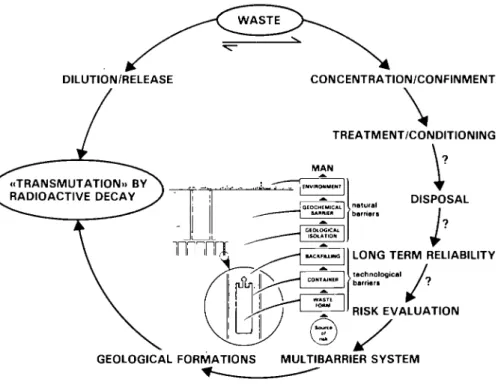
During the next 15 years, between 50.000 and, 100.000 m of low-activity wastes, between 100Û0 and 20.000 m of medium-low-activity wastes and up to about 1000 m of high-activity wastes will undergo the above-described sequence of operations each year in the European Community. This should be compared with the present Community produc-tion of non-nuclear wastes, which amounts to several tens of millions of cubic metres annually (Figs. 1 and 2) (1). What does this repre-sent at national level? Some 5000 tonnes of radioactive wastes arrive each year at the big La Manche storage centre in France, as against 100.000-200.000 tonnes of toxic and hazardous wastes at a large incineration centre. In the United Kingdom, there are today more than 150 sites where toxic wastes are handled or processed, whereas the number of existing and future sites for the storage of radioactive wastes is unlikely to exceed ten according to a recent communication
(2)
A radioactive waste-management enterprise is therefore an industrial enterprise on a modest scale, which is, however, highly diversified; the problem of ensuring consistant, if not centralized, management of such a system is easy to appreciate. This also helps to explain why national management agencies or bodies have been set up in numerous countries during the last few years.
This management problem - since the problem is indeed one of manage-ment - would be purely economic and commercial in nature and easy to master if the enterprise were a "normal" one.
But the substances all carry the label "radioactive". This common label covers specific levels of radioactivity (measured in Bq/m ) which vary over more than 12 orders of magnitude, half-lives ranging over six orders of magnitude (at least in the case of the most significant ones) and radiotoxicities (annual limits for uptake through ingestion or inhalation) which vary to a similar extent. In other words, the sub-stances are toxic to very widely varying degrees, and their toxicity can in some cases persist for a very long time.
These factors have the following repercussions on management:
The criterion of economic viability is replaced by that of "safety within reasonable limits": this is the ALARA (as low as reasonably achievable) principle laid down by the ICRP. The nuclear industry is, sofar at least, the only industry to have adopted this safety prin-ciple.
24 Orlowski & Girardi: The European Community's R & D work
distant future and, at all events, over a much longer timescale than for other industrial undertakings, with the attendant consequences. The major traditional industries plan for a period of three to five years, the mining industry invests for between 20 and 30 years, and civil engineers build structures (bridges, dams, etc.) which can last for decades and even centuries, because regular checks on their safety can be made thanks to easy and constant access. Here, the time-scale ranges from a few centuries (in the case of the surface storage of low-activity wastes) to a few thousand or a few tens of thousands of years (in the case of the geological storage of alpha-emitting high-activity wastes). The latter case rules out the possi-bility of permanently monitoring the storage facilities and of retrieving the substances stored.
- It is necessary to take account of the problem facing society as a result of the development of industry in general and of nuclear energy in particular.
These three considerations determine the particular context in which radioactive wastes have to be managed.
3. The role of R&D <