Nut consumption for vascular health and cognitive function
Jayne A. Barbour
1, Peter R. C. Howe
2, Jonathan D. Buckley
1, Janet Bryan
1and Alison M. Coates
1*
1Nutrition Physiology Research Centre, Sansom Institute for Health Research, University of South Australia, GPO Box 2471,
Adelaide, SA 5001, Australia
2Clinical Nutrition Research Centre, University of Newcastle, Callaghan, NSW 2308, Australia
Abstract
Nuts are rich in many nutrients that can benefit multiple cardiometabolic functions, including arterial compliance, blood pressure, inflam-mation, glucoregulation and endothelial vasodilatation. Impaired vasodilatation may contribute to impaired cognitive performance due to poor cerebral perfusion. The present narrative review examines associations between nut consumption, vascular health and cognitive function. It includes a systematic search which identified seventy-one epidemiological or intervention studies in which effects of chronic nut consumption on blood pressure, glucoregulation, endothelial vasodilator function, arterial compliance, inflammatory biomarkers and cognitive performance were evaluated. Weighted mean changes were estimated where data were available; they indicate that nut consumption reduces blood pressure and improves glucoregulation, endothelial vasodilator function and inflammation, whilst a limited number of studies suggest that nut consumption may also improve cognitive performance. Further clinical trials are warranted to explore relationships between nut consumption, endothelial function and cognitive function.
Key words:Nuts: Endothelial function: Inflammation: Vascular function: Cognition
Introduction
CVD and cognitive impairment are growing worldwide health concerns, particularly as populations age(1,2). In 2006, the worldwide prevalence of Alzheimer’s disease was estimated at 26·6 million and by 2050 this is predicted to quadruple(3). Increasing evidence suggests that CVD, the metabolic syndrome, hypertension, obesity and type 2 diabetes are associated with diminished cognitive function-ing and an increase in all types of dementia(4). These cog-nitive changes may be mediated through compromises in the structural and functional integrity of cerebral blood vessels. Cognitive performance refers collectively to mental processes including attention, memory, language, problem solving and decision making. Understanding the mechan-isms for regulating cognitive functions is important to reduce the impact of declining cognition in older adults. Interventions that slow or prevent this condition are valuable and have become a health priority(5). One of the mechanisms by which cognitive performance can be improved and cognitive decline delayed may be through maintenance of blood vessel health and improvement in blood flow to the brain(6,7). Impaired vasodilatation con-tributes to reduced cognitive performance, due to poor
peripheral and cerebral perfusion(8). Endothelial cells line blood vessels (including those in the brain); thus maintain-ing cerebral vascular function to ensure normal regulation of cerebral blood flow for the delivery of nutrients is essen-tial to maintain endothelial cell integrity(9).
It has been hypothesised that inflammation may con-tribute to cognitive decline(10) and to CVD processes(11). This may be a result of endothelial dysfunction(12,13) associ-ated with reduced NO bioavailability. NO is an important vasodilator, produced from L-arginine by endothelial NO synthase(14). Early phases of atherosclerosis involve the adhesion of circulating monocytes to the endothelium (inner lining of blood vessel walls) and their migration to the intima layer. This is a complex disease process mediated by inflammatory responses that involve cytokine production and up-regulation of adhesion molecules such as intercellular adhesion molecule-1 (ICAM-1), vascular cell adhesion molecule-1 (VCAM-1) and E-selectin. An increase in inflammatory cytokines (for example, C-reactive protein (CRP) and IL-6) have been found to be independent pre-dictors of CVD and type 2 diabetes(15). The endothelium is crucial for the maintenance of vascular tone and vascular structure; endothelial dysfunction predisposes individuals to complications of atherosclerosis by increasing blood
*Corresponding author:Dr Alison M. Coates, faxþ61 8 83022178, email [email protected]
Abbreviations:ALA,a-linolenic acid; CRP, C-reactive protein; ICAM-1, intercellular adhesion molecule-1; PREDIMED, PREvencion con DIeta MEDiterranea; VCAM-1, vascular cell adhesion molecule-1.
Nutrition Research Reviews
https:/www.cambridge.org/core/terms. https://doi.org/10.1017/S0954422414000079
pressure and arterial stiffness, characterised by increased pulse-wave velocity and an increase in augmentation index. Endothelial function declines with age but is also adversely affected by hypertension, hyperglycaemia, dyslipidaemia and obesity, individually or collectively known as the metabolic syndrome(16).
The principal energy source for the brain is glucose, which must be supplied continuously due to a limited storage capacity(17). In addition, a range of nutrients and substrates including oxygen needs to be delivered via the blood(18); hence cerebral blood flow and substrate trans-port across the blood – brain barrier are primary determi-nants of brain function(19). There is a growing interest in the role of nutrition in the causation and prevention of age-related cognitive decline and dementia; more research is needed to understand mechanisms for cognitive decline and possible delay.
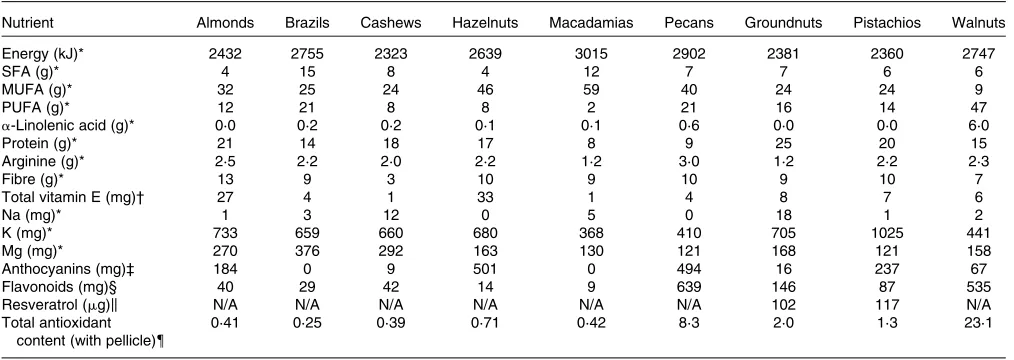
As shown in Table 1, nuts contain a range of nutrients with potential health benefits including improved glucose control and insulin sensitivity(20,21). Despite the high fat content of nuts, nut consumption has not been shown to increase body weight; instead it is associated with improved weight control(15,22). There is a substantial body of evidence demonstrating lipid-lowering effects of nut consumption(23) and large epidemiological studies have consistently revealed an association between frequent
nut consumption and reduced incidence of CHD(24).
A meta-analysis of thirteen intervention studies using walnuts(25) and a pooled analysis of twenty-five interven-tion studies with a range of nuts indicated a consistent cholesterol-lowering effect(26). The analysis in the latter review revealed a 7·4 % reduction in LDL-cholesterol with a mean nut consumption of 67 g/d. Reductions in
LDL-cholesterol were dose dependent, but not dependent on the type of nut consumed(26). The lipid-lowering effects may be attributed to the high content of unsaturated fat and fibre in nuts. Other bioactive nutrients in nuts may benefit glucoregulation(27), endothelial function, blood pressure control(28) and inflammation(21). Studies have demonstrated that higher nut consumers are at a signifi-cantly lower risk of non-cardiovascular inflammatory disease mortality(29) and risk of developing type 2 diabetes(30) than low nut consumers. These benefits may be attributed to their nutrient profile; plant-derived n-3 fatty acids (a-linolenic acid; ALA) found in walnuts have been shown in clinical and epidemiological studies to improve inflammation, arterial compliance, insulin resist-ance, endothelial function and blood pressure(31 – 34). Nuts, especially consumed with their skin intact, have a sig-nificant amount of polyphenols(35). The results of many epidemiological studies suggest that the intake of polyphe-nol-rich foods has a beneficial effect on a large number of cardiovascular risk factors including high blood pressure and poor vascular function(36). Polyphenols and vitamin E may have a role in modifying some of the inflammatory mediators(37,38) and be beneficial for cognitive
perform-ance(39,40). Unsalted nuts contain high levels of K and
Mg, making them a potential food for blood pressure con-trol. However, nuts are commonly sold as a highly salted product and in this form can substantially increase the intake of Na, hence reducing their potential benefit. In addition, nuts contain fibre and L-arginine that has been
[image:2.595.47.554.495.675.2]shown to improve endothelial function(41 – 44). Studies have investigated the impact of nuts on endothelial func-tion(28); however, no study has taken the next step and considered whether nuts may have beneficial effects on
Table 1.Nutritional composition of nuts (per 100 g)
Nutrient Almonds Brazils Cashews Hazelnuts Macadamias Pecans Groundnuts Pistachios Walnuts
Energy (kJ)* 2432 2755 2323 2639 3015 2902 2381 2360 2747
SFA (g)* 4 15 8 4 12 7 7 6 6
MUFA (g)* 32 25 24 46 59 40 24 24 9
PUFA (g)* 12 21 8 8 2 21 16 14 47
a-Linolenic acid (g)* 0·0 0·2 0·2 0·1 0·1 0·6 0·0 0·0 6·0
Protein (g)* 21 14 18 17 8 9 25 20 15
Arginine (g)* 2·5 2·2 2·0 2·2 1·2 3·0 1·2 2·2 2·3
Fibre (g)* 13 9 3 10 9 10 9 10 7
Total vitamin E (mg)† 27 4 1 33 1 4 8 7 6
Na (mg)* 1 3 12 0 5 0 18 1 2
K (mg)* 733 659 660 680 368 410 705 1025 441
Mg (mg)* 270 376 292 163 130 121 168 121 158
Anthocyanins (mg)‡ 184 0 9 501 0 494 16 237 67
Flavonoids (mg)§ 40 29 42 14 9 639 146 87 535
Resveratrol (mg)k N/A N/A N/A N/A N/A N/A 102 117 N/A
Total antioxidant content (with pellicle){
0·41 0·25 0·39 0·71 0·42 8·3 2·0 1·3 23·1
N/A, not available.
* Data from US Department of Agriculture, Agricultural Research Service(140). † Data from Kornsteineret al.(141).
‡ Data from Bollinget al.(35). § Data from Yanget al.(142). kData from Tokus¸ogluet al.(143). {Data from Blomhoffet al.(144).
Nutrition Research Reviews
https:/www.cambridge.org/core/terms. https://doi.org/10.1017/S0954422414000079
cerebral vascular function and little research has been conducted on the impact of nut consumption on cognitive performance.
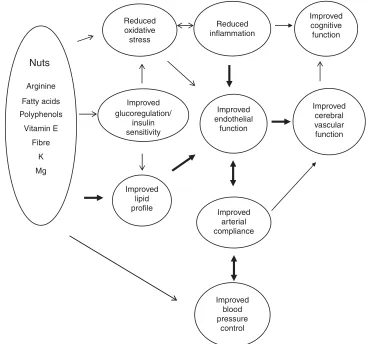
Thus, unsalted nuts contain the precursor, key ingredi-ents for cardiometabolic benefits needed to enhance blood vessel health, which may in turn improve cognitive function and limit cognitive decline as proposed in Fig. 1. Using a systematic search protocol, we reviewed the evidence for the effects of both tree and ground nuts on glucoregulation, blood pressure, arterial compliance, inflammation, endothelial vasodilator function and cog-nitive performance. As noted previously, there is a large body of consistent evidence demonstrating improvements in lipid regulation with nut consumption(25,26); hence this component has not been included in the present review.
Methods
Selection of studies
Medline (via Ovid) and CINAHL (via Ebsco host) databases and the Cochrane Library were searched on 21 November 2012. Search terms used included MeSH (Medical Subject
Headings) terms: ‘nuts’ OR ‘almond*’ OR ‘Brazil nut*’ OR ‘cashew*’ OR ‘hazelnut*’ OR ‘macadamia*’ OR ‘peanut*’ OR ‘pecan*’ OR ‘pistachio*’ OR ‘walnut*’ AND ‘endothel*’ OR ‘FMD’ OR ‘vascular*’ OR ‘blood pressure’ OR ‘arterial compliance’ OR ‘vasodilatation’ OR ‘glucose’ OR ‘insulin’ OR ‘inflam*’ OR ‘cognit*’. Limits included ‘human only’ and ‘English language’. In addition, reference lists from the publications identified by the database searches were also manually searched to identify other relevant articles that were not detected by the searches. Studies were included if they met the following criteria: intervention or epidemiological studies in human subjects. Intervention diets included at least one of the following nuts: almonds, cashews, hazelnuts, macadamias, groundnuts, pistachios, walnuts, pecans or Brazil nuts. Intervention studies included assessment of chronic nut consumption for a minimum period of 3 weeks, thereby assessing chronic changes. Published studies were required to be original research and evaluate the effects of nuts on at least one of the following in human subjects: glucoregulation, endo-thelial vasodilator function, arterial compliance, resting blood pressure, inflammation or cognitive performance.
Reduced inflammation
Improved cognitive function Reduced
oxidative
Nuts
Arginine
Fatty acids
stress
Improved
Improved endothelial
function Polyphenols
Vitamin E
Fibre
K
Improved cerebral vascular function glucoregulation/
insulin sensitivity
Mg
Improved lipid profile
Improved arterial compliance
Improved blood pressure
[image:3.595.111.477.356.700.2]control
Fig. 1.Summary of potential effects of nutrients in nuts to improve cardiovascular risk factors (lipid profile, arterial compliance, glucoregulation, oxidative stress, blood pressure and inflammation) and consequent improvement in endothelial function and potential improvement in cerebral vascular function and hence cognitive performance. !, Weak evidence;!, strong evidence; $, bi-directional effect; $, strong bi-directional effect.
Nutrition Research Reviews
https:/www.cambridge.org/core/terms. https://doi.org/10.1017/S0954422414000079
Studies were excluded if they were non-English-language papers, narrative reviews, systematic reviews, expert opinions, editorials, abstracts, letters to the editor, theses, or animal or in vitro studies. Weighted mean changes in glucoregulation, systolic and diastolic blood pressure, CRP, ICAM-1, VCAM-1 and endothelial vasodilator function were calculated for studies that reported data suitable for calculating a percentage change. Study sample size was used to weight the calculation of the overall mean percentage change across studies using STATA software (StataIC 11; StataCorp LP).
Results
The search revealed articles published between March 1993 and October 2013. Of the 4198 articles identified by all databases and nine articles identified from hand searching, 3019 were excluded as duplicates, 114 were excluded because of document type (review, note, letter, proceedings paper, or meeting abstract) and 837 were excluded because they did not assess endothelial function, blood pressure, inflammation, glucoregulation or cognitive performance in conjunction with nut consumption. Of the 237 articles screened (titles and abstracts), 166 were excluded because they did not meet the inclusion criteria. Therefore, seventy-one studies were included in the present
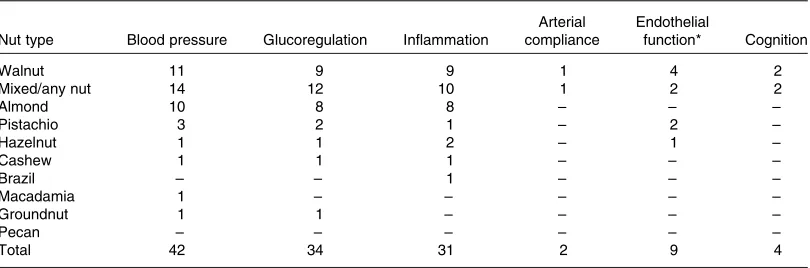
review as shown in the PRISMA (Preferred Reporting Items for Systematic Reviews and Meta-Analyses) flowchart (Fig. 2). A total of forty-four studies evaluated blood pressure, thirty-two evaluated glucoregulation, thirty-one evaluated inflammatory markers, nine evaluated endothelial vasodilator function, two evaluated arterial compliance and four eva-luated cognitive performance. A total of nine types of nut were used in these studies: almonds, Brazil nuts, cashews, hazelnuts, macadamias, groundnuts, pistachios, pecans and walnuts. The majority of studies examined walnuts, almonds and mixed/any nuts (Table 2).
Most research measuring the effect of nut consumption on glucoregulation, blood pressure, inflammation, arterial compliance, endothelial vasodilator function and cognition has been performed with walnuts, mixed or non-specified nuts, almonds and pistachios, with only seven studies using groundnuts, hazelnuts, cashews, Brazil nuts or maca-damias and no studies with pecans (Table 2). Studies are summarised in Tables 3 – 8 and are grouped according to outcomes, presented in order of efficacy (using mean percentage or blood pressure (mmHg) change where avail-able). The following information was also extracted: author and year of publication, number, age and sex of the participants, type of individuals studied (i.e. healthy, hyperlipidaemic, high CHD risk, type 2 diabetes, over-weight/obese or metabolic syndrome), study design,
Additional studies identified with hand
search Initial bibliographic search
Pool of citations (n 4198) (Medline n 2845, Embase
n 1097, CINAHL n 190, Cochrane Library n 66)
Pool of citations (n 9) Pool of citations (n 4207)
Identification
Duplicate removal (n 3019 removed)
Application of inclusion and exclusion criteria
(n 951 excluded) Remaining articles after
duplicate removal (n 1188)
Remaining articles (titles and abstracts) after assessment for
eligibility (n 237) Screening
Eligibility
Included Final full-text articles included in analysis (n 71)
Application of inclusion and exclusion criteria
[image:4.595.121.464.397.708.2](n 166 excluded)
Fig. 2.PRISMA (Preferred Reporting Items for Systematic Reviews and Meta-Analyses) flow chart showing procedures used to identify studies investigating the effect of nuts on blood pressure, endothelial function, inflammation, arterial compliance, glucoregulation and cognition included in the systematic search.
Nutrition Research Reviews
https:/www.cambridge.org/core/terms. https://doi.org/10.1017/S0954422414000079
length of intervention, type and dose of nut, controls used and effect-size calculations where possible. Fig. 3 presents the number of outcome measures and the type of studies reflecting the level of evidence for these studies according to National Health and Medical Research Council guide-lines(45). Most intervention studies were randomised and controlled, providing greater evidence than uncontrolled or non-randomised trials.
Effects of nuts on glucoregulation
Details of studies measuring the effect of nut consumption on glucoregulation are reported in Table 3. A total of eight observational and twenty-four intervention trials evaluated the effects of chronic consumption of nuts on gluco-regulation. Nuts consumed included walnuts, pistachios, groundnuts, almonds, cashews and mixed nuts, with amounts consumed ranging from 10 to 108 g/d (13 ounce to 4 ounces) (approximately 2 – 20 % of energy intake). The duration of consumption ranged from 4 weeks to 16 years. Intervention studies made comparisons with a healthy diet (fourteen studies), habitual diet (three studies), high-fat diet (one study) or other food products (five studies): muffins, pretzels, cereal bar, cheese or another type of nut. One study used no control. Of the studies, four compared habitual or healthy diets with interven-tion diets including nuts (NORDIET(46)or a Mediterranean diet(47,48)).
Tree nuts were associated with a lower prevalence of fasting hyperglycaemia compared with non-nut consumers in the National Health and Nutrition Survey (NHANES) cohort study(49). However, a healthy dietary pattern inclu-ding nuts found no association with fasting glucose or insulin(50). It is possible that the amount of nuts consumed was insufficient to show benefits. Nut consumption has also been associated with a reduced risk of type 2 diabetes; evidence to support this comes from large epidemiological studies(51 – 54). The Nurses’ Health Study demonstrated that consumption of nuts ($ 5 times per week), peanut butter ($ 5 times per week) or walnuts ($ twice per week) was
associated with a 24, 21 and 15 % lower risk, respectively, of developing type 2 diabetes(51,54) compared with those who never or rarely ate nuts; the effect was greatest in those of healthy body weight(51). In addition, the Shanghai Women’s Health Study demonstrated that groundnut con-sumption was associated with a 22 % decreased risk of type 2 diabetes(55). The SUN Study demonstrated a 35 % reduced risk of type 2 diabetes with a Mediterranean diet including an unspecified quantity of nuts(53). However, other components of the Mediterranean diet including olive oil and a high fibre intake may have also contributed to this outcome(56). In contrast, the Iowa Women’s Health Study did not find any association of consumption of foods high in vegetable fat (including nuts) and incidence of type 2 diabetes(57), which may in part be due to the low mean intake of nuts in this cohort.
[image:5.595.95.500.89.223.2]Clinical trials examining nut consumption and diabetes risk, glycaemic control or insulin resistance have suggested some beneficial effects. Some short-term intervention studies have shown benefits of nut consumption on glucose homeostasis(58,59) and insulin secretion(46,58,60,61). The effects of nuts on insulin sensitivity are influenced strongly by changes in body weight, which may have accounted for the changes observed in one of these studies where participants reduced body weight with nut con-sumption. Longer intervention trials with Mediterranean diets supplemented daily with 20 – 50 g of walnuts or 30 g of mixed nuts (a mixture of walnuts, almonds and hazel-nuts was used in the PREvencion con DIeta MEDiterranea (PREDIMED) trial as reported by Casas-Agustenchet al.(21)) resulted in a reduction in fasting glucose, insulin and improvement in insulin sensitivity (homeostatic model assessment of insulin resistance; HOMA)(47) and the inci-dence of type 2 diabetes by 52 % over 4 years(30). Benefits shown in studies with nuts included as part of the interven-tion diet (NORDIET(46)or Mediterranean diet(47)) may have been partly due to other components of these diets(62). Other studies have not shown benefits; consumption of pistachios, almonds, walnuts and a Mediterranean diet (supplemented with 10 g nuts/d) revealed no effect on Table 2. Number of measures of nut consumption on the effect on blood pressure, glucoregulation, inflammation, arterial
compliance, endothelial function and cognition (some studies tested more than one type of nut)
Nut type Blood pressure Glucoregulation Inflammation
Arterial compliance
Endothelial
function* Cognition
Walnut 11 9 9 1 4 2
Mixed/any nut 14 12 10 1 2 2
Almond 10 8 8 – – –
Pistachio 3 2 1 – 2 –
Hazelnut 1 1 2 – 1 –
Cashew 1 1 1 – – –
Brazil – – 1 – – –
Macadamia 1 – – – – –
Groundnut 1 1 – – – –
Pecan – – – – – –
Total 42 34 31 2 9 4
* Endothelial vasodilator function assessed by either flow-mediated dilatation or Endo-PAT device.
Nutrition Research Reviews
https:/www.cambridge.org/core/terms. https://doi.org/10.1017/S0954422414000079
Table 3.Studies measuring effect of nut consumption on glucoregulation
Author Time Participants Study design Amount/type of nuts Outcomes†
Effect; effect size
Observational studies measuring effect of nut consumption on diabetes risk and elevated glucose (studies presented in order of efficacy) Martı´nez-Gonza´lez
et al.(2008)(53)
4 years n13380, healthy, M and F, mean 38 (SD12) years
Prospective cohort (SUN study), FFQ and incidence of Dm
Tertiles of Med diet (unspecified amount of nuts)
RR Med diet # 35 % RR
incidence of Dm
þ 1·0
0·41 (95 % CI 0·2, 0·9) 0·17 (95 % CI 0·04, 0·8) Jianget al.
(2002)(51) 16 years n137856, healthy, F,mean 46 (range 34 – 59) years
Prospective cohort (Nurses’ Health Study), FFQ and incidence of Dm
Quantiles of nuts/peanut butter
RR Nuts # 24 % RR, peanut
butter # 21 % RR incidence of Dm
þ
Never/rare 1·0
,1 time/week 0·98 (95 % CI 0·9, 1·1)
1 – 4 times/week .5 times/week
0·91 (95 % CI 0·8, 1·0) 0·79 (95 % CI 0·7, 0·8) Villegaset al.
(2008)(55) 5 years n64227, healthy, F, mean49 (range 43 – 63) years Prospective cohort(Shanghai Women’s Health Study), FFQ and incidence of Dm
Quintiles of groundnut consumption
RR Groundnuts # 20 % RR
incidence of Dm
þ 1·0
0·8 (95 % CI 0·7, 0·9) 0·95 (95 % CI 0·82, 1·1) 0·79 (95 % CI 0·7, 0·9) 0·8 (95 % CI 0·7, 0·9) Panet al.
(2013)(54)
4 years n137856, healthy, F, mean 52 (SD10) years
Prospective cohort (Nurses’ Health Study cohorts 1 and 2), FFQ and incidence of Dm
Quintiles of walnut consumption
RR Walnuts # 15 % RR
incidence of Dm
þ
Never/rare 1·0
,1 serve/week 1·01 (95 % CI 0·95, 1·08)
1 serve/week 1·01 (95 % CI 0·90, 1·13)
$2 serves/week 1·04 (95 % CI 0·92, 1·18) Meyeret al.
(2001)(57)
11 years n7210, high risk of CVD, M and F, mean 68 (SD6) years
X-sect, FFQ, prevalence of elevated glucose (PREDIMED)
Quintiles of vegetable fat (including nuts)
Data N/A No association of
incidence of Dm with nut consumption
NS-G
Cross-sectional studies measuring effect of nut consumption on diabetes risk and elevated glucose (studies presented in order of efficacy) Nettletonet al.
(2008)(145)
X-sect n5011, healthy, M and F, 45 – 84 years
X-sect, MESA, FFQ and prevalence of Dm
Quintiles of healthy dietary pattern (including any nuts)
# 15 % RR incidence of Dm with nut consumption
þ
O’Neilet al. (2011)(49)
X-sect n13 292, general population, M and F, 19 – 50þ years
X-sect, 1999 – 2004 NHANES, 24 h recall and prevalence of elevated glucose
‘All’ nut group$7 g/d (A) No association of
prevalence of elevated glucose with ‘all’ nut consumption
NS-G
Tree nut group$7 g/d (B) 4 % # prevalence
elevated glucose with tree nut consumption
þ
Ibarrola-Jurado
et al.(2013)(81) X-sect n7210, high risk of CVD,M and F, mean 68 (SD6) years
X-sect, FFQ, prevalence of elevated glucose (PREDIMED)
Tertiles (any nuts) No association of elevated
glucose with nut consumption
NS-G
,28 g/week 1·0
28 – 84 g/week 0·95 (95 % CI 0·71, 1·29)
.84 g/week 0·85 (95 % CI 8·81, 1·53)
Intervention studies measuring effect of nut consumption on glucoregulation (studies presented in order of efficacy) Salas-Salvado´
et al.(2011)(30) 4 years n418 (control
¼134,
nuts ¼145, OO ¼139) high risk of CVD, M and F, mean 68 (range 55 – 80) years
RCT, parallel, Med dietþ OOv.Med dietþnuts v.LF diet (control) (PREDIMED)
30 g/d mixed nuts‡ # 52 % RR incidence of Dm
þ
J.
A.
Barbour
et
al.
136
.
https://doi.org/10.1017/S0954422414000079
https:/www.cambridge.org/core
. University of Southern Queensland
, on
05 Jun 2017 at 00:00:53
Table 3.Continued
Author Time Participants Study design Amount/type of nuts Outcomes†
Effect; effect size
Espositoet al.
(2004)(47) 2 years n180 (control
¼90, Med diet ¼90), Met-S, M and F, mean 44 (SD6) years
RCT, parallel, Med diet (including nuts)v. prudent diet (control)
20 – 50 g/d walnuts Glucose # 5 %* þ; 0·8
Insulin # 33 %* þ; 0·8
HOMA # 45 %* þ; 0·8
Wienet al.
(2010)(61) 16 weeks n65 (control
¼32, nut ¼33), pre-diabetes, M and F, mean 53 (SD9) years
RCT, parallel, American Diabetes Association diet (control) with/ without almonds
56 g/d almonds Glucose NS NS-G; 0·2
Insulin # 32 %* þ; 1·3
HOMA # 40 %* þ; 0·2
HbA1c NS NS-G; 0·4
Casas-Agustench et al.(2011)(60)
12 weeks n50 (control ¼25, nut ¼25), Met-S, M and F, mean 52 (SD8) years
RCT, parallel, isoenergetic healthy diet (control) with/without nuts
30 g/d mixed nuts‡ Glucose NS NS-G; 0·0
Insulin # 33 %* þ; 0·4
HOMA # 33 %* þ; 0·4
Adamssonet al.
(2011)(46) 4 weeks n86, M and F (control¼42, NORDIET ¼44), mean 53 (SD8) years, hypercholesterolaemic
RCT parallel, NORDIET (high fibre, fish, LF dairy, nuts)v.habitual diet (control)
Ad libitumalmonds Glucose NS NS-G; 0·0
Insulin # 24 %* þ; 0·5
HOMA # 25 %* þ; 0·6
Sariet al.
(2010)(59) 4 weeksper arm n32, healthy M, mean 22(range 21 – 24) years Prospective cohort,isoenergetic Med diet (control) with/without pistachios, no washout
80 – 100 g/d pistachios Glucose # 9 % þ; 0·9
Kalgaonkaret al. (2011)(62)
6 weeks n31 (almond ¼14, walnut ¼17), F, with PCOS, age range 20 – 45 years
Pre-/post-measures walnutsv.almonds
36 g/d walnuts (W) 26 g/d almonds (A)
Glucose NS (Wv.A) NS-G
Insulin NS (Wv.A) NS-G; 0·8
HOMA NS (Wv.A) NS-G; 2·3
HbA1c # 4 %* (Wv.A) þ; 0·1
Estruchet al. (2006)(58)
12 weeks n772 (control ¼257, OO ¼257, nuts ¼258), high risk of CVD, M and F, mean 69 (SD6) years
RCT, parallel, Med dietþ OOv.Med dietþnuts v.LF diet (control) (PREDIMED)
30 g/d mixed nuts‡ Glucose #* data N/A þ; 0·1
Insulin #* data N/A þ; 0·2
HOMA #* data N/A þ; 0·3
Cohen & Johnston
(2011)(64) 12 weeks n13 (control
¼6, nut ¼6), Dm, mean 66 (SD3) years
Pilot study, RCT, parallel almonds or cheese (control)
28 g/d almonds Glucose NS NS-G; 0·3
Insulin NS NS-G; 0·7
HbA1c # 4 %* þ; 1·5
Lovejoyet al. (2002)(65)
4 weeks per arm
Study 1,n20, healthy, mean 25 (SD1) years
Prospective cohort (no control) habitual dietþ almonds
100 g/d almonds Glucose NS NS-G; 0·2
Insulin NS NS-G; 0·1
Study 2,n30, Dm, mean 54 (SD2) years
RCT, cross-over, HF (control) with/without almonds and LF (control) with/without almonds
57 – 113 g/d (10 % energy) almonds
HF glucose NS NS-G; 0·3
LF glucose NS NS-G; 0·2
HF insulin NS NS-G
LF insulin NS NS-G
HF HbA1c NS NS-G
LF HbA1c NS NS-G
Jenkinset al. (2011)(66)
3 months n117 (control ¼37, 37 g/d nut ¼40, 75 g/d nut ¼40), Dm, M and F, mean 62 (SD10) years
RCT, parallel, 75 g/d nutv. 37 g/d nutþhalf-dose muffinv.muffin (control)
75 or 37 g/d mixed nuts§
Glucose (75 g) NS NS-G; 0·2
Glucose (37 g) NS NS-G; 0·2
HbA1c (75 g) NS NS-G; 0·0
HbA1c (37 g) NS NS-G; 0·0
Thomazellaet al.
(2011)(48) 12 weeks n40 (control
¼19, Med diet ¼21), M, CVD, mean 55 (SD5) years
Prospective controlled study, Med diet (includ-ing nuts)v.LF diet (control)
10 g/d any nuts Glucose NS NS-G; 0·4
V
ascular
and
cognitive
effects
of
nuts
137
.
https://doi.org/10.1017/S0954422414000079
https:/www.cambridge.org/core
. University of Southern Queensland
, on
05 Jun 2017 at 00:00:53
Table 3.Continued
Author Time Participants Study design Amount/type of nuts Outcomes†
Effect; effect size
Mercanligilet al. (2007)(74)
4 weeks per arm
n15, M, mean 48 (SD8) years, hypercholestero-laemic
Two-period study, LF diet (control)v.LFþ hazel-nuts, non-isoenergetic
40 g/d hazelnuts (12 % energy)
Glucose NS NS-G; 0·3
Llorente-Corte´s
et al.(2011)(67) 12 weeks n49 (OO
¼16, nut ¼15, control ¼15), high risk of CVD, M and F, mean 66 (SD7) years
RCT, parallel, Med dietþ OOv.Med dietþnuts v.LF diet (control) (PREDIMED)
30 g/d mixed nuts‡ Glucose NS NS-G; 0·4
Wienet al. (2003)(76)
24 weeks n52 (control ¼28, nut ¼24), M and F, over-weight/obese, mean 55 (SD2) years
RCT, parallel, iso-energetic, LE dietþ almondv.CHO (control)
84 g/d almonds Glucose NS NS-G; 0·0
Insulin NS NS-G; 0·3
HOMA NS NS-G; 0·0
HbA1c NS NS-G; 0·0
Zaveri & Drum-mond (2009)(63)
12 weeks n36 (control ¼13, cereal bar ¼14, almond ¼18), healthy, M and F, mean 40 (SD7) years
RCT, parallel, healthy diet with/without nuts or cereal bar (control)
56 g/d almonds Glucose NS NS-G
Insulin NS NS-G
Liet al.(2010)(75) 12 weeks n31, obese, M and F, (control ¼28 pistachio ¼31), mean 45 (SD7) years
RCT, parallel, isoenergetic prescribed dietþ pretzels (control) or pistachios
53 g/d pistachios Glucose NS NS-G;20·6
Insulin NS NS-G; 1·8
Tapsellet al.
(2004)(69) 6 months n41 (control
¼21,
walnut ¼20), Dm, M and F, mean 60 (SD8) years
RCT, parallel, isoenergetic LF diet (control) with/without walnuts
30 g/d walnuts HbA1c NS NS-G; 0·0
Tapsellet al.
(2009)(70) 12 months n34 (control
¼17,
walnut ¼17), over-weight, Dm, M and F, mean 55 (SD9) years
RCT, parallel, isoenergetic LF diet (control) with/without walnuts
30 g/d walnuts Glucose NS NS-G; 0·4
Insulin " 6 %* NS-G;20·3
HbA1c NS NS-G; 0·1
Mukuddem-Peter-senet al.(2007)(71) 8 weeks n64 (control
¼22,
walnut ¼21, cashew ¼21), Met-S, M and F, mean 45 (SD8) years
RCT, parallel, isoenergetic LF diet (control) with/without walnuts or cashews
63 – 108 g/d walnuts/ cashews
Cashew
glucose " 13 %*
NS-G;20·8
Walnut glucose NS NS-G;20·6
Maet al.(2010)(72) 8 weeks per arm
n21, Dm, M and F, mean 58 (SD8) years
RCT, cross-over, ad libitumdiet (control) with/without nuts, not isoenergetic, 8 weeks washout
56 g/d walnuts Glucose NS NS-G;20·3
Insulin Ns NS-G; 0·7
HOMA NS NS-G;20·4
HbA1c NS NS-G; 0·0
Kasim-Karakas
et al.(2004)(73) 3 months n17, mean 34 (
SD5) years, F, PCOS
Prospective cohort, iso-energetic habitual diet (control)v.walnuts
106 g/d walnuts Glucose " 19 %* 2;24·5
Insulin NS NS-G; 0·2
HOMA NS NS-G; 1·0
Glucose, fasting glucose; M, male; F, female; Dm, type 2 diabetes; Med diet, Mediterranean diet; #, reduction; RR, relative risk;þ, significant reduction; X-sect, cross-sectional; PREDIMED, PREvencion con DIeta MEDiterranea;
N/A, not available; NS-G, no significant change; MESA, Multi-Ethnic Study of Atherosclerosis; NHANES, National Health and Nutrition Survey; RCT, randomised controlled trial; OO, olive oil; LF, low-fat; Met-S, metabolic
syndrome; insulin, fasting insulin; HOMA, homeostatic model assessment of insulin resistance; NS, no significant difference; PCOS, polycystic ovary syndrome; HF, high-fat; LE, low-energy; CHO, carbohydrate; ", increase;
– , significant increase
*P#0·05.
† Outcome (activev. control) for intervention studies.
‡ Mixed nuts¼walnuts, almonds and hazelnuts.
§ Mixed nuts¼almonds, pistachios, walnuts, groundnuts, hazelnuts, pecans, cashews and macadamias.
J.
A.
Barbour
et
al.
138
.
https://doi.org/10.1017/S0954422414000079
https:/www.cambridge.org/core
. University of Southern Queensland
, on
05 Jun 2017 at 00:00:53
Table 4.Studies measuring effect of nut consumption on blood pressure (BP)
Author Time Subjects Study design Amount/type of nuts Outcomes†
Effect; effect size
Prospective cohort studies measuring the effect of nut consumption on HT (studies are presented in order of efficacy) Steffenet al.
(2005)(78) 15 years n4304, M and F,healthy, 18 – 30 years Prospective cohort(CARDIA), diet history and prevalence of HT
Any nuts HR Inverse relationship
between nut consump-tion and HT
þ
,0·1 serves/d 1·0
0·1 – 0·3 serves/d 0·84 (95 % CI 0·73, 0·98) Pfor trend¼0·04 .0·3 serves/d 0·85 (95 % CI 0·72, 0·99)
Djousse´et al.
(2010)(77) 12 months n15966, free of HT, Mand F, mean 52 (range 45 – 64) years
Prospective cohort, FFQ and self-reported risk of HT (Physicians’ Health Study)
Any nuts HR Nut consumption
associ-ated with # risk of hypertension (P¼0·01)
þ
None 1·0
1 – 3 serves/month 0·93 (95 % CI 0·86, 1·01) 1 serves/week 0·94 (95 % CI 0·86, 1·03) 2 – 6 serves/week 0·87 (95 % CI 0·79, 0·96) $7 serves/week 0·77 (95 % CI 0·64, 0·93) Wenget al.
(2013)(79)
9 years n9913, healthy, M and F, mean 53 (SD6) years
Prospective cohort, ARIC, FFQ and BP
Quintiles of nut consumption
HR Nut intake inversely
related to incidence of HT (P¼0·02)
þ 1·2 (95 % CI 0·98, 1·27)
0·96 (95 % CI 0·87, 1·07) 0·91 (95 % CI 0·81, 1·03) 0·87 (95 % CI 0·77, 0·97) Martı´nez-Lapiscina
et al.(2010)(80) 4 years n17177, healthy, M andF, mean 36 (range 25 – 51) years
Prospective cohort (SUN) study, FFQ and self-reported HT
Any nuts, never/rarely to 2þ/week
HR highestv.lowest intake
No association with HT and nut consumption
NS-BP
Cross-sectional studies measuring effect of nut consumption on BP/HT (studies are presented in order of efficacy) O’Neilet al.
(2011)(49)
X-sect n13292, general
population, M and F, 19 – 50þ years (20 % nut consumers)
1999 – 2004 NHANES, 24 h recall and BP
HTv.non-consumers BPv.non-consumers (A) SBP # 1 mmHg
(P,0·01)
þ
‘All’ nut group$7 g/d (A)
# 3 %* (A) DBP NS NS-BP
Tree nut group$7 g/d (B)
# 3 %* (B) SBP # 1 mmHg
(P,0·01)
þ
(B) DBP NS NS-BP
Nettletonet al.
(2008)(52) X-sect n5089, healthy, M andF, 45 – 84 years MESA, FFQ and BP Quintiles of healthy diet-ary pattern (including any nuts)
No data provided No association of SBP or DBP with healthy diet-ary pattern
NS-BP
Alvarez Leo´net al. (2006)(50)
X-sect n578, healthy or Met-S, M and F, 18 – 75 years
ENCA, FFQ and BP Tertiles (any nuts) OR HT No association of BP
with nut consumption
NS-BP
Nuts T1 1·0
Nuts T2 0·73 (95 % CI 0·41, 1·28)
Nuts T3 0·83 (95 % CI 0·47, 1·46)
Ibarrola-Jurado
et al.(2013)(81) X-sect n7210, high risk of CVD,M and F, mean 68 (SD6) years
X-sect, FFQ and prevalence of HT (PREDIMED)
Tertiles (any nuts) T1,28 g/week T2 28 – 84 g/week T3.84 g/week
OR HT No association of HT
with nut consumption
NS-BP 1·0
0·96 (95 % CI 0·71, 1·29) 1·12 (95 % CI 0·81, 1·53) Chronic effects of nuts on resting BP (studies are presented in order of efficacy)
Wienet al. (2003)(76)
24 weeks n52 (control ¼28 nut ¼24), M and F, over-weight/obese, mean 55 (SD2) years
RCT, parallel, iso-energetic, LE dietþ almondv.CHO (control)
84 g/d almonds SBP # 14 mmHg* þ; 0·7
DBP NS NS-BP; 0·0
Estruchet al.
(2006)(58) 12 weeks n772 (control
¼257,
OO ¼257, nut ¼258), high risk of CVD, M and F, mean 69 (SD6) years
RCT, parallel, Med diet þOOv.Med dietþ nutsv.LF diet (control) (PREDIMED)
30 g/d mixed nuts‡ SBP # 7 mmHg* þ; 0·3
DBP # 3 mmHg* þ; 0·2
V
ascular
and
cognitive
effects
of
nuts
139
.
https://doi.org/10.1017/S0954422414000079
https:/www.cambridge.org/core
. University of Southern Queensland
, on
05 Jun 2017 at 00:00:53
Table 4.Continued
Author Time Subjects Study design Amount/type of nuts Outcomes†
Effect; effect size
Espositoet al.
(2004)(47) 2 years n180 (control
¼90,
Med diet ¼90), Met-S, M and F, mean 44 (SD6) years
RCT, parallel, Med diet (including nuts) v.prudent diet (control)
20 – 50 g/d walnuts SBP # 3 mmHg* þ; 0·7
DBP # 2 mmHg* þ; 0·7
Adamssonet al. (2011)(46)
4 weeks n86 (control ¼42, NORDIET ¼44), M and F, hypercholes-terolaemic, mean 53 (SD8) years
RCT, parallel, NORDIET (high fibre, fish, LF dairy, nuts)v.habitual diet (control)
Ad libitumalmonds SBP # 6 mmHg* þ; 0·6
DBP # 3 mmHg* þ; 0·4
Llorente-Corte´s
et al.(2011)(67) 12 weeks n49 (OO
¼16, nut ¼15, control ¼15), high risk of CVD, M and F, mean 66 (SD7) years
RCT, parallel, Med diet þOOv.Med dietþ nutsv.LF diet (control) (PREDIMED)
30 g/d mixed nuts‡ SBP #7 mmHg* þ; 0·4
DBP NS NS-BP; 0·2
Fitoet al.
(2007)(85) 12 weeks n372 (OO
¼123, nut ¼128, control ¼127), high risk of CVD, M and F, mean 66 (SD9) years
RCT, parallel, Med diet þOOv.Med dietþ nutsv.LF diet (control) (PREDIMED)
30 g/d mixed nuts‡ SBP #* (data N/A) þ
DBP #* (data N/A) þ
Jenkinset al.
(2008)(82) 1 year n50, hyperlipidaemic, Mand F, mean 59 (
SD1) years
Single-phase prospective study, pre-/post-measures, sterolþ soyaþalmonds (no control)
23 g/4·2 MJ per d almonds
(v.. baseline)
SBP # 4 mmHg* þ; 0·4
DBP # 2 mmHg* þ; 0·5
Menaet al. (2009)(84)
12 weeks n106 (control ¼36, nut ¼35, OO ¼35), Dm, risk of CVD, M and F, mean 66 (SD7) years
RCT, parallel, Med diet þOOv.Med dietþ nutsv.LF diet (control) (PREDIMED)
30 g/d mixed nuts‡ (v.baseline)
SBP # 3 mmHg* þ
DBP # 2 mmHg* þ
Toledoet al. (2013)(83)
4 years n7158 (control ¼2064, OO ¼2345, nuts ¼2065), M and F, risk of CVD, mean 67 (SD6) years
RCT, parallel, Med diet þOOv.Med dietþ nutsv.LF diet (control) (PREDIMED)
30 g/d mixed nuts‡ SBP NS NS-BP; 0·2
DBP # 2 mmHg* þ; 1·1
Wienet al. (2010)(61)
16 weeks n65 (control ¼32, nut ¼33), prediabetes, M and F, mean 53 (SD9) years
RCT, parallel, American Diabetes Association diet (control) with/ without almonds
56 g/d almonds SBP NS NS-BP; 0·2
DBP NS NS-BP; 0·2
Jenkinset al. (2011)(66)
3 months n117 (control ¼37, 37 g/d nut ¼40, 75 g/d nuts ¼40), Dm, M and F, mean 62 (SD10) years
RCT, parallel, 75 g/d nut v.37 g/d nutsþ half-dose muffin v.muffin (control)
75 or 37 g/d mixed nuts§ SBP NS NS-BP; 0·2
DBP NS NS-BP; 0·2
Spaccarotellaet al. (2008)(146)
8 weeks per arm
n21, healthy, M and F, mean 66 (range 45 – 75) years
RCT, cross-over, habit-ual diet (control) with/ without walnuts (2 weeks washout)
75 g/d walnuts SBP NS NS-BP; 0·1
DBP NS NS-BP; 0·2
Wuet al.(2010)(68) 12 weeks n277 (control ¼95, flax ¼94, nut ¼94), Met-S, M and F, mean 49 (SD8) years
RCT, parallel, isoenergetic LF diet (control) with/without flaxseeds or walnuts
30 g/d walnut flour SBP NS NS-BP; 0·1
DBP NS NS-BP; 0·0
J.
A.
Barbour
et
al.
140
.
https://doi.org/10.1017/S0954422414000079
https:/www.cambridge.org/core
. University of Southern Queensland
, on
05 Jun 2017 at 00:00:53
Table 4.Continued
Author Time Subjects Study design Amount/type of nuts Outcomes†
Effect; effect size
Sariet al.
(2010)(59) 4 weeks perarm n32, healthy, M, mean22 (range 21 – 24) years
Prospective cohort, isoenergetic Med diet (control) with/without pistachios, no washout
80 – 100 g/d pistachios SBP NS NS-BP; 0·3
DBP NS NS-BP; 0·1
Dinet al.
(2011)(109) 4 weeks perarm n30, healthy, M and F,mean 23 (
SD3) years
RCT, cross-over, non-isoenergetic habitual diet (control) with/without walnuts, no washout
15 g/d walnuts SBP NS NS-BP; 0·3
DBP NS NS-BP;20·1
Thomazellaet al.
(2011)(48) 12 weeks n40 (control
¼19, Med diet ¼21), M, CVD, mean 55 (SD5) years
Prospective controlled study, Med diet (including nuts) v.LF diet (control)
10 g/d any nuts SBP NS NS-BP; 0·2
DBP NS NS-BP; 0·1
Mukuddem-Peter-senet al.(2007)(71) 8 weeks n64 (control
¼22, nut ¼21, cashew ¼21), Met-S, M and F, mean 45 (SD8) years
RCT, parallel, iso-energetic LF diet (control) with/without walnuts (W) or cashews (C)
63 – 108 g/d walnuts/ca-shews
SBP NS W and C NS-BP; 0·1
DBP NS W and C NS-BP; 0·1
Iwamotoet al.
(2002)(147) 4 weeks perarm n80, healthy, M and F,mean 24 (
SD9) years
RCT, cross-over, Japanese diet with/ without walnuts (no washout)
44 – 58 g/d walnuts SBP NS NS-BP
DBP NS NS-BP
Westet al.
(2012)(107) 4 weeks perarm n25, hypercholestero-laemic, M and F, mean 48 (SD2) years
RCT, cross-over, LF diet (control)v.low-dose pistachiosv.high-dose pistachios, no washout
32 – 63 g/d (A) or 63 – 126 g/d (B) pistachios
(A) SBP NS NS-BP; 0·1
(A) DBP NS NS-BP; 0·1
(B) SBP NS NS-BP; 0·0
(B) DBP NS NS-BP; 0·0
Jenkinset al.
(2003)(89) 4 weeks n25 (control
¼12, nut ¼13), hyperlipidae-mic, M and F, mean 59 (SD1) years
RCT, parallel, plant sterolþsoyaþ almondv.statin v.LF diet (control)
14 g/4·2 MJ almonds SBP NS NS-BP; 0·1
DBP NS NS-BP; 0·1
Jenkinset al. (2002)(99)
1 month per arm
n27, hyperlipidaemic, M and F, mean 64 (SD9) years
RCT, cross-over, isoenergetic almonds v.half-dose almonds þhalf-dose muffin v.muffin (control)
36 or 73 g/d almonds SBP NS NS-BP; 0.0
DBP NS NS-BP; 0·0
Hiraoka-Yamamoto
et al.(2004)(148) 3 weeks n71 (control
¼24,
coconut ¼23, nut ¼24), F, students, mean 19 (SD3) years
RCT, parallel, coconut v.macadamiav.butter (control)
10 g/d macadamias SBP NS NS-BP; 0·0
Damescenoet al. (2011)(149)
4 weeks per arm
n18, hypercholestero-laemic, M and F, mean 56 (SD13) years
RCT, cross-over, isoenergetic Med diet þOO (control)v.Med dietþwalnutsv.Med dietþalmonds, no washout
40 – 65 g/d walnuts SBP NS NS-BP; 0·2
DBP NS NS-BP; 0·2
50 – 75 g/d almonds SBP NS NS-BP; 0·1
DBP NS NS-BP; 0·2
Olmedilla-Alonso et al.(2008)(150)
5 weeks per arm
n25, high risk of CVD, M and F, mean 54 (SD8) years
RCT, cross-over, meat product with/without 20 % walnut flour, 1-month washout
19 g/d walnuts SBP NS NS-BP;20·2
DBP NS NS-BP; 0·0
V
ascular
and
cognitive
effects
of
nuts
141
.
https://doi.org/10.1017/S0954422414000079
https:/www.cambridge.org/core
. University of Southern Queensland
, on
05 Jun 2017 at 00:00:53
Table 4.Continued
Author Time Subjects Study design Amount/type of nuts Outcomes†
Effect; effect size
Casas-Agustench
et al.(2011)(60) 12 weeks n50 (control
¼25 nut ¼25), Met-S, M and F, mean 52 (SD8) years
RCT, parallel, isoenergetic healthy diet with/without nuts
30 g/d mixed nuts‡ SBP NS NS-BP;20·2
DBP NS NS-BP;20·1
Nouranet al. (2010)(151)
4 weeks n108 (control ¼54, groundnut ¼54), hypercholesterolae-mic, M and F, mean 43 (SD10) years
RCT, parallel, habitual diet (control) with/ without groundnuts
77 g/d groundnuts SBP NS NS-BP; 0·0
DBP NS NS-BP; 0·0
Roset al.
(2004)(98) 4 weeks perarm n20, hypercholestero-laemic, M and F, mean 55 (range 26 – 75) years
RCT, cross-over, isoenergetic Med diet (control) with/without walnuts, no washout
40 – 65 g/d walnuts SBP NS NS-BP; 0·0
DBP NS NS-BP; 0·1
Lo´pez-Uriarteet al. (2010)(106)
12 weeks n50 (control ¼25, nut ¼25), Met-S, M and F, mean 52 (SD8) years
RCT, parallel, American Heart Association diet (control) with/without nuts, not isoenergetic
30 g/d mixed nuts‡ SBP NS NS-BP
DBP NS NS-BP
Sola`et al. (2012)(86)
4 weeks per arm
n113 (control ¼28, nut ¼28, nutþsterol ¼30, nutþsterolþ fibre ¼27), risk of CVD, M and F, mean 54 (SD9) years
RCT, parallel, iso-energetic cocoaþnut v.cocoaþnutþ sterolv.cocoaþnut þsterolþfibre v.cocoa (control)
30 g/d hazelnuts SBP NS NS-BP
DBP NS NS-BP
Sabateet al.
(1993)(152) 4 weeks perarm n18, healthy, M, mean30 (range 21 – 43) years
RCT, cross-over, isoenergetic LF diet (control) with/without walnuts, no washout
20 % energy walnuts (84 g/4·4 MJ per d)
SBP NS NS-BP
DBP NS NS-BP
Edwardset al.
(1999)(153) 3 weeks perarm n10, hypercholestero-laemic, M and F, mean 46 (range 41 – 64) years
RCT, cross-over, iso-energetic habitual diet (control) with/without pistachios
(20 % energy)
(20 % energy) pistachios SBP NS NS-BP
DBP NS NS-BP
Spilleret al.
(2003)(154) 4 weeks n38 (raw
¼14, roasted ¼14 butter ¼10), M and F, 32 – 74 years, hypercholesterolaemic
RCT, parallel, LF dietþ nuts (roasted v.roasted butter v.raw (control))
100 g/d almonds/almond butter
SBP NS NS-BP
DBP NS NS-BP
Jenkinset al.
(2002)(88) 4 weeks perarm n13, hyperlipidaemic, Mand F, mean 65 (
SD3) years
Prospective cohort, LF diet followed by portfolio diet (soya/ plant sterol/fibre/nuts)
28 g/8·4 MJ per d almonds
SBP NS NS-BP
DBP NS NS-BP
Schutteet al. (2006)(155)
8 weeks n62 (control ¼21, walnut ¼20, cashew ¼21) Met-S, M and F, 45 years
RCT, parallel, isoenergetic LF diet (control) with/without walnuts or cashews
63 – 103 g/d walnuts or cashews (20 % energy)
SBP NS NS-BP
DBP NS NS-BP
Sheridanet al. (2007)(156)
4 weeks per arm
n15, hypercholestero-laemic, M and F, mean 60 (SD12) years
RCT, cross-over, isoenergetic habitual diet (control) with/ without pistachios, no washout
56 – 84 g/d pistachios (15 % energy)
SBP NS NS-BP; 0·1
DBP NS NS-BP; 0·1
J.
A.
Barbour
et
al.
142
.
https://doi.org/10.1017/S0954422414000079
https:/www.cambridge.org/core
. University of Southern Queensland
, on
05 Jun 2017 at 00:00:53
fasting glucose or insulin . One study that failed to achieve an improvement in insulin sensitivity sup-plemented participants’ diets with 100 g almonds/d for 4 weeks. In this study there was a significant weight gain, which may have masked any benefit on insulin control(65). Unexpected increases in plasma glucose (but not insulin) were observed with walnut and cashew consumption in women with polycystic ovary syndrome and adults with the metabolic syndrome, respectively(71,73). Other studies investigated HbA1c in individuals with type 2 diabetes and found that 28 g walnuts/d and 36 g almonds/d reduced HbA1c by 4 %(62,64). However, in other individuals, HbA1c did not change with 37 – 75 g mixed nuts/d(66), 30 – 50 g walnuts/d(69,70,72)or 57 – 112 g almonds/d (for 4 weeks)(65). The lack of effect in the latter study may have been due to the short intervention time. Whilst epidemiological studies suggest an association of nut consumption with improve-ment in glucoregulation and diabetes risk, not all evidence from randomised controlled trials is supportive. Some inconsistencies in findings may be attributed to variations in the number or health status of the study participants, length of trial, or the dose of nuts used.
Weighted mean changes in glucoregulation indicate sig-nificant reductions in fasting insulin and HOMA scores of 14 (95 % CI224, 24·5) % and 34 (95 % CI249, 219) %, respectively, with small non-significant reductions of 2·8 (95 % CI26·9, 1·3) % and 1 (95 % CI23, 0·9) % for fasting glucose and HbA1c, respectively. This indicates positive effects of nut consumption on the most widely accepted markers of glucoregulation. Overall, there is considerable evidence of benefits of nut consumption for glycaemic control and insulin sensitivity observed after 4 – 6 weeks of consumption. However, inconsistencies make it difficult to reach precise conclusions on the role of nuts. The target population, dose and length of consumption (particularly to observe changes in HbA1c) need to be further con-sidered so that targeted advice can be provided to consumers.
Effects of nut consumption on blood pressure
Studies measuring the effect of nut consumption on blood pressure are found in Table 4. Nuts consumed included walnuts, pistachios, groundnuts, almonds, cashews, hazel-nuts, macadamias and mixed nuts in different forms includ-ing oil, whole nuts and nut flour added to baked goods. As with many studies using whole-food products, participant blinding was not possible. Amounts consumed ranged from 10 to 108 g/d (13ounce to 4 ounces/d) (approximately 2 – 20 % of energy intake). The length of consumption ranged from 3 weeks to 2 years. Whilst there were thirty-six intervention trials that reported on the effect of chronic consumption of nuts on blood pressure, most measured blood pressure as a secondary outcome. Comparisons were made with a healthy diet (sixteen studies), habitual diet (seven studies) or other food products including
Table 4 . Continued Author Time Subjects Study design Amount/type o f n uts Outcomes† Effect; effect size Ma et al. (2010) (72) 8 weeks p er arm n 21, Dm, M a nd F, mean 5 8 ( SD 8) years RCT, cross-over, ad libitum diet (control) with/without n uts, not isoenergetic 56 g/d walnuts SBP " 9 mmHg* 2 ; 2 0·8 DBP " 4 mmHg* 2 ; 2 0·7 HT, hypertensio n ; M , male; F, female; CARDIA, Co ronary A rtery Risk Development in Young Ad ults; HR, hazard ratio; þ , s ignificant red uction in BP/HT; # , d ecre ase; ARIC, Atheroscle rosis Risk in Communities; NS-BP, no signifi-cant change in BP/HT; X-sect, c ross-sectio nal; NHANES, Nation a l Health and Nutrition Survey; SBP, systolic BP; DBP, diastolic BP; N S , n o s ignificant difference; MESA, Mul ti-Ethnic S tudy of Atheroscleros is; ENC A, Canary N utri-tion Survey; T1, T2, T3, tertiles; PREDIMED, PREvencion con DIeta MED iterranea; RCT, ran domised controlled trial; LE, lo w-energy; CHO, carb ohydra te; OO, olive o il; Med d iet, Mediterranean diet; N /A, not a vailable; LF, lo w-fat; Met-S, metabolic syndrome; Dm, type 2 d iabetes; " , increa se; – , signific ant incre ase in BP. * P # 0· 0 5 . † Outcome (active v . c on trol) for chronic s tudies. ‡ M ixed nuts ¼ walnuts, almonds and hazelnuts. § M ixed nuts ¼ almonds, pistachios, walnuts, groundnuts, hazelnuts, pecans, cashews and macadamias.
Nutrition Research Reviews
https:/www.cambridge.org/core/terms. https://doi.org/10.1017/S0954422414000079
Table 5.Effects of nut consumption on inflammatory markers
Author Time Subjects Study design Amount/type nuts Measure Outcome†
Effect; effect size
Cross-sectional studies measuring effects of nut consumption on inflammatory markers (studies are presented in order of efficacy)
Jianget al.
(2006)(90)
X-sect n6080, healthy, M and F,
mean 62 (range 45 – 84) years
X-sect, FFQ and inflamma-tory markers, MESA
Rare to.4 serves/week
any nuts and seeds
CRP Negative correlation** þ
r0·06
IL-6 Negative correlation** þ
r0·05 Salas-Salvado´
et al.
(2008)(91)
X-sect n772, high risk of CVD, M
and F, mean 68 (range 55 – 80) years
X-sect, FFQ and inflamma-tory markers (PREDIMED trial)
Tertiles (any nuts)
T1,3·92 g
ICAM # 17 %* þ
VCAM NS NS-I
T2 3·92 – 10·84 g IL-6 NS NS-I
T3.10·84 g CRP NS NS-I
O’Neilet al.
(2011)(49)
X-sect n13292, general population,
M and F, mean 57 years
1999 – 2004 NHANES, 24 h recall and CRP
All nuts#7 g/d CRP NS NS-I
Tree nuts 7 g/d CRP # 12 %* þ
Liet al.
(2009)(92)
X-sect n6309, F, Dm FFQ and inflammatory
markers
0 –.5 serves/week; 1
serve¼28 g any nuts
ICAM NS NS-I
E-selectin NS NS-I
Chronic effects of nuts on inflammatory markers (studies are presented in order of efficacy) Zhaoet al.
(2004)(93)
6 weeks per arm
n23, hypercholesterolaemic,
M and F, mean 50 (SD2)
years
RCT, cross-over, LA diet
(walnutþwalnut oil)v.
ALA diet (flaxþwalnutþ
walnut oil)v.American
diet (control), no washout, isoenergetic
37 g/d walnutsþ15 g/d
walnut oil
CRP (ALA) # 75 %* þ
VCAM (ALA) # 12 %* þ
E-selectin (ALA) # 12 %* þ
E-selectin (LA) # 7 % þ
CRP (LA) # 35 % þ
VCAM (LA) # 7 % þ
Menaet al.
(2009)(84)
3 months n106 (control ¼36, OO
¼45, nuts¼35), high
risk of CVD, M and F,
mean 68 (SD8) years
RCT, parallel, Med dietþ
OOv.Med dietþnutsv.
LF diet (control) (PREDIMED)
30 g/d mixed nuts‡ IL-6 # 40 %* þ; 0·3
ICAM # 52 %* þ; 1·1
VCAM # 33 %* þ; 1·5
CRP # 78 %* þ; 0·4
E-selectin NS NS-I;20·2
P-selectin NS NS-I; 0·2
Espositoet al.
(2004)(47)
2 years n180 (control ¼90, Med
diet¼90), Met-S, M and
F, mean 44 (SD6) years
RCT, parallel, Med diet
(including walnuts)v.
prudent diet (control)
20 – 50 g/d walnuts CRP # 36 %* þ
IL-6 # 28 %* þ
IL-7 # 21 %* þ
IL-18 # 9 %* þ
Sola`et al.
(2012)(86)
4 weeks per arm
n113 (control ¼28, nut
¼28, nutþsterol¼30,
nutþsterolþfibre
¼27), risk of CVD, M and
F, mean 54 (SD9) years
RCT, parallel, isoenergetic
cocoaþhazelnut (A)v.
cocoaþhazelnutþ
phytosterol (B)v.cocoaþ
hazelnutþphytosterolþ
soluble fibre (C)v.cocoa
(control), no washout
30 g/d hazelnuts VCAM (A) (B) NS NS-I; 0·1
VCAM (C) NS NS-I; 0·0
ICAM (A) (B) (C) NS NS-I; 0·0
IL-6 (A) (B) (C) NS NS-I
CRP (A) (B) NS NS-I
CRP (C) # 33 %* NS-I
Sariet al.
(2010)(59)
4 weeks per arm
n32, healthy, M, mean 22
(range 21 – 24) years
Prospective cohort, iso-energetic Med diet (control) with/without pistachios, no washout
80 – 100 g/d pistachios IL-6 # 25 %* þ; 0·4
CRP NS NS-I
TNFa NS NS-I; 0·0
Jenkinset al.
(2002)(99)
4 weeks per arm
n13, M and F, mean 65
(SD3) years,
hyper-lipidaemic
Prospective cohort, LF diet (control) and portfolio diet (soya/sterol/fibre/nuts)
28 g/d almonds CRP # 26 % þ
Jenkinset al.
(2003)(89)
4 weeks n46 (control ¼16, statin
¼14, nut¼16),
hyper-lipidaemic, M and F, mean
59 (SD1) years
RCT, parallel, isoenergetic
statinv.sterolþsoyaþ
almondsv.LF diet
(control)
14 g/4·2 MJ almonds per d CRP # 18 %* þ; 0·1
Canaleset al.
(2011)(97)
5 weeks per arm
n22, risk of CVD, M and F,
mean 55 (SD2) years
RCT, cross-over, meat pro-duct (control) with/without walnuts, 5 weeks washout
21 g/d walnuts VCAM # 12 %* þ; 0·4
ICAM # 17 %* þ; 0·3
Jenkinset al.
(2005)(94)
1 month per arm
n34, hyperlipidaemic, M and
F, mean 55 years (SD7)
years
RCT, cross-over,
iso-energetic statinv.
phyto-sterolþsoyaþalmonds
v.LF diet (control), 4
weeks washout
14 g/4·2 MJ almonds CRP (all subjects) NS NS-I; 0·0
CRP (subjects#3·5 mg/l) # 9 %* þ; 0·4
J.
A.
Barbour
et
al.
144
.
https://doi.org/10.1017/S0954422414000079
https:/www.cambridge.org/core
. University of Southern Queensland
, on
05 Jun 2017 at 00:00:53
Table 5.Continued
Author Time Subjects Study design Amount/type nuts Measure Outcome†
Effect; effect size
Rajaramet al.
(2010)(95)
4 weeks per arm
n25, healthy, M and F,
mean 41 (SD13) years
RCT, cross-over, low-almond
diet (L)v.high-almond
diet (H)v.healthy heart
diet (control), no washout
Low almond (L) (34 g/8·4 MJ per d)
High almond (H) (68 g/8·4 MJ per d)
E-selectin (H) # 8 %* þ; 0·5
E-selectin (L) NS NS-I; 0·0
CRP (H) # 5 %* þ; 0·1
CRP (L) # 9 %* þ; 0·1
IL-6 (H) (L) NS NS-I; 0·1
Roset al.
(2004)(98)
4 weeks per arm
n20, M and F,
hypercholes-terolaemic, mean 55 (range 26 – 75) years
RCT, cross-over, isoenergetic Med diet (control) with/without nuts, no washout
About 65 g/d walnuts (32 % energy)
VCAM # 12 %* þ; 0·5
ICAM NS NS-I; 0·3
CRP NS NS-I; 0·0
Estruchet al.
(2006)(58)
3 months n772 (control ¼257, OO
¼257, nut¼258), high
risk of CVD, M and F,
mean 69 (SD6) years
RCT, parallel, Med dietþ
OOv.Med dietþnuts
v.LF diet (control)
(PREDIMED)
30 g/d mixed nuts‡ CRP NS NS-I
ICAM Data N/A* þ
VCAM Data N/A* þ
IL-6 Data N/A* þ
Chianget al.
(2012)(96)
4 weeks per arm
n25, hyperlipidaemic, M and
F, mean 33 (range 23 – 65) years
RCT, cross-over,
isoenergetic fatty fishv.
walnutsv.no nut/fish
(control)
43 g/10 MJ walnuts per d CRP NS NS-I
ICAM NS NS-I
TNF-a NS NS-I
IL-1band IL-6 NS NS-I
E-selectin NSv.control NS-I
(#v.fish*) þ
Kasim-Kara-kaset al.
(2004)(73)
3 months n17, mean 34 (SD5) years,
F, PCOS
Prospective cohorts isoenergetic habitual diet
(control)v.walnuts
106 g/d walnuts TNF-a NS NS-I; 1·0
Jenkinset al.
(2011)(66)
3 months n117 (control ¼37,
37 g/d¼40, 75 g/d¼40),
Dm, M and F, mean 62
(SD10) years
RCT, parallel, 75 g/d nutsv.
37 g/d nutsþhalf muffin
v.muffin (control)
75 or 37 g/d mixed nuts§ CRP (full dose) NS NS-I; 0·1
CRP (half dose) NS NS-I; 0·2
Jenkinset al.
(2002)(99)
1 month per arm
n27, hyperlipidaemic, M and
F, mean 64 (SD9) years
RCT, cross-over almondsv.
half almondsþhalf muffin
v.muffin (control)
73 g/d almonds or 36 g/d almonds
CRP NS NS-I; 0·0
Adamsson
et al.
(2011)(46)
4 weeks n86 (control ¼42,
NOR-DIET ¼44),
hypercholes-terolaemic, M and F,
mean 53 (SD8) years
RCT, parallel, NORDIET (fibre, fish, LF dairy, nuts)
v.habitual diet (control)
Almondsad libitum CRP NS NS-I; 0·1
Thomazella
et al.
(2011)(48)
3 months n40 (control ¼19, Med
diet¼21), M, CVD,
mean 55 (SD5) years
Prospective controlled study, Med diet (including nuts)
v.LF diet (control)
10 g/d any nuts CRP NS NS-I; 0·3
ICAM NS NS-I; 0·3
VCAM NS NS-I; 0·0
Lo´pez-Uriarte
et al.
(2010)(106)
12 weeks n50 (control ¼25, nut
¼25), Met-S, M and F,
mean 5 (SD8) years
RCT, parallel, American Heart Association diet (control) with/without nuts, not isoenergetic
30 g/d mixed nuts‡ ICAM NS NS-I; 0·3
VCAM NS NS-I; 0·6
Damasceno
et al.
(2011)(149)
4 weeks per arm
n18, M and F, mean 56
(SD13) years,
hyper-cholesterolaemic
RCT, cross-over,
iso-energetic Med dietþ
walnuts (W)v.almonds
(A)v.OO (control), no
washout
40 – 65 g/d walnuts (W), 50 – 75 g/d almonds (A)
VCAM (W and A) NS NS-I;20·2
ICAM (W and A) NS NS-I; 0·2
CRP (W and A) NS NS-I; 0·2
Kalgaonkar
et al.
(2011)(62)
6 weeks n31 (almond¼14, walnut
¼17), F, PCOS, age
range 20 – 45 years
Pre-/post-measures, walnuts
v.almonds
36 g/d walnuts (W), 26 g/d almonds (A)
IL-6 (Wv.A) NS NS-I; 1·3
TNF-a(Wv.A) NS NS-I; 1·2
IL-1b(Wv.A) NS NS-I; 0·9
CRP (Wv.A) NS NS-I; 0·4
Kurlandsky & Stot (2006)(157)
6 weeks n41 (control ¼10,
choco-late¼10, nut¼10, nut
þchocolate ¼11),
healthy, F, mean 47
(SD9) years
RCT, parallel, LF diet
(control)v.chocolatev.
almond (A)v.chocolateþ
almonds (CA)
60 g/d almonds CRP (CA) NS NS-I; 0·0
ICAM (CA) NS NS-I; 0·2
VCAM (CA) NS NS-I; 0·2
CRP (A) NS NS-I; 0·2
VCAM (A) NS NS-I; 0·1
ICAM (A) NS NS-I; 0·2
V
ascular
and
cognitive
effects
of
nuts
145
.
https://doi.org/10.1017/S0954422414000079
https:/www.cambridge.org/core
. University of Southern Queensland
, on
05 Jun 2017 at 00:00:53
butter, muffins, processed meat, olive oil and cocoa. Of the studies, four compared habitual or healthy diets with intervention diets including nuts (NORDIET(46) or a Mediterranean diet(47,48)); only one of the studies reported controlling for salt intake(46). The remaining studies used control diets with unsalted nuts added as the intervention but overall dietary salt intake was not specified. Four prospective cohort studies measured blood pressure or incidence of hypertension in participants consuming nuts. The Physicians’ Study demonstrated a significant reduction in self-reported hypertension after 12 months in those con-suming nuts$ twice per week (hazard ratio 0·87; 95 % CI 0·79, 0·96) and greatest reduction with consumption $ 7 times per week (hazard ratio 0·77; 95 % CI 0·64, 0·93)(77). However, salt intake and changes in weight were not accounted for, which could have affected outcomes observed. The Coronary Artery Risk Development in Young Adults (CARDIA) Study demonstrated an inverse relationship between nut consumption and prevalence of hypertension despite those classified as the highest
consu-mers only consuming nuts $ 2 times per week (hazard
ratio 0·85; 95 % CI 0·64, 0·93)(78). In support of this, the Atherosclerosis Risk in Communities (ARIC) Study also reported that nut consumption was inversely related to a reduced risk of hypertension; those who consumed approximately two serves of nuts per week were at a lower risk of hypertension than those who rarely or never consumed nuts (hazard ratio 0·87; 95 % CI 0·77, 0·97)(79). In contrast, the SUN Study demonstrated no association between hypertension and nut consumption after a 4-year follow-up(80). However, the young educated adult sample in this study is less likely to demonstrate improvements in blood pressure with a dietary interven-tion than older individuals who are more likely to have higher blood pressure.
In all, four cross-sectional studies were identified com-paring blood pressure or prevalence of hypertension in nut consumers with low-/non-nut consumers. The National Health and Nutrition Survey (NHANES) observed a general population and found a 3 % lower risk of hypertension and 1 mmHg reduction in systolic and diastolic blood pressure in nut consumers(49). The Canary Nutrition Survey demon-strated a trend for reduced prevalence of hypertension with higher nut consumption but this did not reach signifi-cance(50). The Multi-Ethnic Study of Atherosclerosis (MESA) in Spain did not find an association with a healthy dietary pattern (incorporating an undetermined quantity of nuts) and blood pressure(52). The authors suggest that routinely assessed blood pressure may have increased risk factor awareness, thereby attenuating associations with dietary intake. No association was found with hypertension and nut consumption in participants with a high risk of CVD(81). However, 90 % of the participants were hyperten-sive which may have made it difficult to demonstrate a relationship in this population. It is more difficult to account for health benefits from an individual food with
Table 5 . Continued Author Time Subjects S tud y desig n Amou nt/type nuts Measu re Outcome† Effect; effect si ze
Casas- Agustench et
al. (2011) (60) 12 weeks n 50 (control ¼ 23 , nut ¼ 27), Met-S, M and F, mean 52 ( SD 8) years R CT, parall e l, pru dent di et (control) with/without ad libitum nuts Abo ut 30 g/d m ixed nuts‡ CRP NS NS-I; 0·0 IL-6 NS NS-I; 0·2 IL-18 N S NS-I; 0·0 Maranha ˜o et al. (2011) (101) 16 weeks n 17 (control ¼ 9, nut ¼ 8), obese, F, mean 1 5 ( SD 3) years Pi lot RCT, paralle l, Brazil nuts v. pl acebo (lactose), not isoenergetic 15 – 2 5 g /d Brazil nuts CRP NS NS-I; 0·1 Mukuddem- Petersen et al. (2007) (71) 8 w eeks n 64 (control ¼ 22 , nut ¼ 21, cashew ¼ 21), Met-S, M an d F , mean 45 ( SD 8) years R CT, parall e l, isoe nergetic LF diet (control) with/without walnuts o r cashews 63 – 108 g/d walnuts o r cashews CRP NS (both nuts) NS-I; 0·1 Schutte et al. (2006) (154) 8 w eeks n 62 (control ¼ 21 , waln u t ¼ 20, cashew ¼ 21), Met-S, M an d F , 4 5 years R CT, parall e l, isoe nergetic LF diet (control) with/without walnuts o r cashews 63 – 103 g/d walnuts o r cashews (20 % energy) CRP NS NS-I VCAM NS NS-I CRP walnu ts NS 2 ; 2 0· 3 CRP cashews NS 2 ; 2 0· 2 X-sect, c ross-sectio nal ; M , m a le; F, female; MESA, Multi-Ethnic S tudy of Atheroscl erosis; CRP, high-sensitivity C-re active p rotein; þ , s ignificant decrease in in flammatory marker; PREDIMED , PREvencion con D Ieta MEDiterranea T1, T2, T3, tertiles; ICAM, intercel lular adhesion molecule-1; VC AM, vascular cell adhesion mo lecule-1; , decrease; NS, no significant di fference; NS-I, no si gnificant change in inflammatory marker; NHANES, Na tional Health and Nutrition Survey; Dm, type 2 diabetes; RCT, randomised controlled trial; LA, linoleic acid ; ALA, a -linolen ic aci d; Med die t, Mediterra nean diet; OO, olive o il; LF, low-fat; Met-S, metabolic syndrome; N/A, not a vailable; PCOS, polycystic ovary s yndrome; – , significant increase in inflammatory marker. * P , 0 ·05, ** P , 0·01. † Outcome (active v . control) for c hron ic studie s . ‡ M ixed nuts ¼ walnuts, almonds and hazelnuts. § M ixed nuts ¼ almonds, pistachios, walnuts, groundnuts, hazelnu ts, pecans, cashews and macadamia s .
Nutrition Research Reviews
https:/www.cambridge.org/core/terms. https://doi.org/10.1017/S0954422414000079
Table 6. Chronic effect of nut consumption on endothelial vasodilator function (studies are presented in order of efficacy)†
Author Time Subjects Study design Amount/type nuts
Outcome (active v.control)
Effect; effect size
Roset al.
(2004)(98) 4 weeksper arm n20, hypercholesterolaemic, Mand F, mean 55 (range 26 – 75) years
RCT, cross-over, isoenergetic Med diet (control) with/without walnuts, no wash-out
About 65 g/d walnuts (32 % energy) " 64 %* þ; 0·3
Maet al.
(2010)(72) 8 weeksper arm n21, Dm, M and F, mean 58(
SD8) years
RCT, cross-over,ad libitumdiet (control) with/without walnuts, 8 weeks washout
56 g/d walnuts " 45 %* þ; 0·6
Westet al.
(2010)(104) 6 weeksper arm n20, hypercholesterolaemic, Mand F, mean 49 (
SD6) years
RCT, cross-over, American diet (control)v. LA diet (flaxþwalnutþwalnut oil)v. ALA diet (walnutþwalnut oil), no washout
37 g/d walnutsþ15 g/d walnut oil ALA " 34 %* þ; 0·4
LA NS NS-EF; 0·1
Sariet al. (2010)(59)
4 weeks per arm
n32, healthy, M, mean 22 (range 21 – 24) years
RCT, cross-over, isoenergetic Med diet (control) with/without pistachios, no washout
80 – 100 g/d pistachios (20 % energy) " 24 %* þ; 1·0
Espositoet al. (2010)(47)
2 years n180 (control ¼90, Med diet ¼90), Met-S, M and F, mean 44 (SD6) years
RCT, parallel, Med diet (including walnuts) v.prudent diet (control)
20 – 50 g/d walnuts " 21 %* þ; 0·9
Mercanligilet al.
(2007)(74) 4-weekperiod n15, M, mean 48 (
SD8) years, hypercholesterolaemic
Two-period study, LF diet (control)v.LFþ hazelnuts, non-isoenergetic
40 g/d hazelnuts (12 % energy) NS NS-EF
Lo´pez-Uriarte et al. (2010)(106)
12 weeks per arm
n50 (control ¼25, nut ¼25), Met-S, M and F, mean 52 (SD8) years
RCT, parallel, American Heart Association diet (control) (mixed nuts, not iso-energetic)
30 g/d mixed nuts‡ NS NS-EF; 0·0
Thomazellaet al.
(2011)(48) 3 months n40 (control
¼19, Med diet ¼21), M, CVD, mean 55 (SD5) years
Prospective controlled study, Med diet (including nuts)v.LF diet (control)
10 g/d any nuts NS NS-EF; 0·0
Westet al. (2012)(107)
4 weeks per arm
n25, hypercholesterolaemic, M and F, mean 48 (SD2) years
RCT, cross-over, LF diet (control)v. low-dose pistachiosv.high-dose pistachios, no washout
32 – 63 g/d pistachios NS NS-EF;20·10
63 – 126 g/d pistachios NS NS-EF; 0·10
M, male; F, female; RCT, randomised controlled trial; Med diet, Mediterranean diet;", increase;þ, significant increase in endothelial function; Dm, type 2 diabetes mellitus; LA, linoleic acid; ALA,a-linolenic acid; NS, not significant;
NS-EF, no significant change in endothelial function; Met-S, metabolic syndrome; LF, low-fat.
*P,0·05.
† Vasodilator function measured by flow-mediated dilatation, except Lo´pez-Uriarteet al.(2010)(106), measured by Endo-PAT device.
‡ Mixed nuts¼walnuts, almonds and hazelnuts.
V
ascular
and
cognitive
effects
of
nuts
147
.
https://doi.org/10.1017/S0954422414000079
https:/www.cambridge.org/core
. University of Southern Queensland
, on
05 Jun 2017 at 00:00:53