Wellbeing Assessment
for Climate Change
Silva Larson
Wellbeing Assessment
for Climate Change
Silva Larson
© The Cairns Institute, James Cook University
This report should be cited as:
Larson, S. (2013). Wellbeing assessment for climate change. The Cairns Institute, Cairns, Australia
Published by the Cairns Institute, James Cook University, Cairns, Australia.
This publication is copyright. The Copyright Act 1968 permits fair dealing for study, research, information or educational purposes subject to inclusion of a sufficient acknowledgement of the source.
The views and opinions expressed in this publication are those of the authors and do not necessarily reflect those of the Cairns Institute or James Cook University.
Cover photographs: Silva Larson
This report is available for download from http://eprints.jcu.edu.au
TABLE OF CONTENTS
INTRODUCTION ... 1
WELLBEING ASSESSMENT FOR CLIMATE CHANGE ... 4
GUIDING PRINCIPLES ... 4
WELLBEING ASSESSMENT FOR CLIMATE CHANGE (WACC) METHOD ... 4
SUPPLEMENTARY ANALYSIS ... 6
INTRODUCTION
The processes of social development, which can be described as resulting in the transformation of social structures to improve the capacity of a society in order to fulfil its objectives (Jacobs & Asokan, 1999, p. 152), is increasingly linked in contemporary literature to concepts of vulnerability and adaptation to climate change. The concept of vulnerability is often discussed in relation to natural hazards and the ability of individuals or social groups to cope with these hazards (Adger & Vincent, 2005). On the other hand, although the study of adaptation of humans to environmental variability has its roots in anthropology (Janssen, Schoon, Kee & Bonner, 2006), in recent decades it has
principally been applied to issue of global climatic change and its impacts (Adger, Arnell & Tompkins, 2005; IPCC – Intergovernmental Panel on Climate Change, 2001).
Within the vulnerability and adaptation domain, adaptive capacity has been defined in several ways1. Adaptive capacity, along with exposure and sensitivity, is considered a determinant of vulnerability (Adger & Vincent, 2005). A region, community or a family is thus regarded as more vulnerable if its adaptive capacity is low; but having high adaptive capacity in itself does not render it immune from disturbance - the nature of the disturbance and its impact also matter (Bohensky, Stone-Jovicich, Larson & Marshall, 2010).
Different regions, sectors, communities and enterprises will need to adapt to highly diverse aspects of climate change, depending upon those manifestations of climate that are relevant to them. Adaptation options are particularly critical in developing countries and remote regions of developed countries, which experience severe financial, capacity, institutional and other constraints (Ujang & Buckley, 2002). For them, climate change is an additional obstacle to other drivers of change, such as increasing populations, provision of basic needs such as clean water and shelter, livelihood security, and other poverty reduction and development goals. Hence, climate change adaptation must form a part of a holistic response which aims to build resilience of communities to a range of shocks and stresses they are exposed to (Daze, Ambrose & Ehrhart, 2009; Limalevu & McNamara, 2012).
The core questions for adaptation research have been identified as (Smit, Burton, Kelin & Wandel, 2000): What are we adapting to? Who adapts? and How do we adapt?, and a significant body of literature examines these questions. In addition, Larson (2010b) proposes a fourth question, ‘What do we want to achieve by adaptation?’. What is it that we ultimately want to protect by adapting, she asks. It can be assumed that the ultimate objective of adaptation analyses is the long-term sustainability of the system, ensuring the maintenance of current qualities of life and levels of wellbeing. However, only some of the discourses and definitions of adaptation specifically refer to the improvement of social wellbeing (Kane & Yohe, 2000) or health and wellbeing (Burton, 1992), while the majority attaches more importance to the maintenance or enhancement of economic activity (Smit, 1993; Smit, McNabb & Smithers, 1996) or livelihood systems (ADB - Asian
Development Bank, 2011; Daze, et al., 2009).
2
Empirical research, however, indicates that maintenance of wellbeing and quality of life is the main desirable outcome reported by participants, for themselves, their families and the societies they live in (Eckersley, 1999; Eckersley, 2000; GIAB - Growth Innovation Advisory Board, 2004). Hence, future research should acknowledge the important role wellbeing plays in human perceptions of future.
Box 1 briefly introduces some of many existing frameworks, tools and methods for vulnerability and associated assessments. The bulk of relevant literature deals with, essentially, top-down
communication, such as the creation of policies and institutions that would enable or enhance adaptive capacity or facilitate learning about the science of climate change (Berkes, Colding & Folke, 2002; Lemos, Boyd, Tompkins, Osbahr & Liverman, 2007; Scheffer, Brock & Westley, 2000; Smit, et al., 2000; Yohe & Tol, 2002). Although several of the methods are participatory by nature, many of them convey concepts that are essentially top-down by nature (i.e., impacts, vulnerabilities and/or adaptation options are pre-defined rather than identified by those concerned) (Reid, et al., 2009). Little research appears to have been carried out on the bottom-up direction (Kirono, et al., 2013), that is, trying to convey factors that are of importance to ordinary people to policy and decision makers, investigators (NGOs) or donor agencies (Larson, 2009).
Although most of the tools and analyses acknowledge importance of cross-level analysis, they tend to concentrate on one level only - typically, either a nation or community/ies. Further, although acknowledging importance of holistic approach to issue such as climate change adaptation, they tend to focus on one aspect only (typically, food security/ livelihoods/ agriculture or water
resources). Climate change tend to be stitched on top of a series of more traditional considerations that need to be examined when considering social development, developing a project or an
intervention: gender sensitivity, equality, equity, capacity, etc.
Another shortcoming identified by end users is that many of the assessments aim at providing enabling environments, capacity building and planning; but offer little guidance on concrete actions that can be implemented or financed to improve the adaptive capacity and hence wellbeing of the communities.
A method of wellbeing assessment for climate change will be introduced in the next section. This method aims at complimenting the existing frameworks, tools and methods for vulnerability and associated assessments (such as but not limited to those presented in Box 1), by providing additional information. Specifically, this method:
- Does not promote passive or functional, but rather, interactive participation2
- Is not limited to a particular region, sector, or to a livelihood analysis: it specifically deals with the wellbeing of the people, encouraging people to talk about a range of concerns they have or vulnerabilities they perceive
- Proposes a person or a household as a unit of analysis, and hence allows for collation of data to any level (informing community, regional or national level projects or programs) - Allows for quantification of participant input
- Allows for quick identification of differences in perceptions of concerns, vulnerabilities and adaptation options, and dissemination of results by vulnerable groups in the community.
BOX 1. Examples of methods, tools and guidelines for vulnerability and associated assessments
Methods, tools and guidelines for vulnerability and associated assessments are many and varied. They range from broad information providers on climate projections or disasters (such as PRECIS and UN-ISDR) and on vulnerability (e.g., CAIT, ILRI-et al, CARE CVCA); through to those targeting design of projects that incorporate climate concerns (e.g., CRiSTAL, UNDP, ADAPT, USAID Guidebook); to others that create spaces/platforms for decision support (e.g., DGIS, ORCHID, ADB Risk Atlases) (Sharing Climate Adaptation Tools, 2007).
For example, SERVIR set of tools (for further details see USAID Climate Adaptation Guidance Manual and http://www.servir.net/) is a web-based set of GIS based tools that assist national-level users to instantly access climate information needed for adaptation projects. Hence, the tool is applicable to multiple sectors and various users. ILRI range of tools (ILRI, TERI, ACTS, CIAT, see http://www.dfid.gov.uk/research/-climate.pdf) go further, combining GCM outputs, agriculture systems and land use data, GIS and vulnerability data, providing users with information on key characteristics in the agriculture sector at the national level. The tool identifies vulnerable populations ("hotspots"), and, in the second phase, assesses climate change impacts and costs and benefits of potential adaptation options. Both tools are currently providing limited coverage, of Central America and Sub-Saharan Africa, respectively.
A wide range of tools and methods target community level, and most of them are participatory in nature. One of them is CRiSTAL, a decision-making framework centred on livelihoods (CRiSTAL stands for “Community-based Risk Screening Tool – Adaptation and Livelihoods”, see www.iisd.org cristaltool ) . CRiSTAL helps users to identify and prioritize climate risks that their projects might address; and the livelihood resources most important to climate adaptation. This information is then used to design adaptation strategies.
In the Asia-Pacific region, Asia Development Bank (ADB - Asian Development Bank, 2011) has developed a GIS-based method that supports climate vulnerability assessments and adaptation planning; while the PACE guidebook published by University of South Pacific (Limalevu & McNamara, 2012) aims at developing community understanding of the climate change; exploring the current status of livelihood resources in the community; identifying the most prominent community concerns and appropriate solutions for long-term sustainability; as well as the most feasible and culturally appropriate adaptation measures.
CARE Handbook on climate vulnerability and capacity analysis (Daze, et al., 2009) is widely used by both practitioners and community organisations. This is essentially a participatory livelihood analysis method that specifically deals with the issue of climate change. The CARE framework targets communities as the main level of analysis and the analysis process involves four interrelated strategies: promotion of climate-resilient livelihoods; disaster risk reduction; capacity (institutional) development; and addressing underlying causes of vulnerability.
4
WELLBEING ASSESSMENT FOR CLIMATE CHANGE
GUIDING PRINCIPLES
This assessment is guided by the principles of Participatory Action Research, which place emphasis on participants’ themselves to provide their opinions, experiences and worldviews (Chambers, 1994; Pain & Francis, 2003). Like other participatory approaches (for example, Daze et al., 2009; Limalevu & McNamara, 2012), it follows principles of best practice for field and community work; and ensures that local communities are directly involved in the assessment process, guaranteeing that they are active agents in making decisions about their future (Mercer,Kelman, Lloyd & Suchet-Pearson, 2008).
The method proposed stems from the wellbeing assessment and Index of Dis-Satisfaction (IDS) methods develop by Larson (2009; 2010a; 2011). As such, it specifically deals with the wellbeing of the people, encouraging people to talk about a wide range of factors that are important to them. Although some of the factors identified by respondents would fall under the broad umbrella of “Five Capitals” production model (human, social, financial, produced and natural capital; Ellis, 2000; Porritt, 2007), other factors relate to institutional and cultural arrangements, decisions making processes, etc. As such, the method is not limited to a particular region or sector, nor to a specific model and hence type of analysis (i.e., five capitals; livelihood analysis, or similar).
Proposed unit of analysis is a person or a household and not a community. Many community-level tools inherently contain element of danger that vulnerable will – for cultural, moral, educational, and other reasons – remain unheard or under-heard at this level of analysis. Household level of analysis gives each household “equal vote”. However, even at this level, some members of the household, and hence their perceptions, can remain under-represented in the analyses (i.e., perceptions of the head of household will be heard but can markedly differ from those of women and youth). Ideally, each adult person should have individual say in such assessments. Having a person or a household as a unit of analysis then allows for collation of data to community, regional or national level; thus making this method a useful data collection tool for any level.
Further, the method proposed allows for both qualification and quantification of participant input. As such, it provides support for policy and decision-makers - both governments and NGO.
Collection of individual or household socioeconomic and demographic characteristics also allows for quick identification of differences in perceptions of concerns, vulnerabilities and adaptation options; and disintegration of results by a range of respondent characteristics and/or by different
(vulnerable) groups in the community.
WELLBEING ASSESSMENT FOR CLIMATE CHANGE (WACC) METHOD
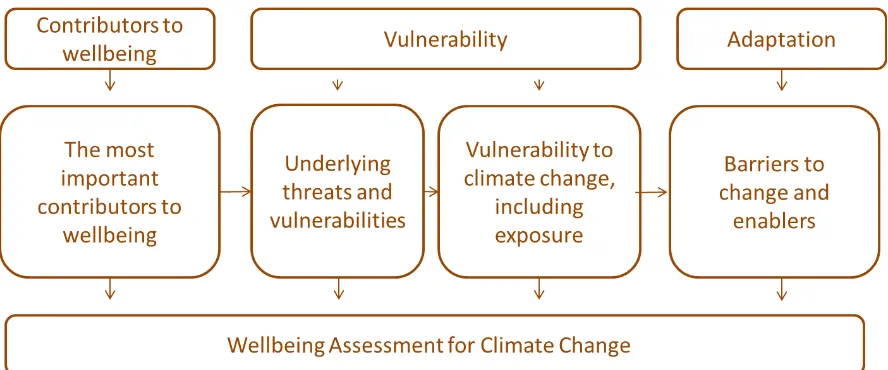
Principal components of the Wellbeing Assessment for Climate change (WACC) method are summarised in Figure 1.
details can be found in Larson 2011). All lists are continually updated to include new concepts and items mentioned by respondents, until no new concepts or items emerge.
In face-to-face interviews (surveys), the most important contributors to wellbeing are identified first. Respondents are asked what contributes to their and their family’s wellbeing, and by how much? This is achieved in two steps: First, participants are asked to nominate/select all the factors that they considered as contributing to their wellbeing – their ‘Contributors to Wellbeing’ (from free-list, being encouraged to add additional contributors of importance to them). Second, they are asked to choose a sub-set of factors identified in step one that they considered the most important. They are then asked to assign those factors relative levels of importance by allocating points between 1 (least important) and 100 (most important) to each factor selected. Typically, respondents settle for 3 to 5, maximum 7 “most important” factors. It appears that this subset is large enough to capture the most important contributors, but not too large to become unmanageable for respondents to proceed with the weighing step.
[image:8.595.76.520.305.490.2]
Figure 1. Elements of Wellbeing Assessment for Climate Change (WECC)
For each of the most important wellbeing factors, respondents are asked to select (or nominate) the most relevant, to them and their families, current (underlying) and potential climate-change related vulnerabilities. Again, this is done by allocating points between 1 (least important) and 100 (most important) to each vulnerability selected. They are also encouraged to provide qualitative
explanations of nature, mechanism etc. of the vulnerabilities selected (the How? Why? When? Where? etc, noting that vulnerabilities can be at any level, from personal (i.e. educational
attainment) to national (i.e. land rights)). Underlying and climate change related vulnerabilities can be combined into a single list, depending on context.
6
Vulnerability and adaptation questions are then repeated for each of the most important contributors to wellbeing selected by respondent.
During the analysis, the scores for all questions are multiplied. Factors with higher wellbeing importance (WBI) score, higher underlying vulnerabilities (UV) and climate change vulnerability (CCV) scores and higher score for barrier to change (BC), will received higher WACC scores. WACC scores can then be used to rank responses by any of the components explored.
The second pool of questions included in survey deals with the respondent’s attributes. The main reason for including this type of questions is to collect information that would allow exploration of the relationship between wellbeing perceptions and characteristics of the respondents. Data on socio-cultural, psychological, environmental, sense of place, financial and other factors can be recorded, and used to explore characteristics of people with similar responses.
Individual data thus collected can be collated on any level and can be explored for differences in perceptions based on gender, ethnicity, employment type, place of residence, perceptions of climate change, or any other attribute of the respondent recorded.
SUPPLEMENTARY ANALYSIS
Communities in which assessments are to take place should preferably be a representatives sample of the project/ planning area, ensuring agro-ecological, socioeconomic and other representativeness of the sample. Communities pre-identified as particularly vulnerable could also be analysed, but in this case the base of such identification, i.e. the process of pre-identification and the specific vulnerabilities explored, should be clearly specified.
As stated in introduction, WACC method is intended as complimentary to existing frameworks, tools and methods for vulnerability and associated assessments. To facilitate interactive participation, WACC method should ideally be combined with supplementary analyses (such as institutional analysis, livelihood analysis, disaster risk reduction methods such as hazard mapping, capacity and resource needs assessments, vulnerability matrix timelines, etc., well documented elsewhere3), using combination of key informant interviews and focus group discussions. Climate context should be explored by experts, and reported together with the anticipated changes in disaster risk and livelihood related changes. Institutional context related to wellbeing and climate change should also be reported, and methods and process used to collate relevant secondary data should be described.
As proposed by others (Daze, et al., 2009), given the dynamic nature of vulnerabilities, it might be appropriate to update the findings of the analysis over the course of the project or to incorporate such approached into long-term monitoring and evaluation.
3
REFERENCES
Abarquez, I., & Murshed, Z. (2004). Community based diaster risk management field practitioner’s handbook.
Bangkok: Asian Disaster Preparedness Center.
ADB - Asian Development Bank. (2011). Community based climate vulnerability assessment and adaptation
planning: Cook Islands pilot project. Manila: Asian Development Bank.
Adger, W., Arnell, N., & Tompkins, E. (2005). Successful adaptation to climate change across scales. Global
Environmental Change, 15, 77-86. doi: 10.1016/j.gloenvcha.2004.12.005
Adger, W., & Vincent, K. (2005). Uncertainty in adaptive capacity. Comptes Rendus Geoscience, 337, 399-410.
doi: 10.1016/j.crte.2004.11.004
Berkes, F., Colding, J., & Folke, C. (2002). Navigating social-ecological systems: Building resilience for
complexity and change. Cambridge, UK: Cambridge University Press. doi:
10.1017/CBO9780511541957
Bohensky, E., Stone-Jovicich, S., Larson, S., & Marshall, N. (2010). Adaptive capacity in theory and reality:
Implications for governance in the Great Barrier Reef region. In D. Armitage & R. Plummer (Eds.),
Adaptive capacity: Building environmental governance in an age of uncertainty (pp. 23-41).
Heidelberg: Springer. doi: 10.1007/978-3-642-12194-4_2
Burton, I. (1992). Adapt and thrive. Canadian Climate Change Centre. Ontario, Canada.
Carter, T. R., Parry, M. L., Harasawa, H., & Nishioka, S. (1994). IPCC technical guidelines for assessing climate
change impacts and adaptations with a summary for policy makers and a technical summary:
Department of Geography, University College London, UK and the Center for Global Environmental
Research, National Institute for Environmental Studies, Japan.
Chambers, R. (1994). The origins and practice of participatory rural appraisal. World Development 22, 953-969.
doi: 10.1016/0305-750X(94)90141-4
Daze, A., Ambrose, K., & Ehrhart, C. (2009). Climate vulnerability and capacity analysis: Handbook (1st ed.).
Geneva, Switzerland: CARE International.
Eckersley, R. (1999). Dreams and expectations: Young people’s expected and preferred futures and their
significance for education. Futures 31, 73-90. doi: 10.1016/S0016-3287(98)00111-6
Eckersley, R. (2000). The state and fate of nations: Implications subjective measures of personal and social
quality of life. Social Indicators Research, 52, 3-27. doi: 10.1023/A:1007071621613
8
Feenstra, J. F., Burton, I., Smith, J. B., & Tol, R. S. J. (Eds.). (1998). Handbook on methods for climate change
impact assessment and adaptation strategies, version 2. Amsterdam: United Nations Environment
Programme and Institute for Environmental Studies Free University of Amsterdam.
GIAB - Growth Innovation Advisory Board. (2004). Research on growth and innovation, Wellington, New
Zealand: Growth & Innovation Advisory, Board Ministry of Research Science and Technology.
IPCC – Intergovernmental Panel on Climate Change. (2001). Climate change 2001: Impacts, adaptation and
vulnerability. Summary for policy makers. Geneva: World Meteorological Organisation.
Jacobs, G., & Asokan, N. (1999). Towards a comprehensive theory of social development. In H. Cleveland, G.
Jacobs, R. Macfarlane, A. Natarajan & R. van Harten (Eds.), Human choice: The genetic code of social
development. Minneapolis, MN: World Academy of Art & Science.
Janssen, M., Schoon, M., Kee, W., & Borner, K. (2006). Scholarly networks on resilience, vulnerability and
adaptation within the human dimensions of global environmental change. Global Environmental
Change, 16, 240-252. doi: 10.1016/j.gloenvcha.2006.04.001
Kane, S., & Yohe, G. (2000). Societal adaptation to climatic variability and change: An introduction. Climatic
Change 45, 1-4. doi: 10.1023/A:1005699828901
Kirono, D., Larson, S., Tjandraatmadja, G., Leitch, A., Neumann, L., Maheepala, S., et al. (2013). Adapting to
climate change through urban water management: A participatory case study in indonesia. Journal of
Regional Environmental Change. doi: 10.1007/s10113-013-0498-3
Larson, S. (2009). Communicating stakeholder priorities in the Great Barrier Reef region. Journal of Society and
Natural Resources, 22(7), 650-664. doi: 10.1080/08941920801992102
Larson, S. (2010a). Regional wellbeing in tropical Queensland, Australia: Developing a dis-satisfaction index to
inform government policy. Environment and Planning A, 42, 2972-2989. doi: 10.1068/a43193
Larson, S. (2010b). Understanding barriers to social adaptation: Are we targeting the right concerns? In S. Roaf
(Ed.), Transforming markets in the built environment: Adapting for climate change (pp. 51-58).
London: Earthscan Publications Ltd.
Larson, S. (2011). From individual wellbeing to regional priorities: Concepts and measures to assist policy
makers. Newcastle upon Tyne, UK: Cambridge Scholars Publishing.
Lemos, M., Boyd, E., Tompkins, E., Osbahr, H., & Liverman, D. (2007). Developing adaptation and adapting
Limalevu, L., & McNamara, K. (2012). PACE-SD guidebook: Participatory assessment of vulnerability and
adaptation. Suva, Fiji: Pacific Centre for Environment and Sustainable Development, University of the
South Pacific.
MA - Millennium Assessment. (2005). Millennium ecosystem assessment: Ecosystems and human well-being.
Washington, DC: Island Press.
Mercer, J., Kelman, I., Lloyd, K., & Suchet-Pearson, S. (2008). Reflections on use of participatory research for
disaster risk reduction. Area, 40(2), 172-183. doi: 10.1111/j.1475-4762.2008.00797.x
Pain, R., & Francis, P. (2003). Reflections on participatory research. Area, 35(1), 46-54. doi:
10.1111/1475-4762.00109
Porritt, J. (2007). Capitalism as if the world matters. London: Earthscan.
Pretty, J. (1995). Typology of participation: Participatory learning for sustainable agriculture. World
Development, 23(8), 1247-12643. doi: 10.1016/0305-750X(95)00046-F
Reid, H., Cannon, T., Berger, R., Alam, M., Ashley, H., Kenton, N., et al. (Eds.). (2009). Participatory learning and
action: Community-based adaptation to climate change. London: International Institute for
Environment and Development.
Scheffer, M., Brock, W., & Westley, F. (2000). Mechanisms preventing optimum use of ecosystem services: An
interdisciplinary theoretical analysis. Ecosystems, 3, 451-471. doi: 10.1007/s100210000040
Sharing Climate Adaptation Tools. (2007). Improving decision-making for development, geneva workshop
organised by IISD, WB and IDS. Geneva ,Switzerland.
Smit, B. (Ed.). (1993). Adaptation to climatic variability and change, Canada. Guelph: Environment Canada.
Smit, B., Burton, I., Kelin, R., & Wandel, J. (2000). An anatomy of adaptation to climate change and variability.
Climatic Change, 45, 223-251. doi: 10.1023/A:1005661622966
Smit, B., McNabb, D., & Smithers, J. (1996). Agricultural adaptation to climate change. Climatic Change, 33,
7-29. doi: 10.1007/BF00140511
Ujang, Z., & Buckley, C. (2002). Water and wastewater in developing countries: Present reality and strategy for
the future. Water Science and Technology, 46, 1-9.
Yohe, G., & Tol, R. (2002). Indicators for social and economic coping capacity: Moving toward a working
definition of adaptive capacity. Global Environmental Change, 12, 25-40. doi: