Volume 2012, Article ID 918202,6pages doi:10.1155/2012/918202
Clinical Study
Four Weeks of Inspiratory Muscle Training Improves
Self-Paced Walking Performance in Overweight and Obese
Adults: A Randomised Controlled Trial
A. M. Edwards,
1G. P. Maguire,
2, 3D. Graham,
4V. Boland,
4and G. Richardson
4 1Institute of Sport and Exercise Science, James Cook University, Cairns, Sydney, QLD 4870, Australia2School of Medicine and Dentistry, James Cook University, Cairns, Sydney, QLD 4870, Australia 3Baker IDI, Research and Medical Education, Central Australia, Alice Springs, NT 0871, Australia 4Department of Psychology, James Cook University, Cairns, QLD 4870, Australia
Correspondence should be addressed to A. M. Edwards,[email protected]
Received 20 February 2012; Revised 26 April 2012; Accepted 10 May 2012 Academic Editor: Jack A. Yanovski
Copyright © 2012 A. M. Edwards et al. This is an open access article distributed under the Creative Commons Attribution License, which permits unrestricted use, distribution, and reproduction in any medium, provided the original work is properly cited.
Objective. To examine whether a programme of inspiratory muscle training (IMT) improves accumulative distance of self-paced
walking in overweight and obese adults. Methods. A total of 15 overweight and obese adults were randomized into experimental (EXP:n =8) and placebo (PLA:n =7) groups. Lung function, inspiratory muscle performance, 6-minute walking test, and predicted ˙VO2 max were assessed prior to and following the 4-week IMT intervention. Both groups performed 30 inspiratory
breaths, twice daily using a proprietary inspiratory resistance device set to 55% of baseline maximal effort (EXP), or performing the same inspiratory training procedure at the minimum resistive setting (PLA). Results. Lung function was unchanged in both groups after-training; however inspiratory muscle strength was significantly improved in EXP (19±25.2 cm H2O gain;P <0.01) but
did not significantly change in PLA. Additionally, the posttraining distance covered in the 6-minute walking test was significantly extended for EXP (62.5±37.7 m gain;P <0.01), but not for PLA. A positive association was observed between the change (%) of performance gain in the 6-minute walking test and body mass index (r=0.736;P <0.05) for EXP. Conclusion. The present study suggests that IMT provides a practical, minimally intrusive intervention to significantly augment both inspiratory muscle performance and walking distance covered by overweight and obese adults in a clinically relevant 6-minute walk test. This indicates that IMT may provide a useful priming (preparatory) strategy prior to entry in a physical training programme for overweight and obese adults.
1. Introduction
Obesity is a serious health concern which increases the risk of all-cause mortality across all populations [1]. To address this issue, many exercise-based interventions have been developed which aim to reduce excess body weight and improve health outcomes for obese individuals [2]. However, the effectiveness of exercise interventions is often limited by factors including premature sensations of fatigue among overweight and obese individuals [3] which could diminish the motivational drive to commence (or continue) a physical training programme. As obesity leads to an increase in respiratory demands [4–6], it is possible that an intervention
such as inspiratory muscle training (IMT) might improve respiratory compliance, exercise tolerance, and the benefits of exercise training in this population group.
obese adults demonstrated an aggressive two-month inter-vention of supervised respiratory (inspiratory and expira-tory) muscle training coupled with diet and physical training significantly improved both respiratory muscle endurance (∼52% gain) and the distance covered in a 6-minute walking test (∼11% gain) [8]. While the results of that experiment strongly suggest respiratory muscle training may be of value to obese individuals, its findings are not directly applicable to nonhospitalised individuals due to the multidimensional nature of the intervention and the supervisory requirements of such an intense protocol. A less aggressive, but potentially equally effective strategy, is via inspiratory muscle training (IMT) using a portable inspiratory-resistance training device [9].
The IMT strategy proposed in this study is minimally intrusive, does not require supervision, and directly targets inspiratory effort which account for up to 80% of the work of breathing [7]. This strategy has been shown to improve inspiratory muscle strength and physical perfor-mances across a range of individuals in as little as four weeks [9,10]. This intervention has not, to our knowledge, been investigated as a strategy to augment physical performances in overweight or obese individuals, although other recent studies of supervised respiratory muscle training appear to support the development of this technique as a useful strategy to augment resistance to respiratory fatigue [11], promote performance gain, and potential weight loss [12]. Performance gain in response to IMT could support this technique as an important priming (preparatory) strategy for overweight and obese individuals prior to prospective entry in a physical training programme.
As obese individuals are well known to experience shortness of breath to a greater extent than healthy normal subjects [5], it is therefore likely that a programme of IMT training will be particularly meaningful for obese individu-als. The aim of this study is therefore to investigate whether a 4-week intervention of IMT will improve inspiratory muscle strength and functional performance as assessed by the 6-minute walk test [13].
2. Methods
2.1. Participants. Fifteen adults (male and female)
volun-teered for this study, provided written informed consent prior to participation, and were randomly allocated to either experimental (EXP:n= 8) or placebo (PLA:n =7) group as matched parallel pairs based on body mass index (BMI) and history of smoking. Inclusion criteria were (i) BMI > 27 kg/m2, (ii) being free of respiratory or cardiovascular
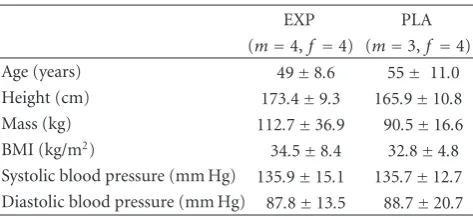
diseases. The physical characteristics of the two groups are shown in Table 1. Ethical clearance for this study was provided by the Research and Ethics committee of James Cook University.
2.2. Study Overview. All individuals in EXP and PLA
com-pleted baseline physical assessments of height, mass, blood pressure, standard spirometry (FVC, FEV1), inspiratory
[image:2.600.310.547.87.196.2]muscle performance (MIP), estimation of maximal aerobic
Table 1: Participants’ characteristics.
EXP PLA (m=4,f=4) (m=3,f =4) Age (years) 49±8.6 55± 11.0 Height (cm) 173.4±9.3 165.9±10.8 Mass (kg) 112.7±36.9 90.5±16.6 BMI (kg/m2) 34.5±8.4 32.8±4.8
Systolic blood pressure (mm Hg) 135.9±15.1 135.7±12.7 Diastolic blood pressure (mm Hg) 87.8±13.5 88.7±20.7
Mean±SD. There were no statistically significant differences between the physical characteristics of EXP and PLA groups.
power ( ˙VO2 max), and 6-minute walk test performance.
Following baseline measurements, all individuals were famil-iarized with a proprietary portable inspiratory-resistance training device (POWERBreathe, Gaiam, UK) to be used over the duration of the intervention period. The device was preset to either 55% of their individualized maximal inspiratory effort (EXP) or to the minimum device setting equivalent to approximately 10% of maximal inspiratory effort (PLA) [9,14]. Both groups thereafter performed 2× 30 daily inspiratory efforts using the IMT device [15,16]. Immediately following the 4-week intervention, the same battery of assessments as used at baseline was repeated. Adherence and compliance to the training protocol were checked twice weekly. No participants reported experiencing any issues or difficulties with the intervention.
2.3. Study Procedures
2.3.1. Lung Function and Inspiratory Muscle Performance.
Baseline spirometry included measurements of forced vital capacity (FVC) and forced expiratory volume in 1 sec-ond (FEV1) using a portable hand-held device
(Microlab-Spirometry SN M20364, USA). Participants were seated and wearing noseclips. After inspiration to total lung capacity, FEV1and FVC were measured.
Maximal static inspiratory mouth pressure (MIP) was measured at residual volume following a slow and complete expiration using a portable hand-held mouth pressure meter (POWERBreathe KH1 INSPIRATORY METER, Gaiam, UK). The best of three maximal efforts were analysed for spirom-etry and MIP measures. All procedures were performed in accordance with methodologies previously reported [9,14].
2.3.2. Functional Exercise Capacity. The 6-minute walk test
is a performance-based measure assessing voluntary effort in response to an exercise stimulus and provides an effective measure of functional capacity in untrained, sedentary adults [13]. Participants were instructed to “walk as far as you can in
100 200 300 400 500 600
Before After
EXP
∗
0
Distanc
e (m)
(a)
100 200 300 400 500 600
Before After
0
Distanc
e (m)
PLA
[image:3.600.76.528.70.258.2](b)
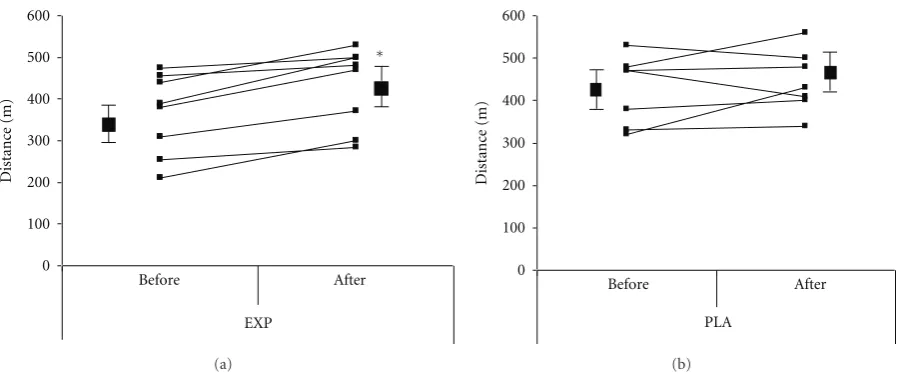
Figure 1: Distance covered (metres) in response to the 6-minute walk test for both experimental (EXP;n=8) and placebo (PLA;n=7) groups.∗=significant difference between baseline and posttraining distance covered (P <0.01). Means±SD and individual (before and after training) results are displayed.
on the treadmill visual display, but velocity and distance covered were obscured from vision. Participants therefore paced the 6-minute bout in the knowledge of exercise duration and their individual capabilities. Distance covered (m) and heart rates were recorded at the conclusion of the 6-minute period [19,20].
Maximal aerobic power ( ˙VO2max) was estimated from
a validated heart-rate-derived algorithm utilizing a submax-imal single stage 4-minute walking test [21]. Participants were required to complete a brisk but comfortable constant walking pace ranging from 3.5 to 5 km/h for 4-minutes on a treadmill.
Participants were required to wear a chest strap trans-mitter (Polar, T31 Coded Transtrans-mitter, Australia) for the measurement of heart rate during exercise testing.
2.4. Psychological Measures. The modified Borg Scale (CR10)
[22] was used to measure ratings of perceived exertion RPE in response to exercise as an index of fatigue perception.
2.5. Statistical Analyses. The statistical software package
SPSS (version 18.0, SPSS, Chicago, IL,USA) was used for all statistical analysis. Pre-and posttraining results and group interactions were statistically compared using two-way repeated measures analyses of variance (group×time) (ANOVA) and post hoc Tukey tests of honestly significant difference were used where differences were indicated. The relationships between data sets were examined using Pearson Product Moment Correlations. Probability values of<0.05 were considered significant and all tests were two sided. All results are expressed as means (SD) unless otherwise stated. Sample size analysis was based on an anticipated mean improvement (SD) in the 6-minute walk test of those in the EXP of 54(35) metres versus 1(7) metres in the PLA group [8]. Based on a statistical power (1-beta) of 90% and alpha of 0.05 a sample size of six was required in both the EXP
and PLA groups. Sample sizes were also in accordance with previous work utilizing this intervention technique [9,14– 16].
3. Results
There was no between-group difference for distance covered either at baseline or posttraining, but group×time ANOVA interaction indicated a meaningful effect (P ≤ 0.05). Consequently, post hoc within-group comparisons for time (pre- to posttraining) indicated EXP significantly improved distance covered (m) in response to the 6-minute walk test from baseline to posttraining (62.5±37.7 m gain;P <0.01). However, PLA did not significantly extend distance covered across the 4-week intervention period (14.3±58.9 m gain; NS) (Figure1).
The prediction of ˙VO2max from submaximal heart rates
did not identify significant differences between EXP and PLA at either baseline or posttraining (Table2).
Additionally, assessment of standard spirometry vari-ables (FVC and FEV1) also did not identify differences
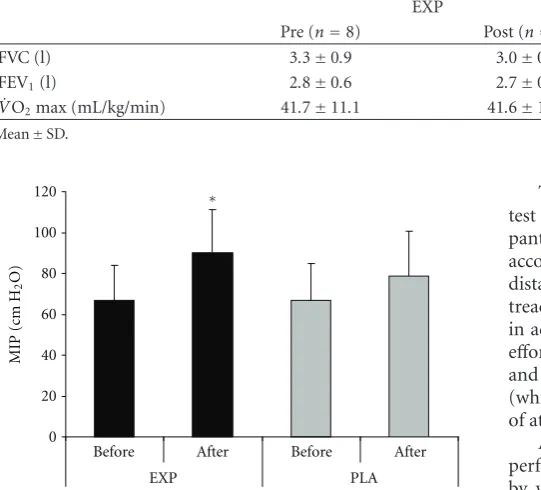
between groups at either baseline or posttraining (Table2). For MIP, a group×time ANOVA interaction indicated a meaningful effect (P < 0.05) and subsequent post hoc evaluation revealed MIP improved significantly over the 4-week training period for EXP (19.4±25.2 cm H2O gain;P <
0.01) but was not significantly changed for PLA (9.9±7.2 cm H2O gain; NS) (Figure 2). There were no between group
differences.
Mean heart rates in response to the 6-minute walk test were unchanged for EXP (121.3 ±16.1 and 119.5 ± 16.4 b/min) and PLA (114.1±15.3 and 114.9±11.6 b/min) from pre- to posttraining.
Table 2: Lung function and estimated maximal aerobic power variables prior to and following the 4-week intervention period.
EXP PLA
Pre (n=8) Post (n=8) Pre (n=7) Post (n=7) FVC (l) 3.3±0.9 3.0±0.8 2.8±0.8 2.7±0.7 FEV1(l) 2.8±0.6 2.7±0.7 2.5±0.5 2.5±0.5
˙
VO2max (mL/kg/min) 41.7±11.1 41.6±10.7 42.3±11.6 42.4±11.6 Mean±SD.
0 20 40 60 80 100 120
Before After Before After
EXP PLA
MIP (cm H
2
O)
∗
Figure 2: Maximal inspiratory mouth pressure (MIP) measure
before and after the 4-week intervention period for both experi-mental (EXP) and placebo (PLA) groups.∗=significant difference between baseline (before) and posttraining (after) distance covered (P <0.01).
Bivariate analysis identified several significant correla-tions between participant factors and intervention response which were specific to EXP. The % change of distance covered in the 6-minute walk test (pre- to post-training) was significantly associated with baseline BMI (r = 0.736;P < 0.05) (Figure3(a)). The % change from pre- to posttraining 6-minute walking distance was also correlated with % change in MIP (r =0.746;P <0.05) (Figure3(b)). There were no meaningful associations identified in PLA.
4. Discussion
This study demonstrated that 4 weeks of inspiratory muscle training (IMT) significantly improved the physical perfor-mance of obese and overweight subjects as assessed by the 6-minute walk test. As this effect was not evident for PLA, it suggests IMT is a meaningful intervention with which to augment physical performance outcomes for overweight and obese individuals. The results of our study support and exceed those of Villiot-Danger et al. [8] from hospitalized obese individuals (∼11% gain in walking distance) but were achieved with a considerably less aggressive intervention which could be undertaken at home and without supervision. It is possible the statistically significant 62.5 m gain (18.8% gain) in walking distance observed in our study was achieved as a consequence of directly targeting inspiratory muscles for the intervention rather than generalized respiratory muscle training.
The walking distance covered during the 6-minute walk test was subject to self-regulation in so far as partici-pants were able to continually adjust the treadmill velocity according to their individual requirements [18]. Accrued distance was obscured from participants’ view on the digital treadmill display unit to ensure pacing was not performed in accordance with simply attempting to better the baseline effort [23, 24]. Consequently, performances by both EXP and PLA occurred in the knowledge of only time elapsed (which was displayed) and participants transient perceptions of attainable work outputs across a 6-minute period.
Although a significant improvement in 6-minute walking performance following IMT was observed, the mechanisms by which IMT evokes performance improvements remain unclear. Several putative mechanisms have been proposed to explain performance-enhancing effects of IMT [25] and these include a delay in respiratory muscle fatigue [26,27], a redistribution of blood flow from respiratory to locomotor muscles [25] and a decrease in the perceptions of respiratory and limb discomfort during exercise to fatigue [27,28]. As changes within the respiratory muscles underlie interactions between the brain and working locomotor muscles [23] it seems likely that IMT-induced improvements to inspiratory muscle functionality would positively influence this feedback mechanism. This could therefore desensitize subconscious recruitment patterns of skeletal muscle as a consequence of reduced sensations of breathlessness during the 6-minute walk test. As the instruction for performing this test was for individuals to walk as far as they could without running or jogging, they were not requested to perform at a preset RPE. Posttest evaluations of perceived exertion were not different between groups or test occasions but this is to be expected where individuals pace themselves according to physical sensations. For example, numerous studies have demonstrated pacing is based on the anticipated level of physical discomfort the individual is prepared to endure in the defined task [24]. As such, participants would be expected to experience the same level of tolerable physical discomfort during the 6-minute walk test at both baseline and posttraining; the difference, being that greater distance was achieved posttraining for the same level of physical discomfort when compared to baseline.
0 10 20 30 40 50 60
0 10 20 30 40 50
6-minute walking distance (% change)
Bod
y mass inde
x (kg/m
2) r=0.736;P <0.05
y=1.1647x−21.394
(a)
y=0.2338x+ 11.508
r=0.746;P <0.05
0 10 20 30 40 50 60
0
10 20 30 40 50
6-minute walking distance (% change)
MIP (% c
hange)
−10
[image:5.600.67.538.73.224.2](b)
Figure 3: Associations between (a) body mass index and % change in 6-minute walking distance from pre- to posttraining and (b) between
the (%) changes of maximal inspiratory mouth pressure and 6-minute walking distance from pre- to posttraining.
inspiratory muscle performance remains suboptimal. Pre-vious studies (e.g., [9]) have also indicated that concurrent IMT and physical conditioning enhances training outcomes. Therefore, further studies may elucidate whether extending IMT prior to physical training and also concurrent (IMT and physical) training strategies improve performance outcomes for overweight and obese individuals.
Standard spirometry measures FVC and FEV1 were
unchanged in this study which is consistent with previous observations [10]. As the intervention in this study focused on inspiratory muscle training this effect is largely to be expected and demonstrates specificity of the inspiratory pressure threshold technique.
There were several interesting associations between data sets observed in this study. First, the (%) change from baseline to posttraining in distance covered for the 6-minute walk test was positively related to BMI for EXP (r = 0.736; P <0.05). This suggests individuals of higher BMI could gain the most from an IMT intervention as greater adiposity of the chest wall increases respiratory resistance which contributes to exercise-induced dyspnea [29]. As a positive association was observed between the change in 6-minute walking performance and change in MIP (r = 0.746;P < 0.05) it could be expected that IMT, to some extent, alleviates this effect. However, correlation analysis of such small subject numbers should be treated with caution as, alternatively, it is equally likely that greater adiposity is simply indicative of greater physical inactivity. This would probably act to evoke a greater detraining effect of the respiratory system and a wider study is required to confirm this observation.
Despite the significant benefits associated with IMT the small sample size means these findings should be interpreted with caution. Further substantiation from larger confirmatory studies and demonstration of whether the changes seen here are sustainable will be required before IMT can be advocated as a component of exercise training in this setting.
In summary, this study indicates that IMT may provide a practical, inexpensive, and minimally intrusive intervention to augment both inspiratory muscle strength and walking distance among overweight and obese adults. The beneficial
effects of this treatment were similar to those previously reported from vigorous, supervised training among hos-pitalised obese patients [8]. Our findings indicate similar effects could be expected without the need for hospitalisation and indicate that IMT via an inspiratory resistance device can easily be performed in the home environment. IMT therefore appears a useful strategy to enhance walking performance in overweight and obese individuals which may prove a meaningful priming intervention with which to stimulate performance adaptations and future engagement with physical activity.
Conflict of Interests
None of the authors had any conflict of interests regarding any aspect of this work.
Acknowledgments
The authors would like to thank Megan Mackenzie and Stephanie Tahn for their valuable contributions to data collection in this project.
References
[1] C. L. Ogden, S. Z. Yanovski, M. D. Carroll, and K. M. Flegal, “The epidemiology of obesity,” Gastroenterology, vol. 132, no. 6, pp. 2087–2102, 2007.
[2] WHO, “Obesity: preventing and managing the global epi-demic,” Report of a WHO Consultation, Geneva, Switzerland, 1997.
[3] P. Ekkekakis, E. Lind, and S. Vazou, “Affective responses to increasing levels of exercise intensity in normal-weight, overweight, and obese middle-aged women,” Obesity, vol. 18, no. 1, pp. 79–85, 2010.
[4] C. P. O’Donnell, C. D. Schaub, A. S. Haines et al., “Leptin prevents respiratory depression in obesity,” American Journal
of Respiratory and Critical Care Medicine, vol. 159, no. 5 I, pp.
1477–1484, 1999.
subjects,” International Journal of Obesity, vol. 32, no. 3, pp. 502–509, 2008.
[6] J. M. Luce, “Respiratory complications of obesity,” Chest, vol. 78, no. 4, pp. 626–631, 1980.
[7] A. B. Otis, W. O. Fenn, and H. Rahn, “Mechanics of breathing in man,” Journal of applied physiology, vol. 2, no. 11, pp. 592– 607, 1950.
[8] J. C. Villiot-Danger, E. Villiot-Danger, J. C. Borel, J. L. P´epin, B. Wuyam, and S. Verg`es, “Respiratory muscle endurance training in obese patients,” International Journal of Obesity, vol. 35, no. 5, pp. 692–699, 2011.
[9] A. M. Edwards, C. Wells, and R. Butterly, “Concurrent inspi-ratory muscle and cardiovascular training differentially improves both perceptions of effort and 5000 m running performance compared with cardiovascular training alone,”
British Journal of Sports Medicine, vol. 42, no. 10, pp. 523–527,
2008.
[10] A. M. Edwards and R. E. Walker, “Inspiratory muscle training and endurance: a central metabolic control perspective,”
International Journal of Sports Physiology and Performance, vol.
4, no. 1, pp. 122–128, 2009.
[11] S. Verges, O. Lenherr, A. C. Haner, C. Schulz, and C. M. Spengler, “Increased fatigue resistance of respiratory muscles during exercise after respiratory muscle endurance training,”
American Journal of Physiology - Regulatory Integrative and Comparative Physiology, vol. 292, no. 3, pp. R1246–R1253,
2007.
[12] I. Frank, R. Briggs, and C. M. Spengler, “Respiratory muscles, exercise performance, and health in overweight and obese subjects,” Medicine and Science in Sports and Exercise, vol. 43, no. 4, pp. 714–727, 2011.
[13] P. L. Enright, “The six-minute walk test,” Respiratory Care, vol. 48, no. 8, pp. 783–785, 2003.
[14] A. M. Edwards and C. B. Cooke, “Oxygen uptake kinetics and maximal aerobic power are unaffected by inspiratory muscle training in healthy subjects where time to exhaustion is extended,” European Journal of Applied Physiology, vol. 93, no. 1-2, pp. 139–144, 2004.
[15] L. M. Romer, A. K. McConnell, and D. A. Jones, “Effects of inspiratory muscle training on time-trial performance in trained cyclists,” Journal of Sports Sciences, vol. 20, no. 7, pp. 547–562, 2002.
[16] S. Volianitis, A. K. McConnell, Y. Koutedakis, L. McNaughton, K. Backx, and D. A. Jones, “Inspiratory muscle training improves rowing performance,” Medicine and Science in Sports
and Exercise, vol. 33, no. 5, pp. 803–809, 2001.
[17] P. Ekkekakis, “Let them roam free?: physiological and psy-chological evidence for the potential of self-selected exercise intensity in public health,” Sports Medicine, vol. 39, no. 10, pp. 857–888, 2009.
[18] D. Stevens, E. Elpern, K. Sharma, P. Szidon, M. Ankin, and S. Kesten, “Comparison of hallway and treadmill six-minute walk tests,” American Journal of Respiratory and Critical Care
Medicine, vol. 160, no. 5 I, pp. 1540–1543, 1999.
[19] M. Hulens, G. Vansant, A. L. Claessens, R. Lysens, and E. Muls, “Predictors of 6-minute walk test results in lean, obese and morbidly obese women,” Scandinavian Journal of Medicine
and Science in Sports, vol. 13, no. 2, pp. 98–105, 2003.
[20] W. J. Gibbons, N. Fruchter, S. Sloan, and R. D. Levy, “Reference values for a multiple repetition 6-minute walk test in healthy adults older than 20 years,” Journal of Cardiopulmonary
Rehabilitation, vol. 21, no. 2, pp. 87–93, 2001.
[21] C. B. Ebbeling, A. Ward, E. M. Puleo, J. Widrick, and J. M. Rippe, “Development of a single-stage submaximal treadmill
walking test,” Medicine and Science in Sports and Exercise, vol. 23, no. 8, pp. 966–973, 1991.
[22] G. A. V. Borg, “Psychophysical bases of perceived exertion,”
Medicine and Science in Sports and Exercise, vol. 14, no. 5, pp.
377–381, 1982.
[23] A. St Clair Gibson, E. V. Lambert, L. H. G. Rauch et al., “The role of information processing between the brain and peripheral physiological systems in pacing and perception of effort,” Sports Medicine, vol. 36, no. 8, pp. 705–722, 2006. [24] T. D. Noakes, A. St Clair Gibson, and E. V. Lambert, “From
catastrophe to complexity: a novel model of integrative central neural regulation of effort and fatigue during exercise in humans: summary and conclusions,” British Journal of Sports
Medicine, vol. 39, no. 2, pp. 120–124, 2005.
[25] A. K. McConnell and L. M. Romer, “Respiratory muscle training in healthy humans: resolving the controversy,”
Inter-national Journal of Sports Medicine, vol. 25, no. 4, pp. 284–293,
2004.
[26] B. D. Johnson, M. A. Babcock, O. E. Suman, and J. A. Dempsey, “Exercise-induced diaphragmatic fatigue in healthy humans,”
Journal of Physiology, vol. 460, pp. 385–405, 1993.
[27] M. J. Mador, U. J. Magalang, A. Rodis, and T. J. Kufel, “Diaphragmatic fatigue after exercise in healthy human sub-jects,” American Review of Respiratory Disease, vol. 148, no. 6, part 1, pp. 1571–1575, 1993.
[28] S. Suzuki, M. Sato, and T. Okubo, “Expiratory muscle training and sensation of respiratory effort during exercise in normal subjects,” Thorax, vol. 50, no. 4, pp. 366–370, 1995.