CHILDREN, EDUCATION AND SKILLS
research
social
Evaluation of the Impact of the
Implementation of Teaching
Evaluation of the Impact of the Implementation of Teaching Scotland‟s Future
Contents
Glossary and abbreviations ... 1
1 Executive summary ... 4
2 Introduction ... 10
3 Methodology ... 14
4 Culture of professional learning ... 19
What has changed? ... 19
What are the challenges? ... 23
5 Initial Teacher Education ... 26
What‟s working well? ... 26
What are the challenges? ... 31
Key areas for consideration ... 33
6 Probation ... 34
What‟s working well? ... 34
What are the challenges? ... 37
Key areas for consideration ... 41
7 LA/University partnerships ... 42
What‟s working well? ... 42
What are the challenges? ... 43
Key areas for consideration ... 46
8 CLPL activities ... 47
Satisfaction with current provision of CLPL ... 47
What‟s working well? ... 48
What are the challenges? ... 53
Key areas for consideration ... 65
9 Professional Review and Development ... 66
What‟s working well? ... 66
What are the challenges? ... 72
Key areas for consideration ... 74
10 Mentoring and coaching ... 75
What's working well? ... 75
What are the challenges? ... 76
Key area for consideration ... 78
11 Leadership ... 79
What‟s working well? ... 79
Key areas for consideration ... 83
12 National and LA support ... 84
What‟s working well? ... 84
What are the challenges? ... 86
Key areas for consideration ... 88
13 Conclusions ... 89
The context ... 89
A significant cultural shift ... 89
On the path – but not there yet ... 91
Appendix A – Online survey and topline results ... 93
Appendix B – Sampling approach ... 123
Appendix C – Profile of respondents and weighting ... 125
Appendix D – Topic guides ... 127
1
Glossary and abbreviations
ASN – Additional Support Needs
BME – Black and Minority Ethnic
CLPL – Career-long professional learning
CPD – Continuous professional development
Curriculum for Excellence (CfE) – the national curriculum for children aged 3 to 18
years in schools in Scotland. It offers a broad general education for children up to S3 followed by a senior phase from S4 onwards and completion of National qualifications.
Distributed leadership –the concept that all teachers are leaders and involves leadership roles being devolved to staff that do not have a formal leadership remit within their role.
Experiences and Outcomes – experiences and outcomes recognise the importance of
the quality and nature of the learning experience in developing attributes and capabilities and in achieving active engagement, motivation and depth of learning. An outcome represents what is to be achieved. Taken as a whole, the experiences and outcomes embody the attributes and capabilities of the four capacities.
ESOL – English for Speakers of Other Languages
Probationer scheme - flexible route – a way to complete probationary service for
teachers who have decided to opt out of the Teacher Induction Scheme; are not eligible to join the Teacher Induction Scheme; can't commit to a full-time post; want to complete their probationary period somewhere other than a Scottish state school; are registered in more than one subject; and are looking to gain full registration in their second subject.
GTCS – General Teaching Council for Scotland
Getting it right for every child (GIRFEC) – the national approach to improving
outcomes through public services that support the wellbeing of children and young people.
How Good is Our School 4 – a framework of quality indicators to promote effective
self-evaluation as the first important stage in a process of achieving self-improvement in schools.
ITE – Initial Teacher Education
Joint assessment –this means the assessment of student teachers during school
placement by the school, the university and the local authority.
National Implementation Board (NIB) –the group of stakeholders that were tasked
with implementing the recommendations from Teaching Scotland‟s Future.
2
Professional review and development (PRD) – a process in which teachers review
their professional learning and reflect on teaching practice with their reviewer.
Raising attainment for all (RAFA) – Raising Attainment is a national policy programme
to improve attainment and achievement of young people through a collaborative learning system and improvement methodology. The aim of this policy programme is to reduce inequalities in education and ensure that every child can succeed in school.
PGDE – Post Graduate Diploma in Education
Professional Update (PU) – a requirement of General Teaching Council for Scotland
(GTCS) registration for fully registered teachers. The key purpose of Professional
Update is to: maintain and improve the quality of our teachers as outlined in the relevant Professional Standards and to enhance the impact that they have on pupils‟ learning; support, maintain and enhance teachers‟ continued professionalism and the reputation of the teaching profession in Scotland.
SCEL – Scottish College for Educational Leadership
SQA – Scottish Qualifications Authority
SCQF – Scottish Credit and Qualifications Framework
SCQF level 11 learning – refers to accredited CLPL available to teachers (also known
as master-level learning).
Scottish Index of Multiple Deprivations (SIMD) – a tool that identifies areas of
multiple deprivation in a consistent way using a number of key measures such as education, housing and employment.
Stages of Early Arithmetic Learning (SEAL) – Stages of Early Arithmetic Learning is a
strategy for maths learning used in Primary schools.
Standard for Provisional Registration – standard for what is expected of a student
teacher at the end of Initial Teacher Education who is seeking provisional registration with the GTCS.
Standard for Full Registration – the standard required of every qualified teacher to
formally enter the profession and is a benchmark of competence in teaching.
Standard for Career-long Professional Learning –standard for teachers to continue to
develop their expertise and experience across all areas of their professional practice through appropriate and sustained career-long professional learning.
Standard for Leadership and Management (Middle Leaders) – the standard
3
Standard for Leadership and Management (Head Teachers) – the standard
specifying the role of Head Teachers as leaders of the whole school community and within the wider children‟s services network.
Teacher Induction Scheme – The Teacher Induction Scheme (TIS) provides a
guaranteed one-year training post in a local authority to every eligible student graduating with a teaching qualification from one of Scotland's universities.
TSF – Teaching Scotland‟s Future is a review of teacher education conducted by
4
1 Executive summary
Background
1.1 In 2010, Professor Graham Donaldson undertook a review of teacher education on behalf of the Scottish Government. The resulting report „Teaching Scotland‟s Future – Report of a review of teacher education in Scotland‟, published early in 2011, concluded that the two most important and achievable ways in which school education can realise the high aspirations Scotland has for its young people are through supporting and strengthening, firstly, the quality of teaching, and secondly, the quality of leadership‟.
1.2 The report also set out 50 recommendations for how improvements could be made to teacher education. The Scottish Government accepted, in full or in part, all of these recommendations and established a National Partnership Group to consider them in more detail. Ultimately, this resulted in 20 substantial projects being taken forward by the National Implementation Board for Teacher
Education.
1.3 Ipsos MORI Scotland was commissioned by the Scottish Government in July 2015 to evaluate the early impact of Teaching Scotland‟s Future (TSF) on teacher education and professional learning. This report sets out the findings of that evaluation.
Purpose and scope of the evaluation
1.4 The purpose of the evaluation was to guide and inform future improvements in teacher education and professional learning and, ultimately, to help build the capacity of teachers and improve the learning of young people.
1.5 Some evaluations are designed to measure the impact of a specific initiative or programme of work, in order to assess whether it „works‟, and whether it should be continued or rolled out. However, TSF was not a single programme of work, it was a wide-ranging review resulting in 50 recommendations some of which set out a vision for 21st century teacher professionalism while others specified particular actions. Moreover, TSF did not emerge in isolation from other policy developments or existing work that was already in progress.
1.6 This evaluation does not assess progress on each of the 50 recommendations, and, although some of the drivers and facilitators of change are discussed, it does not attempt to measure the precise contribution of TSF to areas where there has been progress. Rather, this report offers an overview of the current landscape of teacher education, highlighting what progress has been made in key areas since TSF was published and where further progress and
5
Methods
1.7 The evaluation used a mixed-method approach. An online survey was carried out between 14 September and 9 October 2015 among a representative sample of teachers in primary, secondary, special schools across Scotland (including both the state and independent sectors) who were randomly sampled from the
General Teaching Council for Scotland‟s (GTCS‟s) database. The achieved sample was 6,346 and the response rate was 21%.
1.8 Focus groups and in-depth interviews were conducted with teachers across Scotland at all career stages and from all sectors. In total, 80 teachers took part in 15 focus groups and a further 33 took part in in-depth interviews. This
qualitative fieldwork took place between November 2015 and February 2016.
1.9 In-depth interviews were also conducted with representatives from all 32 Local Authorities (LAs) and with 21 other key educational stakeholders (all the Initial Teacher Education providers in Scotland; all the teaching unions; Association of Directors of Education in Scotland; Association of Head Teachers & Deputes in Scotland; COSLA; Education Scotland; GTCS; School Leaders Scotland; Scottish College for Educational Leadership; Scottish Council of Independent Schools; and the Scottish Teacher Education Committee). The interviews were conducted in November 2015.
The context
1.10 The 2010 TSF review of teacher education took place at a time when governments across the world were reforming their education systems to
address challenges arising from globalisation, societal change and technological development. The immediate context in Scotland was, and remains, Curriculum for Excellence (CfE). The opportunity offered – and the challenge posed – by CfE is that curriculum development, and transformational change at school and system level, will be driven by the professional capacity of teachers rather than through the central development of guidance and resources and external accountability.The recommendations contained in TSF were designed to build the capacity of the teaching profession to deliver this ambitious reform.
6
Key findings: progress
1.12 The teaching profession has risen to the challenge set out in TSF. The
evaluation found evidence of real progress in many areas of teacher education and, above all, there has been a significant shift in the culture of professional learning. This shift in culture was demonstrated in four key areas of
improvement:
teachers are more engaged with professional learning. Several inter-related aspects to this increased engagement were identified: heightened awareness of the importance of professional learning; a move away from a conception of professional learning as „going on a course‟ and a broader understanding of the range of professional learning activities; increased ownership by individual teachers‟ of their career-long professional learning (CLPL); and an increased focus on learning relevant to a teacher‟s own particular development needs.
there is a greater focus on the impact of professional learning on pupils.
Decisions about what professional learning to undertake are now more likely to involve a consideration of the needs of the individual pupils that a teacher is working with.
there is a consensus that teachers are engaging in professional dialogue more often and that there has been a cultural shift towards more openness, sharing of experience and willingness to talk about pedagogy.
there is a greater willingness to try new approaches. One important marker of the change in culture is that a sizeable minority of teachers (41%) say that they try new teaching practices and strategies more often than they did five years ago (40% say they try them the same amount and 18% say they try them less often).
1.13 In addition to this cultural shift, there have been a number of specific improvements to teacher education at all stages:
At the ITE and early career stage, partnerships between LAs and universities have developed further, and support for students on placement and
probationary teachers has improved.
In relation to CLPL, the proportion of teachers reporting that they face barriers in accessing professional learning has greatly decreased in the last five
years, from 68% in 2010 to 42% in 2015. This is, in part, due to their increased participation in a wider range of different professional learning activities and, in particular, an increase in collaborative working and in-school activity.
There has also been a substantial increase in the number of teachers
7
Although there was already a considerable focus on leadership prior to TSF, it has increased further and teachers (at all career stages) are more aware of opportunities to develop their leadership skills. The new GTCS Standard for Leadership and Management has helped clarify the pathway for formal leadership positions. Leadership skills are the main focus for head teachers‟ CLPL and they reported that both the range and the number of high quality CLPL opportunities available to them have increased over the past five years.
What has helped change the culture?
1.14 Participants in the qualitative research pointed to several factors which they felt had driven the cultural changes discussed above. Some of these were a direct result of TSF, some were given increased impetus by TSF and some were independent.
1.15 There was widespread agreement that the introduction of Professional Update and the new GTCS Standards played a very important role in increasing engagement with professional learning. It was felt that the new Standards provided coherence to CLPL through all career stages. It was also noted that they promoted a shared language around CLPL and pedagogy.
1.16 There was also a widespread view that the „new generation‟ of teachers
emerging from Initial Teacher Education in recent years had helped change the culture. It was felt that it was „ingrained‟ in these teachers from the start that they should be self-reflective, engage in professional dialogue, share practice and work collaboratively. Not only did this help change the culture simply because the new generation were gradually replacing the older generation, but it also forced more experienced staff to „raise their game‟.
1.17 There were two other factors, independent of TSF, which were felt to be
important drivers of the cultural shift. Firstly, the need to adapt to the significant changes in Scottish education in recent years including GIRFEC, the new National Qualifications, How Good is Our School and, above all, CfE. It was suggested that the only way that teachers could possibly keep up to date and adapt to these changes was by engaging more with professional learning – and with professional dialogue and collaborative working in particular.
1.18 Secondly, reduced resources (particularly LA support and provision of courses) and limitations on time had forced schools and individual members of staff to look at other ways of meeting professional learning needs. Although the drivers may have been unwelcome, it was clear that this had stimulated more internal work within schools, more collaborative working among colleagues, more sharing of practice, and more variety and creativity in ways to achieve professional
8
Key findings: remaining challenges
1.19 Nonetheless, there was widespread acknowledgement – across the teaching profession and among LA and national stakeholders – that there is a
considerable way to go before the vision set out in TSF is fully realised. As one participant put it „the profession is on the path, but not there yet‟.
1.20 The evaluation has identified the following areas where further improvement is required – or where progress would help facilitate improvements:
At the ITE and early career stage, the development of teachers would be enhanced by: further clarification and agreement of the respective roles of the school and the university in relation to joint assessment; improved
communication between the university and the school on aspects of student placements; and the provision of additional support for probationers to further develop key pedagogical skills.
CLPL for class teachers could be improved by: increasing their awareness and involvement in LA/university partnerships; raising awareness of different options for SCQF level 11 learning; better PRD support for supply teachers; developing a shared understand of coaching and mentoring; increasing coaching and mentoring skills; and by encouraging teachers to reflect more on experiences of leading initiatives and more actively using the experiences to develop leadership skills.
CLPL for all teachers could be enhanced by better signposting to high quality resources and by the development of more professional networks. With so much creativity happening at a school level, networks could help share good practice more effectively and they would be particularly beneficial for those with relatively specialist expertise, interests or needs.
1.21 There are also two system-wide challenges that should be addressed. Firstly, the difficulties in obtaining supply cover due to a lack of available supply teachers : this is one of the main barriers to CLPL.
1.22 Secondly, the number of national „priorities‟. One of the concerns most
commonly raised was that there are currently too many priorities in education. This has a perceived impact on ITE (because of the need to cover all the different, emerging priorities which leaves less time for core pedagogical skills) and on CLPL more generally (because the impact on workloads reduced the time available for CLPL and some of the remaining CLPL time was spent „getting to grips‟ with the priorities).
1.23 Some of these improvements will be easier to achieve than others and most will require the teaching profession, universities providing teacher education, LAs and national bodies to continue to work together. However, the significant
progress that has already been made and the teaching profession‟s engagement with professional learning provides a strong base. With the continued
9
teaching profession move further along the path and „strengthen further its vital role in building Scotland‟s future‟1
.
1
Donaldson, G. Teaching Scotland‟s Future – Report of a review of teacher education in
10
2 Introduction
Teaching Scotland’s Future
2.1 In November 2009, the Scottish Government commissioned Professor Graham Donaldson to undertake a review of teacher education in Scotland. The review followed a period of substantial change within the profession, including the introduction of A Teaching Profession for the 21st Century and the introduction of the Curriculum for Excellence (CfE) in 2005. CfE offers a less prescriptive
curriculum than earlier models and there is the expectation that teachers will tailor their programmes of learning to better meet the needs of their learners and introduce greater depth of learning. This, alongside other key policy
developments, such as Getting It Right for Every Child (GIRFEC), Raising Attainment For All and Developing Scotland‟s Young Workforce, require the teaching force to have greater skills to meet the higher and changing demands of the education system. Professor Graham Donaldson‟s report „Teaching
Scotland‟s Future – Report of a review of teacher education in Scotland‟ was published early in 2011, setting out 50 recommendations for how improvements could be made to teacher education.
2.2 The review identified major strengths in teacher education. These included the all-graduate nature of the profession; the General Teaching Council for Scotland (GTCS) Standard for Initial Teacher Education (ITE) and the Standard for Full Registration; that parents in Scotland generally held the teaching profession in high regard; and that newly qualified teachers benefitted from an induction scheme and were guaranteed paid employment for one year, with the support of a mentor.
2.3 However, the review also noted weaknesses such as the ad hoc and fragmented nature of continuous professional development and aspects of ITE for the
primary sector that needed improvement. For example, many teachers who followed the B.Ed. route into primary teaching were thought to have relatively limited literacy and numeracy skills and a lack of in-depth subject knowledge. The review also noted that post-graduate students had limited time to come to terms with all aspects of the primary curriculum.
2.4 The report identified Leadership as a key area for development, highlighting the increasing difficulty in recruiting head teachers that many education authorities were experiencing. Recommendations were made aimed at increasing the number and skills of leaders to meet the perceived shortage, and improve the quality of leadership. It recommended more opportunities for experienced head teachers to develop their leadership skills, and the establishment of a leadership college to improve leadership capacity at all levels within Scottish education. The review also suggested that teacher leadership skills should be developed from the outset of their careers within a distributed model of school leadership.
11
that reforms to ITE would also contribute to raising the levels of professionalism within future generations of teachers.
2.6 The report recommended that professional development should move away from one-off courses towards a culture of career-long professional learning, and emphasis should be placed upon more school-focussed and collegiate learning linked to school priorities. These priorities were to be informed by self-evaluation and research evidence gathered by teachers within their daily practice. In order to encourage this cultural shift, the report recommended that the GTCS introduce Standards that recognise this continuous professional learning.
2.7 The Scottish Government accepted, in full or in part, all of the recommendations of the report and subsequently established a National Partnership Group to consider them in more detail. Ultimately this resulted in 20 substantial projects being taken forward by the National Implementation Board for Teacher
Education, nearly all of which have now been completed.
Research aims and objectives
2.8 Ipsos MORI was commissioned by the Scottish Government in July 2015 to evaluate the early impact of Teaching Scotland‟s Future (TSF) on teacher education and professional learning.
2.9 The evaluation was based on an online survey of a representative sample of teachers at all career stages and qualitative research with teachers at all career stages as well as representatives from the 32 Scottish Local Authorities (LAs) and a range of national stakeholders.
2.10 The broad aim of the project was to:
explore views and perception of teachers, LA representatives and, national stakeholders on the impact of current teacher education and professional learning on:
o teachers‟ skills, knowledge and practice
o pupils‟ educational experiences
o the culture within teacher education. 2.11 The specific objectives were to:
assess awareness and understanding of current professional development opportunities, including changes that have followed the TSF report such as revised Professional Standards, SCQF level 11 learning, Professional Review and Development (PRD), Professional Update, mentoring and the Scottish College for Educational Leadership (SCEL)
understand views on the quality and culture of current teacher education
12
assess how much the increased focus and investment in career-long
professional learning (CLPL) has supported teachers to maintain and improve their teaching skills and knowledge, and apply this to their teaching practice
assess how much the increased focus on professional learning is supporting and enhancing the confidence of early career teachers (years 1–6)
identify the impact that digital technology has had on the delivery of teacher education and the extent to which new teaching practices (or new
pedagogies) made possible by digital technology feature as part of teacher education provision
assess the extent of changes (on some specific measures) since the TSF survey in 2010
identify differences between sub-groups (e.g. teachers at different stages, teachers in different geographical areas, teachers in
primary/secondary/special schools).
Scope of the research
2.12 The purpose of the evaluation was to guide and inform future improvements in teacher education and professional learning and, ultimately, to help build the capacity of teachers and improve the learning of young people.
2.13 Some evaluations are designed to measure the impact of a specific initiative or programme of work, in order to assess whether it „works‟, and whether it should be continued or rolled out. However, TSF was not a single programme of work; it was a wide-ranging review resulting in 50 recommendations some of which set out a vision for 21st century teacher professionalism while others specified particular actions. Moreover, TSF did not emerge in isolation from other policy developments or existing work that was already in progress.
2.14 This evaluation does not assess progress on each of the 50 recommendations, and, although some of the drivers and facilitators of change are discussed, it does not attempt to measure the precise contribution of TSF to areas where there has been progress. Rather, this report offers an overview of the current landscape of teacher education, highlighting what progress has been made in key areas since TSF was published and where further progress and
improvements are still needed.
Report structure
13
2.16 Each of these chapters contain a section on what is working well, a section on what the challenges are, and ends by highlighting a few key areas for
consideration.
2.17 The final chapter presents our overall conclusions.
Notes on terminology
2.18 Those who took part in the quantitative research are referred to as „respondents‟ and those who took part in the qualitative research are described as
„participants‟.
2.19 In the qualitative research, „current probationers‟ are those who were part-way through their probationary year, and were asked to discuss their recent
experiences of ITE. „Early career teachers‟ are those who had completed probation and had up to five years‟ experience as fully registered teachers. These teaching staff were asked to talk about their experiences of undertaking probation and the subsequent early years of their career.
Acknowledgements
2.20 Most importantly, we would like to thank the teachers who generously gave up their time to complete the survey and participate in interviews and focus groups. Also, thanks to all the individuals from national stakeholder organisations and LA representatives who made time to contribute their views.
2.21 We would also like to thank James Niven, David Roy and Scott Brand and their colleagues from the Scottish Government for their support and guidance
throughout the project.
2.22 Finally, we would like to thank the Research Advisory Group for their invaluable input into the research:
John Daffurn – Scottish College of Educational Leadership (SCEL)
David Kirk – Scottish Teacher Education Committee (STEC)
Ken Muir – General Teaching Council for Scotland (GTCS)
Jim Thewliss – School Leaders Scotland (SLS)
Robert Hair – Association of Headteachers & Deputes in Scotland (AHDS)
Susan Quinn – Educational Institute of Scotland (EIS)
14
3 Methodology
Summary of the approach
3.1 This evaluation used a mixed-method approach. The first stage comprised an online quantitative survey carried out with teachers in primary, secondary, and special schools across Scotland (including both the state and independent sectors). The second stage involved in-depth interviews with representatives from all LAs and with key educational stakeholders, and in-depth interviews and focus groups with teachers.
3.2 All research materials, including the survey questionnaire and interview topic guides, were developed by Ipsos MORI in consultation with the Scottish
Government and the Teaching Scotland‟s Future steering group. Terry Carr, an independent education consultant and former HM Inspector of Schools, worked with Ipsos MORI as an advisor. All fieldwork was carried out between September 2015 and February 2016. All fieldwork was conducted by the core Ipsos MORI research team (the four authors of this report).
Online survey
3.3 An online survey was conducted with 6,346 members of the teaching profession between 14th September and 9th October 2015.
3.4 A small pilot was conducted in early September 2015 with 35 teachers (these were sampled to ensure a mix of sector, teaching experience and LA). Following the pilot, minor amendments were made to the questionnaire. The final version used is shown in Appendix A.
3.5 The sampling approach is detailed in Appendix B. In summary, a stratified random sampling approach was used to select staff. The sample was stratified by sector and staff group and within each strata respondents were sorted by school level variables (rurality, percentage of BME pupils, SIMD, school size) and local authority. Finally, respondents were selected using a random, 1 in n approach2. In total, 30,157 respondents were sampled.
3.6 The overall response rate was 21%. The profile of respondents was compared with the known profile of all staff (using Scottish Government data on school sector, staff group, age, sex, school size, proportion of BME pupils in school, rurality of school, deprivation of school, whether full-time/part-time and whether permanent/temporary). The profiles were very similar which indicates that the achieved sample was representative of all staff - at least in terms of those variables. The data were weighted to take account of the slight differences. Full details are contained in Appendix C.
2
15
LA interviews
3.7 Letters were sent to all Directors of Education requesting their support with the research and to nominate a representative to participate in an in-depth interview about the impact of the implementation of TSF on the teachers, schools and pupils in their area. Interviews were carried out by telephone, and all 32 LAs took part. The interviews were semi-structured and included qualitative and
quantitative elements. Interviews were carried out between September and November 2015.
Key stakeholder interviews
3.8 Key stakeholders (shown below) were identified by the TSF steering group, and representatives from each organisation participated in a telephone interview. As with the LAs, these interviews were semi-structured, with both qualitative and quantitative elements. Fieldwork took place during November 2015.
Stakeholders
ITE providers
University of Aberdeen
University of Dundee
University of Edinburgh
University of Glasgow
University of the Highlands and Islands
The Open University
University of Strathclyde
University of Stirling
University of the West of Scotland Teaching unions
EIS
NASUWT
Scottish Secondary Teachers‟ Association (SSTA)
VOICE – the union Other stakeholder bodies
Association of Directors of Education in Scotland (ADES)
Association of Head Teachers & Deputes in Scotland (AHDS)
COSLA
16
General Teaching Council for Scotland (GTCS)
School Leaders Scotland (SLS)
Scottish College for Educational Leadership (SCEL)
Scottish Council of Independent Schools (SCIS)
Scottish Teacher Education Committee (STEC)
Interviews with teachers
3.9 Face-to-face in-depth interviews and focus groups were carried out between November 2015 and February 2016 with a range of teachers in Scotland to gain further insight into the impact of TSF on their professional learning and teaching practice. Teachers who had taken part in the survey and agreed to be
recontacted were invited to participate in this follow-up qualitative research. Head teachers who had taken part were also used to recruit staff from their school.
3.10 In cases when it was difficult to recruit from survey recontacts, recruitment was undertaken by „snowballing3‟ from confirmed participants, and working with LA Education Service contacts to reach out to teacher networks or groups. Teachers and schools were selected to ensure a wide range of different experiences was covered in relation to the following characteristics:
Sector: early years, primary, secondary and special school
Geography: urban/rural
Number of years teaching experience
Role (e.g. class teacher, principal teacher, depute head teacher, head teacher, probationer, early career teacher)
3.11 In addition, supply teachers, those who undertook ITE outwith Scotland and those who had returned from a career break and were interviewed (these
interviews were largely undertaken by telephone though some took part in focus groups).
3
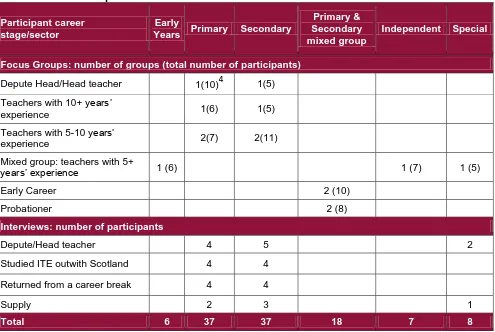
17 Table 3.1 Profile of qualitative interviews
Participant career stage/sector
Early
Years Primary Secondary
Primary & Secondary mixed group
Independent Special
Focus Groups: number of groups (total number of participants)
Depute Head/Head teacher 1(10)4 1(5)
Teachers with 10+ years‟
experience 1(6) 1(5)
Teachers with 5-10 years‟
experience 2(7) 2(11)
Mixed group: teachers with 5+
years‟ experience 1 (6) 1 (7) 1 (5)
Early Career 2 (10)
Probationer 2 (8)
Interviews: number of participants
Depute/Head teacher 4 5 2
Studied ITE outwith Scotland 4 4
Returned from a career break 4 4
Supply 2 3 1
Total 6 37 37 18 7 8
Interpreting the data
Quantitative data
3.12 Data tables were created from the online survey results. Each question in the survey was shown with results broken down by key analysis variables. The tables included significance tests to highlight differences between sub-groups. Throughout the report, differences between sub-groups are commented upon only where these are statistically significant i.e. where we can be 95% certain that they have not occurred by chance.
3.13 The analysis comprised question by question analysis examining both the frequency of response to each survey question and the extent to which
responses varied by key demographics such as school sector, teacher type and teaching experience.
3.14 In the charts throughout the report, where percentages do not sum to 100%, this may be due to computer rounding, the exclusion of „don‟t know‟ categories or multiple answers. Throughout the report, an asterisk (*) denotes any value of less than half a per cent and a dash (-) denotes zero.
4
The number in the cell indicates how many discussion groups were conducted for that
18
3.15 Where possible, comparisons have been drawn between the 2010 TSF teacher survey and the survey in this study. Due to the changes made to the
questionnaire, only a small number of questions were directly comparable – these questions are highlighted in the survey topline results in Appendix A.
3.16 As noted above, the online survey from the evaluation was weighted to reflect the teaching current teaching population, while the 2010 data was not. This meant that, in order to allow comparison, the 2010 results had to be weighted in line with the procedures in 2015. The resulting figures may, therefore, differ from those found in the 2010 TSF Report.
Qualitative data
3.17 Unlike survey research, qualitative social research does not aim to produce a quantifiable summary of attitudes or experiences, but seeks to identify and explore the different issues and themes relating to the subject being researched. The assumption is that issues and themes affecting participants are a reflection of issues and themes in the wider population concerned, and the way in which these impact on people.
3.18 With the permission of participants, interviews and groups were audio-recorded and transcribed for analysis. In addition, after completing each interview or group, detailed field notes were written up to capture the key points of the discussion.
3.19 Once the fieldwork was completed, the team held a series of meetings to enable a collaborative discussion of the findings and their implications.
19
4 Culture of professional learning
4.1 This chapter provides an overview of the current culture of professional learning among Scotland‟s teachers and how it has changed since the TSF review in 2010. Subsequent chapters (particularly the chapter on CLPL activities) explore specific aspects in more detail.
What has changed?
4.2 The overwhelming view, from teachers at all career stages and from national and local authority stakeholders, was that – while there are challenges and there is still a considerable way to go – there has been a significant shift in the culture of professional learning over recent years. There was evidence, from both the survey and the qualitative research, that:
teachers are more engaged with professional learning
there is more professional dialogue taking place
there is a greater willingness to try new approaches. Increased engagement with professional learning
4.3 Almost all LA representatives reported increased engagement with professional learning: 22 of the 30 who were asked thought teachers in their LA were „more engaged‟ than they were five years ago and six of the 30 thought they were „much more engaged‟. The remaining two thought there was no difference.
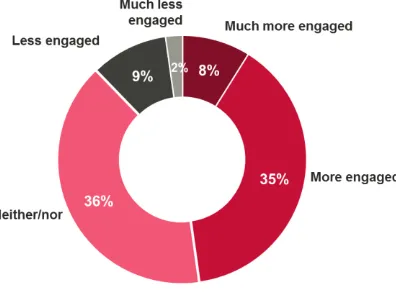
4.4 The views of teachers themselves were more mixed but nonetheless 43%5 of survey respondents thought that teachers were „more engaged‟ with professional learning than they were five years ago, while 36% thought there was no
[image:23.595.126.324.557.705.2]difference and just 11% thought they were „less engaged‟ (Figure 4.1).
Figure 4.1: Based on your experience, how engaged are teachers with professional learning in comparison to 5 years ago?
5
20
4.5 Participants in the qualitative research identified several inter-related aspects to this increased engagement:
Increased focus on professional learning. National stakeholders and LA representatives felt that one of the main benefits of TSF was that it had helped raise the profile of professional learning – and this heightened awareness came through strongly in the qualitative research with teachers.
I think it's more at the forefront of people‟s minds now than it has ever been.
Secondary Head Teacher
Increased ownership of CLPL. In the qualitative research discussions with teachers, it came through strongly that they felt an ownership of their
professional learning: while they expected (to a greater or lesser extent depending on their experience) to be supported, they saw it as chiefly their responsibility to identify their needs and take the initiative in trying to address those needs. LA representatives also felt that teachers now had a greater sense of ownership of their professional learning – and that this was one of the main benefits of TSF.
Greater awareness of the range of activities that can lead to
professional learning. There was a shift away from the assumption that CLPL equated to „going on a training course‟ and teachers talked about a wide range of professional learning activities that they had undertaken. Not only were teachers more aware of, and more open to, different ways of addressing their own learning needs, they also realised that much of what they were already doing was professional learning.
[There is a realisation] that it‟s not about going on course – it might be as simple as speaking to the teacher next door – and that‟s a huge mind shift.
LA representative
More relevant to needs. There was an increased focus on prioritising learning that was relevant to the individual teacher‟s particular development needs – rather than going on a course just because it was on.
Increased focus on impact. Linked to the above, there was also an
increased focus on the potential impact of professional learning on the pupils. Decisions about what professional learning to undertake were now more likely to involve a consideration of the needs of the individual pupils that a teacher was working with.
More professional dialogue
21
Teachers in the qualitative research commonly contrasted the current culture with the situation they experienced earlier in their careers.
If you went into a class as a student and asked questions, some
teachers were quite open to having discussion with you about different things, but other teachers would kind of shut you down because they didn't want to feel like they were being questioned. I think that culture is slowly going away.
Teacher who qualified 10 years ago
Greater willingness to try new approaches
4.7 One important marker of the change in culture is that a sizeable minority of teachers (41%) say that they try new teaching practices and strategies more often than they did five years ago (Figure 4.2).
Figure 4.2: In your professional practice, do you try new teaching practices and strategies more or less often than you did around 5 years ago?
22
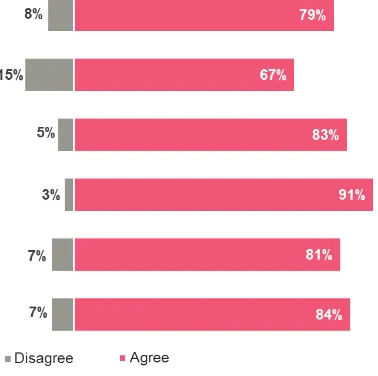
Figure 4.3: How much do you agree or disagree with each of the following statements…?
What has helped change the culture?
4.9 Participants in the qualitative research pointed to several factors which they felt had driven the cultural changes discussed above. Some of these were a direct result of TSF, some were given increased impetus by TSF and some were independent.
4.10 There was widespread agreement that the introduction of Professional Update and the new GTCS Standards played a very important role in increasing engagement with professional learning. It was felt that the new Standards provided coherence to CLPL through all career stages. It was also noted that they promoted a shared language around CLPL and pedagogy.
4.11 There was also a widespread view that the „new generation‟ of teachers
emerging from ITE in recent years had helped change the culture. It was felt that it was „ingrained‟ in these teachers from the start that they should be
self-reflective, engage in professional dialogue, share practice and work
collaboratively. Not only did this help change the culture simply because the new generation were gradually replacing the older generation, but it also forced more experienced staff to „raise their game‟.
For me, somebody who is relatively new to the profession, it almost feels like an ethos in terms of you should be self-reflective, you should be constantly evaluating your own practice, I think. So, I guess, it's almost an institutionalised mechanism, if you like, of almost forcing you to evaluate – in a positive way.
23
4.12 Similarly, some participants referred to a „new generation of head teachers‟ who were more focused on trying to embed professional learning and create a culture of openness and collaboration.
[Why have things changed?] There have been a few retirements which were… fantastic and great professionals…however, less likely to be interested in engaging in sort of really soft emotional chat about their teaching and learning. For example, great professionals but interested in a different way of looking at things. Whereas we probably are more interested in engaging with each other and learning from each other‟s experiences
Early career teacher
4.13 There were two other factors, independent of TSF, which were felt to be
important drivers of the cultural shift. Firstly, the need to adapt to the significant changes in Scottish education in recent years including GIRFEC, the new
National Qualifications, How Good is Our School (HGIOS) and, above all, CfE. It was suggested that the only way that teachers could possibly keep up to date and adapt to these changes was by engaging more with professional learning – and with professional dialogue and collaborative working in particular.
4.14 Secondly, reduced resources (particularly LA support and provision of courses) and limitations on time had forced schools and individual members of staff to look at other ways of meeting professional learning needs. Although the drivers may have been unwelcome, it was clear that this had stimulated more internal work within schools, more collaborative working among colleagues, more sharing of practice, and more variety and creativity in ways to achieve professional
learning. It also encouraged prioritisation of activities that would have most impact on pupils and best meet the development needs of the individual teachers.
What are the challenges?
The impact of barriers on engagement
4.15 The cultural change has occurred despite a challenging context (outlined in sections 4.13 and 4.14 above) for Scottish education. All of these issues have impacted on workloads. While, as noted above, the challenges have driven some positive changes, it has to be acknowledged that they have also hindered
progress.
24
that other pressures (particularly workloads) make it unrealistic. This, in turn, has a knock-on impact on the overall culture and the speed of change.
You can‟t expect people to engage in it and take on this idea that it is a journey if there is no outcome at the other end. If you can‟t promise them that what they are putting down, you're sitting having the deep and meaningful conversation, that coaching conversation, that they then feel, but what‟s the point in this because I never get to go? That is, I would say, a massive issue.
Principal teacher
It's almost like a door seems to open and then it's closed really quickly again, because actually you can‟t do it, I can‟t ask. I got all the
paperwork through [to apply for a secondment] and looked at it, but there would be no point in applying because I can‟t be released to do it.
Teacher
4.17 There is a danger, therefore, that the heightened profile of professional learning raises expectations and makes it even more demoralising if the barriers cannot be overcome.
Teachers who have not embraced professional development
4.18 Although there was widespread agreement that there has been a significant change for the better in the culture of professional learning – while
acknowledging the barriers discussed in section 4.163 and 4.14 above – there was also a widespread view that not all teachers have embraced the changes.
There is still a body of staff who are not engaged. The profession is on the path but not there yet.
LA representative
4.19 Participants in the qualitative research most frequently cited the longest serving teachers as not embracing the changes (though they were at pains to point out that they were not referring to all of these teachers). They also thought the culture of some departments and some schools inhibited change. In particular, they talked about departments and schools where there was a lack of openness and an unwillingness to share practice or engage in professional dialogue. A lack of turnover and/or a longer serving staff profile were thought to be contributing factors.
25 A continuing focus on courses
4.21 There was a greater awareness of the range of activities that can lead to professional learning (see section 4.5 above) and participants in the qualitative research frequently made the point that there was much more awareness now that CLPL was not just about going on courses. However it was telling that, later on the discussions, many of those same participants reverted to talking about courses. So, for example, when they were asked about barriers to CLPL or what support the LA provided for CLPL, they naturally talked about barriers to going on courses, or what courses the LA provided/did not provide.
4.22 This suggests that there is some way to go before an appreciation of the range of ways to approach professional learning is fully embedded.
Overall quantitative trends
4.23 While subgroup differences in the results of the online survey are discussed in the relevant chapters, there were some broader trends from the 2010 findings that cut across most of the results and are worth noting:
those in promoted posts were more positive and engaged with professional learning than those in non-promoted posts (with the exception of
probationers) – as the level of responsibility increased (e.g. from PT to DHT), so did engagement
those working in the primary sector held more positive views about professional learning than those in the secondary sector
those who have temporary contracts and, in particular, those that work on a supply basis had poorer experiences of professional learning than those on permanent contracts.
26
5 Initial Teacher Education
5.1 TSF identified the need for substantial developments within ITE in order to raise the overall consistency of quality within the profession and develop the capacity of teachers to respond flexibly to a new curriculum (CfE); be confident in their ability to address social disadvantage, work with additional support needs, and teach literacy and numeracy. Recommendations highlighted a need for more coherence between ITE and induction, with greater opportunity for teachers to continue to learn at SQCF level 11. The report also identified student placements as a key element of ITE, and recommended that universities and Local
Authorities work more closely to deliver high quality placements.
What’s working well?
Effectiveness of ITE
5.2 LA representatives considered ITE to be more effective than five years ago, and both teachers and LA representatives in the qualitative research noted an
improvement in the quality of students and probationers.
5.3 In addition, students appeared to be confident going into their probationary year – two-thirds of survey respondents who had completed ITE at a Scottish
university within the last five years thought that their ITE was „effective‟ or „very effective‟ in preparing them for their first post (Figure 5.1).
Figure 5.1 Overall, how effective do you think your Initial Teacher Education (ITE) at university was in preparing you for your first post as a teacher?
5.4 Teachers were asked in the survey if, in their experience of working with
27
cent of respondents said that it was „effective‟ or „very effective‟. However, those in promoted posts were more likely to think that ITE was effective than classroom teachers, in particular depute heads (68%).
5.5 The survey also asked teachers if, in their experience of working with
probationers over the last two to three years, ITE was more effective than it was five years ago. Views were split; 29% thought ITE was no more or less effective than five years ago, 17% thought it was less effective and 16% thought it was more effective than five years ago.
5.6 The main reasons given by teachers from the qualitative research for why ITE was effective was that students and probationers had improved knowledge and understanding of pedagogy, classroom management, behaviour management and ASN, and were better prepared to work with national policy changes and priorities, than they had been in the past. This meant that they came to their first post more prepared, more confident and better able to deal with the challenges of the profession.
5.7 However, it is clear from the survey results that not all teachers feel that ITE is as effective as it could be – although less commonly this was also reflected in the qualitative research. Some teachers felt that the proliferation of topics covered in ITE due to wider policy priorities (e.g. health & wellbeing, outdoor learning, GIRFEC etc.) had led to an erosion of core pedagogical skills.
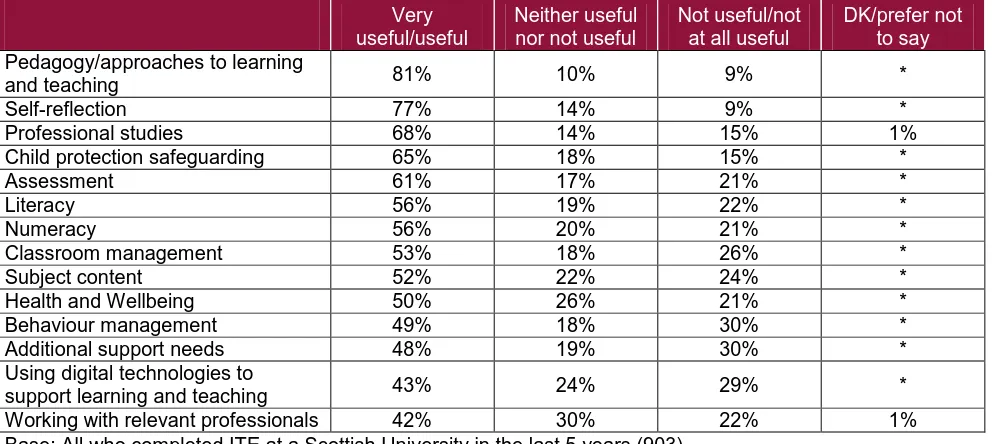
5.8 Those in the survey who had completed ITE in the last five years reported that the most useful aspects were pedagogy/approaches to learning and teaching (81% found these very useful/useful), self-reflection (77% found these very useful/useful) and professional studies (68% found these very useful/useful).
5.9 This reflects the feelings of current probationers and early career teachers in the qualitative research who felt that the most useful aspects were those that
provided them with practical strategies in the classroom – reflected in how positively they viewed the hands on experience they get during school placements (see section 5.18 below for more details).
Uni is very theory based and obviously that‟s good because you need that to be able to inform your practice. But, at the same time I could have done with a bit more like practical strategies as well in terms of actually how to implement certain things.
Current probationer I thought mine [ITE] was amazing, I think that was down to my tutor […] I think my tutor made it a bit like classroom practice, and so many things that I did part of my probation year, he had taught me to do it when we were learning it
28
5.10 The topic areas thought to be least useful by those who had completed their ITE within the last 5 years were; working with relevant professionals (42% found this very useful/useful), using digital technologies (43% found this very useful/useful), working with additional support needs (48% found this very useful/useful) and behaviour management (49% found this very useful/useful) (Table 5.1).
5.11 In contrast to the views of more experienced teachers outlined above, current probationers would have liked more input on ASN and behaviour management within core ITE programmes. To some extent this was purely about the number of inputs provided but, again, concerns were often related to the course inputs not providing enough in the way of practical strategies rather than not being provided at all.
As I say they‟ve got so much to fit in it‟s not the Uni‟s fault because they did a great job in the time they had. I felt like the [behaviour
management] course I was on, I thought it was great, but just in terms if you‟re asking are we all prepared? I think it could have been hammered home a lot more.
Early career teacher
5.12 Current probationers acknowledged that behaviour management is a difficult topic to cover because the problems, and appropriate strategies can vary in any given situation.
I think the behaviour stuff is so difficult, because it is going to be so different in every class.
Current probationers
5.13 In general, current probationers and early career teachers felt that literacy and numeracy were adequately covered during ITE – more so in primary than
secondary. However, as with all aspects of ITE there was still a feeling that more practical strategies would be beneficial.
5.14 Current probationers felt that while literacy and numeracy were covered well, there were fewer inputs about how to incorporate health and wellbeing into teaching and learning.
Considering it‟s given the same weight as literacy and numeracy in policy there‟s very little on it compared to either of those.
Current probationer
5.15 In light of the national policy focus on Raising Attainment for All, current
29
extent to which they are able to help individual children in challenging situations than thinking that the courses provided were insufficient.
It makes you almost think that you should be able to change the world and when you go in you can‟t do that, you‟ve been teaching for three weeks, you can‟t change that child‟s whole life
There was talk of teachers as activists and I‟m not saying that‟s bad, I think it‟s an excellent aspiration, but I think it puts quite a lot of pressure on you as a probationer
[image:33.595.60.556.264.486.2]Current probationer
Table 5.1 How useful did you find the following aspects of Initial Teacher Education (ITE) at university in preparing you for your first post as a teacher?
Very useful/useful
Neither useful nor not useful
Not useful/not at all useful
DK/prefer not to say
Pedagogy/approaches to learning
and teaching 81% 10% 9% *
Self-reflection 77% 14% 9% *
Professional studies 68% 14% 15% 1%
Child protection safeguarding 65% 18% 15% *
Assessment 61% 17% 21% *
Literacy 56% 19% 22% *
Numeracy 56% 20% 21% *
Classroom management 53% 18% 26% *
Subject content 52% 22% 24% *
Health and Wellbeing 50% 26% 21% *
Behaviour management 49% 18% 30% *
Additional support needs 48% 19% 30% *
Using digital technologies to
support learning and teaching 43% 24% 29% *
Working with relevant professionals 42% 30% 22% 1%
Base: All who completed ITE at a Scottish University in the last 5 years (903)
5.16 Current probationers in the qualitative research viewed CLPL as an ongoing process and considered it to be integral to their professional lives. This suggests that improvements made to ITE have helped to embed the cultural values of TSF into those who have newly joined the profession.
5.17 One important value that was thought to have been embedded was that newly qualified teachers have a good appreciation of the fact that while they have an entitlement to CLPL, this must be undertaken in the context of pupil outcomes.
I think as you see new teachers coming into the profession, they
understand that this is for [the pupils‟] benefit. It‟s too impact on learners in the classroom.
Depute head teacher
Placements
5.18 Overall, respondents who had completed ITE in the last five years were positive about the support they received from their university during their school
30
[image:34.595.104.537.154.382.2]„very effective‟ (Figure 5.2). There was no significant change since the 2010 TSF survey, which found that 54% thought that support from the university during their ITE placement was „effective‟ and 20% said that it was „very effective‟.
Figure 5.2 Thinking about your school placement during your Initial Teacher Education, how effective was the support given to you by the [university/school] to help successfully complete the placement?
5.19 However, the proportion of respondents who thought that the support provided by the school during their ITE placement was „very effective‟ has increased substantially since the 2010 TSF survey (41% in 2015, compared with 28% in 2010).
5.20 Respondents who had completed their ITE in the last five years thought that the support they were given by the school during ITE placements was more effective than that given by the university (41% of respondents thought that support given by the school was „very effective‟, compared with 20% who thought the same about the university). This is perhaps to be expected given that students work with teachers on a daily basis while on placement. Probationers in the qualitative research valued being able to discuss teaching strategies and practical solutions to problems they encountered with teachers in their placement schools.
31
5.22 There was a sense from teachers, some stakeholders and current probationers that schools and universities were carrying out more joint assessment6 of student teachers. Teachers and students welcomed this, viewing joint assessment as a fairer process that allows for teachers to comment more effectively on student performance over the duration of a placement.
Predictors of views of ITE effectiveness
5.23 Statistical analysis7 was used to determine which variables from the survey best predicted a respondent’s8 answer to the question ‘Overall, how
effective do you think your Initial Teacher Education (ITE) at university was in preparing you for your first post as a teacher?’.
5.24 By far the strongest predictor was finding the support provided by the University during your school placement effective. Individual aspects of the ITE course that also had a strong influence were finding the
pedagogy/approaches to learning and teaching element useful and finding Additional Support Needs element useful.
5.25 Other variables included in the model were the demographic variables9, other individual aspects of the ITE course10 and support provided by the school during school placement.
What are the challenges?
Aspects of joint assessment
5.26 While there was a perception that joint assessment was taking place more widely, teachers who participated in the qualitative research thought that the operational and organisational aspects of this activity could be improved further11. Teachers made suggestions for improvement in relation to:
6
Joint assessment means that the assessment of student teachers during placement and, where appropriate, of probationers during induction should be a shared responsibility of the school, the university and the local authority.
7
The analysis was conducted using Logistic Regression, for full technical details please see Appendix E.
8
This question was only asked of those who had completed their ITE in the last five years. 9
Sex, sector (primary, secondary etc.), full-time vs. part-time, permanent vs. temporary employment, rurality of school and school type (independent vs. local authority).
10
Literacy, numeracy, Health and Wellbeing, Professional Studies, Classroom management, Subject content, Assessment, Self-reflection, Using digital technologies, Behaviour
Management, Child protection/safeguarding and Working with other professionals. 11
32
the respective roles of the school and university in the assessment process (and the weighting of school and university input to student grades and passing/failing of modules) need additional clarification
the materials (e.g. forms, marking criteria) from universities that teachers use to carry out joint assessments are not always distributed to schools in a regular and timely way
the additional administrative and time requirements of joint assessment could be better supported or recognised in relation to teacher workloads
ensuring both schools and universities are up-to-date on current practice with each sector.
Aspects of school placements
5.27 Most of the concerns about ITE raised in the qualitative research were related to school placements:
There were mixed views about student supporters. While most current
probationers thought that their own supporters had been helpful, there was a concern based on experiences of some of their fellow students that some supporters did not have the requisite skills to act in this role. The probationers who raised this point thought that supporters of students should be given mentoring training and detailed guidance on the role. This view was echoed in interviews with teachers.
Some teachers and school senior management said they were not regularly supplied with accessible information from the university about changes to assessments and ITE content when they were hosting student placements.
Teachers and senior management also indicated that there should be better protocols for communicating concerns about students to universities during placements.
Schools often found it challenging to know what individual students were capable of, and as result, provide suitable on-placement experiences. Teachers suggested that it would be helpful for universities to provide them with clarification on the ITE topics that students have covered and their areas of experience before each placement.
Current probationers also suggested that improved communication between university and schools could help to fill student knowledge gaps in an
immediate and practical way while students are on placement (e.g. trying out different ways of integrating numeracy into lessons, or understanding
Experiences and Outcomes within daily practice).
On the placements I felt there wasn't a connection […] between school and Uni, […] there was no real communication. I felt there were
expectations on both sides that the other party would be providing a certain amount of learning.
33
Teachers and current probationers thought that assignment topics and
submission dates were not always well co-ordinated in relation to placements (e.g. assignments being due the day after placement ends on a topic not related to the placement learning).
Teachers in a special school highlighted the fact that students very rarely, if ever, have placements in special schools/units. They felt that such
placements (even very short ones) would be beneficial. They would be valuable for those who might want to work in a special school/unit and it would potentially increase the pool of such people. Moreover, it would give students more experience of different ASN strategies which would be useful in mainstream schools too – something that current probationers identified as being useful (see section 5.11 above).
5.28 Current probationers also highlighted the extent of portfolio work (e.g. writing up reflective lesson plans) which they felt was a considerable burden alongside school preparatory work during ITE placements.
Key areas for consideration
Joint assessment: further clarification and agreement of the respective roles of the school and the university
Student placements: improved communication between the university and the school on a number of aspects
34
6 Probation
What’s working well?
Support during probation
6.1 There was widespread agreement among teachers, LA representatives and national stakeholders, that programmes to support the full-time probationary year had improved over recent years, providing a more effective transition for newly qualified teachers into their first post.
I felt hugely supported on [my probationary year] and I very much enjoyed it and I feel much more confident. I'm only in the year after my probation year, and I already feel much more confident than I did this time last year.
Early Career teachers
6.2 A similar picture emerged from the survey with respondents viewing the support that they received from their school during the probation period very positively – 86% of respondents thought that the support was „effective‟ or „very effective‟ (with 56% stating that it was „very effective‟) in helping them achieve the Standard for Full Registration12 (Figure 6.1).
Figure 6.1 How effective was the support given to you by the school/establishment to help you successfully achieve the Standard for Full Registration?
12
The Standard for Full Registration (SFR) specifies what is expected of a teacher seeking full registration with the General Teaching Council for Scotland.
35 Professional learning
6.3 Professional learning undertaken during the probationary period was also highly rated. Eighty-five per cent of respondents thought that it was „effective‟ or „very effective‟ in helping them to achieve the GTCS Standard for Full Registration (Figure 6.2).
6.4 Probationers and early career teachers highly valued the role of the probationary year in equipping them with practical teaching skills – more so than their ITE placements- due in part to the extended time they spend in school and the
consequent need to develop longer term solutions to problems and strategies for their classes.
Figure 6.2 During your probationary period, how effective was the professional learning you undertook in helping you achieve the GTCS Standard for Full Registration?
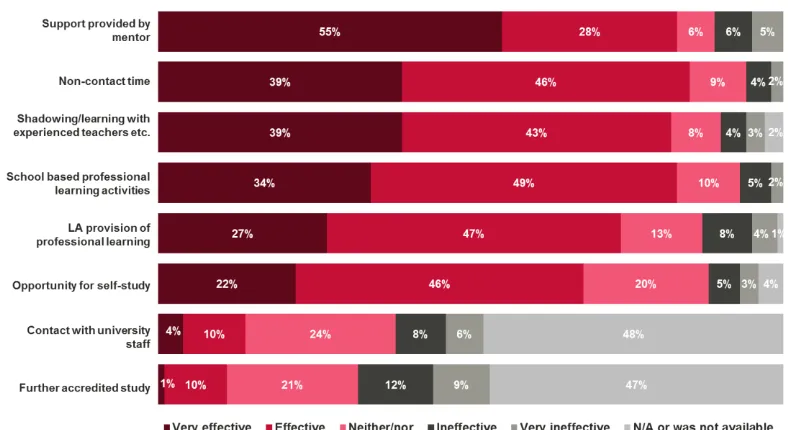
6.5 In the qualitative research, current probationers said they thought there was a good balance between the structured CLPL programme delivered by LAs and having the freedom to tailor their CLPL activity to their own specific needs. This was reflected in responses to the survey, where nearly all aspects of professional learning during the probationary period were viewed favourably – in particular, support provided by a
![Figure 5.2 Thinking about your school placement during your Initial Teacher Education, how effective was the support given to you by the [university/school] to help successfully](https://thumb-us.123doks.com/thumbv2/123dok_us/160485.37629/34.595.104.537.154.382/thinking-placement-initial-teacher-education-effective-university-successfully.webp)