How can it be measured,
managed and grown?
innovation means turning bold ideas into reality and changing lives for the better.
We use our expertise, skills and funding in areas where there are big challenges facing society. Nesta is based in the UK and supported by a financial endowment. We work with partners around the globe to bring bold ideas to life to change the world for good.
www.nesta.org.uk
If you’d like this publication in an alternative format such as Braille, large print or audio, please contact us at: [email protected]
How can it be measured,
managed and grown?
Summary
4
Background: Searching for value
6
A quick survey of the landscape of methods 8
Services, outcomes and justice 10
Value in the real world: Case studies from the frontlines of public value
11
1 The What Works Movement: Bringing more rigorous views of impact 11 and value into public servicesNo common currency of value 14
Valuing children in care 14
How to collect trustworthy data? 15
Citizens measuring, creating and evaluating evidence 17
Differing time horizons 17
Conclusion 19
2 Measuring value in culture and heritage 20
Using wellbeing analysis 24
Policy recommendations: Using existing valuation frameworks more 24 effectively and involving the public in valuation in new ways
3 Realising the value in health 27 When it comes to health, people value more than just clinical outcomes 27 People make decisions every day that affect their health and wellbeing 28
Value for people 30
Value for the system 31
Wider social value 34
A broader view of value 34
Conclusion 36
Some general lessons
37
Social and public value: Effective demand and effective supply 38
Summary
Recent decades have brought periodic waves of interest in finding better ways of mapping and measuring public and social value - outcomes, institutions and services that are valued by the public but not easy to count in the way that the monetary value of cars or computers can be. Governments and parliaments have sometimes tried to encourage this. In the UK for example, the Social Value Act explicitly encouraged broader notions of value, as have recent revisions of the Treasury Green Book used to assess public spending choices.
But these generally remain underdeveloped and lack influence compared to more
traditional market valuation methods. Within government there are still far more developed means for measuring investment in physical things - railways, roads, airports - than in intangibles like reducing social isolation, improving health or the arts. This almost certainly continues to skew public spending.
It’s obviously wrong to claim that you can’t manage what you can’t measure. But the lack of well-established metrics for public value in all its forms makes it harder to compare alternatives and continues to bias public spending against prevention rather than cure, against indirect benefits relative to direct ones, and against intangibles relative to physical objects.
This paper sets out alternatives. It brings together views from Nesta on better ways of mapping and measuring public value. It builds on work Nesta has done in many fields - from health and culture to public services - to find more rounded and realistic ways of capturing the many dimensions of value created by public action. It is relevant to our work influencing governments and charities as well as to our own work as a funder, since our status as a charity commits us to creating public benefit.
Our aim in this work is to make value more transparent and more open to interrogation, whether that concerns libraries, bicycle lanes, museums, primary health services or training programmes for the unemployed. We recognise that value may come from government action; it can also be created by others, in civil society and business. And we recognise that value can often be complex, whether in terms of who benefits, or how it relates to values, as well as more technical issues such as what discount rates to apply.
This paper documents work in progress but we hope its concepts, and applications, will be useful. It shows that:
1. Despite the tensions and dilemmas, public value - in all its forms - can be mapped and
often measured, in ways that are useful for shaping decisions.
2. The best valuation methods avoid the twin errors of, on the one hand, believing that a single measure can adequately capture complex values, and on the other, believing that decisions should just be guided by hunch or intuition.
3. Public value, like value in markets - is not a static fact but arises from the interaction of changing options for supply and changing demands and public priorities.
4. The greatest use of measures of public value comes not just from more detailed analysis
but from the conversations and negotiations they prompt. The key for any measure is whether it can help to enhance rather than replace conversations about priorities and decisions.
5. Public value methods should help governments decide on actions now that can deliver
benefits in the long term, whether on climate change, early childhood or healthcare. This requires new ways of managing public investment, but also a much more sophisticated approach to discount rates.
6. The debate about public value needs to be tied into much more energetic reform of
public finance methods, which need to become more transparent, more focused on outcomes, better suited to experiment and innovation and better shaped for public engagement. If this doesn’t happen, anachronistic methods for managing finance will crush imaginative attempts to map and measure public value.
7. Valuation has limits: in a democracy it should be possible for citizens, or politicians, to decide that they don’t want the state involved either in measuring or seeking to influence important areas of life, including families and communities.
Background:
Searching for value
By Geoff MulganUntil the 1990s, international accounting conventions assumed that public sector productivity never improved: the value of public provision was assumed to be equal to its cost. Yet in a period of greater public pressure for results and value for money that position became untenable.
For a time, the main focus was on critique – showing the limitations of mainstream economics, and methods like cost-benefit analysis, and how inadequately they captured externalities and social benefits.
But over the last 20 years serious attention has turned to finding better alternatives (though critiques can still pull in a big audience). Public bodies like the BBC commissioned detailed studies of the public value they were creating back in the 2000s and for a time the Cabinet Office promoted new methods of assessing public value. These methods aim to measure not just what public interventions cost, but also provide more rounded accounts of what value they create, and, just as important, what value civil society can provide for public commissioners and purchasers. There have been advances both in economic approaches – like Cost Benefit Analysis (CBA) and the UK Treasury Green Book – and non-economic ones, that are mirrored in many countries around the world. Ambitious ideas are also being developed for more precise measures of social and other goods.1
There’s been a parallel push in civil society, mainly driven by funders wanting better measures of social impact and social returns; better measures for the impact in ‘impact investment’; and better ways to compare the results of spending in different fields. A plethora of organisations have been set up to help map and measure value and impact, and – like Global Impact Investment Network – to establish some common standards for fields like clean energy or healthcare. Others offer to measure social value.
At least four distinct communities have been having very similar discussions about value, though with surprisingly little cross-pollination: statisticians attempting to measure
wellbeing and outcomes of all kinds (for example brought together in the OECD Better Life Index); economists applying measurement tools to new fields, such as carbon and natural capital; philanthropists and NGOs interested in impact investment; and activists using new measures as a tool for social change (for example measuring or revealing carbon footprints or social neglect).
Better metrics do not of themselves deliver better outcomes. You can’t fatten a pig by weighing it. But if you don’t have some means of weighing it you may find yourself unable to persuade others that it’s as fat as you believe.
Many methods try to put a price on value. The idea that the value to be gained from a new training programme can be directly compared with the value from a health screening programme or water conservation is immediately appealing to busy bureaucrats and ministers who have to justify spending money on one area over another, as it is to foundations.
So how can this be done? Traditional economic valuation methods (based on utilitarian principles) which try to monetise public value usually draw either on what people say they would pay for a service or outcome (‘stated preference’) or on the choices people have made in related fields (‘revealed preference’). These methods also try to adjust the estimated benefits of public services for quality of outcomes – for example comparing school exam results, or the success of operations. As they deliver commensurable estimates, economic methods imply that the benefits of disparate outcomes can be compared and added up.
Other economic methods, such as subjective wellbeing,2 compare public policy actions
by estimating the extra income people would need to achieve an equivalent gain in life satisfaction.
Decision-making becomes a lot easier if any option can be turned into a comparable number, and there have been many attempts to create such tools. Governments would love to be able to use a single metric to compare spending on a scheme for housing the homeless, primary education, bridges and defence, though none have come even remotely close to having such a tool. Other attempts include CBA and, in the social sector, social return on investment (SROI), and more recently Y Analytics and the Impact Multiple of Money, a single number now being promoted to adjust company valuations to take account of all their impacts.
These are all well-intentioned. But paying too much attention to monetary equivalence can lead to bad decisions and I’ve become sceptical of moves to pretend that a single number can compare very different activities and outcomes. These fall apart intellectually and practically for many reasons (I set out the arguments in more detail in this piece).
Some are reasons of principle (the plurality of approaches to valuation in different fields or spheres); some reasons fall on the boundaries of theory and practice (such as what discount rates to apply to different activities); and some are reasons of practicality (the experience that different methods used to assess value can generate wildly different numbers, and often miss out what people turn out to value most (because people may not be willing to countenance trading off the things they care about most).3 As one recent book put it,
value ‘is neither an intrinsic quality of an object, nor a reflection of a subjects preferences, but rather something that is organized and brought into existence through mechanisms, technologies and practices of valuation.’4 So our attention needs to focus on what these
A quick survey of the landscape of methods
There are many methods for trying to make sense of value in the public sector and civil society, providing a bridge between the complex patterns of public demands and needs, as expressed through political and other processes, and the changing production systems that keep people healthy, educated or safe.
Cost-benefit analysis (CBA) has been the most widely used, mainly in transport (where in recent years they have been integrated with environmental appraisals) and for big projects (where they are notorious for underestimating costs).5 CBA has been subject to criticism for
decades but continues to be used, and President Macron recently introduced a requirement that any project costing more than E20 million needed a CBA.
In philanthropy and civil society many methods are used, some linked into standards of evidence of the kind Nesta has promoted. These aim to capture data on impacts; where possible to draw on longitudinal data sets; and ideally the use of counterfactuals or control groups (New Philanthropy Capital recently mapped some 1,000 different methods in use). Often, these attempt to provide versions of ‘balanced scorecards’ or outcome stars to map value in multiple dimensions.
There are also the many applications of public sector welfare economics, such as environmental economics which has tried to put values on everything from the natural capital of rainforests to carbon emissions. Detailed methods have been in use for several decades to estimate the direct costs of an action (e.g. a drug treatment programme), the probability of it working, and the likely impact on future crime rates, hospital admissions or welfare payments.
Analysis of this kind can be very powerful. In the USA, for example, researchers identified what they called ‘million dollar blocks’ where the costs associated with criminals topped the million-dollar mark. In principle, good preventive actions targeted at the people living in these blocks might save far more than they cost if they diverted some people from a life of crime.
These analyses can also be made highly sophisticated. They can, for example, be adapted to reflect income distribution, on the principle that an extra dollar, or an extra unit of utility, is worth more to a poor person than a rich one (since 2003 the UK Government’s Green Book has required all appraisals to include distributional effects), or time effects (on the principle that if growth continues, the marginal value of an extra £ will be worth less in 50 years’ time simply because average incomes will be higher).
But all measurements of complex effects are inherently hard, and they can be costly. The benefits tend to become more dispersed over time, affecting ever more agencies in ever more uncertain ways. Social science is rarely robust enough to make hard predictions about what causes will lead to what effects – there are usually far too many variables involved. Meanwhile standard cost benefit models apply discount rates to these gains, usually based on prevailing commercial interest rates, which renders a benefit in a generation’s time virtually worthless.
An even more fundamental problem is that these analytic methods presume that
intrinsic virtue in punishing criminals regardless of the costs and benefits of alternatives to prison.6 This is why the economic models for thinking about public goods and externalities,
though informative, are often inadequate to the real choices faced by policymakers and out of sync with public attitudes and politics.
Many valuation methods also fail to take account of what matters to beneficiaries. This is particularly the case for children’s services and care. Too often children are powerless and voiceless, and their concerns are excluded from the clever metrics designed to capture impact. As a result, the key for any measure is whether it can help to enhance rather than replace conversations about priorities and decisions.
Box 1:
The Social Value Act (2013)
The aim of the Social Value Act was to shape the procurement approach and design of public services in England. The Act encourages commissioners to take a value for money approach, not the lowest cost approach. Nonetheless, the Act does not specify how procurement models should incorporate social value or how social value should be measured. At the Social Value Hub, one of the four key areas within the act’s programme of work, different reports suggest SROI can be a useful tool to measure social value. However, there are no reports indicating how many organisations are using SROI.
Implementing the Social Value Act
Lord Young’s two-year review of the act highlighted the issues caused by the lack of a fully developed measurement of social value. The review pointed out that despite many organisations seeing the potential of the Act, it was difficult for public bodies to differentiate the additional social value offered by one bidder over another. Young’s (2015) review also acknowledges that fewer organisations had fully developed a strategy or policy in place and therefore, there were inconsistent practices. According to the report Procuring for Good (2016), 33 per cent of councils make use of the Act but only 24 per cent had a social value policy in place. Healthy
Commissioning (2017) found that only 13 per cent
evidenced and made active use of the Act whereas 57 per cent of CCGs included the term social value in their procurement processes. Power to Change, reporting on the Act, also found that it made little practical difference to how councils commissioned.
Future recommendations
UK Government announced in early 2018 an extension of the act: social value will be an explicit requirement in central government contracts to the private and third sectors (not local
government or other public sector commissioners). This extension does not seem to include a
fully developed measurement of social value. Nevertheless, there are other relevant initiatives in this area. The British Standards Institute is developing a standard for social value with representatives from across sectors. ISO 20400, the first international guidance standard on sustainable procurement, has incorporated social, environmental and economic concerns into the procurement activity and supply chains. Scotland and Wales have also passed similar initiatives. In 2014, Scotland passed the Procurement Reform Act and Wales the Community Benefits Guidance. The Scottish model of procurement includes public services and goods focusing on a business-friendly and socially responsible procurement approach. The Welsh proposal highlights the idea of
Services, outcomes and justice
Many things that governments and civil society do are valuable to the public, but they roughly fall into three main categories:
The first is the value provided by services – like well-maintained roads, or hospitals. Services can be relatively easy to analyse in terms of value. In some cases there are private sector benchmarks and in others people can be asked how much they would be willing to pay for different levels of service – for example, the evening opening of a library, or retaining a very local Post Office.
The second category of value is outcomes. – like lower crime, or security from invasion. Again, through democratic argument, or through surveys, people can place a rough value on these. One of the outcomes they say they often value highly is equity. Whether people use privately funded alternatives to public provision has surprisingly little impact on their propensity to support higher state spending. Often outcomes and services align; but in many cases they point in different directions (e.g. more police on the street experienced as an improvement in services even when it doesn’t result in lower crime).
A third category of value is trust in its widest sense, which includes whether the work of government is seen as just and fair, or more broadly whether institutions are trustworthy (a topic with obvious relevance to charities).7 This is influenced partly by people’s satisfaction
with public services, alongside perceived integrity, reliability and responsiveness of the government. Its flow-on effects matter too, with ‘perceived quality of institutions’ in turn influencing people’s trust in others.8 Our approach has been to encourage an active search
Value in the real world:
Case studies from the
frontlines of public value
In this section we set out a variety of different ways of thinking about public value which show how these complexities can be grappled with in ways that help decision-makers.
1.
The What Works movement:
Bringing more rigorous views of
impact and value into public services.
By Jonathan Breckon and Mariola Tarrega
The UK’s What Works Centres aim to translate value in a way that is useful for frontline professionals and policymakers. Launched in 2013 by ministers from the Treasury and Cabinet Office at Nesta, they seek to marshall the best available evidence to make smarter policy, practice and spending decisions.
National Institute for
Health and Care
Excellence (NICE)
Education
Endowment
Foundation
What Works
Centre for
Crime
Reduction
What Works
Wellbeing
Early Intervention
Foundation
Centre for
Ageing Better
What Works Scotland
(affiliated)
Wales Centre
for Public Policy*
(affiliated)
*Formerly Public Policy Institute for Wales.
What Works Centre for
Children’s Social Care
(affiliated)
1999 2011 2013 2014 2015 2017
What Works Centre
for Local Economic
Growth
…test and trial approaches and assess what works in major social policy
areas, so that commissioners in central or local government do not waste
time and money on programmes that are unlikely to offer value for money.
HM Government 2012, p17
What Works Centres point to how to save money – by cutting things that don’t work.9
But they also show how you can save money in other ways: spending taxpayers’ money on successful things that are also cheaper than other options. For instance, reading comprehension strategies are both cheap and effective in schools, according to extensive evidence. Other successful approaches are just too expensive: one-to-one mentoring, for instance, is reasonably effective, but uses up too much time and money. School budgets just can’t stretch that far.
More controversially, organisations like the National Institute for Health and Care Excellence (NICE) may recommend that the NHS avoids funding life-extending drugs and treatments, because their value fails to justify their costs. NICE – created in 1999 under the Blair government to end the ‘postcode lottery’ of availability and quality of NHS treatments – decides whether a clinical intervention or technology is merited. Their evidence-based recommendations can, however, be hard for the public to stomach. For instance, guidance issued by NICE in 2005 caused a ‘firestorm of controversy’ by banning drugs for Alzheimer’s,
known as cholinesterase inhibitors.10 While NICE acknowledged that there were some
promising clinical trials showing cognitive improvements for Alzheimer’s patients, it doubted whether the size of the benefit was worth the hefty cost of the drugs. However, there were no other drugs available to patients at the time and NICE received over 8,000 complaints.11 Such
controversies do not go unnoticed in other countries. In the US, Obama’s Affordable Care Act (ACA) explicitly banned the use of quality adjusted life years (QALYs) in health care.12
Box 2:
US Congress legislates against QALYs
The Affordable Care Act legislated against the use QALYs, saying that ‘The Secretary shall not utilize such an adjusted life year (ie QALYS) (or such a similar measure) as a threshold to determine coverage, reimbursement, or incentive programs.’ This might reflect the US aversion to ‘big government’ and so-called ‘death panels’. Nevertheless, a ban on such valuation techniques has its own ethical dilemmas. As the authors of an article in the prestigious New England Medical Journal pointed out:
No common currency of value
The NICE model is by far the most sophisticated model of value amongst the What Works Centres. For the others, there is a more mixed record of how they assess public value. Only half of them have any clear way of comparing values – such as through cost-benefit analysis, cost-effectiveness, or cost-utility ratios (basically a medical variation of cost-effectiveness). Some, like the What Works Centre for Crime Reduction just recognise costs, but don’t compare it to value. Yet others, like the Centre for Ageing Better, have no approach to value at all, although they do have plans to use more economic measures in the future.
Generally, the Centres have not picked one common currency of cost and value.
Instead, they have grown their measurements organically, some would say haphazardly, with no rigid fixed model (see Annex comparing the ten What Works Centres). This is understandable, as the sectors they cover are so diverse, covering clinics, foster homes, classrooms and more. Shoehorning everything into one uber-measure would not win friends for the What Works Centres. What matters to a nurse may be very different from a teacher. But, as will be argued below, it can be confusing having ten different What Works Centres with ten different ways of thinking about value.
Valuing children in care
In some sectors, there is almost no consensus on how to measure what counts. How, for instance, can you understand whether the care system is helping children in foster care or children’s homes? It’s not enough to look at these children’s outcomes in isolation – such as through their GCSE results, or whether they go to university. That approach doesn’t take into account the legacy of trauma, abuse or neglect they may have suffered long before they came into care. According to Louise Bazalgette, Evidence Lead for the What Works Centre for Children’s Social Care, incubated at Nesta:
If we want to know whether foster care or children’s homes are helping, then a good start is to ask the children themselves, as Coram Voice’s Bright Spots project is doing – still a rare approach to measuring the quality of children’s care. Where children’s feedback is sought in most cases it still isn’t being gathered and analysed systematically.
We also need to listen to the children’s carers and social workers and provide them with the support they need to do what is sometimes a very demanding job. The What Works Centre for Children’s Social Care has to find meaningful ways of understanding what makes for great care for children. That means measuring the things that really make a difference – the quality and stability of children’s relationships, their resilience and wellbeing, getting a job – so that we can see which interventions support these kinds of outcomes – rather than just measuring the things that are easy to count.
How to collect trustworthy data?
The example above on Children’s Social Care alludes to the difficulty of getting good data from people when subjective views are important. Sometimes it’s easier to collect independent figures, such as exam results in schools, or numbers of medical diagnoses. But when quality of life comes into the equation, then people need to be asked how they feel. For NICE, their preferred tool is the EQ-5D questionnaire. It asks patients about pain, discomfort, self-care, anxiety, and other factors that created 243 unique combinations of health.14 For the What Works Centre for Wellbeing, subjective views of life quality is their
core business. They have opted for questions on Life Satisfaction, such as answering: ‘overall, how satisfied are you with your life nowadays?’ Life Satisfaction is a ‘common currency’ for subjective wellbeing.15
But can you trust what people tell you? Perceptions may not match reality. For instance, results from the British Crime Survey consistently show that people’s perceived likelihood of being a victim of crime is considerably higher than their risk of actually being a victim. This is important when thinking about subjective wellbeing. What is more important: the fear of crime or the actual act of crime? It would be misleading to wholly dismiss people’s fears: perceptions matter.
Nesta’s standards of evidence
16Nesta provides a framework for thinking about how much you can trust evidence. It lays out five levels of evidence of impact, ranging from early-stage Theory of Change (Level 1) to robust, replicable evidence (Level 5). The framework supports cost-benefit analysis (at Level 4). As well as being used to assess Nesta’s social investment funds since then, the Standards of Evidence have been used in other parts of the organisation, such as Centre for Social Action Innovation Fund, a partnership between Nesta and the Cabinet Office. Recipients of Nesta funding such as the Action Tutoring charity have interpreted the standards according to their needs. Action Tutoring used the standards (see below) to demonstrate the quality of their impact evaluation and according to their report their evidence went up from Level 1 to 3. The comparison group approach used did not indicate direct correlation between their intervention and their initial aims. However, there was enough evidence to demonstrate the long-term potential of continuing their programme.
Level 5
You have manuals,
systems and procedures to
ensure consistent replication
and positive impact
Level 4
You have one +
independent replication
evaluations that confirms
these conclusions
Level 3
You can demonstrate
causality using a
control or comparison
group
Level 2
You capture data that
shows positive change,
but you cannot confirm
you caused this
Level 1
Citizens measuring, creating and evaluating evidence
When measuring value, it’s a wise move to use credible evidence, tried-and-tested methods, mix quantitative and qualitative, and use frameworks, such as the Nesta standards of evidence. But the views of the public at large – the voters and taxpayers – may differ from those close to the project. There are different methods and strategies to incorporate a wider range of voices in evidence-making and evidence evaluation processes. To help get round this, we mentioned before that NICE runs a survey of 3,000 members of the public to check their views on Quality of Life. Essentially it’s a survey of the gut instincts of people, although made in the artificial environment of filling in a questionnaire. A more sophisticated technique is to use deliberative ‘mini-publics’ such as Citizen Juries or Consensus Conferences.17 For example, the NICE Citizen Council invites a representative
group of people to get to grips with the ethical and scientific complexities of health (see Box 3). Like a legal jury, they need to weigh up the evidence, spend time really understanding the issue, discuss trade-offs, and come to some final conclusions. The Citizen Council’s recommendations are incorporated into ‘Social Value Judgements’ and, where appropriate, into NICE’s methodology on guidance for healthcare. Citizen or user participation is a core part of the Scottish public sector ethos.18 For instance, for What Works Scotland, involving
the public in its work is essential. Co-production is the guiding principle for much of its work, such as the Scottish Participatory Budgetary Evaluation Toolkit. The views and contributions of citizens and others are just as important as research evidence. These initiatives require organisations to transfer part of their decision-making power to users and/or citizens. They also need sustained investment in capacity building to ensure citizens have the skills and motivation to participate in the process.19 Finally, organisations need to be open to enact
changes promoted by these initiatives i.e. adopting new evaluation measures.
Box 3:
‘Science is not enough’ – NICE’s public forum for
social value judgements
NICE’s Citizens Council is a unique example of an established and semi-permanent mini public, integrated into a decision-making body. It was established in 2002.
The Citizens Council of 30 members meets once a year for two to three days. The Council was set up to ensure that the perspectives of the public are included in the processes it uses to develop clinical guidance. It explicitly excludes anybody involved already in health, such as those employed by the NHS, or patient advocacy groups.
Working on the premise that ‘science is not enough’, the Council aims to ensure that
specifically on issues where social value judgments must be made, and the moral and ethical
issues that NICE should take into account in its guidance and methodology. Its conclusions are incorporated into NICE’s Social Value Judgements document.
Differing time horizons
Another important way to think about value is over different time scales. The What Works Centres all handle timescales differently.
The Education Endowment Foundation (EEF) toolkit shows the amount of months gained or lost in the classroom from teaching techniques. The EEF values do not reflect benefits in the future, such as employment and welfare – they only focus on educational attainment now, in the school. The danger with this approach is that it ignores a whole raft of other longer-term social, emotional and societal benefits. For instance, pre-school support for kids such as Sure Start programmes can benefit children and families for years – and even decades
Box 4:
Education Endowment Foundation Teaching
and Learning Toolkit
For the Education Endowment Foundation, value is narrowly defined as educational attainment. Other outcomes are not used in their toolkits, such as wellbeing, character or social equity. This approach is not without difficulties. Teaching
assistants, for instance, have little impact on school results. But they create all sorts of other value, such as saving the sanity of teachers by helping to look after children in the classroom.
at short-term costs (even if that is the reality for the holders of school budgets: they have to worry about where to find the cash for next term, not worry about future generations). Other What Works Centres do take into account the longer-term costs and benefits. The Early Intervention Foundation puts lots of attention on future value, not just immediate benefits. Other What Works Centres such as NICE and What Works Wellbeing recognise the bias towards valuing present benefits today and putting less value on benefits accrued in the future – and quantify this via the use of discount rates. For wellbeing, the proposed discount rate is 1.5 per cent per annum, in line with Department of Health and Treasury
Green Book guidelines.22
Conclusion
Nesta’s Alliance for Useful Evidence was set up in 2012 to champion the smarter supply and use of evidence – in whatever form evidence may take – as long as it is used by the people that need it. Evidence of value is necessary and needed. But the whole point is to make measures of value actionable. Otherwise we just create new gleaming ivory towers of value metrics that are ignored – except by the back-office bean counters.
The great advantage of the What Works Centres is how they foreground the user. Any teacher, governor or parent can, for instance, grasp the Education Endowment Foundation toolkit. If you want more of the research nuance, then you can dig down a few clicks for detail. It also uses a measure of value that is plausible in the eyes of the public: the months gained or lost in the classroom by using certain teaching techniques. This is not an abstract monetisation of value, but something that matters to schools, budget holders and parents. But there is no consistency between the different types of value they use. When the Centres were first launched in 2013 there were only six of them. Now there are ten (although the one in Scotland is closing). And there are at least four other prospective ‘what works wannabees’ who came together at an event in Nesta in 2017. None of these organisations is working towards using a common currency of costs, benefits and public value.
We need to address this. It’s confusing if one social programme is given one measure of value by one organisation, and another measure by another organisation. The point is to make decisions easier, not harder, and to avoid cherry-picking value estimates to justify decisions about the utility of certain policies and programmes. We also need to learn from behavioural research about the best way to communicate numbers and value – in a way that lands with stakeholders. Using good user-focused design, tailored-and-targeted messaging, systems that hard-wire evidence and value into daily decision-making, will all help. Various ‘nudges’ may help citizens and professionals act on value too. The Behavioural Insights Team, a partnership with Nesta and the Cabinet Office, has created nudges to help citizens do things they value but that they have not got around to doing, such as enrolling in workplace pensions, or signing up for organ donation.
2.
Measuring value in culture
and heritage
By Hasan Bakhshi and John Davies
Cultural activities and cultural objects are the subject of several policy interventions which raise questions about their public value. Most obviously, many cultural institutions in the UK, such as museums and performing arts organisations, at national and local levels, receive funding – directly or indirectly – from the state. Cultural objects can also be subject to specific legal protections such as licensing rules on their export or, in the case of physical buildings and structures, listing and conservation status in the planning system.
At the same time, there are a number of challenges in measuring the value of culture:
• The frequent absence of a price as a measure of the value to users. A lot of cultural activity does not have a clear market price that can be used as a proxy measure for value to the public, for example when museums have free entry. And even if there is a price, as this is often not set on a commercial basis it may not necessarily reflect the cost of the service or people’s valuation of it. In the case of cultural objects many may have been acquired without involving financial transaction, and if they were sold it may have been a long time ago.
• The value extending beyond direct users. The value of culture can extend beyond people who make direct use of it (so called non-use values). For example, we may enjoy the view of a historic cathedral even if we do not visit it. We may value that a museum exists to protect cultural assets for future generations even if we have never been. There is often not a ready measure of these non-use values, and of how they vary over the population.
• Uniqueness. Some cultural objects are unique, so it is not clear how they can be valued using economic techniques based on the principle that they can be traded off with other valued objects. For example, there is only one Westminster Abbey and one Rosetta Stone.
• The value requiring expertise/experience to appreciate. Some cultural activities arguably require high levels of knowledge to fully understand and appreciate their quality, for example the technical excellence of an orchestra or the extent to which a building should be valued for its architectural importance.
• The value arising from activities which are hard to clearly define. There are also certain cultural activities, such as historic/social traditions, which do not always correspond to a tangible object or institution, so it may not be clear to the public what the thing being valued actually is.
More fundamentally, there is a widely held view in the cultural sector, which is sometimes but not always linked to the issues just described, namely that the sector transcends valuation and that there is a danger in reducing its complexity to a single economic measure. This is despite the fact that implicit financial measures of the sector’s value are made regularly, both in terms of the general allocation of public funding and in individual business cases made to funders for specific projects. There has also historically been a lack of rigorous evidence on people’s valuation of culture.
To explore these issues, Nesta has undertaken three studies with research consultants Simetrica to assess the value of culture using economic techniques. These studies have focused on cultural institutions and the built environment. The main valuation challenges that they have addressed being the absence of a use value (due to free entry), the existence of non-use values and uniqueness. The studies attempt to establish a rigorous evidence base on the applicability of economic valuation techniques to heritage and culture, while also generating values that can, in principle, be applied in similar contexts.
This research has looked at the value that users and non-users obtain from the following institutions:
• Tate Liverpool and the National History Museum in London.24
• Four regional museums: the Great North Museum, Newcastle; the National Railway
Museum, York; the Ashmolean Museum, Oxford and the World Museum, Liverpool.25 The
findings from this are summarised in Box 5 below.
• Four historic cities (York, Lincoln, Canterbury and Winchester) and their associated cathedrals.26
These studies estimate both use and non-use value for these sites (although it can be difficult to separate the two, as non-users’ valuation may potentially include their valuation of a future visit). The regional museums and historic cities/cathedrals studies also investigate the validity of transferring values estimated for one group of sites to others, a process known as ‘benefit transfer’.
Consistency with best practice for valuation in other sectors
Box 5:
Valuing users’ and non-users’ attitudes to museums
Table 1: Museum use values and non-use willingness to pay values
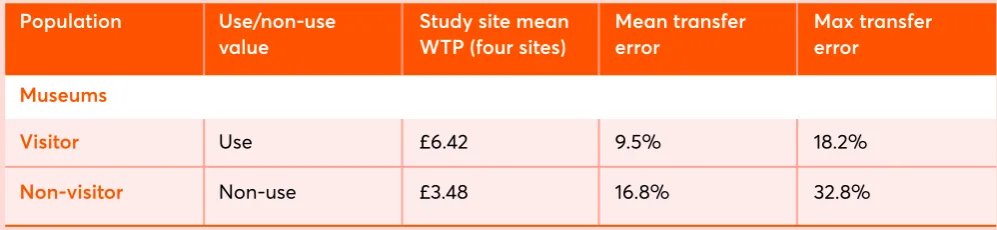
The table below shows the average estimates of use value and non-use values as measured by willingness to pay (WTP) among visitors and non-visitors at four regional museums: The World Museum (Liverpool), the Ashmolean Museum (Oxford), the Great North Museum (Newcastle) and the National Railway Museum (York). The information was obtained by means of an online survey that is representative of the general population.
The willingness to pay estimates relate to the amount that survey respondents are prepared to pay to prevent a hypothetical scenario of museum closure due to funding cuts. For museum visitors this is measured by means of willingness to pay an entry fee that would be imposed due to the cuts (all the museums studied have free entry) and for non-visitors the payment (as they would not be subject to the entry fee) is framed as a donation.
People are counted as visitors in the study if they have visited in the previous three years.
The use value as measured by individuals’ willingness to pay averaged across all four museum sites is found to be around £6.40 for museum visitors and the average non-use value is estimated at £3.50.
To test the feasibility of applying these values to comparable sites, each museum’s values are selected in turn and predicted using the average of the estimated values from the remaining museums. This is done for all the sites, for both users and non-users, and the percentage prediction errors averaged (the mean transfer error) to provide a measure of how accurate transferring values between sites was. This and the largest error from all the predictions (the max transfer error) is shown in the table.
The broad similarity of values across the sites, as evidenced by the comparatively low transfer errors, supports the proposition that these values can be
used to estimate the use and non-use values for regional museums that are considered comparable.
Population Visitor Non-visitor Museums Use/non-use value Use Non-use
Study site mean WTP (four sites)
£6.42 £3.48 Mean transfer error 9.5% 16.8% Max transfer error 18.2% 32.8% The approach followed is consistent with the best practice set out in the UK Treasury’s Green
Book, the manual which provides guidance in UK central government on how appraisal
Box 6:
Valuing users’ and non-users’ attitudes to cathedrals
and historic cities
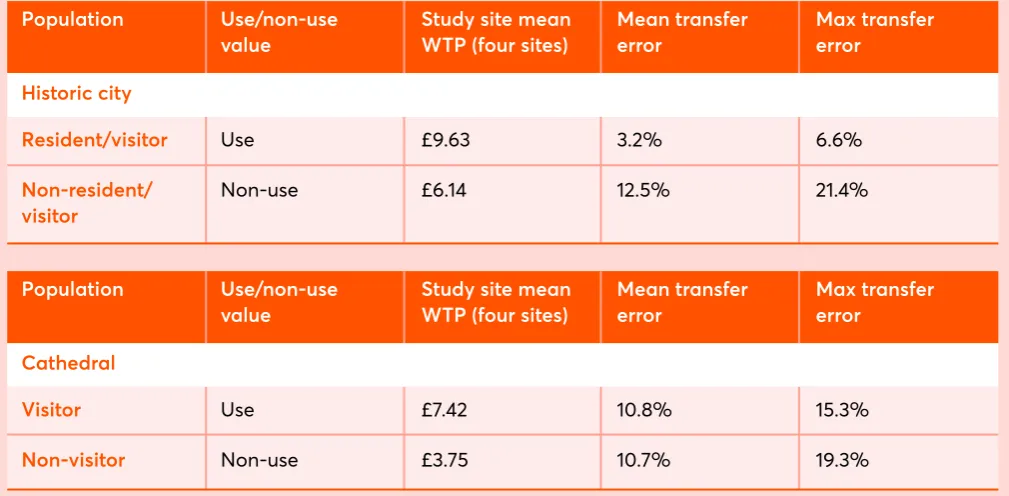
The table below shows the estimated willingness to pay (WTP) values for both users and non-users of historic cities (York, Canterbury, Lincoln and Winchester) and their associated cathedrals. Users including both residents and tourists from within the past three years. All cathedral visitors/users count as city visitors/users.
These estimates are in terms of willingness to make a one-off donation towards measures to reduce the risk of closure and damage buildings in the historic city (including its cathedral) due to a hypothetical scenario of the effects of future climate change. Where a historic city value is given, the cathedral valuation is obtained using the share of the amount that those surveyed state they are prepared to allocate to the cathedral from their overall city-wide donation; otherwise, respondents are asked a specific cathedral valuation question.
The estimates are obtained by means of an online survey of people who have previously visited the city and cathedral and a survey of the general population that have not visited.
The value as estimated by individuals’ willingness to pay averaged across the cities is around £9.60 and £6.15 for historic cities’ use and non-use value respectively. For their cathedrals it is just over £7.40 and £3.70 for use and non-use value.
As with the museums study, to assess the feasibility of applying the values to other sites each historic city and cathedrals’ values are selected in turn and predicted using the average of the estimated values from the remaining cities and cathedrals. This is done for all the sites, for both users and non-users, and the mean transfer error calculated as a measure of accuracy in transferring values. This and the largest error from all the predictions (the max transfer error) is shown in the table.
As with the regional museums, the similarity proposition that these values can be used to
Population Population Resident/visitor Visitor Non-resident/ visitor Non-visitor Historic city Cathedral Use/non-use value Use/non-use value Use Use Non-use Non-use
Study site mean WTP (four sites)
Study site mean WTP (four sites)
[image:23.595.46.551.442.690.2]£9.63 £7.42 £6.14 £3.75 Mean transfer error Mean transfer error 3.2% 10.8% 12.5% 10.7% Max transfer error Max transfer error 6.6% 15.3% 21.4% 19.3%
Using wellbeing analysis
Another approach to assess valuation is to use measures derived from estimates of the subjective wellbeing of the public, which are based on individuals’ self-assessment of their wellness in the moment or in terms of life satisfaction. The approach looks at how experiencing certain activities, such as visiting a cultural institution affects wellbeing, by comparing the stated wellbeing of users and non-users of the institution. In principle, the impact of subjective wellbeing of culture on non-users can also be assessed using vignettes (whereby survey respondents are presented with a hypothetical scenario, in which they are asked to report their levels of subjective wellbeing if they were able to visit the institution more often).
The wellbeing impacts can then be converted to economic valuation estimates by
assessing the change in income that is equivalent to the change in wellbeing impact using econometric models relating wellbeing impact to monetary income.
The Tate Liverpool and Natural History Museum study proposes and tests a new hybrid approach combining willingness to pay with contingent valuation and wellbeing valuation by asking people who had said that their life satisfaction would decline if they were not able to visit the museum how much money they would require for their willingness to pay to be unaffected.
Policy recommendations: Using existing valuation
frameworks more effectively and involving the public in
valuation in new ways
Public policy affects the cultural sector in many different ways. There are overall decisions on how much is allocated to different forms of cultural activity and decisions that relate to individual institutions, for example an investment in a cultural facility which expands its capacity, such as a museum extension. There are also legislative decisions which affect the sector.
In principle, all such decisions should be informed by economic evidence on the value of these activities/projects for society, but in practice the extent to which this happens is limited. This is partly because of a widespread belief that economic valuation estimates which are, at least in principle, straightforward to implement necessarily omit essential dimensions of value and for key stakeholders. While we share this belief, we also believe there is under-recognition of the wide scope of benefits that economic valuation
1. Improved use of evidence within the existing Government valuation framework
There should be a commitment to improving an interdisciplinary evidence base on valuing culture and heritage and to integrate it within public decision-making. In the UK, the forthcoming Centre for Cultural Value from the AHRC, Arts Council England and Paul Hamlyn Foundation, obviously has an important role to play here, although the extent to which it will be resourced to fund the new methodological research needed is unclear. Rigorously assessing the value of cultural activity can be costly. Given the many parties involved in the cultural sphere it can also lead to inefficient duplication of effort and inconsistent approaches to valuation. Even if good evidence is generated it may not be used consistently in policymaking.
There should therefore be a commitment from Government to make a greater investment in establishing the value related to cultural and heritage activity. This will involve estimating values on a consistent basis for similar cultural and heritage assets/activities, as done in our regional museums and historic cathedrals/cities studies, to provide benchmark values that can be applied in business cases in the public sector. Government should also play a greater coordinating role to ensure that the Green Book approach is more widely adopted in the evaluation and policy making framework.
There should be a requirement that all large cultural and heritage projects have an assessment of non-market valuation impact. Related to this, there should be a requirement in the business cases for all large-scale cultural projects that there is an economic assessment of the value that they generate which may not be captured in market transactions. For example, as many cultural amenities, in addition to having value for visitors are widely considered to contribute to local wellbeing, it is reasonable that consideration should be given to this in the project business cases for all large-scale capital investments.29
2. Greater consideration given to new approaches to involving the public in assessing cultural value using digital technology
There has never been greater potential to understand people’s valuations of culture due to the advances in technology which have increased our capability for measurement and to involve the public in decision-making processes. Policy initiatives to improve understanding of the public’s values about cultural activity using digital tools represent an exciting, new approach to valuation in the sector which should be explored. In other areas, for example, work has already been done in crowdsourcing information to understand perceptions of an area’s safety, the extent to which people’s surroundings make them happy and even the public benefits of digital online services based on much larger sample sizes than usually
feasible with valuation surveys.30 Computer game environments have also been used to
3. Greater use of crowdsourcing and crowdfunding to involve the public in valuation
• We can allow the public a greater say in cultural policy through more sophisticated uses of crowdsourcing to ensure that their valuations are incorporated into decision- making. Initiatives could range from:
·Using information from the public to decide programming at a cultural venue.
·Making decisions between projects that have already gone through an expert selection
process.
• It is, however, important to acknowledge the challenges involved in ensuring such activity is inclusive, as the ability to engage in crowdfunding will not be consistent across the population.
A concern relating to the use of valuation techniques in the cultural sector is that, in making assessments of value, expertise is often needed to make judgements about a cultural activity or object’s technical excellence and originality/importance. The concern being that the general population is not sufficiently knowledgeable to make these decisions and the result of a valuation determined by such choices would be less innovative and of lower technical quality.32 An assessment of how much this is indeed the case could be built into
the trialing of such initiatives.
4. Using augmented and virtual reality to provide the public with better information on cultural and heritage facilities/objects as a way to improve accuracy of valuation assessments
3.
Realising the value in health
By Halima Khan and Annie Finnis
The Realising the Value programme
In 2015-2016 Nesta Health Lab worked with a consortium of partners, including NHS England and The Health Foundation, to look at how and why health and care services can work alongside people and communities to create value. This section brings together some of what we found.
www.realisingthevalue.org.uk
When it comes to health, people value more than just
clinical outcomes
In health, perceptions of value have been dominated by a mix of clinical outcomes, system targets, competition mechanisms and encouragement for single organisational units to act autonomously and be judged as single services. Despite being critiqued, these approaches continue to have a significant impact on the behaviours of individuals and organisations. The current NHS payment system is a highly complex mix of methods, prices, incentives and penalties.
People make decisions every day that affect their health
and wellbeing
It is people, not health and care services, that primarily drive the creation of value in health. Although medicine and hospitals make a vital contribution, the roots of health and wellbeing actually lie in being connected into a thriving community. For example, in relation to exercise, managing stress, taking part in social activities or developing skills to successfully look after a health condition. And people have family, friends, communities and peer networks that can work alongside healthcare professionals to support them to live well. For example, the value of voluntary activity in the UK has been estimated to be £23 billion.35
The economic value of the contribution made by carers in the UK has been estimated at £132 billion a year.36
There is, therefore, increasing interest in how measures of value in health and care can focus on what is important to people, what skills and attributes they have, the role of their family, friends and communities and, given all this, what they need to enable them to live as well as possible. In Realising the Value we called this taking a ‘person- and community-centred’ approach.
A great deal of work is already being done at both national and local level to embed person- and community-centred approaches in national programmes and local services. Adult social care has been a long journey towards personalisation and a values-based approach which prioritises improved wellbeing, independence, social connectedness, choice and control.37 The NHS across the UK has followed. For example, NHS England’s Five Year
Forward View included a vision to develop new relationships with people and communities
Box 7:
Examples of person and community centred approaches
in health and care
The Realising the Value programme partnered with
five voluntary, community and social enterprise sector organisations that are exemplars in these fields, and measure their value in a variety of ways:
Approach Peer support Health coaching Asset-based approaches Self-management education Group activities
What is it
Approaches through which people with shared experiences, characteristics or circumstances provide mutual support to promote health and wellbeing.
A form of coaching that aims to help people to set goals and take actions to improve their health or lifestyle.
Ways of working that build on and connect existing assets and strengths, within people and communities, to maintain and sustain health and wellbeing. Asset-Based Community Development is an example of an asset-based approach where communities drive the development process and both respond to and create local Formalised education or training for people with long-term health conditions which focuses on helping them to develop the knowledge, skills and confidence to effectively manage their own health and care.
Group activities that can be beneficial to support health and wellbeing, such as exercise classes, cookery clubs, community choirs, walking groups and gardening projects.
Example of value from Realising the Value local partner site
Positively UK conducted an independent evaluation which found that 80 per cent of participants reported reduced feelings of isolation and were better able to talk to others about living with HIV. 95 per cent of participants reported improved wellbeing.
A former participant in Being Well Salford said,
“I am volunteering and attending an art group and I am far more active. It is established that I am valued and I have value in life. I feel normal again, ‘my normal’. You can’t put a price on a person’s health and wellbeing.”
A social return on investment study of Salford Dadz, a project run by our partner site Unlimited Potential and featured in the case study below, found that £1 invested yielded approximately £3 of potential savings to children’s services and also yielded approximately £13 of wellbeing value for the fathers involved.
Penny Brohn UK have demonstrated a
significant change in Patient Activation Measure (PAM) scores among those taking part in their education course, with people at the lowest levels of ‘activation’ before the course showing the greatest levels of improvement.
Through Realising the Value we aimed to make more visible the difference that such approaches can make to people’s own health and wellbeing and to the wider system. We found that there is growing – and increasingly convincing – evidence that when people are actively involved in their own health and wellbeing, or support others to stay well, it can create value for them and the health and care system across a range of dimensions, outlined below.
Value for people
Realising the Value demonstrated that when people are more actively involved in health, their own mental and physical health and wellbeing can be improved, including improved clinical outcomes and improvements in people’s confidence to self-manage as well as their wider wellbeing and quality of life. We think this value for people strengthens the investment case for person- and community-centred approaches.
For example, person- and community-centred approaches have been shown to increase people’s self-efficacy and confidence to manage their health and care, improve health outcomes and experience, and reduce social isolation and loneliness. UK-based studies on the benefit of group activities among those with dementia and those with mental health issues have reported impressive outcomes in areas such as quality of life, anxiety, depression, communication, and feeling in control of life and able to cope with its challenges.38
The case study below demonstrates the value that can be added through people being actively involved in health.
Box 8:
Case study: Alex McCraw, Father, Community Volunteer,
Salford Dadz committee member, Expert Link Advisory Panel
member
I am a 41-year-old father of three. I faced many challenges growing up of sexual and mental abuse, bullying, mental and physical health issues and social isolation. I learnt how to survive by cutting myself off from nearly everything and everyone.
A couple of years ago I received the best help from somewhere I wasn’t expecting… A new project was set up to promote the importance of fathers’ wellbeing and the impact it has on their kids. They put me in direct contact with other fathers who had been through their own struggles, some of which were similar to mine. Here I found that actually talking about and sharing lived experiences helped me to bring some clarity to my life.
Salford Dadz has allowed me to sit down and talk
Value for the system
In addition to being valuable for people, person- and community-centred approaches have the potential to impact how people use health and care services, bringing value for the system. Realising the Value demonstrated how involving people and communities in health can support the financial sustainability of the health and care system, including reducing demand on formal, particularly acute, health services, as well as achieving savings for local authority care budgets.
The cost-effectiveness of interventions is less reported in the formal research evidence than outcomes relating to improvements in physical and mental wellbeing, and there are merits (and limits) to this type of analysis. A number of organisations have previously sought to quantify the potential global impact. For example, Reform estimates stronger patient engagement, including more self-care, improved public health and greater patient contribution to their care, could save £2 billion.39 Monitor has estimated that teaching
people with long-term conditions to manage their own care could save between £0.2 billion and £0.4 billion.40 And through previous programmes of work, Nesta has estimated
over £4.4 billion a year could be saved if the NHS adopted innovations that involve people, their families and communities more directly in the management of long-term health conditions.41
The Realising the Value programme undertook economic modelling, led by PPL Consulting, to see if it were possible to show how implementing person- and community-centred approaches at scale can contribute to efforts to slow the demand pressures on the system and yield efficiency savings – at the same time as bringing value to people and communities. We saw this modelling as a contribution to the debate, recognising that the evidence base is not yet developed enough to enable us to calculate how the potential long-term benefits of a shift towards person- and community-centred approaches will play out.
Based on a scoping review undertaken by the Institute of Health and Society at Newcastle University, which collated and analysed systematic reviews of person- and community-centred approaches, we found the evidence is relatively stronger for peer support and self-management education approaches. In terms of financial benefits, our modelling suggests that for people with a subset of particular long-term conditions, we could anticipate net savings of around £2,000 per person reached per year. There is considerable uncertainty about how these potential savings might scale up at a population level but scaling these approaches up to the whole target population in an average-sized Clinical Commissioning Group (CCG) area could lead to savings of over £5 million per year. Extrapolating the model further suggests that if implemented well and at scale across England, there may be potential for savings of up to £950 million per year from targeted peer support and self-management education with people with these particular conditions, who are expected to see the most benefit.
Estimated annual net savings from implementing targeted peer support and self-management education
The estimates focus on specific health conditions and interventions because they have the most robust financial evidence to date (e.g. evidence that uses control group comparison). The model aims to produce estimates within a clearly defined scope. These estimates do not, for example, extrapolate evidence from condition-specific research on other health conditions, or put financial values on outcomes where there is not sufficient evidence to do so. While the model uses some of the most robust evidence available, the data still has limitations, for example studies conducted in one part of the UK may not produce the Source: Realising the value (2016)42
Wider social savings are based on offering: Peer support to individuals with HIV, and self-management education interventions to people with cancer.
Savings to the health system are based on providing: Peer support to people with mental health issues and coronary heart disease; and self
management education to people with cardiovascular disease and asthma.
Potential wider
social savings —£20,800 —£22m —£4.5b Estimated savings
to the health system —£2,100 —£5.2m —£950m
Savings per person Savings for one CCG National savings
All five approaches show a range of positive effects for individuals, as well as great financial promise. The evidence is particularly robust for peer support and self-management education.
If these initiatives were offered to people with the four long-term health conditions we have data for, they have the potential to offer commission-ers a net saving of —£2,100 per person per year.
If these interventions were provided at CCG level, we estimate that CCGs could save around £5.2m per year. This would require the intervention to be targeted carefully, at those people who might see the most benefit, and implemented well.
It is harder to make robust estimates at a national level – e.g. We don’t know what has already been implemented.
Box 9:
Assumptions in the economic model
Source: Realising the value (2016)43
• Per person savings are calculated using results from a CCG with a population of approximately 250,000 people (the average CCG population is 259,000).
• For CCG and national results, we have assumed
that there would be no overlap between peer support and self-management education benefits, especially as they are targeted at different conditions.
• For net financial savings, we are only showing benefits for conditions we have evidence for, and for conditions that show positive net savings.
• For net wider social benefits, we are only showing benefits for conditions we have evidence for and for conditions that show positive net benefits.
• All results use the economic model’s ‘suggested targeted population’ rather than the total eligible population. This is because we recognize that a CCG is unlikely to provide person-and community-centred approaches to all of its residents with a health condition such as cancer or diabetes. We assume that CCGs will target the proportion of the population most likely to benefit; for example, patients with severe health conditions and the ability to commit to an intervention.
• The results assume that person-and
community-centred approaches have not yet been implemented in CCGs and there would be capacity in the system to scale up (i.e. providers would be able to offer the interventions). If a large number of providers are already implementing these approaches, there would be lower potential benefit.
In today’s financial environment there is significant pressure for approaches to demonstrate return on investment. We see this modelling as the beginning of a process of understanding how we can measure what people value in a way that is useful for the health and care system. And it could potentially be seen as representing the ‘tip of the iceberg’. It is
plausible to suggest that there may be unaccounted-for benefits, because we currently have quantitative, financial evidence for a very small number of conditions and approaches. If person- and community-centred approaches were offered for more conditions, to a wider population, and in different forms, the savings could be greater. Although more longitudinal evidence is needed to understand when and where the financial benefit will be felt.
Wider social value
Wider social value can include more resilient communities and greater social connections as well as wider societal benefits from supporting people to return to work and reducing demand on other public services. Person- and community-centred approaches can lead to a wide range of social outcomes, from improving employment prospects and school attendance to increasing volunteering. They may also contribute to reducing health inequalities for individuals and communities.
Although it is plausible to assume that person- and community-centred approaches bring wider social value, we found little authoritative work to evidence this impact. We know that poor mental and physical health can be a significant barrier to all kinds of participation in public life that creates value for society, but our ability to link investments in health and care to these outcomes is limited. We feel this is a missing part of the ‘business case’ for person- and community-centred approaches, and that more research and investment in this area would be useful.
A broader view of value
Value frameworks – and techniques for evaluation and measurement – that are capable of capturing all of the valued outcomes and impacts are required. These are likely to consist of financial information such as cost–benefit analyses, other forms of quantifiable data, stakeholder experience and person-reported outcomes, and also qualitative information, bound together by narratives that make sense of all the various outcomes as a whole. Realising the Value called for a future articulation of value aligned across health, social care and community organisations, that takes a broad view in the following ways:
Value: broadening the focus
Not only... But also...
Specific clinical outcomes
What the system values, e.g. cost and value for money indicators
Immediate outcomes of a single service, e.g. success of a treatment
Patient experience, i.e. what contact with services feels like
Individual outcomes for the person
Wider health and wellbeing impacts
What people and their communities value, i.e. the outcomes most important to them
Outcomes over time of all the services and support a person or community may draw upon
Wellbeing, e.g. quality of life; people feeling supported, in control, socially connected and independent
Many organisations have already called for a new, simplified outcomes framework. These include the NHS Confederation, the Local Government Association, the association of directors of adult social services in England (ADASS), the Academy of Medical Royal Colleges and patient organisations. NHS England and others should respond to this cross-sector, multi-organisational demand for a change and take action. This work will need to engage with the tension between centralisation and standardisation, and