ResearchOnline@JCU
This is the author-created version of the following work:
Bruce, Christine (2011)
Informed learning: a catalyst for change in theological
libraries.
ANZTLA EJournal, 2011 (7) pp. 26-49.
Access to this file is available from:
https://researchonline.jcu.edu.au/55453/
Copyright © 2011 The Author(s)
Please refer to the original source for the final version of this work:
Biography
Christine Susan Bruce
Title: Professor
Email: [email protected],
Address: Information Studies, Faculty of Science and Technology, Queensland University of Technology, Level 9, 126 Margaret St, Brisbane, QLD 4000.
Christine Bruce is Professor in the Faculty of Science and Technology, QUT. She researches
information literacy, information technology learning, graduate capabilities, and research study and supervision. Christine is best known for her development of the relational approach to information literacy and information literacy education, based on the Seven Faces of Information Literacy (1997)
Auslib Press. Her most recent extension of that concept is published in Informed Learning (2008), ACRL, ALA, where the idea of information literacy is interpreted as using information to learn across workplace, community and education contexts. Christine conducts seminars and workshops
internationally and is regularly sought as a conference keynote speaker. Her thinking is informed by her research and various professional roles over twenty five years, including user education librarian, LIS educator, academic developer, and assistant dean teaching and learning. In 2008 Christine received an Australian Learning and Teaching Council fellowship. In 2010 she received a State Library Board of Queensland Award for contribution to information literacy, information literacy education and research.
Archived versions of publications are available at:
Informed Learning: a catalyst for change in theological libraries
Abstract
This paper discusses the potential interest of informed learning as a catalyst for change in
theological libraries. Informed learning is a label for the relational approach to information literacy and information literacy education. It was created to highlight the importance of simultaneous attention to both information and learning when we consider peoples’ experiences in their information rich lives. The paper explores the idea of informed learning, suggesting that serious attention to informed learning experiences may challenge our thinking about our role as information professionals and the ways in which we serve our clients. The paper then moves to explore our current understandings of informed learning in faith communities and suggests some ways in which theological librarians can work to build informed communities.
Introduction
Who are the members of the communities served by theological libraries? What is their experience of information literacy or informed learning? What do they use information for, and how do they use it? What do they consider to be information? For each of us our responses may be somewhat
different. We may be serving academic researchers and teachers who are heavily concerned with their discipline and its norms, we may be serving students who are struggling with their learning or who have a desire to go beyond the learning that is offered them. We may be serving those who are interested in the mission field and wish to understand the people they will be working with, whether this is in a church context or some other setting.
What do we know about how people within the college context and in the faith communities beyond, use information? How can we use this knowledge to help people develop their information literacy experience, and become aware of others as information users also?
This paper will develop these ideas through looking at the key concepts associated with the idea of informed learning, discussing research findings about informed learning in faith communities, and suggesting ways in which information professionals can build informed communities. Central to the position of the paper is the idea that librarians have a vital role to play in revitalizing and refreshing their clients’ experiences of information use, as well as enhancing clients’ awareness of their own information experiences and the experiences of the wider community of faith. Figure 1 is a simple illustration of the broadening perspective that can be adopted. While critical aspects of the information literacy experience in the broader academic, workplace and community contexts are also relevant, I focus here on the faith community context as one which holds distinctive
Figure 1: Widening the view of the information literacy experience beyond the college to the community of faith.
The experience of effective information use: from information literacy to informed learning
Since the mid 1990s, the idea of information literacy has been interpreted as ways of experiencing effective information use, and is the cornerstone of the relational approach to information literacy and information literacy education (Bruce 1997, 2008). Information use from a relational perspective is always for something, or some purpose, a purpose which typically involves changing one’s
experience or awareness of the world in some way. For example, looking at a bus timetable may change (by way of confirming or modifying) one’s experience of the public transport system. Even in becoming aware of arrival or departure times, our experience is modified. Such change in awareness may be understood as learning (Marton and Booth 1997); where learning is coming to experience or be aware of the world in different, usually more complex ways. Thus the experience of information use has come to be expressed as ‘using information to learn’ or ‘informed learning’.
Continuing this example, it may be expected the experience of reading the bus timetable may vary between different people, some may have a positive and others a frustrating experience. These different experiences may result from focusing on different aspects of the timetable, correctly or incorrectly, or from attending to other aspects of the wider situation. What constitutes information may thus differ… for one individual information may be the arrival and departure times, for another it may be the poor quality of the web site the timetable is available on, or for another it may be the significant difference between what is stated on the timetable and what actually happens. And the ‘information’ may be used in different ways. In each case the information may also be experienced as objective (an unchanging fact), subjective (subject to varied interpretation) or transformational (impacting, changing the life of the person involved). These ideas, the variation in ways of
experiencing information use for a particular purpose, the variation in what constitutes information and variation in the way that information is experienced, are all central to the idea of informed learning.
We, as information professionals and educators can transform and ground our understanding of information literacy by focussing on people’s experience of using information in different contexts. People's experience of information literacy may be said to be an "intricately woven fabric, revealing different patterns of meaning depending on the nature of the light cast upon it" (Bruce 1997, 151).
This brings us back to the kinds of questions with which I opened this paper:
• What does the community we serve experience as information?
• What informs them as they go about their work, study or spiritual development?
• What does the experience of information literacy look like in our communities?
• What information practices are important? How do people experience information use within these practices?
• How do people experience information use in the context of the college and beyond its walls? In the taking up of their vocation? In the wider community of faith?
In attempting to answer these questions we are exploring: what does it mean for people to be informed learners in theological, religious or faith communities?
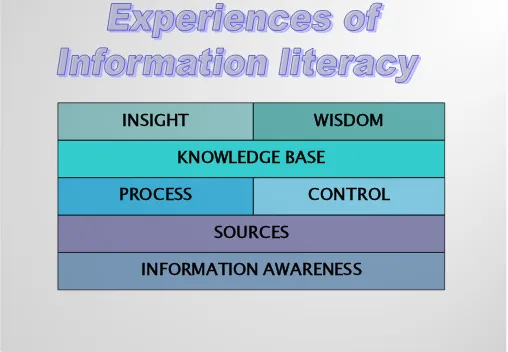
We may of course begin to answer the question by looking at the typical experience of information literacy or informed learning in the wider academic community and exploring how this might relate to the theological college community. Figure 2 below identifies the seven key experiences of informed learning, across academic, workplace and community contexts, all of which may
presumably have applicability in a theological college context. We would clearly want members of the college community, students, educators, researchers and others to experience using information to learn as 1) using technology for information awareness and communication, 2) using sources of different kinds, including information professional support, 3) adopting information processes based on personal heuristics, 4) identifying links between information encountered and projects of
interest, 5) building a knowledge base in an unfamiliar area, 6) gaining insights through drawing on intuition and the personal knowledge base, and 7) using information wisely for the benefit of others.
KNOWLEDGE BASE
INFORMATION AWARENESS SOURCES
PROCESS CONTROL
[image:5.595.72.326.344.520.2]INSIGHT WISDOM
Figure 2: Seven Faces of Informed Learning (Bruce, 2008)
Such insights for the theological community do not reveal the context specific insights that would be useful for deeper understandings of religious and faith communities.
Why talk about informed learning and why explore it in faith communities?
In the previous section of this paper I explained the initial derivation of the term informed learning. An extended description of informed learning, derived from interpretive research into informed learning over the last fifteen years looks like this:
Informed learning is using information creatively, reflectively effectively and ethically in order to learn in any of life’s paths. It is learning that is grounded in the effective information practices of professional community and academic life. (Bruce 2008, viii )
information literacy that focus more on actual engagement with information for learning than on the learning of information, bibliographic or library skills. The phrase also reflects the etymology of inform (Bruce, Hughes and Somerville 2011), where inform suggests giving form or shape to.., giving life to.., giving organizing power to.., moulding; essentially information forms learning. The use of that language is intended to reposition our thinking beyond skills to the experience of using
information to learn; and to encourage us to simultaneously attend to that which is learned, as well as the experience of information use in the learning process.
Why explore informed learning in faith communities? Firstly, as suggested above, to provide
contextualized insights into the experience of informed learning within such communities. Secondly, because there appear to be interesting differences between, at least some, faith communities and our more common interpretations of academic, workplace and civic settings. Of particular interest in faith communities is the way in which professional community and academic life intermingle for many people. If we take the church community as an example, it is not so easy for students to separate their study from their own faith development in the church community, or for the ministers to separate their professional work from academic scholarship. There seems to be an interesting integration across what have been traditionally separated academic, community and workplace contexts in our thinking about librarianship and information literacy also. Thirdly the nature of information use experiences appears significantly different from the nature of experiences of information literacy or informed learning in settings that have been traditionally explored.
For us as librarians and information researchers this reinforces the potential value of moving beyond thinking about providing training in library skills, information skills or research skills, to becoming involved in the wider arena of making people aware of how they and others use information to learn, both for their own development and also for the enrichment of those they serve or will serve.
Understanding information use in faith communities
We come now to the question of how we can develop deeper understandings of information use in faith communities.
In seeking to understand information use in the wider community, there is a wide range of
information behaviour and information literacy research available. Attention to the relational model of information literacy is more focused, and interested readers should look especially for titles by Mandy Lupton (2004, 2008), Sylvia Edwards (2006) and Susie Andretta (2007a, b) for important contributions. Mandy Lupton (2004) focuses on effective information use in the context of academic essay writing and later on students’ experiences of the relationship between information literacy and learning (2008). Sylvia Edwards draws attention to the experiences of learning to search the internet in the academic context. Susie Andretta makes available key papers developing the relational approach and explains the application of the theory to practice in higher education. Recently Margaret Blackmore has used the relational framework as a platform for understanding threshold concepts associated with information literacy in academic settings (Blackmore, 2010).
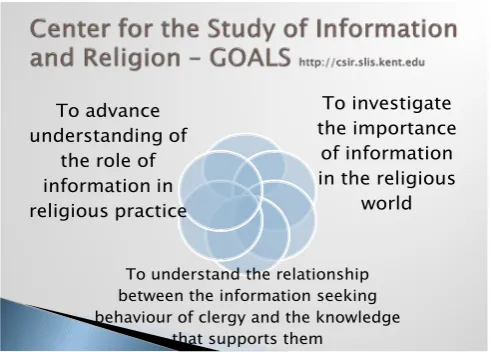
The importance of information and religion for research and practice has recently been highlighted by the establishment of a Center for the Study of Information and Religion at Kent State University. This Center has key goals which are vital to our understanding of information use in faith
To investigate the importance
of information in the religious
world
To understand the relationship between the information seeking behaviour of clergy and the knowledge
that supports them To advance
[image:7.595.108.354.71.247.2]understanding of the role of information in religious practice
Figure 3: Goals of the Center for the study of information and religion
Only recently established, the Center has already hosted an annual conference, with Brenda Dervin delivering a keynote on spiritual knowledge, and promises an Annual Review of Information and Religion. Some of the topics gaining attention in papers at the 2011 conference included:
• The information seeking behaviour of clergy
• The use of multimedia in sermon delivery
• Information and its application to local congregations and communities
• Information entropy and belief
• Longitudinal studies of the role of information in the development of new congregations and the establishment of new ones. (Centre for the Study of Information and Religion 2011)
Informed learning in one faith community
In addition to the wider body of knowledge around the information seeking and behaviour in religious contexts, we have been privileged within the QUT Information Studies Group to be able to conduct some pilot research into the experience of informed learning in one faith community, a church community in the Uniting Church of Australia. The experiences of informed learning which we have described reveal a range of information and learning experiences of church community members. I highlight here the essential features of the experiences which may be of particular value to librarians, educators and students of theology; as well as perhaps to the wider community of church leadership and lay people. Summaries of these experiences, presented here, have recently been submitted for publication. Details are available in Gunton, Bruce and Stoodley (2011).
Informed learning in the church community is experienced as using information in five different ways. Each of these ways involves a particular meaning being associated with the informed learning experience. Each also involves a depiction of what constitutes information in that experience and an indication of how the information is used in learning.
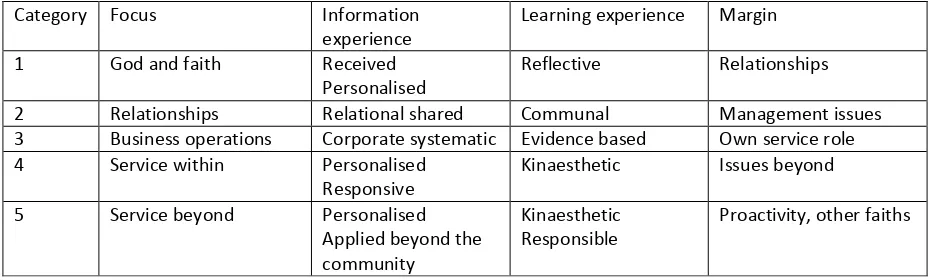
In each of the categories below the original manuscript notes a shift in focus of awareness from, in each of categories one to five, 1) God and faith, 2) relationships with people 3) the business or operations of the church, 4) service within the community, to 5) service outside the community. This shifting focus is an important aspect of understanding the variation in informed learning
in community, 4) issues outside the immediate community, to 5) proactivity and interest in other faiths. Also, across the categories, information is experienced differently from 1) received and personalised, 2) embedded in relationship and shared, 3) corporate and systematic, 4) personalised and responsive, to 5) personalised and applied beyond the community. Learning is variously
experienced as 1) reflective, 2) communal, 3) evidence-based, 4) kinaesthetic, and 5) kinaesthetic and responsive. These variations can be tabulated (Table 1) for comparison . They also appear in the textual descriptions below.
Category Focus Information
experience Learning experience Margin 1 God and faith Received
Personalised Reflective Relationships 2 Relationships Relational shared Communal Management issues 3 Business operations Corporate systematic Evidence based Own service role 4 Service within Personalised
Responsive Kinaesthetic Issues beyond 5 Service beyond Personalised
Applied beyond the community
Kinaesthetic
[image:8.595.65.532.179.319.2]Responsible Proactivity, other faiths
Table 1: Some varying aspects in experiences of using information to learn in church community
Category 1: Informed learning is experienced as understanding and interpreting communication inspired by God to develop a personal faith journey.
Forms of information (what constitutes information): the Bible (text), artistic (visual) expression and narrative, craft, stories, drama and song around the same message.
Learning experiences (How information is used): personal reflection and study, small group/peer discussion, informal conversation, formal education in the form of workshops, seminars and lectures, and learning by doing.
Focus: God and personal faith
While text is a common point of departure for exploring faith; for example biblical commentary, academic research, theological treatise, personal reflections, other forms of information such as artistic expression, such as art, music, and drama, are significant for growing faith. Peoples’
experiences suggest that using information in the form of artistic expression such as music improves learning by increasing interest and improving recollection. Visual information appears to be also vital to spiritual development, complementing other forms of information and supporting a wide range of learning approaches. Relating text (for example God’s Word to everyday life is also enhanced
through narrative, stories and parables.
Category 2: Informed learning is experienced as using information generated through social and pastoral interactions to grow relationships.
Learning experiences: community activities, engagement in informal and social interactions; sharing with the wider community in worship services; supporting one another to cope with life experiences; emerging use of social media.
Focus: Relationships
This experience of using information usually involves two or more members of the community engaging in face-to-face interaction. Social and pastoral relationships are developed and strengthened through sharing information, which may be personal or confidential.
Category 3: Informed learning is experienced as using collaborative approaches to engage with corporate information to develop administrative functions.
Forms of Information: a broad range of documentation, shared in print, digital format via email, or in audio, as presented during meetings or conversations; minutes, quotes, invoices, reports, statistics.
Learning experiences: in groups, where the sharing of information is interactive rather than solitary learning experiences, such as reading or listening
Focus: Business operations
Information in this experience may be accessed from external sources, for example quotes or invoices property development or maintenance; or the documentation detailing council requirements for a church property. It may also be sourced internally, for example committee reports, the informal information shared by one minister with another, or statistical data.
Information is used to manage the church, as decreed by the Word of God and implemented by the people of God. Members of the church community prefer to learn in groups, engaging in interactive information sharing rather than solitary learning.
Category 4: Informed learning is experienced as using personal interpretations of gifts and talents in response to needs within the community.
Forms of information: text, such as church notices, and verbal information distributed in face-to-face interactions, such as worship services or committee meetings, including digital information.
Learning experiences: learning by doing, using kinaesthetic styles, putting learning into practice; engaging in acts of service.
Focus: Service within the community
In this experience members of the church community use a combination of spiritual, operational and relational information. They use spiritual and introspective information to determine how they might serve. External information indicates where the need for help or service is required.
Category 5: Informed learning is experienced as using personal interpretations of gifts and talents in response to needs beyond the church community.
Learning experiences: Learning by doing, using kinaesthetic styles, putting learning into practice; engaging in acts of service
Focus: Service outside the community
In this experience information is usually controlled and in a published, printed format. Materials received from charities and missions are acted upon.
Theological librarians building informed communities
Make building an informed community a goal. An informed community might comprise informed scholars, students and researchers; informed workers in ministry and mission; and informed
members of the community of faith. An informed community engages in a wide range of information experiences and is aware of how they, and those they serve use information to learn.
Building an informed community is building an information literate community; one in which people are empowered to engage with information for learning, where they are aware of the different kinds of information use experiences they might engage in, and where they are aware of others’
experiences of information use and are able to work with those preference.
Building an informed community in a theological college might fundamentally involve a) expanding our own awareness of peoples’ experiences of using information to learn, b) helping staff and students expand their awareness of their own experiences and those of relevant community or organisational groups, and c) making it possible for people to engage with the experiences most effective for them.
a) expanding our own awareness of peoples’ experiences of using information to learn
Our own experiences of information literacy will influence how we think about informed learning. Research done in public libraries indicates that for librarians, information literacy may be
experienced as the acquisition of technical skills. This might present the need for a significant refocus beyond the skills to the experience of learning and using information to learn.
Others may understand information literacy as experienced organically through the process of being part of a learning community. This kind of view is perhaps more easily developed into a focus on the experience of information use. (Demasson, Partridge and Bruce 2010)
As we widen our own experience of the use of information for learning, we also need to consider the information experience of members of our college communities, as well as those of the wider faith community and beyond; this may often involve including the experience of less represented or marginalised groups. This may come from reading or observation or talking with others, individually or in groups according to our own preferences.
b) helping staff and students expand their awareness of their own experiences and those of relevant community or organisational groups
Draw attention to experiences of using information to learn in the wider academic community, in faith communities and in other relevant contexts. Help people become aware of how information may be used to grow faith, develop relationships and manage the church in order to support the spiritual wellness of the community and the cultivation of lifelong learning in faith contexts (Gunton 2011 ).
Focus attention on how information is used in learning experiences in the church community. Understanding these experiences, and becoming interested in people’s experience of using information in church community, may assist members of the college community, both with their own information use, and their use of information in the service of others.
Use resources such as Informed Learning (Bruce 2008) to identify simple strategies for helping students become informed learners by exploring their student experiences of information use, exploring the experience of information use in relevant communities, designing experiences of effective information use into student learning opportunities and encouraging reflection on information use. Informed Learning also provides a range of Tips and Tricks such as:
• Sample engagements blending information interaction with content learning
• Questions to ask yourself and academic colleagues
• Prompts to build into student assignments
• Suggestions for possible learning tasks
When we see our role as supporting learning, rather than helping people use the library, we may become interested in partnering or leading college thinking around other aspects of supporting student learning. The QUT library for example has developed an integrated literacies program which brings together a focus on a wide range of student needs under the auspices of the library, including study skills, team-work skills, etc, and for the theological library I would suggest a focus on the spiritual wellness of the college community would also be appropriate.
In this paper and elsewhere we have seen how people use information in different ways in their faith walk (Gunton 2011). Librarians can bring this kind of knowledge to the table and partner or indeed lead the process of building spiritual wellness in the college community and beyond.
In thinking about what you might be able to do consider something small, something focused, something targeted at a key group that might benefit, something that might involve those with responsibility for funding as the well being of the college and its library.
References
Andretta, Susie. Ed. 2007. Change and Challenge: Information Literacy For the 21st Century. Adelaide: Auslib Press.
Astin, Alexander W., Astin, Helen S., and Jennifer A. Lindholm. 2010. Cultivating the Spirit: how college can enhance students’ inner lives. San Francisco: Jossey-Bass.
Blackmore, Margaret. 2010. “Student Engagement with Information: Applying a Threshold Concept Approach to Information Literacy Development.” Paper presented at the 3rd Biennial
Threshold Concepts Symposium: Exploring transformative dimensions of threshold concepts, Sydney, Australia, July 1-2. Accessed 10 July 2011.
http://www.thresholdconcepts2010.unsw.edu.au/
Bruce, Christine Susan. 1997. Seven Faces of Information Literacy. Adelaide: Auslib Press.
Bruce, Christine Susan. 2008. Informed Learning. College and Research Libraries, ALA: Chicago.
Bruce, Christine, Hughes, Hilary and Mary Somerville. 2011, in press. “Supporting Informed Learning in the 21st Century”. Library Trends. Fall/November 60 (2).
Centre for the Study of Information and Religion. 2011. “2011 Conference Summary and Papers” Accessed July 10, http://csir.slis.kent.edu/ .
Edwards, Sylvia. 2006. Panning For Gold: Information Literacy and the Net Lenses Model. Adelaide: Auslib Press.
Gunton, Lyndelle. 2011. “Religious information literacy: Using Information to Learn in Church Community”. Australian Library Journal 60(2): 155-64.
Gunton, Lyndelle, Bruce, Christine, and Ian Stoodley. 2011 (manuscript). “ Experiencing Religious Information Literacy: Informed Learning in Church Communities”. Paper presented at the RAILS Conference, Brisbane, Australia, May 10.
Lupton, Mandy. 2004. The Learning Connection: Information Literacy and the Student Experience. Adelaide: Auslib Press.
Lupton, Mandy. 2008. Information Literacy and Learning. Adelaide: Auslib Press.
Marton, Ference and Shirley Booth. 1997. Learning and Awareness. New York: Lawrence Erlbaum.
Lipu, Suzanne, Williamson, Kirsty and Annemaree Lloyd, eds. 2007. Exploring Methods in Information Literacy Research. Centre for Information Studies, Charles Sturt University: Wagga Wagga, NSW.
Demasson, Andrew E., Partridge, Helen and Christine Bruce. 2010. “How do Public Librarians Constitute Information Literacy? Paper presented at the 5th International Conference on Qualitative Research in IT & IT in Qualitative Research (QualIT2010), QUT, Brisbane, Australia, November 29-30. Accessed 10 July 2011
Acknowledgements
For helping make this paper possible I would particularly like to thank:
• ANZTLA for inviting the contribution
• The QUT information studies research team for the intense intellectual effort in this area
• Lyndelle Gunton and Dr Ian Stoodley for their particular interest in informed learning in faith communities
• The QUT Information Systems Discipline for providing a summer scholarship to assist Lyndelle to continue the work