Beyond the Borders: The Three Ts of Contemporary
Protocols for Efficient Teleworking
Liz Neary
1, Ray Hingst 2Abstract
The goal of any team is the work results, not the time spent in an office working. This paper will identify and evaluate the Three Ts, (Task, Teams and Technology) of contemporary protocols to enable the teleworker to work both effectively and participatory at a distance from a central place of work.
The concept of telework is not new; it may have a new name and the definition of telework may have evolved somewhat with the significant growth in information and communications technology (ICT) and mobile devices, but it is not a new phenomenon. However this framework for understanding and operationalising is an advance beyond the simple provision of the tools required; the spotlight needs to shine on the human dimension.
What becomes apparent, no matter the name used, is that virtual work in the 21st Century is about people and how they work and interact in a digital world.
Track: Management – Field of Research: Management
1 Student, Master of Professional Studies, School of Humanities & Communication, Faculty of
Business, Education, Law and Arts, University of Southern Queensland, Toowoomba
Email: [email protected]
2 Lecturer, Administration and Management, School of Management and Enterprise, Faculty of
Business, Education, Law and Arts, University of Southern Queensland
1. Introduction
This paper develops ‘protocols’ to effectively unite the Three Ts, (Task, Teams and Technology) of telecommuting in order to provide a guide for implementation, integration and operation of the virtual workplace. Here we take Task to mean the work to be done, the job/s to be performed, that is, the objective/s to which productive efforts are applied. Teams are taken to reflect a group which has advanced in its development to the point where members approach tasks interdependently; they rely on each other not just to perform work but also for supportive relationships which provide a level of cohesion and collaboration not evident to the same extent in workgroups. Technology represents the tools which the team uses to unite their efforts and facilitates the transfer and dissemination of data, information and knowledge and provides a conduit for communication and inter-personal connections necessary to enable the team to perform as a coherent identity.
The purpose of this research is to investigate how, and to what extent, do the skills and attributes of the teleworker and the enabling characteristics of virtual teams influence the perceived effectiveness of virtual teamwork. Our ‘protocols’ identify a number of considerations which complement the etiquette which teams in a conventional, face-to-face setting observe. It is anticipated that this study will establish and build on previous work to highlight effective and contemporary protocols for virtual teams to facilitate both the individual and the organisation; enabling the teleworker to work effectively and efficiently at a distance from a central place of work whilst ensuring the organisation’s goals are met.
As more employees seek the opportunity of flexible work practices, the skills and attributes of the teleworker increase the benefits of the success of the virtual team. Being virtually connected can offer an increased opportunity for flexible working arrangements. With the rapid growth and expansion of technology now available, working at a distance does not automatically mean having to be tethered to being at home, but work can be conducted anywhere, any time. Developments in digital working hubs, co-working spaces and digital communities offer more freedom, providing individuals with options about how and where they work, meet, collaborate and find the best approach for given tasks. (Mason and Buksh, 2014)
Developing the skills and attributes to working from a distance, when successful, creates an organisational culture and a set of capabilities which enables the organisation, and the individual, to enhance and embrace the opportunities and benefits of flexible work practice. Telework may not change the skills and attributes of the individual compared to working in a physical office space however it is the presence of these characteristics which may influence teleworkers’ work outcomes and attitudes.
2. Literature review
academic circles. At the time, it was the energy crisis that led researchers to consider telecommuting as an alternative to physically commuting. The issues of rising real estate, rental costs and problems with traffic congestion were also key factors. (Felstead, 2012)
Thousands of companies and millions of employees in a wide range of industries across the globe have already successfully adopted a wherever, whenever approach to work. (TeleworkAustralia, 2014, Lister and Harnish, 2011) They are proof that the traditional barrier to telework, that of management mistrust, can and should be overcome because the triple benefits are worth the effort; financial, social and environmental. And those companies have led the way by perfecting best practices that address the security, communications, and collaboration, managerial and social aspects of remote work with a combination of technological and cultural solutions. (Lister and Harnish, 2011)
By offering workplace flexibility and measuring performance based on results, rather than presence, changes to the nature of work should continue to evolve and mature. Telework Australia defines telework as: “work from a distance’, (2014) although it has many forms and labels, including remote access, remote work, mobile work, e-work, telecommuting, working from home and more. The word has also been defined in many different ways; some accentuate the role of technology whilst some focus only on workers based in home offices. (TeleworkAustralia, 2014) Telework has attracted interest from diverse quarters. What has consequently emerged is not one but a variety of discourses about telework, involving different images of the teleworker, different problems for which telework is a solution and different perspectives from which to evaluate this phenomenon. (Haddon and Silverstone, 1992)
The days of when paid employment was confined to designated hours in a specified place are fast fading, particularly for managers, professionals and other white-collar workers. Internet connectivity, email, mobile phones, laptops and notebook computers mean that work can be done wherever we are and whatever the time. (Felstead, 2012) Recent announcements by Google and Yahoo about flexible work practices have sparked new interest and debate about the management of those who have the capacity to work from virtually anywhere. While telework/telecommuting/flexible work might have been on the management agenda for some Australian organisations, it may be the case that management are now rethinking their plans and strategies as a result of the debate of management versus the productivity and trust of the flexible worker. (Bosua and Gloet, 2013)
increase in technological capabilities is not the only factor driving the changes in the nature of our work.
The potential key benefits of a flexible workplace are substantial in terms of time savings, a reduced need for expensive office space, workforce participation and staff turnover; important factors for the future of regional Australia. Factors of talent shortages, changing workforce dynamics and employee burnout, worries over natural disasters, and terrorism, are now likely to drive more widespread adoption of teleworking. Additional factors of increased productivity, improved moral among employees and a more balanced work/life benefit can further assist companies to recruit and retain employees. (Department of Communications, 2013a) Employer expectations are also added drivers in this changing nature of the workforce. Less distractions and interruptions as well as the flexibility over their work schedule, enabling more control over when and how they work, are highlighted as important factors.
Research indicates that one of the most critical challenges facing organisations is developing leaders with the requisite skills to succeed in the global and complex work environment. Work using a virtual approach appears in almost all organisations but in a wide array of configurations, from one person working remotely to whole offices co-located. (Dennis et al., 2013) Management resistance seems to be fuelled by misconceptions and fears of many leaders. Do work flexibilities offer advantages to the employer or is it just another benefit to the employee? Does out of sight equate to out of mind, therefore leading to a disconnection between the leader and the flexible worker? Physical proximity with co-workers and the simple ritual of the physical handshake can be lost. (Felstead, 2012) The challenges of always being connected, heightened levels of self-discipline and understanding what works where and how, are highlighted. The need to communicate primarily through technology means the building of trust and effective relationships are important challenges. (Felstead, 2012, Khan, 2012). Protocols for operationalising telework represent an advance beyond the simple provision of the tools for the task; the spotlight needs to shine on the human dimension. ‘To achieve the benefits of telework as part of flexible workplace practices, telework should not be treated simply as an add-on to existing work practice and management systems’ (Department of Communications, 2013a)
In order to move beyond teleworking and build capacity to create a smart presence, fundamental protocols should be explored. Protocols can ensure that an appropriate standard procedure for telework is defined for all employees to be aware of and understand to enhance organisational endeavours.
3. Research methodology
and qualitative data collection methods as a means of validating the results of the research process. According to Creswell (2003), pragmatism is not committed to any one system of philosophy and reality with pragmatic researchers looking to the “what” and “how” to research based on its intended consequences – the direction the researcher wants to go. This applies to mixed methods research in that inquirers draw liberally from both quantitative and qualitative assumptions when they engage in their research. Creswell further adds that pragmatism opens the door to multiple methods, different worldviews, and different assumptions, as well as to different forms of data collection and analysis in the mixed methods study. (Creswell, 2003, Creswell, 2010) The strategy of employing a mixed methods approach to the research design has allowed the researcher to involve collecting and analysing both quantitative and qualitative data in a single study. (Creswell, 2003) The survey design used in this research was an adaptation of a survey by (Mogale and Sutherland, 2010); the main purpose of their survey was to identify perceptions on leadership preferences and factors enabling or inhibiting the effective leadership of virtual teams. For the purpose of this study, the survey was adapted and designed to investigate the characteristics of the teleworker and the skills and attributes of an effective virtual team member, determining features of a successful virtual team and, identifying the challenges a teleworkers face in a virtual team.
The regional Australian university has staff located across three campuses with each campus at a distance from the other. Academic staff, students and professional staff from various divisions across the University’s three campuses; formed a total population of 453 staff.
4. Data Analysis
This initial study, conducted at a regional Australian university, relies on a pragmatic paradigm, employing a mixed-methods approach to the research. Various departments within the university were purposely sampled to investigate the individual and shared sense of the meaning of teleworking; those invited to undertake the survey were thought to be those most likely to use teleworking at the university. A response rate of less than 10% of the sample size was received; this sample size is regarded as a limitation to some areas of the study, however there appears to be adequate statistically significant relationships within the data deserving further research.
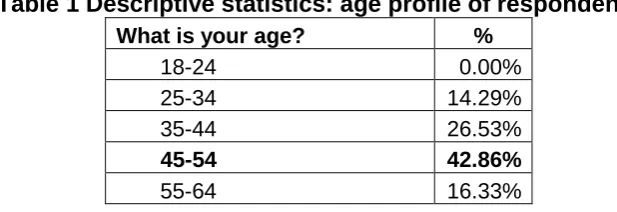
Table 1 Descriptive statistics: age profile of respondents
What is your age? %
18-24 0.00%
25-34 14.29%
35-44 26.53%
45-54 42.86%
55-64 16.33%
A moderate percentage of respondents currently, or have previously worked in a virtual team environment, as reflected in Table 2 Descriptive statistics: experience of teleworkers, with the majority of respondents having worked in a virtual team environment for less than 5 years. (Responses presented in Table 3 Descriptive statistics: period of teleworking.)
Table 2 Descriptive statistics: experience of teleworkers Are you currently, or have you previously, worked in a virtual team environment?
%
Yes 62.50%
No (Your opinion is still very much valued and may inform future study by the research team)
37.50%
It appears that while the concept of teleworking has existed for decades, it is only recently achieving a degree of maturity in Australia.
Table 3 Descriptive statistics: period of teleworking
If yes, how long have you worked in a virtual team environment? %
Less than 1 year 24.00%
1 - 3 years 32.00%
3 - 5 years 12.00%
greater than 5 years 32.00%
From the responses to the question What is your understanding of teleworking? it would appear that most people were familiar with the concept of teleworking. Being able to work both effectively and participate at a distance from a central place of work, using various technology enabled tools to maintain communication, work collaboratively and produce outcomes, were key aspects from this evidence.
As highlighted in the literature, the goal of any team is to deliver the results and should not be measured by the time spent in the office working.
Figure 1: Skills & Attributes of the teleworker
The most critically important skill and attribute was perceived to be self-motivation, with 72.2% of respondents in agreement. As Howarth (2012) points out, crucial to making the model (teleworking) work is selecting people with the right mindset and temperament to work at home; personality traits are emerging as one of the clearest determinants of the success of teleworking initiatives. The managing director of HR consulting firm Corporate Canary, Anne-Marie Orrock, agrees that certain individuals just don’t have the right psychological make-up, with those who perform best tending to be people with high levels of drive and independence, as opposed to those who are more compliant and need more instruction. (Howarth, 2012)
The results of toughness and aggressiveness rated the highest not important skill and attribute of an effective virtual team member. This was also found in the South African study (Mogale and Sutherland, 2010) from which this survey was adapted. Although the Mogale & Sutherland study was to identify perceptions on leadership preferences and factors enabling or inhibiting the effective leadership in virtual teams, it also is a perception within members of the virtual team that this is not an important skill; relationship building is very and critically important.
The next stage in the survey was to determine respondents’ perception of the key factors of a successful virtual team. According to Bergiel et al (2008) many of the elements that constitute a successful face-to-face team are also necessary for successful virtual teams, with the key factors including high levels of trust, clear communication, strong leadership and appropriate levels of technology. (Bergiel et al., 2008) The data highlights a particular perception of a key factor of a successful virtual team as being one that: “fundamentally understands that members of the virtual team are members of the team, and that the team is incomplete at all times without the virtual team.” This comment reflects the literature from the Department of Communications (2013a) that telework should not be treated simply as an add-on to existing work practices and management systems. From the evidence presented it appears that the majority of respondents agree, in addition connectivity, regular check-ins, inclusiveness, collaboration, relationship building (interpersonal relationships between members) and adaptability (a tolerance for adaptability).
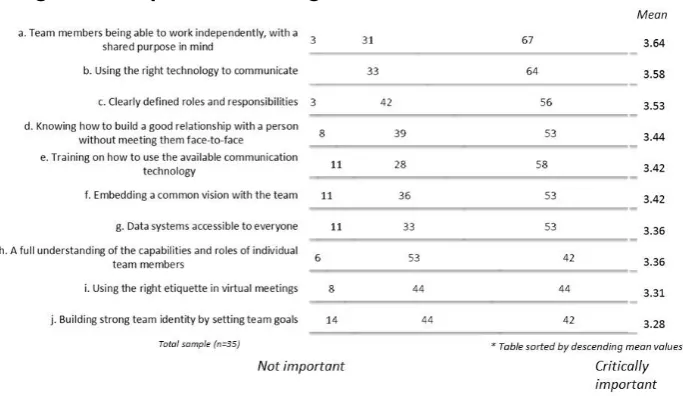
[image:8.595.123.465.385.583.2]The next section in the survey was to determine the perception of enabling characteristics of virtual teams, as presented in
Figure 2: Top Ten Enabling Characteristics of virtual teams (sorted highest to lowest by mean).
Figure 2: Top Ten Enabling Characteristics of virtual teams
As per the Mogale & Sutherland (2010) survey results, the top ten items reveal similar enabling themes, although the Mogale & Sutherland survey was leadership focused, whilst this adapted survey was focused more on investigating the team environment; How and to what extent do the skills and attributes of the teleworker and the enabling characteristics of virtual teams influence the perceived effectiveness of virtual team work. The first theme the results highlight is the ability to build a strong team vision and identity, with everyone understanding their role in the team. Team members must work interdependently with a shared purpose in mind. (Bergiel et al., 2008)
teams could not exist in their current guise without the advanced technological tools available today. (Bergiel et al., 2008)
[image:9.595.107.474.292.382.2]The third theme focuses on the nature of team relationships; working independently with a shared purpose in mind and knowing how to build a good relationship with a person without meeting them face-to-face. This is further highlighted in the very important category of respondents’ perception of enabling characteristics of virtual teams such as setting team goals and continuous improvement on how to perform in a virtual team environment. Bergiel et al (2008) emphasises that human resource development is an important issue. The role of human resource development to provide the necessary training in technology, personal and inter-personal skills for virtual communication is fundamental. (Bergiel et al., 2008)
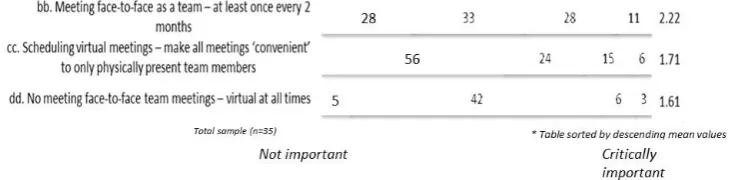
Figure 3: Least important enabling characteristics of virtual teams
The items ranked of least importance by a significant majority of respondents reflect that the creation of a smart presence is more effective than being together and the need to meet in a physical space.
The data represented in the section What are some of the challenges you face when being a part of a virtual team of the survey reflects the data presented Table 3 Descriptive statistics: period of teleworking; that a high percentage of respondents have previously worked or are currently working as a teleworker. 76% of respondents have previously, or are currently working as a teleworker for between one and five years.
Further, the results would appear to confirm that telecommuting, particularly full time, can mean you’re outta sight, outta mind. (McCune, 2007) Perceived challenges of isolation, not connecting, loneliness and an inability to contribute as an effective virtual team member reflect the theme of the nature of team relationships. However, these perceived challenges can be addressed, and overcome, by the establishment of protocols that set the tone for a successful virtual team and help to build and maintain trust. As Dennis et al (Dennis et al., 2013) point out, virtual work with dispersed teams are here to stay, so finding ways to work effectively to harness the collective energy of these teams is critical to the success of organisations for now and in the future.
variables to determine which skills most influence the sum of skills. A composite score for the skills scale was calculated by obtaining the average of all 19 items. The results of the Pearson’s correlation of the relationship of which skills most influence the sum of the skills, revealed significant relationships in areas of:
Table 4: Which skills most influence the sum of the skills?
Variable: Skills & attributes Pearson
Correlation**
Sig. (2-tailed) Being a humanist - concern for human welfare, values and
dignity 0.70 0.000
Being a visionary - having foresight, imagination and vision 0.69 0.000 Ability to succeed in the face of conflict and opposition 0.68 0.000 Analytical skills – ability to visualise, articulate and solve
problems 0.66 0.000
Emotional intelligence 0.65 0.000
Assertive 0.62 0.000
Networking skills – developing and using contacts in
business & building strong alliances 0.58 0.000
Imagination and creativity 0.57 0.000
Toughness and aggressiveness 0.57 0.000
Technical expert 0.56 0.001
Interpersonal skills – ability to interact with others 0.54 0.001
** p<.001 (2-tailed)
There are six skills and attribute variables that have the greatest significant impact on the total skills and attributes scale:
Being a humanist (r(34)=.70, p<.001) Being a visionary (r(34)=.69, p<.001)
Ability to succeed in the face of conflict & opposition (r(34)=.68, p<.001) Analytical skills (r(34)=.66, p<.001)
Emotional Intelligence (r(34)=.65, p<.001) Assertiveness (r(34)=.62, p<.001)
One variable was found to have no significant relationship with the total skills and attributes scale; self-motivation (r(34)=.19, p<.272). As indicated in the qualitative data results, crucial to making the model (teleworking) work is selecting people with the right mindset and temperament to work at home with personality traits emerging as one of the clearest determinants of the success of teleworking initiatives (Howarth, 2012). Self-motivation, as opposed to self-managed, appears more a personality trait rather than a professional skill.
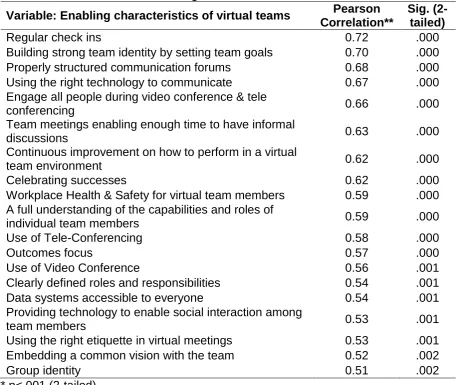
influence the sum of the enabling characteristics revealed significant relationships in areas of:
Table 5: Which enabling characteristics most influence the sum of the enabling characteristics?
Variable: Enabling characteristics of virtual teams Pearson Correlation**
Sig. (2-tailed)
Regular check ins 0.72 .000
Building strong team identity by setting team goals 0.70 .000
Properly structured communication forums 0.68 .000
Using the right technology to communicate 0.67 .000 Engage all people during video conference & tele
conferencing 0.66 .000
Team meetings enabling enough time to have informal
discussions 0.63 .000
Continuous improvement on how to perform in a virtual
team environment 0.62 .000
Celebrating successes 0.62 .000
Workplace Health & Safety for virtual team members 0.59 .000 A full understanding of the capabilities and roles of
individual team members 0.59 .000
Use of Tele-Conferencing 0.58 .000
Outcomes focus 0.57 .000
Use of Video Conference 0.56 .001
Clearly defined roles and responsibilities 0.54 .001
Data systems accessible to everyone 0.54 .001
Providing technology to enable social interaction among
team members 0.53 .001
Using the right etiquette in virtual meetings 0.53 .001
Embedding a common vision with the team 0.52 .002
Group identity 0.51 .002
** p<.001 (2-tailed)
Eight enabling characteristic variables were found to have the greatest significant impact on the total enabling characteristics scale:
Regular check-ins (r(34)=.72, p<.001)
Building strong team identity by setting team goals (r(34)=.70, p<.001) Properly structured communication forums (r(34)=.68, p<.001)
Using the right technology to communicate (r(34)=.67, p<.001)
Engage all people during video conference & teleconference (r(34)=.66, p<.001)
Team meetings enabling enough time to have informal discussions (r(34)=.63, p<.001)
Continuous improvement on how to perform in a virtual team environment (r(34)=.62, p<.001)
Three variables were found to have no significant relationship with the total enabling characteristics scale:
Scheduling virtual meetings – make all meetings ‘convenient’ to only physically present team members (r(34)=.30, p<.087)
Using photographs to visualise a person (r34)=.29, p<.093)
No meeting face-to-face team meetings – virtual at all times (r(34)=.07, p<.708)
These results re-emphasise the perceived effectiveness of virtual teams in that the majority of respondents reflect that the creation of a smart presence is more effective than being together and the need to meet in a physical space.
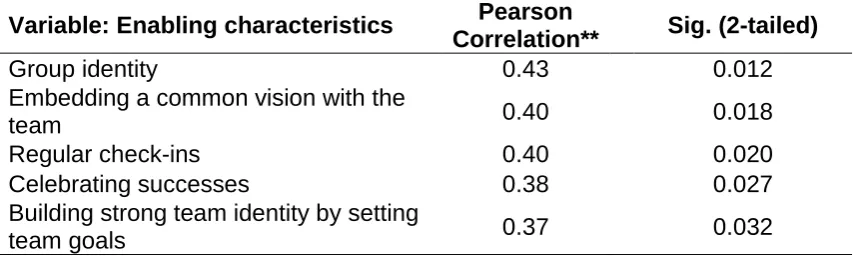
[image:12.595.85.512.336.466.2]To establish which enablers most influence the sum of skills, a single scale was created from the sum of all 19 skills. A composite score for the skills scale was calculated by obtaining the average of all 19 items. The results of the Pearson’s correlation of the relationship of which enabling characteristics most influence the sum of the skills and attributes revealed significant relationships in areas of:
Table 6: Which enabling characteristics most influence the sum of the skills & attributes?
Variable: Enabling characteristics Pearson
Correlation** Sig. (2-tailed)
Group identity 0.43 0.012
Embedding a common vision with the
team 0.40 0.018
Regular check-ins 0.40 0.020
Celebrating successes 0.38 0.027
Building strong team identity by setting
team goals 0.37 0.032
** p<.05 (2-tailed)
These enabling characteristic variables have a medium strength correlation with the greatest significant impact on the total skills & attributes scale:
Group identity (r(34)=.43, p<.05)
Embedding a common vision with the team (r(34)=.40, p<.05) Regular check-ins (r(34)=.40, p<.05)
Celebrating successes (r(34)=.38), p<.05)
Building a strong team identity by setting team goals (r(34)=.37, p<.05)
A single scale was created from the sum of all 30 enabling characteristics variables to identify which skills most influence the sum of enabling characteristics. A composite score for the skills scale was calculated by obtaining the average of all 30 items. The results of the Pearson’s correlation of the relationship of which skills most influence the sum of the enabling characteristics revealed only one significant relationship:
Variable: Skills & attributes Pearson Correlation**
Sig. (2-tailed)
Assertive 0.54 0.001
** p<.001 (2-tailed)
Being assertive is having the confidence in one’s right and/or putting forward one’s views.
5. Findings
The aim of this study was to determine how and to what extent do the skills and attributes of the teleworker and the enabling characteristics of virtual teams influence the perceived effectiveness of virtual team work. A further aim was to determine the perceived challenges of teleworking, thereby assessing the perceptions of what makes the model of teleworking successful. The study was exploratory with a mixed-methods approach, with an online survey electronically distributed to a population consisting of 453 staff from across a regional Australian university. The sample of 38 provided both qualitative and quantitative data results which have been analysed by the researcher. Much has been written on the advantages of teleworking from company through to personal perspectives. Further, literature indicates the need for developing leaders with the requisite skills to succeed in a virtual environment. (Bergiel et al., 2008, Dennis et al., 2013, Department of Communications, 2013b, Howarth, 2012, Khan, 2012, Mahler, 2012, Mogale and Sutherland, 2010) This study has determined that it is equally important to embed contemporary protocols for the success of the individual teleworker/virtual team member, which in turn influences the effectiveness of virtual team work. The results of this study indicate that although teleworking is not a new concept, it appears that it is only recently achieving a degree of maturing in Australia.
5.2. Protocols
Tasks
Clearly define the roles and responsibilities of team members. Outcomes focus.
Ensure a continuous improvement approach is adopted in a virtual team environment.
Celebrate success!
Teams
Develop and embed a common, shared mission, vision and values within the team.
Build a strong team identity by setting team goals.
Have a full understanding of the capabilities and roles of individual team members
Ensure a regular check-in with all team members is set.
Engaging all people during video conference & teleconferencing meetings. Use the right etiquette in virtual meetings.
Use structured communication forums.
Technology
Use the right technology to communicate such as video-conferencing, tele-conferencing; adopt a preferred communication method.
Enable extra time at team meetings to have informal discussions and provide the technology to socially engage with all members.
Ensure data systems are accessible to all team members.
Be aware of workplace health & safety for virtual team members.
6. Conclusions
is essential. It is recommended that protocols be adopted by organisations/virtual teams in the planning stage of telework and/or the establishing of a virtual team; clearly articulating the protocols will assist in the success of the individual and team outcomes.
References
BERGIEL, B. J., BERGIEL, E. B. & BALSMEIER, P. W. 2008. Nature of virtual teams: a summary of their advantages and disadvantages. Management Research News, 31, 99-110.
BOSUA, R. & GLOET, M. 2013. Managing flexible work practices – three key factors for success. LG Manager, 10-13.
COURVILLE, R. 2009. The virtual presenter's handbook. Troutdale OR: 1080 Group, LLC.
CRESWELL, J. 2010. Mapping the developing landscape of mixed methods research. In: TASHAKKORI, A. & TEDDLIE, C. (eds.) Sage handbook of mixed methods in social & behavorial research. Thousdand Oaks CA: Sage publications, Inc.
CRESWELL, J. W. 2003. Research Design, Thousand Oaks, CA, Sage Publications.
DENNIS, D. J., MEOLA, D. & HALL, M. J. 2013. Effective leadership in a virtual workforce. American Society for Training and Development, 46-51.
DEPARTMENT OF COMMUNICATIONS. 2013a. The Telework Kit Making telework a success: a guide for leaders, managers and employees [Online]. Canberra:
Commonwealth of Australia. Available:
http://www.telework.gov.au/tools_for_successful_telework [Accessed 31
October 2014].
DEPARTMENT OF COMMUNICATIONS. 2013b. Telework: a new way to work [Online]. Canberra: Commonwealth of Australia. Available:
http://www.telework.gov.au/ [Accessed 31 October 2014].
FELSTEAD, A. 2012. Rapid change or slow evolution? Changing places of work and their consequences in the UK. Journal of Transport Geography, 21, 31-38.
FIELZER, M. Y. 2010. Doing mixed methods research pragmatically: implications for the rediscovery of pragmatism as a research paradigm. Journal of mixed methods research, 4, 6-16.
HADDON, L. & SILVERSTONE, R. 1992. Information and Communication Technologies in the Home: The Case of Teleworking.
HOWARTH, B. 2012. Doing the Telecommute. HR Monthly, 33-36.
KHAN, M. S. 2012. Role of trust and relationships in geographically distributed teams: exploratory study on development sector. International Journal of Networking and Virtual Organisations, 10, 40-58.
LISTER, K. & HARNISH, T. 2011. WORKshift Canada: The Bottom Line on Telework. Calgary: WORKshift Calgary.
MAHLER, J. 2012. The Telework Divide: Managerial and Personnel Challenges of Telework. Review of Public Personnel Administration, 32, 407-418.
MASON, R. & BUKSH, B. 2014. The digital work hub project [Online]. Available:
http://www.digitalworkhub.com.au/the-project/ [Accessed 30 October 2014].
MCCUNE, J. 2007. Tales of Telecommuting. officePRO, 12-16.
MOGALE, L. & SUTHERLAND, M. 2010. Managing virtual teams in multinational companies. South African Journal of Labour Relations, 34, 7-24.
TASHAKKORI, A. & TEDDLIE, C. 2010. Overview of contemporary issues in mixed method research. In: TASHAKKORI, A. & TEDDLIE, C. (eds.) Sage handbook of Mixed methods in social & behavioral research. 2 ed. Thousand Oaks CA: Sage Publications, Inc.
TELEWORKAUSTRALIA. 2014. Telework Australia: maximising the benefits of flexible work location [Online]. Telework New Zealand. Available: