On the dynamical stability of the proposed planetary system orbiting
NSVS 14256825
Robert A. Wittenmyer,
1‹J. Horner
1and J. P. Marshall
21Department of Astrophysics and Optics, School of Physics, University of New South Wales, Sydney 2052, Australia 2Departmento F´ısica Te´orica, Universidad Aut´onoma de Madrid, Cantoblanco, 28049 Madrid, Spain
Accepted 2013 February 13. Received 2013 January 15
A B S T R A C T
We present a detailed dynamical analysis of the orbital stability of the two circumbinary planets recently proposed to orbit the evolved eclipsing binary star system NSVS 14256825. As is the case for other recently proposed circumbinary planetary systems detected through the timing of mutual eclipses between the central binary stars, the proposed planets do not stand up to dynamical scrutiny. The proposed orbits for the two planets are extremely unstable on time-scales of less than a thousand years, regardless of the mutual inclination between the planetary orbits.
For the scenario where the planetary orbits are coplanar, a small region of moderate stability was observed, featuring orbits that were somewhat protected from destabilization by the influence of mutual 2:1 mean-motion resonance between the orbits of the planets. Even in this stable region, however, the systems tested typically only survived on time-scales of the order of 1 Myr, far shorter than the age of the system.
Our results suggest that if there are planets in the NSVS 14256825 system, they must move on orbits dramatically different to those proposed in the discovery work. More observations are clearly critically required in order to constrain the nature of the suggested orbital bodies.
Key words: planets and satellites: dynamical evolution and stability – binaries: close – binaries: eclipsing – stars: individual: NSVS 14256825 – planetary systems.
1 I N T R O D U C T I O N
The intriguing possibility of circumbinary planets has been a fea-ture of science-fiction for decades. Theoretical studies of plane-tary formation have shown that such systems are indeed possible (Quintana & Lissauer 2006; Gong, Zhou & Xie 2013), and that they can be dynamically stable (Kubala, Black & Szebehely 1993; Holman & Wiegert 1999), but their secure detection remained quite elusive, even in this present age of accelerating exoplanetary dis-covery. Finally, in late 2011, the first unambiguous example of a circumbinary planet was announced by the Kepler science team (Doyle et al. 2011). This discovery was quickly followed by the first multiple-planet circumbinary system, Kepler-34 (Orosz et al. 2012), and two additional circumbinary systems (Orosz et al. 2012; Welsh et al. 2012). These exciting results have yielded a first esti-mate that∼1 per cent of close binary stars host such circumbinary planets.
In addition to theKeplerdiscoveries, there is a growing body of literature claiming the detection of circumbinary planets orbiting post-common-envelope host stars. Such objects can, in theory, be detected by light-travel-time variations: as the postulated planetary
E-mail: [email protected]
companions orbit the central stars, they cause those stars to move back and forth as they orbit around the system’s centre of mass. As a result, the distance between the Earth and the host stars varies as a function of time, meaning that the light from the stars must sometimes travel further to reach us than at other times. This ef-fect results in measurable variations in the timing of mutual eclipse events between the two stars that can be measured from the Earth. The stars proposed as hosts of circumbinary planets detected in this manner include cataclysmic variables (e.g. UZ For; Potter et al. 2011), pre-cataclysmic variables (NN Ser; Beuermann et al. 2010) and detached subdwarf-M dwarf (e.g. HW Vir; Beuermann et al. 2012b) or subdwarf-white dwarf (e.g. RR Cae; Qian et al. 2012) binaries. Zorotovic & Schreiber (2013) provide a complete sum-mary of the 12 proposed post-common-envelope planetary systems in their table 2.
While the profusion of circumbinary planets claimed to orbit post-common-envelope binaries would suggest that such systems are extremely common, all is not as it seems. When subjected to rigorous dynamical testing, a great many of these proposed plan-etary systems have been found to be simply unfeasible. That is, the orbits of the proposed planets are such that, if they were truly planets, they would rapidly experience significant and ultimately catastrophic mutual interactions (ejections or collisions). Recently, several of the proposed circumbinary multiple-planet systems have
C
2013 The Authors Published by Oxford University Press on behalf of the Royal Astronomical Society
at University of Southern Queensland on June 25, 2014
http://mnras.oxfordjournals.org/
Table 1. Data on the NSVS 1425 system from Almeida et al. (2012b).
Parameter Inner planet Outer planet
Eccentricity 0.0±0.08 0.52±0.06
ω(degrees) 11.4±7 97.5±8 Orbital period (yr) 3.49±0.21 6.86±0.25 Orbital radius (au) 1.9±0.3 2.9±0.6
Msini(MJup) 2.8±0.3 8.0±0.8
been tested in this manner. Highly detailed dynamical maps, show-ing the lifetimes of a wide range of orbital configurations for the planets in question, demonstrate that a number of these candidate systems are dynamically unstable on time-scales of104yr. Some
proposed circumbinary systems investigated in this way include HU Aqr (Horner et al. 2011; Hinse et al. 2012; Wittenmyer et al. 2012a), NN Ser (Horner et al. 2012b) and HW Vir (Horner et al. 2012a). The same dynamical mapping techniques have also been applied to multiple-planet systems discovered by radial velocity studies, in order to check their long-term stability (Wittenmyer et al. 2012b) and to assess the role of low-order resonances (Robertson et al. 2012a,b; Wittenmyer, Horner & Tinney 2012c).
NSVS 14256825 (hereafter NSVS 1425) is an eclipsing binary consisting of a subdwarf OB star and an M dwarf orbiting one an-other with a period of 0.110374 d (Almeida et al. 2012a). The com-bination of a hot subdwarf and a late-type dwarf produces significant reflection effects in the light curves, and such systems are known as ‘HW Vir’ systems, of which only 10 are currently known (Almeida, Jablonski & Rodrigues 2012b). Since its discovery in the Northern Sky Variability Survey (Wo´zniak et al. 2004), eclipse timings have been reported by Wils, di Scala & Otero (2007), Kilkenny & Koen (2012) and Beuermann et al. (2012a). A linear period change was noted by Kilkenny & Koen (2012), and Beuermann et al. (2012a) reported a cyclic period change, which they attributed to the pres-ence of an∼12MJupplanet with an unconstrained periodP20 yr.
Most recently, Almeida et al. (2012b) presented additional eclipse timings and, by combining all available timings, fitted two period-icities which were then attributed to the influence of two unseen circumbinary planets. The reported parameters for the candidate planets are given in Table 1. In this work, we bring our well-tested dynamical mapping techniques (Section 2) to bear on the candidate NSVS 1425 planetary system. We determine the dynamical stability of the complete±3σ range of orbital parameters, and we test the effect of mutual inclinations between the two planets (Section 3). We discuss the results and make our conclusions in Section 4.
2 DY N A M I C A L A N A LY S I S
As in our previous work (e.g. Marshall, Horner & Carter 2010; Horner et al. 2011, 2012b), we used the Hybrid integrator within the N-body dynamics packageMERCURY(Chambers 1999) to perform
our integrations. We held the initial orbit of the inner planet fixed at its best-fitting parameters, as reported in Almeida et al. (2012b), and then created 126 075 test systems. In those test systems, the initial orbit of the outer planet was varied systematically in semimajor axisa, eccentricity e, periastron argumentωand mean anomaly M, resulting in a 41×41×15×5 grid of ‘clones’ spaced evenly across the 3σrange in those parameters (as given in Table 1). For the mean anomaly, not reported in Almeida et al. (2012b), we simply tested the entire allowed range 0◦–360◦. We assumed the central stars to be a single point mass, an acceptable approximation as
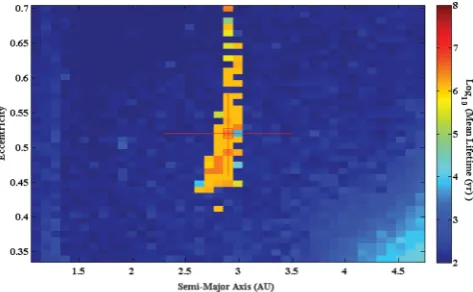
Figure 1. Dynamical stability of the NSVS 1425 system as proposed by Almeida et al. (2012b), as a function of the semimajor axisaand eccen-tricityeof the outer planet. The mean lifetime of the planetary system (in log10(lifetime/yr)) at a givena–ecoordinate is denoted by the colour of
the plot. The lifetime at eacha–elocation is the mean value of 75 separate integrations carried out on orbits at thata–eposition (testing a combination of 15 uniqueωvalues, and 5 uniqueMvalues). The nominal best-fitting orbit for the outer planet is shown as the small red square with±1σ error bars.
the binary separation isorbital radius of the inner planet, with M=0.62 M(Beuermann et al. 2012a).1We assumed the planets
were coplanar with each other and had masses equivalent to their minimum mass,Msini. We then followed the dynamical evolution of each test system for a period of 100 Myr, and recorded the times at which either of the planets was removed from the system. Planets were removed if they collided with one another, hit the central body or reached a barycentric distance of 10 au.
In addition to this highly detailed ‘nominal’ run, we examined the effects of mutual inclinations between the two planets by running further suites of simulations at lower resolution (e.g. Horner et al. 2011; Wittenmyer et al. 2012c). We varied the initial orbit of the outer planet as above, resulting in a 21×21×5×5 grid ina,e, ωandM, respectively (for a total of 11 025 test systems). We ran five such scenarios, with the inclination between the two planets set at 5◦, 15◦, 45◦, 135◦ and 180◦(the latter two corresponding to a retrograde orbit for the outer planet). Again, the 11 025 test systems were allowed to run for 100 Myr, or until the system was destabilized due to ejection or collision.
[image:2.595.85.248.82.157.2]3 R E S U LT S
Fig. 1 shows the stability of the nominal orbits for the NSVS 1425 system as given in Almeida et al. (2012b). It is immediately apparent that the vast majority of the±3σ parameter space is extremely unstable, with mean lifetimes of less than 1000 yr. This result is not particularly surprising, given that the great majority of solutions tested place the two planets on mutually crossing orbits – meaning that close encounters between the two are a certainty.
The nominal best-fitting orbit of the outer planet does fall in a narrow strip of increased stability, featuring mean lifetimes∼106yr.
However, as the subdwarf B host star has evolved well off the main
1We note that Almeida et al. (2012a) recently determined a combined mass
of 0.528±0.074 for the central stars, 1.2σsmaller than our assumed value. This small difference would have no effect on the interactionsbetweenthe planets, only on the overallscaleof the system, and hence does not affect our results.
at University of Southern Queensland on June 25, 2014
http://mnras.oxfordjournals.org/
sequence, one would expect the system to be considerably older than this mean lifetime. While the ages of subdwarf B stars are highly uncertain (Hu et al. 2010), even an A-type progenitor would make the system∼0.5 Gyr old. Population-synthesis models of the close binary progenitors of these post-common-envelope systems show that the initial mass distribution of primary stars that result in subdwarf B stars ranges from 1.0 to 1.8 M. The shortest lived (i.e. highest mass) progenitors would then evolve off the main se-quence in∼2×10⁹yr. Hence, any planets which existed before the
common-envelope stage would be expected to demonstrate dynam-ical stability on a time-scale far longer than that exhibited by the NSVS 1425 system.
The observed strip of moderate stability is attributed to the protec-tive influence of the mutual 2:1 mean-motion resonance between the two proposed planets. Such resonant protection is well known, both in our own Solar system (e.g. Horner & Lykawka 2010; Lykawka et al. 2011) and in exoplanetary science (e.g. Rivera et al. 2010; Robertson et al. 2012a,b). Indeed, it is interesting to compare our
results with those obtained for the proposed planets around HU Aqr (e.g. fig. 1 of Horner et al. 2011). In both cases, the proposed outer planet lies on a highly eccentric best-fitting orbit (e∼ 0.5) that crosses that of the innermost planet and the two planets are close to mutual 2:1 mean-motion resonance. Additionally, the proposed system proves to be dynamically unstable on typical time-scales of hundreds or thousands of years.
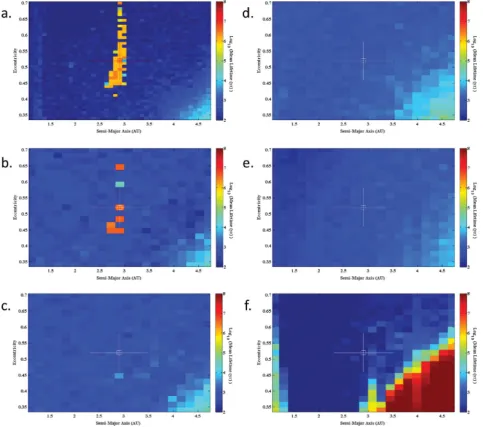
[image:3.595.55.539.268.695.2]We then considered the possibility of non-zero mutual inclina-tions between the two candidate planets in the NSVS 1425 system. For a significantly interacting planetary system, retrograde orbits can provide a dynamically stable configuration (e.g. Eberle & Cuntz 2010; Horner et al. 2011; Quarles, Cuntz & Musielak 2012; Morais & Giuppone 2012). To explore the dynamical stability of systems resulting from such non-coplanar scenarios, we performed a second suite of simulations at lower resolution, as described in Section 2. The results of the five mutually inclined scenarios are shown in Fig. 2, along with the nominal coplanar scenario from Fig. 1. We see that mutually inclined scenarios are even more unstable than
Figure 2. Dynamical stability for the NSVS 1425 system, for six values of inclination between the two planets. Panels (a) through (f) represent mutual inclinations of 0◦, 5◦, 15◦, 45◦, 135◦and 180◦, respectively. Panel (a) is a duplicate of Fig. 1, reprised here for ease of comparison. As in the previous figure, the colour bar represents the log of the mean survival time at eacha–eposition (testing a combination of fiveωvalues and fiveMvalues).
at University of Southern Queensland on June 25, 2014
http://mnras.oxfordjournals.org/
the coplanar scenario. Even for the 180◦configuration (i.e. retro-grade and coplanar, panel f), the only region of stability appears in the lower right, at the lowest eccentricities and largest semimajor axis for the outer planet. As was the case for HU Aquarii (Horner et al. 2011), the highly stable region is restricted to orbits which have periastron distances of several Hill radii from the inner planet. However, this region lies well beyond the 1σ uncertainties of the orbits derived by Almeida et al. (2012b).
4 D I S C U S S I O N A N D C O N C L U S I O N S
We have shown that the two circumbinary planets proposed by Almeida et al. (2012b) are dynamically unfeasible in virtually any configuration within 3σ of their derived orbital parameters. Based on our results, a mechanism other than, or in addition to, one (or more) planets is needed to explain the observed period variations. Zorotovic & Schreiber (2013) note that about 90 per cent of eclips-ing post-common-envelope binaries are reported to have timeclips-ing variations, nearly all of which have been attributed to one or more orbiting circumbinary planets. Both avenues to such planetary sys-tems – survival of the planets through the asymptotic giant branch (AGB) and planetary nebula phase, or secondary accretion from the ejected envelope of the primary star – are possible but highly uncer-tain (e.g. Postnov & Prokhorov 1992; Tavani & Brookshaw 1992; Phinney & Hansen 1993; Villaver & Livio 2007; Hansen, Shih & Currie 2009; Kunitomo et al. 2011; Veras et al. 2011; Mustill & Villaver 2012).
Zorotovic & Schreiber (2013) examined the formation and ob-servational statistics of circumbinary planets in order to investigate the puzzling trend that fully 90 per cent of post-common-envelope eclipsing binaries appear to host planets. They note that observa-tions of disc-bearing pre-main-sequence stars (Kraus et al. 2012) indicate that the circumbinary disc lifetime is too short (1 Myr) to form giant planets by core accretion. Observational results from Kepleralso point to a main-sequence circumbinary giant planet fre-quency of∼1 per cent (Welsh et al. 2012). Wittenmyer et al. (2011) estimate the frequency of giant planets in 3–6 au orbits to be no more than 37 per cent, based on data on single main-sequence stars from the Anglo-Australian Planet Search. All of these strands of evidence led Zorotovic & Schreiber (2013) to the conclusion that ‘virtually all close-compact binaries are unlikely to be explained by first-generation planets.’
Another potential solution to the near-ubiquitous presence of planets around evolved binaries is the formation of these compan-ions in the post-main-sequence circumstellar envelope produced by the subdwarf OB progenitor as it evolves through its AGB phase. The amount of material cast off by an AGB star (up to 70 per cent of the stellar mass; Habing & Olofsson 2004) is comparable to that of the Minimum Mass Solar Nebula (Weidenschilling 1977) and the lifetime of the AGB phase is similar to that of gas-rich protoplan-etary discs within which first-generation planet formation occurs (Hern´andez et al. 2007), lending plausibility to the idea of a second generation of planet formation. However, this second-generation planet formation scenario is highly speculative and requires fur-ther scrutiny (and detailed modelling) before it can be considered a viable answer (Akashi & Soker 2008; Perets 2010).
As was the case in earlier studies of proposed circumbinary planets in highly evolved systems (e.g. Horner et al. 2011, 2012a; Wittenmyer et al. 2012a), we find that the planetary system proposed in the evolved binary system NVSS 1425 is simply not dynamically feasible. Our results suggest that some mechanism other than plan-ets must be responsible for the observed eclipse-timing variations,
and once again highlight the critical importance of performing de-tailed dynamical analyses of potential new planetary systems in order to determine whether the proposed systems make sense.
AC K N OW L E D G E M E N T S
JPM is supported by Spanish grant AYA 2011/02622. The work was supported by iVEC through the use of advanced computing resources located at the Murdoch University, in Western Australia. This research has made use of NASA’s Astrophysics Data System (ADS), and the SIMBAD data base, operated at CDS, Strasbourg, France.
R E F E R E N C E S
Akashi M., Soker N., 2008, New Astron., 13, 157
Almeida L. A., Jablonski F., Tello J., Rodrigues C. V., 2012a, MNRAS, 423, 478
Almeida L. A., Jablonski F., Rodrigues C. V., 2012b, preprint (arXiv:1210.3055)
Beuermann K. et al., 2010, A&A, 521, L60 Beuermann K. et al., 2012a, A&A, 540, A8
Beuermann K., Dreizler S., Hessman F. V., Deller J., 2012b, A&A, 543, A138
Chambers J. E., 1999, MNRAS, 304, 793 Doyle L. R. et al., 2011, Sci, 333, 1602 Eberle J., Cuntz M., 2010, ApJ, 721, L168
Gong Y.-X., Zhou J.-L., Xie J.-W., 2013, ApJ, 763, L8
Habing H. J., Olofsson H., 2004, Asymptotic Giant Branch Stars. Springer, Berlin
Hansen B. M. S., Shih H.-Y., Currie T., 2009, ApJ, 691, 382 Hern´andez J. et al., 2007, ApJ, 662, 1067
Hinse T. C., Lee J. W., Go´zdziewski K., Haghighipour N., Lee C.-U., Scullion E. M., 2012, MNRAS, 420, 3609
Holman M. J., Wiegert P. A., 1999, AJ, 117, 621 Horner J., Lykawka P. S., 2010, MNRAS, 405, 49
Horner J., Marshall J. P., Wittenmyer R. A., Tinney C. G., 2011, MNRAS, 416, L11
Horner J., Hinse T. C., Wittenmyer R. A., Marshall J. P., Tinney C. G., 2012a, MNRAS, 427, 2812
Horner J., Wittenmyer R. A., Hinse T. C., Tinney C. G., 2012b, MNRAS, 425, 749
Hu H., Glebbeek E., Thoul A. A., Dupret M.-A., Stancliffe R. J., Nelemans G., Aerts C., 2010, A&A, 511, A87
Kilkenny D., Koen C., 2012, MNRAS, 421, 3238
Kraus A. L., Ireland M. J., Hillenbrand L. A., Martinache F., 2012, ApJ, 745, 19
Kubala A., Black D., Szebehely V., 1993, Celest. Mech. Dyn. Astron., 56, 51
Kunitomo M., Ikoma M., Sato B., Katsuta Y., Ida S., 2011, ApJ, 737, 66 Lykawka P. S., Horner J., Jones B. W., Mukai T., 2011, MNRAS, 412, 537 Marshall J., Horner J., Carter A., 2010, Int. J. Astrobiol., 9, 259
Morais M. H. M., Giuppone C. A., 2012, MNRAS, 424, 52 Mustill A. J., Villaver E., 2012, ApJ, 761, 121
Orosz J. A. et al., 2012, Sci, 337, 1511 Perets H. B., 2010, preprint (arXiv:1001.0581)
Phinney E. S., Hansen B. M. S., 1993, Planets Around Pulsars, 36, 371 Postnov K. A., Prokhorov M. E., 1992, A&A, 258, L17
Potter S. B. et al., 2011, MNRAS, 416, 2202
Qian S.-B., Liu L., Zhu L.-Y., Dai Z.-B., Fern´andez L. E., Baume G. L., 2012, MNRAS, 422, L24
Quarles B., Cuntz M., Musielak Z. E., 2012, MNRAS, 421, 2930 Quintana E. V., Lissauer J. J., 2006, Icarus, 185, 1
Rivera E. J., Laughlin G., Butler R. P., Vogt S. S., Haghighipour N., Meschiari S., 2010, ApJ, 719, 890
Robertson P. et al., 2012a, ApJ, 749, 39
at University of Southern Queensland on June 25, 2014
http://mnras.oxfordjournals.org/
Robertson P. et al., 2012b, ApJ, 754, 50 Tavani M., Brookshaw L., 1992, Nat, 356, 320
Veras D., Wyatt M. C., Mustill A. J., Bonsor A., Eldridge J. J., 2011, MNRAS, 1332
Villaver E., Livio M., 2007, ApJ, 661, 1192 Weidenschilling S. J., 1977, Ap&SS, 51, 153 Welsh W. F. et al., 2012, Nat, 481, 475
Wils P., di Scala G., Otero S. A., 2007, Inf. Bull. Var. Stars, 5800, 1 Wittenmyer R. A., Tinney C. G., O’Toole S. J., Jones H. R. A., Butler R. P.,
Carter B. D., Bailey J., 2011, ApJ, 727, 102
Wittenmyer R. A., Horner J., Marshall J. P., Butters O. W., Tinney C. G., 2012a, MNRAS, 419, 3258
Wittenmyer R. A. et al., 2012b, ApJ, 753, 169
Wittenmyer R. A., Horner J., Tinney C. G., 2012c, ApJ, 761, 165 Wo´zniak P. R., Williams S. J., Vestrand W. T., Gupta V., 2004, AJ, 128, 2965 Zorotovic M., Schreiber M. R., 2013, A&A, 549, A95
This paper has been typeset from a TEX/LATEX file prepared by the author.
at University of Southern Queensland on June 25, 2014
http://mnras.oxfordjournals.org/