A Self-Stabilizing Algorithm for Finding a Minimal Positive
Influence Dominating Set in Social Networks
Guangyuan Wang
1Hua Wang
1Xiaohui Tao
1Ji Zhang
11 Department of Maths and Computing
University of Southern Queensland, QLD, Australia 4350, Email:[email protected]
Abstract
Online social network has developed significantly in recent years. Most of current research has utilized the property of online social network to spread informa-tion and ideas. Motivated by applicainforma-tions in social networks (such as alcohol intervention strategies), a variation of the dominating set called a positive influ-ence dominating set (PIDS) has been studied in the literature. However, the existing work all focused on greedy algorithms for the PIDS problem with differ-ent approximation ratios, which are limited to find ap-proximate solutions to PIDS in large networks. In or-der to select a minimal PIDS (MPIDS) in large social networks, we first present a self-stabilizing algorithm for the MPIDS problem in this paper, which can find a MPIDS in an arbitrary network graph without any isolated node. It is assumed that the nodes in the proposed algorithm have globally unique identifiers, and the algorithm works under a central daemon. We further prove that the worst case convergence time of the algorithm from any arbitrary initial state isO(n2) steps wherenis the number of nodes in the network.
Keywords: Self-stabilizing algorithm, Minimal posi-tive influence dominating set, Graph algorithm
1 Introduction
1.1 Minimal Positive Influence Dominating Set Problem
Recently, social networks have received dramatic in-terest in research and development, partly due to more and more social networks are built online and the fast development of Web 2.0 applications, such as the e-learning research (Wang et al. 2009, Sun & Wang 2011) and privacy protection (Wang et al. 2005, Sun et al 2011, Sun et al. 2012). On the other hand, many different kinds of social networks in our lives such as friendship networks, telephone call networks, and academia co-authorship networks can be modeled by graph structures using vertices and edges. Some classical graph problems such as domination problems in social networks have various new applications.
The concept of the positive influence dominating set (PIDS) was introduced in 2009 by Wang et al. (2009). PIDS can deal with some social problems,
Copyright c⃝2013, Australian Computer Society, Inc. This pa-per appeared at the 24th Australasian Database Conference (ADC 2013), Adelaide, South Australia, January-February 2013. Conferences in Research and Practice in Information Technology (CRPIT), Vol. 137, Hua Wang and Rui Zhang, Ed. Reproduction for academic, not-for-profit purposes permitted provided this text is included.
such as drinking, smoking and drug related issues. In a social network which consists of individuals with a certain type of social problem, people can have both positive and negative impact on each other, and a per-son can take and switch among different roles since they are affected by their peers (Jaccard et al. 2005, Larimer & Cronce 2007, Standridge et al. 2004). For example, within the context of the drinking problem, a person named Mark never drinks and has positive impact on his direct friends (Barry, etc.), but Mark might turn into a binge drinker and have negative im-pact on his neighbors if Barry and other friends are binge drinkers and vice versa. So, a person can be an abstainer or a binge drinker. In order to truly alleviate the main source of the drinking problem, in-tervention programs are important tools to help com-bat some of the social problems through disseminated education and therapy via mail, Internet, or face-to-face interviews. Ideally, we want to educate all binge drinkers, since this will reduce the possibility of con-verted binge drinker being influenced by his binge drinking friends who are not chosen in the interven-tion program. On the other hand, due to the budget limitations, the lower total cost of the education and therapy program, the better. So, it is impossible to include all the binge drinkers in the intervention pro-gram. Therefore, it becomes an important research problem as to how to choose a subset of individuals to be part of the program so that the effect of the intervention program can spread through the whole group under consideration.
Formally, a social network can be represented as a graph G = (V, E), where i ∈ V represents a person (node) in the social network and edgeeij ∈E repre-sents a relationship between personsi andj. Recall that D ⊆ V is a positive influence dominating set (PIDS) (Wang et al. 2009, 2011) such that any node
iinV is dominated by at least⌈d(i)2 ⌉nodes (that is,
ihas at least⌈d(i)2 ⌉neighbors) inDwhered(i) is the degree of node i. Note that there are two require-ments for PIDS: firstly, every node not in D has at least half of its neighbors inD, secondly every node in D also has at least half of its neighbors inD. A PIDS D is minimal (MPIDS) if no proper subset of
Dis a PIDS.
For the drinking example remarked earlier, a min-imal positive influence dominating set (MPIDS) is a plausible solution since MPIDS can guarantee that by selecting MPIDS nodes to participate in the in-tervention program, each individual in the social net-work has more positive neighbors than negative ones to ensure that the intervention can result in a globally positive impact on the entire social network.
APX-hardness of PIDS means that if N P ̸= P, then PIDS has no PTAS (polynomial-time approximation scheme). Some greedy approximation algorithms have been proposed (Wang et al. 2009, 2011), which are all limited to find approximate solutions to pos-itive influence dominating sets (PIDS) in large so-cial networks. If we can obtain a smaller size solu-tion to the PIDS, it might save the total cost of an intervention and education program while satisfying positively dominating the whole group. Moreover, it might offer considerable benefit to both the economy and society. In this paper, we present a self-stabilizing algorithm for finding a minimal PIDS (MPIDS) in general networks.
1.2 Dijkstra’s Central Daemon Model
Self-stabilization is an optimistic fault tolerance ap-proach for distributed systems. It was introduced by Dijkstra (Dijkstra 1974, Dijkstra & van Gasteren 1986). According to his work, a self-stabilizing sys-tem is guaranteed to reach a correct state, in a finite time, regardless of its initial state (Dolev 2000). Thus, a self-stabilizing system can recover from any tran-sient fault without any external intervention. Self-stabilization is also a non-masking approach, since after the occurrence of a transient fault, the system exhibits temporarily disrupted behavior for a certain period of time.
A fundamental idea of self-stabilizing algorithms is that the distributed system may be started from an arbitrary global state. After finite time the system reaches a correct global state, called a legitimate or stablestate. An algorithm isself-stabilizing if the fol-lowing two properties hold: convergence andclosure. That is, when the system executes the algorithm,
(i) for any initial illegitimate state it reaches a legit-imate state after a finite number of node moves (convergence), and
(ii) for any legitimate state and for any move allowed by that state, the next state is a legitimate state (closure).
The convergence property ensures that, start-ing from any incorrect state, the distributed system reaches a correct state. The closure property ensures that, after convergence, the system remains in the set of correct states.
Recently, some self-stabilizing algorithms for dom-inating sets, independent sets, colorings, and match-ings in graphs have been developed (Hedetniemi et al. 2003, Goddard et al. 2008, Hedetniemi et al. 2003, Manne et al. 2007). In a self-stabilizing algorithm, each node maintains its local variables, and can make decisions based on the knowledge of its neighbors’ states. A node changes its local state by making a move (a change of local state). The algorithm is a set of rules of the form “if P(i) thenM”, whereP(i) is a predicate and M is a move. A node i becomes privileged ifP(i) is true. When a node becomes privi-leged, it may execute the corresponding move. A cen-tral daemon selects, among all privileged nodes, the next node to move. If two or more nodes are privi-leged, one cannot predict which node will move next. In this paper, We assume the model in which no two nodes move simultaneously. Another popular sched-uler is the distributed daemon, which selects a subset of the system processes to execute an atomic step at the same time. Thus if a system is self-stabilizing under the distributed daemon model, then it is self-stabilizing under the central daemon model. The
con-verse, however, is not true. Multiple protocols ex-ist (Nesterenko & Arora 1999, Beauquier et al. 2002, Goddard et al. 2003) that provide such a scheduler.
The topology of a distributed system can be rep-resented as an undirected graph G = (V, E) (called the system’s communication graph), where the nodes represent the processes and the edges represent the interconnections between the processes. As remarked earlier, throughout this paper, we denote by n the number of nodes ( |V| = n), and by m the num-ber of edges (|E| = m) in the graph G. Let i ∈ V
be a node; thenN(i), itsopen neighborhood, denotes the set of nodes to whichi is adjacent. Every node
j∈N(i) is called a neighbor of nodei. We denote by
d(i) the number of neighbors of node i, or its degree (d(i) =|N(i)|). Throughout this paper we assumeG
is connected andn >1.
1.3 Main Results and the Organization of the Rest of the Paper
In this paper, we are interested in a minimal positive influence dominating set (MPIDS) raised from some social problems. We believe the following to be our contributions in this paper.
1. We present a self-stabilizing algorithm for find-ing a minimal positive influence dominatfind-ing set (MPIDS) in an arbitrary connected network graph under a central daemon.
2. We further prove that the worst case convergence time of the algorithm from any arbitrary initial state is O(n2) steps where n is the number of nodes in the network.
To the best of our knowledge, this is the first work using a self-stabilizing algorithm to find a MPIDS. The rest of this paper is organized as follows. Section 2 presents related work. Section 3 presents a self-stabilization algorithm and an illustration for finding a MPIDS. Section 4 analyzes the complexity of the algorithm. Section 5 discusses the algorithm compar-ison. Section 6 concludes the paper and discusses the future work.
2 Related Work
Graph algorithms have natural applications in net-works and distributed systems, since a distributed system can be modeled with an undirected graph. Dominating Set and related problems are considered to be of central importance in combinatorial opti-mization and have been the object of much research. Due to the publication of Dijkstra’s pioneering pa-per, some self-stabilizing algorithms for graph prob-lems have been proposed in the literature, such as the self-stabilizing algorithms for dominating sets (Gair-ing & Johnson 2003), independent sets and match(Gair-ings in graphs (Goddard et al. 2008, Hedetniemi et al. 2003). Due to the NP-complete of domination prob-lems (Garey et al. 1979), researchers have developed some self-stabilizing algorithms for finding minimal dominating sets.
(MDS) problems. The algorithms all work for any connected graph and assume a central daemon. God-dard et al. (2008) proposed another uniform algo-rithm for finding a minimal dominating set (MDS) in an arbitrary graph under a distributed daemon.
On the other hand, some self-stabilized algorithms have been proposed in the multiple domination case. In a graphG(V, E), a set of nodes D ⊆V is called a k-dominating set if each node not in D is adjacent to at least k nodes in D. When the positive integer
k= 1, it is a question of single domination.
Kamei and Kakugawa (2003) presented two self-stabilizing algorithms for the minimal k-dominating set (MKDS) problem in a tree. The first uniform al-gorithm works under a central daemon and the second algorithm works under a distributed daemon. Huang et al. (2007, 2008) presented two self-stabilizing al-gorithms to find a minimal 2-dominating set (M2DS) under a distributed daemon (Huang et al. 2007) and a central daemon (Huang et al. 2008) respectively in an arbitrary graph.
However, there is no algorithm for the MKDS problem in arbitrary graphs that works under a dis-tributed daemon. The proposed algorithms for the minimal k-dominating set (MKDS) either work for trees (Kamei & Kakugawa 2004) or find a minimal 2-dominating set (Huang et al. 2007, 2008). For a more detailed discussion of self-stabilizing algorithms for dominating sets, see a survey (Guellati & Khed-douci 2010).
Positive influence dominating set (PIDS) which has application in social networks can be considered as a special case of multiple domination, introduced by Wang et al. (2009). Wang et al. (2009) proposed a greedy approximation PIDS selection algorithm and analyzed its effect on a real online social network data set through simulations. Wang et al. (2011) also proved the PIDS problem is APX-hard and de-veloped another greedy approximation algorithm and analyzed its approximation ratio.
All of these proposed algorithms can only find ap-proximate solutions to PIDS in large social networks. On the other hand, none of these algorithms for the PIDS problem are self-stabilizing. In order to obtain a minimal PIDS (MPIDS), in this paper, we first pro-pose a new self-stabilization algorithm for computing a MPIDS in a general network and analyze the time complexity of the proposed algorithm.
3 Self-Stabilizing Positive Influence Domina-tion Algorithm
3.1 Formal Definition of the Problem
Let G = (V, E) be a simple connected undirected graph. Assume now that for each node i ∈ V, the set N(i) represents its open neighborhood, denotes the set of nodes to which i is adjacent. d(i) repre-sents the number of neighbors of nodei, or its degree (d(i) = |N(i)|). Our algorithm requires that every node has a unique ID. Sometimes i interchangeably denotes a node or the node’s ID. Assume there is a total ordering on the IDs. Assume further that each node has a target integer h(i) ≤ N(i), where
h(i) =⌈d(i)2 ⌉ indicates that any node i ∈V is dom-inated by at least ⌈d(i)2 ⌉nodes in N(i). Given these assumptions we seek a MPIDSD ⊆V in which, for alli∈V,
|N(i)∩D| ≥h(i) (1)
Note that in the case of total domination (a set
D⊆V is said to be total dominating if everyi∈V
is adjacent to at least a member of D), the h(i) in inequality (1) is precisely uniformly one.
In our algorithm, each nodeihas two variables: a set of pointersP(i) and a boolean flagx(i). IfP(i) = {j}, then we say thatipoints toj, writteni→j. We allowP(i) to containiand its cardinality is bounded byh(i). Each node also has a boolean flagx(i). At any given time, we will denote withDthe current set of nodesiwithx(i) =true.
At a given time, assume |N(i)∩D| = k ≤ h(i). Then sinceh(i)≤ |N(i)|, there at leasth(i)−k mem-bers inN(i)−D.
Definition 1 Let Mi denote the unique set of those
h(i)−k nodes inN(i)−D having the smallest IDs. Note this set depends onN(i) andD.
Definition 2 A set of pointers Q(i) is designed as follows:
Q(i) =
{
(D∩N(i))∪Mi if |N(i)∩D|=k≤h(i) ∅ if|N(i)∩D|> h(i). (2) Note that the valueQ(i) can be computed byi (i.e., it uses only local information).
Definition 3 The boolean conditiony(i)is defined to be true if and only if a neighbor ofi points to it.
3.2 Proposed Algorithm
The Algorithm 1 consists of one rule (R1) is shown below. In Algorithm 1 each node i has a boolean variablex(i) indicating membership in the setDthat we are trying to construct. The value x(i) = true
indicates that i ∈ D, while the value x(i) = f alse
indicates thati /∈ D. The boolean conditiony(i) is defined to be true if and only if a neighbor ofipoints to it. P(i) is a set of pointers. Q(i) is counted by equation (2). Thus, a nodeiisprivilegedifx(i)̸=y(i) or P(i) ̸=Q(i). If R1 executes, then it sets x(i) =
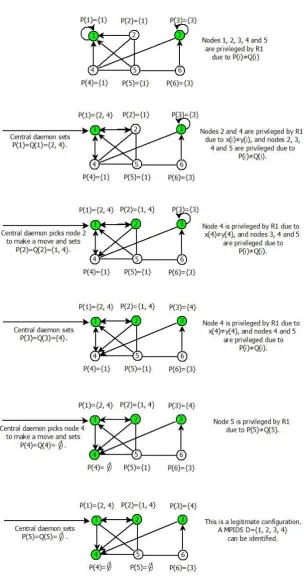
y(i) and P(i) = Q(i). An example to illustrate the execution of Algorithm 1 is shown in Fig. 1.
Input: A graphG= (V, E),∀i∈V, a boolean flagx(i) and a set of pointers P(i)
Output: D={i∈V|x(i) =true}
R1: if x(i)̸=y(i)∨P(i)̸=Q(i) then x(i) =y(i)∧P(i) =Q(i) Algorithm 1: Finding Minimal Positive Influ-ence Dominating Set
It is obvious that the system is in a legitimate configuration if and only if no node in the system is privileged. The following lemma clarifies that in any legitimate configuration, a minimal positive influence dominating set (MPIDS) D = {i ∈ V|x(i) = true}
can be identified.
Lemma 1 If Algorithm 1 stabilizes then D = {i ∈ V|x(i) =true} is a minimal positive influence domi-nating set (MPIDS) satisfying inequality (1).
Proof: Suppose that D satisfies inequality (1). By
P(i) and j /∈ D, then y(j) is true but x(j) is false, a contradiction, soD is a PIDS. We now claimD is minimal as well. Suppose there exists a subsetD′ ⊂ D is a PIDS. For some node j ∈D−D′, there is a nodei∈N(j) that points to it. That meansP(i) = {..., j} ̸=∅. Since no node in the system is privileged, we haveP(i) =Q(i), and we must have|N(i)∩D|=
h(i) according to the equation (2). Thus, the removal ofj fromDwill leave|N(i)∩D|< h(i) andDis not a PIDS. So the PIDSD is minimal.
3.3 An Illustration
The example in Fig. 1 illustrates the execution of Algorithm 1. Note that in each configuration, the shaded nodes represent nodes inD (x-value is true). The privileged node selected by the central daemon according to Algorithm 1 to make a move or reset the value ofP(i).
In the first subgraph of Fig. 1, we set x(1) =
x(3) = true, other nodes’ x-values are false, that meansD = {1,3}. P(1) = P(2) = P(4) =P(5) = {1}, P(3) = P(6) = {3}, just as the arrows point in the first subgraph. According to the definition of Algorithm 1, after a serials of moves, the system reaches a legitimate state. As the last subgraph of Fig. 1 shows, which is a legitimate configuration, we can see a minimal positive influence dominating set
D={1,2,3,4}can be identified (the shaded nodes).
4 The Stabilization Time of Algorithm 1
In this section, we show the convergence of Algorithm 1. We say that node i invites node j (with j = i
allowed) if at some time|N(i)∩D| < h(i), j ∈Mi,
j executes a move. For a node to joinD, it must be pointed to from an initial state or be invited. Definition 4 A move is an in-move if it causesx(i) to become true, thereby causing a nodeito enter D.
Lemma 2 Let ibe a node and suppose that between two movest andt′, there is no in-move by any node
k > i. Then during this move interval node i can make at most two in-moves.
Proof: Ifiis never invited during this interval, then
oncei leavesD, it cannot re-join. The first in-move made by i may have been because a neighbor node happened to initially point toi. The second in-move made byimust be by invitation. So supposeiis in-vited by nodej, allowingito make an in-move. Once
ientersDit must remain there ifjcontinues pointing to it. And this is ensured, provided|N(j)∩D| ≤h(j) throughout. Suppose during the move interval fromt tot’,|N(j)∩D|=k. Nodes having IDs larger thani
do not move during this period, but the smaller nodes can. during the move interval fromt tot’,iis among the h(j)−k smallest nodes in N(j)−D. Even if all nodes smaller than i were to enter D, we would still have |N(j)∩D| ≤ h(j). It follows that j will remain pointing to i throughout, and i will remain in D. Hence, x(i) can make at most two in-moves during this move interval.
We now show our algorithm stabilizes. Observe that ifD remains the same, then every node can ex-ecute at most once (to correct its pointer). So it suf-fices to show thatD changes at most a finite number of times.
Theorem 1 Algorithm 1 always stabilizes, and finds a minimal positive influence dominating set (MPIDS).
Proof: In light of Lemma 1 we see that if
Algo-rithm 1 is stabilizing it always finds a minimal posi-tive influence dominating set (MPIDS). We need only prove stabilization. It suffices to show that every node makes only a finite number of in-moves. By Lemma 2, noden, which has largest ID, makes at most two in-moves. During each of the move intervals fromt
to t′, the pointer setP(i) makes a finite number of moves since it only use the information of its neigh-bors. when noden is not making an in-move, using Lemma 2 again, node n−1 makes at most a finite number of moves. It is easy to show this argument can be repeated, showing that each node can make only finitely many in-moves during the intervals in which larger nodes are inactive.
We provide a correctness proof and a computation of the worst case stabilization time for Algorithm 1. Theorem 2 Algorithm 1 produces a minimal positive influence dominating set (MPIDS) and stabilizes in
O(n2)steps.
Proof: From Lemma 1 and Theorem 1, we see that
Algorithm 1 produces a MPIDS. We need only prove Algorithm 1 stabilizes in O(n2) steps. By Lemma 2, each node will change its x-value at most twice. Therefore, there can be at most 2nchanges ofx-value on all nodes in all the time. If there is no change in
x-value of any node in a time-step, then the time-step involves only changes inP(i)-values. The change in aP(i)-value is determined only byQ(i)-values. Since we are working with the central daemon, there cannot be two consecutive time-steps without a change inx -value orP(i)-value. Therefore, there can be at most ⌈∆
2⌉n changes of P(i)-value on all nodes in all the time (where ∆ is the maximum degree ofG). So, the upper bound of the execution time is (⌈∆2⌉+2)n time-steps. Considering the graphGis a simple undirected graph, therefore, the stabilization time of Algorithm 1 isO(n2) steps.
5 Algorithm Comparison
In this section we respectively present and discuss the existing self-stabilizing algorithms and greedy algo-rithms for dominating sets. We also compare our al-gorithm with them.
Hedetniemi et al. (2003) presented two uniform algorithms for the dominating set (DS) and the mini-mal dominating set (MDS) problems. The algorithms work for any connected graph. The main idea of the first algorithm is to partition the set of nodes into two disjoint sets, such that each set is dominating. The algorithm for the dominating set (DS) problem stabilizes in linear time (O(n) steps) under a central daemon. The second algorithm calculates a MDS. The main idea of this algorithm is that it allows a node to join the setS, if it has no neighbor inS. On the other hand, a node that is already a member of
S, and has a neighbor that is also a member of S, will leave the set if all its neighbors are not point-ing to it. Thus, after stabilization the setS will be a MDS. The algorithm for the minimal dominating set (MDS) problem stabilizes inO(n2) steps under a central daemon.
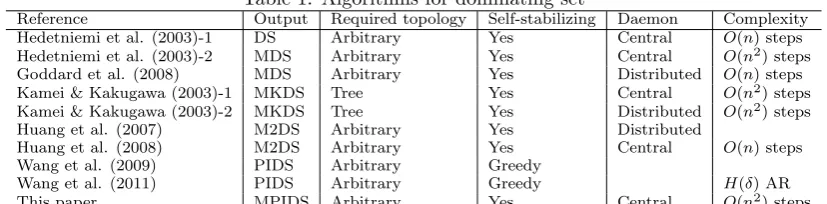
Table 1: Algorithms for dominating set
Reference Output Required topology Self-stabilizing Daemon Complexity Hedetniemi et al. (2003)-1 DS Arbitrary Yes Central O(n) steps Hedetniemi et al. (2003)-2 MDS Arbitrary Yes Central O(n2) steps Goddard et al. (2008) MDS Arbitrary Yes Distributed O(n) steps Kamei & Kakugawa (2003)-1 MKDS Tree Yes Central O(n2) steps Kamei & Kakugawa (2003)-2 MKDS Tree Yes Distributed O(n2) steps
Huang et al. (2007) M2DS Arbitrary Yes Distributed
Huang et al. (2008) M2DS Arbitrary Yes Central O(n) steps
Wang et al. (2009) PIDS Arbitrary Greedy
Wang et al. (2011) PIDS Arbitrary Greedy H(δ) AR
This paper MPIDS Arbitrary Yes Central O(n2) steps
and an integer to count a node’s neighbors that are members of the MDS. The algorithm allows an un-dominated node that has smaller identifier than any undominated neighbor to join the set under construc-tion. On the other hand, a node leaves this latter set if it is not the unique dominator of itself nor any of its neighbors. The algorithm stabilizes inO(n) steps. On the other hand, some self-stabilizing algo-rithms have been proposed in thek-domination case. Kamei and Kakugawa (2003) presented two uniform algorithms for the minimalk-dominating set (MKDS) problem in a tree. The first algorithm allows a node to join the set under construction S if it has fewer than k neighbors in S, and to leave the set S if it has more than k neighbors inS. The first algorithm works for a central daemon. Based on this idea, in the second algorithm, a node having more thank neigh-bors in the set under constructionS will first make a request to leave S, and then leaves the setS only if its identifier is the smallest among all the neighbors requesting to leave S. So, after stabilization the set
S will become a minimalk-dominating set (MKDS). The second algorithm works under a distribute dae-mon. The time complexity of the two algorithms are both O(n2) steps.
Huang et al. (2007) presented a self-stabilizing al-gorithm to find a minimal 2-dominating set (M2DS) in an arbitrary graph. The algorithm assumes glob-ally unique identifiers for the nodes and works under a distributed daemon. The algorithm allows a node to join the set under construction if it is dominated by fewer than two nodes and none of its neighbors hav-ing smaller identifier is in the same situation. Also, a node may leave the set under construction if it is dominated by more than two nodes, and all of its neighbors are either in the set under construction or dominated by more than two nodes.
Huang et al. (2008) presented another self-stabilizing algorithm for finding a minimal 2-dominating set (M2DS) in an arbitrary graph. The algorithm allows a node to join the set under con-structionS if it has fewer than 2 neighbors inS, and to leave the set S if it has more than 2 neighbors in
S. The algorithm works under a central daemon, with liner time complexity.
Wang et al. (2009) introduced the notion of pos-itive influence dominating set (PIDS) and proposed a greedy approximation PIDS selection algorithm in 2009. They revealed that approximately 60% of the whole group under consideration needs to be chosen into the PIDS to achieve the goal that every indi-vidual in the community has more positive neighbors than negative neighbors. They also presented another greedy approximation algorithm and gave theoretical analysis about its approximation ratio (AR) in 2011 (Wang et al. 2011). The authors proved that PIDS is APX-hard and proposed a greedy PIDS selection algorithm with an approximation ratio ofH(δ) where
H is the harmonic function and δ is the maximum vertex degree of the graph representing a social net-work.
In order to select a small size of positive influ-ence dominating set (PIDS) in large social networks, we present a uniform algorithm for finding a mini-mal PIDS that works in arbitrary graphs. We assume globally unique identifiers for the nodes and a central daemon. The algorithm uses a mechanism of point-ers to show that a nodei will point to its neighbors having the smallest identifiers ifi has less thanh(i) neighbors in the set under construction D. On the other hand, if a nodeihas more thanh(i) neighbors in the set D then P(i) will point to emptyset; oth-erwise P(i) will point to its unique neighbors that are members of the set D. The algorithm allows a node to join the setDif some neighbor is pointing to it, and to leave the setD otherwise. So after stabi-lization, the setD will become a MPIDS. The time complexity of our algorithm in any arbitrary graphs isO(n2) steps. To the best of our knowledge, this is the first work using a self-stabilizing algorithm to find a MPIDS, which can find an exact solution for PIDS (minimal).
The algorithms we compared in this section are summarized in Table 1. As we can see, the basic ideas of the first six algorithms are self-stabilizing, and the algorithms for the PIDS problem are greedy. Our algorithm is the first work using a self-stabilizing approach to discuss the MPIDS problem.
6 Conclusions and Future work
In this paper, we have proposed a self-stabilizing dis-tributed algorithm to find a minimal positive influ-ence dominating set (MPIDS) which arises from some social problems in social networks; Algorithm 1 can be used for an arbitrary connected graph. All pre-viously known algorithms are approximate greedy al-gorithms. We have also shown the stabilization time of Algorithm 1 withO(n2) steps under a central dae-mon. We briefly discuss how the ideas can be further generalized.
We can also extend these ideas even further to other graph dominations such as weak, strong and optional domination (Haynes et al. 1998). It can also be altered to allow a node to have weights in a range {−b′(i), ..., b(i)}and so handle minus domination.
References
Beauquier, J., Datta, A. K., Gradinariu, M. & Magni-ette, F. (2002), ‘Self-Stabilizing Local Mutual Ex-clusion and Daemon Refinement’, Chicago Journal of Theoretical Computer Science 2002(1).
Dijkstra, E. W. (1974), ‘Self-stabilizing Systems in Spite of Distributed Control’, Commun. ACM 17(11), 643–644.
Dijkstra, E. W. & van Gasteren A. J. M. (1986), ‘A Simple Fixpoint Argument Without the Restriction to Continuity’, Acta Inf.23(1), 1–7.
Dolev, S. (2000),Self-Stabilization, MIT Press. Gairing, M., Hedetniemi, S. T., Kristiansen, P. &
McRae, A. A. (2003), Self-Stabilizing Algorithms for {k}-Domination, in ‘Self-Stabilizing Systems’, pp. 49–60.
Garey, M. R. & Johnson, D. S. (1979), Computers and Intractability: A Guide to the Theory of NP-Completeness, W. H. Freeman.
Goddard, W., Hedetniemi, S. T., Jacobs, D. P. & Sri-mani, P. K. (2003), A Self-Stabilizing Distributed Algorithm for Minimal Total Domination in an Ar-bitrary System Grap,in‘IPDPS’, pp. 240.
Goddard, W., Hedetniemi, S. T., Jacobs, D. P. Srimani, P. K. & Xu, Z. (2008), ‘Self-Stabilizing Graph Protocols’, Parallel Processing Letters18(1), 189–199.
N. Guellati, N. & Kheddouci, H. (2010), ‘A survey on self-stabilizing algorithms for independence, domi-nation, coloring, and matching in graphs’, Parallel Distrib. Comput. 70(4), 406–415.
Haynes, T. W., Hedetniemi, S. T. & Slater, P. J. (1998), Domination in Graphs: Advanced Topics, Marcel Dekker.
Haynes, T. W., Hedetniemi, S. T. & Slater, P. J. (1998), Fundamentals of Domination in Graphs, Marcel Dekker.
Hedetniemi, S. M., Hedetniemi, S. T., Jacobs, D. P. & Srimani, P. K. (2003), ‘Self-stabilizing algo-rithms for minimal dominating sets and maximal independent sets’,Computer Mathematics and Ap-plications46(5-6), 805–811.
Hedetniemi, S. T., Jacobs, D. P. & Srimani, P. K. (2003), ‘Linear time self-stabilizing colorings’, In-formation Processing Letters87(5), 251–255.
Huang, T. C., Chen, C. Y. & Wang, C. P. (2008), ‘A Linear-Time Self-Stabilizing Algorithm for the Minimal 2-Dominating Set Problem in General Networks’,Inf. Sci. Eng. 24(1), 175–187.
Huang, T. C., Lin, J. C., Chen, C. Y. & Wang, C. P. (2007), ‘A self-stabilizing algorithm for finding a minimal 2-dominating set assuming the distributed demon model’, Computers and Mathematics with Applications 54(3), 350–356.
Jaccard, J., Blanton, H. & Dodge, T. (2005), ‘Peer influences on risk behavior: Analysis of the ef-fects of a close friend’, Developmental Psychology 41(1), 135–147.
Kamei, S. & Kakugawa, H. (2003), A self-stabilizing algorithm for the distributed minimal k-redundant dominating set problem in tree network, in ‘PD-CAT’ pp. 720-724.
Kamei, S. & Kakugawa, H. (2004), ‘A Self-Stabilizing Distributed Algorithm for the Steiner Tree Prob-lem’,IEICE Transactions87-D(2), 299–307. Larimer, M. E., & Cronce, J. M. (2007),
‘Iden-tification, prevention, and treatment revisited: Individual-focused college drinking prevention’, Addictive Behaviors32, 2439–2468.
Manne, F., Mjelde, M., Pilard, L. & Tixeuil, S. (2007), ‘A New Self-Stabilizing Maximal Matching Algorithm’,in‘SIROCCO’ pp. 96–108.
Nesterenko, M. & Arora, A. (1999), ‘Stabilization-Preserving Atomicity Refinement’, in ‘DISC’ pp. 254–268.
Standridge, J. B., Zylstra, R. G. & Adams, S. M. (2004), ‘Alcohol consumption: An overview of benefits and risks’, Southern Medical Journal 97(7), 664–672.
Sun L. & Wang H. (2011), ‘Access control and autho-rization for protecting disseminative information in E-learning workflow’, Concurrency and Computa-tion: Practice and Experience 23(16), 2034-2042.
Sun, X., Wang H., Li J. & Zhang Y. (2012), ‘Satisfy-ing Privacy Requirements Before Data Anonymiza-tion’,Comput. J.55(4), 422-437.
Sun, X., Wang H., Li J. & Pei J. (2011), ‘Publishing anonymous survey rating data’,Data Min. Knowl. Discov.23(3), 379-406.
Wang, F., Camacho, E. & Xu, K. (2009), ‘Positive In-fluence Dominating Set in Online Social Networks’, in‘COCOA’ pp. 313–321.
Wang, F., Du, H., Camacho, E., Xu, K., Lee, W., Shi, Y. & Shan, S. (2011), ‘On positive influence domi-nating sets in social networks’,Theor. Comput. Sci. 412(3), 265–269.
Wang H., Cao J. & Zhang Y. (2005), ‘A flexible payment scheme and its role based access control’, IEEE Transactions on Knowledge and Data Engi-neering17(3), 425–436